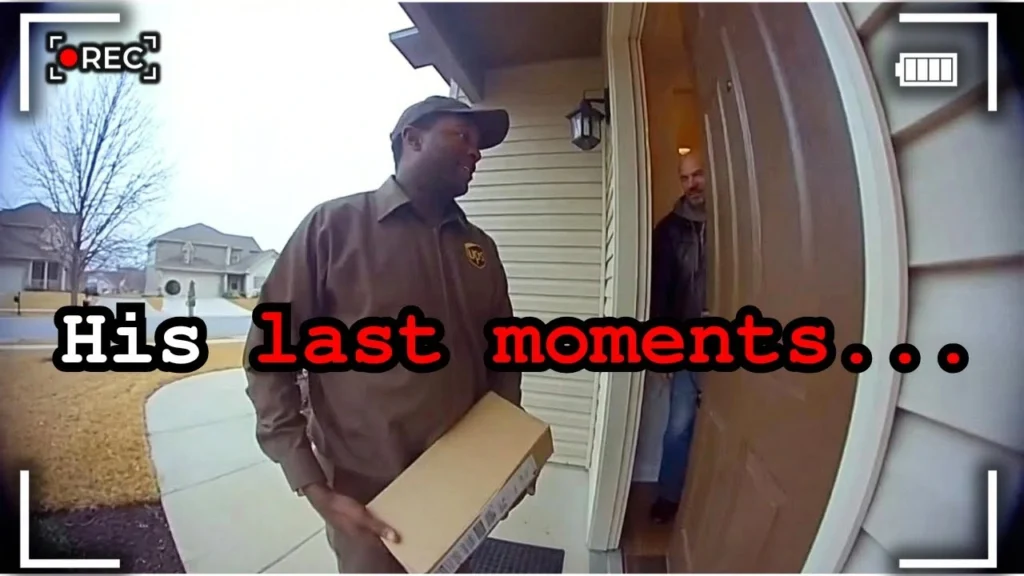
The same smile from the CCTV footage
The same smile from the CCTV footage.
He did not resist.
He did not speak.
He handed them a burner phone.
On that phone were 47 minutes of video.
I cannot tell you what was on that video.
I can tell you that two of the investigators who watched it took medical leave and never returned to duty.
I can tell you that the prosecution played 90 seconds of audio during the trial with the screen turned away from the jury and three jurors had to be excused.
Wayne had recorded everything, not because he was stupid, because he was proud, because this was not the first time, and because he wanted someone to know what they were capable of.
During interrogation, Wayne gave investigators three names.
Three men who had been in that warehouse with him, all members of the same online group, all believers in the same ideology, all participants in what Wayne called cleansing operations.
Those three men were arrested within 48 hours.
Their homes were searched.
In one home, they found a similar collection of photographs.
23 photos, six with red X marks.
In another home, they found journals, detailed entries spanning four years, names, dates, locations.
The third man’s computer contained communication logs with 14 other members of the group across six states.
The FBI took over the case.
>> >> What started as one missing delivery driver in Oklahoma became a federal investigation spanning a decade of activity across the American South and Midwest.
Here is what the trial revealed.
Wayne had done this before, at least twice, possibly more.
The photos with X marks corresponded to missing person cases that had gone cold.
One in Arkansas 2018, one in Louisiana 2020.
both black men, both delivery workers, both cases where the body was never found.
Wayne never confessed to these specifically, but DNA evidence linked him to a vehicle found abandoned in rural Arkansas 3 years ago.
A vehicle that belonged to a 32-year-old FedEx driver named Clarence Morton, who disappeared after his last delivery on a Tuesday afternoon in August 2018.
Clarence’s body has never been recovered.
Neither has the body of Jerome Washington, 29, UPS driver from Shreveport, who vanished in November 2020 after his route took him through a rural subdivision 40 mi from the city.
His truck was found, his body was not.
Wayne smiled when these names were mentioned in court.
The same smile, always the same smile.
Wayne Prescott was convicted on 14 charges, including first-degree murder, kidnapping, conspiracy, and federal hate crime enhancements.
He received six consecutive life sentences with no possibility of parole.
His three accompllices received sentences ranging from 45 years to life.
But here is what the conviction cannot fix.
The online group still exists.
Different name now, different platform, but the same 14 members in six states that investigators identified have never been charged.
The evidence was circumstantial.
The communication logs suggested knowledge, but not participation.
They are still out there.
They are still planning.
And delivery drivers still make stops at houses in rural Oklahoma every single day.
Tamika Simmons gave one interview after the trial, just one.
She said she thinks about March 19th constantly.
She thinks about the two seconds Darnell hesitated on that porch.
She thinks about what would have happened if he had said no thank you and walked back to his truck.
She thinks about the 47 stops he made before that one and how every single homeowner had been kind and normal and human.
She thinks about how nine years of positive interactions taught her husband to trust, to see good in people, to accept a cup of coffee from a stranger on a hot afternoon.
She said the hardest part is not the grief.
The hardest part is raising three children to be open and kind in a world where that kindness can kill you.
Elijah is 11 now.
He wants to be a delivery driver like his father.
Tamika does not know how to tell him no.
She does not know how to explain that the same job that supported their family is the reason his father never came home.
The delivery company changed protocols after Darnell’s case.
Drivers are now instructed to never enter a customer’s home for any reason.
GPS tracking is monitored in real time.
Any stop exceeding 10 minutes triggers an automatic check-in.
These are good changes.
They might save lives.
But here is what they cannot change.
Wayne Prescott spent seven years identifying potential victims.
He studied roots.
He learned patterns.
He chose locations specifically because they were isolated.
He did not need Darnell to come inside.
That was just preference.
If Darnell had said no, he would have waited for the next driver or the one after that or he would have found another way.
Because for people like Wayne, this is not impulse.
This is ideology.
This is mission.
And no company protocol can protect against someone who believes that ending your life is a righteous act.
Remember the 14 photos with X marks? Only three have been connected to confirmed cases.
That leaves 11.
11 men who disappeared over an 8-year period.
11 families still waiting for answers.
11 bodies that might be buried in rural fields or abandoned buildings or places no one will ever think to look.
Wayne knows where they are.
He has not said.
His three accompllices know some of them.
They have not said either.
They have no incentive to talk.
They are already serving maximum sentences.
What would cooperation give them? Nothing.
So, they stay silent.
And those 11 families stay trapped in an endless present tense, not knowing, never knowing.
Is he alive somewhere? Is he dead? Will we ever bury him? Will we ever say goodbye? If you work delivery routes in rural America, I need you to understand something.
Darnell did nothing wrong.
He was friendly.
He was professional.
He trusted his instincts.
And his instincts said, “This man is safe”.
Because every signal pointed that way.
Clean house, American flag, friendly smile, coffee on the counter.
Nothing about Wayne Prescott suggested danger.
That was the entire point.
He had spent years perfecting the appearance of normal.
And he is not the only one.
The FBI investigation identified 14 other members of groups with similar ideologies who have expressed intent to target delivery workers specifically.
They see the uniform as both symbol and opportunity.
The truck arrives alone.
The driver approaches alone.
No witnesses, no backup, just trust.
Darnell’s route number was retired after his death.
No other driver will ever make those 55 stops in that sequence again.
His truck was decommissioned.
His locker at the distribution center has been turned into a memorial with photos and cards from customers who remembered him.
Mrs. Gutierrez still makes lemonade every summer.
She leaves it on her porch in case a delivery driver needs it.
She says it helps her feel like Darnell is still out there somewhere finishing his route.
This is what happened to Darnell Simmons.
This is what 14 seconds of CCTV captured.
This is what a cup of coffee offered by a smiling man cost a family.
If you have ever accepted a drink from a stranger.
If you have ever stepped inside a home because someone seemed nice.
If you have ever trusted your instincts about a person you did not know, remember this.
Wayne Prescott seemed nice, too.
And somewhere right now, someone just like him is smiling at a delivery driver, standing on their porch, asking themselves, “Should I go inside?” The answer should always be no.
But Darnell said yes because he was kind, because he was trusting, because 9 years of experience told him people are mostly good.
He was right about that.
Most people are good, but it only takes one who is not.
One smile, one cup of coffee, one moment of trust, and then 11 days in a warehouse with men who believe you do not deserve to exist.
Share this video.
Tell people about Darnell because the protocol changes and the GPS tracking and the company memos cannot do what awareness can.
They cannot make someone pause before they step through that door.
Only stories like this one can do that.
Darnell deserved better.
His family deserves answers.
And every delivery driver in America deserves to come home.