1,038 km.
That is how close the Juno spacecraft flew to the surface of Ganymede on June 7th, 2021.
It was the closest any spacecraft had come to this moon in two decades, moving at nearly 70,000 km per hour.
And what it saw broke a rule scientists thought they understood.
A moon this far from the sun should be dead, frozen, silent since the day the solar system formed.
But Ganymede is cracked open like something tore it apart from the inside.
It has its own magnetic field.
It may hide an ocean bigger than every ocean on Earth.
And it is making a chemical that should not survive in space.
So, what is really going on with this moon? Stay with me because the strangest clue is still waiting at the end.
Let me start with the size because most people do not realize how big this thing is.
Ganymede is about 5,268 km across.
That makes it wider than the planet Mercury.
It is the largest moon in the entire solar system.
It dwarfs Pluto.
What that means in plain language is this.
If Ganymede orbited the sun instead of Jupiter, we would almost certainly call it a planet.
And here is the first strange thing.
Look at the surface.
It is not one smooth ball of ice.
It is split into two completely different kinds of ground.
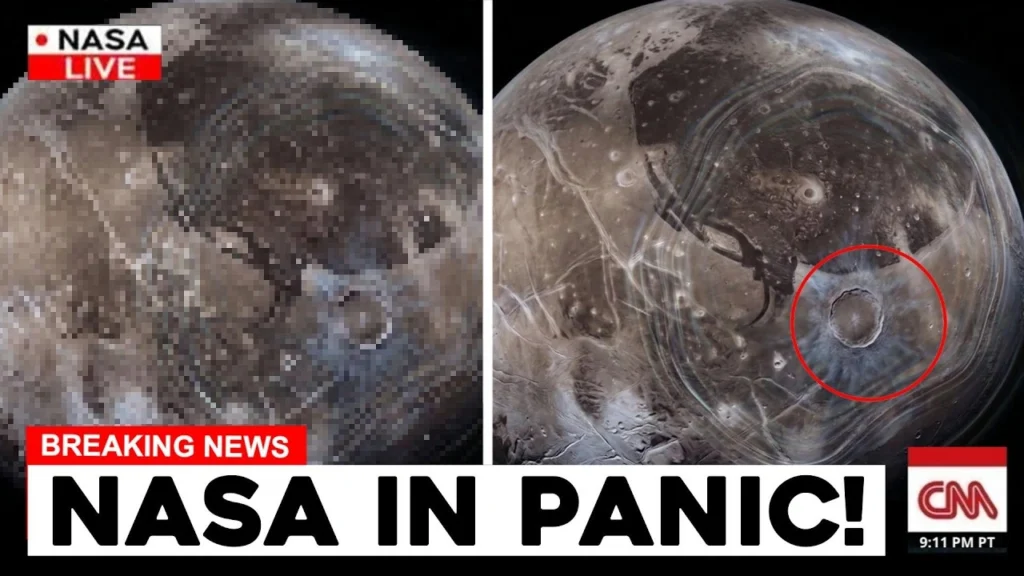
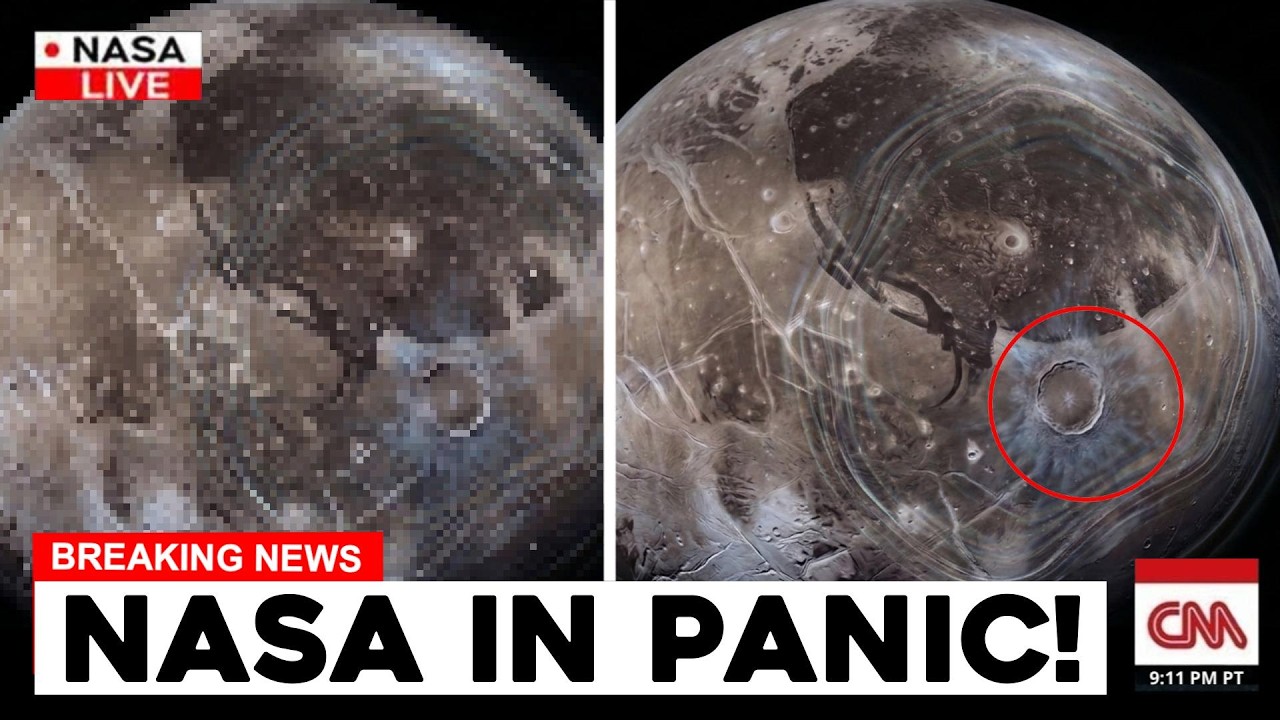
About a third of Ganymede is covered by dark, heavily cratered terrain.
When scientists count the craters, they estimate this ground is around 4 billion years old.
That is almost as old as the solar system itself.
This is the kind of surface you expect on a frozen, dead world.
But cutting straight through that old ground are wide, bright bands of grooved ice.
They are made of long parallel ridges and deep troughs that run for thousands of kilometers.
They look a lot like rift zones on Earth where the crust has been stretched and broken into tilted blocks.
These bright bands are younger, though still probably more than a billion years old.
Now, think about what that means.
To make deep cracks like that, the ice shell had to be pulled apart until it snapped.
You cannot do that to a frozen shell without a lot of heat coming from deep inside the moon.
Before the Voyager probes flew by in 1979, the common belief was simple.
The farther a moon is from the sun, the less can happen on it.
Past the asteroid belt, there is not enough sunlight to keep anything warm.
So, the moons out there were expected to be dead blocks of ice.
Ganymede’s dark terrain fits that old idea.
The bright groove terrain destroys it.
Scientists still argue about exactly how those bright bands formed.
One idea says water or slush from below pushed up through the cracks and froze, leaving new bright ice.
Another idea, based on closer pictures from the Galileo spacecraft, says the faulting did most of the work.
Blocks of old, dirty ice tilted and slid and exposed cleaner ice underneath.
Probably both processes played a role, but either way, something warmed this moon enough to break it.
And here is the question that bothers planetary scientists the most.
Where did that heat come from? And is any of it still there today? Because so far, we have not seen any new grooves forming right now.
To answer that, we have to go deep, much deeper than any camera can see.
Because what Ganymede hides in its center is something no other moon in the solar system has.
Quick pause.
If you’re enjoying this, stay until the end.
Because in a few minutes, I will explain why a chemical found on Ganymede’s poles has scientists asking a very big question.
And later, I will tell you about a spacecraft that is already on its way to answer it.
Now, back to the core.
In June 1996, the Galileo spacecraft flew past Ganymede and its magnetometer spiked.
Scientists had never seen anything like it around a moon.
Ganymede was pushing back against space.
It was making its own magnetic field.
It is the only moon we have ever found that does this.
Europa and Callisto have weak magnetic fields, but those are only induced by Jupiter’s changing field.
Our own moon has patches of old magnetism frozen into its rocks, but it does not make a field today.
Ganymede is the only moon with a magnetic field of its own.
To do that, you need a working dynamo.
What that means in plain language is this.
You need a big region of liquid metal, most likely iron mixed with sulfur, that keeps churning and moving.
That is exactly how Earth makes its field.
It is why compasses point north, and it is why the solar wind gets pushed away from our planet.
But, here is the problem.
Moons are small.
Small objects lose their heat fast.
A moon core should have cooled off and frozen solid billions of years ago.
Somehow, Ganymede kept a liquid, iron-rich heart that is still stirring.
How? Scientists are not sure.
One idea is that sulfur lowers the melting point of the core, and iron crystals forming in the melt could keep the liquid moving, a bit like snow falling through the core.
Another idea is that long ago, Ganymede’s orbit passed through a resonance with Europa and Io.
That could have boosted the tidal flexing, which means the squeezing and stretching from gravity, and reheated the moon.
Some researchers even link that event to the groove terrain on the surface.
Neither idea has been confirmed.
So, we have a moon with a hot engine inside, and that engine creates a magnetic bubble around Ganymede.
But, that bubble sits in one of the most dangerous places in the solar system.
Jupiter has the largest magnetic field of any planet.
It is a huge, spinning storm of charged particles.
It grabs stray particles and speeds them up to a fraction of the speed of light.
This creates radiation belts so strong that they can destroy unprotected electronics.
That is why the Juno spacecraft keeps its most sensitive hardware inside a titanium vault.
Here’s how it works.
Jupiter spins once every 10 hours.
Ganymede takes about 7 days to go around once.
So, the plasma, which is hot charged gas, keeps overtaking the moon and hitting it from behind.
When that plasma crashes into Ganymede’s magnetic bubble, the two magnetic fields collide.
Field lines break and reconnect.
Both Galileo and Juno detected this directly.
You can think of it like a boulder in the middle of a fast river.
The water has to bend and flow around it.
Ganymede’s magnetic bubble does the same thing to Jupiter’s plasma.
It carves out a small, protected pocket inside Jupiter’s domain, and it keeps much of the radiation away from the equator and lower latitudes up to roughly 40° north and south.
But, the poles are a different story.
Near the poles, Ganymede’s magnetic field lines do not loop back to the moon.
They open up and connect to Jupiter’s field.
Those open lines act like giant funnels.
They guide Jupiter’s charged particles straight down to the surface.
The electrons slam into thin wisps of oxygen above the ice and the gas glows.
This creates rings of aurora around each pole.
Hubble first spotted this ultraviolet glow in the late 1990s.
Earth has auroras, too, but ours change with the solar wind.
Ganymede’s auroras are always on because Jupiter keeps feeding the collision.
And here is where it gets really interesting.
Those auroras do not sit perfectly still.
Jupiter’s magnetic field is tilted, so as the planet spins, the field rocks back and forth at Ganymede and the aurora rings rock with it.
In 2015, a team used Hubble to measure that rocking.
They found it was much smaller than it should be if Ganymede were solid ice and rock all the way through.
The best explanation was a layer of electrically conducting material under the ice.
Most likely, a salty ocean.
It works like a metal detector.
A changing magnetic field creates electric currents in a conductor.
Those currents make a magnetic field of their own and that field pushes back against the swing.
Galileo had already found hints of this extra field years before.
Together, these clues are among the strongest evidence that an ocean exists under Ganymede’s ice.
So, the glowing auroras are not just beautiful.
They carry news from deep inside the moon.
But here is what nobody is telling you.
The same funnels that make the beautiful auroras are also wrecking the surface.
Right now, the polar ice is being hit by radiation around the clock and that is where the story takes a very strange turn.
In July 2022, the James Webb Space Telescope turned toward Jupiter and stared right at Ganymede.
Scientists were not hunting for craters or cracks.
Webb’s infrared instrument reads the chemical fingerprints of a surface.
They wanted to know exactly what the ice was made of.
When a team led by astronomer Samantha Trumbo published the results in 2023, they found something unexpected.
Hydrogen peroxide.
Now, you might know hydrogen peroxide from your medicine cabinet.
It is the liquid used to clean wounds or bleach hair.
It is a harsh, unstable molecule.
It breaks down quickly into water and oxygen if you do not keep it in a dark bottle.
So, finding it on a moon in the vacuum of space is a big surprise and it was not spread evenly.
The peroxide was concentrated at the highest latitudes.
It formed caps around the north and south poles, exactly where the open magnetic funnels guide Jupiter’s radiation to the ice.
What that means in plain language is this.
Something on Ganymede is making hydrogen peroxide right now, again and again, because it could not survive long on its own.
The ice is not a frozen museum, it is a chemical factory.
Here is how the factory works.
High energy particles slam into the ice at a fraction of the speed of light.
Scientists call this radiolysis, which is a fancy word for breaking molecules apart with radiation.
The particles smash water molecules and shatter the bonds that hold hydrogen and oxygen together.
The lightest piece, hydrogen, can escape into space.
The heavier pieces stay behind and recombine with whatever is nearby.
When two fragments called hydroxyl, each one an oxygen atom attached to a hydrogen atom, lock together, they form a brand new molecule of hydrogen peroxide.
So, the top layer of Ganymede is not a dead relic, it is a laboratory powered by Jupiter itself.
Now, here is why scientists care.
Hydrogen peroxide is a powerful oxidant.
On its own, it is not food.
But when you pair an oxidant with chemicals that give up electrons like hydrogen, iron, or sulfur compounds from rock, you can create a chemical imbalance.
On Earth, microbes use that kind of imbalance as an energy source.
So, the fuel is being made on the surface, but there is a catch.
The ocean is deep.
Models place it roughly 150 km down under an ice shell much thicker than the one on Europa.
For this chemistry to matter for life, material would need to move from the surface to the water or from the water up to the surface.
So, is there any sign that the two are connected? To find out, scientists needed a very different set of data from a very different part of the moon.
That brings us back to Juno.
During its 2021 flyby, Juno’s infrared instrument called JIRAM and built by the Italian Space Agency, scanned a strip of low northern latitudes on Ganymede.
This is the opposite of the polar zone.
It is the calm region tucked under the moon’s magnetic shield.
When a team led by Federico Tosi published the results in late 2023, the chemistry looked completely different.
They found hydrated sodium chloride, which is a form of salt.
They found ammonium chloride, and they found sodium or ammonium carbonates.
Along with them, they saw possible signs of aliphatic organics.
Those are carbon chain molecules that are common in comets and meteorites, and they are among the raw materials of biological chemistry.
I need to be clear about one thing.
Organic does not mean alive.
Organic molecules form easily without life.
Finding them is exciting, but it is not proof of anything living.
So, why does the location matter so much? Because these salts and organics are fragile.
Radiation breaks them down fast.
If they sat near the poles, Jupiter’s particles would have destroyed them, but they were found inside the protected zone between about 10 and 30° north, where the magnetic shield blocks the worst radiation.
There, the delicate chemistry survives.
Even more important is the pattern.
If these materials had been delivered by asteroid impacts or swept up from space, they should be scattered all over the moon.
Instead, their abundance follows the magnetic shielding.
And the mix of salts looks like what you would get if salty water evaporated and left its minerals behind.
That is a strong clue, though not a smoking gun.
It suggests the materials may not have fallen from above.
They may have come from below.
The Juno team’s leading idea is that these minerals are the dried leftovers of salty brine that once oozed out from the deep interior.
The ammonium salts may also hint that Ganymede formed from material cold enough to hold ammonia, and the carbonates could be relics of carbon dioxide-rich ice.
Both stories could be partly true.
Salt matters here.
Salt acts as an antifreeze.
It lowers the freezing point of water so liquid can stay mobile even in the deep cold.
As the ice shell cracked and shifted, pressurized brines may have squeezed up through faults and spilled onto the surface.
Then the water turned to vapor or froze and left the salts behind.
And when did this happen? Nobody knows.
It could have been during the ancient time when the bright groove terrain formed.
It may not be happening today, but to push brine through the crust, you need a big supply of liquid underneath.
And that leads us to the biggest feature of all, a hidden global saltwater ocean.
Let that sink in.
A frozen moon, hundreds of millions of kilometers from the sun, might hold more water than our entire blue planet.
So, now put the pieces together.
At the poles, radiation makes oxidants.
At lower latitudes, salts and possible organics are preserved.
And below the ice, a huge ocean may have once leaked brine to the surface.
We may be looking at a world that has mixed some of the ingredients for life across its frozen crust.
But, I want to be careful.
With ice this thick, how often and how well any of this mixing happens is one of the biggest open questions in planetary science.
Juno and Webb cannot look through more than 100 km of ice.
For that, a spacecraft has to stay.
That is why the European Space Agency built the Jupiter Icy Moons Explorer called JUICE.
JUICE launched on April 14th, 2023.
And here is the latest update.
On September 28th, 2026, just over a month ago, JUICE flew past Earth for its third gravity assist.
It came within about 8,740 km of our planet, passing over the Indian Ocean.
It used Earth’s gravity to change speed and direction without burning much fuel.
Mission teams also used the flyby to test and calibrate the spacecraft’s 10 science instruments on Earth and the moon.
One more Earth flyby is planned for January 2029.
After that, JUICE will head for Jupiter, arriving in July 2031.
Then the real work begins.
JUICE will make dozens of flybys of Europa, Ganymede, and Callisto.
And in December 2034, it will fire its engines and enter orbit around Ganymede.
It will be the first spacecraft ever to orbit a moon of another planet, and it carries tools built for exactly this puzzle.
One is an ice-penetrating radar called RIME.
It sends radio waves down into the ice and listens to the echoes.
It works a bit like tapping on a wall to find the stud behind it.
It can map layers, faults, and possible pockets of brine in roughly the upper 9 km of the shell.
But, the ocean itself is likely far deeper than that.
So, JUICE carries a laser altimeter to measure how much the whole moon flexes under Jupiter’s gravity.
If a global ocean separates the ice shell from the interior, the surface should rise and fall by several meters during each orbit.
Without an ocean, it would move by less than 1 m.
By measuring that flex, along with radio tracking and magnetic readings, scientists can estimate how thick the ice is and how deep the water goes.
It also carries spectrometers to map the salts and organics that Juno only briefly glimpsed.
At the end of the mission in 2035, JUICE is planned to crash into Ganymede’s surface.
And the big question is simple, could this huge ocean be habitable? If the ocean floor touches bare rock instead of a thick layer of dense, high-pressure ice, then the water could be dissolving minerals from the rock.
On Earth, that kind of water and rock contact helps power the hydrothermal vents at the bottom of our oceans.
Those places are far from sunlight, yet they are full of life.
Now, here’s a careful point.
Even those vents depend partly on the surface.
Many vent animals breathe oxygen that was made by photosynthesis and carried down by currents.
On Ganymede, radiation could play a similar role.
It could supply oxidants from the top, while rock supplies fuel from the bottom.
But, I want to be very clear.
That is a comparison for how an energy supply could be built.
It is not evidence that one has been built.
So, let me bring this back to the title.
What is seriously off about this moon? It is the biggest moon in the solar system, yet it was supposed to be dead.
Instead, its surface was torn open by ancient heat.
It has a magnetic field that no other moon has.
It has auroras that rock like a pendulum and point to a hidden ocean.
Its poles are being burned by radiation into a chemical factory.
And its calmer regions hold salts and possible organic molecules that look like they came from below.
For decades, we thought the outer solar system was a graveyard of frozen rocks quietly orbiting in the dark.
Voyager and Galileo began to break that picture.
Juno and Webb finished the job.
Ganymede is not a silent tomb.
It is a churning chemical engine powered by Jupiter’s gravity, Jupiter’s magnetic storm, and its own inner heat.
The great mystery is no longer whether Ganymede has some of the raw materials for life.
It is whether those materials ever get the chance to meet.
If the oxidants made under the polar auroras can find a way down through well over a hundred kilometers of ice, they could reach the ocean.
On Europa, with its thinner shell, that kind of exchange is easier to imagine.
On Ganymede, it is a harder question, and we do not yet know the answer.
What we do know is this, a spacecraft is on its way.
It is already more than three years into an eight-year journey.
It has just swung past our home planet to line up its path, and in less than a decade, it will park itself above the fractures of the largest moon in the solar system and listen for what lies beneath.
There is something deeply moving about that.
Humans built a machine, sent it on a journey of more than a billion kilometers, and asked it to stay near a frozen moon just to answer one simple question.
Are we alone? And it may not find life.
It may find nothing at all.
But we are reaching further than any generation before us.
So, I want to ask you, if JUICE finds an ocean under Ganymede, do you think there is life in it? Tell me yes or no in the comments, and tell me why.