
PART 2
Bethany left the cottage with every paper she could carry. She didn’t call Sterling. She didn’t call Natalie. For the first time since Owen died, she didn’t ask herself what the Corbetts wanted her to do. The next morning, she sat across from Marla Whitcomb, a 52-year-old attorney with an office above an old brick building near the courthouse. Marla read Owen’s letter twice, then studied the deeds. “Who told you this cottage was sold?” “Owen. His father told him.” Marla looked up. “Then somebody lied.”
Three days later, Marla called. The cottage had never been sold. Its ownership had been shuffled through trusts and companies for years, with transfers that contradicted county records. That was the old secret. Then she slid a newer document across the desk, prepared less than four months before Owen died. “In plain English: if Owen’s interest in this property ever passed to you, this paper could be used to claim you’d already given it up.” On the last page, under a signature line: Bethany Corbett. Bethany couldn’t breathe. “That isn’t mine. I’ve never seen this.”
“Where were you on June 17th?” Marla asked. Bethany thought hard — then remembered. “The senior center took residents to Wilmington. I drove one of the vans.” “Then there’ll be schedules, mileage logs, coworkers. We don’t accuse anyone yet. We prove where you were.” Bethany stared at the forged name. Someone had used it while Owen was still alive. “If Owen found this…” she whispered. Marla didn’t finish the sentence. “Did he seem frightened before he died?” Bethany thought of the water tower, the hidden key, the missing page. “Not frightened,” she said slowly. “Prepared.”
That evening, Natalie was waiting outside Bethany’s motel room with two cups of coffee. “I’ve been worried about you.” For one desperate second, Bethany wanted to tell her everything — to have someone from Owen’s family on her side. But Marla had warned her: tell no one. So she smiled tiredly. “I’m okay.” “You don’t have to pretend with me,” Natalie said gently. Then Bethany noticed it. A thin streak of pale, almost-white sand dried along the edge of Natalie’s black boot. The same sand that surrounded the cottage.
Maybe it meant nothing. The whole coast had sand. But that night, Bethany couldn’t stop seeing those tire tracks… and that boot. For the first time, she wondered if the person offering to help her was the very one Owen had been trying to warn her about.
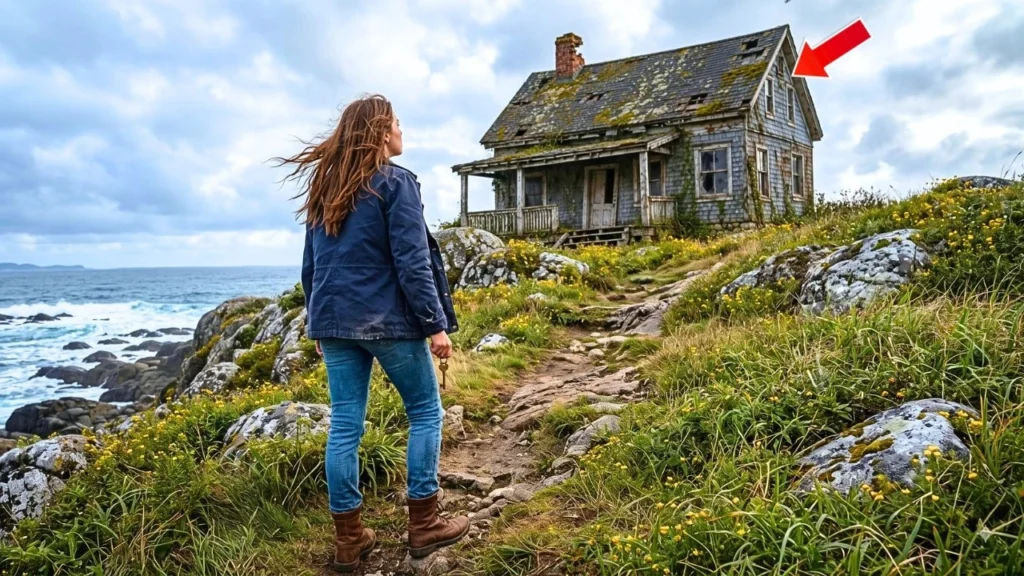
Two days later, she drove back to the cottage, Marla on the phone. The front door stood open. She had locked it. She was certain. Inside, drawers were yanked out, cushions thrown on the floor, the hidden compartment exposed. Nothing valuable was missing — only papers. Two envelopes were gone, along with a folder of letters between Sterling and a coastal development company. But the intruder had missed something. Under the bottom shelf was a strip of masking tape in Owen’s handwriting: Ask about 2008.
The next morning, Sterling called. “I hear you’ve been asking questions about old family property. You’re grieving. Owen had a habit of digging into things he didn’t understand.” Something inside Bethany shifted. Not fear. Clarity. “If there’s nothing to understand, why are you worried?” Sterling hung up. Then Louise called, softly warning that “bringing up the past won’t bring Owen back.” Heath texted that Owen had become “obsessed” in his final months. Three people. Three warnings. Not one answer to the question: what happened in 2008?
Natalie came again with chicken soup, towels, and a box of Owen’s childhood photos. Owen at ten, missing a tooth. Owen with his first fishing rod. And Owen and Natalie as kids, standing in front of the very same cottage. Bethany looked up. Natalie’s face changed. “You found it, didn’t you?” Silence. “What happened there in 2008?” Bethany asked. Natalie’s eyes filled. “Our father nearly lost the business. He moved property between companies so creditors couldn’t take everything. Owen found out years later and couldn’t let it go.”
“Was my name ever used?” Natalie looked away. Then, too quickly: “I didn’t forge your signature.” Bethany hadn’t asked who did. Natalie began to cry. “I loved my brother.” The terrible part was, Bethany wanted to believe her. Natalie was the closest thing to a sister she had left. So she didn’t accuse her. Not yet.
That night, studying the old photos, Bethany spotted something in the corner of one: a small trail camera strapped to a pine tree facing the cottage. The next morning she returned with Marla. After twenty minutes of searching the tree line, Bethany found it — a newer camera, half hidden behind loose bark. Owen must have put it there. The battery was weak, but it was still recording. Marla slipped the memory card into an evidence envelope. “Don’t open this here.”
The card held hundreds of images — wind, rain, deer at night. Then, suddenly, Owen. Alive, walking toward the cottage with a canvas bag on his shoulder. Bethany touched the screen. Marla gave her a moment. Then they kept going. Six weeks before Owen died: Natalie on the cottage porch. Eleven days later: Natalie again. And then the one that changed everything — timestamped the evening after Bethany’s first visit. Natalie’s SUV pulling in. Natalie walking to the door.
Bethany felt sick — and ashamed. “I should have seen it. The sand. The way she answered before I asked.” Marla closed the laptop. “Trusting someone isn’t foolish, Bethany. Refusing to see the truth once it’s in front of you — that would be.”
That evening, Bethany asked Natalie to meet her at the cottage. When Natalie arrived at sunset, Bethany turned the laptop toward her. Natalie went white and sank into a chair. “I didn’t forge your signature,” she whispered. “But you know who did.” Natalie covered her face. “My father told me it was just paperwork. That’s how it always started.”
The truth spilled out. In 2008, Sterling’s construction company was drowning in debt. Terrified of losing land the Corbetts had held for generations, he hid it in a maze of trusts and companies. Records were altered. Temporary arrangements became permanent lies. Natalie was 21 when he asked her to help with the books. “He said I was protecting the family.” Last year, Owen found the inconsistencies and confronted his father. When Sterling realized Owen could reclaim his share of the coastal property, new documents appeared — including the one with Bethany’s forged name. “Owen found out about that too,” Natalie said.
“Did you search this cottage after I came here?” A long silence. “Yes. Owen once said he’d kept something that could unravel everything. After he died, Dad was terrified he’d left it to you. I thought if I found it first, I could keep the family from being destroyed.” Bethany stared at her. “You threw me out of that family.” “I didn’t—” “You stood there while it happened.”
For most of her life, Bethany believed keeping people meant being easy to keep. Don’t argue. Don’t ask for too much. Don’t make them regret taking you in. Now she finally understood what Owen spent four years trying to teach her: love that requires silence isn’t safety. Family that requires lies isn’t belonging. “Where is the last page of Owen’s letter?” Natalie looked genuinely confused. “I don’t know.” For once, Bethany believed her.
At the door, Natalie stopped. “Three days before he died, Owen came to see me. He said if Dad ever forced you out, I should tell you one thing.” She glanced at the old fireplace. “Tell Bethany the cottage remembers what the family forgot.”
The next morning, Bethany pried loose bricks from the fireplace. Behind them was an old metal box: photographs, insurance papers, a yellowed 2008 newspaper clipping. And a photo of the cottage after the hurricane — damaged, but standing. On the back: Not sold. Moved to trust. It was the proof Marla needed. Over three weeks, she traced it through tax filings and corporate records. And Bethany’s work logs proved that at the very moment her “signature” was supposedly witnessed on the coast, she was 87 miles away in Wilmington with 14 residents and two coworkers.
Marla called a formal meeting. Sterling arrived with Louise and Heath, looking at Bethany as if she were still the frightened widow he’d ordered off his property. She wasn’t. Marla laid out every record. “The cottage was never sold. Owen kept an interest through the trust. The relinquishment can’t be authenticated — and we can prove Bethany was elsewhere when it was signed.” Sterling’s jaw clenched. “You’re tearing this family apart over paperwork you don’t understand.” Bethany answered before she could stop herself. “No. The paperwork didn’t tear this family apart. The lying did.”
Then Natalie walked in and placed a thick folder on the table. Sterling turned. “What is that?” “The records I kept.” His face changed. Copies of his instructions, emails, bookkeeping notes — everything he thought had been destroyed. “I told myself I was protecting us,” Natalie said. “I wasn’t. I was protecting what we owned.” Louise began to cry. Heath stared at his father. Sterling said nothing at all.
It took months, not minutes. No dramatic gavel. Title reviews, amended filings, sworn statements, hard questions. But in the end, Owen’s lawful interest in the coastal property was formally recognized — and passed to Bethany. The cottage and its land were valued at about $685,000. Six months earlier, that number would have sounded impossible. Now it felt strangely beside the point. “I could sell it,” she said. “You could,” said Marla. Bethany looked at the distant strip of ocean. “But I don’t think Owen kept it because of what it was worth.”
Sterling never apologized. Natalie cooperated fully and owned her part. One day Louise came alone. “I watched them treat you like you were temporary. I knew it was wrong.” Her voice shook. “Owen never saw you that way.” “No,” Bethany said softly. “He didn’t.” She didn’t tell Louise everything was forgiven. Some wounds deserve honesty more than easy forgiveness.
That spring, with help from Cecil Ward, a 70-year-old neighbor down the road, Bethany began restoring the cottage. One afternoon, Cecil’s hammer struck a hollow spot beside the fireplace. Behind a warped panel sat one sealed envelope. Owen’s handwriting: For Bethany. Last page. Her hands shook as she opened it.
Owen reminded her of something she’d confessed in their first year of marriage: being poor had never scared her as much as being unwanted. That a bedroom could vanish overnight. A family could change its mind. A lock could suddenly belong to someone else. Then came the line that broke her: You once told me a house isn’t a home if someone else can decide when you have to leave. You were right.
At last, she understood the Polaroid. Owen hadn’t fought for the cottage because it was valuable. He fought because he knew her deepest wound — the fear that someday, someone would tell her again that she didn’t belong. He couldn’t promise to live forever. So he tried to leave her the one thing no foster home, no family trust, and no Corbett could ever take away. A place that was hers.
Months later, the porch stood straight. Hydrangeas bloomed by the steps. Cecil had fixed every window, and Bethany painted the front door a deep coastal blue. She kept her job at the senior center. Nearly $700,000 in property didn’t make her a different person. She simply stopped measuring her worth by whether other people chose to keep her.
One autumn evening, as the Atlantic turned gold, she stood on the porch holding two keys: Owen’s old brass one, and the new key to her restored home. She hung Owen’s beside the door. All her life, the sound of a lock had meant she was living in someone else’s house. That night, she turned the key — and smiled. Tomorrow, it would still be hers. And the day after that. For the first time in 24 years, Bethany wasn’t waiting to find out if she could stay.
She was home.
💬 What do you think Owen’s greatest gift really was — the cottage, the truth, or finally giving her a place to belong? Tell us in the comments. 🏡 Share this with someone who deserves to know they’re never “temporary.”