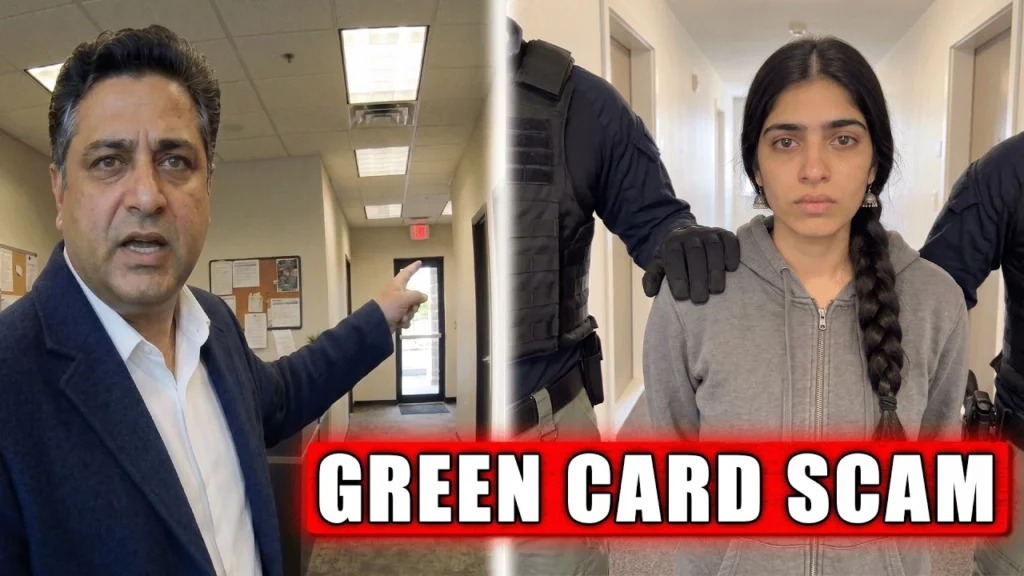
Federal agents recorded this phone call
Federal agents recorded this phone call.
The man on the line had no idea.
May 1st, 2023.
A cheated cook asks the owner of a fake immigration office who is responsible.
The answer is calm.
Don’t worry, the girl handles all of it.
I only stamp.
The girl was Mansi Dhawan, 23, from Jaipur, India.
Her mother sold her wedding bangles so Mansi could study law and protect families from frauds exactly like this one.
Instead, her signature was on fake green card files for 41 families, $143,500.
Five weeks later, at 6:15 in the morning, agents knocked on her door.
She opened it before they finished.
I know why you’re here.
The man who only stamped was sure every paper led to her.
He never thought about the one file she refused to delete.
Now, watch how a cash job at a fake green card office ended the American dream for Mansi Dhawan.
>> Before we dive deeper, let us know in the comments where you’re watching from.
We’d love to hear from you.
And don’t forget to hit that subscribe button so you never miss any of our upcoming videos.
>> Mansi Dhawan was 23.
Six months before federal agents came to the door of Mile High Immigration Services, she believed that office was the best thing that had ever happened to her.
In Jaipur, at a jeweler’s counter, her mother, Kamla, did not cry.
She took off her gold bangles one by one and slid them across the glass to be weighed.
They were her wedding bangles.
They paid for Mansi’s first semester at Front Range State University.
Those bangles would be mentioned again in a federal courtroom.
Her father, Rakesh, kept the accounts for a government school.
He stood at the airport glass until she was out of sight.
In her suitcase, she carried one pair of sandals and a thousand-page book on American immigration law.
She had picked the book over a second pair of shoes.
Since she was 16, she had one plan.
A master’s degree, then law school, then a small office where families could hear the truth.
The reason was her cousin Tarun, who paid a middleman for a student visa.
The man vanished with the money.
Tarun came home and stopped talking about America.
Mansi decided she would one day sit on the other side of the desk.
She would sit behind a desk much sooner than she planned.
And it would be the wrong side.
Aurora, Colorado was flat and windy and loud.
She shared a one-bedroom with two other students and slept on a mattress in the living room.
Every Sunday, her mother sent a voice message, never longer than a minute.
Behind her voice, a pressure cooker whistled.
For that minute, Mansi was home.
On campus, she bound other people’s theses at the print shop.
In September, the university cut her hours to four a week.
Tuition was due in November.
She did the math twice.
It did not change.
She was not a girl who asked for help.
She was a girl who looked for a lesson inside every problem.
That habit was about to cost her.
At the Indian Community Center, where she went on Sundays for free lunch, a flyer hung by the notice board.
Free green card consultation.
Mile High Immigration Services.
At the bottom, a gold seal.
Notary Public.
She read every word.
In India, a notary is a lawyer with a government license.
To Mansi, that seal meant an attorney.
The office was a bus ride away in a strip mall on East Colfax Avenue, next to a halal butcher, the line was out the door.
40 people held folders against their chests.
Cooks, cleaners, a man in a delivery uniform.
One of those people would later make a phone call that agents were recording.
Nobody in that line could have guessed which one.
At the back, an old woman was holding a form upside down.
Her name was Savitri Gulati.
She did not read English.
Mansi sat down beside her without being asked.
She turned the paper around and read every line aloud in Hindi, explaining each box.
When it was done, Mrs. Gulati held her hand in both of hers and called her beta.
No one had called Mansi that in 2 months.
A man was watching them from the doorway of the back office.
Naveen Chopra was 44, in a pressed white shirt, with a smile that reached all the way up to his eyes.
He knew every name in that room, every birthday and home village.
When Mrs. Gulati dug through her purse for bus change, he pressed a monthly pass into her palm, a gift from the office.
On page two of an indictment, Mrs. Gulati would appear as two letters, S.
G.
Mansi watched him and thought, “This is what a good man looks like”.
After closing, he asked her to stay.
She told him everything, even about the book in her suitcase.
Then, he made his offer.
He needed someone who spoke Hindi and understood the law.
$1,400 a month in cash, starting the following Saturday.
There was a problem, and Mansi saw it at once.
A new student cannot work off campus.
Naveen waved it away.
He would handle the paperwork.
She should have asked what paperwork he meant.
Who pays $1,400 in cash to a girl who is not allowed to work.
Munsey answered the question herself that night on the mattress in the living room.
Someone kind, someone who finally saw her.
And what did that gold seal on the flyer really mean? She told herself it was a classroom, not a job.
Six months with real families and no law school could ignore her.
In America, a notary only confirms that a signature is real.
Munsey would hear that soon from Naveen himself and it would not sound like a warning.
On the first Saturday, she arrived early.
The line was already out the door.
Not one of those 40 people asked whether Naveen Chopra was a lawyer.
And Munsey, who had wanted to be one since she was 16, did not ask either.
Inside, the office smelled of cardamom tea and printer toner.
Naveen gave her a desk by the window and the use of the office laptop.
Above the front door, a small white camera blinked once.
Munsey never looked up at it.
The binder was labeled priority family program and it already held 20 families’ files.
Munsey read the first page slowly.
For $3,500 per family, the program promised a green card in 6 to 8 months.
She knew the real numbers.
A family petition takes years and for some Indian families, it takes close to 20.
There is no way to pay the government to skip that line.
So, why had no one mentioned this program in her thousand-page book? She asked that afternoon.
Naveen smiled like a teacher who had been waiting for that question.
The book was old, he said.
The program was new and only a few offices knew about it.
It was a good answer.
That was the trouble with Naveen.
Every answer was a good answer.
Her job was simple.
She sat with each family and filled out the intake forms.
She translated every question and every fear.
Within a week, the line had doubled.
Word travels fast in a community that has been cheated before.
Now, there was a young woman who explained everything slowly in Hindi.
41 families would hand their savings across that desk while Mansi sat behind it.
They paid in cash or money orders.
Nobody wrote a check.
Naveen kept the envelopes in a gray cabinet in the back office and locked it himself.
Why would an office that dealt with the government take only cash? He had an answer for that, too.
Many of these families had never trusted a bank.
It sounded like kindness.
Mrs. Gulati came back on a Thursday with a sandwich bag of small bills.
She counted them out on the desk slowly and apologized for the wrinkles.
Then came the part Mansi understood least.
After each family paid, they needed proof that their case had been filed.
Naveen called it a receipt notice.
A real receipt notice comes from the government.
It carries a case number, three letters followed by 10 digits, and anyone can check it online.
Naveen’s came out of her printer.
He gave her a template and a sticky note.
On the note, in his handwriting, was a number.
She typed it into the box and printed the page.
Then she slid it into an envelope.
She did not ask where the number came from.
A family was waiting, holding its breath, and the page was still warm.
Her little office printer would end up with an evidence tag.
Her first payday was $1,400 in cash.
The second was $1,700.
Naveen called the extra a bonus and said the office was growing because of her.
She bought a pressure cooker of her own, the same small steel kind her mother used.
That Sunday, she sent a voice message home, and this time the whistle traveled the other way.
Outside the halal butcher, a cook stopped her and called her Vakilji.
In Hindi, that means lawyer.
Mansi opened her mouth to correct him.
She did not.
It was a tiny lie told with silence, and she liked how it felt.
Bhaskar Yadav had stood in that first line, a cook with burn scars on both forearms.
His wife was in Lucknow.
He had saved for 2 years and paid in 20s.
A jury would later hear his voice.
And who exactly was mailing all those forms to the government? Mansi never saw one leave the building.
Naveen said he took them to the post office himself late at night.
Late in November, he called her into the back office and closed the door.
He never closed that door.
“A notary,” he explained, “must stay clean.
A notary may only stamp a signature,” he said, “and must never prepare immigration forms.
Those forms needed the name of someone who spoke the language and understood the law”.
He slid a stack of copies across the desk.
Each page had a box at the bottom.
“Prepared by”.
She hesitated for exactly one breath.
Then she thought of Mrs. Gulati’s hands around hers and picked up the pen.
M.
Dhawan Then again and again until her wrist ached.
In a federal courtroom, a prosecutor would read that signature aloud.
The next morning, the first packet carrying her signature went into the mailbox on Colfax Avenue, addressed to a family.
Mansi watched it drop.
Inside was a receipt with a case number that did not exist and her name on the forms around it.
By January, the office had a rhythm.
Afternoons after class, all day Saturday, tea, intake, envelopes, and a quiet question that Mansi kept pushing under the pile.
Why had nobody received a single fingerprint appointment? In her thousand-page book, every real green card application produced one.
A notice in the mail, a date, and a building where the government photographs your hands.
Months had passed, and no family had ever mentioned it.
Mrs. Gulati asked her in the waiting room, in Hindi, very politely, “Beta, how long does it usually take?” Mansi said, “Soon”.
It was the first thing she had said that she did not believe.
That night, she typed one receipt number into the government’s online case checker.
The screen answered in a second.
“No record of this number”.
She tried another.
Then, a third.
The same screen, the same sentence.
Why did every number on her sticky notes begin with the same seven characters? Real numbers change as the days go by.
Hers had not moved since November.
Naveen had invented one number and changed only the last digits.
The next morning, she mentioned it to Naveen as lightly as she could.
He nodded slowly.
“The online checker lags,” he said.
“Sometimes it takes 90 days”.
The program ran on an internal system.
She wanted to believe him.
So, she went back to check on her own.
It was a Wednesday night in February, and the office was dark.
She let herself in with the key he had given her.
A small white camera above the door recorded her at 9:14 pm She had walked under it for almost 4 months and never once looked up.
The gray cabinets stayed locked, but the laptop was open to a spreadsheet she had never been shown.
Dozens of names, amounts, all in cash, and a column labeled filed, completely empty.
In the shared folder, a file called receipt_blank sat beside the printer queue.
It had been edited that same week.
There was no copy of a single government form, not one.
Mansi sat on the floor with her back against the desk.
For a long time, she did not move.
She had a way out.
She could walk into any police station or call any lawyer and say what she had seen.
And she knew what would happen next.
They would ask where she worked.
They would ask whether she had permission.
She had no permission for it.
One answer and she would lose everything her mother’s bangles had paid for.
The truth was more complicated.
Immigrants who report fraud are not always punished for it, but Mansi did not know that, and there was nobody she could ask.
Months later, a federal agent would ask her what she did next.
She would have to say that she went home.
At 9:00 the next morning, she told Naveen what she had found.
He kept his voice low.
He told her, very gently, that she was tired.
He said the program was real and that families were waiting.
And he added one more sentence, softly, almost as an afterthought.
“If anyone started asking questions,” he said, “they would not begin with him.
They would begin with the person who was working without permission”.
Mansi understood then that she was not just an employee.
She was the name on every page.
She went back to her desk and printed the day’s receipts.
In March, Bhaskar Yadav needed a work permit.
Naveen gave him a laminated card with his photo on it and charged him extra.
Mansi had translated the promise for him herself.
On a Friday, his restaurant ran the card through the federal verification system.
The system could not confirm it.
The manager, afraid of trouble, let him go that day.
At 11:52 that night, Monsey’s phone lit up on the mattress.
A voicemail.
She pressed play.
“Madam, please call me.
They say my card is not real”.
She listened to it once.
She listened to it again.
Then, she put the phone face down and did not call him back.
Why didn’t she call him back? In April, an agent would ask her that exact question in a quiet room.
10 days later, on a Monday morning, a woman in a gray suit was sitting in the waiting room.
Her hands were folded on a manila envelope.
The woman did not smile.
