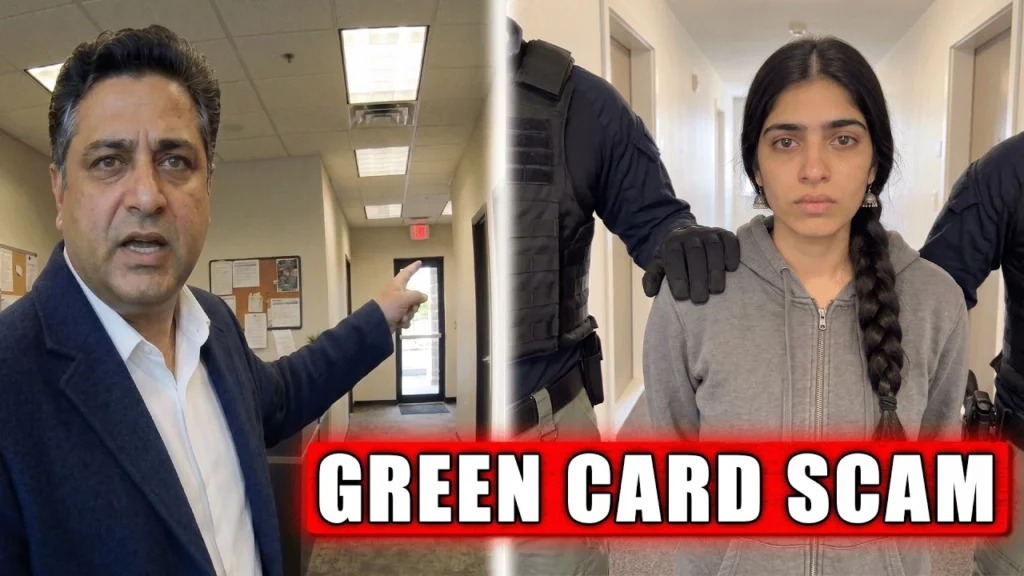
She looked at Monsey the way a doctor looks at an…
She looked at Monsey the way a doctor looks at an x-ray.
The envelope was addressed to M.
Dewan, not to Naveen Chopra.
To her.
Why had a stranger addressed it to Monsey and not to the man whose name was on the door? The woman in the gray suit was Dorothy Lindgren, an immigration attorney from downtown Denver.
Her client was Bhaskar Yadav, the cook who had lost his job.
Dorothy had spent a week making phone calls.
She had checked the case numbers of four families against the government’s records.
None of them existed.
Her letter was short.
It demanded the case files and a refund of every fee within 10 days.
It said that if the office did not comply, she would report the matter to federal authorities.
At the bottom, she had written one more line by hand.
“You should speak to a lawyer of your own”.
That was why the envelope said M.
Dewan.
On every form Bhaskar had signed, Naveen’s name appeared nowhere.
Only hers.
Monsey read it standing up.
Then, she carried it into the back office and put it on Naveen’s desk because she did not know what else to do.
He read it once.
His face did not change.
Then he asked her to close the door.
He did not shout.
He explained in the same warm voice what had to happen next.
The families were frightened, so they needed comfort.
Comfort meant paper.
That afternoon she printed a second batch of receipt notices, 14 of them with fresh numbers from fresh sticky notes.
She mailed everyone.
This time she knew.
That was the difference.
After a Monday in March, nobody could say she was only following instructions.
And there was one more thing.
Naveen told her to take the office laptop home for safekeeping.
He also told her to clear a file called receipt_blank.
Why did he want that laptop in her apartment and not in his? Monci carried it home on the bus, the cheap bag on her lap.
She opened the folder.
She put her finger on the delete key.
She did not press it.
She could not have said why.
Maybe it was Mrs. Gulati’s sandwich bag.
Maybe it was the last thing left in her that still belonged to the girl from Jaipur.
That one refusal would matter more than anything she had done in 5 months.
Dorothy Lindgren did not wait 10 days.
That Thursday she sent her evidence to a federal office with a long name and a short job.
It was called fraud detection and national security and it sits inside the immigration service.
An officer there named Priscilla Okafor checked the numbers for herself.
Then she checked a few more.
By the end of the week the case had left her desk and landed on another.
It belonged to special agent Megan Ostrowski of Homeland Security Investigations in Denver.
Ostrowski did not rush.
She pulled the office’s lease, the owner’s name, and the bank account that cash was moving into.
She sat in a parked car on Colfax Avenue and counted the line outside.
Then, on a Saturday morning in April, a quiet woman came in and sat in the waiting room for 40 minutes.
She told the front desk that she was asking about her mother’s visa.
Who was she? And why did she keep glancing at the ceiling? At 10:26 am, Naveen sat across from her and explained the priority family program.
He promised her a green card in 6 to 8 months.
He told her that nobody in the program had ever been denied.
He asked for $3,500 in cash today.
She counted it out of an envelope.
The bills had been photocopied the night before.
Monsi was in the next room typing.
Nobody told her what was going on.
She had no idea who the woman was.
The woman was an undercover agent.
Her glances at the ceiling had been counting cameras, and under her jacket, her own camera had recorded every word.
12 days later, on Thursday, April 20th, 2023, she got to the office at 6:40 am Naveen had asked her to come early to mail the week’s letters.
She had a stack of envelopes in her hands.
Somebody knocked on the glass.
The video from an agent’s camera shows the rest.
A gray morning, a line of vests that said HSI, a young woman in a blue sweater holding the door open with her hip.
Federal agents, we have a warrant to search this office.
Monsi froze.
The envelopes slid from her hands and fanned out across the floor.
Every one of them with a stamp.
Agents carried out the laptops, the gray cabinet, and a black ledger from Naveen’s desk.
They tagged the printer and took the hard drive from the camera above the door.
Inside the cabinet, wrapped in rubber bands, they found $41,200 in cash.
At 7:55, Naveen Chopra walked in with a coffee and found the office full of agents.
An agent’s camera caught the next few minutes.
He looked offended, not shocked.
He told the nearest agent at 7:58 that he was only the notary.
The girl ran everything.
Ask her.
He had been in that building for 3 minutes, and he had already chosen who would take the fall.
Down the hall, Monsey waited.
At 9:52, Agent Ostrowski sat down across from her and turned on a small recorder.
She said that Monsey was free to leave.
She said she did not have to answer.
Monsey had been waiting for this moment since February.
She decided to answer, and she kept going for 3 hours and 13 minutes.
She was not under arrest.
She had been told twice that she could leave, and she had not asked for a lawyer.
Why not? Dorothy Lindgren had urged her to find one.
Monsey had planned for 7 years to become an attorney herself, but she thought she could still explain.
She told the agents she was only an assistant who printed what Naveen gave her.
At 10:31, Ostrowski asked her a simpler question.
When did you first know the numbers weren’t real? Monsey looked at the table.
Then, she said it.
I knew in February.
I printed them anyway.
It was the most honest sentence she had spoken in 5 months.
It was also the sentence that turned a witness into a defendant.
Ostrowski asked what she had done after finding the empty spreadsheet.
She said she went home.
And why hadn’t she called Boscar back? She said she had been afraid.
It was not a good answer.
Before she left, Mansi handed over her phone with the voicemails still on it.
She also told the agents that the office laptop was sitting in her apartment unwiped.
That afternoon, with her written consent, two agents picked it up from her kitchen table.
Prosecutors would say Naveen wanted the evidence at her address, not at his.
A second warrant let them open it.
The spreadsheet was still there, and the files history showed most edits made late at night from Naveen’s own login.
His bank records told the same story.
Most of the money from the families had landed in an account with his name on it.
The rest had sat in his gray cabinet.
Mansi’s name was on no account.
She was paid in envelopes.
When agents opened the black ledger, they found two columns.
One said how much the family paid.
The other said whether a receipt had gone out.
No line mentioned a filing with the government.
Agents spent the next weeks at kitchen tables.
Mrs. Gulati offered tea before anything else.
Her son, it turned out, was a United States citizen.
For a mother in her position, an ordinary application with the government’s own fee had probably been open to her all along.
Mansi had typed that son’s name onto the intake form herself.
Naveen had told her the program was faster.
Mrs. Gulati had paid $3,500 for a program that did not exist.
After the raid, the office stayed dark.
Agents asked Mansi to stay in Aurora.
Naveen worked out of a rented room.
On Monday, May 1st, at 4:07 pm, Bhaskar Yadav made a phone call from a conference room at the Homeland Security Investigations Field Office.
An agent had pressed record before he dialed.
He told Naveen he needed another work card.
Naveen’s voice came through clearly.
“Come Saturday.
Bring 600 in cash”.
Then Bhaskar asked who he should talk to if something went wrong.
“Don’t worry.
The girl handles all of it.
I only stamp”.
In a federal courtroom, jurors would hear that sentence three times.
On Wednesday, June 7th, a grand jury in Denver returned an indictment.
Eight counts.
One of conspiracy and seven of mail and wire fraud.
Two names appeared on every page.
Naveen Chopra, Mansi Dhawan.
On page two, a victim appeared only as two letters, S.
G.
, Mrs. Gulati.
At 6:15 the next morning, agents knocked on a door in Aurora.
Mansi opened it before they finished.
She was wearing a university sweatshirt and holding a cup of tea.
The arrest team’s camera caught her first words.
“I know why you’re here”.
She set the cup on the counter and turned around.
She made no sound while the handcuffs closed.
Naveen was also arrested that morning at his home.
He was home by dinner.
Why did the man who ran the scheme sleep in his own bed that night while the girl who typed for him did not? He was a citizen with a house and a lawyer and he made bond.
Mansi had no family in the country and an immigration hold waiting behind any door that opened.
The judge kept her in custody.
On her second night in jail, she was allowed to call home.
She had to tell her mother.
In Jaipur, the pressure cooker was still whistling when Kamla picked up.
In the first weeks of detention, she called Jaipur every Sunday, the day the voice messages used to arrive.
Her mother never asked what she had done.
She only asked if Mansi was safe.
Her lawyer was Isaac Branvold from the Federal Public Defender’s office.
He did not talk about justice.
He talked about numbers.
The government had her recorded words, her signature on dozens of forms, and a laptop full of files she had printed.
At trial, those facts would speak louder than her.
He brought her one offer from the government.
Plead guilty to the conspiracy count.
Testify against Naveen.
In return, the other seven counts would disappear.
There was a price attached to the offer.
Mansi would agree to be removed from the United States, not months later in some hearing room.
The judge would sign the order herself at sentencing.
She knew the law.
That was the worst part.
She had read every page about this exact situation in her thousand-page book.
On Tuesday, September 12th, 2023, Mansi stood in a federal courtroom for the first time.
Judge Eleanor Voss asked if she was pleading guilty because she was guilty.
“Yes, your honor”.
she said.
The trial of Naveen Chopra began on Monday, January 22nd, 2024.
His lawyer had a simple story.
Mansi ran the office.
Naveen only stamped.
Who would the jury believe? The girl who printed the numbers or the man who stamped them? Prosecutor Paul Renner called Dorothy Lindgren and Agent Ostrowski.
He called Bhaskar Yadav, who stood in a borrowed jacket and could not stop shaking.
His voicemail played for the jury, every word.
Then, he called Mrs. Gulati.
She testified in Hindi through an interpreter.
When the lawyer asked who had helped her, she said one word, “Beta”.
Renner held up one of the forms and read the signature aloud, “M.
Dhawan”.
Then, the next form, and the next.
Mansi testified for 2 days.
The defense asked if she had signed every form.
She said, “Yes”.
If she had printed every receipt, “Yes”.
If she had known by February, “Yes”.
Why would a jury trust a witness who had admitted to the crime? Then, Renner played them the recording.
“The girl handles all of it.
I only stamp”.
Three times, in a silent courtroom, in the voice of a man who had never expected to be heard.
Renner added the bank records.
The money had gone into Naveen’s account and his gray cabinet.
None of it had gone into an account of hers.
On Friday, January 26th, at 3:40 in the afternoon, the jury returned a verdict.
Guilty on all eight counts.
Marshals took Naveen into custody before he left the courtroom.
Later, jurors said what had convinced them.
Mansi had not defended herself once, so they believed everything else she said.
Mansi’s sentencing came on Thursday, April 11th.
The guidelines called for 21 to 27 months.
Her plea agreement limited the loss to what came after she joined.
41 families, $143,500.
Branvold told the judge about the bangles.
A mother in Jaipur had weighed her wedding gold at a jeweler’s counter so her daughter could study law.
The prosecutor asked the court to go below the guidelines because Mansi had cooperated.
The judge agreed.
12 months and 1 day, with credit for the 308 days she had already spent in custody.
And what happened to the families’ money? Her share of the restitution was $143,500, owed jointly with Naveen.
Naveen owed all 213,500 for 61 families.
The $41,200 from the gray cabinet was forfeited and set aside for the families.
Within 3 weeks, with credit for good conduct, the sentence was finished.
Federal custody handed her to immigration officers.
On Tuesday, April 30th, 2024, she boarded a flight to Delhi with one bag.
Her thousand-page book stayed behind in Aurora in a box she would never see again.
Under the law, fraud above $10,000 is an aggravated felony for immigration purposes.
That means a permanent bar.
In theory, she can ask permission to return.
In practice, it is a door with the handle on the other side.
Naveen’s sentencing came on Thursday, May 9th.
He begged for mercy and blamed her again.
Judge Voss gave him 63 months, near the middle of his range, on every count, served together.
Mrs. Gulati’s son filed an ordinary petition for her that summer with the government’s own fee.
This time, the receipt number was real.
Her mother never got her bangles back.
They had been sold.
On the day she landed in Delhi, her father was standing at the glass again.
So, who was Muncy Dhawan? A victim of a charming man or a partner who looked away? Tell us in the comments where you would draw the line.
