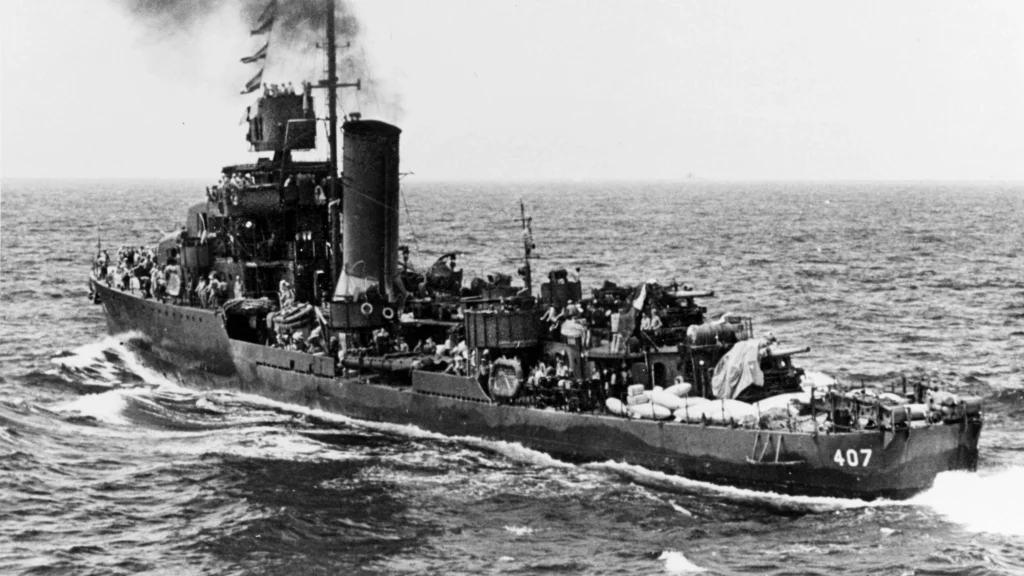
Battle of Vella Gulf: 24 U.S
At 11:18, Dunlap reports a radar contact at about 4,500 yd.
The range is close enough to force an immediate decision.
If the return is a ship, the Americans may already be inside the final approach, but the other destroyers do not confirm it.
The contact is abandoned as false.
That brief moment reveals the discipline on which the entire plan depends.
One suspicious mark on one screen has not triggered six ships into opening fire.
The operators and officers treat the contact as information to test, not permission to announce themselves to everything in the Gulf.
Caution has a cost.
A real enemy cannot be allowed to approach while every report is debated indefinitely.
The answer is comparison.
Another radar, another bearing, another observation.
15 minutes later Dunlap gets a different contact.
This time much farther away.
Craven confirms ships ahead.
The first reports do not agree perfectly on the number.
Craven initially sees three targets.
Dunlap reports four, but the returns persist.
Their bearings change.
Their ranges close.
What first appears as separate marks becomes a moving column.
Now the Americans can begin solving the real problem.
Not where the Japanese ships are at this instant, where they will be when the torpedoes arrive.
A torpedo cannot be aimed at the place a moving destroyer occupies now.
While the weapon crosses the water, the target continues on its course.
The firing solution must lead the column and create an intersection in the dark.
Radar can supply course, speed, bearing, and range.
It cannot make the target remain obedient.
Once launched, these torpedoes will not search for a ship or correct themselves toward a new heading.
They will settle onto preset courses and run through the water according to the information given before release.
A Japanese turn made at the right moment could send the entire spread through empty sea.
Even a perfect surface plot is not enough.
A torpedo can cross the correct point and still pass beneath a destroyer’s hull.
It can strike and fail to explode.
It can malfunction before reaching the target.
The radar operators will continue to see the Japanese ships, but they will not see the submerged weapons closing the distance.
On Maury, Executive Officer Russell Crenshaw has already acted on one of those risks.
Concerned that the torpedoes may run deeper than their settings indicate, he supervises a shallow setting of 5 ft.
The adjustment does not make the weapons reliable.
It addresses one specific failure.
If the torpedo runs deeper than ordered, beginning as shallow as possible may still give it a chance to meet the target instead of passing underneath.
The distinction is serious.
The geometry across the surface can be right while the weapon misses below it.
That uncertainty is one reason the Americans will launch a large spread.
24 torpedoes will cover a band of possible positions across the Japanese course.
It increases the number of chances for a hull to meet a weapon.
It does not guarantee that every target will be hit.
The range continues to fall.
Moosbrugger’s group maneuvers to bring its tubes onto the required bearing.
Simpson’s division holds a separate position, ready to move across the Japanese line after the strike.
If all six ships follow the same track, the second blow disappears.
On the Japanese ships, there is no comparable picture of two American groups moving into different roles.
Lookouts search the rain-darkened horizon.
They know that enemy ships may be in the gulf.
They do not yet have a bearing they can turn into an effective attack.
The Americans are close enough that another minute could change everything.
A lookout may catch a wake.
A ship may emerge from the island’s background.
A radar contact may be followed by a visual report, but the Japanese have not forced the gun battle to begin.
The order to prepare to fire goes to Dunlap, Craven, and Maury.
Their targets remain beyond the range at which American lookouts can identify the hulls clearly.
The combat narrative places the launch ranges between 4,300 and just under 4,900 yd with surface visibility shorter than that.
The destroyers will fire at ships located and tracked by radar.
Between 11:41 and 11:42, each of the three ships releases eight torpedoes, 24 in all.
Heavy steel cylinders slide from the tubes and strike the water.
Their engines begin.
They settle onto the courses calculated for targets the crews still cannot see.
No 5-in gun fires.
There is no flash to reveal the launching ships.
No artillery report to warn the Japanese column that the attack has begun.
For a few more moments, the visible surface of Vella Gulf looks almost unchanged, but below it, the decisive geometry is already moving.
The torpedoes fan across the predicted path of the column.
Hagikaze, Arashi, Kawakaze, and Shigure continue south.
The opportunity to prevent the launch has vanished.
The Japanese still have an opportunity to turn before impact, but only if something tells them that they must.
The Americans cannot remain where they fired.
Moosbrugger gives the prearranged order.
Dunlap, Craven, and Moori turn to starboard together.
The maneuver is sudden enough to be felt through every deck.
The narrow hulls heel.
Men brace against bulkheads and stanchions.
Propellers churn pale water behind the ships as three bows swing toward a new heading.
The guns remain silent.
This is the most unnatural part of the plan.
The Americans have reached close range against an enemy they have tracked without being seen.
Their gun crews are ready.
Their fire control teams have targets.
Every instinct built around taking the initiative argues for opening fire now.
Instead, the launching division is turning away before anyone knows whether a single torpedo will work.
It is not retreat.
It is an attempt to leave the water at which a Japanese counterattack is most likely to be aimed.
If the Japanese calculate a torpedo solution from the American approach, that solution becomes less useful with every second the Americans spend on a new heading.
If they launch toward the place where Dunlap, Craven, and Maury were, the weapons may arrive after those ships have already vacated it.
The turn is a precaution, not immunity.
A wide Japanese spread or a different estimate could still threaten them.
Moosbrugger cannot erase the danger.
He can refuse to offer an unchanged target.
Simpson’s ships do not follow the turn.
Lang, Sterett, and Stack continue moving into the position from which they can attack the Japanese after the torpedoes strike.
Their loaded guns remain cold.
The second division must preserve its own concealment while the first division changes course.
Now there is nothing to do but wait.
Inside the American combat information centers, radar operators watch the Japanese returns continue along the plotted track.
Four marks move across the scopes.
They are not the torpedoes.
They are the ships the torpedoes are supposed to meet.
The clocks move toward the calculated intersection.
The geometry still looks good.
That does not answer the question that matters.
Are the weapons running at the right depth? Will their detonators work? Has the Japanese column altered course in a way the latest plot has not yet revealed? The first minute passes.
The ships on the radar screens continue forward.
Another interval disappears.
No premature explosion lights the gulf.
No sudden Japanese turn breaks the formation.
The American guns remain silent while the torpedoes travel beyond anyone’s control.
On the Japanese bridges, lookouts are searching for the kind of warning they know how to use, a muzzle flash, a silhouette against open water, the sound and light of an enemy committing himself to a gun attack.
The Americans give them none of it.
The Japanese are not inattentive.
They are applying skill and vigilance to a battlefield that is withholding the crucial information.
Their eyes are searching above the surface while the attack approaches beneath it.
Then Shigure’s lookouts finally separate dark shapes from the coast of Kolombangara, American destroyers.
The range is short.
Hara reacts.
Shigure begins an evasive turn and prepares a torpedo counterattack.
But the American launching ships are already turning away.
The second American group has not yet fired, and the torpedoes are close to the leading Japanese destroyers.
The battle appears to be beginning at the exact moment the opening attack is about to end.
At about 11:46 in the American record, an explosion appears among the targets, then another.
Then the dark line ahead of Shigure breaks into fire.
The blasts do not arrive as a neat sequence that observers can later assign with certainty.
Torpedo detonations, ruptured compartments, burning fuel, and secondary explosions overlap.
Water and smoke rise around the leading ships.
Their silhouettes change before the men watching can agree on what each flash means.
Hagikaze, Arashi, and Kawakaze are caught in the spread.
One moment they are moving as a column toward Vila.
The next they are slowing, listing, burning, or losing control.
The organized formation collapses before its commanders can turn the entire group into a coordinated reply.
A torpedo strike below the waterline creates problems that spread through the whole ship.
Flooding threatens propulsion and stability.
Broken power lines darken compartments.
Fires begin while damage control teams are still trying to understand which spaces have been opened to the sea.
The first question after the launch has been answered.
Enough American torpedoes have reached their targets and exploded to break the Japanese formation.
But the battle is not over.
A mortally damaged destroyer can still have working guns.
A crew fighting flooding can still launch torpedoes.
Weapons released before a ship loses power will continue through the water whether the firing ship survives or not.
And the Americans detected four targets.
Only three are burning.
Somewhere behind the flames, Shigure is still moving.
This is the moment for which Simpson’s division has been waiting.
Lang, Sterett, and Stack turn across the Japanese direction of movement and bring their batteries into action.
The silence that protected the torpedo attack ends in a wall of gunfire.
5-in guns flash across the American second division.
Shells move towards ships now outlined by their own fires.
The targets are easier to see than they were minutes earlier, but the scene is not simple.
Smoke covers parts of the hulls.


