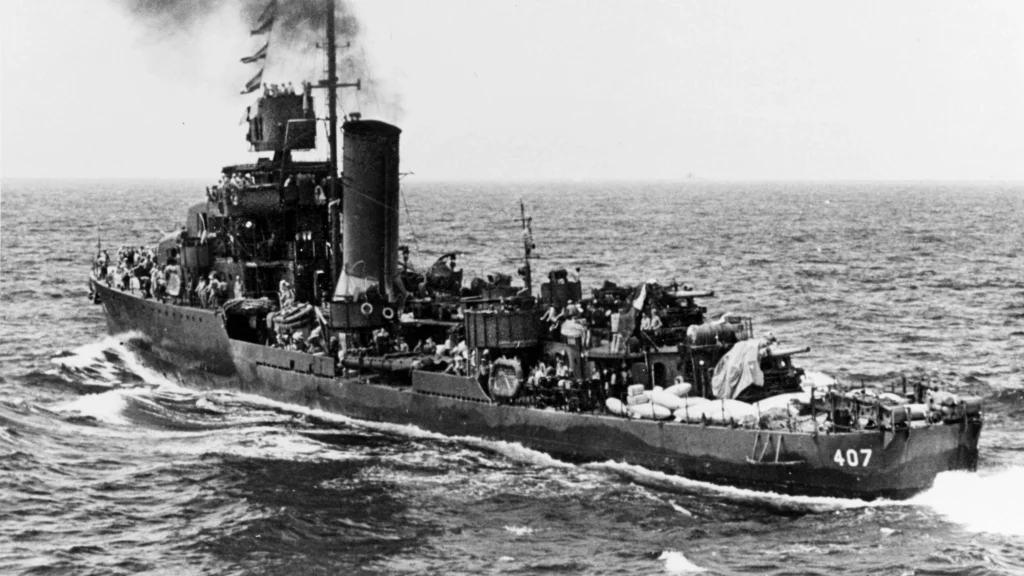
Moosbrugger cannot erase the danger
Flames distort their apparent size.
One burning destroyer can disappear behind another and then reappear from a different angle.
Lang uses fire control radar to select and track a target.
An early hit gives the other ships a clear point of concentration.
Sterett and Stack join without waiting for a separate explanation of the entire battle.
That speed is the reward for planning the handover before contact.
If all six American destroyers had turned away together after launching, the attack would now pause.
The Japanese would gain time to recover, return fire, or withdraw.
Instead, Simpson’s group is already in position while Moosbrugger’s ships complete their evasive maneuver.
The battle has passed from one division to the other without giving the Japanese formation the same pause.
Shellfire compounds the damage from the torpedoes.
The underwater explosions have opened holes and disrupted movement.
The guns strike weapons, control positions, and equipment above the waterline.
The effects reinforce one another.
A destroyer that cannot maintain speed is easier to keep under fire.
A ship losing electrical power has greater difficulty directing weapons and managing flooding.
Men sent to fight fires cannot repair every damaged system at once.
Japanese guns answer.
The return fire is brief and ineffective, but it matters.
The first explosions have not removed human resistance.
Men aboard the damaged ships continue trying to find the attackers through smoke, fire, rain, and darkness.
They are now fighting from the worst possible position.
Their own burning ships reveal them.
The American second group has only just announced itself.
The first American group is no longer where a rapid counterattack against the original Bearing expects it to be.
Moosbrugger’s division has not left the battle permanently.
After completing the turn, Dunlap, Craven, and Moory move back toward a position from which they can add gunfire.
Within minutes, the ships that launched the opening spread are engaging again from another direction.
Now six American destroyers are acting around a Japanese formation that has already lost its movement and cohesion.
That creates a new danger for the Americans.
Darkness does not distinguish friend from enemy.
Fires, smoke, changing courses, and multiple firing positions can turn a successful ambush into confusion.
Each division must know where the other is expected to be.
A ship crossing the wrong sector could enter friendly gunfire or the path of another torpedo attack.
The pre-arranged separation gives the captains enough structure to keep acting without waiting for a complete picture that may never exist.
By midnight, the center of the Gulf contains burning ships, shell splashes, smoke, wreckage, and torpedoes moving through water no observer can fully read.
But one Japanese destroyer remains outside the concentration of fire.
Shigure’s survival begins before the first explosion.
She has fallen behind the three leading ships.
Accounts of the approach describe an engineering limitation that leaves her roughly a mile astern when the formations meet.
That spacing changes the geometry of the attack.
Hagikaze, Arashi, and Kawakaze enter the torpedo spread together.
Shigure reaches the same area later.
The explosions ahead become a warning that the leading ships never received.
The extra distance does not make her safe.
It gives Hara something more valuable than safety, time to react.
Shigure turns hard, launches a torpedo counterattack, and begins using smoke as she pulls away from the illuminated area.
Hara is not avoiding a threat he predicted with perfect accuracy.
He is reacting to the destruction of the ships in front of him while the remaining weapons of the spread are still moving through the water.
His torpedoes run toward the direction from which the American attack appears to have come.
They find no American destroyer.
Dunlap, Craven, and Moorer have already changed course.
The patch of water that would have held three excellent targets is emptying before the Japanese weapons arrive.
This is the practical value of Moosbrugger’s turn.
The Americans have not defeated Japanese torpedoes with armor.
They have made the first firing solution obsolete by refusing to remain on it.
Shigure’s escape still depends on more than the turn.
Accounts differ on the exact contact, but describe an American torpedo striking or passing through Shigure’s rudder without exploding.
The rudder is damaged, but the blast that destroyed the ships ahead never comes.
For a moment, the weapon has done almost everything required.
It has crossed the dark water, reached the maneuvering destroyer, and made physical contact near the stern.
Then, the detonator fails.
The ship shudders.
The rudder is damaged, but there is no underwater explosion to break the hull or stop Shigure in the middle of the burning gulf.
That failure places a limit on every claim that the American trap worked flawlessly.
The same torpedo system that has devastated three destroyers has allowed the fourth to survive at the final point of contact.
Hara uses the opening.
Shigure continues withdrawing under smoke and rain.
A Japanese reconstruction describes her reloading and turning back toward the battle before finally abandoning the attempt.
Returning would be a different problem from escaping.
The burning ships reveal where the Japanese losses are, but not the full position of the Americans.
A rescue attempt would require slowing near vessels already under concentrated fire.
A renewed attack would put one damaged destroyer against opponents that can locate targets in darkness and coordinate from more than one direction.
Shigure cannot restore the formation by reentering it.
She leaves Hagikaze Arashi and Kawakaze behind.
The Americans do not immediately know that the fourth ship has escaped.
From their changing positions, they are trying to decide whether targets appearing through the smoke are damaged ships seen again, new ships entering the battle, or the missing destroyer returning.
Simpson’s division fires additional torpedoes as the attack continues.
Moosbrugger also has to look beyond the ships already burning.
The original plan allowed for the possibility of another Japanese group.
A commander who commits every gun to the visible wreckage may discover too late that fresh ships are entering through the northern end of the gulf.
Shortly after midnight, Moosbrugger moves his division toward that entrance while Simpson’s ships continue the action around the damaged targets.
No second Japanese formation appears, but that answer is available only afterward.
During the battle, the Americans must divide their attention between finishing the first force and protecting themselves from an enemy that may still be approaching.
Coordination remains dangerous even in victory.
When Simpson prepares another torpedo attack, Moosbrugger orders his own division clear of the range.
A torpedo follows its settings regardless of the flag on a crossing ship.
The same plan that put the Americans into favorable positions can destroy them if those positions are not updated as the divisions move.
The opening spread broke the Japanese column.
Gunfire and later attacks complete the destruction.
There is no reliable way to assign every flash seen through smoke to one weapon or one American ship.
One target disappears, then seems to return against the light of another fire.
A listing destroyer presents a different shape from each angle.
Observers count holes, lose them, and count them again.
This is how a force with radar can win decisively and still misunderstand part of its own victory.
The Americans initially believe that all four Japanese ships have been destroyed.
Some reports identify one of the targets as a cruiser.
Later reconstruction establishes the result.
Hagikaze, Arashi, and Kawakaze are sunk.
Shigure escapes.
There was no Japanese cruiser in the intercepted formation.
The correction does not reduce the scale of the victory.
Three Japanese destroyers have been lost.
The reinforcement force they carried will not arrive at Vila as the organized body that sailed that evening.
For the soldiers aboard the destroyed ships, the mission has become a struggle in burning oil, wreckage, and darkness.
Men who were supposed to step ashore with weapons and supplies are scattered in the water.
Some survivors eventually reach land, but the transport operation has failed.
The Americans search the area and attempt to take men aboard.
Though those efforts produce no prisoners that night, they also have to leave safely.
Mooris’ engineering trouble, which affected the force before contact, has not disappeared because the battle has been won.
Her ability to maintain speed is deteriorating.
Moosbrugger withdraws with the first division, while Simpson’s ships continue the search and leave later.
All six American destroyers return without combat damage.
That fact makes Vella Gulf look inevitable when viewed from the end.
It was not.
The Americans entered confined water with incomplete reconnaissance.
One ship could not make its expected speed.
Their first radar contact was false.
Their torpedoes could run deep or fail to explode.
The Japanese still had time to turn after the launch.
Shigure did turn, fired back, and survived when an American weapon reached her stern without detonating.
The result came from a chain of decisions that had to remain connected.
Confirm the target before revealing the force.
Use radar to build an approach rather than immediately beginning a gun duel.
Launch torpedoes while the enemy still lacks a useful bearing.
Turn away before seeing the result.
Keep a second group in position to continue the attack.
Then keep searching after the first targets begin to burn.
Break any one of those links and the battle changes.
If the Americans fire their guns at the first confirmed contact, Japanese lookouts gain flashes to track before the torpedoes are launched.
If Moosbrugger’s division remains on its approach course, Shigure’s counterattack has a steadier target.
If Simpson follows the first group through the same turn, the damaged Japanese ships gain time before the gunfire begins.
If every American ship concentrates on the fires, a second enemy group could enter the Gulf unopposed.
Vella Gulf does not prove that radar sees everything, that American torpedoes have suddenly become perfect, or that Japanese night fighting skill has disappeared.
It proves something narrower and more important.
Information becomes an advantage only when the next decisions preserve it.
The Americans do not win merely because they detect the Japanese first.
They win because they resist the urge to spend that advantage on the first visible action available to them.
They withhold their guns, accept the uncertainty of an unseen torpedo run, and move before the enemies reply can be aimed at the place they occupied.
Their technology matters, so does geography, so does the condition of each ship, but the decisive difference is sequence.
Shigure’s escape prevents the story from becoming a myth of flawless execution.
Her position gives her warning.
Hara reacts.
The American turn denies his torpedoes an unchanged target.
Then a failed detonator gives his ship the final opening it needs.
Victory and imperfection occupy the same stretch of water.
Return to the moment when Shigure’s lookout first catches the American silhouettes against Kolombangara.
Hara still has decisions to make.
His ship can turn.
His torpedoes can launch.
The three destroyers ahead have not yet vanished beneath the surface.
The American guns have not yet opened, and the outcome has not yet been fully decided, but one opportunity has already gone.
The Japanese can no longer react before the American torpedo attack begins.
They have finally found the ships.
The weapons are already on their way.


