
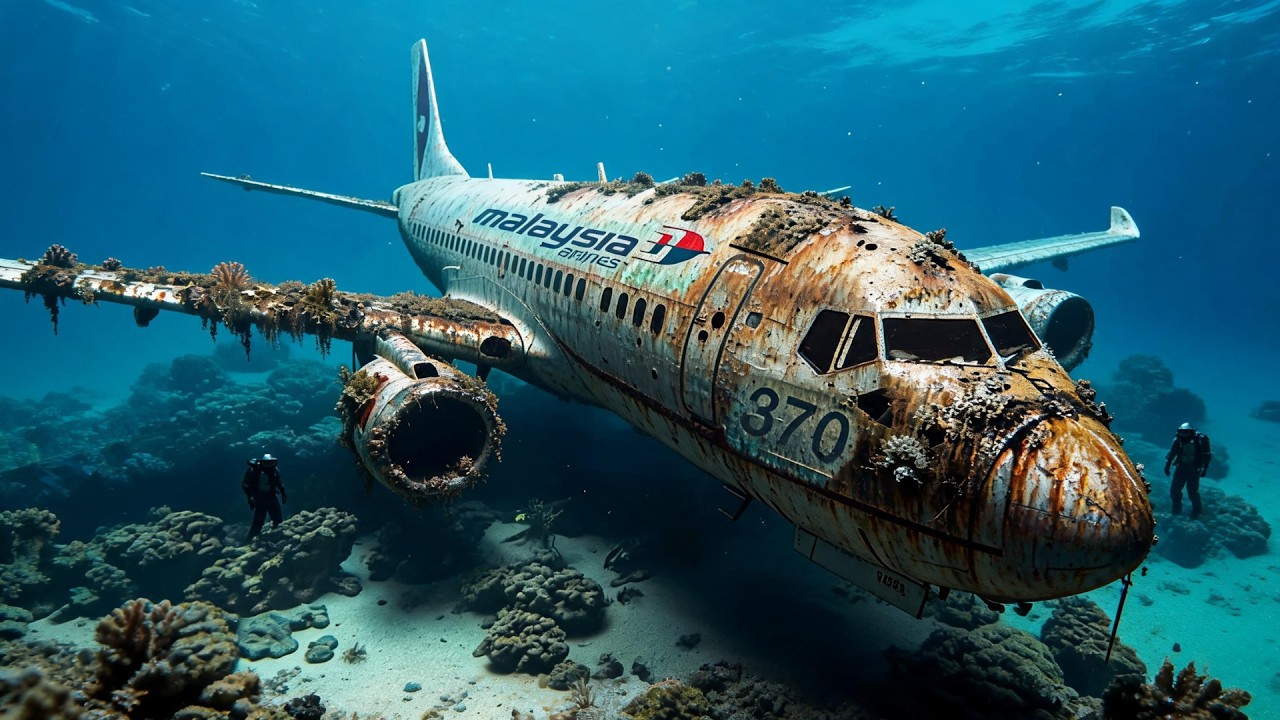
 A Malaysia Airlines jet with 239 people on board, three of them Americans, has disappeared in what is now one of the biggest unsolved mysteries in aviation history.
Flight MH 370 slipped off every screen tracking it, and the whole world was left stunned, unable to believe a plane that size could simply be gone.
For years, search teams have mapped the floor of the Indian Ocean and picked through every scrap of data, desperate to work out what happened that night.
But what if the answers have been hiding in a string of new findings and fresh theories? Today, we’re going through the newest discoveries and the boldest theories that might finally explain what happened to Malaysia flight MH 370.
I’m Ambrose Wild, and the most unsettling thing investigators have learned since that night is that this plane didn’t simply fall out of the sky.
Somebody turned it around by hand, and it kept flying for hours in a direction nobody was watching.
Kuala Lumpur International Airport, the 8th of March, 2014.
At 12:42 in the morning, 7 minutes behind schedule, a Malaysia Airlines Boeing 777 lifted off runway 32, right, and turned north toward Beijing.
On board were 227 passengers and 12 crew.
The passengers came from more than a dozen countries, and 153 of them were Chinese.
The crew were all Malaysian.
In the left seat sat Captain Zaharie Ahmad Shah, 52 years old, a Malaysia Airlines pilot since he joined as a cadet in 1981, with 18,365 hours in his logbook.
He was also a type rating instructor, which meant he trained other pilots on this exact aircraft.
Beside him sat First Officer Fariq Abdul Hamid, 26, with 2,763 hours.
For Fariq, this flight was the last step in his training on the 777.
The first half hour went by like a thousand other red-eye flights.
The jet climbed to 35,000 feet.
At around 1:07, its automatic reporting system, a data link that sends engine and position updates back to the airline, beamed out a routine message.
Everything looked normal.
The next one was due half an hour later.
It never arrived.
At 1:19 and 30 seconds, as the plane approached the edge of Malaysian airspace, the controller in Kuala Lumpur handed it over to Ho Chi Minh City.
The reply came back calm and routine.
“Good night, Malaysian 370”.
Investigators later concluded that voice belonged to the captain.
Less than 2 minutes later, at 1:21, the plane’s transponder, the box that tells civilian radar who and where you are, stopped talking.
The Vietnamese controllers waited for a call that never came.
That’s where most people think the story ends.
A blip disappears, a plane crashes somewhere, and the ocean hides it.
But over the years since, scientists, engineers, and amateur investigators have pulled far more out of that night than anyone expected, and some of it is frightening.
Here are 15 of those discoveries and theories, counting down.
And the newest one is the one that changes the picture most.
Number 15.
The plane kept talking to a satellite for 6 more hours.
The transponder had gone quiet, but one piece of equipment on board hadn’t.
Up above the Indian Ocean, a communications satellite owned by Inmarsat, a company based in London, was still listening.
At 2:25 in the morning, more than an hour after the jet vanished from civilian radar, its satellite unit suddenly logged back onto the network.
Then, roughly once an hour, the ground station sent out a short electronic ping, the satellite equivalent of asking, “Are you still there?” and the plane answered.
Seven of these handshakes were logged in all.
Two were started by the aircraft itself when it logged on, and five came from the ground station checking in.
On top of that, the airline tried to call the cockpit through the satellite twice, at 2:39 and again at 7:13.
Both calls rang through to the aircraft.
Nobody picked up.
Those handshakes carried no words, no position, and no altitude, just timing and frequency.
But, that’s the part that matters.
A plane that had broken apart over the South China Sea couldn’t have answered a satellite for 6 hours.
Somebody or something had kept this aircraft in the air.
Number 14.
Military radar watched it turn around.
Civilian radar loses a plane when its transponder goes dark, but military radar picks up the metal of the aircraft itself.
And the Malaysian Air Force’s radar recordings, which came out in pieces over the following weeks, showed something nobody in the airline’s operation center had imagined.
Right after the transponder went silent, the 777 made a sharp turn back to the southwest across the Malay Peninsula.
Between 1:30 and 1:35, it was tracked at about 35,700 ft, moving at 496 kn, a little under 600 mph.
At 1:52, it passed just south of Penang Island, then swung northwest and flew up the Strait of Malacca.
At 2:03, it went by a tiny island called Pulau Perak, and at 2:22 near the Andaman Sea, at 29,500 ft and more than 200 nautical miles from Penang, the military radar lost it for good.
That’s almost an hour of flying that looked deliberate, past cities and an airbase without a single word on the radio.
It didn’t look like a crash and it didn’t look like a typical hijacking where someone usually wants to land somewhere and make demands.
Malaysian officials denied the turnback at first, which is a big part of why the first search went to the wrong sea.
Number 13.
The turn toward Antarctica.
Once investigators had those satellite handshakes, engineers at Inmarsat in London started working them over and they pulled out something the system was never designed to give, a rough idea of where the plane had gone.
Around 2:40 in the morning, somewhere near the northern tip of Sumatra, the data suggested the jet turned south and then it kept going out over open water, away from every runway on the map, in the general direction of Antarctica.
The last full handshake was at 8:10.
At 8:19, the satellite unit logged on again.
Investigators believe that happened because the engines had run out of fuel, the power dropped out, and a small backup generator called a ram air turbine kicked in and woke the unit back up.
8 seconds later came the final transmission.
The ring of possible positions for that last ping became known as the seventh arc and the frequency readings from those final two messages, 8 seconds apart, showed the plane accelerating downward at roughly 2/3 of the force of gravity.
A team at Australia’s Defense Science and Technology Group, led by Ian Holland, concluded the aircraft should lie relatively close to that arc.
The descent rate may have topped 15,000 ft a minute, which means the plane was in a steep dive.
At 9:15, the ground station pinged again.
There was no answer.
Number 12.
The Doppler number.
Here’s how it works in plain terms.
Each handshake gave investigators two readings.
The first was timing, called the burst timing offset.
It’s the delay between the ground station’s message and the plane’s reply.
And since radio travels at a fixed speed, that delay works out to a distance.
A distance from the satellite gives you a big circle on the Earth.
The plane is somewhere on that ring, but the ring alone can’t tell you where.
The second reading was frequency, called the burst frequency offset.
And this one comes from the Doppler effect.
The same thing that makes a siren change pitch as it drives past you.
A plane moving toward or away from the satellite shifts the frequency a tiny bit.
That shift is what told analysts the jet went south instead of north.
It’s messy, though.
The satellite drifts, the equipment compensates in its own ways, and the oscillators that generate the signal wobble with temperature.
So, the analysts tested their math against broadcasts from 20 earlier flights in the week before MH370 disappeared to see how the numbers behaved when they already knew the answer.
Every search since has been built on those two readings.
Number 11, the hunt for the black boxes.
In the first weeks, the search went to the wrong ocean.
From March 18th to the 28th of April 2014, 19 ships and 345 aircraft sorties covered more than 4.
6 million square kilometers of sea surface, and they found nothing that came from the plane.
Foreign investiga- tors complained about information that arrived late or not at all, and critics accused Malaysia’s government of secrecy for years afterward.
Australia took over coordination of the search in the southern Indian Ocean, and then came the hard part.
The seafloor out there was so poorly mapped that ships first had to chart about 208,000 square kilometers of it before anyone could safely tow sonar vehicles a few miles beneath the surface.
The underwater search started on the 6th of October 2014 with a goal of covering 120,000 square kilometers.
It was suspended on the 17th of January 2017 after 1,046 days.
The bill came to about 155 million dollars split between Malaysia, Australia, and China.
In its final report that October, the Australian Transport Safety Bureau wrote that it was almost inconceivable and certainly societally unacceptable in the modern aviation era for a large commercial aircraft to be missing.
Then a private company, Ocean Infinity, tried in 2018 on a no find, no fee deal using eight underwater drones.
By June, it had covered more than 112,000 square kilometers.
It found nothing and that company would come back years later with better machines.
And what happened on that return trip is where this whole countdown is heading.
Number 10, the flight that looks planned.
Here’s where the story takes a turn nobody expected.
When investigators ran through the usual causes of air disasters, almost none of them fit the facts.
A fire, a sudden loss of cabin pressure, a lightning strike, a bird strike, ice, volcanic ash, a cargo explosion, a pilot suddenly falling ill.
Any one of those can bring down a plane.
None of them explains a jet that turns around, threads its way past Penang, flies up a straight, turns again, and then cruises south for 6 hours.
Investigators found no history of confused pilots, no sign of a bomb, and no act of war.
In July 2018, Malaysia’s own safety investigation team released its final report, nearly 500 pages long with about 1,500 pages of appendices.
It said the turnback had been made under manual control, not by the autopilot, either by the pilot or a third party.
It found no evidence that anyone other than the designated crew flew the plane.
And then, in the same report, it admitted the team was unable to determine the real cause of the disappearance.
The day after it came out, the head of Malaysia’s civil aviation authority resigned.
Number nine.
The climb to 40,000 ft.
In Boulder, Colorado, an electrical engineer named Mike Exner spent years with the radar data.
He’s one of the best-known members of the independent group, a loose network of scientists and engineers who’ve studied MH370 since the early days.
Exner came to believe that during that first turn, the 777 climbed to around 40,000 ft, close to its limit.
His theory is that this was done on purpose to speed up a depressurization of the cabin.
The journalist William Langewiesche, writing in The Atlantic in 2019, laid out why that idea is so disturbing.
The oxygen masks that drop down in the cabin are meant to keep people going for about 15 minutes while the pilots descend to below 13,000 ft.
At cruising altitude, with nobody descending, they’d be close to useless.
People in the cabin would lose consciousness quickly and quietly, probably without even realizing what was happening.
The cockpit was different.
It had four masks connected to a pressurized oxygen supply that could last for hours.
If someone up front had planned this, they’d have had everything they needed to keep breathing while everyone behind them slept.
And this is where it gets worse.
The radar track ran right past Butterworth airbase near Penang, where Malaysia kept a squadron of F-18 interceptors and an air defense radar.
According to Langwiesche’s reporting, the military knew roughly what the aircraft was and chose not to send up an interceptor because it was considered friendly.
A former Malaysian defense minister later asked what the point of launching a fighter would have been if nobody was going to shoot it down.
Number eight, control from inside the cockpit.
One early theory said someone could have taken over the plane from the electronics bay, a compartment below the forward galley where much of the aircraft’s equipment sits.
But the timeline makes that hard to believe.
Between about 1:01, when the jet was settled at cruising height, and 1:21, when its transponder went dark, the plane’s reporting system sent its scheduled update through the satellite link with fuel, altitude, speed, and position.
The link was working.
Then, in a short space of time, the transponder went off, the reporting system went quiet, and the satellite connection dropped until 2:25.
If you shut down a big part of the electrical system, all of that happens together.
Analysts have also argued the turn back was too tight and too precise for the autopilot, which lines up with the official finding that it was flown by hand.
So, whoever was flying was sitting in a pilot seat, and since two pilots acting together seems so unlikely, one theory holds that when the plane vanished from civilian radar, one of them was locked out, incapacitated, or already gone.
Number seven, when pilots crash their own planes.
Nobody likes this possibility, but it isn’t new.
In December 1997, a Silkair Boeing 737 dived into a river in Indonesia shortly after takeoff, killing 104 people.
American investigators found the cockpit voice recorder had been deliberately disconnected.
In 1999, Egyptair Flight 990 went into the Atlantic off New England with 217 people on board, and sources close to the investigation said the first officer had acted on purpose.
In November 2013, just months before MH370, a Mozambican Airlines jet came down in Namibia, killing all 33 on board, and officials ruled the captain had a clear intention to crash it.
And in March 2015, a year after MH 370, a Germanwings co-pilot locked his captain out of the cockpit and flew an Airbus into the French Alps.
So, if a pilot was involved, which one? Farik doesn’t fit easily.
He was 26, on his final training flight, with a career at the national airline just opening up in front of him, and he was reportedly looking forward to getting married.
Investigators found nothing in his background that pointed in that direction, which leaves the man in the left seat.
Number six.
The captain behind the official portrait.
On paper, Zaharie was a model pilot.
The Malaysian report described a calm, capable family man who loved aviation so much he’d built a flight simulator at home.
It found he handled work stress well, and it stated there was no known history of apathy, anxiety, or irritability.
Airport camera footage from the day of the flight and from his three previous flights showed him well-groomed and relaxed, with nothing unusual in how he carried himself.
Langgjewiesche, after interviewing people who knew him, described a very different man.
In his account, Zaharie was often lonely and sad.
His marriage had broken down.
He spent long stretches alone at home between trips, and he’d become fixated on people he followed on social media, including two young models who never really responded to him.
Langgjewiesche wrote that the official portrait was either irrelevant or at odds with what was knowable about the captain.
One lifelong friend, himself a 777 captain, told him that he’d reluctantly concluded Zaharie was responsible, saying it was hard to reconcile with the man he knew.
No court and no official investigation has ever found that Zaharie did it, and Malaysia’s report didn’t rule out a third party, but the doubts around him have never gone away.
And there’s one piece of evidence on his home computer that keeps pulling people back.
We’ll come to it in a moment.
Before we get to number five, there’s one theory that didn’t make the official list, but refuses to die.
In the days after the disappearance, relatives of some of the passengers said that when they called their loved ones phones, they heard ringing instead of going straight to voicemail.
On Chinese television, one man dialed his brother’s number to show that it still rang.
19 families signed a statement saying the same thing, and some took it as proof the plane had landed somewhere and the passengers were still alive.
It’s an agonizing idea, and it’s easy to understand why people held on to it, but telecom analysts offered a much simpler explanation.
When you call a phone, the network starts searching for it.
First where it last connected, then more widely.
And while it searches, the caller can hear ringing.
That happens even if the other phone is switched off, out of range, or destroyed.
The wireless analyst Jeff Kagan said, “The ringing you hear doesn’t mean the other phone is actually ringing”.
So, the ringing tones, as heartbreaking as they were, told the families nothing about where the plane was.
Number five, the trail on the simulator.
In July 2016, New York magazine reported on a confidential Malaysian police document.
After the disappearance, Malaysia had handed the FBI hard drives from Zaharie’s home simulator, and the FBI recovered six deleted data points from a session on Microsoft Flight Simulator.
Together, they sketched a flight that left Kuala Lumpur, went northwest up the Strait of Malacca, turned left, and then headed south over the Indian Ocean until the fuel ran out over empty sea.
The report said this session happened less than a month before the real flight.
Malaysia’s police chief flatly denied passing any such report to anyone, saying it wasn’t true.
Australia’s Prime Minister, Malcolm Turnbull, said that even if the data showed the captain had planned it, it didn’t tell anyone where the aircraft actually was.
The simulated endpoint was about 900 miles from where searchers believed the real plane went down.
Malaysia investigators later dismissed the route as one of several hundred on the machine, but Victor Iannello, an engineer and entrepreneur from Roanoke, Virginia, and another leading member of the independent group, noticed something odd.
Of all the flights that matched, this was the only one Zaharie hadn’t flown as one continuous trip.
He moved it forward in stages by hand, subtracting fuel until it ran dry.
Iannello said it was as if he was simulating a simulation.
His suspicion is that it was a kind of breadcrumb trail, a way of saying goodbye.
Number four, the remote control theory.
Not everyone accepts that someone in the cockpit was flying.
The British historian Norman Davies, in his book Beneath Another Sky, suggested the plane could have been hijacked remotely.
His idea rests on something called the uninterruptible autopilot.
After the September 11 attacks, Boeing was awarded a patent in 2006 for a system that could take control of a hijacked airliner away from everyone on on and fly it automatically to a chosen airstrip, activated by the pilots, by sensors, or by authorities on the ground.
Davies speculated that MH370 might have been carrying sensitive cargo or people bound for Beijing, and that it may have been hacked by one party trying to divert it toward the American base at Diego Garcia, then taken over again by someone else to stop it from getting there.
But, there’s a big problem.
There’s no publicized evidence that this system was ever installed in any airliner.
The aviation consultant, Bob Mann, has said its existence isn’t proven, and concerns that it could itself be hacked have kept it from ever being rolled out.
Number three, the jet in the jungle.
In September 2018, Ian Wilson, a British video producer, said he’d found MH370 on Google Maps sitting in a high stretch of Cambodian jungle.
He pointed to an outline that looked like an airliner, apparently wedged into a hillside at an angle.
And he measured it at about 69 m long.
His argument was that only a handful of pieces from the plane had ever been confirmed in the Indian Ocean.
So, why trust the ocean theory at all? Wilson and his brother, Jackie, set off to find the site on foot, but rough terrain forced their guides to turn back.
Even the article that first carried his claim admitted the image might simply show a different plane caught in flight as it passed under the satellite that took the picture.
Aviation expert Tim McMillan said the shape looked too small for a 777.
And it collided with everything the satellite data says about a long flight south over open water.
Still, the brothers stood by their find and talked about going back.
Meanwhile, the scientists working the ocean side of this mystery were building far better tools than a satellite photo, and we’ll get to what those tools turned up.
Number two, a stowaway and a mystery load.
Another idea is that someone got on board who shouldn’t have been there.
One documented oddity did turn up early.
Two Iranian passengers had boarded with stolen passports, but both were investigated and eliminated as suspects.
Some families went further.
Ghyslain Watrelos, a Frenchman who lost his wife and two of his children on the flight, has said French investigators told him about cargo that didn’t add up, including a container that was over its weight limit, and a load of about 89 kg that appeared on the paperwork after takeoff.
Why that happened, through carelessness or something else, has never been explained in public.
The aviation security expert Tim Termini has said there’s real support for a hijacking, and he’s described four ways it could have happened.
By a member of the crew, by a passenger, by a stowaway, or by someone taking over the plane’s electrical systems remotely.
Philip Baum, another aviation security specialist, has pointed out how reluctant officials have been to even discuss the stowaway idea.
And remember, the Malaysian report itself didn’t exclude a third party.
Number one, was it shot down? This is the darkest theory on the list.
Mark Dugain, a French author and the former head of a French airline, Proteus, went to the Maldives, not far from Diego Garcia.
In a six-page article in the magazine Paris Match, he described locals on the island of Kuda Huvadhoo who said they’d seen a huge plane flying low over them with red and blue stripes on a white background, the colors of Malaysia Airlines.
On another island, he was shown a device that had washed up on the beach, which he said aviation experts identified as a fire extinguisher.
His suspicion was that hackers had taken control of the plane, and that American forces on Diego Garcia shot it down, fearing a September 11-style attack.
He also said a British intelligence officer warned him about the risks of digging into MH370.
Others have floated similar ideas, including the British author Nigel Cawthorne, who suggested in a book that fighters from a joint American and Thai exercise might have brought the plane down by mistake.
Watrelos has also claimed the US Air Force shot the plane down, and that a cover-up followed.
The trouble is that none of this has ever been backed up.
No missile, no fighter jet near the plane, and no satellite image has ever been verified by an official source.
And a cover-up that big, with no leaks and no whistleblowers, would be almost impossible to keep quiet for more than a decade.
Most of all, the plane wasn’t anywhere near Diego Garcia when its fuel ran out.
The satellite data puts it far to the southeast, out along the seventh arc.
And that brings us back to the ocean, and to the newest find of all.
In late July 2015, a piece of wing called a flaperon washed up on a beach at Saint Andre, on the French island of Reunion.
In September, French officials confirmed it came from MH370.
Then the beachcombers went to work.
An American named Blaine Gibson found a panel stamped “No Step” on a sandbank in Mozambique in February 2016.
And later, the back of an economy seat monitor in Madagascar.
By October 2017, 20 pieces had been recovered along the shores of the western Indian Ocean, and the Australian investigators rated 18 of them as very likely or almost certainly from the plane.
That flaperon was covered in barnacles.
In 2023, a team led by the geoscientist Gregory Herbert at the University of South Florida showed that barnacle shells grow in daily layers, a bit like tree rings, and the chemistry of each layer records the temperature of the water it grew in.
Water temperatures change quickly along the Seventh Ark, so the largest and oldest barnacles, which haven’t yet been released for study, could point back to where the plane went in.
A year later, Usama Kadri at Cardiff University went through more than 100 hours of underwater microphone recordings from 10 earlier plane crashes and found that crash impacts can be heard thousands of kilometers away.
The station at Cape Leeuwin, Australia, sits less than 2,000 km from the search area.
His team found only one weak signal in the right window, and he said it wasn’t certain enough to justify a new search.
And an amateur radio researcher, Richard Godfrey, says that faint disturbances in a global network of radio signals pin the crash site near 33.
2° S, 95.
3° E.
So, in March 2025, Malaysia signed a new no find, no fee deal with Ocean Infinity, worth up to $70 million to search a priority zone of 15,000 sq km.
Bad weather cut the first phase to just 4 days.
The ships went back on the 31st of December 2025 and stayed until the 23rd of January 2026.
In 28 days of searching across both phases, they covered roughly 7,571 sq km of seafloor with newer underwater drones, and they found nothing.
In March 2026, the company’s chief executive, Oliver Plunkett, put it plainly.
“If nothing else,” he said, “we can say with confidence that it isn’t where we looked.
That empty result is is newest find, and it changes the whole search because every square kilometer that comes back clean shrinks the patch of ocean where the plane can be.
In June 2026, Malaysia’s cabinet extended the contract to the 30th of June 2027 to cover the remaining 7,428 square kilometers, and the work isn’t expected to restart before November.
As of now, the plane and the 239 people on it are still out there somewhere.
And for their families, this story isn’t over.
I’m Ambrose Wilde, and if you want to be here when the next piece of this mystery comes up from the deep, stick around because there are more videos like this one on the way.