PART 1: The Gavel
Every room has a temperature, and the Vale Foundation’s annual charity auction ran cold.
Not the air itself. The air was warm, honeyed with candle smoke and the expensive perfume of women who had never once looked at a price tag. The cold lived underneath. It lived in the way the men at the outer tables laughed a half-second too late. It lived in how the waiters moved, silent and quick, eyes never rising above the second button of anyone’s jacket. It lived in the guest list, which Mara Ellison had memorized in the back of a cab with shaking hands: three judges, a deputy police commissioner, two state senators, and roughly two hundred people whose names appeared only in sealed indictments.
“Stop staring at the exits,” her father murmured beside her. “You look like a hostage.”
“I am a hostage, Dad.” Mara kept her voice light and her champagne untouched. “So are you. We’re just the polite kind.”
Walter Ellison smiled the way he had smiled at a hundred gallery openings, charming and tired and slightly unreal. Thirty years ago he had been the most gifted art restorer in New York. Twenty years ago he had discovered that a man with his hands could earn more painting old masters than repairing them. Three months ago, a buyer had discovered the same thing, and Walter now owed four hundred thousand dollars to people who did not accept apologies as currency.
The people, ultimately, belonged to Lucien Vale.
“He’ll be reasonable,” Walter said, for the fifth time that night. “Vale is a businessman. I’ll offer him work. Restoration, authentication, whatever he needs. A man like that always needs an expert.”
Mara didn’t answer. She was an appraiser for a mid-sized auction house in Chelsea, which meant her entire professional life was devoted to a single question: Is this real? She had built a reputation on being right. She was looking at her father now and knew, with the grim certainty of her trade, that his optimism was a forgery.
The lights dimmed. Conversation thinned and died.
At the front of the ballroom, a curtain parted to reveal a raised platform, an auctioneer’s podium, and an easel draped in black velvet. To the left of the stage, on a low dais set apart from every other table, sat a semicircular booth of oxblood leather.
It was empty. Then it wasn’t.
Mara never saw him enter. One moment the booth held nothing but shadow; the next, a man occupied its center as though the room had been built around him. Lucien Vale was not loud in any visible way. He wore a black suit without a tie, his collar open, his dark hair pushed carelessly back. He was perhaps forty, broad through the shoulders, with a face that might have been handsome if it ever moved. It didn’t. His eyes, heavy-lidded and colorless in the low light, swept the ballroom once, and Mara watched three hundred people pretend they hadn’t felt it.
“God,” her father breathed, and for the first time that night he sounded afraid.
The auction began. A diamond bracelet. A week in a villa on Lake Como. A vintage Aston Martin that sold to a man with a scar through his eyebrow for an amount that would have paid Walter’s debt twice. Mara watched the bidding with professional detachment, cataloging the room, cataloging the danger, counting the minutes until her father could make his plea and they could both go home with all their fingers.
Then the auctioneer stepped toward the velvet-draped easel.
“Ladies and gentlemen, the centerpiece of tonight’s evening. Generously donated from the private collection of Mr. Vale himself.”
The velvet fell.
A soft sound moved through the crowd, admiring and hungry. On the easel stood a seventeenth-century Dutch portrait: a young woman in a pearl-gray collar, half-turned toward the viewer, light falling across her cheek like water. Portrait of a Lady with a Letter, attributed to Pieter de Hooch’s circle and missing from public view since 1974.
“We’ll open the bidding,” the auctioneer said, “at five million dollars.”
Paddles rose. Six million. Seven. Eight.
Mara was not looking at the paddles. She was looking at the painting.
Something was wrong.
She felt it before she could name it, the way a musician hears one flat note in a symphony. She stepped closer, unconsciously, past her father’s sleeve. The light on the woman’s cheek. The fine craquelure of the varnish. The pearl-gray of the collar. Her eyes moved across the canvas in the slow, disciplined pattern she’d been trained to use, and every pass tightened the knot under her ribs.
The craquelure was too regular. Real age cracks paint like dried riverbeds, chaotic and branching. These ran in neat, shallow webs, the signature of a canvas baked in an oven and rolled over a cylinder. The lead white in the collar was too bright and too smooth. And in the lower left corner, where the letter in the woman’s hand curled against her skirt, there was a single brushstroke Mara would have recognized blindfolded.
A small hooked flick at the end of a fold. A painter’s habit. A signature hidden inside a signature.
Her father’s.
The blood left her face so fast her vision sparked.
“Nine million,” the auctioneer called. “Do I hear ten?”
Mara turned slowly. Walter had gone gray. He was not looking at her. He was looking at the painting the way a man looks at his own handwriting on a ransom note.
“Dad,” she whispered. “What did you do?”
“It was years ago,” he said, barely moving his lips. “I sold it through a dealer in Antwerp. I didn’t know it would end up here. I swear to God, Mara, I didn’t know whose wall it would hang on.”
“Ten million,” the auctioneer said. “Ten million to the gentleman in the third row.”
The gentleman in the third row was Senator Harlan Pryce.
Mara understood, then, the full architecture of the disaster. Lucien Vale was selling a forgery to a sitting senator, publicly, for eight figures, in a room full of witnesses. When it was discovered, and it would be discovered, because any serious lab would find the titanium white Walter had always been too impatient to avoid, Vale would be humiliated in front of every man who feared him. And men like Vale did not survive humiliation. They erased its causes.
The trail from that canvas led to Antwerp. From Antwerp, to Walter Ellison.
“Eleven million,” the auctioneer said. “Eleven million going once.”
Her father was trembling. Mara’s mind was moving faster than her fear, running the math of survival the way her father had never learned to. If the sale closed, they were dead, not tonight but soon. If she spoke, they might be dead tonight. But a forgery exposed by the seller before the sale was an embarrassment avoided. A forgery exposed after was a war.
“Going twice.”
There was no clever path. There was only the truth, and the narrow chance that the most dangerous man in the room valued it.
“It’s a fake.”
She did not shout it. She didn’t have to. Her voice landed in the silence between the auctioneer’s breath and his gavel, and the acoustics of the vaulted ballroom carried it to every corner.
The gavel stopped in midair.
Three hundred heads turned.
Mara’s heart was trying to break out through her collarbone. Somewhere behind her, her father made a sound like something tearing. She did not look at him. She did not look at the senator, whose face had gone a mottled red, or at the auctioneer, who was staring at the oxblood booth with naked terror.
She looked at Lucien Vale.
He had not moved. He sat exactly as before, one arm along the back of the leather booth, a glass of something dark resting on his knee. But his eyes had found her, and the weight of his attention was a physical thing, a hand pressed flat against her sternum.
Two men in gray suits detached themselves from the wall and began walking toward her. Not rushing. Rushing would imply there was anywhere for her to go.
“Wait.”
Vale’s voice was quiet. It was also the only sound in the room. The men stopped as though their strings had been cut.
He set his glass down. He rose. And he walked toward her down the center aisle while the crowd parted around him like water around a stone.
He stopped an arm’s length away. Up close he was larger than he’d seemed, and he smelled of cedar and cold air and the faint, clean bite of gun oil. His eyes were not colorless after all. They were gray, the gray of a winter river, and utterly unreadable.
“Say it again,” he said.
Mara’s throat had sealed shut. She forced it open. “The painting is a forgery. The craquelure was artificially induced. The lead white in the collar is too uniform, probably modern pigment. If you put it under ultraviolet, the varnish will fluoresce wrong. Any lab in the city will confirm it within a week.”
A murmur ran through the room and died instantly when Vale tilted his head.
“And who,” he said softly, “are you?”
“Mara Ellison. I’m an appraiser.”
“Ellison.” Something shifted behind his eyes, like a lock turning. His gaze moved, briefly, past her shoulder to the gray, shaking man behind her. “Walter Ellison’s daughter.”
He knew. Of course he knew. Men like Lucien Vale did not lend four hundred thousand dollars without knowing the borrower’s blood type.
“Yes,” Mara said.
“Your father owes me a considerable sum.”
“Yes.”
“And now you’ve stood up in my house, in front of my guests, and told a United States senator that the gift I offered him is worthless.” His voice had not risen at all. Somehow that was worse. “Do you understand what you’ve done?”
“I’ve saved you,” Mara said, “from selling a forgery to a man who will eventually have it tested.”
Silence. Absolute and ringing.
Then Senator Pryce lurched to his feet, red-faced and sputtering. “This is outrageous. Lucien, you can’t seriously let some shopgirl…”
Vale lifted one finger without looking at him. The senator sat down.
“How do you know,” Vale asked Mara, “with such certainty?”
This was the precipice. Mara felt it beneath her feet, the edge of everything. She could lie. She could cite pigment chemistry and lab techniques and leave her father out of it. And Lucien Vale, who had built an empire on knowing exactly when he was being lied to, would know. She was sure of it the way she was sure of the cracks in the varnish.
“Because I know the hand that painted it,” she said. “There’s a brushstroke in the lower left corner. A hook at the end of the fold. I grew up watching that hand.”
Behind her, her father let out a broken sob.
Vale’s eyes did not leave her face. The room held its breath so completely that Mara could hear the candle flames hissing on the tables.
“You’re telling me,” he said slowly, “that your father forged my painting. In front of all these people. Knowing he already owes me his life.”
“I’m telling you the truth,” Mara said, and her voice cracked down the middle. “Because I think you’d rather have that than a ten-million-dollar lie. And because I think it’s the only thing I have that’s worth anything to you.”
For a long, endless moment, Lucien Vale simply looked at her.
Then his hand closed around her wrist.
His grip was not brutal, but it was absolute, warm, and impossible to break. He turned without a word and walked back up the center aisle toward the oxblood booth, and Mara had no choice but to follow. She felt the stares like heat on her bare shoulders: the women’s venom, the men’s calculation, the senator’s naked hatred. Behind her, she heard her father call her name and then go abruptly silent, as if a hand had covered his mouth.
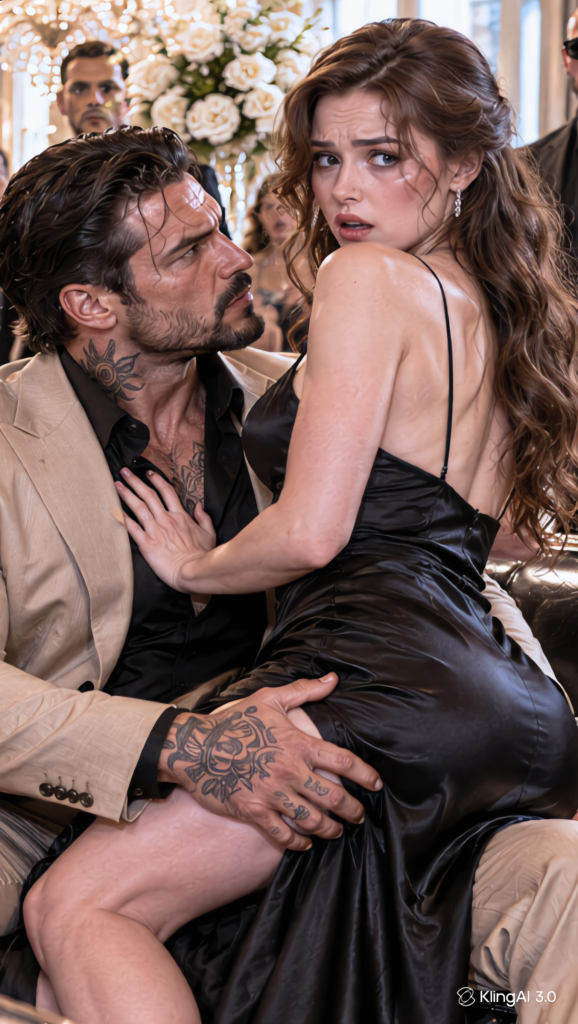
Vale reached the booth. His bodyguards stepped aside. He sat in the center of the leather, and before Mara understood what was happening, he pulled.
She fell sideways onto his lap.
A collective gasp rippled through the ballroom and froze. Mara went rigid. Her hip pressed against the hard muscle of his thigh; his left arm settled around her waist, heavy and immovable, his palm flat against her side. It was not tender. It was not cruel. It was a declaration, written in the only language this room understood.
Vale did not look at her. He looked at the three hundred faces staring back at him.
“The painting is withdrawn,” he said. His voice was quiet and carried everywhere. “Senator, my apologies. You’ll receive something genuine by the end of the week.”
He paused.
“Walter Ellison’s debt is settled.”
A ripple of shock. Mara’s breath caught.
“His daughter has paid it.” Vale’s fingers tightened, just slightly, at her waist. “As of tonight, Miss Ellison works for me. Anyone who touches her, or her father, answers to me personally.” His gaze moved slowly across the room. “Is that understood?”
A ragged chorus of yes, Mr. Vale rose and fell.
Only then did he look down at her. His face was inches from hers, and for the first time something moved in those winter-river eyes, something dark and unreadable and terribly, terribly focused.
“You told the truth to save him,” Lucien Vale murmured, for her ears alone. “Let’s find out what else you’re willing to tell me.”
He leaned closer.
“Because someone in this room sold me that forgery, Miss Ellison. And it wasn’t your father.”
PART 2: Provenance
The car came for her at seven the next morning.
Mara had not slept. She had driven her father to his apartment in a silence so dense neither of them could breathe through it, watched him pour a whiskey with hands that couldn’t hold the glass, and finally sat on the edge of his bathtub while he wept and apologized and told her everything. Antwerp. A dealer named Kessler. A commission in 2009 for a “decorative copy” that paid more than Walter had earned in three years of honest restoration.
“I never sold it as real,” he’d said. “I swear to you. Kessler said it was for a film set.”
By dawn, Mara believed him. Which meant Lucien Vale was right. Somewhere between a film set and a charity auction, someone had turned a copy into a crime.
The black sedan took her not to a warehouse or a back room but to a converted textile mill in Brooklyn, all brick and steel and enormous arched windows. Vale Holdings, the discreet plaque read. Inside, it looked like a private museum. White walls. Climate-controlled galleries. Paintings, hundreds of them, hung with the reverence of a cathedral.
Vale was waiting for her on the top floor, in a studio flooded with northern light. He wore a gray sweater with the sleeves pushed up, revealing forearms ridged with faded scars. He was holding a magnifying loupe. On the easel in front of him stood the forgery.
“Come here,” he said, without turning.
She did.
“Show me,” he said. “The hook.”
Mara took the loupe from his hand. Their fingers brushed; she ignored the jolt it sent up her arm. She bent close to the canvas and pointed to the lower left corner, the small curling flick at the end of the letter’s fold.
“There. He does it on every fold. He can’t help it. It’s like a tic.”
Vale leaned in beside her, close enough that she could feel the warmth of his shoulder through her blouse. He studied the stroke for a long time.
“I’ve owned this painting for six years,” he said finally. “Bought it through a broker I trusted. Authenticated by an expert I trusted more.” He straightened. “Both of them are on my payroll. Both of them are still alive. I’d like you to tell me which one of them I should change that for.”
Mara set down the loupe very carefully.
“I’m an appraiser,” she said. “Not an executioner.”
“You’re whatever I need you to be.” His tone was not unkind. It was simply factual, the way gravity is factual. “Last night you were brave in front of three hundred people. Don’t become a coward in front of one.”
He handed her a key card and a folder. Inside the folder was a list: sixty-three works of art, their purchase dates, their sellers, their authenticators.
“Every piece I bought through the same channel,” he said. “Check them all. You’ll work here. Your father’s safety is guaranteed for as long as you do.”
“And when I’m finished?”
Vale looked at her for a long, measuring moment.
“Then we’ll discuss what you’re worth,” he said, and left her alone with the light.
She worked for nineteen days.
The routine became its own kind of captivity. The car at seven. The silent driver, a giant named Teo who never spoke more than three words at a time. The studio, the loupe, the ultraviolet lamp, the endless provenance records. Vale appeared at irregular intervals, sometimes for minutes, sometimes for hours, sitting in a leather chair in the corner of the studio with his own work, a laptop, a phone that never stopped vibrating, saying nothing at all.
He watched her. She felt it like sunlight on the back of her neck.
At first she hated it. Then, slowly and against every instinct she possessed, she stopped hating it. There was something strangely steadying in his presence. He never hovered. He never threatened. When she found something, he listened with complete, unblinking attention, asking questions so precise they cut straight to the bone of the problem. He was, she realized with a jolt somewhere in the second week, the most intelligent man she had ever spoken to.
That was the most dangerous thing about him.
By day eleven, she had found three more forgeries. By day fifteen, seven. None by her father’s hand; these were rougher, quicker, the work of a factory rather than an artist. But they shared something more damning than brushwork. Every single one had been authenticated by the same expert: Dr. Anselm Reyes, a soft-spoken, silver-haired scholar who had written two books on Dutch Golden Age portraiture and who, Mara learned from the records, had been Lucien Vale’s personal art advisor for eleven years.
And every single one had been sold to Vale through the same broker.
Gideon Marsh.
She knew the name. Everyone in the art world knew it. And on the night of the auction, she had seen the face that went with it: a lean, elegant man at Vale’s own table, sitting at his right hand, the only person in the ballroom who had dared to laugh when Mara called the painting a fake.
On the nineteenth night, it was raining.
The mill was nearly empty. Mara sat at the long worktable under a single pool of lamplight, surrounded by photographs, invoices, and ultraviolet scans, building the final page of her report. Her coffee had gone cold hours ago. Her eyes burned.
The numbers didn’t just show a fraud. They showed a structure. Marsh had sold Vale nine forgeries over six years, totaling just over thirty-one million dollars. Reyes had signed every certificate. The originals, Mara was almost certain, had never existed in the market at all. The money had flowed out through a shell company in Luxembourg, then back into a gallery in Geneva that listed Gideon Marsh as a silent partner.
Six years. Thirty-one million dollars. Right under the nose of a man who was supposed to see everything.
Mara stared at the final page and felt sick.
Because she knew what would happen when she handed it over.
“You’ve stopped working.”
She flinched. Vale stood in the doorway, his coat dark with rain, his hair wet. She hadn’t heard the elevator.
“I’ve finished,” she said.
He crossed the room slowly and stopped beside her chair. He did not reach for the report. He looked at her face instead.
“Tell me.”
“If I tell you,” Mara said quietly, “what happens to them?”
“You already know the answer to that.”
“Then I don’t want to tell you.”
The silence that followed was very long. Rain drummed against the arched windows. Vale pulled out the chair beside her and sat, close enough that his knee nearly touched hers.
“You think,” he said, “that if you hand me a piece of paper, you become a murderer.”
“Don’t I?”
“No.” His voice was low. “You become a witness. What I do with the truth is mine. I’ve carried worse than this, Mara. I’ll carry it alone.”
It was the first time he had used her first name. It landed in her chest like a struck bell.
“Why does it matter to you?” she whispered. “What I think of it. You could have taken the report off this table any night this week. You could have had Teo take it.”
Vale was quiet for a long moment. When he spoke, he did not look at her. He looked at the forgery on the easel across the studio.
“Because every person in my life tells me what keeps them safe,” he said. “Marsh told me what kept him rich. Reyes told me what kept him comfortable. Your father told everyone whatever kept him painting. You’re the first person in twenty years who stood in front of me and told me something that could have gotten you killed. Simply because it was true.”
He turned to her then, and his gray eyes were not cold at all.
“I’m not going to waste that on a man like Gideon Marsh.”
Mara’s breath caught. Slowly, she slid the report across the table.
“Marsh and Reyes,” she said. “Together. Six years. Thirty-one million.”
Vale read it in silence. His face did not change. But she watched the muscle in his jaw lock and hold, and she understood, in that moment, exactly how much self-control it cost him to sit still.
He closed the folder.
“Thank you,” he said.
He stood, and on his way past her chair, his hand rested, briefly, against the back of her neck. Warm. Heavy. Gone almost before she could feel it.
“Teo will take you home. Don’t come in tomorrow.”
She didn’t go home.
She told Teo she’d forgotten her phone, rode the freight elevator back up, and found the studio dark. Through the rain-streaked windows she saw headlights pulling out of the lot below. Vale’s car.
Mara stood in the darkness and told herself to leave. She had done what she was bought to do. Her father was safe. Whatever happened next was none of her business.
Then she heard the floor creak behind her.
She turned. A figure stood between the easels, silhouetted against the gray window light. Tall. Lean. Elegant even in the dark.
“Miss Ellison,” said Gideon Marsh pleasantly. “Working late.”
Every hair on Mara’s body rose.
“Mr. Vale just left,” she said, and hated how thin her voice sounded.
“I know. I watched him go.” Marsh stepped into a slant of light. He was smiling. In his right hand, held loosely at his side, was a small black pistol. “He’s on his way to my apartment, I imagine. With some of his more enthusiastic friends. Unfortunately, I’m not there.”
“How did you…”
“Reyes,” Marsh said. “Poor Anselm called me in tears an hour ago. Apparently someone in the building owes me a favor and let him know you’d been asking about Luxembourg.” He tilted his head, studying her with mild, academic curiosity. “Nineteen days. It took you nineteen days to see what Lucien couldn’t see in six years. I admire that. I truly do.”
He raised the pistol.
“Now, you’re going to call him. And you’re going to tell him to come back here. Alone.”
PART 3: The Ledger Closed
Mara’s hands were shaking so badly she nearly dropped the phone.
“Speaker,” Marsh said, settling into Vale’s leather chair in the corner as though he owned it. The pistol rested on his knee, aimed at her stomach. “And Miss Ellison? If you say anything clever, I’ll know.”
The line rang twice.
“Mara.” Vale’s voice, sharp. “Why aren’t you home?”
She looked at Marsh. She looked at the forgery on the easel, the pearl-gray collar glowing faintly in the dark. Her father’s hook in the corner. A lie that had nearly killed everyone she loved.
She was so tired of lies.
“Gideon Marsh is in the studio,” she said clearly. “He has a gun. He wants you to come back alone. Don’t.”
Marsh was on his feet before she finished. The slap snapped her head sideways and sent the phone skittering across the concrete floor. She tasted copper.
“That,” Marsh said softly, “was very stupid.”
From the phone on the floor, Vale’s voice came through the speaker. It was not loud. It was something far worse than loud.
“Gideon. If you touch her again, I will make you understand that there are worse things than dying.”
Then the line went dead.
Marsh laughed, but there was something brittle in it now. He grabbed Mara by the arm and hauled her toward the windows, putting her between himself and the door. “Well. I suppose we’ll find out whether he comes alone after all.”
They waited.
Mara counted her heartbeats. One hundred. Two hundred. The rain softened. Somewhere below, a door opened and closed. Marsh’s grip tightened on her arm until she felt the bruises forming.
The elevator chimed.
The doors slid open on an empty car.
Marsh swung the pistol toward it, and in that half-second, every light in the studio went out at once.
Darkness. Total and absolute. Mara heard Marsh swear, felt his grip jerk, and then there was a sound she would hear in her dreams for years: the soft, swift scuff of someone moving through the dark as though it were daylight.
A gunshot. Deafening. A spray of glass from somewhere high above.
Then the brutal, wet crack of bone meeting concrete, and Marsh’s hand was gone from her arm.
The emergency lights flickered on, dim and red.
Lucien Vale stood over Gideon Marsh’s crumpled body, the pistol in his own hand now, its slide locked back. Marsh was alive, moaning, his wrist bent at an angle that made Mara’s stomach turn. Vale did not look at him.
He looked at her.
He crossed the studio in four strides. His hands came up to her face and stopped an inch away, hovering, as if he were afraid that touching her might break something. His eyes moved over her: the red mark on her cheek, the blood at the corner of her mouth, the bruises already rising on her arm.
“He hit you,” Vale said. His voice was barely human.
“I’m all right.”
“He hit you.”
“Lucien.” She caught his wrists. She had never said his name aloud before. It stopped him like a wall. “I’m all right. I’m here.”
Something cracked open in his face then, something she had never seen there and suspected no one had seen in a very long time. He pulled her against his chest and held her there, one hand cradling the back of her head, his heart hammering against her cheek like something trying to escape.
“You told me not to come,” he said into her hair.
“You came anyway.”
“Of course I came.” He drew back just enough to look at her. “You stood in front of a man with a gun and told the truth. Again. Do you have any idea what that does to me?”
Behind them, Teo and two other men had emerged from the stairwell. They lifted Marsh from the floor without a word.
“Wait,” Mara said.
Everyone stopped.
She looked at Marsh, bleeding and gray-faced, and then at Vale.
“Don’t kill him.”
Vale’s jaw tightened. “Mara.”
“He stole thirty-one million dollars through a shell company in Luxembourg and a gallery in Geneva. I have every transaction.” Her voice was shaking, but she made it hold. “Dead, he’s worth nothing. Alive, he signs every asset back to you, testifies against Reyes, and spends the next twenty years in a federal prison for fraud you can document without ever touching a weapon. Everyone will know he robbed you. Everyone will know he paid for it. And no one will ever know you needed blood to do it.”
The red emergency lights hummed in the silence.
Vale stared at her for a long time. Then, slowly, something that might almost have been a smile touched the corner of his mouth.
“Teo,” he said without looking away from her. “Call our friends at the U.S. Attorney’s office. Tell them I have a gift.”
Three weeks later, the forgery hung alone in an empty gallery on the ground floor of the mill.
Mara stood in front of it in the late-afternoon light. Gideon Marsh had pleaded guilty that morning. Reyes had fled to Lisbon and been arrested at the airport. The thirty-one million dollars was already coming home, piece by piece, through channels clean enough to survive any audit.
Her father had sent her a letter from Vermont, where he was teaching restoration at a small college under his own name for the first time in twenty years. I’m painting only what’s real now, he had written. Turns out it’s harder. Turns out it’s better.
She heard Vale’s footsteps behind her and did not turn.
“You could have sold it,” she said. “As a decorative copy. You’d get a decent price.”
“I don’t want a decent price.” He stopped beside her, close enough that his sleeve brushed hers. “I want to remember the night someone told me the truth.”
Mara looked at the hook in the lower left corner.
“My debt’s paid,” she said quietly. “My father’s safe. Marsh is gone. There’s nothing left for me to authenticate.” She swallowed. “So I suppose this is the part where we discuss what I’m worth.”
Vale was silent for so long she finally turned to look at him.
He was not looking at the painting. He was looking at her the way she looked at a masterpiece: slowly, completely, as though he were memorizing every line.
“I’ve spent my whole life surrounded by beautiful things that turned out to be lies,” he said. “You’re the only thing I’ve ever found that’s real.”
He took her hand. Not a grip this time, not a claim. An offer.
“Stay,” Lucien Vale said. “Not because you owe me. Because you want to.”
Mara looked at the forgery, the beautiful, worthless lie that had brought her here. Then she looked at the man beside her, dangerous and scarred and, against every rule she had ever lived by, utterly genuine.
She had spent her whole life asking one question.
For the first time, she already knew the answer.
“Yes,” she said, and laced her fingers through his.
Is this real?
It was.
THE END


