But when the Japanese submarines arrived at French…
But when the Japanese submarines arrived at French Frigate Shoals in late May, they raised their periscopes and found an astonishing sight.
The shoals were not empty.
Two American seaplane tenders were casually riding at anchor, conducting routine operations exactly where the Japanese intended to surface.
Denied their refueling point, the Japanese submarines were forced to remain submerged and cancel Operation K entirely.
Because of the strict radio silence, Yamamoto, sailing far to the west on the Yamato, was never explicitly informed that the critical reconnaissance flight over Pearl Harbor had failed.
He simply assumed no news was good news.
The second, even more catastrophic intelligence failure occurred beneath the waves.
To ensure they had advanced warning if the American fleet finally decided to leave Hawaii, the Japanese deployed a sophisticated picket line of submarines designated the advanced expeditionary force.
This cordon of steel predators was ordered to form a tripwire across the central Pacific between Hawaii and Midway.
If Nimitz deployed his ships, they would have to sail directly over this submarine line, instantly triggering a warning to Yamamoto’s approaching armada.
According to Yamamoto’s meticulous timetable, the submarine cordon was required to be on station and fully operational by June 1st.
However, due to severe logistical delays, mechanical issues, and a fundamental lack of urgency driven by the belief that the Americans would not move for days, the Japanese submarines did not arrive at their designated patrol coordinates until June 3rd.
It was a fatal delay.
Raymond Spruance and Frank Jack Fletcher, sailing in total silence, had already passed through the exact coordinates of the submarine tripwire on May 29th and May 31st.
They had slipped through an open door before the guards even arrived to lock it.
When the Japanese submarines finally raised their periscopes on June 3rd and scanned the horizon, they saw nothing but empty ocean.
They duly reported that there was no sign of American movement.
In the wardrooms of the Japanese carriers, officers drank sake and confidently finalized their strike packages.
They were operating in an echo chamber of their own design, continually reinforcing their own illusions.
They firmly believed that the Yorktown was a shattered wreck rusting at the bottom of the Coral Sea.
They firmly believed that the Enterprise and the Hornet were safely anchored in Pearl Harbor, thousands of miles out of the tactical equation.
They believed that when their aircraft launched the next morning to bombard the tiny garrison at Midway, they would face only a handful of obsolete land-based fighters.
The dramatic irony was absolute.
The Imperial Japanese Navy, arguably the most powerful maritime force ever assembled, was casually steaming eastward, fully preparing to execute a land strike against an undefended target.
They were sailing directly into the crosshairs of three fully operational American aircraft carriers, waiting in total silence at a coordinate they could not possibly predict, commanded by an icy tactician who is waiting for the exact moment they lowered their guard.
The Japanese armada was steaming forward under the illusion of total control, but their meticulously crafted machine was about to fracture under its own weight.
Before the sun even crests the horizon on the morning of June 4th, 1942, that fractured intelligence picture directly dictates Vice Admiral Chuichi Nagumo’s tactical decisions on the bridge of the flagship Akagi.
Positioned roughly 240 mi northwest of the atoll, Nagumo orders the commencement of Operation MI’s primary tactical phase.
At 4:30 am, the Japanese flight decks roar to life.
He commits a massive first wave of 108 Kate bombers, Val dive bombers, and Zero fighters to obliterate the Midway garrison.
Because the strategic tripwires had failed to warn him of any American naval presence, Nagumo approaches this launch not as a cautious fleet commander in hostile waters, but as a man conducting a routine firing exercise.
His aircraft are armed strictly for a land assault, loaded with general-purpose fragmentation and high explosive bombs, completely unsuited for penetrating the armored decks of warships.
But the most catastrophic consequence of Japan’s systemic overconfidence manifests in Nagumo’s reconnaissance plan.
Traditional naval doctrine demands a dense overlapping screen of scout planes to ensure the carriers are not flanked.
However, believing the United States Pacific Fleet is moored safely in Hawaii, Nagumo treats the morning search as a tedious administrative formality.
He assigns a skeletal force of just seven float planes to search a vast million square mile semicircle of ocean.
It is a terrifyingly thin safety net for an armada of this value.
Then, the rigid complexity of the Japanese master plan suffers a fatal mechanical breakdown.
The specific reconnaissance plane assigned to search sector number four, the exact vector that points directly toward the American ambush at Point Luck, belongs to the heavy cruiser Tone.
As the Japanese air crews race to execute their coordinated launch, the cruiser’s steam catapult jams.
For a grueling 30 minutes, mechanics frantically hammer at the catapult machinery while the rest of the search pattern flies away.
When the Tone’s scout finally clears the deck and banks eastward, it is a half hour behind schedule.
In the unforgiving mathematics of naval aviation, 30 minutes of distance is an eternity.
Blind to this widening fatal gap in his outer defenses, Nagumo watches his first wave vanish into the pre-dawn clouds toward Midway.
He feels completely secure holding the remaining half of his aircraft in reserve on the hangar decks, waiting for Yamamoto’s anticipated American reaction days from now.
He has no idea that the reaction has already happened.
Just over the horizon, precisely in the blind spot created by the delayed scout plane, Raymond Spruance and Frank Jack Fletcher are already awake.
Their own flight decks buzzing with lethal, silent intent.
The Japanese vanguard has willingly walked into a meticulously calculated kill zone, stripping away its own situational awareness at the exact moment it needed it most.
The American trap is now fully set and locked in place.
But a flawless ambush means nothing until the steel jaws actually snap shut.
The decisive, annihilating blow still requires the Japanese high command to wake up and realize exactly how completely they have been outplayed.
At 7:28 am, the radio room aboard the flagship Akagi intercepts a frantic transmission that violently shatters the Japanese illusion.
It comes from the scout plane of the heavy cruiser Tone, the exact aircraft that had launched 30 minutes late due to a jammed catapult.
The pilot reports sighting 10 enemy ships bearing down on the Japanese flank.
On the bridge, Admiral Nagumo is paralyzed.
The message contradicts every piece of intelligence he has been fed by Tokyo.
The American fleet is supposed to be thousands of miles away in Hawaii.
Now an enemy task force is practically in his backyard, occupying the exact blind spot he failed to search at dawn.
Nagumo is instantly caught in a nightmare of naval logistics.
Deep inside the enclosed hangar decks of his four carriers, his reserve strike force of Kate torpedo bombers and Val dive bombers sits fully fueled and armed with high explosive land bombs, prepared for a second run over Midway.
You cannot sink an American warship with a land bomb.
It will merely shatter on the armored deck.
To destroy the newly discovered naval threat, Nagumo must equip his planes with armor-piercing bombs and type 91 aerial torpedoes.
At 7:45 am, Nagumo issues an order that will ultimately seal the fate of the Imperial Japanese Navy.
He commands his crews to strip the land bombs from the reserve aircraft and rearm them for a fleet engagement.
Down in the claustrophobic hangar decks, absolute chaos erupts.
Rearming a carrier strike force is a meticulous, hours-long process requiring heavy winches and strict safety protocols.
The Japanese mechanics have minutes.
Hundreds of men frantically wrestle 1,700 lb torpedoes onto hydraulic carts, muscle them under the bellies of the aircraft, and desperately bolt them into the racks.
Because there is no time to return the discarded high-explosive bombs to the heavily armored lower magazines, the mechanics simply shove them against the bulkheads.
The unventilated hangar decks are instantly transformed into a labyrinth of unexploded ordinance, snaking fuel hoses, and volatile pools of high-octane aviation gas.
At 8:09 am, the Tone scout delivers a second terrifying update.
The enemy formation appears to include an aircraft carrier.
The trap is real, but Nagumo cannot launch.
His first wave is returning from Midway, their fuel tanks nearly empty, desperately needing to land.
If he brings his reserve strike force up to the flight deck, his returning pilots will be forced to ditch in the ocean.
Frozen by conflicting priorities, Nagumo makes a fatal compromise.
He orders the flight decks cleared to recover the Midway strike, keeping his heavily armed, fueled reserve planes trapped below in the hangars.
Miles away, Raymond Spruance is unburdened by hesitation.
He does not wait to form up a perfectly coordinated strike package, calculating the distance, the wind, and the exact turnaround time of the Japanese aircraft, Spruance hurls his squadrons into the sky early, aiming them precisely at the mathematical window of Nagumo’s maximum vulnerability.
By 10:20 am, the Japanese carriers are locked in a frantic turnaround.
The flight decks of the Akagi, Kaga, and Soryu are crowded with refueling aircraft and exposed munitions.
The Japanese combat air patrol, swarms of agile Zero fighters, has been drawn down to the surface of the ocean, exhausted [clears throat] by fending off uncoordinated suicidal attacks from American torpedo squadrons over the previous hour.
The sky high above the Japanese fleet is completely empty.
At 10:22 am, falling out of the high-altitude clouds directly above the Japanese armada, two squadrons of American Dauntless dive bombers arrive.
They push their noses down into a near-vertical 70° dive, plunging toward the pristine wooden decks below.
The scream of wind rushing through their perforated dive flaps drowns out the chaotic noise on the Japanese ships.
The American pilots are not dropping their payloads against armored, defended warships.
They’re dropping them onto floating powder kegs.
At 10:26 am, a 1,000-lb bomb smashes through the flight deck of the Akagi and detonates directly inside the enclosed hangar.
The explosion vaporizes the fueled aircraft and instantly ignites the discarded land bombs stacked against the bulkheads.
A chain reaction of sympathetic detonations rips through the ship.
Simultaneous strikes tear into the Kaga and the Soryu.
In the span of exactly 5 minutes, the intricate, unstoppable juggernaut of the Japanese offensive ceases to exist.
Three of the most powerful aircraft carriers in the world are transformed into burning, uncontrollable infernos.
The pride of the Imperial fleet is erased in a matter of minutes, not by overwhelming American numbers, but by cold, calculated timing.
In the span of a single, brutal morning, Isoroku Yamamoto’s impossibly intricate, invincible trap was completely inverted.
The vast stretch of ocean that the Japanese high command had confidently designated as the final graveyard for the United States Pacific fleet had instead swallowed the elite core of their own aviation vanguard.
The burning wrecks of the Kido Butai, slipping beneath the waves of the Central Pacific, represented far more than just the loss of heavy steel and veteran pilots.
They marked the catastrophic collapse of an Imperial illusion.
History would often romanticize the Battle of Midway as an incredible miracle of chance, a fortunate convergence of delayed scout planes, scattered fighter screens, and perfectly timed dive bombers falling from the clouds.
But to view the American victory as merely a stroke of profound luck fundamentally misreads the architecture of the engagement.
The destruction of the Japanese carrier force was not a random accident.
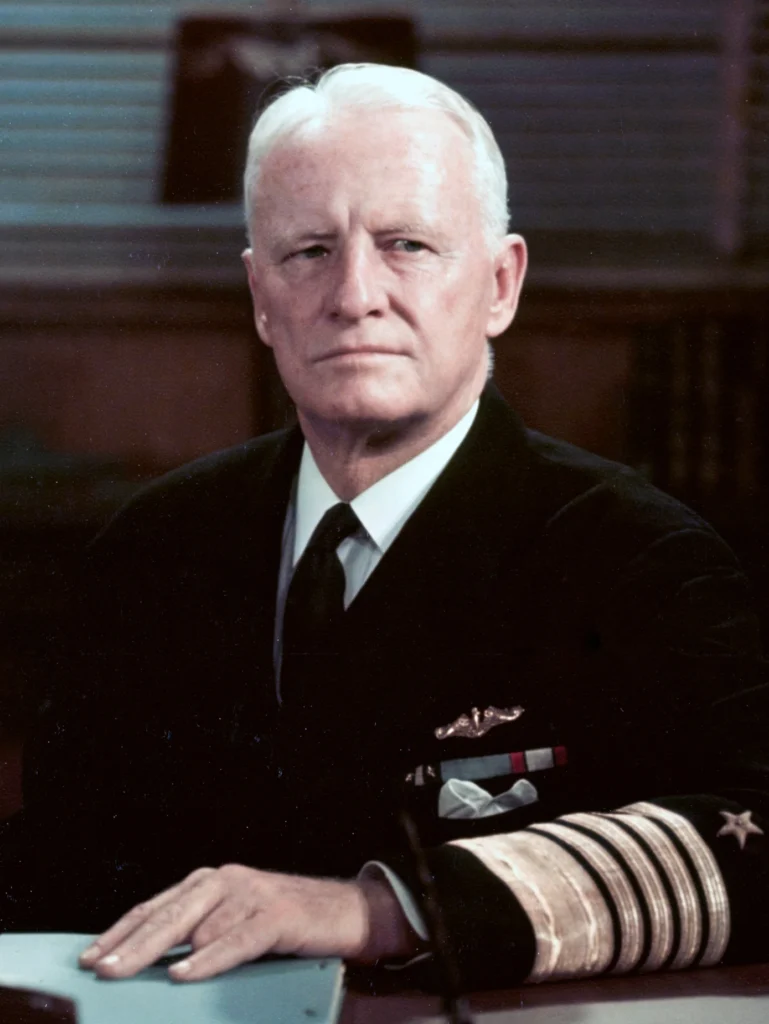
It was the brutal, logical conclusion of a psychological trap deliberately engineered by Chester Nimitz.
Nimitz did not win the battle through a sudden superiority in ships or firepower.
He won because he correctly identified that Yamamoto’s greatest strategic vulnerability was his rigid arrogance.
The Japanese Admiralty had become intoxicated by their own unbroken string of victories, convinced of their inherent superiority and the inevitable passivity of their enemy.
Nimitz took that inflexible certainty and weaponized it.
He recognized that Yamamoto had constructed a military machine so vastly complicated, so utterly dependent on absolute secrecy and flawless synchronization that it could not survive contact with an adversary who already possessed its operational blueprints.
By consciously feeding Tokyo the exact illusions it expected to see and by placing a cold analytical mind like Raymond Spruance precisely in the blind spot of the enemy’s advance, Nimitz allowed the immense weight of the Japanese offensive to crush itself.
The Japanese commanders, isolated by their own strict radio silence and blinded by the absolute assumption of total control, actively facilitated their own annihilation.
Down in the chaotic, crowded hangar decks of their flagships, the strategic landscape of the Second World War permanently fractured in those five devastating minutes.
The balance of naval power in the Pacific, heavily tilted toward Tokyo since the fires of Pearl Harbor, violently snapped back into equilibrium.
The grand, sweeping strategic design that Yamamoto had meticulously drafted to secure the ocean forever ended up achieving the exact opposite.
It became the very mechanism that buried the fleet that created it.
The Imperial Japanese Navy had sailed across the vast expanse of the Pacific under a cloak of absolute radio silence, completely convinced they were executing the most flawlessly orchestrated ambush in the history of naval warfare.
They brought heavy fleet carriers, a vanguard of elite aviators, and an impenetrable curtain of overconfidence, anticipating the easy slaughter of a blind, helpless American fleet.
Instead, they steamed directly into the crosshairs of a commander who had read their code, hijacked their intricate script, and calmly waited in the shadows for the exact millisecond to strike.
Admiral Isoroku Yamamoto arrived at Midway Atoll fully expecting to snap the jaws of an inescapable trap shut on the final remnants of the United States Navy.
It was only as his burning flagships slipped forever beneath the cold swells of the central Pacific that the Japanese high command finally understood the terrifying truth.
The perfect trap had been set for them all along.


