…
In late May 1942, the physical reality of the United States Pacific Fleet was incredibly grim.
Nimitz had the USS Enterprise and the USS Hornet, both returning exhausted from the South Pacific following the Doolittle Raid.
He needed a minimum of three carriers to stand even a marginal chance against the four heavy fleet carriers of the Japanese vanguard.
His only other option was the USS Yorktown and by all conventional naval metrics, the Yorktown was a lost cause.
During the Battle of the Coral Sea earlier that May, the Yorktown had absorbed severe punishment.
An 800-lb Japanese armor-piercing bomb had punched straight through her wooden flight deck, penetrating deep into the bowels of the ship before detonating in the aviation stores.
The explosion had severed vital communication lines, warped the ship’s internal steel bulkheads, and ruptured her hull.
For weeks, the carrier had limped across the Pacific Ocean, bleeding a heavy iridescent trail of black bunker oil for hundreds of miles, struggling simply to stay afloat.
When the colossal, battered warship finally groaned into the channel at Pearl Harbor on May 27th, she was a terrifying sight.
Her superstructure was scorched, her compartments reeked of incinerated wire and stagnant seawater, and her crew was exhausted.
Navy Yard engineers immediately swarmed the vessel as she was meticulously maneuvered into drydock number one.
Following a rapid, sobering assessment of the twisted structural steel and the flooded compartments below the waterline, the chief engineers delivered their verdict to the Pacific Fleet Command.
To properly repair the structural integrity of the USS Yorktown, she would need to be sailed to a fully equipped shipyard on the American West Coast.
The estimated time to return her to combat readiness was 90 days.
Chester Nimitz did not have 90 days.
He had roughly 72 hours before his fleet had to sail to intercept the Japanese offensive.
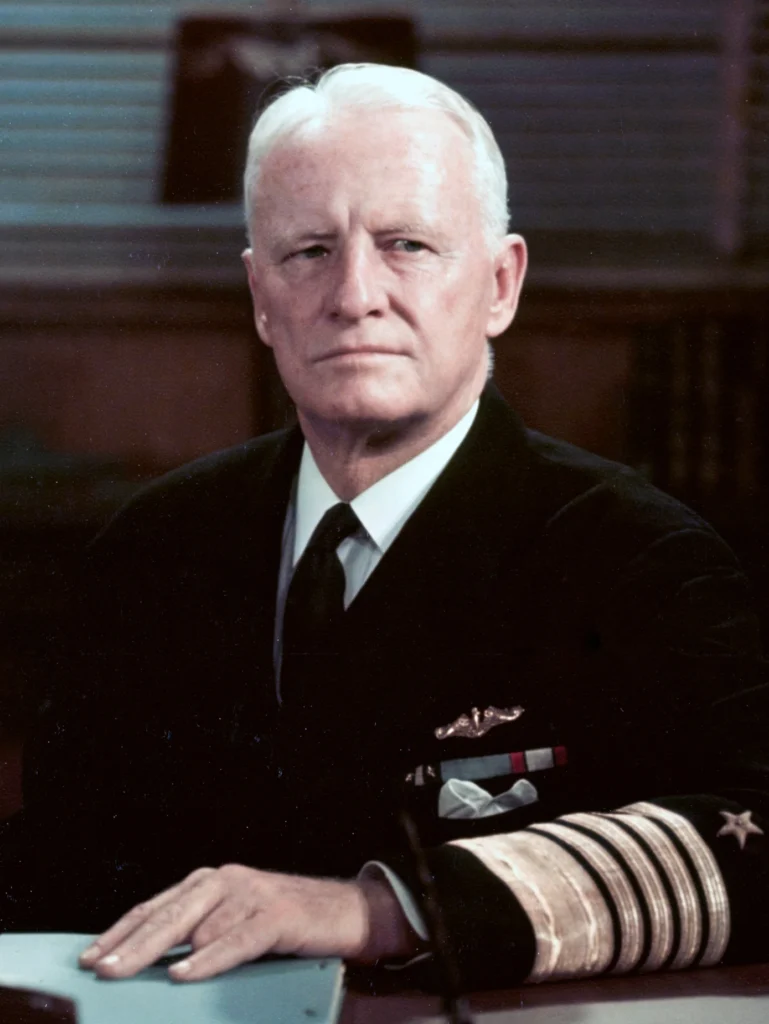
In a moment that defined his pragmatic, uncompromising leadership, Nimmits personally descended into the dry dock.
Wearing high rubber waders, the admiral walked through the ankle deep muck of sea water, oil, and debris beneath the massive keel of the carrier, inspecting the gaping jagged wounds in the ship’s hull for himself.
He looked at the engineers and delivered an impossible directive.
“We must have this ship back in 3 days”.
What followed was one of the most astonishing feats of industrial mobilization and pure brute force labor in military history.
The strict, rigid protocols of naval engineering were instantly abandoned.
To meet Nimmits’ deadline, the Pearl Harbor Navy Yard threw over 1,400 civilian contractors, mechanics, shipwrights, and electricians at the broken carrier.
They worked in suffocating 120° heat inside the unventilated lower decks, standing in knee-deep toxic sludge.
There was no time to draft proper blueprints or wait for custom machined replacement parts.
Platers simply cut massive sheets of raw steel and welded them directly over the gaping holes in the hull.
To power the hundreds of arc welders required to fuse the steel, the city of Honolulu implemented rolling power diversions, plunging civilian neighborhoods into darkness so the electricity could be funneled directly into dry dock number one.
Through the humid Hawaiian nights, the dry dock was illuminated by a blinding, continuous storm of blue electrical flashes.
The noise of pneumatic hammers and grinding steel was deafening, echoing across the harbor in a relentless industrial symphony.
The The workers operated in grueling continuous shifts, fueled by adrenaline, black coffee, and the terrifying knowledge that the survival of the Pacific Fleet depended on their welding seams.
They bypassed shattered watertight doors, patched the fractured flight deck with heavy wooden planks, and rewired the severed lighting circuits by hand.
On the morning of May 30th, just 3 days after she had arrived as a crippled, leaking wreck, the dry dock was flooded.
The USS Yorktown rose with the tide.
She was far from perfect.
Her internal compartments were still scorched, her watertight integrity was highly questionable, and her boilers were fragile, but her flight deck was flat, her elevators functioned, and she could launch and recover aircraft.
As the massive ship cast off her mooring lines and began to slide past the anti-submarine nets of Pearl Harbor, she carried an unprecedented passenger list.
Hundreds of civilian yard workers were still aboard, their acetylene torches flaring in the hangar deck, continuing to weld bulkheads and splice wires as the carrier steamed out into the open ocean.
Through sheer industrial willpower, Nimitz had conjured a third flight deck, turning a ghost ship into the vital cornerstone of his ambush.
But possessing three aircraft carriers was only half the equation.
The far more critical variable was the man who would command them in the impending crucible.
The American tactical command structure was suddenly facing a catastrophic leadership vacuum.
Vice Admiral William Bull Halsey, the aggressive, deeply beloved commander of Task Force 16, had returned to Pearl Harbor in a state of severe physical collapse.
The stress of the early war months had triggered an extreme, debilitating outbreak of severe dermatitis, commonly described as shingles.
Halsey had lost 20 lbs, was incapable of sleeping, and was scratching his own skin raw.
The medical officers gave Nimitz no choice.
Halsey was immediately relieved of command and ordered into the naval hospital.
The loss of Halsey on the eve of the most critical battle of the war was a profound psychological blow.
Halsey was the quintessential carrier commander, a fighter, a risk-taker, an officer who possessed the instinctual aggression required to hurl expensive warships into the teeth of the enemy.
With Halsey incapacitated, the naval aviation community fully expected Nimitz to appoint another seasoned aviator, an officer with gold wings pinned to his chest who intuitively understood the complex geometry of carrier warfare.
Instead, Nimitz made one of the most controversial, unorthodox, and brilliant command decisions of the Second World War.
Based on a strong recommendation from the hospitalized Halsey, Nimitz bypassed a roster of senior aviation admirals and handed command of Task Force 16, comprising the Enterprise and the Hornet, to Rear Admiral Raymond Spruance.
The decision sent shockwaves through the Pacific Fleet Command.
Spruance was a black-shoe admiral, a term denoting an officer whose entire career had been spent commanding traditional surface ships, cruisers, and destroyers.
He was not a pilot.
He had never commanded a carrier task force in combat.
To the seasoned aviators, handing the vanguard of the American defense to a cruiser captain on the eve of an apocalyptic carrier duel bordered on institutional madness.
But Nimitz was looking far beyond the gold wings on a uniform.
He was looking at the precise psychological profile of the enemy.
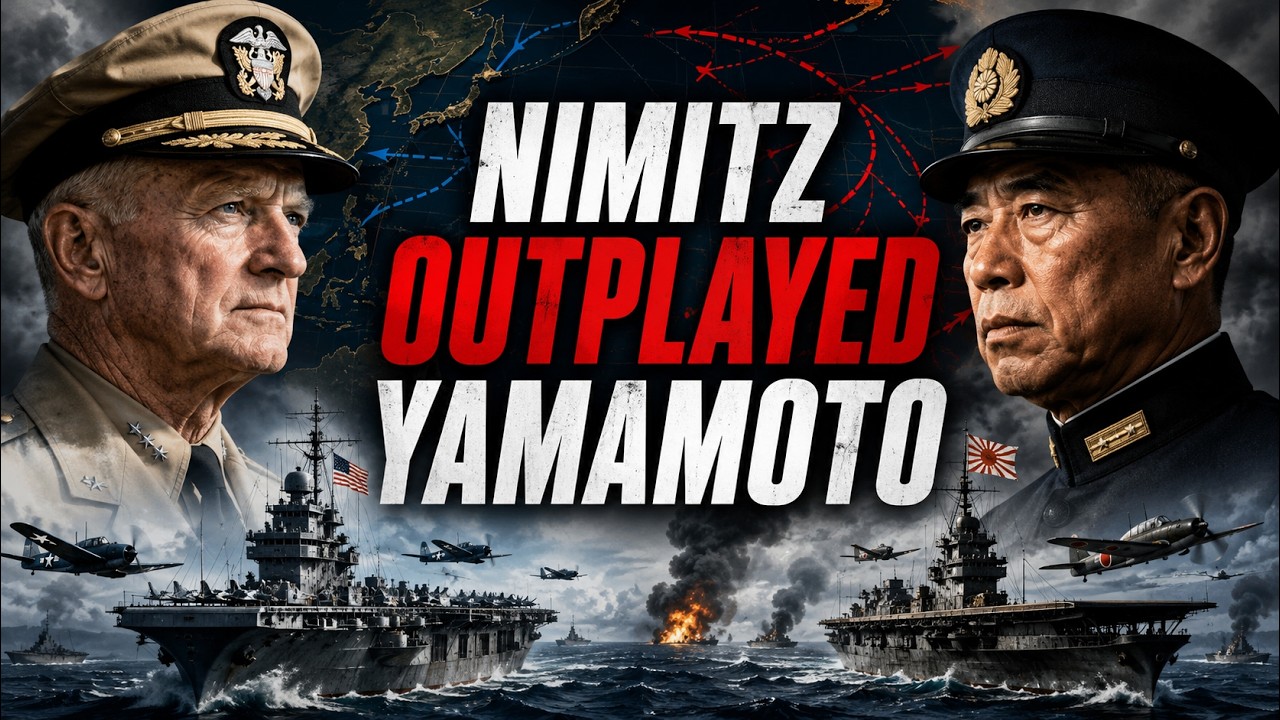
Yamamoto’s incredibly complex Operation M-1 was built entirely on the premise of baiting the Americans into a trap.
The Japanese admiral wanted to face a hot-headed aggressive opponent.
He wanted a commander who would see the Japanese carriers succumb to the red mist of battle and charge forward recklessly right into the waiting guns of the hidden Japanese battleship fleet.
If Halsey had been on the bridge, his inherent aggression might have driven him to take exactly the bait Yamamoto was dangling.
Raymond Spruance was the absolute antithesis of a reckless fighter.
He was an ascetic, cold, deeply analytical thinker.
Spruance shunned the spotlight, detested loud displays of ego, and lived a spartan lifestyle, drinking only coffee and walking miles every day to maintain his physical discipline.
He processed tactical information without a trace of emotion, viewing naval warfare not as a glorious duel of honor, but as an unforgiving mathematical equation of distance, payload, and vulnerability.
Spruance possessed a terrifying ability to remain perfectly calm under immense psychological pressure.
He would not be baited.
He would not charge blindly into the fog.
Spruance would hold his forces in the shadows, calculate the precise millisecond of maximum Japanese vulnerability, and strike with absolute surgical lethality.
By selecting a man utterly devoid of ego, Nimitz had chosen the perfect psychological weapon to dismantle Yamamoto’s arrogant trap.
With the ships repaired and the commanders in place, the American deployment began in absolute secrecy.
Task Force 16, under the cold command of Spruance, and Task Force 17, centered on the resurrected Yorktown, under the command of Rear Admiral Frank Jack Fletcher, slipped out of Pearl Harbor.
They did not leave in a grand public procession.
They vanished into the vast expanse of the Pacific Ocean under the strictest condition of emission control.
There were no radio transmissions.
There were no radar sweeps that could be detected by enemy listening posts.
The ships communicated solely through the archaic methods of flashing light and hoisted signal flags, navigating through the gray rolling swells of the North Pacific like a fleet of heavily armed phantoms.
Their destination was not the Midway Atoll itself.
Anchoring the carriers near the island would be tactical suicide, exposing them immediately to the Japanese reconnaissance aircraft screening the approaching armada.
Instead, Nimitz directed his task forces to navigate toward a highly classified set of mathematical coordinates, located roughly 325 miles to the northeast of Midway.
The Americans designated this invisible patch of open ocean Point Luck.
The selection of Point Luck was a master stroke of geographical positioning, exploiting the fundamental mechanics of carrier aviation.
To launch and recover aircraft, a carrier must turn its bow directly into the prevailing wind to generate the necessary lift over the flight deck.
In the central Pacific during early June, the trade winds blow steadily from the southeast.
The Japanese armada was approaching Midway from the northwest.
Therefore, when Admiral Nagumo prepared to launch his strike aircraft against the island, he would be forced to turn his carriers toward the southeast, sailing directly into the wind and directly toward Point Luck.
By positioning his forces precisely to the northeast, Nimitz was placing his carriers in the ultimate blind spot.
He He effectively hiding his forces on the flank of the Japanese advance.
When the Japanese carriers turned to conduct their flight operations, they would unwittingly close the distance to the American ambush, completely exposing their vulnerable flanks to Spruance and Fletcher.
At Point Luck, beneath heavy, low-hanging overcast clouds that hid them from high-altitude observation, the American sailors waited.
The tension of holding a silent position in the vast, empty ocean, knowing an overwhelming enemy force was steaming directly toward them, exerted a crushing psychological weight on the fleet.
They were a severely outnumbered vanguard floating in the dark, betting the survival of the United States on the fragile hope that the cryptanalysts in the HYPO basement were right.
Thousands of miles to the west, an entirely different atmosphere permeated the command decks of the Imperial Japanese Navy.
While the Americans huddled in silent tension, Admiral Isoroku Yamamoto’s armada was steaming eastward with the terrifying confidence of an invincible juggernaut.
It was a spectacle of maritime dominance unlike anything the world had ever seen.
Over 150 warships carved through the Pacific, their wakes stretching to the horizon.
At the forefront was the legendary Kido Butai, the first mobile force commanded by Vice Admiral Chuichi Nagumo.
Built around the four heavy fleet carriers, Akagi, Kaga, Soryu, and Hiryu.
These were the very ships that had annihilated Pearl Harbor, swept through the Indian Ocean, and shattered every Allied fleet that had dared to face them.
They were the apex predators of the Pacific, manned by the most experienced, battle-hardened aviators on the planet.
Trailing hundreds of miles behind the carriers, completely detached from the vanguard, was Yamamoto himself, commanding the main body from the bridge of the super battleship Yamato.
The Yamato was a floating mountain of steel, the heaviest, most heavily armed battleship ever constructed, boasting massive 18-in guns capable of hurling armor-piercing shells over 20 mi.
Surrounded by a dense screen of escorting battleships, cruisers, and destroyers, Yamamoto felt an overwhelming sense of strategic supremacy, but the sheer scale and complexity of Operation M1 was masking a fatal structural vulnerability.
The Japanese battle plan was a rigid, heavily engineered timetable, a synchronized machine that required every single moving part to perform flawlessly.
It left absolutely no margin for friction, error, or unexpected enemy behavior.
To maintain the vital element of surprise, Yamamoto had ordered absolute, unbreakable radio silence across his entire fleet.
This meant that the massive, sprawling elements of the Japanese armada were entirely deaf to one another.
The Kido Butai could not coordinate with the main body.
>> The submarine screens could not communicate with the cruisers.
Yamamoto, isolated on his flagship far to the rear, possessed high-frequency radio equipment capable of intercepting intelligence from Tokyo, but he was strictly forbidden from broadcasting that intelligence forward to Admiral Nagumo, lest he betray his own position to American listening posts.
The architect of the operation had willingly blinded and gagged his own fleet, trusting completely in the theoretical perfection of his written script.
That script relied entirely on a single foundational assumption, that the American fleet was currently anchored in Pearl Harbor, paralyzed, and totally unaware of the impending strike.
This assumption had become a dangerous psychological narcotic for the Japanese High Command, a a of what would later be termed victory disease.
They had won so easily and so often that they had lost the capacity to imagine an adversary capable of outthinking them.
Because of this arrogance, the Japanese ignored the subtle, terrifying signs that their operational intelligence was collapsing in real time.
Yamamoto had designed a layered reconnaissance plan to confirm that the American carriers were still trapped in Hawaii.
But every layer of that plan failed without the high command recognizing the implications.
The first failure was Operation K.
The Japanese intended to launch two massive Kawanishi H8K Emily flying boats from the Marshall Islands.
These long-range scouts were supposed to fly to a deserted patch of coral known as French Frigate Shoals, quietly refuel from waiting Japanese submarines in the dead of night, and then fly directly over Pearl Harbor to visually confirm the presence of the American carriers.


