Both carriers die together
Both carriers die together.
Every dive bomber pilot in the United States Navy knew it in his sleep.
But McClusky was a fighter pilot by trade.
He had held command of the Enterprise air group for only a few weeks.
He had never dropped a bomb from a Dauntless in combat.
In the roar of the engines and the adrenaline of finally finally finding the enemy, he called the order wrong.
He led his own squadron down onto the near target, the Kaga, and behind him the second squadron following doctrine also dove above the Kaga.
Both squadrons, one ship, and the Akagi, Nagumo’s flagship, the beating heart of the Kido Butai, was going to sail out of this battle untouched.
Except for one man.
Lieutenant Richard Halsey Best was 32 years old, commander of bombing squadron six.
He was already in his dive when he realized what was happening, that everyone above him was falling on the wrong carrier, that the Akagi off to starboard was about to be spared, that in seconds it would be too late for anything at all.
He pulled out of his dive.
That is not something you do, not in an SBD, not at 200 miles an hour with dive brakes screaming.
He wrenched the aircraft level, and he did it because the alternative was losing the war.
He glanced left and right.
Two wingmen, only two, had stayed with him.
The rest were already gone, committed to Kaga.
Three planes against Akagi.
He climbed back up.
He rolled in on the flagship of the Japanese fleet, and he dropped a single 1,000-lb bomb.
Only one of the three bombs from Best’s element actually hit, his own.
It struck the edge of the amidships elevator and punched down through the flight deck into the upper hangar, where fueled aircraft sat wing to wing, and where the torpedoes and bombs that Nagumo had ordered swapped and swapped again lay stacked on the wooden deck plates in violation of every safety rule the Imperial Navy had.
One bomb.
The Akagi’s chief of staff would later describe what came next as a terrific fire.
It was more than that.
The hangar deck detonated from within.
Fueled zeros and Kates flew apart in chain reactions.
The armor deck buckled upward.
Screaming men ran through corridors filling with black smoke and orange flame.
Fuel lines ruptured.
The fire suppression system, inadequate to begin with, failed almost immediately.
Meanwhile, on Kaga, the two squadrons that had dived by mistake were making no mistake at all.
Three to five direct hits in the space of 30 seconds.
One bomb detonated on or near the bridge, killing Captain Jisaku Okada and nearly every senior officer at his side.
Aviation gasoline poured from ruptured lines.
The forward elevator collapsed into an inferno.
Sailors were flung burning off the flight deck into the sea.
And to the north, at almost the same instant, Max Leslie’s Yorktown Dauntlesses came screaming down on the Soryu.
Three bombs.
20 seconds.
That was all it took.
Soryu’s flight deck opened like a torn envelope.
Her hangers packed with the same rearming chaos blew from the inside out.
Within 20 minutes, her crew would begin abandoning ship.
Her captain, Ryusaku Yanagimoto, refused to leave the bridge.
He would go down with her.
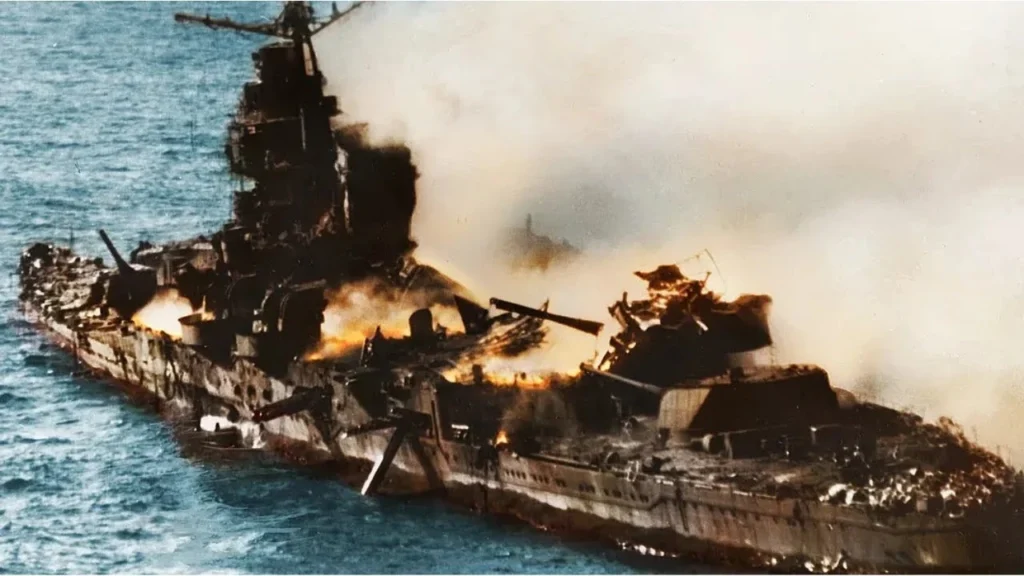
Three carriers, three infernos, six minutes.
Three ships that had helped strike Pearl Harbor now dying together on the same open sea.
Down in the smoke of the Akagi, Commander Mitsuo Fuchida, the pilot who had led Pearl Harbor, the man who would have led the second strike had he been well enough to fly, still weak from his emergency appendectomy, tried to climb down from the burning bridge.
The passages below were on fire.
Someone tied a rope to the bridge structure.
Fuchida began to slide down.
An explosion caught him halfway.
He was thrown to the flight deck.
Both ankles snapped like dry sticks.
He lay there in the smoke unable to walk, unable even to crawl, listening to the ship tearing itself apart above his head.
On the flag bridge, Vice Admiral Nagumo would not leave.
His flagship, his pride, his command.
Rear Admiral Kusaka pleaded with him.
“Sir, most of your ships are still intact.
You must command them”.
Nagumo half-half nodded, half refused.
Captain Aoki, tears on his face, begged him to transfer his flag.
In the end, they had to guide him bodily from the bridge, out a window, down a rope, off the ship he loved to a light cruiser called Nagara that would carry him away from what he had done and what he had failed to do.
Only one Japanese carrier remained, the Hiryu, and on her bridge Rear Admiral Tamon Yamaguchi did not hesitate for one second.
Every fighter he had, every bomber he had, launch now.
Within minutes, 18 Val dive bombers were airborne hunting the American carriers.
They found the Yorktown.
Three bombs punched through her flight deck, killed men in the engine rooms, and left her drifting, listing, smoking on the open sea.
Her crew put out the fires.
They got her moving again briefly, and then an hour later Yamaguchi’s second wave came.
Torpedo bombers this time.
Two fish into her port side.
The Yorktown began to die, but Yamaguchi’s ammunition was spent and his fighters were gone.
At 5:00 in the afternoon, 24 Dauntlesses launched in from the Enterprise.
10 of them belonging to Yorktown’s bombing three, orphaned when their own carrier was crippled, came out of the west sun and put four bombs into the Hiryu’s flight deck.
She burned through the night.
By midnight, Yamaguchi knew.
He gathered the 800 survivors on the flight deck near the bridge.
He led them in three shouts of banzai toward Tokyo.
The national anthem played on the ship’s speakers, thin and lonely over the burning sea.
Then he ordered every man off.
He and Captain Tomeoka Ku turned to walk back to the bridge together.
Someone below deck said they would rather die, too.
Yamaguchi refused.
“Live,” he told them.
“Your empire will need you tomorrow.
That’s an order”.
He and Kaku stood on the wing of the bridge in the moonlight.
Yamaguchi said, “Let us enjoy the beauty of the moon”.
Kaku agreed.
“How bright it shines,” he said.
“It must be in its 21st day”.
Two men admiring the sky over the ocean where their empire was ending.
Then a Japanese destroyer named Makigumo, under orders, put a torpedo into the Hiryu’s bow and finished her.
She sank 4 hours later.
Yamamoto, 300 miles away on the super battleship Yamato, the most powerful surface warship on Earth, sat silent as the reports came in.
Akagi, Kaga, Soryu, Hiryu, every carrier of the First Air Fleet gone.
At 11:55 that night, June 4th, he canceled Operation MI.
His operations officer, Commander Yasuji Watanabe, later remembered that Yamamoto retreated to his cabin and spoke to almost no one for hours.
He knew, in a way that would not be said out loud in Japan for years, that his country had just lost the war.
Not the battle, the war.
Everything from Guadalcanal to Leyte Gulf to the mushroom clouds over Hiroshima and Nagasaki was set in motion by what happened in those 6 minutes off Midway.
In the early afternoon of June 6th, the Japanese submarine I-168 found the wounded Yorktown being towed back toward Pearl.
She put two torpedoes into the carrier and one into the destroyer USS Hammann alongside her.
Hammann broke in half and sank in minutes.
Yorktown held on through the night and rolled over at dawn on June 7th, taking most of the men who had died on her deck the day before down with her.
Three American pilots had been fished from the water alive by Japanese destroyers during the battle.
Ensign Wesley Osmus of the Yorktown, Ensign Frank O’Flaherty and his gunner, Bruno Peter Gaido of the Enterprise.
They were interrogated, then they were tied to weighted kerosene cans and thrown alive into the Pacific to drown.
The order was given aboard the destroyer Arashi by her captain, a different Watanabe, Yasumasa Watanabe.
He would die on another ship in late 1943 before any war crimes tribunal could reach him.
And Ensign George Gay of Waco, Texas, 25 years old, the sole survivor of Torpedo Squadron 8, floated in the oil slick under his rubber seat cushion for 30 hours.
A PBY Catalina fifthly pulled him from the water on the morning of June 5th.
He was burned.
He was wounded.
His squadron was dead.
He had watched the entire battle unfold above him.
The burning carriers, the falling planes, the death of an empire, and lived to tell it.
The final ledger was brutal in both directions.
Japan lost four fleet carriers, the heavy cruiser Mikuma sunk on June 6th.
248 aircraft, 3,057 sailors and airmen dead.
110 of her most experienced naval aviators, pilots she could not replace and never would.
Japan produced only about 100 fully carrier qualified aviators a year.
By the middle of the war, the United States Navy was training aviators at more than 10 times that rate.
America lost the Yorktown, the Hamman, 150 aircraft, 307 men.
And in Washington, in a windowless office at OP-20-G, a group of naval officers who had insisted the Japanese would attack the Aleutians, read the news of Midway and began quietly, methodically to destroy the career of Joseph Rochefort.
They blocked the Distinguished Service Medal that Nimitz had recommended for him.
They engineered his removal from Station Hypo within months.
They sent him to San Francisco to supervise the construction of a floating dry dock.
He never worked in signals intelligence in the Pacific War again.
He retired quietly as a captain in 1953.
He died in 1976 in Torrance, California, still without the medal, still without official recognition of what he had done.
His men never let it go.
For four decades, the codebreakers of Station Hypo wrote letters, filed petitions, testified in obscure hearings.
In 1986, 10 years after his death, President Ronald Reagan presented the Distinguished Service Medal to Rochefort’s son and daughter at a ceremony in the White House.
44 years late.
Down in the coral basement in Pearl Harbor, a middle-aged man in a bathrobe and carpet slippers had read a pattern of five-digit numbers and staked the future of the United States Navy on a single two-letter word.
AF, Midway.
He was right, and for being right, he was punished.
That is the part of Midway they don’t put in the movies.
The Japanese sailed north expecting an easy victory.
They found instead a country that could rebuild a broken carrier in 72 hours, break their most secret cipher in a windowless room, put three quick carriers where none should have been, and absorb the sacrifice of nearly every torpedo pilot who took off that morning knowing they would not come back so that 33 dive bombers could arrive over the fleet in a blue sky no one was watching.
Six minutes, four carriers, one empire beginning to end, and a bathrobe in a basement 4,000 miles away that no one ever thanked.


