
…
27 Marine fighters climbed.
15 were shot down.
Most of the pilots were killed, but Midway was not a soft target.
Anti-aircraft batteries opened up from every emplacement.
11 Japanese planes came down burning.
43 more staggered back to the fleet trailing smoke and hydraulic fluid.
And when the strike leader, Tomonaga, banked over the atoll and looked down at the runway, he saw something he had not expected.
The runway was still operational.
At 7:00 in the morning, he keyed his radio and sent the message that would set the fatal machinery in motion.
“There is need for a second attack wave”.
On the Akagi, Nagumo’s face tightened.
Doctrine again.
A second wave meant rearming his reserve, the aircraft back on the hangar decks of Akagi and Kaga, currently loaded with armor-piercing bombs and torpedoes for anti-ship warfare.
Weapons meant for American carriers.
Carriers his scouts had not found.
Carriers his intelligence swore did not exist within a thousand miles.
At 7:15, he gave the order.
Rearm.
Bombs for the airfield, not torpedoes for ships.
Below decks in the hangars of the Akagi and the Kaga, hundreds of sailors began a race against a clock they did not know was ticking.
They tore torpedoes off the bellies of the Kate bombers.
They rolled armor-piercing bombs back toward the magazines.
They wheeled land-attack fragmentation bombs up from below.
Doctrine said unloaded ordnance must be returned to the armored magazines deep in the ship.
Doctrine took time.
Doctrine was inconvenient.
So, they stacked the bombs right there on the hangar floor.
Torpedoes, too.
Explosives resting on wooden decking next to fueled aircraft, next to open fuel lines.
And then, at 7:28 in the morning, 13 minutes after the order to rearm, the tardy search plane from the cruiser Tone, the one whose catapult had failed at dawn, sent back the message that turned Nagumo’s blood cold.
10 enemy surface ships bearing 010, distance 240 from Midway.
10 ships, but what kind of ships? Were there carriers among them? The pilot did not say.
Nagumo demanded clarification.
Types, numbers, now.
The answer would not come for 30 of the longest minutes of his life.
And on the carrier Hiryu, a very different admiral read the same signal and saw the truth immediately.
Tamon Yamaguchi was 49 years old.
A samurai’s grandson from Tokyo, a Princeton man, a friend of Yamamoto’s, a commander whose flight crews trained until they wept from exhaustion.
He had spent 2 years as naval attaché in Washington.
He had shaken American hands and eaten American food and studied American factories.
He had no illusions about who he was fighting.
He knew what 10 unknown surface ships meant.
It meant American carriers were out there.
He flashed a message to the Akagi.
Attack immediately.
Launch with what we have.
Nagumo refused.
He was waiting to recover Tomonaga’s returning bombers.
He was waiting for full clarification.
He was waiting to build a proper coordinated strike, the way doctrine said he should.
Yamaguchi cursed on the bridge of the Hiryu.
And in the hangars of all four carriers, sailors kept swapping ordnance, stacking bombs on the deck, laying open the arteries of their own ships.
At 8:20, the Tone scout finally admitted what it had seen.
The enemy is accompanied by what appears to be a carrier.
Nagumo now faced an impossible math problem.
Tomonaga’s exhausted low-fuel first wave was circling above the fleet waiting to land.
The hangars were chaos.
Half his reserve was rearmed for ships, half for airfields, and neither half was ready.
If he launched a partial strike now, he would murder Tomonaga’s returning pilots, who would ditch in the sea with empty tanks.
If he waited to land them, he needed 45 uninterrupted minutes.
He chose to wait.
He would never have 45 minutes again.
At 9:20 in the morning, they came out of the southwest, 15 Douglas TBD Devastators of Torpedo Squadron 8 of the USS Hornet, flying at 120 knots, sitting ducks, and at their head, in a plane that would never fly home, was Lieutenant Commander John Charles Waldron.
He had told his men 3 days ago to write letters home.
Now, he led them straight in.
There was no fighter escort.
He had been assigned one.
Through a series of coordination failures, too long to recount, it never came.
The dive bombers he was supposed to attack with had gone the wrong way.
He was alone, and he had a decision to make.
Turn back and live, attack and die.
He attacked.
The zeros fell on them like hawks and doves.
15 Devastators against 20 plus fighters, flown by the most experienced combat pilots on Earth.
A plane exploded, then another, then another.
Waldron’s own aircraft caught fire.
Ensign George Gay, 25 years old from Waco, Texas, flying at the back of the formation, watched his commander stand up in the burning cockpit and wave.
One final futile gesture before the Devastator plunged into the Pacific.
They kept coming.
Every one of them kept coming.
Gay released his torpedo at one of the Japanese carriers.
It missed.
His plane was already shredded by cannon fire.
He crashed into the sea, wounded.
His gunner died in the back seat.
He crawled out under the surface as his aircraft sank, popped up in a slick of aviation gasoline, and pulled a black rubber seat cushion over his head to hide from the zeros still hunting survivors.
He would float there for 30 hours.
He would watch the entire battle.
15 planes, 29 men dead, one survivor.
Not a single torpedo hit.
At 9:40, Torpedo Squadron 6 came in from the Enterprise.
14 Devastators, 10 shot down.
No hits.
Just after 10:00 in the morning, Torpedo Squadron 3 came in from the Yorktown.
12 Devastators, 10 shot down.
No hits.
41 torpedo planes had attacked.
35 would never come home, and the Japanese carriers steamed on, untouched, unmarked, gloating.
But, something else was happening.
Something invisible from the water where John C.
Waldron was floating in oil and shame and disbelief.
The zeros, every single one of them had been dragged down to sea level to slaughter the torpedo planes.
They were low on fuel, low on ammunition.
Their pilots were exhausted, adrenaline blown, scattered across a hundred square miles of sky.
The high altitudes above the Japanese fleet had gone completely, utterly empty, and 40 mi to the southwest, running out of gas, a 40-year-old Lieutenant Commander who had never dropped a bomb from a dive bomber in combat, was staring at his fuel gauge and making the decision that would end an empire.
His name was Clarence Wade McClusky, air group commander, USS Enterprise.
33 SBD Dauntless dive bombers cruising at 19,000 ft, searching an empty ocean.
The Japanese were not where they were supposed to be.
Nagumo had turned.
McClusky had overshot.
His fuel was well below critical.
Every pilot behind him knew that some of them, at this point, would not make it home, no matter what happened next.
He could turn east and try to reach Enterprise.
He could turn south and try to reach Midway, or he could keep hunting.
At 9:55, in a break in the clouds, he saw it.
A single Japanese ship steaming northeast at flank speed.
A wake, like a white knife across the blue.
It was the destroyer Arashi, left behind to depth charge the American submarine Nautilus, which had been circling and stalking the Japanese fleet for hours.
Nautilus had escaped.
Arashi was racing to rejoin her carriers, McClusky did not know any of that.
He knew only that a lone destroyer at flank speed was going somewhere important.
He banked his squadron and followed her wake.
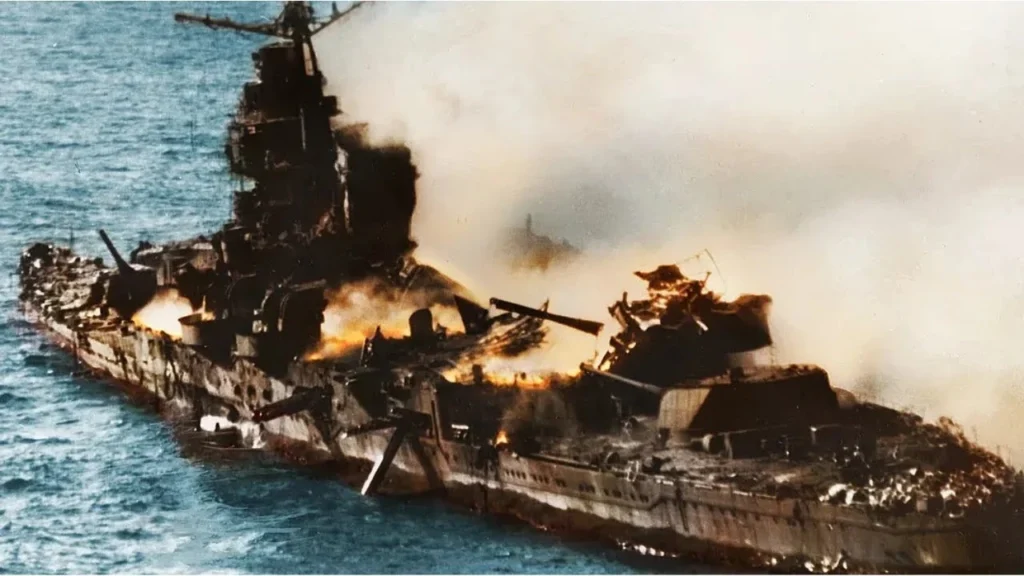
10 minutes later on the horizon he saw the smoke of Japanese ships.
He saw the flight decks.
He saw the wakes carving evasive turns.
He saw fighters low over the water still hunting the last survivors of the torpedo squadrons.
He saw the sky above the carriers wide open and undefended and at almost exactly the same moment coming in from the opposite direction to 17 more SBDs of bombing three of the Yorktown iron.
Led by Lieutenant Commander Max Leslie were tipping over into their dives.
The clock read 10:22.
The Pacific war had 6 minutes left to be decided.
10:22 in the morning.
Wade McClusky pushed his stick forward and dropped into the dive.
Behind him 31 Dauntlesses followed one by one tipping over into the near vertical plunge that gave the SBD its terrible reputation.
Dive brakes cranked open.
Airspeed climbed toward 240 knots.
The horizon disappeared.
The blue Pacific rushed up.
And then McClusky made a mistake.
American doctrine was written for exactly this moment.
Two squadrons, two targets.
The lead squadron takes the far ship.
The trailing squadron takes the near ship.
Simultaneous hits.