In 1993, a small tracked robot crawled into the Great Pyramid and spent hours inching up a shaft about as wide as a sheet of paper.
Around 200 ft in, something blocked its path.
On its camera sat a slab of polished white stone with two copper handles on the front.
It was a door.
A finished, sealed door at the end of a tunnel no person could ever pass through.
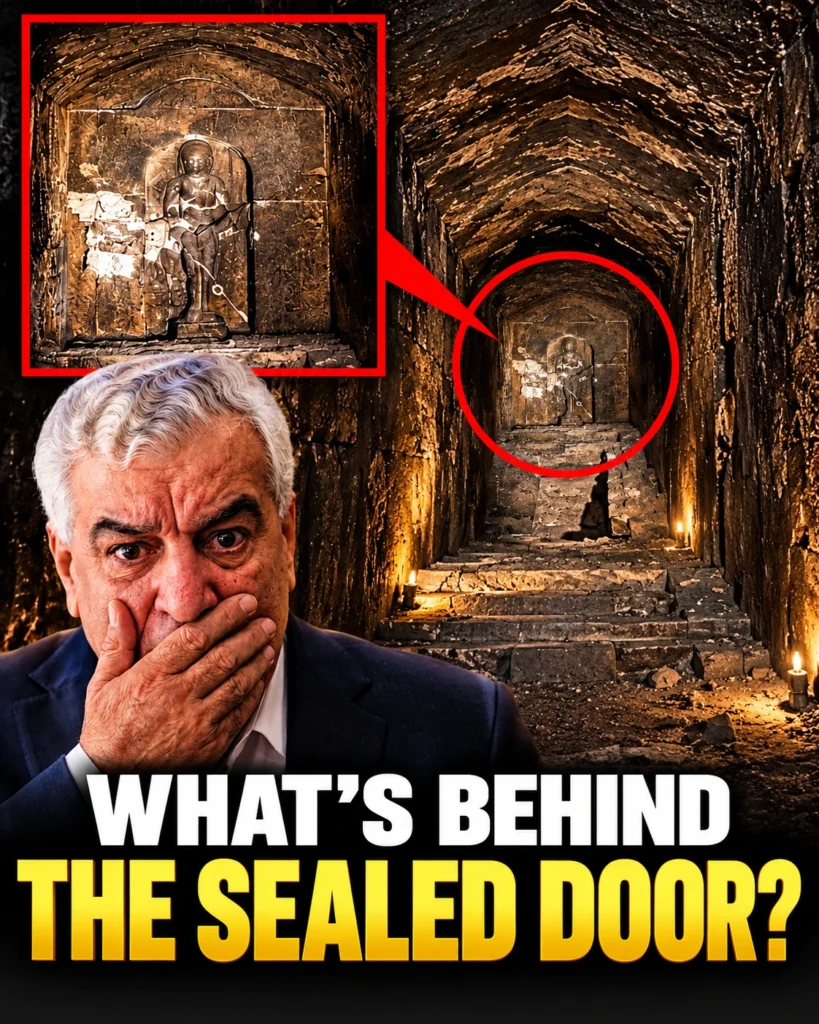
Last November, Egypt’s most famous archaeologist told a crowd his team had reached another sealed door at the end of a hidden 30-m corridor, and that what lies behind it will rewrite a chapter in the history of the pharaohs.
He promised the world would see it this year, and that year is almost over.
Study it the way an engineer would, and the door is the least strange part.
I’m Ambrose Wilde, and that shaft was built so that nobody would ever find it.
Deep inside the pyramid, there’s a room that early Arab explorers called the Queen’s Chamber, even though no queen was ever buried in it.
Two shafts leave that room, one heading north and one heading south, each about 20 cm square.
Higher up in the King’s Chamber, a matching pair runs all the way out to open air.
These two don’t.
They climb into the masonry and stop, and their openings were closed off at the chamber wall.
So, for thousands of years, the room looked like a plain stone box.
People used to call them air shafts, but these two can’t have moved any air because they were sealed at the room and blocked near the top.
No other pyramid we know of has shafts like these.
So, before anyone could chase a door, somebody had to work out that the tunnels were there at all.
That somebody was a British engineer named Waynman Dixon.
In 1872, he knew the King’s Chamber had two shafts, and he reasoned that the room below might have a pair as well, hidden behind the wall.
So, he had the stone cut away where a shaft ought to be.
And it opened into a square channel climbing into the dark.
He tried the opposite wall and found its twin.
Then Dixon and a Scottish doctor exploring with him reached up into those shafts and pulled out three small objects.
There was a metal hook, a stone ball, and a strip of cedar about 13 cm long.
Those three things are still the only objects ever recovered from inside the Great Pyramid.
The hook and the ball ended up in the British Museum.
The cedar went home with the doctor and then it disappeared.
For most of the next century, nobody could say where it was.
The doctor’s daughter gave it to the University of Aberdeen in 1946, but it was never cataloged and it ended up filed with the wrong collection.
At the end of 2019, a curatorial assistant named Abeer Eladany was going through the museum’s Asian collection when she noticed a cigar tin with Egypt’s old flag printed on top.
She had spent 10 years working at the Egyptian Museum in Cairo, so that flag stopped her.
Inside were the splinters of Dixon’s cedar.
She checked the museum’s records against the box and the lost relic had been sitting on a shelf in Scotland the whole time.
Then the pandemic delayed the radiocarbon lab work, so the answer to the obvious question took a little longer.
That would make a good story by itself, but when the wood was carbon dated, it came back between 3,341 and 3,094 BC, roughly 500 years older than the pyramid it was found in.
The university’s head of collections offered two explanations.
The sample might come from the core of a very old tree, which dates the tree’s early growth and not the day it was cut, or the wood was already ancient when the builders used it.
Because timber was so scarce in Egypt that people kept it and reused it for generations.
Either way, the date ties the relics to the original construction.
Someone placed this wood in the shaft while the pyramid was going up, possibly as part of a measuring rule, and then sealed it in.
And Dixon only took a fragment.
The rest of that piece of wood is still inside the pyramid in a spot no person can reach.
It was photographed in 1993 by the same little robot from the start of this video, which was about to find something far stranger than old timber.
That robot was designed by a German engineer named Rudolf Gantenbrink, working under the German Archaeological Institute.
He called it UPUAUT, after an Egyptian god known as the opener of the ways, and it lived up to the name.
The robot first worked in the upper shafts of the King’s Chamber, and after that success, the team pointed it at the lower pair, where nobody had ever seen the far end.
When its lamp found the door at the top of the southern shaft, the slab turned out to be Tura limestone, the fine white stone quarried across the Nile and used for the pyramid’s smooth outer casing.
We know a surprising amount about how that stone traveled because in 2013, French archaeologists working at an ancient harbor on the Red Sea coast found the oldest papyrus documents ever discovered, rolled up and tied with string, wedged between rocks inside storage tunnels cut into a hillside.
Several of them are the logbook of a man named Mera, an inspector in charge of a crew of about 40 men, over roughly 5 months.
Near the end of Khufu’s reign, Mera’s boats carried white limestone from the Tura quarries down the river to Giza, making roughly 10 round trips a month and moving about 1,000 blocks in that stretch alone.
He reported to a nobleman who was Khufu’s half-brother, and his boats unloaded at an artificial harbor dug right at the foot of the Giza Plateau, which Mera calls the Basin of Khufu.
His log even records the pyramid’s original name, Akhet Khufu, the Horizon of Khufu.
It’s the closest thing we have to a work diary from the people who built it.
So, think about what that door really is.
A piece of the same premium stone that wrapped the outside of the pyramid in a white shell was cut, polished, fitted with two copper pins, and set deep inside the structure at the top of a shaft no human would ever crawl.
These were people who logged their deliveries trip by trip.
They didn’t waste their best stone by accident.
Hold on to that, because that choice is the thread running through this entire story.
But, Gantenbrink’s camera couldn’t see past the door.
And for 9 years, that single image was all anyone had.
Then, in September 2002, National Geographic and the Egyptian authorities sent up a new machine built by iRobot, the company behind the Roomba.
On live television, it drilled a hole about 2 cm wide through the door and slid a fiber optic camera inside.
Less than 20 cm behind the door sat a second stone.
This one was rough, cracked, and had no copper fittings at all.
Zahi Hawass, who was running Egypt’s Antiquities Council and leading the expedition, said the second stone looked as if it was screening or covering something.
The camera also settled an older argument.
Two pale round patches behind the pins, which some people had hoped were royal seals, turned out on close inspection to be patches of mortar.
So, the team turned to the other shaft.
The northern one bends partway up, and it still held old metal rods that earlier explorers had pushed up it.
So, the robot had to work its way around them.
About 65 m from the chamber, it found another door made of the same fine limestone with its own pair of copper pins and the same quality of finish.
It sat at almost exactly the same distance from the chamber as the southern door.
Until that moment, nobody even knew the northern shaft ran as far north as the southern one ran south and National Geographic called the two finds together the first major new information about the Great Pyramid in more than a century.
One sealed door could be an accident of construction, a block dropped in to keep out debris.
Two matching doors finished to the same standard on opposite sides of the pyramid look like a plan.
The trouble was that the 2002 camera could only look straight ahead.
It couldn’t turn to see the walls, the floor, or the back of the door it had just drilled through.
Therefore, the next robot had to bend.
In 2011, a robotics team from the University of Leeds sent up a robot called Jedi named after a magician that Khufu consults in an old Egyptian story.
It carried a camera on the end of a flexible snake thin enough to pass through the 2002 hole and able to curl around and look back the way it came.
What that camera saw on the back of the door is the moment this whole story changed for me.
And if you like following a mystery all the way down to the evidence, subscribe because there are plenty more stories like this one on the channel.
The space behind the first door is a pocket only about 20 cm across in each direction.
The camera looked at the floor first.
Running along the bottom of that tiny space was a red ochre line, the same kind of guideline masons painted elsewhere in the shafts, and beside it sat three small red figures.
In their report, Hawass and his colleagues wrote that the two main figures resemble the way scribes wrote the number 21 in hieratic, the quick handwriting used for everyday records.
So, these are most likely working marks left by building crew, people like Mera’s men, counting or labeling as they went.
And the red line on the floor seems to carry on underneath the second stone, which raises the question the team still wants to answer.
If that second stone turns out to be a thin slab resting on a ledge, like the first door, one of the team’s engineers has said that would be a pretty good sign there’s something on the other side.
So far, nobody has published that measurement.
Then the camera curled around and looked at the back of the door.
It was polished just as smooth as the front.
And the copper pins that people had called handles for years went straight through the slab and ended in tiny, neatly finished loops with openings only about 3 mm across.
The engineer who designed the robot said the loops looked too small to do any mechanical job, and that a polished back meant the door must have been important.
That’s the detail I keep coming back to.
Nobody sealing a shaft polishes the side that faces into solid rock unless they expected someone to see it, or unless the door was never meant for human eyes at all.
That second possibility has a long history.
In 1964, an Egyptologist at UCLA and Virginia Trimble, who was still an undergraduate and later became a well-known astrophysicist, worked out where the pyramid’s shafts pointed in the sky when it was built.
In the King’s Chamber, the southern shaft lined up with Orion’s Belt, which Egyptians linked to Osiris, god of the dead.
And the northern shaft aimed at Thuban, the polestar of that era.
In the Queen’s Chamber, the southern shaft pointed toward Sirius, the star of Isis, whose return to the dawn sky announced the yearly Nile flood.
The northern shaft pointed toward Kochab, one of the stars that circled the pole and never set.
Egyptian royal tomb inscriptions called those circling stars the imperishable ones and they describe the dead king crossing over to take his place among them.
Trimble and her colleague never claimed anyone looked through these shafts since they’re blocked.
Their argument was that the shafts were paths for the king’s soul.
Those inscriptions were first carved in a later dynasty so nobody can prove Khufu’s builders thought exactly the same way.
But if they did, the polished back stops being strange.
If the shafts were meant as a road for the king’s soul, a finished door on that road makes sense.
Every answer inside these shafts has arrived with a harder question attached and by the 2010s the question had grown bigger than two narrow tunnels.
If the builders hid shafts this carefully, what else were they hiding? Finding out meant seeing through solid stone.
The tool for that came from particle physics.
When cosmic rays hit the upper atmosphere, they produce particles called muons and about 10,000 of them strike every square meter of ground each minute.
Muons pass through rock but the stone absorbs some of them along the way.
Therefore, if you count how many arrive from each direction, an empty space shows up as a spot where a few too many got through.
The first person to try this on a pyramid was the physicist Luis Alvarez who proposed it in 1965, three years before he won the Nobel Prize.
His team placed detectors in a chamber beneath the pyramid of Khafre, Khufu’s son, and found no hidden rooms at all.
Alvarez argued the result still counted because it proved there were no chambers there to find.
Then in 2015 a project called Scan Pyramids brought the method back with far better detectors and this time pointed them at the Great Pyramid.
One Japanese team laid sheets of special photographic film in the Queen’s Chamber, the same room those shafts come out of and let the muons from above write their tracks into it.
In November 2017, the team reported in the journal Nature that three independent kinds of muon detector had found the same thing, a void at least 30 m long sitting above the Grand Gallery.
It was the first major structure found inside the pyramid since the 19th century.
A space news reports compared to the size of a passenger plane.
One of the physicists pointed out that it appears completely closed.
So, whatever is inside hasn’t been touched since the pyramid was built.
The team couldn’t say whether it was one space or several or whether it ran flat or sloped.
And the loudest skeptic in the room was Hawass himself.
He chaired the committee reviewing the work and he told reporters the pyramid is full of voids that the builders needed a space like this to construct the Grand Gallery underneath it.
And that, in his words, they found nothing.
Keep that quote in mind because the same man is at the center of this year’s promise.
In March 2023, the scans found something a camera could actually reach.
On the pyramid’s north face, behind a set of huge limestone blocks leaning together into a point just above the original entrance, sat a corridor about 9 m long and 2 m wide.
The team fed an endoscope about 6 mm thick through a joint between the stones and became the first people in about 4,500 years to see inside.
They saw an unfinished passage with nothing in it.
Egypt’s Antiquities Chief said it was probably built to spread the weight of the pyramid around the entrance below or around some other space that hasn’t been found yet and that the scanning would continue past the end of the corridor.
So, every sealed space opened so far has followed the same pattern.
Behind the first door, a second stone.
Inside the hidden corridor, bare rock.
Inside the giant void, nothing anyone can reach yet.
And that pattern points straight at the biggest empty space in the whole building.
Khufu’s own burial chamber is lined with red granite brought from Aswan, about 800 km up the Nile.
At its west end sits his sarcophagus, carved from a single block of that granite.
It’s wider than the passage leading into the room.
So, it couldn’t have been carried in later.
It had to be set in place while the pyramid was still rising around it.
When the men of the Caliph Al-Ma’mun tunneled into the pyramid around the year 820, they eventually reached that room and found the sarcophagus empty.
Khufu’s body has never been found here or anywhere else.
The king himself is almost as hard to find as his body.
In 1903, the archaeologist Flinders Petrie was digging at Abydos when his team turned up an ivory figure of a seated king, 7.
5 cm tall, with Khufu’s name carved on the throne.
It came out of the ground without its head.
So, the team sifted the site for 3 weeks until they found it.
Petrie wrote that even at that size, you could see the king’s energy and commanding air.
That tiny figure is still the only complete sculpture of Khufu anyone has found, and the builder of the largest stone monument of the ancient world could sit in the palm of your hand.
If the headlines about this door have been landing in your feed all year, this is where they come from.
When Hawass spoke at the Sharjah International Book Fair last November, that missing king was the reason the room leaned in.
He said thermal imaging, 3D mapping, and muon scans had located a corridor about 30 m long ending at a door that robots had been cleaning openings out of human reach, and that next year, which means this year, the world would see what’s behind it.
He also said a scientific report would come out before the reveal, and he wouldn’t say what he expects to be on the other side.
At the same talk, he dismissed the idea that aliens or supernatural forces built the pyramid.
And he spoke about wanting to find the tombs of Imhotep and Nefertiti.
This is someone who wants the big discovery and who has also poured cold water on other people’s.
As of the most recent reports I could find from late this summer, that report hasn’t been published and the reveal hasn’t happened.
And this corridor is a different door from the ones in the shafts.
Remember what Hawass said about the big void in 2017.
He was right to be careful then.
The pyramid really is full of gaps the builders left and a scan can’t tell you what’s inside one.
That same caution applies to his own announcement.
What actually worries the people who study this place is a day like one in 1927.
Near the Great Pyramid, at the bottom of a hidden shaft almost 90 ft deep, George Reisner’s team had found the sealed tomb of Hetepheres, Khufu’s mother.
The expedition’s photographer spotted the shaft in 1925 while Reisner was away, and he cabled back to close the tomb and wait.
Clearing what was packed inside took years because water had damaged the gilded furniture so badly that it was close to crumbling.
The chamber held an alabaster sarcophagus with its lid still in place.
In front of invited guests, they raised that lid and the sarcophagus was empty.
Reisner told the room, “Gentlemen, I regret that Queen Hetepheres is not receiving”.
Her organs were still sealed in their chest in the wall.
Her body was gone.
Reisner’s theory was that her first tomb had been robbed soon after her burial and that the officials responsible quietly told Khufu his mother was safe and reburied an empty coffin.
So, a sealed lid told them nothing about what was underneath it.
It’s the same caution a Bristol Egyptologist showed in 2017 when he put the odds of the big void holding treasure or a burial at almost nil.
So, after more than 150 years of wires, robots, and particles from space, the hardest question is still the plainest one.
Why would a crew that logged its stone deliveries trip by trip spend Tura limestone, copper, and careful polishing on two doors that face into solid rock at the ends of tunnels no person could ever walk? The best answer the evidence allows is that they were building a way out for a king aimed at the stars that circle the pole and never set.
If that’s right, the treasure was never behind the door.
The door is the evidence of what they believed.
And somewhere inside that pyramid right now, another door waits at the end of that hidden corridor.
If Hawass keeps his promise, someone opens it before this year runs out.
I’m Ambrose Wilde, and when that door opens, I’ll be here to show you exactly what’s behind it, along with more mysteries like this one.
So, make sure you’re subscribed.


