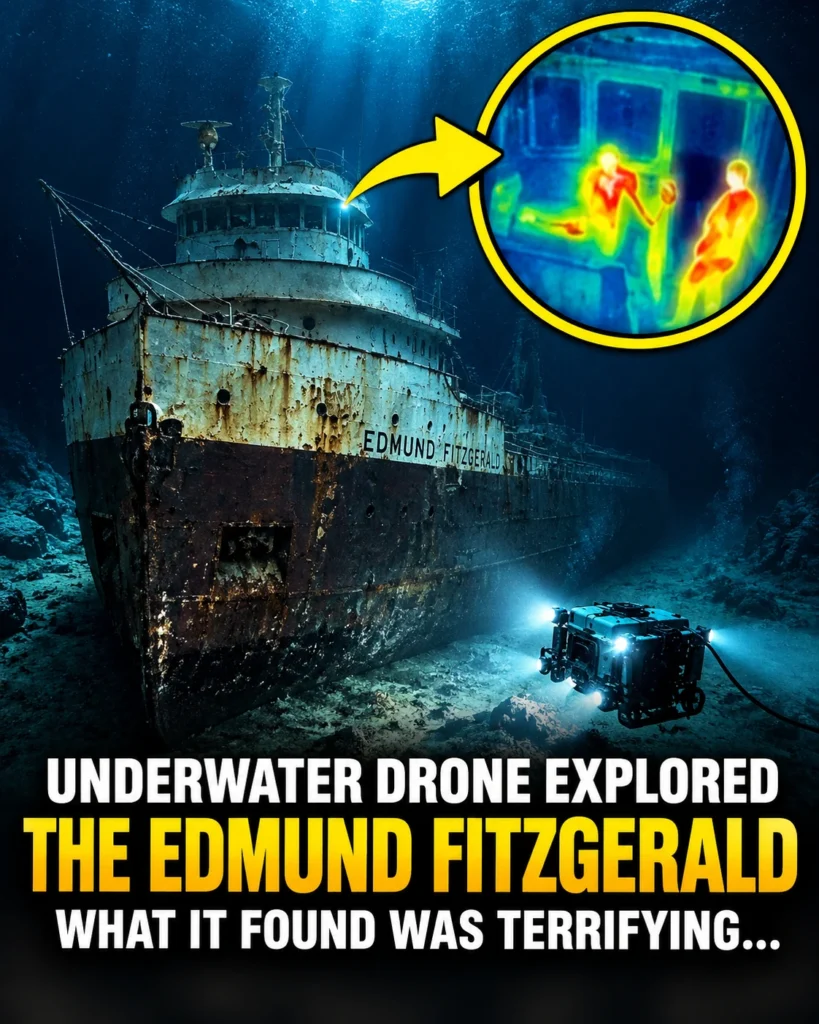
In late August 1989, a research vessel called the Grayling sat over one spot on Lake Superior, about 17 mi out from Whitefish Point on the Canadian side, and her crew eased a small machine over the rail on the end of a cable.
It was an underwater robot, more or less 26 in long and about 55 lb, with thrusters, a set of lights, and two cameras mounted next to each other like a pair of eyes, so the pictures it sent up could be watched in three dimensions.
It sank through the green water and then into total darkness, more than 500 ft down.
When its lights finally picked out the bottom, everyone aboard crowded around the monitor, the way anyone would when a camera touches down somewhere no person has ever stood.
They had 3 days.
On board were government scientists, a university team, a crew from National Geographic, and the director of a little museum on the shoreline who had spent 14 years waiting for this look.
The robot went wherever they steered it, along a wall of steel, up the side of it, right to a doorway, and it brought back something that nobody on that boat had gone down there looking for.
I’ll hold off on telling you what it was, because the reason a few seconds of that footage still start arguments 37 years later comes down to what happened on that same water 14 years earlier and what it did to the families waiting on shore.
To see why grainy video from a little robot can send a chill through you, you first have to know what nobody had ever managed to see.
So, let me show you.
I’m Ambrose Wild, and the place to start is with the ship herself, because a famous song turned her into a legend, and the real ship tends to get lost behind it.
31 years before that robot went down, the Edmund Fitzgerald was the biggest thing afloat on the Great Lakes.
She slid into the water at River Rouge, Michigan, just outside Detroit in June 1958.
She was 729 ft long and 75 ft wide, and she was the first laker built to the largest size the new St.
Lawrence Seaway would allow.
A Milwaukee insurance company, Northwestern Mutual, paid for her, and she carried the name of one of its top men.
Her shape was simple.
A pilot house up front, the engines at the back, and in between long cargo holds under a row of steel hatch covers.
Her job was simple, too.
She hauled taconite, little pellets of iron ore, from the iron ranges up at the far end of Superior to steel mills farther down the lakes, then turned around empty and repeated the trip every season until winter ice closed the locks.
She was good at it.
She set seasonal hauling records six times, and in 1969 she carried 27,402 long tons on a single trip.
One of her captains, Peter Pulcer, liked to pipe music over the intercom while she steamed down the St.
Clair and Detroit Rivers, and at the Soo Locks he’d chat to the tourists through a bullhorn.
The company called her the pride of the American flag.
At 2:15 in the afternoon on the 9th of November, 1975, she pulled out of Superior, Wisconsin, with 26,116 long tons of taconite on board, bound for Zug Island near Detroit.
In command was Ernest McSorley, 63 years old, a man known on the lakes as a heavy weather captain, and he was planning to retire once the season was over.
There were 29 men aboard in all.
The first mate was John McCarthy.
Down the list were oilers, wipers, cooks, deckhands, and watchmen, some of them in their early 20s.
One of them, Oliver Shampo, everyone called him Buck, was 41, a Marine Corps veteran, and this was his very first trip on the Fitzgerald.
Back home, his daughter Debbie was 17.
The forecast that afternoon was ugly, and it kept getting uglier.
Following the Fitzgerald across the lake was another ore boat, the Arthur M.
Anderson, under Captain Jesse Cooper, a man everybody called Bernie.
The two captains agreed to take the long way up along the Canadian shore, hoping the land would break the worst of the wind.
It didn’t.
By the afternoon of November 10, they were in a full gale with winds above 50 knots, snow coming sideways, and seas Cooper later put at 25 to 35 feet.
At about half past three, McSorley got on the radio to the Anderson.
A fence rail was gone, he said.
Two of his vents had been torn away, and the ship had picked up a list.
Both of his pumps were running.
Not long after that, both of his radars went out.
From then on, the Fitzgerald was blind, and the Anderson, trailing behind her, was reading her position off its own radar and talking her toward the shelter of Whitefish Bay.
Then came a detail that still makes people wince.
At 4:39, McSorley called the Coast Guard station at Grand Marais to ask whether the Whitefish Point light and its radio beacon were working, the one fixed mark every captain in that corner of the lake steers for.
The Coast Guard told him its monitors showed both of them out.
A little later, another captain, Cedric Woodard on the Avafors, reported that the light had come back on, but the radio beacon was still dead.
So, the Fitzgerald was heading for a harbor she couldn’t see without radar, without the beacon, and with a list that wasn’t getting better.
Around 6:30, Cooper’s ship was hit by two enormous seas, each one somewhere around 30 to 35 feet.
He watched them roll on ahead toward the Fitzgerald.
He’d later wonder whether a third one followed.
Keep those waves in mind.
Just after 7:10, the Anderson’s mate called the Fitzgerald to pass along a warning about another ship in the area and asked how they were doing.
McSorley answered, “We are holding our own”.
Nobody ever heard from the Edmund Fitzgerald again.
About 10 minutes later, she was gone from the Anderson’s radar and gone from the radio.
There was no Mayday, no flare, nothing at all.
Cooper’s first call to the Coast Guard went out at 7:39 on the emergency channel, and he was told to switch channels.
He didn’t actually get through until 7:54.
So, a ship with 29 men aboard had vanished off a radar screen, and it took a quarter of an hour just to get someone on the line.
And no, I’m not making that up.
The Coast Guard had nothing nearby that could go out in that sea.
So, at about 9:00, it asked Cooper to do something ex- traordinary.
Turn the Anderson around and go back out into the storm he’d just escaped in the dark and look.
He did.
Another freighter, the William Clay Ford, went with him.
The search went on for about 3 days.
They found lifeboats, a raft, oars, and debris floating on the water.
They didn’t find a single man.
Not one of the 29 was ever recovered.
Lake Superior is famous for that.
The water down deep stays barely above freezing, so cold that the bacteria, which would normally bring a body back to the surface, never really get started.
Whatever the lake takes, it tends to keep.
So, 29 families across Wisconsin, Michigan, Ohio, Minnesota, and beyond had a date, a storm, one last radio message, and nobody to bury.
And they had a question nobody could answer because nobody saw it happen.
The Anderson was only about 10 mi behind, watching on radar and talking on the radio, and still, somewhere between one sweep and the next, a ship that was holding her own just stopped existing.
Whatever happened, it happened faster than 29 experienced sailors could get a single word out.
Or that’s what everybody assumed for a very long time.
Hold on to that assumption because a doorway at the bottom of the lake is going to put a crack in it.
Here’s one more piece of the puzzle most retelling skip.
A loaded laker rides low on purpose.
In heavy weather, the waves don’t smash against her so much as climb aboard and pour across her deck and off the far side.
What keeps her alive is freeboard, the height of the deck above the waterline, and the Fitzgerald’s freeboard had been cut three times.
The Coast Guard’s own report shows that changes to the loading rules in 1969, 1971, and 1973 let her load deeper and deeper.
Her winter freeboard had started at about 14 ft 9 in.
By 1973, it was 11 ft 6 in, more than 3 ft less steel between the waves and her hatches.
The board that investigated the sinking listed those reductions as a contributing factor.
On a night like November 10, 3 ft was a lot to give away.
Four days after the sinking, on November 14, a Navy pilot, Lieutenant George Conner, flew a P-3 Orion patrol plane over the area with a magnetic anomaly detector, a device that senses large masses of steel, and got a hit.
She was lying in about 530 ft of water in Canadian territory, about 17 mi from the entrance to Whitefish Bay.
The following May, the Coast Guard sent down the Navy’s unmanned submersible CURV 3, a camera on a cable.
Over 12 dives, it logged 56 hours on the bottom, shot 43,255 ft of video tape, and took 985 still photographs.
Her name on the hull settled who she was.
It also showed how badly she’d been broken.
The front half, around 276 ft of her, was sitting upright in the mud.
The stern, about 253 ft, lay upside down some 170 ft away.
In between, was a mess of twisted steel and spilled taconite where the middle of the ship should have been.
In all those hours, the camera found no sign of the crew.
For the families, that was a strange sort of mercy and a hard silence, too.
Their men were down there somewhere, out of sight, and the wreck wasn’t giving up much else, either.
Mud had settled over parts of the wreck, including the vents on one side of the bow.
And every time the vehicle moved, the bottom stirred.
Investigators could see hatch covers missing or damaged.
They could see two halves of a ship.
What they couldn’t see was how she’d ended up that way.
That’s where the fight started, and it hasn’t stopped.
In July 1977, the Coast Guard’s Marine Board published its report.
It admitted that the exact cause could not be determined, and then it gave its best explanation anyway.
The hatch covers hadn’t kept the water out.
Each cover was a single slab of steel weighing about 14,000 lb, held down by 68 hand-tightened clamps, and the board believed water had been getting into the cargo hold through them for hours.
Slowly, the ship lost buoyancy until her bow dove into a wave and never came back up.
On that theory, she broke apart when she hit the bottom.
The people who sailed the lakes were furious.
To them, it sounded like the board was blaming the crew for sloppy work.
The Lake Carriers Association, the industry’s own group, led by Paul Trimble, pushed a different story.
They believed the Fitzgerald had grazed Six Fathom Shoal, a shallow patch near Caribou Island, without knowing it, and had been leaking from below ever since.
The list, the lost vents, the pumps running non-stop, all of it fits that version two.
And there was a fact on their side.
When the Canadians surveyed that area again in 1976, they found the shoal actually ran about a mile farther east than the charts showed.
Cooper had been watching her track that afternoon.
He wrote that the Fitzgerald was to the west of his course line, maybe too close to Caribou Island, and he pointed out that the survey of those waters dated back to around 1915.
He never claimed she’d touched bottom.
And nobody can.
But a veteran captain worrying about another ship’s course in real time isn’t nothing.
And it was roughly half an hour later that McSorley reported his list.
In May 1978, the National Transportation Safety Board weighed in.
The majority came down on the hatch covers, saying they’d collapsed under the weight of the seas washing over the deck.
One member disagreed in writing and backed the shoal.
So, two federal investigations couldn’t fully agree with each other, never mind with the industry.
The third explanation is the plainest of the lot, and the toughest to pin down.
Sailors talk about the three sisters, a set of giant waves arriving one after another, each hitting before the deck has cleared from the last.
Cooper’s two monster seas that evening, heading straight for the Fitzgerald, are the reason that idea never went away.
And there’s a fourth idea that gets less attention than it should.
In a deposition in January 1978, a former cook named George Burgner, who’d left the ship earlier that year, testified that the Fitzgerald often sailed before all 68 clamps on each hatch were fastened.
He also claimed parts of her keel were held only by tack welds.
A naval architect, Joseph Fisher, later recalled a 1969 investigation into cracks in her keel welds that kept coming back after repairs.
So, bad hatches, a shoal, the waves, or a ship coming apart under her own load.
The only thing that could settle it was the wreck, sitting 530 ft down where nobody could get a proper look.
In September 1980, Jean-Michel Cousteau’s expedition brought its ship, the Calypso, onto Lake Superior and two divers, Albert Falco and Colin Mouney, took a small submarine down to her.
It was the first time human beings had seen the wreck with their own eyes.
The visit was short, but they came up convinced that she’d broken in two on the surface, which was the exact opposite of what the Coast Guard believed.
Nobody could check it, and then 9 years went by.
That brings us back to the grayling.
Michigan Sea Grant, a university program, put the 1989 trip together, and half the agencies around the lakes wanted in.
Federal ocean scientists came, and so did National Geographic, the Army Corps of Engineers, the state’s natural resources department, the Fish and Wildlife Service, plus people from the Great Lakes Shipwreck Historical Society, the group that runs the Whitefish Point Museum.
The robot itself has a story.
It was a mini rover, and the first one had been built in a garage in Falmouth, Massachusetts, by an engineer named Chris Nicholson.
When it came out in 1983, it sold for $26,850 at a time when the next cheapest machine of its kind cost around 100,000.
On Lake Superior, it worked alongside a towed camera system, and between them, the team brought back about 5 hours of three-dimensional footage.
That was the point.
In 1976, the CURV had seen flat shapes in the mud.
Now investigators could see how a bent plate actually sat and which way it had been pushed.
It was slow, fiddly work.
The lights reached only a few yards.
The mud billowed up at the slightest touch, and every pass gave them one thin stripe of the picture.
Then the robot reached the front of the ship.
The first surprise was glass.
After 14 years on the bottom, some of the windows were still in place, unbroken, sitting in their frames on a ship that had been through the worst storm Superior could throw at her, and then struck the bottom hard enough to tear in half.
Water that cold keeps things almost exactly as they were.
Then the robot reached the pilot house, the room where McSorley and his officers spent their final minutes, and where those words, “Holding our own,” went out over the radio.
With the bow upright, it still looks much as it did on the surface, and one of its doors was open.
I’ll give you only what the team actually recorded.
A pilot house door was standing open, and it was not dogged, which means the heavy latches that seal a door shut against the sea had not been thrown.
On a ship that had spent hours fighting a gale, where every door had every reason to be locked down tight, that one wasn’t.
The expedition itself raised the obvious reading.
It could suggest that someone had tried to get out.
Maybe, in those final seconds while she sank, a man in that pilot house realized what was coming and went for the door.
There are quieter explanations.
The impact with the bottom could have thrown it open.
It might have been unlatched during the storm for some ordinary reason and swung open on the way down.
A door doesn’t come with a timestamp, but for 14 years the official picture of the Fitzgerald was a ship that went so fast nobody had time to do anything.
No Mayday, no lifeboats.
And here on the bridge was the first thing anyone had found that looked like a person doing something.
The team found something else that was a lot less comforting.
Looking at the bow damage with real depth for the first time, they concluded it could not have been caused by the storm.
Because it was far too extensive.
Whatever hit the front of that ship was more violent than wind and water.
That could fit a bow first plunge into the lake floor.
It could fit a shoal.
It doesn’t settle either one.
The cameras also got a clearer look at the hatch openings and the same bent steel could be read two ways.
Covers pushed in by the weight of the waves or covers blown off from inside when the hull hit bottom and the air in the holds had nowhere to go.
In 1990, a panel sat down to go through all of it.
The moderator was Frederick Stonehouse, who’d written the first book on the wreck back in 1977.
They reached no conclusions.
The robot had gone down to end the argument and it came back with intact glass, an open door and a bow wrecked worse than any storm could explain.
More evidence and still no verdict.
In the summer of 1994 two separate teams went down and the story grew heavier.
A businessman named Frederick Shannon put up his own money formed a company called Deep Quest and leased a submersible called Delta.
Between July 25 and the 27th of July 1994, he made seven dives and recorded more than 42 hours of video.
Some of the clearest footage ever shot of the wreck.
One of his dives lasted 211 minutes, the longest anyone had spent down there in a submersible.
On the last dive, his team set a memorial plaque down close to the pilot house.
And next to the bow, his camera came across a man.
He was a member of the crew lying on the lake floor, partly dressed in coveralls and wearing a life jacket.
19 years after the sinking, it was the first time anyone had seen one of the 29.
It’s still the only time.
Nobody has ever been able to say who he was, and the pictures don’t make that possible.
The families were angry that he’d been filmed at all.
To them, the lake had kept their men out of sight with a kind of dignity, and a camera had taken that away.
I’ll stick to the one thing that footage tells us.
He was wearing a life jacket.
So, at some moment that night, one of those men got the chance to strap it on.
Put that next to the open door, and you have two small facts, found 5 years apart, that point the same way.
There was time, not much, but some.
Shannon’s own conclusion, by the way, was what he called massive and advancing structural failure.
The second expedition that July was a publicly funded survey led by Joseph MacInnis, using a submersible called Celia, launched from the research ship Edwin A.
Link.
They made six dives over 3 days.
The damage turned out to be worse than anyone had reported.
And the cargo was everywhere.
Taconite pellets, each about the size of a marble, were spread across the wreck and the bottom around it, thrown clear of the holds.
On that team was Tom Farnquist from the Whitefish Point Museum, and he came away saying he could hardly see how she could have split in two while still afloat.
That’s the opposite of what Cousteau’s divers had said.
MacInnis, for his part, concluded the dives didn’t explain why she sank.
Another man on that 1,994 expedition, a diver and filmmaker named Rick Mixtor, has spent the decades since working the problem.
His view is that hatches number one and five caved in and that she broke her back on the surface.
And he says he’s totally ruled out running aground.
He’s not alone on that last point.
A forensic study presented in 2012 by Shawn Career and Ben Fisher reported no sign of grounding damage on the stern section, the half you can actually see the bottom of.
That doesn’t kill the shoal theory because the bow’s underside is buried in mud, but it takes a real bite out of it.
The families themselves asked for one final dive in 1995 and they set a condition.
No video of any of the crew.
Using a Newt suit, a hard diving suit that works almost like a one-man submarine, they recovered the ship’s bell on July 4.
The Canadian Navy, National Geographic, and the Sault Ste.
Marie Tribe of Chippewa Indians all had a hand in it.
The bell is 200 lb of bronze and today it’s on display in the museum at Whitefish Point.
In its place on the wreck, they left a replica engraved with the 29 names.
There’s a footnote here about the song and it’s about this exact argument.
Gordon Lightfoot released The Wreck of the Edmund Fitzgerald in 1976 and it went to number one in Canada and number two on the Billboard chart in the States.
One line in it blamed a hatchway for the sinking, which was basically the Coast Guard’s theory set to music.
In March 2010, Lightfoot was approached about using the song in a History Channel documentary and he learned about the newer findings.
From then on, when he played it live, he sang a different line, one that didn’t blame a hatch.
Not many songwriters rewrite their most famous song because the evidence moved.
He kept singing the new version until he died in 2023 and then the window shut.
In April 2005, Ontario changed its heritage law so that diving on certain protected wrecks requires a license with fines of up to 1 million Canadian dollars.
In January 2006, a protective zone of 500 m was drawn around the Fitzgerald.
In 2009, the rules were widened to cover any surveying device at all.
So, not even a robot can go down without permission.
That permission hasn’t been given.
Nobody has laid eyes on her since that bell came up 31 years ago.
Larry Elliott, who’d been aboard the Greyling in 1989, put it bluntly.
In our lifetimes, he said, we won’t see another expedition to the Fitzgerald.
Mixter sees it differently.
The clues are all down there, he says.
And he’d dive tomorrow.
His argument is 50 years on, we have the technology to work it out.
You’d think one of them has to be wrong.
I’m not sure either one is.
Last November marked 50 years.
At Whitefish Point, the families gathered for their ceremony.
In Detroit, the Mariners Church, the one in the song, rang its bell 30 times, once for each of the 29 men and a final time for every sailor the Great Lakes have taken.
Stonehouse, the author who ran that 1,990 panel, pointed out something that rarely gets said.
Before the Fitzgerald, a ship of similar size was lost on the lakes about every six or seven years.
Since her, not one.
The Coast Guard’s recommendations after the sinking included depth finders on Great Lakes freighters and emergency beacons so a lost ship could be found fast.
Every sailor on the lakes today,” Stonehouse said, “owes the Fitzgerald a debt of gratitude”.
But in all the coverage, nobody could tell those families what had actually happened to their men.
Nobody knows.
50 years of the most studied wreck on the lakes, and the 50th anniversary closed exactly where the 1,975 search did, on a question.
Now, maybe you’re wondering whether somebody is sitting on the answer.
There are people convinced the 1,989 or 1,994 tapes hold more than the public has seen.
Some footage really hasn’t been released, and the families have asked, for good reason, that pictures of the crew stay private.
Still, I doubt there’s a hidden solution on any of those tapes.
The people who’ve watched the most of it, investigators, museum staff, and divers, can’t agree among themselves, either.
If a tape settled it, we’d know by now.
The odd thing about the Fitzgerald is that each team went looking for the answer and surfaced with a piece that helped one theory and hurt another.
Unbroken glass, an unlatched door, a bow too smashed for weather, a stern without a scratch from any rock, and a crewman who’d found time to put on a life jacket aboard a ship that was supposed to have gone down too quickly for anyone to react.
So, here’s what’s left, and nobody is allowed to go and check.
Who opened that door? Did it swing open as she sank or when she struck the bottom? If someone on the bridge had seconds to reach for a latch, why didn’t anyone reach for the radio? What hit the bow so hard? Is the answer to the shoal question lying in the mud under the front half, where no camera has ever reached? And what about the 200 ft of ship that’s simply gone, scattered between the two halves? Nobody has ever mapped that debris field piece by piece with modern equipment.
Meanwhile, the steel is thinning, the silt keeps settling, and every year a little more of whatever is down there gets covered.
Debbie Buchshaum’s daughter was 17 when her father didn’t come home.
She said it took her a while to understand that he wasn’t coming back.
For the past 30 years, she’s been at Whitefish Point to ring the Fitzgerald’s bell, the same bell that Newt Sue brought up in 1995.
“That,” she said, “was the closest thing to my dad”.
She’d like the wreck and the crew to be left alone.
Somewhere 17 mi out, 530 ft down, a pilot house door is still standing open, exactly the way a little robot found it in 1989, and nobody is going down to close it.
I’m Ambrose Wilde, and if you want more stories like this one about the wrecks that still won’t explain themselves, there are plenty more coming right here.


