Investigators believe Orin used lower doses to hur…
Investigators believe Orin used lower doses to hurry guests toward the exit while he accessed restricted areas.
No earlier visitor was physically detained.
The practice made the final attack appear manageable to him.
Blackfern’s cameras are designed around marketing rather than safety.
The entrance produces clean images for souvenir photos.
The underground route uses motion sensors that record only color dots on a map.
The service gate has no camera because advertising panels block it.
Orin understood which systems created an appearance of oversight without documenting the spaces he controlled.
The motion map survives.
During the final tour, three guest bands move together until 5:36.
Then one dot travels toward the booth.
Two remain below and a fourth obsolete dot, Elise’s cloned pass, moves between them.
Orin used the dead ticket as his administrator key.
Its movement is his.
The map therefore contains four dots for three guests.
Investigators initially call the extra signal corruption.
Once tied to Elise, it becomes a digital silhouette of Orin moving through the crime scene.
At trial, prosecutors do not display the motion map as people.
They explain that each dot represents a credential and a credential can be carried by anyone.
The strength comes from Orin possessing the clone tag when arrested and the hidden code appearing wherever his physical evidence is found.
The service gate records pressure changes when its hydraulic arm moves.
At 6:01, it opens wide enough for Cal’s truck, although the main logs as three pedestrians departed.
Tire impressions continue down the quarry lane.
The brothers used the truck to move equipment and later returned phones to the booth.
No women walked through that gate.
Their fabricated messages create another timeline.
The 6:41 message to Lacy’s fiance uses punctuation she never uses and calls the underground section a tour.
Lacy referred to it as the caves in every earlier conversation.
The 8:03 message is sent after Oren moves her phone to the booth.
Wireless access points show Becca’s phone beside it, too.
Yet, a message to her sister says the group stopped for dinner.
June’s device remained silent because its battery died.
Oren could manufacture only two voices, which he believed was enough to make all three seem safe.
The messages delay family concern by nearly 4 hours.
Becca and June testify from opposite ends of the courtroom because their memories remain fragmented by sedation.
They agree on only a few details.
Lacy arguing at the hatch, Cal blocking the upper path, Oren collecting phones and the lights going red before they were separated.
Physical evidence tests each fragment.
Lacy’s photo proves the hatch.
Cal’s truck contains the rope.
Oren holds the phones.
Lighting logs show the emergency red circuit activated manually at 5:43.
Their incomplete memories become reliable where independent systems meet them.
The old investigation into Elise is reopened formally during the same trial preparation.
Her mother had preserved the final voicemail in which Elise says the bridge cable has never been changed.
The timestamp is 30 minutes before her supposed fall.
Photographs from Becca’s phone show the original clamp still installed 2 years later.
Metallurgical scratches match a tool found in Cal’s workshop.
The brothers had loosened the cable after killing Elise to create the fall scene.
Orin’s cloned pass supplied a false exit and return, allowing him to claim she reentered through the fence alone.
There was never a reentry.
Her belongings remained behind the underground hatch from the beginning.
Jurors hear the two cases separately before the scanner histories are placed together.
The identical signal strength, angle, and obsolete fourth code reveal a repeated method without turning the victims into interchangeable stories.
Elise challenged a dangerous bridge and fraud.
Lacy discovered the evidence left by that murder.
Becca and June survived a containment plan meant to protect both crimes.
Orin and Cal are convicted of Lacy’s murder, kidnapping, and conspiracy.
A later jury convicts them of Elise’s murder and insurance fraud.
Moss, the seasonal guard, is cleared after work records and traffic cameras confirm he left before the group arrived.
Before sentencing, the court releases the handwritten security log.
Orin filled the departure line at 4:41, 11 minutes before the women entered.
Ink analysis cannot determine time by itself, but an entrance booth camera shows him writing while Cal places the treated bottles in the cooler.
The page already said final guests departed.
After the group passes the gate, Orin closes the book and never opens it again.
The time 5:58 was not a mistaken recollection at the end of a long shift.
It was selected in advance to fall just beyond the advertised 70-minute tour.
The brothers had also prepared a mechanical explanation for the parked car.
A printed warning under the windshield wiper claims overnight parking is permitted for guests using a shuttle.
No shuttle operates on Saturdays.
Orin planned to tell families the women left with other visitors while their vehicle remained legally behind.
Searchers initially see that notice and delay towing the car for evidence.
Its paper carries Cal’s fingerprint and was printed from the office at 4:38.
Corrine presents the artifacts in the order they were prepared.
Departure log, parking notice, cloned tag, sedated water, and open service lane.
The murder happens later, but the system for making guests disappear from official records exists before they arrive.
This is why the brothers claim of sudden panic fails even where Lacy’s fatal confrontation was not specifically planned.
They had prepared confinement, false movement, and an explanation for absence.
When Lacy resisted, those preparations gave them time and privacy to kill her.
Becca describes hearing Orin above the trapdoor making normal closing announcements over an outdoor speaker.
He thanked non-existent visitors and warned that the parking gate would close.
The recording was part of a timer, yet he spoke live between segments to make the empty ground sound occupied.
June hears Cal drag metal panels across the tunnel and ask whether the scanner shows them outside.
Their statements come from separate rooms and were given before either knew the other survived.
The phrase about the scanner matches a deleted voice memo on Oren’s phone.
He records ticket counts while practicing the clone tag and says, “Outside on paper, below in fact”.
That sentence becomes the prosecution’s simplest description of the crime.
Engineers later test the emergency phone Lacy used.
Its cable had been cut partially, so calls would drop after several seconds.
The brothers expected visitors to use it only during supervised tours, where a failed connection could be blamed on the quarry walls.
Lacy’s 6 seconds escape because one copper strand remained intact.
The call captures Cal’s voice and the scanner chirp before the strand breaks.
At the earlier scene, Alyssa’s damaged camera contains a memory card the first investigation could not read.
New recovery methods extract one thumbnail showing the underground great.
The image was captured 40 minutes before the staged bridge fall.
Oren had claimed Alyssa never entered that section.
Her thumbnail and Lacy’s uploaded photograph show the same numbered clamp from opposite sides of the hatch.
Two images taken 2 years apart preserve an object the brothers repeatedly claimed had been discarded.
The attraction marketed itself as a place where guests solved staged mysteries through hidden passages and false clues.
That branding becomes painful after the truth emerges.
Families ask officials to remove promotional signs calling the underground route an unsolved escape.
Investigators catalog the props carefully because real restraints and blood had been dismissed as theatrical objects.
The boundary between attraction and evidence was another form of cover.
Visitors were trained to interpret locked doors, screams, and abandoned belongings as part of a game.
Becca saw the backpack and cable because she worked in emergency care and recognized that the stains were old, rather than decorative paint.
Lacy acted when Orrin refused to open the hatch.
Their attention did not create the danger.
It exposed what the brothers had hidden among props.
At sentencing, Alyssa’s mother and Lacy’s fiance do not combine their statements.
One describes two years spent arguing that a bridge report was false.
The other describes receiving reassuring messages written after Lacy was dead.
The shared scanner method joins the prosecutions, but each family keeps its own chronology.
Becca and June speak together only once.
They read the three entry names from the reservation and then the line Orrin wrote before they arrived.
Final guests departed.
They ask the court to recognize how the log erased them while two were still locked underground.
Black Fern never reopens.
Inspectors dismantle the rope structures and seal the limestone works.
The entrance gate remains for months because ownership is disputed.
It’s faded arch standing over a path closed by police fencing.
Lacy’s fiance asks that the false messages not be included in memorial displays.
He keeps her earlier voice notes instead, including one recorded on the drive to Oak Glass when all three women argued about who would be most afraid of the underground tour.
Becca and June refuse requests to recreate the route for television.
They provide investigators with written maps separately, and the differences are preserved rather than edited into one clean memory.
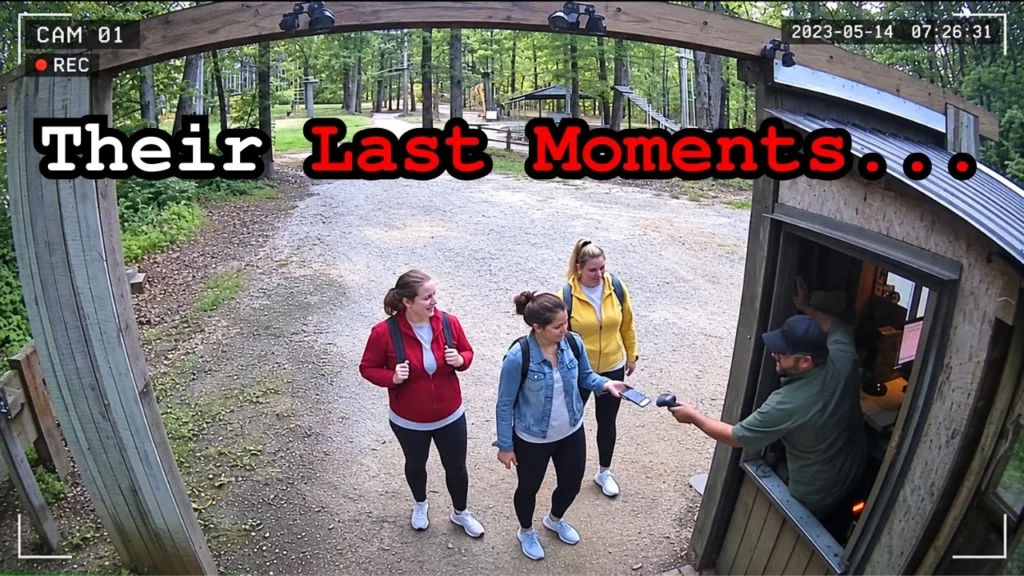
The final footage comes from the entrance at 4:52.
Becca in red, June in denim, Lacy in yellow.
Three women walk beneath the gate together.
Orrin scans June’s phone and the device chirps twice.
The first sound admits the group.
The second copies their identities into a tag already carrying the code of a dead visitor.
Hours later, the log will show three departures.
The camera records none.