The Spanish conquerors may have destroyed ancient temples, sealed sacred caves, and forced indigenous communities to abandon their beliefs.
But they couldn’t erase everything.
Right underneath Oaxaca, archaeologists uncovered evidence that challenges what we thought we knew about the history of Latin America’s past.
And one discovery in particular raises a question that could turn the history books upside down for good.
Chronicles of a Sealed Underworld Back when Spanish missionaries reached Mitla, the ancient Zapotec ceremonial center in southern Mexico, they found something far stranger than the stone buildings above ground.
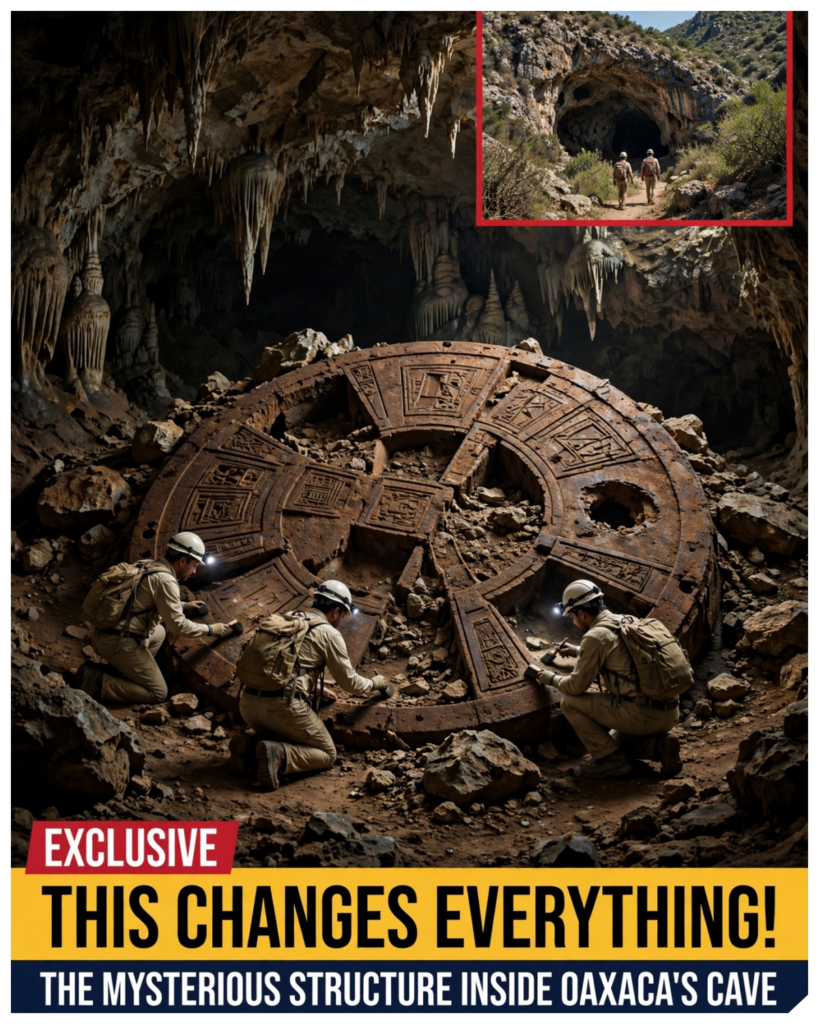
Beneath the main structures was reportedly an entire underground temple.
Dominican friar Francisco de Burgoa documented the account in his 1674 book, Geográfica Descripción.
He described four connected chambers beneath the complex, ending in a mysterious stone doorway that supposedly led into a cavern stretching dozens of miles underground.
Burgoa went on to describe the first three chambers.
The first contained the tombs of Zapotec high priests, buried in their ceremonial clothing.
The second held the remains of kings, dressed in fine robes and surrounded by valuable ornaments.
The third was reserved for fallen warriors, laid to rest in their battle regalia.
Beyond these rooms stood the fourth chamber, sealed by a heavy stone door.
The Zapotecs called the place Lyobaa, meaning the Place of Rest, and believed it was connected to the entrance of the underworld.
The Spanish priests were reportedly horrified by what they found beyond the fourth doorway.
They described the cavern as a gateway to hell and ordered indigenous workers to block the entrance with heavy stones and mortar.
Years later, during the colonial period, the Church of San Pablo Apóstol was built directly over the ruins.
This was no accident.
Spanish authorities often placed churches over indigenous sacred sites, replacing old places of worship with Christian ones and making a clear statement about whose religion now held power.
For more than 350 years, historians remained skeptical of Burgoa’s account.
Many dismissed it as colonial exaggeration or religious storytelling rather than an actual description of what lay beneath Mitla.
After all, no one had ever found or mapped a cavern stretching for miles beneath the valley.
Yet the people of San Pablo Villa de Mitla never stopped talking about the passages.
Stories of tunnels beneath the town continued to pass from one generation to the next, even as outside historians questioned whether they had ever existed.
For centuries, Burgoa’s underground labyrinth was dismissed as little more than a legend.
That began to change when archaeologists started investigating other caves across the Oaxaca Valley and uncovered evidence of a much older secret.
In the nineteen sixties, American archaeologist Kent V.
Flannery turned his attention to the Tlacolula Valley, the stretch of land between Yagul and Mitla.
This part of central Oaxaca is lined with dry, rocky cliffs containing more than 147 prehistoric caves and rock shelters.
From the outside, these sun-baked openings hardly look like places anyone would choose to live, let alone return to for generations.
Flannery focused on a small rock shelter known as Guilá Naquitz, meaning White Cliff.
From the valley floor, it looked like an ordinary overhang, offering little more than shade from the sun.
Yet once Flannery and his team began excavating, they uncovered traces of human activity stretching back thousands of years.
The team carefully excavated five layers of soil and rock, which they labeled Strata A through E.
Inside, they found traces of old campfires, chipped stone tools, and the remains of living spaces dating from roughly 8000 to 6500 BCE.
During this period, near the end of the last Ice Age, small groups of hunter-gatherers moved across the valley, using shelters like Guilá Naquitz during the dry season for protection from the heat and harsh weather.
The dry mountain air in Oaxaca had preserved things that would normally disappear within a few years in a damp tropical climate.
Inside the caves, wooden tools, twisted cords, pieces of woven baskets, and even tiny grains of pollen had survived for thousands of years.
As researchers sifted through the dry soil, they came across something unexpected.
Mixed in with the dust were tiny, dried plant fragments that looked no different from ordinary wild weeds.
At first, they seemed unremarkable, yet those little scraps would eventually reveal something important about the beginnings of farming in the Americas.
Further testing using radiocarbon dating and accelerator mass spectrometry revealed just how old these plant remains really were.
By measuring the radioactive carbon preserved in the samples, scientists found evidence of crops dating much earlier than experts had expected in this part of the Americas.
What first appeared to be an ordinary rock shelter was turning out to be an important piece of the story of how early people began domesticating plants for food.
Buried in the dust of Guilá Naquitz were clues to something far bigger than an ancient meal.
They pointed to the early beginnings of the crops that would later sustain entire civilizations across the Americas.
The Cradle of Latin American Civilization Among the oldest finds were seeds and rind fragments dating back roughly 10,000 years.
Researchers identified squash seeds from Cucurbita pepo alongside pieces of bottle gourd rind.
These remains provided some of the earliest confirmed evidence of plant domestication in the Americas.
This also showed that people were already doing more than gathering whatever grew in the wild.
They were choosing plants with useful traits, saving their seeds, and growing them again to get better results.
A few thousand years later, farmers in the same valley were working on another plant that would eventually change how people ate.
Its wild ancestor, teosinte, looked nothing like modern corn.
It was a branching grass with small, hard seeds that easily fell to the ground.
Yet inside Guilá Naquitz, researchers found three ancient maize cobs dating to 5,420 radiocarbon years before present, or roughly 6,250 years ago by calendar dating.
Botanists Bruce Benz and Dolores Piperno took a closer look at the cobs and found signs that early farmers had already begun changing the plant through selective breeding.
Two features stood out.
The first was a tough central stem, or rachis, that kept the kernels attached instead of allowing them to break off and scatter naturally.
The second was a thinner outer covering, known as the glume, which made the kernels easier to chew, grind, and prepare.
Long before genetics became a science, these early farmers were already changing corn one generation at a time.
The Oaxaca cobs also showed that maize farming began earlier than many experts had believed.
They were about 700 years older than previously discovered corn remains in the Tehuacán Valley to the north, suggesting that farmers in Oaxaca were already cultivating maize much earlier than expected.
As farming developed, corn, beans, and squash became the foundation of the milpa system.
Corn stalks supported climbing bean vines, while the broad leaves of squash covered the ground, helping retain moisture and keep weeds down.
Together, these three crops provided a reliable and nutritious food supply that helped sustain growing communities.
From central Oaxaca, farming knowledge gradually spread across Mesoamerica and into Central and South America.
The crops and growing methods developed by early farmers helped support larger populations and, eventually, powerful civilizations, from Monte Albán and Teotihuacán to the great Maya cities and the Inca Empire much farther south.
In 2010, UNESCO recognized the importance of this history by naming the Prehistoric Caves of Yagul and Mitla a World Heritage Site, preserving evidence of one of the most important changes in human history: the move from hunting and gathering to farming.
Farming helped shape the civilizations that followed, but further inside Oaxaca’s mountains, ancient cave paintings reveal another side of the story, one that goes far beyond food and survival.
10,000 Years of Cave Art Beyond the caves where early farmers left behind seeds and tools, nearby rock shelters such as Caballito Blanco and Cueva Blanca hold a different kind of record.
Their walls carry images left by people who lived here thousands of years ago.
Some painted by placing a hand against the rock and blowing red or black pigment around their fingers through a hollow reed.
Once the hand was removed, its outline remained on the wall.
These simple handprints offer a rare glimpse of the people who once lived in the valley, almost as if they had left their signatures behind for future generations to find.
Near Yagul, one of the best-known paintings is a figure nicknamed the Yagul tadpole, associated with traditions dating back roughly 10,000 years.
It has a rounded body, a face, tiny arms, and a long tail, and may represent ideas about water, fertility, and the cycle of life.
Other caves contain geometric shapes, star-like patterns, and markings across their ceilings that may reflect early attempts to observe the night sky.
Watching the stars and tracking seasonal changes helped these communities know when to move, gather food, and plan important activities throughout the year.
Other cave paintings show scenes of hunting and figures that appear to have held spiritual meaning.
Deer, ritual figures, and human-animal forms suggest a belief system in which animals, plants, and even parts of the landscape were seen as having spirits and special powers.
The artists also made their own paints using materials found around them.
Crushed hematite produced deep red pigments, charcoal and manganese created black, while gypsum and pale clay provided white.
These simple materials allowed them to leave images that have survived for thousands of years.
Researchers also found that the shape of these shelters affected how sound traveled through them.
Their curved rock walls could carry chants, stories, and flute music across the chambers, making them suitable for ceremonies and gatherings.
And the paintings left behind did not simply disappear with the people who made them.
Over thousands of years, some of the visual traditions found in these shelters continued to influence later forms of expression, including Zapotec writing and the painted Mixtec codices.
But the rock shelters only tell part of Oaxaca’s story.
Far beneath the mountains, much deeper caves hold clues to a past that goes back even way back in time.
In Oaxaca’s Sierra Mazateca mountains lies Sistema Huautla, the deepest known cave system in the Western Hemisphere.
It extends more than 1,554 meters, or over 5,100 feet, below the surface, with passages stretching for more than 100 kilometers.
Exploring a system this vast is no easy task.
Cavers have to descend steep vertical shafts on ropes, navigate flooded passages, and sometimes spend weeks living underground.
Every rope, food supply, and piece of equipment has to be carried down with them.
More than 11,000 years ago, during the Pleistocene Ice Age, deep sinkholes connected to this cave system may have acted as natural traps for large animals roaming the highlands.
One wrong step could send an animal tumbling down a vertical shaft, leaving it with little chance of escape.
Far below the surface, the cool, dark conditions helped preserve its bones, protecting them from sunlight, scavengers, and the elements that would normally speed up decay.
Among the most remarkable discoveries was the only known complete skull of Meizonyx salvadorensis, an extinct giant ground sloth that disappeared around 13,000 years ago.
Explorers also recovered remains of extinct shrub-oxen and an ancient American mountain deer known as Odocoileus lucasi.
These fossils offer a glimpse of a very different Oaxaca, one where enormous ground sloths and other animals now lost to extinction once roamed the highlands.
Sistema Huautla also holds clues to what the climate was like hundreds of thousands of years ago.
Scientists used uranium-thorium dating to study stalagmites formed between 114,000 and 342,000 years ago.
Each mineral layer preserves evidence of past rainfall, changes in monsoon patterns, and prolonged droughts across the region.
Regardless, these underground waters mean more than climate records to the indigenous Mazatec people.
In their traditions, cave springs are regarded as living spirits and guardians of the mountains, reflecting a deep connection between water, the land, and the communities that depend on them.
But Sistema Huautla isn’t the only place where Oaxaca’s underground holds unexpected discoveries.
In another mountain range, explorers found the strangest human figures shaped entirely from mud.
The Mud Guardians of Cueva del Rey Kong-Oy In the mist-covered Sierra Mixe mountains lies Cueva del Rey Kong-Oy, also known locally as Cueva del Diablo, or Devil’s Cave.
For the Ayuuk ja’ay, the Mixe people, this cave is tied to the legend of King Kong-Oy, a warrior-hero said to have been born from an egg.
According to their oral traditions, he fought to defend his people before eventually entering the sacred mountain rather than surrendering to his enemies.
Between 2018 and 2025, archaeologist Leslie F.
Zubieta Calvert and her team carried out a detailed study of the cave, publishing major findings in 2025.
Getting to the main ritual chamber is no simple walk.
Visitors must travel about 350 meters underground, following a narrow passage alongside a clear underground stream before finally reaching the gallery.
Inside the chamber, researchers found 72 sculptures rising directly from the cave floor.
Sixty-three depict human figures, while six represent animals, including jaguars, monkeys, and frogs.
The remaining three are models of buildings.
The figures range from about 27 inches tall to more than six and a half feet, with some reaching two meters.
Men, women, and children are all represented, many wearing elaborate headdresses, earspools, and other forms of jewelry.
What puzzled material scientists was how these mud figures had survived for so long.
They had never been fired in a kiln, leaving them vulnerable to the usual problems with wet clay.
As it dries, mud shrinks and cracks, while exposure to rain can gradually wash it away.
Yet inside the cave, stable humidity and still air helped protect the sculptures from cracking and erosion for more than a thousand years.
The tests, which were carried out in 2025 using X-ray fluorescence and micro-Raman spectroscopy, revealed how the sculptors made use of materials found inside the cave.
They collected local clay containing quartz and mica, minerals that helped give the mud figures their structure.
They also used pigments from the surrounding rock to add details, with manganese providing black and hematite producing red.
Even charcoal samples found nearby also helped researchers establish when the cave was used.
The earliest evidence of ritual activity dates to around 151 BCE, suggesting people had been visiting the site for centuries.
However, most of the sculptures were created much later, between 607 and 881 CE, during the Late Classic period.
These sculptures show just how important caves were to the spiritual lives of ancient Mesoamerican people.
And that brings us back to the question hanging over Mitla.
Was there really an underground temple buried beneath the church?
In 2022, a team effort called Proyecto Lyobaa, or Project Lyobaa, set out to investigate the mystery beneath Mitla without disturbing the ancient site.
The team brought together specialists from Mexico’s National Institute of Anthropology and History, the National Autonomous University of Mexico, and the ARX Project.
Rather than digging through the church floor, they turned to geophysical technology, using three different scanning methods to examine what lay beneath the rock and soil.
The team used three different techniques to examine what lay beneath the surface.
Ground-penetrating radar sent pulses into the earth to detect hidden structures, while electrical resistivity measurements helped identify areas where air or moisture had collected.
A third method picked up tiny vibrations in the ground, known as seismic noise, to reveal underground features.
By combining the results, researchers could build detailed 3D images of what was hidden underground.
Their first surveys focused on the courtyard and surrounding areas of the sixteenth-century Church of San Pablo Apóstol in Mitla.
This was the very spot where Friar Francisco de Burgoa had written in 1674 that priests sealed off a passage leading into the underworld.
By 2023 and 2024, the scans had revealed some intriguing features beneath the church.
Researchers detected a large underground space directly below the main altar, along with two tunnels extending east and west at depths of roughly 16 to 26 feet, or five to eight meters.
When the team combined the results into 3D images, the layout closely matched the description Burgoa had recorded centuries earlier.
His account, it seemed, was based on something real after all.
In the following field season, the team expanded its surveys to other parts of Mitla, including the Columns, Adobe, Arroyo, and South Groups.
The scans revealed more underground passages and rectangular rooms extending beneath different sections of the ancient site.
Beneath the church’s sacristy, researchers also detected what appeared to be a blocked staircase leading down toward a possible royal burial chamber.
Getting the scans done wasn’t entirely straightforward.
Church committees initially restricted access to certain areas inside the building, while some residents worried that outside researchers might damage the historic church or interfere with their heritage.
The team had to respect those concerns and work with the local community before expanding the investigation.
But that wasn’t all.
Just months later, another discovery beneath Oaxaca revealed something researchers hadn’t expected.
The Zapotec Tomb Discovery at San Pablo Huitzo In 2025, archaeologists in Oaxaca began investigating an anonymous tip about illegal looting in the town of San Pablo Huitzo.
What they found was far more significant than a looting site.
Hidden underground was a remarkably well-preserved Zapotec tomb dating back to around 600 CE.
When Mexican officials and INAH announced the discovery in January 2026, they described it as the most important archaeological find in Mexico in a decade.
Right above the entrance is a carefully carved stone owl with wide, striking eyes.
In Zapotec belief, owls were associated with the night, death, and the journey into the underworld.
This one has a human face carved directly into its beak.
On either side of the doorway stand two more human figures carved into the stone posts, each holding ritual objects as if guarding the entrance to the tomb.
Inside the burial chamber, researchers found brightly painted walls covered with figures in ochre, white, green, red, and blue.
They appear to be moving in a procession, carrying bags of sacred copal incense.
Calendar signs and symbols linked to family lineages were also carved into the stone, giving experts clues about who was buried there and their position in Zapotec society.
Across Latin America, countless ancient tombs have been looted, often destroying valuable evidence in the process.
This one survived largely intact because someone reported the activity in time, allowing archaeologists to study the paintings, carvings, and burial chamber as one complete historical record.
Taken together, Mitla’s underground passages, Kong-Oy’s mud sculptures, and Huitzo’s painted tomb reveal a much richer picture of the ancient world than we once understood.
Across ancient Mesoamerica, caves held a much deeper meaning than simple openings in the ground.
People saw them as gateways between the human world and the cosmos.
Some traditions described caves as the womb from which the first people emerged into the world, while others saw them as the mouth of a giant Earth Monster, leading down into the realm of the dead.
This belief gave caves a central place in both everyday life and religious practice.
This belief appeared in different forms across Mesoamerica.
In Oaxaca, the Zapotecs associated Lyobaa with a sacred resting place in the underworld.
Farther south, the Maya spoke of Xibalbá, while Aztec traditions described Mictlán as the land of the dead.
The names and stories differed, but they shared the idea that the world beneath the ground was closely connected to the spiritual one.
Caves and underground springs also played an important role in beliefs about rain.
Many indigenous communities believed that rain gods lived in these hidden places.
For the Zapotecs, one of them was Cocijo, the god of rain, thunder, and lightning.
He was believed to send storms and rainfall into the world from beneath the earth.
So when crops depended on the next rainfall, caves and springs became important places to visit and worship.
Mitla held an important place in this belief system.
Ancient accounts describe it as a major religious center where priests entered underground chambers to communicate with revered ancestors.
Even the buildings above ground reflected this connection.
Zapotec craftsmen decorated palace walls with intricate stone patterns known as grecas, arranged in repeated geometric designs that may have echoed the order and symbolism associated with the underworld.
Deep inside these caves, people left offerings as part of rituals meant to maintain balance between the human world and the spiritual one.
Archaeologists have uncovered clay pots, jade beads, copal incense burners, and animal remains placed in hidden corners of underground chambers.
At Cueva del Rey Kong-Oy, researchers have also noted the female figures and themes of birth, growth, and renewal among the mud sculptures.
After Spanish conquest brought the destruction of many indigenous temples, caves offered communities a more private place to continue their ceremonies and preserve traditions that had been passed down for generations.
That spiritual connection has never been confined to the past.
These discoveries are bringing it back into public view and raising new questions about how indigenous history is understood and protected across Latin America.
Rewriting the Colonial Narrative During the colonial period, Spanish writers often described indigenous cave rituals as forms of devil worship.
Even the name Cueva del Diablo, given to King Kong-Oy’s mountain sanctuary, reflected this attitude.
Such labels helped Spanish authorities portray indigenous beliefs as something dangerous that needed to be replaced.
By branding sacred places as evil, they could justify closing them off, suppressing traditional ceremonies, and imposing Christianity in their place.
Modern research is now giving new weight to stories that local communities have carried for generations.
Ground scans beneath Mitla, radiocarbon dates from ancient charcoal, and mineral analysis of cave sculptures are helping researchers connect those accounts to physical evidence.
In many cases, oral traditions preserved details about places and practices long before archaeologists began investigating them.
And these discoveries also challenge the idea that indigenous cultures disappeared after the Spanish conquest in 1521.
Across Oaxaca, Zapotec, Mixe, and Mazatec communities are still very much alive.
Millions of people continue to speak their languages, raise families, and pass their traditions on to younger generations.
Their history was never frozen in the past.
It is still being lived today.
Archaeology itself is also beginning to take a different approach.
More research projects now involve Mexican experts and local communities, giving residents a say in how their heritage is studied and protected.
In places such as Mitla and the Sierra Mixe, community leaders have placed limits on access to certain caves, making sure that research and tourism do not come at the expense of sacred sites.
Online, exaggerated posts and AI-generated images sometimes invent stories about hidden gold and secret ancient books.
These claims can easily overshadow the discoveries that actually matter: mud sculptures preserved for centuries without ever being fired, underground passages mapped without excavation, and ancient tombs saved before looters could destroy them.
A similar change is taking place elsewhere in Latin America.
In Peru, Guatemala, Bolivia, and Colombia, indigenous communities are playing a bigger role in protecting archaeological sites and telling their own histories, rather than leaving others to speak for them.
But as more of these hidden sites are discovered, another concern arises about their survival, especially with the pressure of modern development and the damage caused by nature.
Opening places like the tunnels beneath Mitla or Cueva del Rey Kong-Oy comes with a serious risk.
For centuries, these caves have maintained stable temperatures, moisture levels, and air conditions.
Even a few visitors can disturb that balance.
Body heat raises the temperature, breathing adds carbon dioxide, and artificial lighting can encourage mold and algae to grow.
Once the conditions change, delicate mud sculptures and ancient wall paintings can begin to crack, fade, or deteriorate much faster than they did underground.
Some of Europe’s best-known caves show just how damaging uncontrolled tourism can be.
After the paintings at Lascaux and Altamira attracted large numbers of visitors, changes in the cave environments led to outbreaks of mold and fungus.
Authorities eventually had to close the original sites to protect the artwork.
In some cases, the only way to preserve ancient paintings is to keep visitors away from them.
Digital technology now offers another way to experience these places.
Using laser scans, thousands of overlapping photographs, and virtual reality, researchers can create detailed 3D models that let people explore the caves without putting the original walls at risk.
Outside the caves, looting remains a serious problem across Latin America.
Thieves looking for valuable artifacts often destroy the very evidence that makes an archaeological site worth studying.
The San Pablo Huitzo tomb is a good example of why early reporting matters.
In 2025, a tip gave experts enough time to intervene before looters could strip the burial chamber of its contents.
Tourism brings a different kind of pressure.
News of Project Lyobaa reportedly helped increase visitor numbers around Mitla by about seventeen percent, putting more strain on local roads, parking areas, and sacred sites.
To manage access, communities around Mitla and the Sierra Mixe rely on their own traditional systems of governance, known as usos y costumbres.
These rules allow local assemblies to decide who can enter sacred caves and under what conditions.
Nature presents another challenge.
Changing rainfall patterns, stronger storms, and longer dry periods across southern Mexico can alter underground water levels and gradually weaken the limestone surrounding these ancient spaces.
What makes Oaxaca’s caves remarkable isn’t the treasure people imagine finding inside them.
It’s the evidence they hold of how ancient communities lived, adapted, and survived.
Why Oaxaca’s Caves Change Latin America Forever Looking back at these discoveries together, three major parts of Oaxaca’s history begin to take shape.
The first is the story of survival at Guilá Naquitz, then the Sistema Huautla, and finally the story of spiritual identity, carried through places like Cueva del Rey Kong-Oy, Mitla, and San Pablo Huitzo.
These discoveries push the history of Latin America much further back than the usual story suggests.
Its past did not begin with the arrival of European ships in 1492.
Thousands of years earlier, indigenous communities were already domesticating plants, developing farming methods, and growing crops that would eventually feed people across the Americas.
Places like Mitla and Cueva del Rey Kong-Oy also show how much of that history remains connected to the present.
Along with stories and beliefs passed down through generations and new laboratory findings, together, they are helping researchers understand a past that local communities have remembered all along.
These discoveries also matter to the generations growing up in these communities today.
When young people see their history recognized through real archaeological evidence, it can strengthen their connection to their heritage and encourage greater care for local traditions, schools, and the environment.
Yet much of Oaxaca remains unexplored.
Its rugged mountain ranges contain thousands of caves, many of which have never been properly investigated.
And with so much still hidden beneath the surface, there are likely many more pieces of this history waiting to be found.
So, which of these discoveries caught your attention most?
The ancient origins of corn, the remarkable mud figures of Kong-Oy, or the hidden tunnels beneath Mitla?
Let us know in the comments.
If you enjoyed this, please don’t forget to hit that like button and subscribe right now.
For more content like this, click the video on your screen.
Thank you for watching!