In the mountains of eastern Turkey, a strange boat-shaped formation has puzzled explorers for more than sixty years.
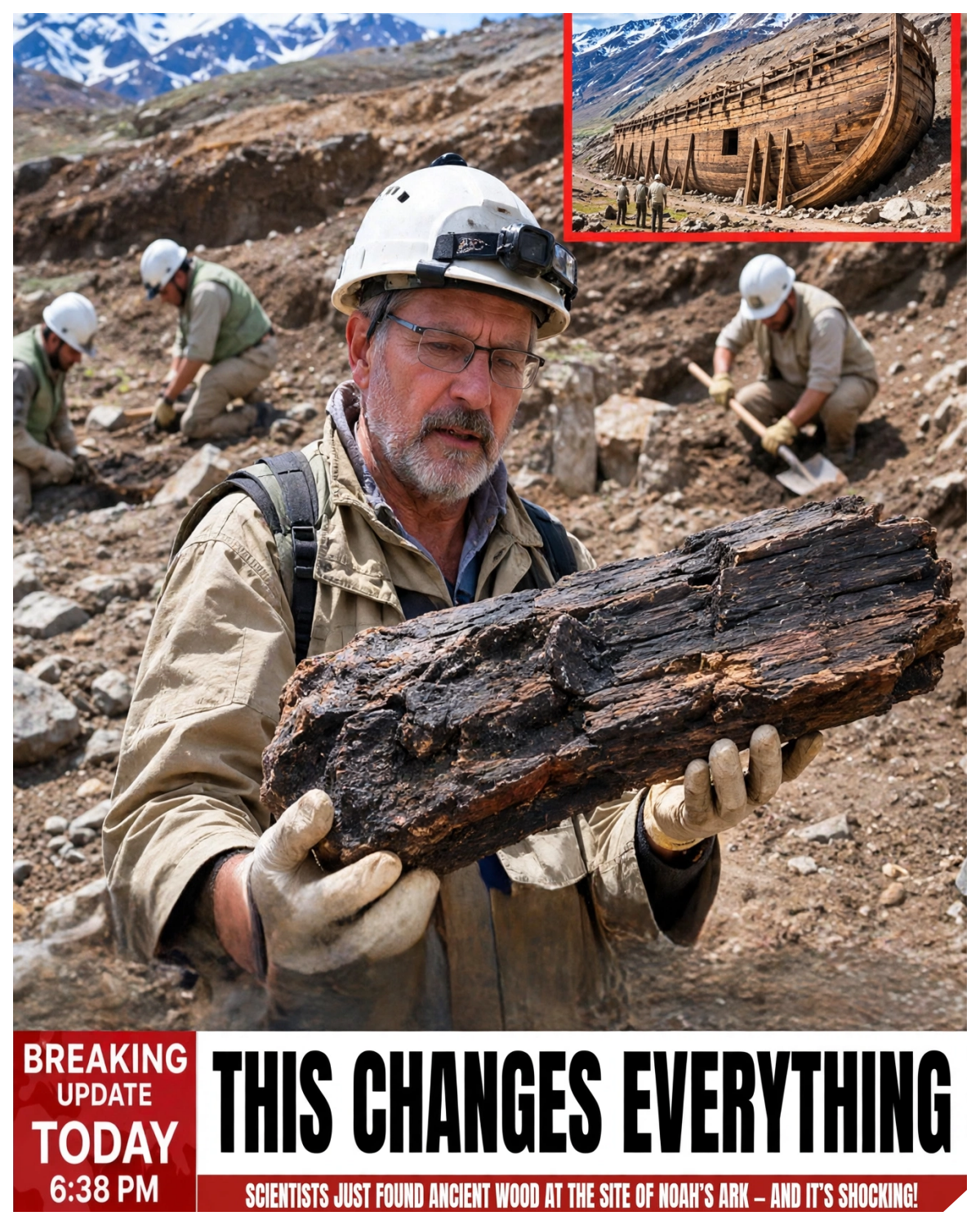
Now, a research team says it has finally pulled something remarkable from deep inside it.
Charred pieces of ancient wood, buried about thirty feet underground.
And according to lab results the team has released, that wood is roughly four thousand three hundred years old.
That number lines up strikingly well with some traditional dates for the biblical flood.
But is this the breakthrough believers have waited centuries for, or something else entirely?
THE BOAT-SHAPED MYSTERY IN THE MOUNTAINS The reason a few burnt pieces of wood are making headlines around the world begins with the place where they were found.
It is called the Durupınar Formation, and it sits in a remote valley in eastern Turkey, close to the borders of Iran and Armenia.
It lies roughly twenty-nine kilometers, or about eighteen miles, south of the peak of Greater Mount Ararat, the snow-capped giant that has been linked to the story of Noah for centuries.
From the ground, the formation can look like just another hill.
But from above, it looks like something else entirely.
It is long and narrow, pointed at one end and wider at the other, with raised edges running along its sides.
To many people who see it for the first time, it looks unmistakably like the hull of an enormous ship, frozen into the earth.
The formation first gained attention in 1959.
During an aerial survey of the region, a Turkish army captain named İlhan Durupınar noticed the unusual shape in the photographs.
It measured roughly one hundred and fifty-seven meters long, or about five hundred and fifteen feet.
The following year, the images were published in Life magazine, and a small expedition traveled to the site.
They did not find anything they considered conclusive, and for a while, the excitement faded.
But the formation never really disappeared from the conversation.
The reason is simple.
In the Book of Genesis, God instructs Noah to build an ark three hundred cubits long.
Depending on which cubit you use, that length can come out very close to the size of the Durupınar Formation.
For believers, that match was too striking to ignore.
In the late 1970s and 1980s, an American named Ron Wyatt became the most famous promoter of the site.
He was not a trained archaeologist, but he spent years visiting the formation, using metal detectors, taking samples, and claiming he had found evidence of a buried ship.
Working with him for a time was David Fasold, a former merchant marine officer who also became convinced that the dimensions matched the Bible.
Their claims drew huge interest in Christian circles, and in 1987, the Turkish government designated the area as a protected site.
A visitor center was eventually built overlooking the formation.
But scientific opinion was a very different story.
Geologists argued that the shape was a natural feature, a product of rock folding, erosion, and mudflows.
And in one of the most surprising turns in the entire saga, David Fasold himself later changed his view.
In 1996, he and geologist Lorence Collins published a paper with a blunt title: “Bogus ‘Noah’s Ark’ from Turkey Exposed as a Common Geologic Structure.”
In that paper, they argued that the evidence Fasold had once found convincing was only circumstantial, and that the formation was natural rock.
For many scientists, that was the end of the matter.
Multiple studies over the years concluded that no ship was buried at Durupınar.
There is another layer of complexity that often gets overlooked.
Genesis does not actually say the Ark landed on a single peak called Mount Ararat.
It says the Ark came to rest on the “mountains of Ararat.”
Scholars point out that no mountain carried that exact name at the time the text was written.
The term is often understood to refer to a broader region, associated with the ancient kingdom of Urartu and later Armenia.
The mountain the Turks call Ağrı only later became internationally known as Mount Ararat.
That means the search area described in the Bible could be far wider than one famous summit.
People have been hunting for the Ark in this part of the world since at least the Middle Ages.
Travelers, monks, adventurers, and explorers have all claimed to have seen or touched pieces of it.
Most of those stories have faded into legend.
But Durupınar has held on, partly because of its shape, and partly because a new generation of researchers has refused to let the question go.
That new generation came with new tools, new partners, and a new determination.
And in the summer of 2026, they say, they pulled something out of the ground that has reignited the entire debate.
THIRTY FEET DOWN: THE DISCOVERY The group at the center of this story is called Noah’s Ark Scans.
It is a U.S.-based team that has spent years studying the Durupınar Formation with modern technology, including ground-penetrating radar and other subsurface imaging methods.
The group’s founder, Andrew Jones, has been a familiar voice in recent coverage of the site, and the team has repeatedly said that it intends to follow the evidence wherever it leads.
This time, the team was working alongside a Turkish academic partner.
The research project is led by Professor Cenker Atila, an archaeologist at Sivas Cumhuriyet University in Turkey.
His involvement is significant, because it brings a credentialed archaeologist directly into the fieldwork, rather than leaving it to amateur explorers as was so often the case in the past.
According to the team, the discovery came during the summer of 2026.
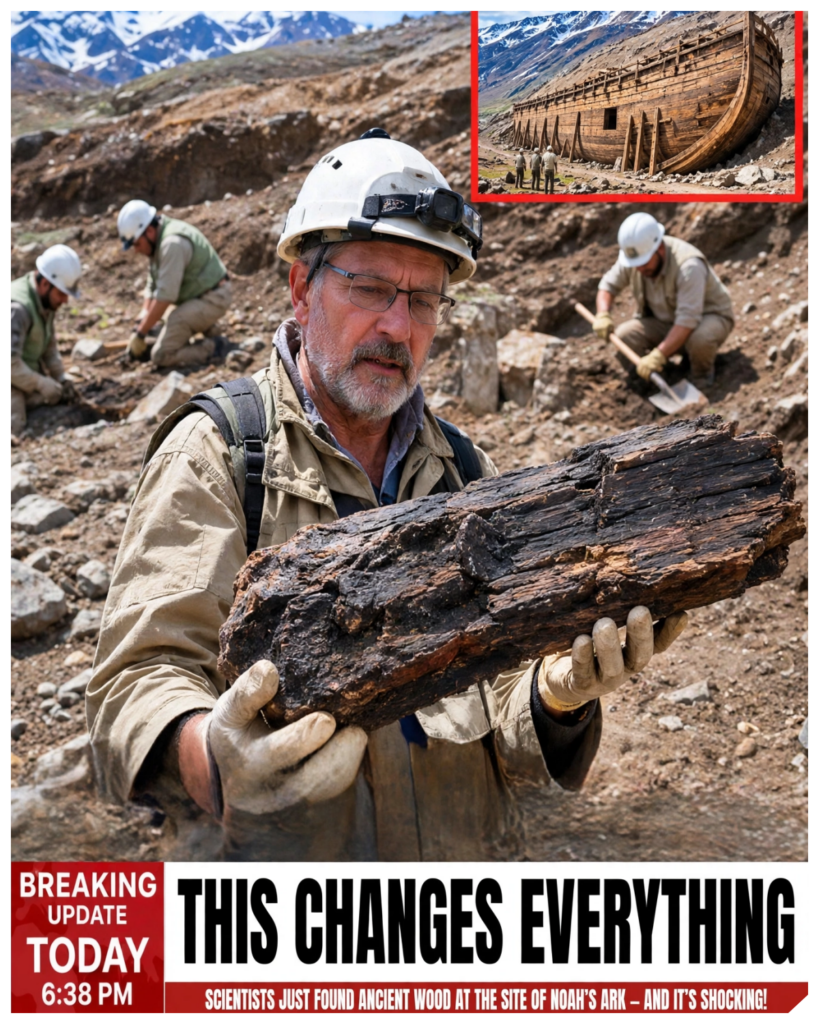
Professor Atila recovered several pieces of wood from an exposed face on the western side of the boat-shaped formation.
The pieces were found about nine meters below the surface, roughly thirty feet down, and about one meter in from the exposed face.
That detail matters.
Wood lying on the surface could have come from anywhere.
Wood embedded deep inside a formation raises far more intriguing questions about how it got there and how long it has been there.
Atila has said that the wood was found at a considerable depth, and he has described the excitement he felt when he first pulled it from the ground.
For someone who has spent time studying a site surrounded by so much controversy, holding a physical object from deep inside it must have been an extraordinary moment.
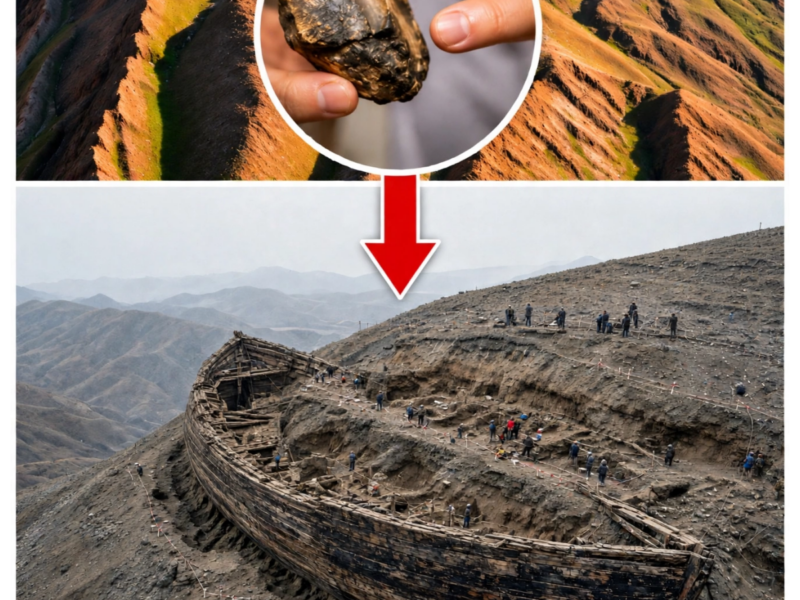
The team later shared images of the material.
They filled several bags with what they described as burnt-looking wood.
The fragments were dark, cracked, and heavily charred.
Yet despite the damage, the grain of the wood was still visible, and so were growth rings.
That is important, because growth rings and grain are what separate genuine wood from rock that only looks like wood.
In the past, critics had dismissed some samples from the area as stone that had been mistaken for petrified timber.
This time, the team says, the material is clearly wood.
Then came an even bolder claim.
Earlier in the same month the results were announced, the group shared images with Newsweek of wood fragments that it said showed signs of human tools.
Professor Atila has said he believes the wood was shaped by human hands.
He has pointed to shaping marks, surface details, and features that he considers unnatural.
In his view, the Durupınar Formation could indeed be the site of Noah’s Ark.
That is a dramatic statement from a university archaeologist.
But it is also worth noticing how carefully the rest of the team has framed things.
Andrew Jones has said that they do not yet know how the wood got there.
He has described the team’s approach as step by step, following the scientific evidence rather than jumping ahead of it.
And notably, the team as a whole has not claimed that the wood is actually part of the Ark.
Instead, the founder of Noah’s Ark Scans has framed the moment in a more personal way.
He has described how exciting it was to hold wood that, according to the dating, existed at the time of the flood described in the Bible.
That is a careful choice of words.
It is not the same as saying the wood came from the Ark.
It is saying the wood is old enough to have been around when the flood is said to have happened.
The charring also raises questions of its own.
Why would wood buried deep inside this formation be burnt?
Some believers have speculated about pitch, since Genesis says Noah covered the Ark with pitch inside and out.
Others wonder about ancient fires, volcanic activity, or other natural processes in a region surrounded by volcanic mountains.
At this stage, no one has offered a definitive answer.
It is also worth thinking about what it means to work at a site like this.
The Durupınar Formation is not a tidy excavation trench in a museum courtyard.
It is a remote, rugged landscape, exposed to harsh winters, heavy rains, and shifting ground.
Over time, erosion and slumping have opened up parts of the formation, creating exposed faces where layers of earth and rock can be seen from the side.
These natural cuts give researchers a rare chance to look deep inside without digging from the top down.
The western face where the wood was recovered is one of those openings.
Working on such a face can be slow and delicate, because researchers need to record exactly where each piece comes from.
A fragment’s position, depth, and surrounding material can be just as important as the fragment itself.
If the wood was sealed within undisturbed layers, that would suggest it had been there for a very long time.
If it had slipped in from above, or been carried in by water or a landslide, the story would be very different.
That is why the detail of being one meter in from the face, and not simply lying on the surface, has been highlighted so strongly by the team.
What is clear is that the discovery itself has changed the conversation.
For decades, the debate over Durupınar revolved around shapes in the landscape, radar images, and stones.
Now, for the first time in a long time, there is organic material that can be tested in a laboratory.
And when the laboratory results came back, they produced the numbers that sent this story racing across the internet.
THE NUMBERS THAT LINE UP WITH GENESIS Wood can be tested in a way that rock cannot.
Because it was once part of a living tree, it contains carbon that can be measured using radiocarbon dating.
Living things absorb carbon from the atmosphere while they are alive, including a small amount of a radioactive form called carbon fourteen.
When the organism dies, it stops taking in new carbon, and the carbon fourteen slowly decays at a known rate.
By measuring how much is left, scientists can estimate how long ago the tree stopped growing.
Radiocarbon dating has become one of the most powerful tools in modern archaeology.
It has been used to date ancient campfires, burial sites, scrolls, textiles, and tools from around the world.
Results are usually given as a range rather than a single year, because the measurements carry some uncertainty and must be calibrated against known records of how atmospheric carbon has changed over time.
That is why the Durupınar results are presented as spans of more than a century.
A range does not mean the scientists are unsure whether the wood is old.
It means they are being precise about how confident they can be within a window of time.
The fact that the team says the testing was done in two different countries is also notable.
When separate laboratories produce results that agree, it adds weight to the dates, because it reduces the chance that a single lab made an error or that a sample was contaminated in one place.
According to a press release dated November 24, 2026, the Durupınar wood samples were radiocarbon dated by laboratories in both the United States and Türkiye.
The results reported for two samples were striking.
One sample was dated to between 2410 and 2269 BCE.
Another was dated to between 2349 and 2193 BCE.
In plain terms, that places the wood at roughly four thousand three hundred years old.
Andrew Jones told Fox News that this lines up with traditional dates for Noah’s flood.
That number causes so much excitement because of how some Christians have calculated the timing of the flood.
In the sixteen hundreds, the Irish archbishop James Ussher worked through the genealogies and timelines of the Bible and produced a famous chronology of world history.
In his calculations, the flood took place around 2348 BCE.
Many other traditional reckonings land in a similar window, give or take a century or two.
Now look again at the dates.
The first sample spans 2410 to 2269 BCE.
The second spans 2349 to 2193 BCE.
Ussher’s date of 2348 BCE falls inside both ranges.
For people who have long believed that the Durupınar Formation is the resting place of the Ark, that overlap feels almost too perfect to be a coincidence.
The wood results also do not exist in isolation.
They come after a series of other claims from the same research effort.
Before the wood was announced, the team released footage of what it called the Ark’s “hull.”
It described a distinct band following the outline of the boat-shaped formation, which it interpreted as a possible outer shell, with mud both inside and outside.
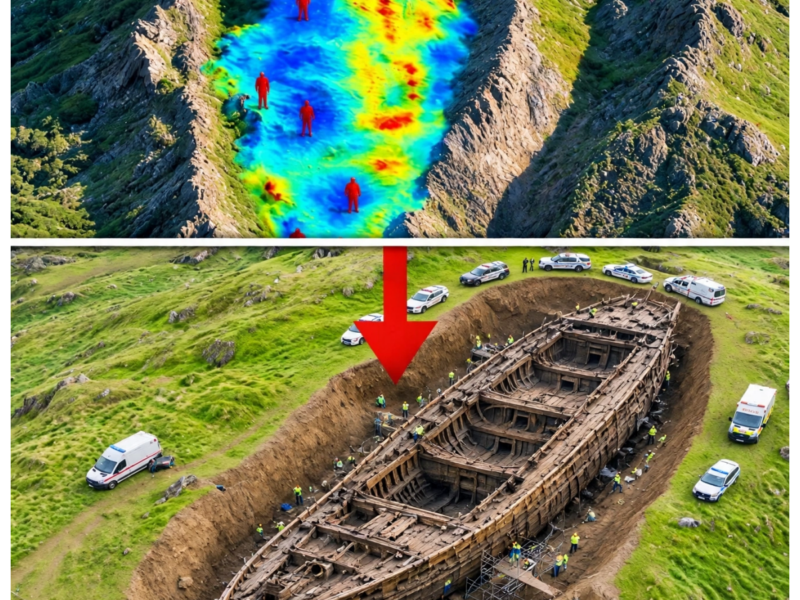
Then there was the radar work.
Khosrow Bakhtar of Bakhtar Research and Engineering produced a preliminary report interpreting radar data from the site.
In that report, which has not yet been peer reviewed, he argued that the data indicated a human-made structure beneath the surface.
He described organized patterns, as well as what he interpreted as corridors, chambers, and hallways inside the roughly five-hundred-and-fifteen-foot formation.
Earlier studies at the site had also drawn attention.
In recent years, Turkish university researchers collected soil samples from the formation and reported that some of the material appeared to be very ancient, along with signs they believed were worth further investigation.
Those findings did not prove a ship was there, but they kept the scientific interest alive.
Put all of this together, and you can see why believers are thrilled.
A boat-shaped formation that roughly matches biblical dimensions.
Radar interpretations of chambers and corridors.
A possible hull outline.
And now, wood found thirty feet down that dates to the very era when tradition places the flood.
To many people following the story, it feels as if the pieces of a very old puzzle are finally coming together.
Noah’s Ark Scans has also stressed that it is using techniques that simply were not available in 1996, when Collins and Fasold published their famous paper rejecting the site.
In the team’s view, older conclusions were based on older tools, and modern technology deserves a fresh look.
That is a fair point as far as it goes.
Science does change as tools improve.
But that same scientific process requires something else too.
It requires that extraordinary claims be tested, checked, and challenged by people who have no stake in the outcome.
And when independent experts looked at these new claims, many of them were far from convinced.
WHY SCIENTISTS AREN’T CONVINCED The first and most important caution is about how the results have been shared.
As of now, the dating results come from a press release and screenshots, not from a peer-reviewed scientific publication.
Peer review is the process where other experts examine the methods, data, and conclusions before a study is published.
It is not perfect, but it is the standard way that science separates solid findings from premature announcements.
Newsweek, which covered the story, noted that it had not independently verified the findings.
The laboratories that performed the dating were not named in that coverage.
Without knowing exactly which labs did the work, how the samples were collected, and how they were prepared, outside scientists cannot properly judge the results.
The second major caution is something experts call the “old wood problem.”
This is one of the most important ideas in the entire story, and it is easy to miss.
Radiocarbon dating does not tell you when a piece of wood was cut down, carved, or used to build something.
It tells you when the carbon in that particular part of the tree was fixed, meaning when that section of the tree was growing.
And trees grow outward, one ring at a time.
The innermost rings of an old tree can be decades or even centuries older than the outer rings.
If a tree lived for five hundred years, wood from its center could date five centuries earlier than the day the tree actually died.
On top of that, wood can lie on the ground for a long time before it is buried, burned, or reused.
A 2021 study published in the journal Radiocarbon found that age differences caused by this kind of issue can range from decades to centuries, and occasionally even thousands of years.
So even if the dates are completely accurate, they do not necessarily tell us when the wood ended up thirty feet inside the formation.
They only tell us roughly when the tree was growing.
Think of it this way.
Imagine someone in the future digs up a wooden beam from an old house and finds that the wood is three hundred years old.
That does not mean the house was built three hundred years ago.
The tree may have been ancient when it was cut, and the beam may have been reused from an even older building.
Archaeologists deal with this kind of puzzle all the time, which is why they rarely rely on a single date to tell the whole story.
They look for multiple samples, short-lived materials like seeds or twigs, and a clear understanding of the layers surrounding each find.
Until that kind of detailed picture is available for Durupınar, the dates remain intriguing, but incomplete.
The third caution is about the type of wood.
At this point, the species has not been identified, and the team says a future test is expected to determine it.
That matters more than many people realize.
Commentators at Wood Central have noted that if the wood turns out to be birch, which tends to be shorter-lived, it would ease some of the dating concerns.
If it turns out to be oak, which can live for centuries, it would make the old wood problem even more serious.
The fourth caution is about the claim of human shaping.
Professor Atila believes the wood shows tool marks and unnatural features.
But according to IFLScience, those signs of shaping have not been documented in a way that outside experts can evaluate.
Charred and cracked wood can take on strange shapes through natural processes, and without detailed published analysis, it is difficult for anyone else to confirm what he is seeing.
Then there is the geology of the formation itself, which has never stopped being a problem for the Ark theory.
The 1996 paper by Collins and Fasold made several specific points.
It argued that a supposed iron bracket found at the site came from weathered volcanic minerals.
It said the so-called metal-braced walls were natural concentrations of iron minerals in tilted layers of sedimentary rock.
It concluded that samples once described as gopherwood bark were actually a type of altered volcanic rock called peridotite.
It pointed out that fossil-bearing limestone cuts across the structure, which would make it younger than the supposed flood deposits.
And it noted that the famous anchor stones in the nearby village of Kazan were made of local andesite, a common volcanic rock.
None of those points has been fully overturned by the new research.
And the geological setting raises another possibility.
The formation sits in an area shaped by volcanic activity, mudflows, and landslides.
Wood from ancient trees could, in theory, have been carried into place and buried by natural events over time.
Charring could come from fires or volcanic heat.
These explanations do not require a ship at all.
Interestingly, even one of the writers covering the story pointed out something odd.
If the team is so excited, why are most of its members careful not to claim that the wood is from the Ark?
That caution may simply be good scientific practice.
But it also shows that, even among the people doing the work, the question is still very much open.
So where does that leave the discovery?
It is real wood, found at real depth, with dating results that, if confirmed, place it in a fascinating period of history.
But between “ancient wood in a formation” and “Noah’s Ark,” there is still a very large gap.
And closing that gap will require far more than a press release.
WHAT HAPPENS NEXT — AND WHY IT MATTERS The good news for anyone following this story is that the research is not over.
Noah’s Ark Scans has said it plans to test soil at various depths across the formation to analyze its composition.
That kind of testing could help show whether the material inside the boat-shaped outline is different from the surrounding ground, and whether there are layers that suggest something unusual buried within.
The team has also said that a test to determine the species of the wood is expected.
As we saw, that single result could make a big difference in how the dating is interpreted.
A short-lived species would strengthen the case that the wood is genuinely close to four thousand three hundred years old at the time it was buried.
A long-lived species would leave much more room for doubt.
A final expedition report is expected in late April or May of 2027.
The group has said that it will report its results wherever the data goes.
That is exactly the right attitude, and it will be worth watching closely to see whether the report includes the kind of detail that independent scientists can check, such as the names of the laboratories, full sampling methods, photographs of any claimed tool marks, and the radar data itself.
If the research is eventually submitted to a peer-reviewed journal, that would be an even bigger step.
It would allow geologists, archaeologists, and dating specialists from around the world to examine the evidence on its own merits.
Some of them might find flaws.
Some might find the evidence stronger than expected.
Either way, the conversation would move from headlines to hard data.
So what would it actually take to convince the scientific world that the Durupınar Formation is the remains of a vessel?
Experts would likely want to see clear, documented, man-made features, such as joints, fastenings, or carefully worked planks, found in place within the structure.
They would want independent dating from multiple labs, with the species identified and the old wood problem accounted for.
They would want a geological explanation for how a wooden ship could survive for thousands of years in that environment and end up buried inside what looks like natural rock.
And they would want all of this published openly, so others could test it.
That is a high bar.
But it is the same bar applied to every major archaeological claim.
The discovery of ancient cities, shipwrecks, and royal tombs all had to clear it before they were accepted.
History offers plenty of reminders that both enthusiasm and skepticism can be wrong.
For centuries, many scholars treated the ancient city of Troy as pure legend, until excavations in western Turkey in the nineteenth century revealed layers of a real settlement at Hisarlik.
On the other hand, the history of biblical archaeology is also full of announcements that collapsed under closer scrutiny, from questionable relics to forged inscriptions.
In both kinds of cases, the deciding factor was the same.
The evidence had to be laid out in full, examined by people with different perspectives, and tested again and again.
Exciting headlines did not settle anything.
Careful work did.
For the Durupınar Formation, that process is only just beginning.
The wood discovery may turn out to be a fascinating clue about the ancient environment of the region, revealing what kinds of trees once grew there and what natural events buried them.
Or it may become part of a larger body of evidence that forces experts to look at the site in a new way.
Either outcome would teach us something.
And that, in the end, is what good science is supposed to do.
Meanwhile, the discovery has already done something important.
It has brought renewed attention to one of the most enduring stories in human history.
Flood stories are not unique to the Bible.
Ancient Mesopotamian texts, including the Epic of Gilgamesh, describe a great flood and a man who survives it by building a boat.
Cultures across the world have their own versions of a deluge that wiped out much of humanity.
Whether people see these stories as history, memory, or myth, they clearly touched something deep in the human imagination.
That is part of why a few pieces of charred wood can cause such a stir.
They are not just wood.
To believers, they represent the possibility that one of the most famous stories ever told could have left a physical trace.
To skeptics, they represent a test of how carefully we handle exciting claims, and how easily hope can run ahead of evidence.
There is also something deeply human about the search itself.
For centuries, people have climbed these mountains, studied these valleys, and wondered whether something extraordinary is hidden beneath the ground.
The tools have changed, from hand-drawn maps to radar and radiocarbon labs, but the question has stayed the same.
Is the story true?
For now, the honest answer is that we do not know.
What we do know is that a team led by a university archaeologist has recovered ancient wood from about thirty feet inside a mysterious boat-shaped formation.
We know that the reported dates fall around four thousand three hundred years ago.
And we know that the evidence has not yet been independently verified or published in a scientific journal.
That may not be the dramatic proof some people hoped for.
But it is something real, something that can be tested, studied, and argued over.
And in a debate that has lasted for more than sixty years, that alone is significant.
Perhaps the most shocking thing about this discovery is not what it proves, but how much it reveals about us.
After thousands of years, the story of a great flood and a single ship still has the power to make headlines, stir arguments, and send researchers digging thirty feet into a mountainside.
Whatever the final report shows, the search for Noah’s Ark is far from over.
So what do you think?
Is this ancient wood a clue to one of history’s greatest mysteries, or just a natural puzzle waiting to be explained?
Share your thoughts in the comments below.
And if you enjoyed this story, be sure to watch more videos on our channel for more deep dives into history, mystery, and the unexplained.