The most recognizable statue anywhere in the world.
Its scale is immense.
It’s one single piece of stone.
It is cut from the natural rock of the Giza Plateau.
In the heart of Egypt’s timeless sands stands a mystery as old as civilization itself.
For generations, the Great Sphinx has fascinated archaeologists, historians, and dreamers alike.
And lately, headlines have been telling us that scientists have finally unlocked its long hidden secrets.
Hidden passages, forbidden tunnels, a flooded shaft with a sarcophagus at the bottom of it, a stone with a date that seems to push Egypt’s history back by nearly a thousand years.
Could any of it rewrite everything we know?
Here is what I want to do on this journey.
I’m going to take each of those claims seriously, and then I’m going to check it against the record.
Some of what you’ve heard is documented, some is disputed.
I’ll tell you which is which.
Because when it comes to the Giza Plateau, the line between a real discovery and a viral rumor is thinner than you’d think.
So stay with me.
We’ll go into the back of the monument, down a shaft into the dark, and out into one of the fiercest arguments in modern archaeology.
And it begins with a quiet passage near the Sphinx’s tail and a single worker who remembered something.
The passage at the back.
The Great Sphinx is about 73 m long and 20 m high, carved out of a single mass of limestone bedrock in a quarry on the Giza Plateau.
It was not built block by block.
It was cut out of the earth and the quarried stone around it was used to build the temples nearby.
Most Egyptologists attribute it to the reign of Cafrey around 2500 B.CE, CE builder of the second pyramid, though no inscription from his time says so.
One of the most intriguing features is a passage near the back of the monument close to the tail.
The story goes that the Egyptologists Zahi Hawas and Mark Laner were told by an elderly worker about a hidden tunnel there.
They removed a single stone and found a passage descending beneath the Sphinx.
For about 3 weeks, they explored it, working in the dark.
They found nothing and the work was recorded in a short report around 16 pages with a small number of photographs, most showing the entrance and the outside.
That thin paper trail is part of why the passage has been surrounded by rumor.
When a site is closed to the public and the documentation is sparse, imagination fills the gap.
Here’s where I’ll slow down.
The viral version says that a few daring visitors working in seconds while the guards were distracted, photographed a new tunnel rising up into the monument, a boarded up passage running upward and eastward, and that those photos line up with ground radar showing cavities in the same direction.
I can’t verify those photographs, but I can tell you the radar claim has a long history.
In 1987, a team from Japan’s Waseda University, led by Sukuji Yoshimura, used electromagnetic sounding around the Sphinx and reported anomalies.
In 1991, Boston University geologist Robert Shock and seismologist Thomas Dobecki ran a seismic survey that suggested possible cavities beneath the front paws.
Has said repeatedly that he has found nothing there, and investigators have long cautioned that cracks, fissures, and water- fil voids in limestone can all look like chambers to a machine.
There’s a reason the legend refuses to die.
In the 1930s, the American mystic Edgar Casey predicted that a hall of records would be found beneath the Sphinx’s right paw containing the history of a lost civilization.
That idea taken up decades later by writers like Graham Hancock helped turn every anomaly into a potential door.
So what do we actually have?
Genuine documented passages, a handful of unexplained instrument readings, and no confirmed chamber.
That’s not nothing, but it isn’t a discovery either.
And not far from the Sphinx, there is a hole in the ground that is real, deep, and flooded into the Osiris shaft.
Along the causeway that links the Sphinx area to the pyramid of Cafrey, a rectangular opening drops into the rock.
This is the Osiris shaft, one of the strangest places on the plateau.
It’s a vertical shaft that leads down through three levels carved straight out of limestone bedrock.
The first shaft plunges roughly 10 m into the first chamber, a plain space without decoration or treasure.
From there, a second shaft descends about 20 m more into a more complex level.
And at the very bottom, around 30 m below the surface, lies the heart of the structure.
A chamber that is partly flooded by groundwater with a large stone sarcophagus standing in the middle of it.
Surrounded by smaller chambers and six empty burial shafts, it’s easy to see why the place feels theatrical.
A sarcophagus half submerged in dark water deep beneath the desert looks like a scene from the Egyptian underworld.
Egyptologists, however, say the water is not a mystery.
Giza lies near the level of the Nile’s water table, so deep shafts in the plateau tend to fill.
But the ancient Egyptians didn’t see water as a nuisance.
It was a symbol.
That’s where the name comes from.
Osiris was the god of the afterlife, death, and rebirth.
In the myth, he was murdered by his brother Set, and his body was torn apart and scattered.
His wife Isis gathered the pieces and through ritual revived him.
He became ruler of the dead, and the Egyptians linked him with the annual flood of the Nile, which brought life back to dry fields.
A tomb surrounded by water built to resemble the island where Osiris was said to rest fits that story almost perfectly.
Here’s a link that few videos mention.
The Greek historian Heroditus writing in the fifth century B.CE claimed that the burial chamber of Kufu lay on an island surrounded by water brought in from the Nile through a channel.
No one has ever found such a chamber inside the Great Pyramid.
But the idea of an island tomb at Giza was clearly in the air in Greek era Egypt.
And the Osiris shaft looks like a physical version of it.
Pottery shards and fragments of stone vessels found in the shaft have led some researchers to suggest a new kingdom origin around 1550 to 1070 B.CE.
Others have argued for the late period, especially the site era of the 7th and 6th centuries B.CE.
When Egypt looked back to the old kingdom and revived its religious and artistic styles.
It’s a reminder that the shaft has no inscriptions to settle the question and that dating a space cut straight into bedrock with no built masonry to study is notoriously difficult.
The shaft has also yielded mummified remains in the surrounding chambers.
They are a reminder that this wasn’t just a symbolic monument.
Real people were buried here, and the way they were buried may tell us more about the period than the architecture does.
Some writers suggest it was a place for initiation rituals, a kind of spiritual theater in which participants reenacted the death and rebirth of Osiris.
It’s an appealing idea, and it would fit the symbolism.
But I should be clear, no ancient text describes such a ritual at this site.
It’s a theory built on resemblance, which raises a different question.
Why can’t you simply walk into the Osiris shaft today?
The shaft that keeps changing.
The shaft has two entrances, one to the south and one to the north.
Photographs from a 2011 expedition show the northern entrance as a weathered open hole in the bedrock about 6 ft high with no ladders and no tool marks and an eroded secondary tunnel beside it.
[music] Visitors who have returned in recent years say it looks very different.
Much of that opening has been sealed with a concrete wall.
The depression below it has been filled with sand and the secondary tunnel has been covered too.
Why?
The simple answer is safety and preservation.
Open shafts are dangerous and the Giza plateau receives millions of visitors.
Closing a hole that leads 30 m down into flooded rock is a sensible decision for any authority.
Egypt’s Ministry of Antiquities has a long record of restricting access to fragile and hazardous sites.
But the ceiling has also fed suspicion, and I understand why.
When a place becomes harder to see, people assume there is something to hide.
Researchers who study these changes point out that the shaft was never designed for casual entry.
The ladders that exist today were added by archaeologists, and the ancient builders left no easy way down.
There are real puzzles inside, too.
Why did the builders bring massive granite sarcophagi down into a shaft [music] when they could have cut burial chambers directly into the bedrock?
The sarcophagi are made of a different stone than the shaft and they carry no inscriptions.
Each is estimated to weigh around 40 tons.
Lowering that much weight on ropes, possibly with water in the shaft to help, would have been a delicate operation.
One slip and the shaft would have been permanently blocked.
Engineering feats like that were not out of reach for Egypt.
The builders of the old kingdom routinely moved blocks of granite weighing dozens of tons, including the roofing beams of the Great Pyramids King’s Chamber, quarried at Aswan about 800 km away.
What’s unusual about the Osiris shaft isn’t the weight, it’s the narrow space.
Then there’s a detail that has caught the attention of researchers.
On the south wall of the second level, a sarcophagus coated in a thin layer of bumen with a metallic layer beneath it.
Analysis reportedly found it was largely lead with traces of zinc, iron, titanium, and arsenic.
The purpose of that coating is unclear.
It might be a decorative finish, a preservative, or a later treatment.
I haven’t found a peer-reviewed paper explaining it.
And that brings us to the sarcophagus everyone is talking about.
The stone that shouldn’t exist.
One of the largest sarcophagi in the shaft is a massive gray one.
And a claim about it has spread widely online through X-ray defraction.
The claim goes the rock was identified as dayight, a mineral supposedly unknown in any other ancient Egyptian artifact.
Geologists, the story says, found no dayight deposits in Africa large enough to produce a block this size, which means it must have been imported by sea from far away, perhaps Europe or the Black Sea region.
Let’s take that apart carefully.
Desight is a real rock.
It’s a volcanic rock, fine grained, made mostly of feldspar and quartz, common in volcanic arcs such as the Andes, the Carpathians, and parts of the Mediterranean.
It’s not rare in the world.
The claim though that none exists in Africa is an enormous assertion because Africa is a huge continent with a long volcanic history, including the East African Rift and the Ethiopian Highlands.
And identifying a rock type from X-ray defraction alone is difficult since many volcanic rocks share the same minerals and differ mainly in proportions and texture.
The claim also doesn’t clearly say who did the analysis, where it was published, or whether it was reviewed.
What we do know about Egyptian stone use is that the Egyptians were extraordinary criers.
They used granite from Azwan, basaltt from Fume, quartzite from Gel Lahmar near Cairo, and alabaster from Hatnub.
They also traded widely.
Importing cedar from Lebanon, and obsidian from the south.
Importing a 40 ton block of stone by sea would be a staggering expense, and it would be a surprising choice when highquality granite could be had from Aswan.
If it happened, it would be recorded somewhere in texts or shipping evidence.
So far, nothing has been presented.
The most dramatic claim is the date.
The sarcophagus, the story says, has been dated to around 3350 B.CE in the predinastic era, roughly 850 years before the usual dating of the Giza pyramids.
Here the method matters.
The technique cited was developed by Professor Yawanis Litzis, an archaeologist at the University of the Aian.
[music] It’s a form of optical luminescence dating and it works on a clever idea.
Tiny crystals inside stone like quartz and feldspar soak up energy from natural radiation and store it in microscopic traps.
When the stone is exposed to sunlight, that stored energy is released and the clock resets to zero.
If two stones are then pressed together in darkness, the clock begins ticking again.
By measuring how much energy has built up, scientists can estimate when the surface was last exposed to light.
It is a legitimate technique and it has been applied to Greek and Egyptian monuments, but it comes with caveats.
The method works best on surfaces that were last exposed during construction, and it’s sensitive to contamination, reuse, and partial bleaching.
Stones that were quarried, moved, and reset could give misleading results.
And I haven’t found a published paper presenting a 3350 BCE date for this sarcophagus.
Claims like that need to appear in a peer-reviewed journal with methods, error ranges, and sample details before they can be taken as a result.
So, here’s the honest summary.
If the date were confirmed, it would be important, but as of now, it’s an unverified claim that appears in videos, not in the literature.
That doesn’t stop people from building on it.
And one of the most influential voices in that conversation is Graham Hancock, The Lost Civilization Theory.
Graham Hancock is a British author known for books like Fingerprints of the Gods and Magicians of the Gods and for the 2022 Netflix series Ancient Apocalypse.
His central idea is that an advanced civilization existed during the last ice age and was wiped out by a catastrophe, leaving survivors who spread knowledge to other early cultures.
In Hancock’s telling, the Osiris shaft is a possible relic of that lost world.
And the water in its lower levels isn’t just groundwater.
It’s a symbolic reminder of ancient floods.
His theory leans on the younger Dryus, a sudden cold period that began about 12,800 years ago and ended around 11,600 years ago.
Some researchers have proposed that a comet impact triggered it, melting ice sheets and unleashing floods that disrupted Atlantic currents and caused rapid cooling.
It’s worth knowing where that science stands.
The younger dus impact hypothesis was proposed in 2007 by Richard Firestone and colleagues and it has been intensely debated.
Many geologists have challenged the evidence including the claimed layers of nano diamonds and microsphererals and several independent reanalyses have failed to reproduce them.
A 2011 paper by Nicholas Pinter and others went so far as to title itself a reququum for the hypothesis.
Supporters continue to publish and the debate isn’t fully closed.
But even if an impact did occur, there is no archaeological evidence connecting it to a lost advanced civilization.
That absence is what bothers professional archaeologists.
In November 2022, the Society for American Archaeology wrote to Netflix asking that Ancient Apocalypse be reclassified as science fiction rather than documentary, arguing that it presented speculation as fact and undermined the achievements of real ancient peoples.
Hancock replied that he was raising questions, not claiming certainty.
Both positions deserve a fair hearing, but they don’t carry equal weight in the evidence.
Hancock also connects the Sphinx to astronomy.
He and the author Robert Balval, whose 1994 book, The Orion Mystery, proposed that the three Giza pyramids mirror the stars of Orion’s belt, argue that the monuments encode a sophisticated knowledge of procession.
The slow wobble of Earth’s axis that completes a cycle roughly every 26,000 years.
Around 10,500 B.CE, CE.
They say the constellation Leo would have risen before the sun on the spring equinox and the lionbodied sphinx would have been gazing at it.
Astronomers have pushed back.
The Griffith Observatory’s Edwin Crup has pointed out that the alignments rely on selecting some stars and ignoring others and that the belt correlation requires choosing the right orientation of the map.
Many Egyptologists add that the pyramids can be explained by Egyptian religion which centered on the sun god Rah and the stars as part of the afterlife, not on a lost astronomical program.
Everything about the Giza layout can be explained within a known cultural framework, which doesn’t mean the alternative is impossible, only that it’s unnecessary.
The most serious scientific challenge to the standard date of the Sphinx came not from Hancock, but from a geologist.
In the early 1990s, Robert Shock, a geologist at Boston University, examined the Sphinx and its enclosure and noticed something that struck him.
The deep fissures, the undulating lines, and the rounded contours of the limestone looked to him more like water erosion than the windb blown sand erosion you’d expect in the desert.
He presented his argument at a meeting of the Geological Society of America in 1991.
If he was right, the Sphinx would have been exposed to heavy rainfall for long stretches, which only fits a period when Egypt was wetter.
Between about 10,000 and 5,000 B.CE., the Sahara was green, a time known as the Neolithic Subluvial or African humid period.
Shul suggested a sphinx dating to at least 7,000 to 5,000 B.CE.
And possibly older.
And Hancock and the writer John Anthony West became champions of the idea.
It’s a serious argument and it’s worth hearing the answers.
Limestone isn’t uniform.
The Sphinx is carved from layers of differing hardness which erode at different rates and wind and blowing sand can cut soft layers into rounded wavy shapes.
Salt is another culprit.
Groundwater rises through the limestone by capillary action.
And when it evaporates, it leaves salt crystals that expand and flake the surface from within.
This process, called salt weathering, is documented around the Sphinx and has damaged it for centuries.
Critics also note that the Sphinx has been buried in sand for much of its life.
Thmos IV left an inscription, the dream stela, between its paws around 1,400 B.CE, E describing how he cleared the sand from the statue.
Layers of sand and moisture trapped against the stone would have driven erosion in a way that doesn’t need heavy rainfall.
The geologist James Herrell of the University of Toledo has argued that the pattern of weathering fits the known climate of Old Kingdom Egypt and that the rain required to explain shocks pattern would have eroded the neighboring tombs and temples in a similar way which isn’t observed.
And then there is the archaeological context.
Mark Laner’s work shows that the Sphinx and the Valley Temple next to it were built together.
The giant limestone blocks of Cafre’s Valley Temple match the stone that was removed to carve the Sphinx’s ditch, which strongly links the two.
The Sphinx faces east along the same axis as Cafre’s complex, and its design echoes the royal portraits of the fourth dynasty.
As a whole, the Sphinx sits comfortably in Cafrey’s world.
Shock never retreated from his claim, though he later suggested a more moderate age than some of his supporters.
That’s the nature of the debate.
A real geological observation, a counter explanation based on other geology and an archaeological case that points to a different timeline.
Now, you may have come across a story that goes a different way.
It involves a hidden hatch, the hatch that never was.
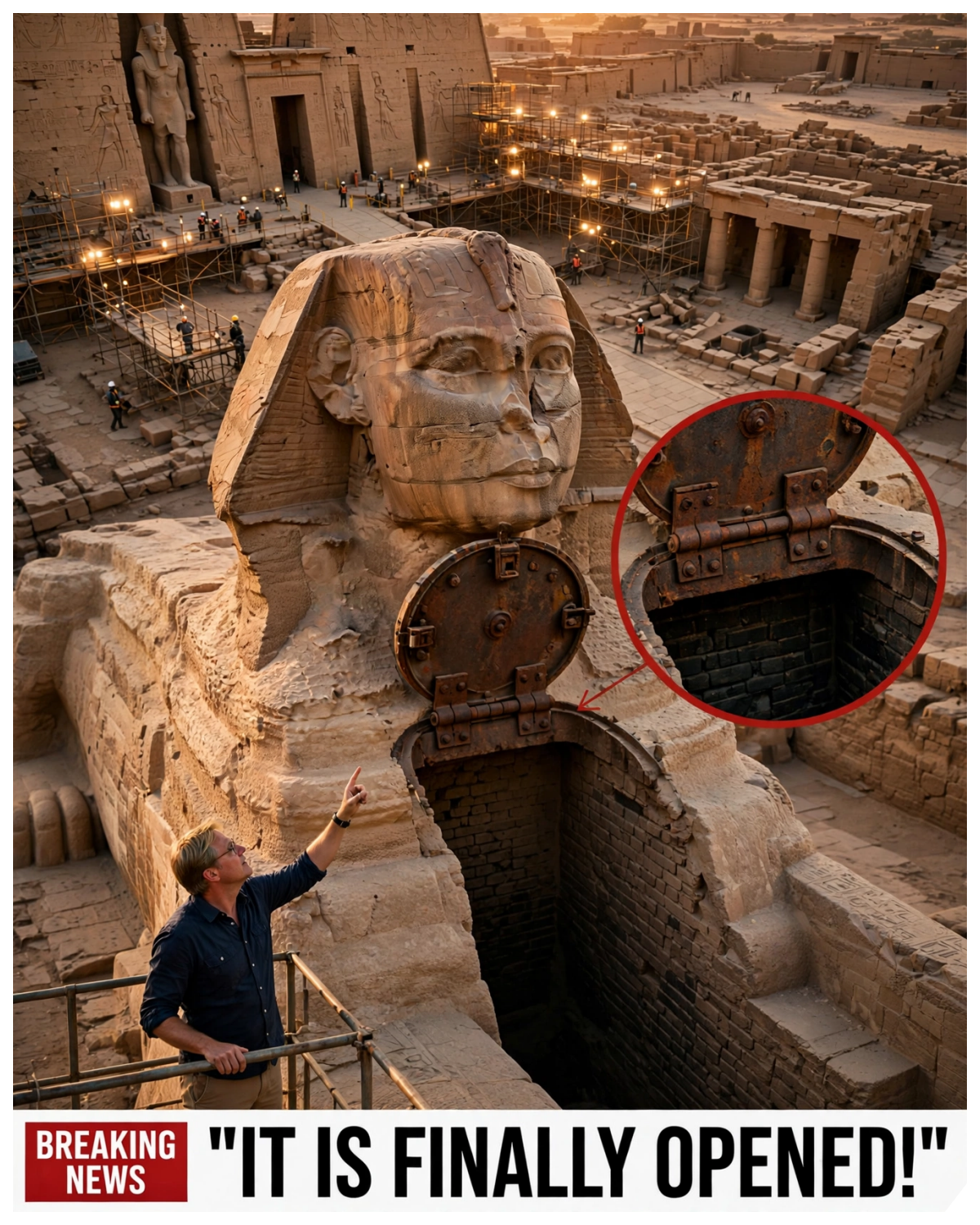
A popular story claims that an expedition led by a renowned archaeologist unlocked a secret hatch on top of the Sphinx’s head.
Beneath it, the story says they found a narrow staircase leading down to a chamber with hieroglyphs on the walls and a perfectly preserved golden amulet that seemed to pulse with ancient power.
Headlines supposedly announced it around the world.
I have to be direct.
I can find no credible report of any such discovery.
No archaeological authority has announced it.
No peer-reviewed paper describes it and no major news organization covered it.
The tone and the details read like fiction, and in the version I found, it’s even labeled as a story.
There is, however, something real on top of the Sphinx’s head.
There is a hole in the crown of the head.
Researchers have long discussed it, and the likeliest explanations are that it held a support for a headdress or attachment, or that it was cut in later periods.
Whatever it was for, nothing in the documentation suggests a staircase, a chamber, or an amulet.
Why does a story like this spread?
[music] Because it fits what we want.
A monument that has watched over the desert for 4,500 years should have a secret.
But the real archaeology of the Sphinx is quieter and in some ways more satisfying.
We know that the Sphinx was cleared of sand by the Egyptians themselves, repaired by Roman and later restorers and excavated in modern times by Emil Berets in the 1920s and 1930s.
The monument has a long documented life and it doesn’t need a golden amulet to be remarkable.
There’s one more story about the Sphinx that millions of people believe.
And unlike the golden amulet, it feels true because you can see the evidence with your own eyes.
Look at the face.
The nose is gone.
Ask almost anyone what happened and you’ll get the same answer.
Napoleon’s soldiers did it.
In 1798, during his campaign in Egypt, French troops supposedly used the Sphinx for target practice and blew off its nose with a cannonball.
It’s a vivid story.
It has a villain, a weapon, and a date.
And it’s wrong.
The first problem is the paper trail.
In 1737, more than 60 years before Napoleon landed in Egypt, a Danish naval officer named Frederick Luis Nordon traveled up the Nile and sketched the Sphinx.
His drawings show the face already without its nose.
The second problem is that there’s an older account written by someone who lived much closer to the event.
The Egyptian historian al- Makrizi working in the early 15th century [music] described a Sufi named Muhammad Sahim Alar who in 1378 was disturbed by local farmers who left offerings at the Sphinx hoping it would bring good harvests.
In Al-Mak’s telling, Sim Alar climbed up and defaced the monument.
He was reportedly punished for it.
In some accounts, killed by an angry crowd.
Now, a careful note that is a medieval chronicle, not a modern excavation report, and historians treat such accounts with caution, but it fits what researchers have seen on the stone itself.
Close studies of the face have found tool marks consistent with a deliberate removal by hand, not with a single blast from a gun.
There’s a lesson hiding in this.
Egyptians of the 14th century believed so strongly in the Sphinx’s power that some of them worshiped it and one of them attacked it.
Seven centuries later, we’ve swapped in a different story in which the damage was done by a famous outsider and in doing so, we’ve lost the real one.
The same thing happened with the beard.
Fragments of it were recovered in the early 1800s and pieces now sit in museums in London and Cairo.
Nobody needed a conspiracy to explain either loss, time, weather, and people did it.
That’s the pattern we keep seeing at Giza.
When the real history is slow and complicated, a faster, more dramatic version moves in.
Sometimes that version is a cannonball, sometimes it’s a golden amulet, and sometimes it’s an entire lost civilization.
So, the next time someone tells you what’s hidden beneath the Sphinx, ask the same question we just asked about its nose.
What’s the earliest record and who wrote it?
Which brings us to the tunnels.
Some enthusiasts believe the bottom of the Osiris shaft connects to a vast network of passages beneath Giza.
On the third level, there’s a section that looks like a tunnel and has never been fully explored.
It’s natural to wonder where it leads since vertical shafts often connect to underground complexes.
Here’s the context.
Egypt does have extensive underground tunnels.
At Tuna Elgel, the catacombs of the sacred ibises and baboons stretch for about 3 km of galleries packed with millions of mummified birds.
Beneath the step pyramid at Sakara, the great substructure built for King Joser around 2650 B.CE contains an elaborate network of shafts and galleries that laid end to end run for roughly 5 1/2 km according to most descriptions.
Some retellings inflate that figure many times over, but even the real number is impressive.
Giza’s tunnels are different.
They are generally the burial shafts and chambers of tombs cut downward beneath Mustabas and they tend to be short.
The idea of a single network linking Sakara to Giza is a rumor and no one has documented it.
What’s more telling is the water.
The lowest levels of the Osiris shaft are flooded and pumping efforts [music] reportedly ongoing since 2012 haven’t solved it.
The reason is straightforward.
The plateau sits near the water table of the Nile.
And in antiquity, the river’s course and flood plane were different from today.
Limestone bedrock acts like a sponge.
Any tunnel cut that deep is going to fill.
So were the tunnels built for travel or for water.
Egyptologists favor a simpler answer.
Most were tombs and ritual spaces, and some may have been designed deliberately to reach the water table, which was symbolically important.
People walking through them was never the point.
Meaning was that brings us to the bigger question behind all of this.
The biggest question Hancock’s broader theory as we’ve seen is that a global civilization existed before the Egyptians, Sumerianss, and the people of the Indis Valley, and that survivors of a cataclysm carried its knowledge around the world.
He points to flood myths from many cultures as a shared memory of that event and to the precision of structures like the great pyramid, Stonehenge, the megaliths of South America and Puma Punku in Bolivia as evidence of that knowledge.
It’s a story with real emotional power, but the details deserve scrutiny.
Take Puma Punku, part of the Tiwanaku complex in Bolivia.
Its carved stones with sharp interior angles and grooves look astonishingly precise, but the site dates to roughly 500 to 1,000 CE.
And the stones are andesite and sandstone, which can be worked with hard stone hammers, abrasion, and patient labor.
Archaeologists have found evidence of the tools and techniques involved.
The precision is impressive, and it’s human.
And the biggest recent challenge to the lost civilization idea comes from a hill in southeastern Turkey.
Gbecepe discovered by archaeologist Klaus Schmidt in 1994 dates to around 9500 B.CE about 11,500 years ago.
It has enormous carved stone pillars, some weighing many tons, arranged in circles decorated with animals.
It was built by hunter gatherers before agriculture and pottery and before anyone had cities.
Gbecepe shows that very early people were capable of astonishing organization and symbolic thought.
It’s a powerful reminder that we’ve repeatedly underestimated ancient humans and that the surprise doesn’t require an unknown civilization.
It requires a revised view of the people we already know.
That may be the most useful lesson in this entire journey.
The Great Sphinx, the Osiris shaft, and the plateau around them are mysterious, but the mystery is in what we don’t yet know about the Egyptians, not necessarily in who else might have been there.
And every year, new tools from ground penetrating radar to cosmic ray imaging give us a chance to look again.
At the Great Pyramid in 2017 and 2023, for instance, the scan pyramids project found real voids that no one had known about.
Proof that even the most studied monuments still hold surprises.
If something is under the Sphinx or behind a sealed wall in a shaft, it will be found the way these discoveries always are with patient work, published evidence, and the willingness to say, “We don’t know yet.”
So, where do you think the builders of the Sphinx got their skills?
From a long tradition of Egyptian craftsmen or from something older we haven’t yet found?
Tell us what you think in the comments below.
If this video made you look at the Sphinx differently, like it, subscribe, and click the next video on your