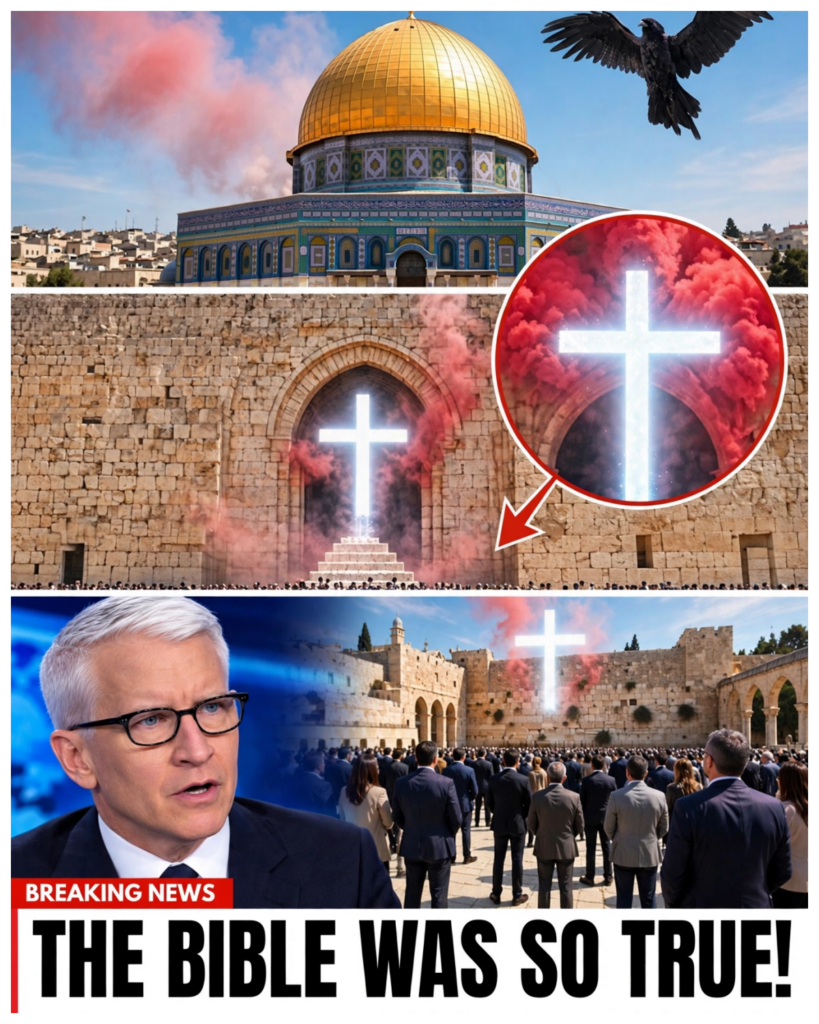
This is the Golden Gate.
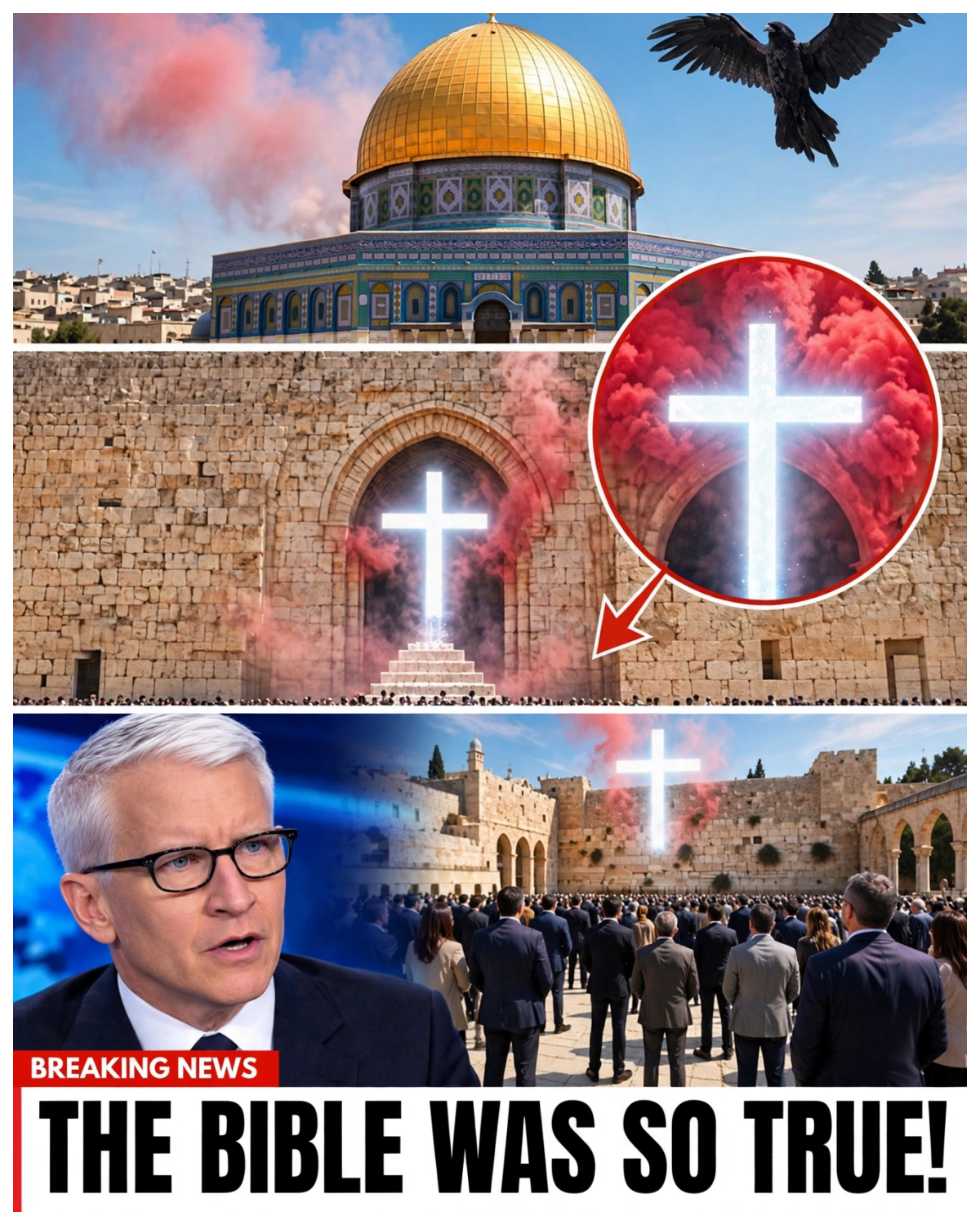
It’s the east gates known as the mercy gate to Jerusalem.
As you can tell, it’s been sealed up for a long, long time.
Every morning, the first light of the day crosses the Mount of Olives, drops into the Kidron Valley, [music] and strikes a wall that has not opened in almost 500 years.
Two sealed arches of pale limestone.
No doors, no guards, no sign.
Tour groups walk past it on the way to somewhere else.
And yet, three faiths have their eyes on it.
Jews call it the gate of mercy [music] and many believe the Messiah will pass through it.
Christians know it as the golden gate and see in it the road of Palm Sunday.
Muslims call it Bob al- Rahma, the gate of mercy and Bob alba, the gate of repentance and they bury their dead in front of it.
Now pilgrims and guides who walk this wall say something is changing.
Fine dust along the seams, stones that no longer sit the way they remember.
Is it age and weather, or is this gate preparing to open?
And if it is, for whom?
Before we decide, there are three stories about the Golden Gate that almost nobody tells.
The first is who really sealed it and why a cemetery lies at its feet.
The second is what an American graduate student found after a rainstorm in 1969 when the ground gave way beneath him.
And the third is an ancient building rule written into the very architecture of the Temple Mount that points this gate at the Mount of Olives like the sight of a rifle.
Stay with me because each of them leads back to one question and I will be honest about which parts are documented and which are only reported.
The sources I will lean on are the Hebrew Bible, the Gospels, the Mishna, Medieval Chronicles, and the published work of archaeologists.
And I will tell you each time which one I am quoting.
Who sealed the gate?
[music] The last hands to close the Golden Gate belonged to the Masons of Sulleon the Magnificent.
The Ottoman Sultan who rebuilt the walls of Jerusalem between 1537 and 1541.
The walls he left are the golden stoneed ramparts that visitors circle today, nearly 4 km of them.
When his builders reached the eastern wall, the golden gate was walled up completely.
Why?
No surviving order from the Sultan says historians usually reach for the practical answer.
A gate facing the Kidron Valley was a weak point in a fortress wall and a sealed gate cannot be stormed.
It is worth remembering what shape those walls were in.
Jerusalem’s fortifications had been partly torn down in 1219 when the Aubid ruler Al-Muazam ordered them demolished so that European crusaders could not use them against him and the city had spent roughly three centuries with weak defenses.
The Ottomans who had taken the city in 1517 were rebuilding a capital that had been left exposed for a very long time.
Sullean’s walls had a famous legend attached to them, too.
A dream of lions threatening the Sultan if he did not rebuild the city’s defenses, which is said to explain the pair of lions carved beside the gate, now called the Lion’s Gate.
Whatever the truth of that story, the project was a serious military and political statement, and it left Jerusalem with the walls it still has.
But the story Jerusalem has told for 500 years is about a very different reason.
It begins with a Jewish belief about who must arrive first.
According to tradition, the prophet Elijah will come before the Messiah to announce him.
And many rabbis counted Elijah among the priests.
The Talmud even records a rabbi who met Elijah standing in a cemetery and asked how a priest could be there.
Since under numbers 19, a priest who touches a grave is unclean for seven days.
The exchange appears in the trackctate bava and it is the kind of story rabbis told to explore fine points of purity law not to give instructions for city planning.
So the legend goes that the Muslim cemetery was allowed to spread right up to the foot of the gate where its white tombs still crowd the wall.
A 15th century Jerusalem historian, Mujir Alin Al-ule, wrote about the gate and the burial ground beside it, which shows how long the place had already been sacred to local Muslims before Sullean’s masons ever arrived.
If the herald could not cross the graves, the king could not follow him in.
That is the tradition.
And I have to tell you that no document has ever been found showing the Sultan or his officials thought that way.
Here is the irony that prophecy teachers love to point out.
Ezekiel 44:2 says, “This gate shall be shut.
It shall not be opened, and no man shall enter by it.”
A Muslim ruler trying to block a Jewish and Christian expectation may have fulfilled the verse that describes the gate.
A caution is in order, though.
The gate Ezekiel describes belongs to a visionary temple, not to the Ottoman wall.
And Jews and Christians have read the passage in different ways for centuries.
Sullean was also not the first to close [music] it.
A tradition dates an early walling up to around 810.
The crusaders reopened the gate in 1102, using it only on special days.
Saladin sealed it again in 1187 after retaking the city.
And in 1541, it was closed for the last time.
Over seven centuries, the gate opened and shut again and again and never left the prophecy conversation.
Seeing gates was not unusual in ancient Jerusalem.
Southern wall of the temple mount also holds blocked gateways including the double gate and the triple gate known as the Hula gates which archaeologists have studied for generations.
The ordinary reasons for closing a gate, from security to structural damage, apply as much to the Golden Gate as any legend does.
There is one more layer to the story of the cemetery.
The land across the Kidron Valley is among the most crowded burial ground in the world.
The Jewish cemetery on the Mount of Olives holds roughly 150,000 graves and has been in use for about 3,000 years.
Because Jewish tradition holds that the resurrection of the dead begins here.
Islamic tradition also places the last judgment in this valley.
Everyone who is buried there is in a sense waiting for the same morning.
And then in the spring of 1969, one of the graves in front of the gate gave way.
The student who fell into the past.
In April 1969, an American graduate student named James Fleming was photographing the walls of Jerusalem the morning after an unusually heavy rain.
He was walking through the cemetery that stretches along the foot of the Golden Gate when the soden ground collapsed.
He dropped into an open grave with human bones around his feet.
The date matters.
Jerusalem’s old city had come under Israeli control only two years earlier in the 1967 war.
And for the first time in a generation, archaeologists and students from many countries were moving freely around the walls.
When his eyes adjusted, he noticed something on the wall in front of him.
Directly beneath the sealed gate, five wedge-shaped stones set in a curve forming the crown of a massive arch.
It was an older gate buried under the one visitors see.
Fleming returned the next day with a flash camera.
It took years for his find to reach the world.
In 1983, he published it in Biblical Archaeology Review.
In an article titled The Undiscovered Gate Beneath Jerusalem’s Golden Gate.
Some scholars think that buried arch may belong to a gate that stood in the time of Jesus, but nobody can dig to confirm it because the cemetery protects the ground.
To appreciate how much was at stake in that ground, remember the scale of the place.
Herod’s expansion of the Temple Mount in the last decades before Christ created a platform of roughly 14 hectares, one of the largest religious enclosures of the ancient world, and its eastern face looked straight across the valley at the Mount of Olives.
That is the twist inside the legend.
The graves that were supposedly placed there to bar the Messiah are now the very thing that shields the oldest gate from the shovel.
As for the gate above it, the one you can see, archaeologists argue about when it was built.
The standard answers are the Byzantine era in the sixth or 7th century or the early Islamic period under the Umayad dynasty.
The name golden gate may itself be an accident of language.
In the book of Acts, a temple entrance is called the beautiful gate.
And some scholars suggest that the Greek word for beautiful was confused with the Latin word for golden, giving the gate its name by mistake.
In Latin, it was the pora.
And in Arabic, it is sometimes called Bob alahhabi.
So the golden name stuck in every language that touched it.
The buried arch rests on a line that began long before any of those builders.
Six centuries before Jesus with a prophet in exile.
The glory that left by the east around 592 BC, the prophet Ezekiel was living among the Jewish exiles in Babylon when he was shown a vision of the temple in Jerusalem.
He had been carried off in the first deportation of 597 BC.
And the temple he saw in his vision was still standing.
It would be destroyed by the Babylonians in 586 BC, which gives the departing glory a terrible urgency.
What he saw was God’s glory leaving.
[music] In chapter 10, the glory rises from the Holy of Holies and pauses at the doorway of the eastern gate of the temple.
In chapter 11 23, it leaves the city altogether and stands on the mountain east of Jerusalem, which is the Mount of Olives.
The Talmud and the ancient rabbitic commentary on lamentations add a heartbreaking detail.
According to the tradition, the divine presence withdrew from the temple in stages and waited on the mount of olives for three and a half years hoping the people would repent before it finally departed.
The Talmud in the tractate Roshashana even counts 10 stations on that long retreat from the holy of holies up to heaven.
Then near the end of the book, Ezekiel sees the reverse.
In chapter 43, the glory of the God of Israel returns from the east with a sound like rushing water and enters the temple through the gate that faces east.
Right after that comes the verse about the shut gate, and it carries a strange instruction.
Only the prince may sit in that gateway to eat bread before the Lord.
Who the prince is has been debated for centuries.
Christian readers often see in him the Messiah, while Jewish commentators have usually understood a Davidic ruler or leader in the restored temple community.
So the glory leaves by the east, lingers on the mountain, returns by the east, and the gate is shut behind it with one exception left open.
Christians have long read that exception as pointing to one person.
Six centuries later, someone came down the Mount of Olives toward that wall.
The donkey on the road.
On the Sunday before Passover, Jesus came over the Mount of Olives from the village of Bethage riding a young donkey.
The detail was deliberate.
The crowds who met him were quoting a psalm.
Psalm 118 was part of the pilgrim festival liturgy and its words, “Blessed is he who comes in the name of the Lord,” ring through the gospel accounts of that day.
The same psalm contains a line that sounds almost like a script for this wall.
Open to me the gates of righteousness that I may enter through them.
This is the gate of the Lord.
The righteous shall enter through it.
Whether or not the crowd had a particular gate in mind, the connection between pilgrimage, praise, and gates was already centuries old.
More than 500 years earlier, the prophet Zechariah wrote in chapter 9:9 that Jerusalem’s king would come to her humble and riding on a donkey.
A donkey was a royal mount in ancient Israel, not a humble joke.
When David wanted Solomon proclaimed king, he had him ride the royal mule down to Guihon.
And the very next lines of Zechariah, promise a king who will cut off the warhorse and speak peace to the nations.
Luke’s Gospel says the crowds began to shout at the descent of the Mount of Olives, the place where the whole city opens up across the Kidron Valley with the eastern wall straight ahead.
And Luke adds something the other gospels leave out.
When Jesus saw the city, he wept over it and said it would be torn down because it did not know the time of its visitation.
Hold on to that line because it comes back.
So did he ride through this exact gate?
The honest answer is that the golden gate you see today was built centuries later.
But Fleming’s buried arch lies directly underneath and the road from Bethage runs straight toward this stretch of wall.
Early Christians did not doubt the route.
In the late 4th century, a pilgrim named Aggeria wrote a famous account of Holy Week in Jerusalem, describing a procession on Palm Sunday that came down the Mount of Olives into the city with palm and olive branches centuries later under the crusaders.
The Golden Gate was opened twice a year on Palm Sunday and on the feast of the exaltation of the cross so that processions could walk through the way Jesus had come.
The tradition never died.
To this day, Christians of many churches walk down the Mount of Olives on Palm Sunday, singing and waving palm and olive branches, following a path that pilgrims have been tracing for more than 16 centuries.
Those processions celebrated his first arrival on this mountain.
The last time he stood on it, he made a promise.
The promise on the mountain.
40 days after the resurrection, according to the book of Acts, Jesus led his followers back out to the Mount of Olives, and from there he was taken up into a cloud.
Acts 1:12 even gives the distance, calling the mountain a Sabbath day’s journey from Jerusalem, which in Jewish law was about 2,000 cubits, a walk of well under a mile.
The mountain takes its name from the olive groves that once covered it.
And at its foot lies Gethsemane, a name that means oil press.
Near the summit, a small shrine called the Chapel of the Ascension marks the traditional spot.
It has been in Muslim hands since the 12th century, though Christians are still allowed to celebrate the feast there each year.
Two men in white appeared and asked why they were staring at the sky.
Then they made a promise.
In verse 11, this same Jesus will come back in the same way you saw him go.
Now put that beside Zechariah 14:4 which says that on the day of the Lord his feet will stand on the Mount of Olives facing Jerusalem on the east and the mountain will split in two from east to west.
That verse has an earthquake in the background.
Zechariah 14:5 says, “The people will flee as you fled from the earthquake in the days of Uzziah, a reference to a quake from around 760 BC that is also mentioned in the book of Amos.
Archaeologists working at sites such as Hazor [music] have found evidence of destruction that many link to that event, and sediment studies of the Dead Sea region point to a major tremor in the same period.
For the prophet’s first listeners, a splitting mountain was not poetry.
It was a memory he left from that mountain and he has promised to return to it.
Directly across the valley from that summit [music] stands a gate that has been bricked shut for most of the last 12 centuries.
That is why any report about its stones gets people’s attention.
The gate that has already halfoped stand in the Kidron Valley today and look up and you will see two arches of pale limestone with heavy masonry where the doors used to be.
Behind them on the Temple Mount is a vaulted hall that Muslims call Bab al-Rah, the gate of mercy, and Bab alaba, the gate of repentance.
One name for each arch.
The interior is a pair of domed bays supported by columns whose carved capitals have long fascinated art historians because they appear to be reused from an earlier period.
Muslim tradition links the gate to a verse in the Quran Surah 57:13 which speaks of a wall with a gate with mercy on the inside and punishment on the outside.
Many Muslims therefore see the gate as the place where the righteous and the wicked will be divided on the last day.
In that sense, the gate carries a strikingly similar weight in Jewish, Christian, and Muslim imagination.
Even though each tradition tells a different story about what will happen there, the hall has been at the center of one of the most sensitive disputes in Jerusalem under the long-standing status quo.
The compound is administered by a Jordanianrun Islamic trust, the WAC, while Israel controls security around it, which is why a single locked door can turn into an international dispute.
An Israeli court order closed it in 2003.
Then in February 2019, after weeks of protests and tension, the inner hall was reopened for Muslim prayer for the first time in 16 years.
So in a strange way, part of the Golden Gate has already reopened from the inside.
Only the arches facing east remain sealed tight.
That is where the newer reports come in.
Pilgrims and guides who know this wall describe fine dust along the sealed seams.
Small stones that look shifted and cracks they do not remember seeing before.
I cannot hand you a dated survey proving any of it.
I could not find a published structural study of the gate showing that anything has changed and you deserve to know that there is a reasonable natural explanation.
Jerusalem sits near the Dead Sea transform, a major fault line.
And the 1927 Jericho earthquake damaged the Dome of the Rock and the Ala Mosque only a few hundred meters from this gate.
Old limestone walls in an earthquake zone shed dust.
Written records note damaging earthquakes in Jerusalem in 749 and 1033 and again in 1927.
So the stones have been shaken many times.
Rain, frost, and the slow crystallization of salts inside the rock do the same.
Jerusalem’s limestone is especially prone to this kind of weathering, and access to the walls is tightly controlled, which means there are very few detailed public measurements to compare against.
But what surprises me most is how old these reports are.
The emperor and the stones people have been saying this gate moves on its own for more than a thousand years.
The legend goes back to the year 630.
The Byzantine emperor Heraclus had just defeated the Persian Empire and recovered the relic of the true cross and he came down the slope from the Mount of Olives dressed in full imperial splendor to carry it back into Jerusalem.
Medieval writers recorded that as he approached the stones of the gateway came down and locked into a solid wall.
An angel appeared above it and reminded him that the king of heaven had entered through this gate humbly on a donkey.
Heracleas took off his crown and his shoes, lifted the cross, and walked toward the gate barefoot.
And the legend says the stones opened for him.
The background is dramatic.
In 614, Persian forces had captured Jerusalem and carried the true cross away to their capital.
Heracleas spent years campaigning against them.
And after his victory in 628, the cross was returned with the emperor bringing it back to the city in March of 6:30.
It was one of the great moments of the Byzantine world, which is why a legend about the Golden Gate grew up around it.
That is also the origin of the feast of the exaltation of the cross celebrated on September 14th, one of the two days when the crusaders later unsealed the gate.
In other words, the crusader ritual was a way of reenacting the legend of Heraclus.
If you want to keep watching this gate with me, subscribe because I will be following every real development at this wall.
The angel’s message in that legend goes deeper than a stubborn gate.
God rarely announces himself the way emperors do, and scripture keeps coming back to that.
When the prophet Elijah fled to Mount Horeb in First Kings 19, the wind, the earthquake, and the fire all passed, and then God spoke in a still small voice.
The Messiah’s birth was announced to shepherds working the night shift, and his royal entry came on a borrowed donkey.
So, if this gate ever does stir, the pattern suggests it will start small enough to argue about.
That is worth remembering before you dismiss the dust or before you turn it into a headline.
Watch.
Jesus told his followers how to handle moments like this.
A few days after Palm Sunday, Mark 13 says, “He sat on the Mount of Olives opposite the temple, and his disciples asked him when the end would come.
His answer known as the Olivet discourse keeps returning to one command in Matthew 24:42.
Watch because you do not know what hour your Lord is coming.”
Notice where he was sitting when he said it.
He was looking straight across the valley at the eastern wall.
Many scholars add a note of caution about how to read that discourse.
[music] Some see most of it as a prophecy about the fall of Jerusalem in 70 AD with a larger meaning still to come while others read it mainly as a description of the end of the age.
Both views take the sermon seriously.
They simply disagree about when its warnings apply.
Keep that picture in mind because there is a phrase in that same sermon.
We will come back to first.
There is the building rule that turned this valley into a single straight line in the time of the second temple.
The line of sight.
The eastern gate of the temple mount carried an image of the palace at Shushon.
The Persian capital Susa and Jewish law gave it one very specific job.
The Mishna, the earliest written collection of Jewish oral law, describes a ceremony called the red hepher.
A perfectly red young cow without a single blemish was led out through the eastern gate across the Kidron Valley and burned on the Mount of Olives.
Its ashes were mixed with water to purify anyone who had touched the dead.
The exact impurity described in Numbers 19.
Here is the detail that matters.
According to tradition, every wall on the Temple Mount was built high except the eastern wall, which was kept low on purpose.
That way, the priest standing on the summit of the Mount of Olives could look directly through the eastern gate and see the entrance of the sanctuary while he sprinkled the blood.
The road on which Ezekiel saw the glory travel.
The slope Jesus rode down and the summit he left from and promised to return to were built into the architecture as a single line of sight from the mountain through the gate and into the house of God.
The causeway itself stood on arches, the Mishna says, so that the procession would never pass over the graves in the valley.
Inside the eastern wall stood the great porch known as Solomon’s portico, a long covered colonade where, according to the gospel of John, Jesus walked during the winter festival.
So the people who passed through the eastern gate in his day were stepping into a space the gospels already knew well.
The cure for the exact impurity that a cemetery forces on a priest was a ceremony that started at this gate.
That is also why the legend of the cemetery and the priest Elijah fits so neatly into the story.
According to the Mishna, only nine red heers were burned from the time of Moses until the temple fell.
And Jewish tradition says the 10th will be prepared in the days of the Messiah.
In September 2022, five red heers were flown from Texas to Israel by groups preparing for the ritual, and the search for one that qualifies has continued since, with some of the animals reportedly disqualified along the way.
The rules are strict.
The Mishna says that even two hairs of another color can disqualify a hepher, which is why finding a qualifying animal has proved so difficult.
That is one reason prophecy watchers keep their eyes on this gate and take the work seriously.
The watchmen on the wall.
The Bible has a name for people who keep their eyes on a city wall.
In Isaiah 62:6, God says, “I have set watchmen upon thy walls, O Jerusalem, which shall never hold their peace, day nor night.”
And Ezekiel 33 gives the role real weight.
If the watchman sees the sword coming and blows the trumpet, the people are responsible for what they do next.
If he sees it and stays silent, their blood is on his hands.
That is why pilgrims who report what they see at this gate matter.
Even when their reports are small and unproven, they are doing what Jesus told his disciples on that hillside.
And what Isaiah said would happen on these walls.
Watching was a real institution in the temple, too.
The Mishna says that priests kept guard at three posts and Levites at 21 so that the sanctuary was never left unattended day or night.
But a watchman also has to tell you when he is not sure.
Which is why I have separated what is documented about this gate from what is only being reported.
The day of visitation.
There is a reason this city is watched more closely than any other.
Jerusalem is the only city the gospels record Jesus weeping over on the slope facing this gate.
He said enemies would surround it and leave not one stone upon another because it did not know the time of its visitation.
About 40 years later in 70 AD, the Roman general Titus did exactly that and the temple Jesus had been looking at burned to the ground.
Jewish tradition marks the day of the destruction on the 9th of Av, a fast day still observed today.
And the arch of Titus in Rome, built soon afterward, shows soldiers carrying the temple’s manora in triumph.
The Greek word Luke uses for visitation is episcope, which means an inspection, the moment when someone comes to look in on you.
The city was expecting a conquering king and when the real one rode in on a donkey.
Most of it never noticed.
That is the real risk.
With a gate like this, missing an earthquake or a headline matters far less than being so focused on the wrong signs that we miss the right one.
In the same sermon he gave on that mountain, Jesus told his disciples to learn a lesson from the fig tree.
When its branch turns tender and puts out leaves, you know summer is near.
Many prophecy teachers read the fig tree as Israel and point to the nation’s rebirth in May 1948 after nearly 1900 years as the first leaves.
Others read the parable more simply as a general lesson about noticing the seasons.
The same saying appears in the Gospels of Mark and Luke with slightly different wording and interpreters have never agreed on a single meaning.
Then comes verse 33.
When you see all these things, know that it is near, even at the doors.
Stop on those three words.
At the doors.
In the original Greek, the word for doors is plural.
And Jesus said it while sitting on a hillside facing the eastern wall of the temple mount.
And the gate standing in that wall today is a double gate.
Two arches, two doors, one called mercy and one called repentance.
The usual reading of at the doors is a figure of speech for very close.
In fact, Greek often uses the plural for a single door.
So that may be all it is.
The same phrase appears elsewhere in the New Testament.
In the letter of James, the judge is said to be standing at the doors.
Again, in the plural, and nobody takes that to mean a double gate, but he chose those words while looking at that wall a few days after riding toward it.
What if he meant it literally?
Lift up your heads.
So imagine it.
The sun rising over the Mount of Olives.
The first light striking those two sealed arches the way it has every morning for nearly 500 years.
King David wrote a song for that moment in Psalm 24.
Lift up your heads, O gates, and be lifted up, you everlasting doors, and the King of glory shall come in.
Who is this King of glory?
The Lord strong and mighty.
Ezekiel saw that glory leave by this road and returned by it.
Jesus rode down it, rose from above it, and promised to come back the same way.
Here is where things stand, documented.
The gate was sealed by Sulleon’s builders in 1541.
An older arch lies beneath it, and the cemetery in front of it is real traditional.
The stories about Elijah, the priests, and the cemetery, which have been repeated for centuries without a document to prove them, reported but unproven, the dust and shifting stones.
Sorting those three categories is the first duty of anyone who watches this wall.
It also helps to remember what a real opening would involve.
The gate is part of the wall of the most contested piece of land on Earth.
And any change to it would be a major political and religious event, not just an archaeological one.
That alone is a reason to rely on evidence rather than rumor.
If you want to follow this story responsibly, look for three things.
Dated photographs or surveys, statements from the bodies that actually oversee the site, such as the WACKO and Israel’s antiquities authorities, and any peer-reviewed publication.
A rumor that cannot survive those tests, is a rumor, however reverent the person repeating it.
Whether the dust at that wall means anything, I cannot tell you yet.
What I can tell you is that this gate has been waiting for one person for a very long time.
And the question is whether it will recognize him when he comes.
I’m Ryan Low and there is a lot more prophecy hiding in the stones of Jerusalem.
So stay with the channel because the next one of these is already on its