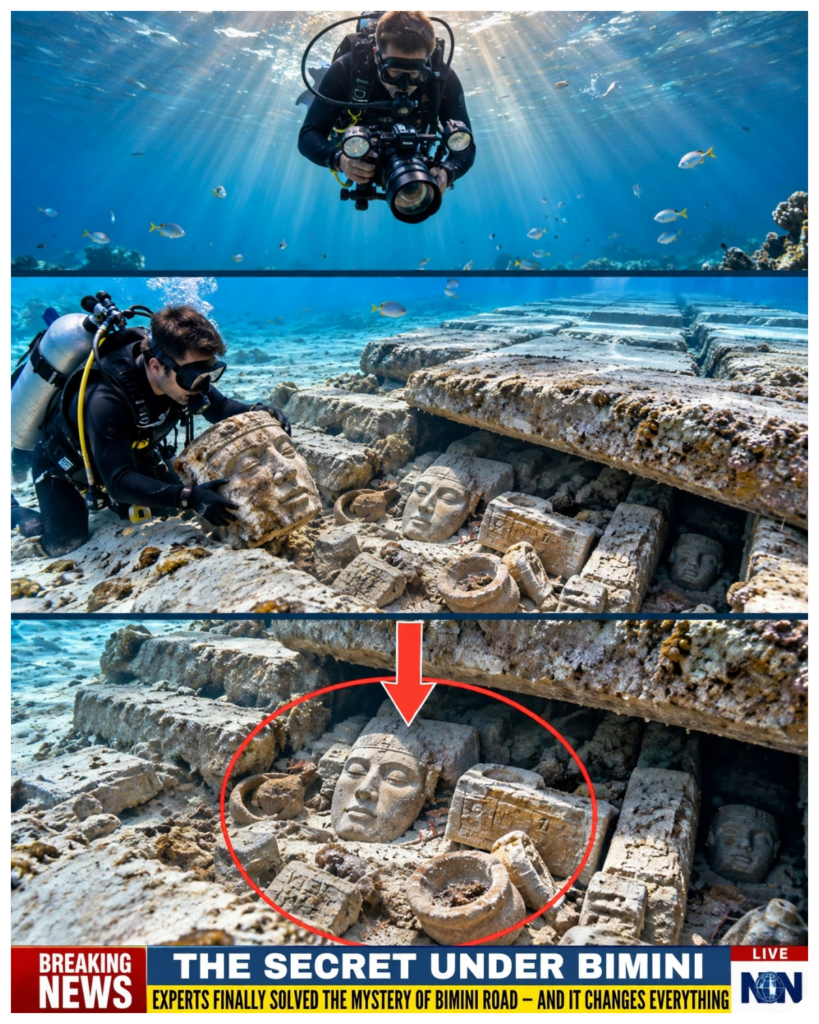
In September of nineteen sixty-eight, divers looking down through the clear Bahamian water saw something that was difficult to interpret as anything other than a piece of architecture.
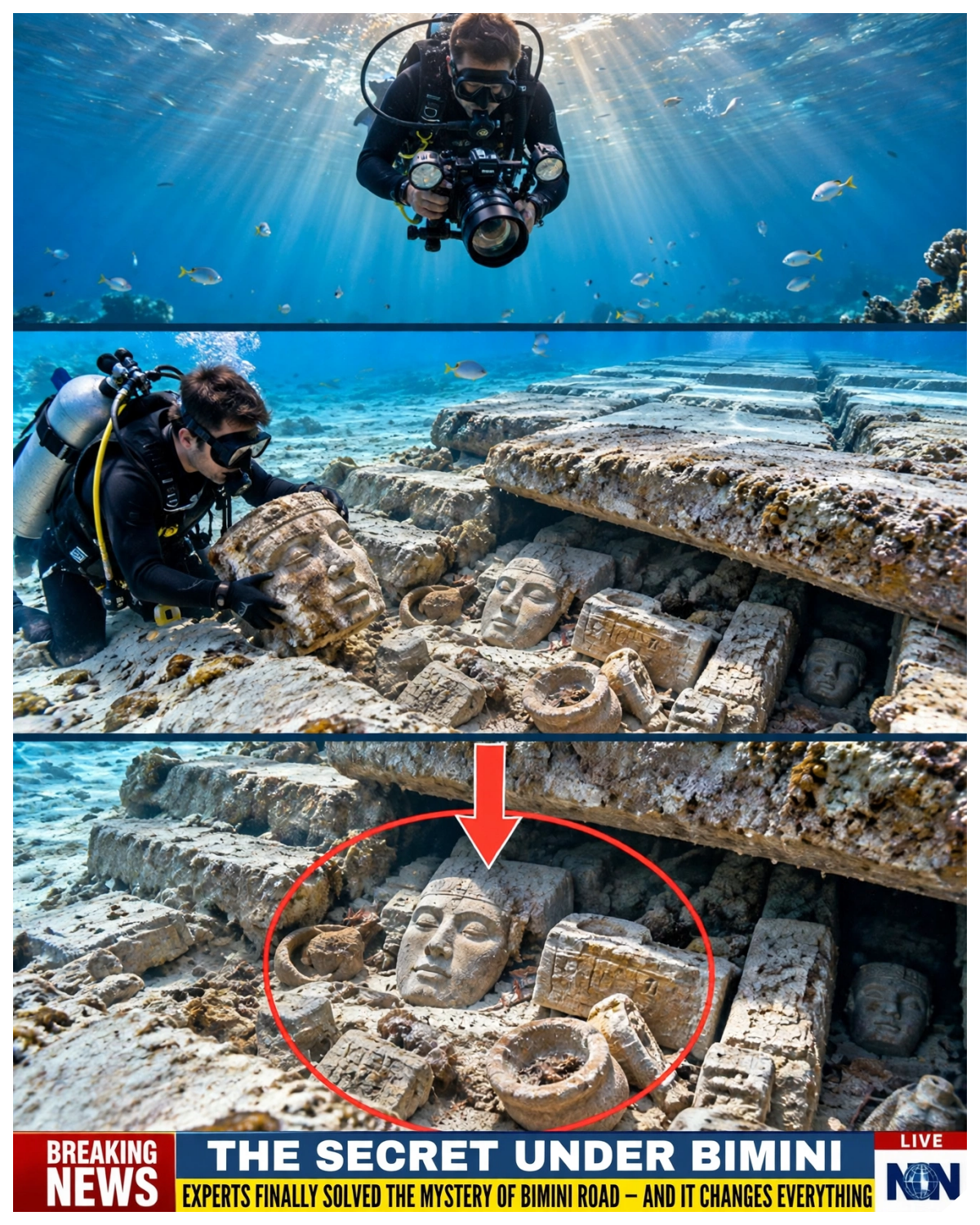
Roughly fifteen to eighteen feet below the surface off North Bimini, a long formation of large, flat limestone blocks stretched for about eight hundred metres, running in a broadly straight line before curving into a distinctive hook.
From above, they looked remarkably like a road that had somehow ended up on the seafloor.
But how?
And who would place a road on the seafloor?
Well, experts have finally solved the mystery of Bimini Road.
And it changes everything!
THE DISCOVERY.
On September second, nineteen sixty-eight, off the northwest coast of North Bimini, in the Bahamas, a great discovery was about to unfold.
The island stood less than fifty miles from Florida.
But underwater, the landscape could feel a world away from the mainland.
The water was warm and clear, the seabed shallow, and the island sat where the pale, sandy flats of the Great Bahama Bank met the deeper waters influenced by the Gulf Stream.
In one direction, sunlight reached down through turquoise water to the sand.
Beyond the island, the seabed dropped away toward darker, deeper blue.
Bimini’s waters were already known for fishing, especially the big game species drawn to the nearby current.
Diving was part of the island’s relationship with the sea.
The man who brought the formation to wider attention was Joseph Manson Valentine, a zoologist and explorer associated with the Miami Museum of Science.
That day, he was exploring the underwater terrain with French freediver Jacques Mayol and Robert Angove.
Mayol would later become famous as one of the world’s pioneering freedivers and an inspiration for The Big Blue.
But there was no formal archaeological expedition underway, no excavation team, and no ancient city they had set out to find.
They were diving in relatively shallow water… Where the bottom was visible beneath them… And then the seabed began to look strangely ordered… Ahead lay a broad pavement of pale stone slabs… They were not scattered like ordinary rubble… And someone had predicted earlier that they would be found… THE PROPHECY.
From above, they appeared to run in lines, with flat surfaces and edges that seemed to meet.
The formation stretched across the sand, its geometry becoming clearer as the divers moved over it.
It was the kind of sight that could make an ordinary dive stop feeling ordinary.
Bimini was known to anglers and boaters, and its surrounding waters offered reefs, shallow banks, and deep-water fishing grounds.
But this particular formation had not yet become the famous underwater mystery that would draw curious visitors.
Local fishermen and divers were already familiar with the stones.
But it was Valentine who helped turn a local underwater feature into an international mystery.
The formation appeared at precisely the moment when an extraordinary explanation was already waiting for it.
Decades earlier, Edgar Cayce, the American psychic who became known as the “Sleeping Prophet,” had made statements about Atlantis and Bimini.
Cayce gave thousands of readings while lying down with his eyes closed, speaking in what his followers understood as a trance state.
A stenographer recorded his words, and the readings were later organized by number and date.
They covered everything from health and personal problems to reincarnation, ancient civilizations, and the fate of lost worlds.
Cayce’s followers regarded the readings as a source of spiritual knowledge.
In the case of Bimini, one reading would acquire a remarkable afterlife.
On December twentieth, nineteen thirty-three, Cayce gave reading four-forty-dash-five to a twenty-three-year-old electrical engineering student.
The questions concerned the man’s supposed previous life in Atlantis, where, according to the reading, he had been involved with advanced mechanical devices.
The discussion turned to a mysterious object Cayce called the “firestone,” a powerful source of energy in his account of Atlantean technology.
Cayce described its construction, its use, and the records that supposedly preserved knowledge of it.
Then came the passage that would later be connected to Bimini.
Cayce said the records describing the firestone’s construction were preserved in three places.
One record, Cayce said, was hidden beneath the sea near Bimini, off Florida, where parts of Atlantis, or Poseidia, might still lie buried beneath accumulated deposits.
Others, he claimed, were in Egypt and the Yucatán.
His remarks concerned an Atlantean energy device and its construction.
But on June twenty-eighth, nineteen forty, another reading introduced a date that would become central to the story.
This time, Cayce spoke to a thirty-one-year-old woman… The reading concerned her spiritual history and past lives.
In its account, she had once lived in Atlantis during a period of upheaval, when the islands of Poseidia had become a major center of activity.
The reading described destructive forces and a conflict between groups Cayce called the “Children of the Law of One” and the “Sons of Belial.”
And near the end came the line that would later be repeated for decades: “Poseidia will be among the first portions of Atlantis to rise again.
Expect it in sixty-eight and sixty-nine.
Not so far away!”
The words were striking.
Cayce did not leave behind a scientific prediction identifying the particular limestone formation later called the Bimini Road.
The connection between the readings and the stones was made afterward.
Valentine, meanwhile, was not a neutral observer.
He had a personal interest in Cayce’s work, which meant that when he encountered an underwater formation that looked like a constructed road, the existing prophecy offered an immediate framework for interpreting it.
The timing was extraordinary: Cayce had named nineteen sixty-eight and nineteen sixty-nine, and Valentine was reporting an apparently artificial formation in nineteen sixty-eight.
That coincidence quickly became central to the story.
The stronger question, though, was whether Valentine had deliberately timed his exploration around the prediction.
That claim has circulated for years, but there is no reliable evidence establishing that he did.
Once that connection was made, the stones stopped being just stones… Dimitri Rebikoff, a French marine engineer and underwater technology pioneer, was involved in the investigations around Bimini and brought a technical interest in what divers could observe beneath the surface.
His name appears in the early literature: a December nineteen sixty-nine Argosy article about Bimini was co-authored by Rebikoff and R.
F.
Marx.
He was not simply another writer repeating the Atlantis story.
He was connected to the practical business of underwater exploration: the equipment, photography, and methods that made it possible to investigate a site that could not be examined from shore.
But the central problem was already taking shape.
Divers could describe the formation.
Photographs could show its blocks and apparent alignment.
Yet none of that, by itself, could establish how the stones had formed.
And as the images circulated, the interpretation began to outrun the evidence.
That was where Charles Berlitz entered the picture.
Berlitz was already a successful popular writer when he published The Mystery of Atlantis in nineteen sixty-nine, just as the Bimini formation was entering public discussion.
His book helped connect the stones to the wider idea of a lost civilization.
So, could this be a surviving trace of Atlantis?
Wyman Harrison’s nineteen seventy-one paper in Nature later cited Berlitz’s book alongside early reports about Bimini, showing how quickly the site had entered the Atlantis literature.
Then came David Zink, who took the argument further… Zink was an academic and experienced diver who investigated Bimini in the nineteen seventies.
His book, The Stones of Atlantis, published in nineteen seventy-eight, presented the site as evidence connected to an ancient civilization.
Zink drew on geology, astrophysics, anthropology, mythology, and psychic readings to argue not only for Atlantis, but for the possibility that travelers from the Pleiades had helped colonize Earth.
That extraterrestrial element was not a minor footnote.
It showed how far the Bimini investigation had expanded from its starting point.
What began as an unusual arrangement of limestone blocks was now being placed inside a story involving lost continents, ancient technology, psychic information, and visitors from another star system.
Zink also interpreted other underwater material as possible archaeological evidence.
A retrospective account in The Nassau Institute describes his team finding pieces of fluted marble near the formation, which Zink regarded as ancient artifacts.
The same account says they were later identified as ship’s ballast, material that could have been carried and discarded by a vessel rather than left by an ancient civilization.
It also quotes Zink explaining his idea of “sacred geometry,” arguing that the site had important terrestrial and astronomical orientations.
Zink was making an interpretation about the meaning and origin of the site.
The existence of unusual objects or alignments did not automatically establish that they belonged to an ancient city.
Each claim needed to be tested independently.
Were the objects actually artifacts?
Were they found in a secure archaeological context?
Did the stones show evidence of construction?
And could the proposed alignments be demonstrated rather than selected after the fact?
Well, geologists had answers… NATURE’S UNDERWATER ARCHITECTURE.
The first problem with the Bimini Road is also the reason the mystery survived for so long: the formation really does look built.
Beneath the clear water off North Bimini, large, flat slabs of pale limestone lie in a broad linear arrangement, with relatively straight edges and joints that divide the rock into shapes that can resemble enormous paving stones.
From above, the impression is immediate.
There appears to be a road on the seafloor.
The question is what happens when you stop looking at the formation as an arrangement of objects and start asking what those objects are actually made of.
They are limestone, but not limestone blocks in the sense that an ancient builder would have quarried them.
The rocks are a form of beachrock, a material that can develop naturally along tropical coastlines.
Beachrock begins as loose coastal sediment: sand, broken shells, fragments of coral, and other carbonate material accumulating near the shoreline.
Groundwater moving through that sediment can carry dissolved calcium carbonate, which later precipitates between the grains and cements them together.
Over time, material that began as loose beach sediment becomes a solid slab of rock.
That process is ordinary… What is less obvious is what can happen to that slab after it forms… A beachrock layer can develop roughly parallel to the shoreline because it is literally forming within the coastal environment.
Then erosion begins to expose it.
Waves, shifting sand, and physical stresses act on the hardened layer, and fractures develop through the rock.
Those fractures do not need a mason’s measuring tools to produce straight lines.
Natural joints can divide a continuous slab into rectangular, polygonal, and irregular sections.
Once the softer material around and beneath those sections is removed, the remaining pieces can stand out as individual blocks.
Seen underwater, separated from the beach that originally produced them, the geological process becomes difficult to recognize.
The result can look less like a former shoreline and more like something deliberately assembled.
That possibility was not merely a modern attempt to explain away an inconvenient mystery.
In April of nineteen seventy-one, just a few years after the Bimini formation became internationally associated with Atlantis, Wyman Harrison published a paper in the scientific journal Nature titled “Atlantis Undiscovered: Bimini, Bahamas.”
Harrison examined the formation as a geological structure and concluded that what had been interpreted as prehistoric stonework was actually the underwater remains of an originally coherent formation of coquina limestone.
But was it, really?
THE CORES, THE DATES, AND THE MAN WHO TESTED THE MYSTERY.
From the surface, a row of rectangular slabs could be interpreted in almost any way.
A builder could have quarried them, transported them, and positioned them.
Nature could have fractured a continuous layer of rock and left the pieces exactly where they formed.
Those two explanations produce very different predictions, and Eugene A Shinn realized that the only way to separate them was to stop studying the outside of the stones and look inside.
That meant drilling directly into the formation.
Shinn was a geologist associated with the United States Geological Survey and was familiar with carbonate rocks and coastal environments around Florida and the Bahamas.
During the nineteen seventies, he and his colleagues developed a diver-operated coring drill that made underwater sampling practical.
The logic was straightforward.
Beachrock forms from layers of sediment deposited along a shoreline, and those layers preserve their original orientation as the sediment becomes cemented into stone.
If the Bimini slabs had formed where they now lay, their internal bedding should retain a consistent direction from block to block.
If ancient builders had quarried the slabs and rearranged them, there was no obvious reason for those invisible layers to remain consistently aligned.
The investigation produced seventeen oriented cores from separate adjacent stones.
“Oriented” was critical: the researchers recorded the direction of each core before removing it, allowing the internal layers to be compared with the actual geography of the site.
The cores were then cut and examined using X-radiography, which made the internal stratification visible.
What appeared on those images was not a random collection of blocks with unrelated internal structures.
The bedding showed consistent slopes and dip directions toward deeper water, and layers of rounded beach pebbles could be traced between different stones.
That pattern is what would be expected if the slabs had originally formed as part of a continuous beachrock deposit and later fractured in place.
It is much harder to reconcile with a collection of blocks that had been quarried and deliberately rearranged.
The result was important, but it also had limits.
Seventeen cores do not mean every piece of limestone along every part of the Bimini formation was drilled.
The samples also came from particular areas, so the findings directly describe those tested sections rather than magically resolving every geological question about every stone.
Still, the internal evidence gave scientists a physical record of how the rock had formed.
And the investigation did not stop with structure.
Once researchers had pieces of the formation in their hands, another question became possible.
How old was the material itself?
A core collected by Shinn in nineteen seventy-seven was subsequently analyzed by the University of Miami’s radiocarbon laboratory.
The results were not a single neat number.
Whole-rock samples produced radiocarbon ages of approximately two thousand seven hundred and eighty, three thousand three hundred and fifty, and three thousand five hundred years before present.
Shells extracted from the beachrock produced an age of approximately three thousand five hundred and ten years, while carbonate cement binding the material together produced ages of approximately two thousand seven hundred and seventy and two thousand eight hundred and forty years.
That difference is exactly the kind of result expected from beachrock: shells can exist as sediment long before calcium carbonate cement finally binds that sediment into solid rock.
The shells were already old when they became part of the sediment.
The younger cement dates are closer to the process that turned that sediment into beachrock.
These are radiocarbon years, not simple calendar dates, and the samples represent different components of the formation.
What the measurements did provide was a geological timeline consistent with natural beachrock formation rather than evidence of an ancient road suddenly being constructed at one precise moment.
And that was not the only dating result investigators had to confront.
There was another number that seemed, at first, capable of reopening the entire mystery: approximately fifteen thousand years.
John Gifford and Mahlon Ball obtained a uranium-thorium date from marine limestone beneath the beachrock, producing an age of fourteen thousand nine hundred and ninety-two years before present, with an uncertainty of two hundred and fifty-eight years.
However, supporters of the Atlantis interpretation have cited that figure because it appears much closer to the extreme antiquity required by some Atlantis theories.
There was an even larger problem with the number.
Around fifteen thousand years ago, global sea levels were dramatically lower, and the Bimini site would have been far above the contemporaneous sea surface.
That makes a fifteen-thousand-year marine deposition age for the limestone beneath the present formation difficult to reconcile with the site’s geological setting.
The result therefore became a disputed dating claim rather than a straightforward clock proving that the Bimini Road was ancient human construction.
This brings us back to the Atlantis theory… THE ATLANTIS ARGUMENT: THE EVIDENCE THAT WOULDN’T GO AWAY.
Proponents of the Atlantis theory suggested that a natural beachrock formation could theoretically have been used, modified, or incorporated into an ancient harbor.
So even if scientists were right about how the limestone formed, one question remained open: had people done anything to it afterward?
John A.
Gifford and Mahlon M.
Ball studied submerged beachrock deposits around Bimini in work published by the National Geographic Society in nineteen eighty.
The surrounding waters contained other submerged beachrock formations, providing a broader setting in which the famous line of stones could be compared.
If similar structures existed elsewhere without any connection to an ancient civilization, then the unusual appearance of Bimini had to be understood as part of a larger geological process rather than as a unique monument.
The answer begins thousands of years before anyone could have imagined Atlantis.
Along a tropical shoreline, sand, shell fragments, and other carbonate material accumulated in the intertidal zone.
Groundwater moving through that sediment helped cement it into beachrock.
The resulting layer could remain relatively continuous until erosion exposed it, fractures divided it, and wave action rounded the exposed edges.
Then rising sea level submerged the former shoreline… This sequence is important because finding beachrock several metres beneath modern water does not mean the rock formed underwater.
It can simply mean that the coastline where it formed no longer exists at the same elevation.
Shinn later documented similar large, rounded beachrock blocks in other parts of the Caribbean, the Bahamas, and elsewhere, showing that the basic phenomenon was not unique to Bimini.
That geological history also changes how the famous geometry should be interpreted.
The Bimini blocks can look like enormous paving stones because natural fractures divided a once-continuous layer into separate pieces.
Their edges were subsequently rounded by erosion, while the gaps between them made the remaining slabs stand out against the seafloor.
The result happens to resemble construction.
Yet resemblance is not the same thing as evidence of construction.
To establish a human origin, researchers would need something the visual appearance could not provide: a physical feature that natural beachrock could not reasonably explain.
That is why the search for tool marks and artifacts mattered so much.
And this is where the Atlantis argument encountered a difficult absence.
Despite decades of attention, there is no verified archaeological artifact from the Bimini Road that establishes it as a constructed road, wall, or temple.
No accepted assemblage of tools, pottery, inscriptions, or occupation debris has emerged from the formation.
That does not logically prove that nobody ever visited or interacted with the area.
Archaeology rarely works through absolute negatives.
A naturally formed structure could theoretically have been used by people without being built by them.
The problem for the Atlantis interpretation is narrower and more important: there is no securely documented archaeological evidence demonstrating that this particular formation was deliberately constructed.
The dating controversy complicated the story further.
Some investigators obtained uranium-thorium results from marine limestone beneath the beachrock that suggested an age of roughly fifteen thousand years.
That number attracted attention because it was dramatically older than the radiocarbon ages obtained from the Bimini beachrock itself.
Yet those are not necessarily measurements of the same event.
Dating the underlying marine limestone asks when that older limestone formed.
Dating shells and carbonate cement within the beachrock asks about the much later coastal sediment and its cementation.
The stronger dating evidence from Shinn’s core therefore remained considerably younger.
Radiocarbon measurements on whole-rock samples, shells and carbonate cement clustered within roughly the last few thousand radiocarbon years, with the cement producing ages around two thousand eight hundred years before present.
By the time Marshall McKusick and Eugene Shinn published Bahamian Atlantis Reconsidered in Nature in nineteen eighty, the central contradiction was becoming difficult to avoid.
The stones really were there.
Their geometry really was unusual.
The surrounding geology really did contain ancient submerged shorelines.
Yet the internal structure of the sampled blocks pointed toward formation in place, and the dating evidence did not establish an Atlantean construction horizon.
Even more revealing, Shinn’s own study had not been a formal United States Geological Survey project; Nature noted that he had conducted the Bimini work at his own expense.
The scientist most closely associated with testing the Atlantis claim had followed the evidence into geology rather than archaeology.
And that is precisely what makes what happened to Shinn afterward so unexpected: the man who helped undermine the Atlantis interpretation would eventually become part of another Bimini controversy entirely!
THE MAN WHO DEBUNKED ATLANTIS AND THE FAKE ARTIFACT CONTROVERSY.
Eugene Shinn had helped turn the Bimini Road from a visual mystery into a testable geological problem.
His cores had revealed internal layering consistent with beachrock, and radiocarbon samples had provided dates for material within that rock.
His work was also part of a scientific argument that did not begin with him: Wyman Harrison had already published a natural explanation in Nature in nineteen seventy-one, years before Shinn’s best-known Bimini work.
So when allegations later emerged about Shinn himself, the implications were serious, but they had to be separated carefully from the geological evidence.
The controversy surfaced publicly through Gregory Little, a researcher who has argued for a human interpretation of the Bimini formations.
Little reported that on April twenty-seventh, two thousand fifteen, Shinn spoke to biology students at Florida International University and was questioned about objects he had supposedly placed underwater decades earlier.
Little’s account says Shinn described making artificial objects, hiding them beneath the Bimini stones, and waiting to see whether anyone would discover them.
Those claims come primarily from Little’s account of the filmed presentation rather than from an independent institutional investigation.
According to Little, it was more complicated than simply dropping a random object into the sea.
Little says an audience member recalled seeing Shinn carving a stone statue at his United States Geological Survey laboratory in Florida during the late nineteen seventies.
The object was allegedly intended to be taken to the Bahamas and thrown overboard.
When asked decades later where the objects had been placed, the account quotes Shinn as saying that they were hidden beneath the Bimini stones, along with small cement structures and what he described as images of astronauts.
If that account accurately reflects the recording, the episode was intended as a prank rather than as a serious archaeological discovery.
Yet the distinction does not eliminate the scientific problem.
An artificial object deliberately introduced into a disputed archaeological environment can create misleading evidence for anyone who encounters it without knowing its origin.
That is why the allegation became so consequential.
Archaeological evidence depends heavily on context.
A stone object found underwater is not automatically evidence of a civilization.
Researchers need to know where it was found, what layer contained it, what other material surrounded it, and whether it arrived there naturally, through human activity, or through modern interference.
Plant an object beneath a disputed formation and those questions become almost impossible to answer after the fact.
Little treated the episode as evidence of serious misconduct.
Other accounts have described it more narrowly as a prank intended to expose how easily unusual objects could be interpreted as ancient artifacts.
The alleged artifact episode does not erase the geological evidence that existed independently of it.
Shinn’s oriented cores are one body of evidence.
The radiocarbon measurements are another.
Harrison’s nineteen seventy-one geological interpretation came before Shinn’s investigation, and Marshall McKusick co-authored the nineteen eighty Nature paper with Shinn.
The broader geological interpretation therefore does not stand or fall on the personal reputation of one scientist.
Even if the prank occurred exactly as described, it would not automatically transform naturally formed beachrock into human construction.
The core samples would still have to be evaluated on their own, the radiocarbon measurements on their own, and the surrounding geology on its own.
There is another detail that makes Shinn’s role more complicated than the popular version suggests.
Later biographical material describes him as a “bootstrap geologist.”
He would often find his own locations, collaborators, and resources to investigate geological questions rather than waiting for conventional large-scale projects to be organized.
This makes the alleged prank particularly awkward… Yet even that contradiction does not answer the question that started everything… The Bimini Road still exists… Its stones still form their striking geometric pattern… The geological evidence still has to be interpreted… And that leads to the most uncomfortable question in the entire Bimini story… If people can manufacture evidence that looks meaningful… What happens when the evidence was never manufactured at all?
WHY YOUR BRAIN CANNOT STOP SEEING A ROAD.
In nineteen seventy-one, just three years after J.
Manson Valentine brought the formation to wider attention, geologist Wyman Harrison argued in Nature that the supposed stonework was natural coquina limestone.
In nineteen seventy-seven, Eugene Shinn collected a core from the formation.
Two years later, radiocarbon measurements of its components helped establish the age of the beachrock itself.
Then, in nineteen eighty, Shinn and Marshall McKusick returned to the Atlantis claims in Nature.
The scientific explanation had been developing for decades, even as the mystery continued to capture public imagination.
But the Atlantis story had something geology could not easily compete with: a prophecy that appeared to fit.
Edgar Cayce had mentioned submerged temples near Bimini and said that Poseidia would be expected in nineteen sixty-eight and nineteen sixty-nine.
When the formation came to public attention in nineteen sixty-eight, the connection seemed extraordinary.
Yet the readings never identified the particular limestone formation later called the Bimini Road.
The controversy surrounding Shinn’s reported planted artifacts further complicated things.
But that episode must be kept separate from the geological case.
A dispute over alleged artificial objects does not erase the earlier research, the cores, or the physical structure of the limestone.
And proving that the Bimini Road is natural does not settle every question about ancient people in the Bahamas.
Coastlines changed as sea levels rose, and places once above water now lie submerged.
Those landscapes may still hold archaeological evidence.
But that broader possibility cannot establish that this particular formation was built by an ancient civilization.
Perhaps the most revealing part of the mystery is that the geological explanation does not make the stones look any less extraordinary.
Look down through the clear Bahamian water and the slabs still resemble a road.
Their edges still seem deliberate.
Their arrangement still invites the same question that captured the first divers: who, or what, put them there?
The answer, according to the evidence, is nature… Well, that’s it for now, thanks for watching!
Did you like this video?
If you did, please consider liking, dropping a comment, and hitting the subscribe button so that you don’t miss out on our new uploads.
Also, don’t miss this video you see on your screen right now.
It’s truly unbelievable!