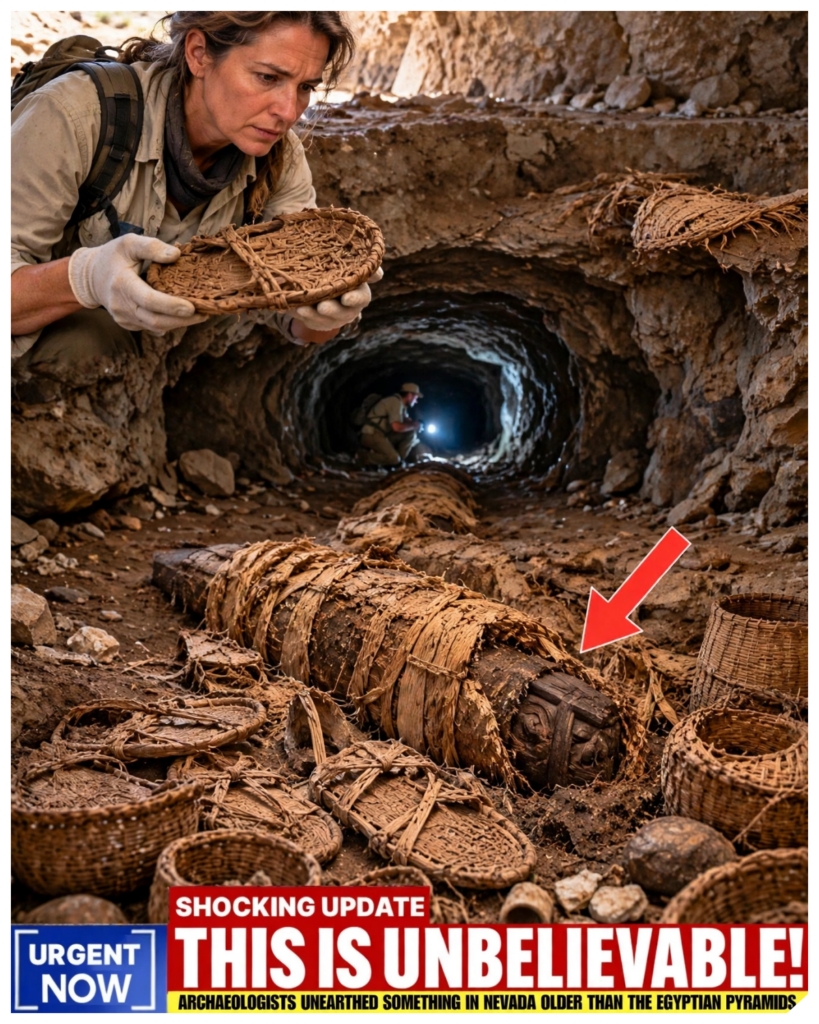
For fifty-six years, a dead man lay forgotten inside a storage box at a Nevada museum, while almost no one realized what they were guarding.
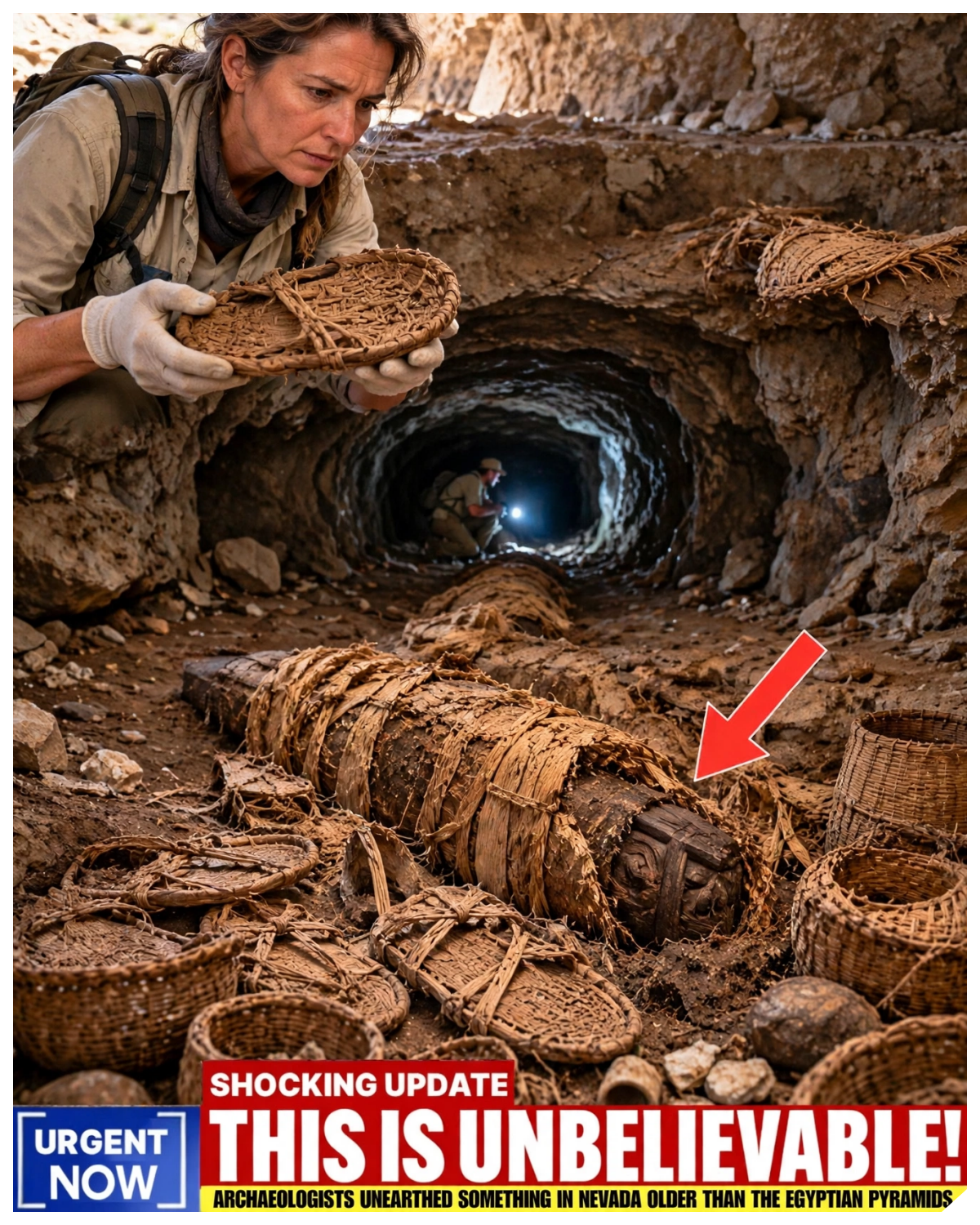
His preserved hair and skin offered a haunting glimpse into a world older than the Egyptian pyramids.
But when archaeologists finally uncovered the truth about his age and identity, the discovery did not bring closure.
Instead, it triggered a bitter twenty year battle over who had the right to claim his remains.
The Day He Finally Went Home In two thousand eighteen, a small group of people gathered in the Nevada desert near the town of Fallon to bury a man who had already been dead for more than ten thousand years.
Cameras were not invited and the location was kept private, because the families of the Fallon Paiute Shoshone Tribe had waited too long for this moment to share it with strangers.
People cried, they sang, and they prayed as the remains were placed inside a casket with farewell gifts.
One of the few outsiders allowed to attend was a Danish geneticist named Eske Willerslev, and he later admitted he was surprised by how deeply the ceremony moved him.
Most of us, if we are honest, have stood at a graveside and felt that strange mixture of grief and relief when a long illness finally ends.
That is very close to what those families felt, except their loved one had been taken from his grave in nineteen forty and kept on a museum shelf while they begged for his return.
Their grandparents had fought for him, and some of those grandparents did not live long enough to see him come home.
The road to that burial began in October of two thousand fifteen, when the tribe made a decision that went against everything their elders had taught them.
Many Paiute people believe that disturbing the dead is a serious spiritual wrong, so allowing scientists to drill into an ancestor’s skull was an enormous sacrifice.
They agreed only because Willerslev made them a promise that no government agency had ever offered.
He would not test anything without their permission, and if the results showed the man was Native American, he would be handed back to them.
Two tribal members, Donna and Joey, travelled all the way to a laboratory in Copenhagen so they could watch the drill enter the dense bone behind the ear with their own eyes.
Willerslev later described the moment as deeply emotional and deeply cultural, and anyone who has trusted a doctor with a relative’s body can understand why those two people refused to stay home and wait for a phone call.
The early results arrived quickly and they were clear.
On the twenty second of November, two thousand sixteen, the Bureau of Land Management, the same federal agency that had refused the tribe for years, handed the remains over.
Its own spokesman admitted that the DNA showed Native American heritage and that returning him to the tribe living on his ancestral land was the right thing under federal law.
The complete study was published in the journal Science in November of two thousand eighteen.
Willerslev’s team had sequenced fifteen ancient people from Alaska all the way down to Patagonia, and the man from Nevada fitted neatly inside the Native American family tree.
There was even a twist that few news stories bothered to mention.
His closest genetic cousins were Native peoples living today in Central and South America, which tells us the first Americans spread across two continents far faster than most experts had ever guessed.
The tribe released a statement that carried years of frustration inside a few polite sentences.
It said the science confirmed what they had always known from their oral tradition, and it also noted, rather pointedly, that their experience with the scientific community had been mostly negative.
Reading those words, I found it hard not to feel that the apology the families deserved never quite arrived.
To understand why a simple act of returning a body took twenty years, three court battles, and a laboratory in Denmark, we have to go back to a husband and wife crawling into a cave with dust on their knees and no idea that the man in front of them would one day divide an entire country’s scientists.
The Drawer In Carson City In nineteen forty, Sydney and Georgia Wheeler were working for the Nevada State Parks Commission, travelling from cave to cave across Churchill County.
Their job was far less romantic than it sounds.
Guano miners were tearing through Nevada’s caves to dig out bat droppings for fertilizer, and the Wheelers had been sent to record anything of value before the shovels destroyed it.
About thirteen miles east of Fallon, they squeezed into a shallow alcove in a limestone ridge and found a body lying on a blanket made from rabbit fur.
The man had been placed on his right side with one hand resting gently beneath his chin, the way a tired person might fall asleep on a sofa.
Skin still covered his back and shoulders, and a small tuft of dark hair clung to his skull.
When the outside air reached that hair, the Wheelers watched it slowly change from black to a reddish brown colour, a small detail that will matter a great deal later in this story.
Whoever buried him had taken enormous care.
His head and shoulders were sewn inside a mat woven from tule reeds in a diamond plaited pattern, and a second mat wrapped his lower body and was tied tightly beneath his feet.
He wore a robe made of twisted animal skin and a pair of leather moccasins.
Decades later, the museum researchers Donald Tuohy and Amy Dansie would describe that matting as the earliest stage of weaving technology found anywhere in North America.
People who are constantly running after animals do not produce work like that, because a textile of that quality needs days of patient work by skilled hands that have settled somewhere long enough to sit down.
The Wheelers recovered sixty seven objects from the cave.
Among them were two small bags holding the cremated remains of other people, which tells us this was not a lonely grave but a family resting place.
Based on the objects around the body, the couple guessed he was somewhere between fifteen hundred and two thousand years old.
They wrote a short report, packed him into a box, and sent him to the Nevada State Museum in Carson City.
Then, for fifty six years, almost nothing happened.
Radiocarbon dating became standard practice in American archaeology, other caves in the Great Basin were tested and retested, and the whole field moved forward while this man sat in storage with a date that nobody bothered to question.
I think most of us have a drawer at home full of old papers we swear we will sort through someday, and this was the museum version of that drawer, except the forgotten paper happened to be a human being.
In the middle of the nineteen nineties, Tuohy and Dansie finally pulled the remains out again and sent small samples away for a newer and far more precise kind of radiocarbon test.
The results came back in nineteen ninety six, and the number stunned everyone who saw it.
The man had died roughly ten thousand six hundred years ago, around seven thousand four hundred twenty BC.
The original guess had been wrong by more than eight thousand years.
The Great Pyramid of Giza was built around two thousand five hundred sixty BC, which means this man had been lying on his fur blanket for close to five thousand years before the first block was set in place.
He was older than the great stone circle at Stonehenge, and he was thousands of years older than the earliest naturally preserved bodies found in Egypt.
The oldest known mummy in North America had been sitting in a box in Carson City the entire time.
A discovery like that should have made him famous in the best possible way.
Instead, the moment his age became public, the people who lived closest to his cave came forward with a very simple request, and a team of scientists with measuring tools stood in their way.
The Skull That Started A War In nineteen ninety seven, the Fallon Paiute Shoshone Tribe filed a claim under a federal law called the Native American Graves Protection and Repatriation Act, which had been passed seven years earlier to return ancestral remains to the tribes they belonged to.
The tribe’s argument could hardly have been clearer.
He was found on their ancestral land, he was buried in the way their people had always buried their dead, and they wanted to lay him back to rest.
What stood in the way was the shape of his head.
Physical anthropologists, including Douglas Owsley of the Smithsonian and Richard Jantz of the University of Tennessee, had built a database in which each skull was described by around ninety different measurements, such as the distance between the eyes.
When they studied the oldest skulls found in the Americas, including this one, they argued that several did not resemble modern Native Americans and leaned instead towards Europeans or South Asians.
Out of that argument grew what became known as the Paleo American theory.
It suggested that an earlier and completely different population had reached the Americas first and had later been replaced by the ancestors of today’s tribes.
If that theory was right, the man from Spirit Cave was not legally Native American, the repatriation law did not apply to him, and his body belonged to science rather than to the families living a short drive from his grave.
I would ask you to think for a moment about how that must have felt from the tribe’s side of the table.
Strangers with calipers were effectively telling them that the grandfather buried on their land, wrapped in the same kind of reed mats their own grandmothers had woven, was not really theirs.
In two thousand, the Bureau of Land Management agreed with the scientists and formally refused to return him.
The same fight was happening at the very same time in Washington State over a skeleton known as Kennewick Man.
Richard Jantz was one of eight anthropologists who sued the federal government to gain access to those remains for study, which meant the same small circle of experts was shaping the fate of both bodies.
Two tribes were asking for their ancestors, and two government agencies were saying the bones were simply too old to belong to anyone alive.
The Fallon Paiute Shoshone did not give up, and they took the fight to federal court.
On the twenty first of September, two thousand six, Judge Larry Hicks in Nevada delivered a ruling that most retellings of this story completely skip.
He found that the Bureau of Land Management’s decision had been arbitrary and capricious, which is a judge’s polite way of saying the agency had not properly weighed the evidence in front of it.
He sent the case back to be reconsidered.
That should have been the end of it, and this is the part that still frustrates me.
Even after winning in court, the tribe did not get him back.
The case drifted back into the government’s hands, the remains stayed in storage, and years slipped by while elders who had started the fight grew older and some of them passed away.
It was only the DNA agreement with Willerslev in two thousand fifteen that finally broke the deadlock, and the genome proved that the measuring tape had been telling the wrong story all along.
Yet the scientists who fought over his skull for twenty years were mostly interested in what category he belonged to.
Very few people paused to ask what his bones could tell us about the man himself, and when researchers finally examined him closely, his skeleton turned out to hold a record of violence, pain, and a family that refused to let him suffer alone.
His Last Meal The man in Spirit Cave was in his forties when he died, and in his world that was a long life.
His skeleton shows that those years were anything but easy.
At some point, somebody struck him hard on the head.
A fracture ran from the left front of his skull back to a point behind his left ear, and two cracks spread out from a round dent, as though he had been hit with a club or a smooth stone.
That blow was more than a year old when he died and had partly healed, which means he survived an attack that would have killed many people.
His right hand had also been broken in two places and had healed, and his spine had been malformed since birth, which would have left him with the kind of constant lower back pain that many of us over fifty know only too well.
None of those injuries killed him.
What finally took his life was something far more ordinary.
He suffered from repeated abscesses in his teeth, and in his final days three of them became badly infected.
The pus drained through an open sore in his cheek, and the infection spread into his bloodstream.
Gentry Steele, an anthropologist at Texas A and M University, believed he died from complications of either his old head wound or those infected teeth, and most researchers point to the teeth.
It is hard not to feel something when you realise that a man who survived being clubbed over the head was brought down by a toothache that any dentist today could treat in half an hour.
Then there is the detail that turned this study from a medical report into something far more human.
Scientists found the remains of his last meal inside him.
His family had caught small chub and sucker fish, boiled them, and mashed them into a soft paste so that a man too sick to chew could still eat.
Anyone who has spooned soup into the mouth of an ageing parent in a hospital bed will recognise that act immediately.
It is the same love, the same patience, and the same refusal to give up on someone, performed ten thousand years before any of us were born.
He died shortly after that meal.
His people then carried him up the hillside to a shallow cave, dug a grave, and placed him inside with his hand beneath his chin.
They wrapped him in the finest weaving they knew how to make, laid him on soft fur, and left him in the dark with the ashes of others they had loved.
For twenty years, the tribe’s opponents argued that this man was a stranger with no connection to anyone alive.
When you read what his bones actually say, the family connection is the loudest thing in the whole story.
This was someone who was protected, fed, and mourned properly.
He ate that last meal beside the water, on the shore of a lake that no longer exists.
That vanished lake was so enormous it would have swallowed an entire American state, and its disappearance is the only reason a single hair of him survived.
The Sea That Dried And The Carvings It Left Behind When you drive across northwestern Nevada today, you see brown hills, salt flats, and sagebrush rolling towards a horizon that shimmers in the heat.
The man from Spirit Cave would not have recognised any of it, because in his world much of this land lay under a vast body of fresh water called Lake Lahontan.
At its peak, about twelve thousand seven hundred years ago, the lake covered more than eight thousand five hundred square miles of Nevada, California, and southern Oregon.
Near today’s Pyramid Lake, the water reached a depth of around nine hundred feet, and the whole thing was bigger than Lake Ontario.
The Lahontan cutthroat trout grew to enormous size in that cold water, and the shores were thick with cattails, bulrush, and flocks of ducks so large they are difficult to describe.
People carrying the same fluted stone spear points used by the famous Clovis hunters had reached the basin by around eleven thousand BC.
Then the Ice Age came to an end, the rivers could not keep pace with the heat, and the lake began to shrink.
By about nine thousand years ago most of it was gone, leaving behind Pyramid Lake, Walker Lake, the Carson Sink, and dry white lake beds with strange tufa towers standing in the open air like coral reefs pulled from the sea.
The people did not leave when the water went away.
They followed it to the springs and marshes that remained, and they learned to live on fish, birds, and marsh plants instead of big animals.
There is a detail here that connects everything in this story.
Spirit Cave, Lovelock Cave, and Hidden Cave were all carved into the rock by the waves of that ancient lake.
The water created the caves, and once it disappeared, the dry desert air inside them preserved almost everything that people left behind.
About thirty five miles northeast of Reno, a dry lake bed called Winnemucca Lake shows how dramatic those changes were.
The lake had shrunk to nothing by the late nineteen thirties after the Truckee River was diverted to irrigate farmland.
Along its western shore sits a row of limestone boulders covered in deep carved grooves and dots that form shapes looking like diamonds, trees, and the veins of a leaf.
For most of the twentieth century, nobody could say how old those carvings were, because stone cannot be radiocarbon dated.
Larry Benson, a scientist at the University of Colorado Boulder who had spent years with the US Geological Survey, found a clever way around that problem.
Before he touched anything, he asked the Pyramid Lake Paiute Tribe for permission, and he worked alongside Ben Aleck, who was connected to the tribe’s own museum.
Benson realised that the boulders had been underwater at different times, and whenever the lake rose, it left a hard crust of carbonate over the carvings.
That crust could be dated.
By comparing it with sediment records from Pyramid Lake, his team found only two periods when the boulders stood above water long enough for anyone to carve them, the first between fourteen thousand eight hundred and thirteen thousand two hundred years ago, and the second between eleven thousand three hundred and ten thousand five hundred years ago.
That made the carvings at least ten thousand five hundred years old and possibly close to fifteen thousand, the oldest dated rock art anywhere in North America.
The previous record holder was a set of carvings at Long Lake in Oregon.
Benson admitted that the team knew the carvings were old but had no idea they were that old, and he was refreshingly honest about the bigger mystery when he said they have no idea what the designs mean.
Archaeology magazine named the discovery one of the top ten of two thousand thirteen.
A short drive from Spirit Cave, at a place called Grimes Point, more carvings cover around one hundred fifty boulders along the same vanished shoreline.
The man from Spirit Cave may well have walked past some of them.
Further north along the old shore, near the town of Lovelock, two miners were about to begin shovelling through a cave floor that hid eleven perfectly made ducks.
That same cave was also the setting of a Paiute legend about red haired giants that would keep conspiracy theorists busy for over a century.
The Cave Of Decoys And Red Haired Giants In nineteen eleven, two miners named David Pugh and James Hart were hired to dig bat guano out of a large cave north of the Humboldt Sink.
Guano was valuable in those days because it was used as fertilizer and in the making of gunpowder, and the layer on this cave floor was several feet thick.
The two men dug out around two hundred fifty tons before anybody with archaeological training arrived.
It hurts to think about how much history went out of that cave in wheelbarrows.
In nineteen twelve, a researcher named Llewellyn Loud from the University of California arrived and spent five months recovering around ten thousand objects, including baskets, nets, traps, grinding stones, and weapons.
Lovelock Cave became the first major cave excavation in the entire Great Basin.
Twelve years later, in nineteen twenty four, Loud returned with Mark Raymond Harrington of the Museum of the American Indian in New York.
While digging, they found a false floor hiding an underground storage pit.
Harrington later wrote that they uncovered a bulky package wrapped in rush matting, and inside a woven basket lay eleven duck decoys.
Eight were finished, painted, and covered in real canvasback duck feathers, and three were still being made, as though their owner had put down his work one evening and never came back for it.
Each decoy was built from bundled tule reeds and shaped so carefully that it could fool a real duck flying overhead at dawn.
Their journey through the scientific world was almost as clumsy as the Spirit Cave story.
The first attempt to date them in nineteen sixty nine failed because the sample material was lost.
It was not until nineteen eighty four that two decoys were successfully tested, and they came back at roughly two thousand eighty and two thousand two hundred fifty years old.
They are among the oldest hunting decoys known anywhere in the world, and today they are held by the Smithsonian’s National Museum of the American Indian.
Duck hunters still gather on the marsh below the cave, and some of them say they can look over their shoulder from the blind and see the cave entrance where their craft began.
Scientists also studied preserved human waste from the cave and found that almost everything these people ate came from the nearby marshes.
Their diet was trout, ducks, mudhens, and marsh plants, and there was not a trace of farmed grain anywhere.
Now we come to the legend that has followed this cave for generations.
The Paiute people have long told the story of the Si Te Cah, a group of red haired enemies who were said to have been trapped inside this cave and killed when the entrance was set on fire.
Sarah Winnemucca, a famous Paiute author, wrote about it in eighteen eighty three.
Over the years, newspapers and television programmes turned those enemies into giants, and you can still find people online insisting that enormous skulls were hidden away by the Smithsonian.
What gets lost in all that noise is that Loud and Harrington’s own informants described ordinary human beings living an entirely rational human life.
The red hair, however, may have a surprisingly simple explanation, and it leads us straight back to the man from Spirit Cave.
Very old dark hair naturally loses its colour over time and turns reddish, which is exactly what the Wheelers watched happen to his hair the moment the air touched it in nineteen forty.
It seems very likely that people who found ancient remains in these caves saw that red tint and built a frightening story around it.
I find that oddly comforting, because it shows how easily a real grandfather can be turned into a monster simply because nobody understood what time does to a body.
Twelve miles from Spirit Cave, four boys chasing an old story about stolen treasure felt cold air breathing out of a crack in the rocks.
What lay behind that crack had been used as a family pantry for two thousand years.
What The Desert Kept And The Water Took In nineteen twenty seven, four boys searching the hills near Fallon for loot from an old robbery felt a cool draught coming from a crack in the rock.
They dug inside and found a cave.
Like the others in this story, it had been carved by the waves of Lake Lahontan and stayed underwater until around four thousand years ago.
The Wheelers excavated Hidden Cave in nineteen forty, the same year they found the man in Spirit Cave, and pulled out more than fifteen hundred objects.
The real secrets waited until nineteen seventy eight, when David Hurst Thomas returned with more careful methods.
His team found storage pits holding pine nuts, cattail pollen, and bulrush seeds, each gathered in a different season.
Thomas concluded that nobody had lived there at all.
For around two thousand years it had been a pantry where families stored food for hard times.
The same pattern appears in the far south, with a sadder ending.
In the Moapa Valley, ancestral Puebloan people built Pueblo Grande de Nevada, the Lost City, which thrived from around three hundred AD to eleven fifty AD.
Some buildings held more than a hundred rooms, and salt mines supplied a trade network across the Southwest.
After archaeologists worked there in the twenties and early thirties, the Hoover Dam was built.
As Lake Mead filled, part of the city disappeared beneath the water.
What was saved sits in the Lost City Museum in Overton.
The rest lies under a reservoir that did not exist a century ago.
The lesson of Nevada is clear.
Dry air kept skin on the man from Spirit Cave for more than ten thousand years, feathers on the Lovelock decoys for two thousand, and seeds in the Hidden Cave pantry recognisable for thousands more.
The same dryness makes the land look empty, with no columns, temples, or walls on the skyline, because everything important is tucked inside caves or buried under dust.
When water returns as a dam or a canal, it wipes out what the desert protected so patiently.
Visitors walk past the carved boulders at Grimes Point, and most do not stop.
A few miles away lies the grave of a man who was clubbed and survived, who lived with a crooked spine and a broken hand, and whose family boiled and mashed fish for him when he could no longer chew.
He was wrapped in the finest weaving of his age, left in a museum box for fifty six years, argued over by experts for twenty more, and finally carried home by the descendants who never stopped calling him their own.
Steven Simms, an archaeologist at Utah State University who studied the remains, said that at least the knowledge was gathered before they went back into the ground.
I think he was right, but the most important thing we learned was not his age or his DNA.
It was that ten thousand years ago, when a man in Nevada became too sick to eat, somebody who loved him sat down beside him and fed him by hand.
Do you believe the scientists were right to keep studying him for so long, or should he have been returned to his people the moment they asked?
Tell me your thoughts in the comments below.