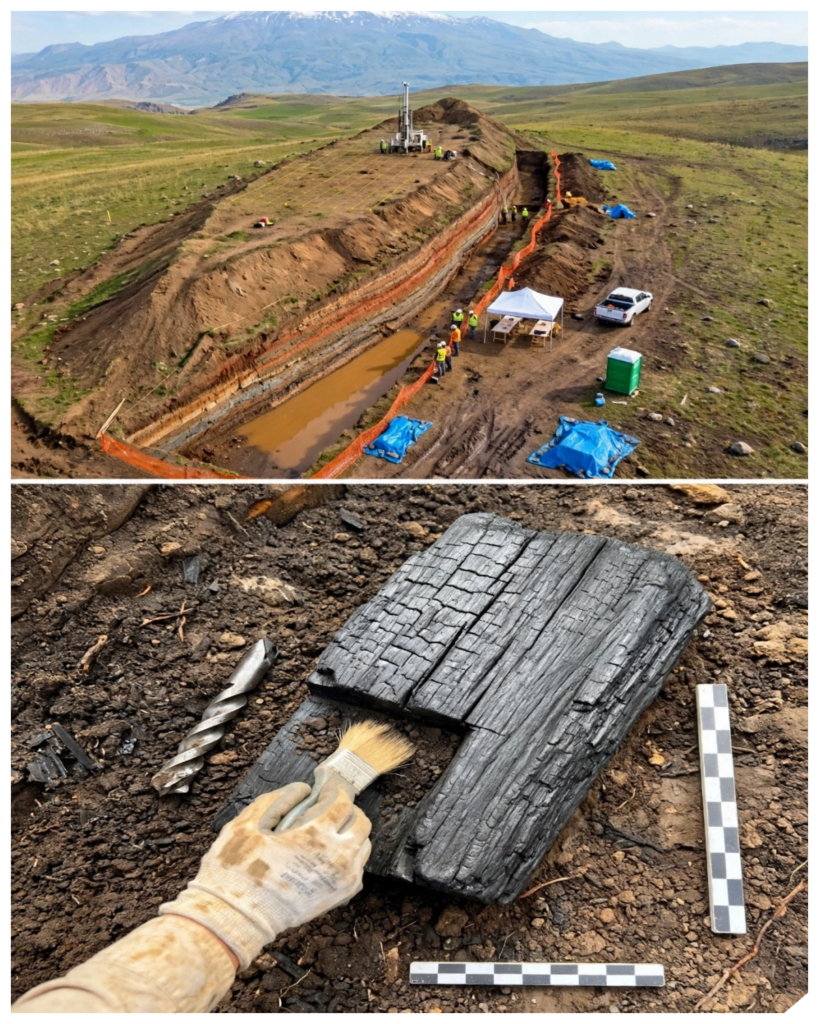
In the summer of 2026, a drill was grinding into a hillside in eastern Turkey, 6,300 ft up, 18 mi south of Mount Ararat.
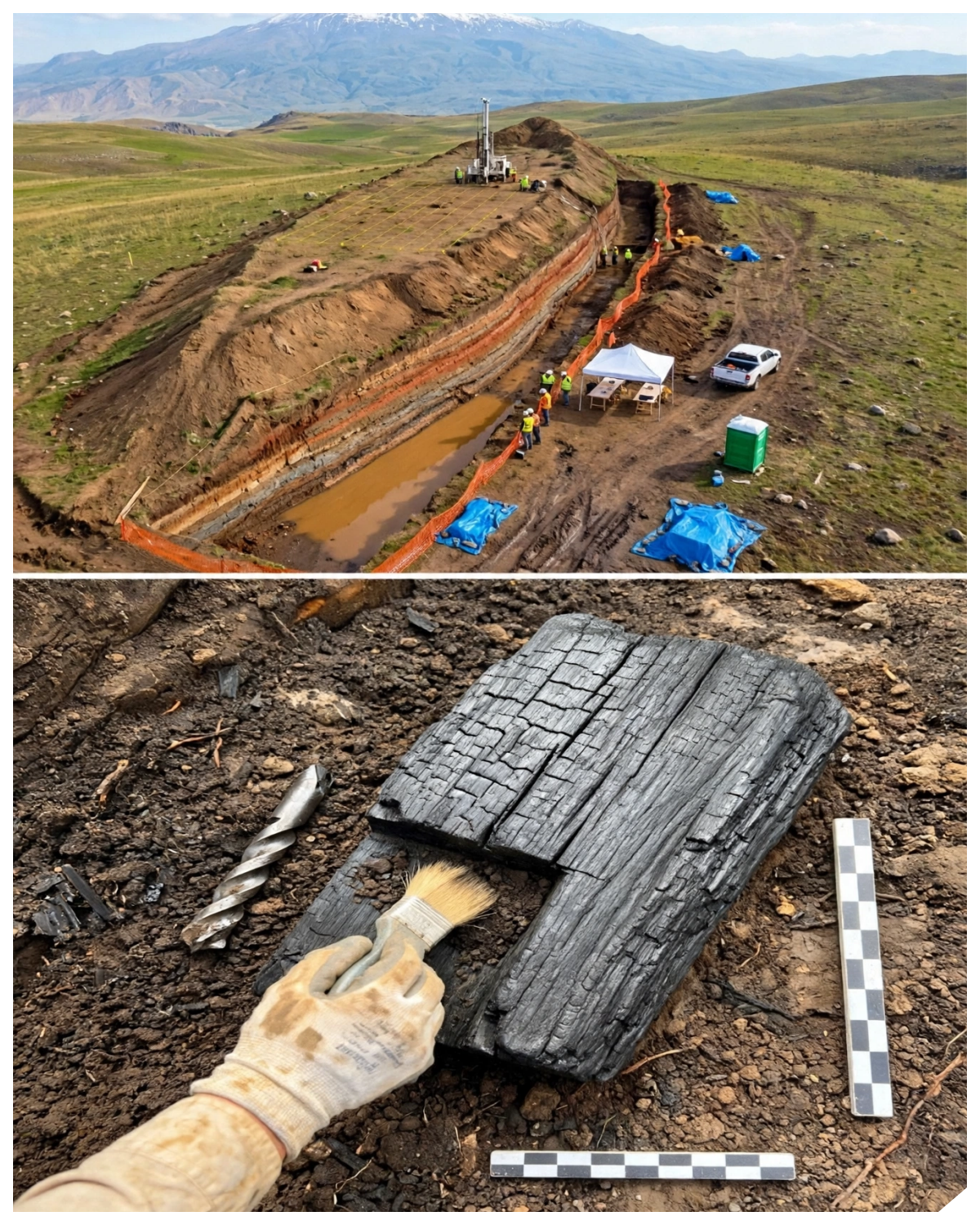
The hill beneath it is more than 500 ft long.
From the air, it looks exactly like a boat.
Four or 5 meters down, the drill bit snapped in half.
For 30 years, a scientific paper had said this hill was solid rock.
Nothing inside it but stone.
Four things came out of those holes.
A broken drill bit, holes with no bedrock in them, a robot camera in a dark, empty space underground, and something black and burnt that was announced only weeks ago.
Both sides agree something is down there.
They just cannot agree on what it is.
To understand why a broken drill bit matters, you have to know what was supposed to be inside that hill.
If you want the real evidence behind stories like this and the honest arguments on both sides, subscribe because this one begins with an earthquake.
In May 1948, the ground above the town of Dogubayazit shook three times.
When it settled, a Kurdish shepherd named Rashid Sarhan was working the hillside.
He saw something that had not been there before.
A long oval shape rising out of the mud, pointed at both ends, raised along the middle.
He told people about it.
The story went around the villages, and there it stayed.
For 11 years, almost nobody outside that valley knew it existed.
Then in October 1959, a Turkish army captain named Ilhan Durupinar was studying aerial photographs.
They had been taken during a NATO mapping flight over eastern Turkey.
Durupin was a ctographer.
Reading landscapes from the air was his job.
He knew what hills and valleys were supposed to look like.
In one photograph, he found a shape that did not fit.
He reported it to the Turkish government.
In 1960, the photographs reached Life magazine.
Millions of readers saw the outline of what looked like a giant boat lying on a mountainside.
One of the people who studied those photographs was Arthur Brandenburgger.
He was a professor at Ohio State University and [music] an expert in measuring the Earth from aerial images.
His verdict was simple.
The site deserved a closer look.
So, in September 1960, a small team went up the mountain.
Brandenburgger was there.
So was Durupinad himself.
They were joined by members of an American group called the Archaeological Research Foundation.
They stayed for 2 days.
They dug into the formation.
In places they used dynamite and blasted into its edge.
They were looking for wood, anything that looked like a ship.
They found soil and rock and they went home.
For most of the world, that was the answer.
Experts had gone up the mountain.
They had dug.
There was nothing there.
But look closely at what happened.
Two days of digging, a few blasts with explosives, no systematic testing of the soil, no drilling into the core, no study of what the formation was made of.
The team had not proved the site was empty.
They had proved there was no wooden ship lying below the surface waiting to be picked up.
That is a very different thing.
And it left a door open.
For the next 17 years, that door stayed quiet.
Then in 1977, an amateur explorer from Tennessee walked up the hill.
He was not a scientist.
He was not an archaeologist, but he was certain he knew what was inside it.
His name was Ron Wyatt.
He worked as a nurse anesthetist, and he had become obsessed with finding the objects of biblical history.
Wyatt looked at the mound and decided it was Noah’s Ark.
He said so loudly on television [music] in books he published himself.
He brought equipment to the site and said it detected iron arranged in a grid beneath the surface.
He said he had found the ribs of a ship.
Almost no professional geologist accepted any of it.
His methods were questioned.
His readings were disputed.
But Wyatt kept coming back.
And in 1985 he brought someone very different with him.
David Fold was a marine salvage expert.
His career was finding sunken ships.
If anyone knew what the buried remains of a boat looked like, it [music] was him.
Fold studied the formation.
He listened to Wyatt and he agreed.
In 1988, he published a book called The Ark of Noah.
It argued the hill was the real ark.
Then 8 years later, he turned against his own book.
In 1996, Foldel wrote a paper with a geologist named Lawrence Collins.
It was published in the Journal of Geoscience Education, a peer-reviewed science journal.
[music] The title did not leave much room for doubt.
Bogus Noah’s Ark from Turkey exposed as a common geologic structure.
The two men had looked at the material Wyatt claimed was man-made.
They studied it under the microscope.
Here is what they reported.
The formation was a doubly plunging sincline.
That is a fold in layers of rock.
Pressure inside the earth bends the layers down into a long trough.
Then erosion wears the surface away.
What is left can be an oval ridge with tapered ends.
In other words, a shape that looks like a boat made by nature.
The iron grid was weathered volcanic mineral.
There was no fossil wood.
There [music] were no traces of reed.
There was no carbon left behind by anything that had once been alive.
It was rock.
It had always been rock.
There is one strange footnote.
Fold’s biographer, June Daw, later said that in private he never fully let go, that he still believed he had found something important.
Nobody can check that now.
Fel died in 1998, 2 years after the paper came out.
Whatever he believed, he took with him.
But keep that conclusion in your mind because the rest of this story depends on it.
If this hill is a sincline, then the inside of it is solid rock.
Drill into it and you hit stone.
For 23 years, nobody tested that with a drill.
Then someone pointed radar at it.
His name is Andrew Jones.
He is an American researcher who runs a group called Noah’s Ark Scans.
He believes the formation is the ark, but belief is not evidence.
In 2019, he worked with a company from Oregon called Topa 3D.
Together, they ran a ground penetrating radar survey across the whole formation.
The idea behind radar is simple.
You send pulses of energy into the ground.
They bounce back off whatever is buried down there.
Solid rock bounces them back one way.
Empty space bounces them back another way.
Walls and edges show up as lines.
Combined, they make a picture of what lies below.
If the hill was one solid fold of rock, the picture should have been plain.
It was not.
The radar showed three separate layers.
It showed what looked like a long corridor running through the inside of the mound, about 13 m of it, and it showed lines meeting at right angles, some of them 8 m down, some of them 20.
Jones chose his words carefully.
He did not say the radar proved anything.
He said, “This was not what you would expect from a solid block of rock.
It was what you would expect from something that had been built.”
But the other side has a real answer.
Lawrence Collins pointed out that rock under pressure cracks and it can crack in straight lines.
Those cracks can meet at sharp angles.
On a radar screen, a crack can look exactly like a wall.
Straight lines underground, he said, are not proof that people made them.
Both things can be true.
The radar saw something.
Nobody could yet say what.
Then the soil started to talk.
In 2024, the team took soil samples from 22 points in and around the formation.
They measured how much organic matter was in each one, the dark material left when living things rot.
According to the team, the soil inside the outline held about three times as much organic matter as soil from just outside it.
Potassium was higher inside, too.
The acidity was different.
A few steps across the edge of the shape and the chemistry changed.
Jones had an explanation.
Wood that rots for thousands of years does not vanish.
It soaks into the soil around it.
But there is a fair objection.
The inside of the shape is lower ground.
Water drains into low ground.
It carries plant matter.
A natural hollow can collect all of that over centuries.
The team agreed.
They called the soil a lead.
Not proof.
And to go further than a lead, they needed something nobody had ever been given here.
Permission to drill.
In May 2026, the Turkish government finally gave it.
For the first time in the history of this site, someone was allowed to go underground.
Every earlier claim about this hill had been made from the surface.
The project was led by Professor Jenkeer Atila, an archaeologist at Civas Jum Hurriet University.
This was no longer a group of enthusiasts with a spade.
It was a university excavation with a government permit.
About 20 researchers came from five countries, archaeologists, geologists, soil scientists, [music] and the team from Noah’s Arc Scans.
First, they scanned the hill again, this time with a more advanced radar system led by a defense scientist named Kosro Baktar.
The new scans showed what the team described as possible empty spaces between 3 and 13 m down.
One possible passage ran more than 250 ft through the formation.
The radar also showed a thick buried layer split into three levels.
The book of Genesis describes the ark as having three decks.
The team was careful here.
They said the match could be coincidence.
Sediment settles in layers all over the world.
Then that summer, the drills went in.
If you are finding this as gripping as I am, subscribe now because what came up out of those holes is the reason this video exists.
The team drilled 16 holes, 12 inside the outline of the boat shape and four outside it.
Those four were controls.
They would show the normal hillside underground.
Some cores came up from 18 m down.
In one hole inside the formation, the drill pushed through four or 5 m of softer ground.
Then it stopped.
The percussion bit had struck something so hard that it snapped.
Jones said it could be petrified wood.
Wood so old it has turned to stone or mineralized wood.
Or it could simply be a hard block of rock.
Nobody knows yet.
No laboratory has named it.
But the broken bit was not the biggest surprise.
In every hole drilled inside the outline, the team reported the same thing.
No bedrock, no solid limestone.
Instead, they found dark soil, layers of sediment, bands rich in organic material.
And in the control holes outside the shape, the drills behaved differently.
Outside there was bedrock.
Now remember what the paper from 1996 said.
This hill is a sincline, a fold of solid rock.
Drill into it and you hit stone.
Inside the boat shape, the drills did not hit stone.
The 1996 study never drilled.
This was the first time anyone checked.
But a drill only tells you what it hits.
To see what was down there, someone had to go inside.
The machine they sent down was never built for archaeology.
It was built for wombats.
Dr.
Robert Ross is an associate professor of electronics engineering at Latroe University in Melbourne.
In 2021, he and his team built a small remotec controlled robot called Wombot.
Its job was to crawl into the narrow muddy burrows of wombats in Tasmania without damaging them.
It helped study a skin disease in the animals.
Then Ross saw a news item.
A team in eastern Turkey was looking for a robot that could explore tight spaces underground.
He got in touch.
For 9 months, he worked with the Noah’s Ark team.
Together, they built a smaller version of his machine.
They called it Gopher, the same word the Book of Genesis uses for the wood of the Ark.
Gopher is about the size of a large book.
It has waterproof wide-angle cameras on the front and the back.
It carries sensors that read the air around it and it can work as deep as 25 m below the surface.
In late July 2026, it left Australia.
A wombat robot was heading for one of the most argued over hills on Earth.
Ross kept his feet on the ground.
He said it could turn out to be the discovery of the century.
But whether this was Noah’s ark or something completely different, he simply wanted to know what was there.
The team lowered Gopher into one of the bore holes on a cable.
The cameras were running.
The first run hit trouble straight away.
The floor at the bottom was covered in very loose sediment.
The robot’s wheels spun and slid.
It could barely move.
But think about what that problem means.
A robot cannot get stuck on a floor unless there is a floor.
And there cannot be a floor unless there is a space above it.
The footage the team released shows the walls of the drilled shaft sliding past in the dark.
Then about 16 ft down, the camera finds an opening, a void that spreads out to one side.
Below it is dark ground, and at the bottom, a faint shimmer of water.
Now, be careful here.
Most of that footage is very dark, and water collecting underground is not unusual.
It happens naturally.
A void with water in it does not prove a ship, but it does not look like solid rock either.
Engineers are now rebuilding the robot’s wheels for loose ground.
Next season, it goes deeper into the mapped spaces.
The robot found a space.
Then weeks later, the team said they had pulled something out of the ground that had been burnt.
Before I show you what it was, a quick favor.
If you want to be here when the lab results come back, subscribe now because this part of the story is still being written.
In November 2026, a photograph appeared online.
It showed Professor Sanker Atilla holding a small black fragment in his hand.
According to Andrew Jones, it was charred wood, [music] blackened and burnt found deep inside the formation.
And Jones went further.
He said one of the pieces clearly showed signs of human workmanship.
That would be an extraordinary claim.
So listen to what he said next.
Jones admitted the burnt wood could have another explanation.
It might have come from a fire.
Perhaps one lit by a shepherd on that hillside centuries later.
No laboratory has dated it.
No laboratory has even confirmed what it is.
The team has been careful before.
Back in September, Jones told Newsweek they had not identified any material as ancient wood.
He said there were no laboratory results yet.
Professor Attilla has been even firmer.
He warned against stories on social media claiming the ark had been confirmed.
It had not.
He said the findings would go through peer review and be published like any other research.
That is exactly how it should work.
On the other side, Lawrence Collins still has the strongest scientific case against the ark.
In the 1990s, his team looked at material under the microscope.
They found no wood, no reed, no carbon.
Better drills in 2026 do not cancel that out.
But some questions now sit on the table that nobody has answered.
If this hill is a fold of solid rock, why is there no bedrock inside it?
Why does bedrock appear in the holes just outside?
Why does the soil inside carry a different chemistry from the soil a few steps away?
And what was hard enough to snap a drill bit 5 m down?
Collins would likely say the lab results will give natural answers.
Drainage, volcanic minerals, erosion.
He may well be right.
There is one more small detail.
During the fieldwork, the team found pieces of ancient pottery.
Not inside the formation, beside it on a remote hillside.
People were up there long ago.
Perhaps they noticed it, too.
So, what could the laboratories tell us?
The cores are now in labs in Ankura.
If they hold organic material, it can be carbon dated.
If that date lands near the time the flood story is set, that would be significant.
If the hard layer turns out to be ordinary rock, that would be just as significant in the other direction.
Right now, neither answer exists.
Go back to that photograph from 1959.
A map maker looked at a hillside from the air and saw a shape he could not explain.
67 years later, a robot built for wombat burrows went inside it.
Four things came out of those holes.
A drill bit snapped in half.
Holes with no bedrock, a dark, empty space underground, and a fragment of something burnt.
None of them prove the hill is a ship, but none of them fit neatly inside a fold of solid rock either.
The cores have been pulled out of the mountain, but the answer is still sealed inside a laboratory in Turkey.
When those results land, this story gets its next chapter.
Subscribe so you are here the day it does.
So tell me below when the lab results come back, what do you think that hard layer will turn out to be?