Even today, there are some places on the map of the world which are beyond the reach of humans.
Man has stepped on the moon, has made his reach up to Mars, and has measured the unfathomable depths of the ocean.
But there is a place on Earth where humans could not reach even if they wanted to.
Standing amidst the high, snowy plateaus of Tibet,this place is the highly sacred and mysterious Mount Kailash.
While in Hinduism, Kailash is considered the permanent abode of Lord Shiva and Mother Parvati, people of Buddhism, Jainism, and Tibet’s ancient Bon religion also count it among the most sacred places in the world.
But Mount Kailash is not just a center of faith, rather, such mysteries are associated with it which have surprised even scientists, explorers, and researchers.
Humans, who have conquered the world’s highest peak like Mount Everest thousands of times, have not been able to set foot on Mount Kailash, which is much lower in height, to this day.
It is said that till date, whoever dared to climb Mount Kailash, either had to lose their life or suddenly occurring fierce blizzards forced them to return.
It is believed that as soon as humans step near Mount Kailash, the laws of nature change, and the wheel of time spins so fast that a young man starts growing old in a matter of days.
People even believe that it is the gateway to heaven.
Meanwhile, some people also connect it with the ancient mystic city of Shambhala, which exists right beneath this Mount Kailash.
Let us know what the actual truth behind Mount Kailash is.
Is it merely a center of religious faith, or is there really some mystery hidden in this snow-covered mountain, which the world has not been able to solve to this day.
To know this entire mystery, we will have to go quite back in time.
When about 50 million years ago, separating from the Gondwana Supercontinent and moving towards the North, the Indian Plate collided with the Eurasian Plate.
This collision was so massive that the debris accumulated in the ancient Tethys Sea present between both plates folded like paper and began to rise, and gradually a massive mountain range like the Himalayas was formed.
During this very time, along with some of the highest peaks in the world, Mount Everest was also born.
But Mount Kailash’s story begins about 30 million years ago.
Mount Kailash is the second highest peak of the Kailash Mountain range, after Lumpo Gangri.
Rising approximately 6638 meters above sea level, Mount Kailash is not just a sacred mountain, but also plays the role of a life giver for the entire Indian subcontinent.
From its foothills four of Asia’s largest and most important rivers— Indus, Sutlej, Brahmaputra, and Karnali—originate.
These rivers quench the thirst of not only India but crores of people in Tibet, Nepal, Bangladesh, and Pakistan, and become the foundation of their agriculture and lives.
But as important as this region is, it is equally difficult as well.
Surrounded on all sides by high, snow-covered mountains, bone-chilling cold, strong icy winds, and a severe lack of oxygen, the weather here is nothing short of a test for humans.
For most of the year, the temperature here remains in the minus.
Therefore, no permanent human settlement exists in this region.
During only a few months of the year, when the weather clears up, sages and pilgrims are able to reach here.
The biggest mystery of Mount Kailash is the presence of two such lakes nearby, seeing which it seems as if nature itself has placed two completely opposite worlds right next to each other.
The first of these is Rakshas Tal Lake, which is located at a distance of about 50 kilometers from Mount Kailash.
Situated at an altitude of about 4575 meters above sea level, this is a saltwater lake where there is no trace of life.
Neither are fish found in it, nor any other creature, nor is any greenery visible on its banks.
When viewed from afar, the water of this lake appears grey in color, and local people claim that its color also keeps changing from time to time.
Tibetan people also consider this lake ominous and cursed.
According to them, its water is toxic, and the further one stays from it, the better.
This is the reason why even today, people avoid going near it.
The surprising thing is that in satellite images, the shape of Rakshas Tal looks like a crescent moon, which is considered a symbol of darkness.
On the other hand, in the beliefs of Hinduism, it is called the lake of demons.
According to Hindu Puranas, this is the very place where the king of Lanka, Ravana, performed harsh penance to please Lord Shiva.
In some stories, it is even said that when Ravana took a dip in Rakshas Tal, only then did this lake come under the possession of demonic powers and every trace of life was wiped out from here.
But the most astonishing thing is that just a short distancefrom Rakshas Tal, Mansarovar Lake is located, which is completely opposite to it.
Situated at an altitude of about 4590 meters above sea level, Mansarovar Lake is considered the most sacred lake in the world.
The water of Mansarovar is so clean and transparent that those who see it are left stunned by its purity.
While the water of Rakshas Tal is salty and lifeless, the water of Mansarovar is extremely clean and sweet.
Where silence and desolation are visible around Rakshas Tal, an abundance of life is visible around Mansarovar.
Here, fish, swans, and various types of birds are seen wandering.
And nature has blessed this lake with so much beauty that looking at it fills the mind with peace.
People believe that taking a dip in this lake washes away all sins and opens the path to salvation.
Other aquatic organisms, aquatic plants, and many types of herbs are found.
According to Hindu beliefs, this lake was created by Lord Brahma himself through his mind’s resolve.
It is very surprising that despite being extremely close to each other, the nature of these two lakes is so vastly different.
Not only their water, but their shape also leaves people astonished.
Where the shape of Rakshas Tal is like a crescent moon, which represents darkness, Mansarovar’s shape is round like the sun, which is a symbol of light.
The coexistence of these two lakes shows that balance of the universe’s creation and destruction which makes Mount Kailash the most mysterious mountain in the world.
But Mount Kailash is not special just because of its geographical structure, rather, for thousands of years, this mountain has also been the center of faith for crores of people.
The significance of Mount Kailash is connected with Sanatan Dharma, Buddhism, Jainism, and Tibet’s ancient Bon religion.
In Hinduism, it is considered the permanent abode of Lord Shiva and Mother Parvati, where they are absorbed in eternal meditation.
On the other hand, followers of Buddhism call it Kang Rinpoche and believe that it is the abode of Buddha Demchok.
According to Jainism, their first Tirthankara, Rishabhdev, attained Nirvana here.
While the people of the Bon religion consider it the source of all spiritual power.
According to beliefs, this mountain is also considered the gateway to heaven, and its mention is also found in the Ramayana, Mahabharata, and many Hindu Puranas.
It is said that after the Mahabharata, the Pandavas started their final journey from here in search of salvation.
But the most famous story associated with Mount Kailash is that of the king of Lanka, Ravana.
According to Hindu Puranas, once Ravana was going somewhere in his Pushpaka Vimana.
But when he started passing over Mount Kailash, Shiva’s beloved servant Nandi stopped him and asked him to go by some other route.
But Ravana, consumed by his ego, in order to show his power, tried to uproot Mount Kailash from its very foundation.
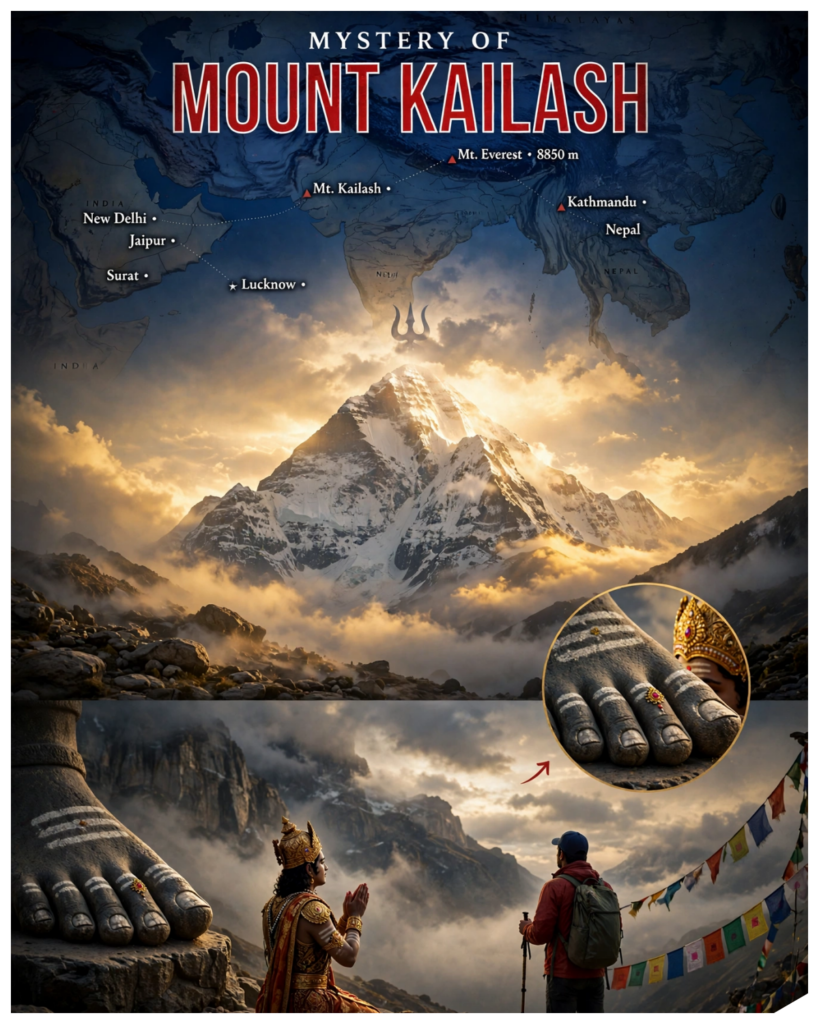
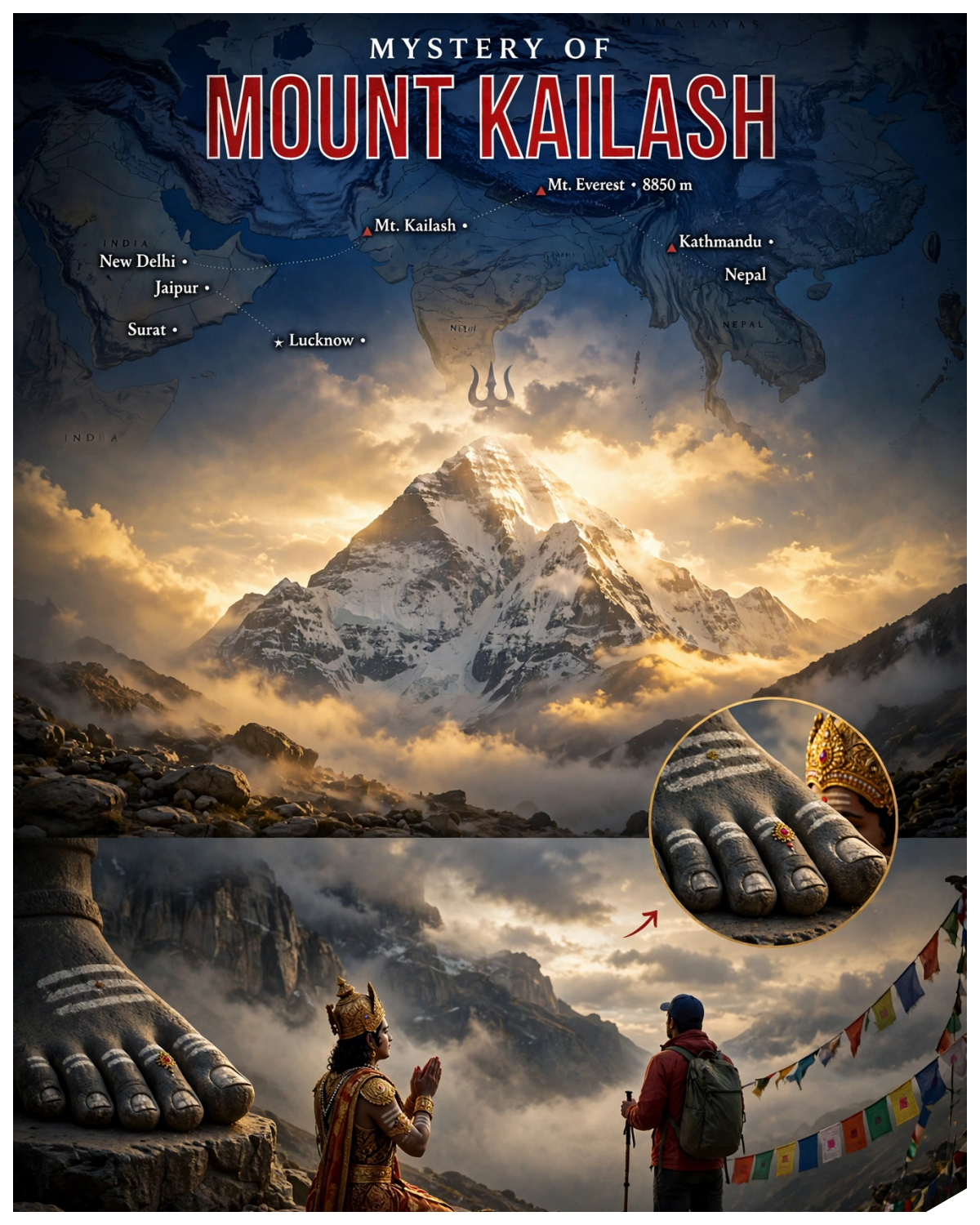
When the mountain started shaking because of his lifting and panic spread everywhere, Lord Shiva, in order to crush Ravana’s ego, pressed the mountain slightly with the big toe of his foot.
With the pressure of just one toe of Mahadev, the weight of Mount Kailash increased so much that Ravana’s hands got crushed under the mountain.
Ravana cried out in pain and realized his mistake.
After this, Ravana sat there and performed penance for Mahadev for a long time.
It is said that during this very time, he composed the famous Shiva Tandava Stotram, pleased with which Lord Shiva forgave him.
This story of Ravana is a lesson that in front of Mount Kailash, human ego is like a mere straw.
This is why no one can set foot on this mountain.
But Human nature has always been about exploration.
What the world calls impossible, humans often insist on accomplishing.
From Mount Everest to the North Pole, humans have accepted every challenge.
In such a scenario, the dream of conquering the world’s most mysterious and unconquered mountain, Mount Kailash, was also seen by many.
From 1920 to this day, many mountaineers, explorers, and adventurers tried to reach its peak.
But every time, such obstacles stood before them which deepened the mystery of this mountain even further.
The first major attempt was made in 1926 when India was under British rule.
Almora’s Deputy Commissioner Hugh Ruttledge and Colonel R.C.
Wilson were searching for a route to climb the peak of Mount Kailash.
For many days, they inspected different parts of the mountain, but the closer they got to Kailash, the more they realized that this is no ordinary mountain.
Steep cliffs, suddenly changing weather, lack of oxygen, and dangerous snow-covered slopes were blocking their way at every step.
Eventually, Hugh Ruttledge reached this conclusion that climbing this mountain is impossible and it should remain only a sacred mountain.
But Colonel R.C.
Wilson, who accompanied him, was not ready to give up so easily.
An experienced Sherpa named Satan, who was with him, told him that the mountain’s South East Ridge could be a possible route to reach the peak.
That was all it took; Wilson decided to challenge destiny.
But as soon as he begins to move forward, the weather suddenly takes a turn, and within a few hours, the sky gets filled with dark clouds and heavy snowfall begins.
Strong icy winds block his path completely.
Conditions become so bad that taking even a single step forward becomes like risking one’s life.
Ultimately, Wilson also has to leave his climb midway and has to return.
But the mystery of Kailash does not end here.
After this, in the year 1936, Austrian Mountaineer Herbert Tichy also wanted to reach this mountain.
Herbert Tichy, along with being a professional mountaineer, was also a writer, geologist, and journalist, and he was among those few Western people of that time who had experienced Tibetan culture and its spirituality very closely.
Before reaching Kailash, he interacts with many Tibetan monks.
He only wanted to know whether this mountain could be climbed.
Then he received an answer which changed his entire perspective.
The monk tells him that only that human can reach the peak of Kailash who has never committed any sin in their life, and if there is any such human, then to go up, they will not need ropes nor shoes, but will fly like a bird and reach the peak on their own.
This answer quieted the mountaineer inside Herbert Tichy.
He realized that this is not just a mountain of stone, but the center of faith for billions of people.
Therefore, he gives up the idea of going to the peak of Mount Kailash.
But even after this, people’s passion for going to Mount Kailash did not diminish.
After Tibet was occupied by China in 1950, China starts promoting Tibet’s tourism and mountaineering potential across the world.
During this very time, in the 1980s, the Chinese government offers one of the world’s most famous mountaineers, Reinhold Messner, the chance to climb the peak of Mount Kailash.
Messner was no ordinary mountaineer, rather, he had conquered all 14 peaks in the world higher than eight thousand meters.
Not only that, in 1978, he made history by climbing Mount Everest without oxygen support.
At that altitude, oxygen is so low that even a human’s brain stops functioning properly, and many experienced climbers also lose their lives.
For such a person, climbing Mount Kailash was probably not impossible.
But the surprising thing is that Messner rejects this proposal of China and says that this mountain has its own spiritual value and conquering it is not within human capability.
His companions also said that no one should trample with their shoes upon gods who have turned to stone.
Messner believed that by climbing this sacred peak, we would snatch away something very precious connected to the faith of crores of people.
Messner was not the only person who held such respect for Kailash in his heart.
Russian climber Sergei Cistiakov also claimed later on that when he reached very close to Kailash, a strange feeling began to arise inside him.
He felt as if this mountain was telling him that he should not be there.
He said that as soon as he decided to return, he felt a strange sense of relief.
Apart from this, many other travelers also felt unusual when they got close to Kailash.
They claimed that their compasses began to behave abnormally around Kailash, and as soon as they went there, a strange storm suddenly arose.
But the mysteries of Mount Kailash do not end here.
In 1999, Russian Ophthalmologist and Researcher Doctor Ernst Muldashev, taking a special team of his seven experts, reaches Tibet to understand the mystery of Kailash.
Many years before this expedition, he had studied ancient maps, Tibetan scriptures, and local legends.
On this very basis, he was convinced that this is indeed a unique place.
Was convinced that the region of Kailash is not just an ordinary mountain area, but could be the center of the ancient City of the Gods.
As Doctor Ernst Muldashev’s team gets closer to Kailash, their experiences become even stranger.
Muldashev later claims that they felt as if some invisible power was signaling them to return.
But his most sensational claims were yet to come.
After his research around Kailash, Muldashev claims that Mount Kailash is not a natural mountain, rather it is a pyramid built by some super advanced ancient civilization.
According to him, this mountain could be hollow from inside and hidden chambers and tunnels might exist within it.
He even said that some kind of energy field works around the mountain which modern science has not been able to understand to this day.
Further, he mentioned that one night when their team was resting there, they also heard some sounds coming from inside Mount Kailash, hearing which they were completely shocked.
It felt as if stones were falling inside the mountain.
Apart from this, he also made claims like time dilation there.
According to them, the length of their nails and hair increased in just a few hours as much as it usually does in weeks.
Muldashev also mentioned an old story according to which, a few years ago, some young Siberian mountaineers had grown old while climbing Mount Kailash, and due to a fierce storm midway, they had to return, and soon they passed away.
In his book ‘Where Do We Come From’, he claimed that such caves could exist around Kailash where people of ancient civilizations are present in deep meditation.
He also described this entire region as the entry gate to the mysterious city of Shambhala.
These claims of Doctor Muldashev caused a sensation worldwide.
Even today, thousands of articles, videos, and discussions regarding his claims are present on the internet.
But modern science, geologists, and most researchers do not accept these claims of Muldashev and call them fabricated.
But still, these claims deepened the mystery of Mount Kailash even further.
In the year 2001, Mount Kailash once again came into the global spotlight when the Chinese government gave permission to a Spanish expedition team to climb Mount Kailash.
This team was being led by Jesus Martinez Novas.
As soon as the news came before the world, especially the people of India, Nepal, and Tibet became very angry.
The mountain which for centuries was considered unconquered and the abode of gods, the news of human steps reaching there started a major controversy.
Protests started at many places, and thousands of people appealed to the Chinese government to stop this expedition.
Even international mountaineers stood in support of the devotees.
Reinhold Messner, who had once rejected China’s proposal, also opposed it.
He said that if we conquer this mountain, then we will lose something very special from our soul.
Seeing the mounting international pressure and respect for religious sentiments, This matter hurt the sentiments of crores of people.
In no time, the matter did not remain limited only to religious sentiments.
Cultural heritage, religious rights, and human rights organizations also jumped into this controversy.
Many famous mountaineers of the world also opposed this expedition.
The opposition grew so much that eventually the Chinese government had to bow down, and they cancelled the permission of the Spanish team.
After this, the Chinese administration took another major step and placed a permanent ban on all future attempts to climb Kailash as well.
Even today, this law is in force, that no person can attempt to climb the peak of this mountain.
The surprising thing is that Mount Everest, the highest peak in the world, has been climbed thirteen thousand seven hundred times, but Mount Kailash, which is about two thousand two hundred meters shorter, still stands unconquered.
But it is believed that in this world to this day, only one human has been able to reach the peak of Mount Kailash.
This story is associated with Jetsun Milarepa, one of the most famous monks of Buddhism.
It is said that Milarepa, who was born in the eleventh century, had a childhood full of many sorrows.
After his father’s death, his uncle usurped all the family’s property and forced his mother, his younger sister, and him to live an extremely miserable life.
In such a situation, at the wish of his mother, Milarepa learned occult practices and black magic to take revenge.
When he became an expert in this, he used his powers to take revenge on his enemies and, during a wedding, demolished his uncle’s house, in which thirty-five people were killed.
The revenge was completed, but after that, Milarepa felt such remorse for his actions that he could not find peace anywhere.
Wandering in search of peace, eventually, under the guidance of Mahaguru Marpa, he performed harsh penance for a very long time, and gradually the same Milarepa, who was once known for black magic, became one of the most respected spiritual masters of Tibet.
It is said that he set out on a journey to Mount Kailash in ten ninety-three.
During this, he faced the powerful occultist of Tibet’s ancient Bon religion, Naro Bonchung.
A battle of superiority broke out between the two, and it was decided that whoever reached the peak of Kailash first would be considered the greatest spiritual leader of that region.
Naro Bonchung, on the strength of his powers, started climbing up rapidly without stopping, while Milarepa kept meditating below in a calm state of mind.
Time passed, and in no time Naro Bonchung reached extremely close to the peak of Kailash.
It seemed as if victory was now in his grasp.
But just then, the first ray of the sun fell on Mount Kailash.
According to the story, at that very moment Milarepa caught that first ray of the sun and, rising up with its light in the blink of an eye, reached the peak of Kailash.
Naro Bonchung was astonished to see this and he accepted his defeat.
Even today, Milarepa is highly revered in Tibetan culture.
According to Buddhist beliefs, Milarepa was the first and the last human to reach the peak of Mount Kailash.
It is said that when Milarepa reached the peak of Kailash, he also felt that this place is not made for humans, and it should only be respected from afar.
How true these stories are, cannot be said.
But the mystery and curiosity among people regarding Mount Kailash has not ended even today.
The most popular mystery is that of time distortion.
Many travelers have claimed that time does not pass in a normal way around Kailash, and hair and nails grow rapidly here.
However, science does not accept this claim.
According to science experts, lack of oxygen at high altitude, fatigue, extreme weather, and the stress on the body can affect a human’s time perception, making time feel different from normal.
Meanwhile, the claim of hair and nails growing rapidly has also not been proven in any scientific study to this day.
Just like this, regarding the mysteries of Mansarovar and Rakshas Tal lakes, scientists do not hold any mysterious power responsible, but rather natural causes.
Mansarovar is a freshwater lake which constantly gets water from surrounding glaciers and melting snow.
On the other hand, Rakshas Tal is a closed saline lake whose water does not flow out.
Therefore, over time, the salt content in it kept increasing, and any trace of life was wiped out from here.
Apart from this, the mysterious sounds heard around Mount Kailash have also kept people astonished.
Many travelers have claimed that in the silence of the night, they heard the echo of ‘Om’ and ‘Damru’.
But scientists believe that when strong winds crash against the mountain’s crevices and rocks, an aero-acoustic effect is created.
Due to this, such sounds can be heard which our brain begins to interpret as a damru, bell, or other familiar sounds.
In psychology, this is called auditory pareidolia, where our brain finds a familiar pattern or tune in any random sound.
But for devotees, this is still a sign of Mahadev’s presence.
Apart from these sounds, the sky of Kailash also tells its own unique story.
Some travelers have also claimed to see strange lights and colorful light beams over Kailash at night.
Apart from this, according to some people, the yeti, the wild man, lives here, and some people have even claimed to have seen him nearby.
Moreover, some people’s claims are even more shocking.
According to them, some highly advanced alien civilizations also exist near Mount Kailash.
But the mystery does not end here.
Mount Kailash is also considered to be the Axis Mundi.
That is, a place where Earth and Heaven are connected to each other.
According to some beliefs, Kailash is the spiritual center of the entire world, and from here, the energy of the universe spreads across the whole world.
Apart from this, another thing surprises people.
It is said that the distance from Mount Kailash to the North Pole and Stonehenge is about 6,666 kilometers, while the height of Mount Kailash is 6,638 meters, which is very close to this number.
Meanwhile, the South Pole is at about double the distance, that is, 13,332 kilometers.
Some people consider this a mere coincidence, while for some, it is part of a larger mystery connected to Kailash.
But the most surprising thing is yet to come.
The four sides of Mount Kailash are perfectly aligned towards the North, South, East, and West directions.
Such a formation is very rarely seen in a natural mountain.
This is why some researchers even described it as a giant pyramid.
Not only this, some people also view this in connection with the Shiva Shakti axis line.
From Rameshwaram in South India to Kedarnath in North India, many ancient Shiva temples exist in a straight line which fall on the 79-degree East longitude.
When this line is seen on a map, it appears to pass parallel to the Kailash region.
For some people, this is just a coincidence, but some people believe that these temples built thousands of kilometers away and Kailash are tied by a single invisible thread.
Apart from this, there is another thing which makes the faith of crores of people even stronger.
Many travelers coming here believe that when seen from afar, the Southern face of Mount Kailash does not look like an ordinary rock, but like the actual face of Lord Shiva himself.
Although there is no scientific evidence of this, there is one thing which can be seen to a great extent even in photos.
On the Southern face of Mount Kailash, some marks appear which look like a Swastika.
Meanwhile, some people also claim to see the symbol of Om here.
However, scientists call this Pareidolia.
That is, a situation when the human brain begins to see familiar faces or symbols even in natural shapes.
According to some religious beliefs, the mysterious ancient city of Shambhala exists beneath this mountain.
In Tibetan Buddhist tradition, Shambhala is described as a place where highly wise people live who know about the past, future, and present.
It is said that when unrighteousness increases on earth, then the people living in this very Shambhala will protect the earth.
Now, how much truth lies in these stories, it is difficult to say.
Science today still views this mountain as a unique geographical formation, but for billions of people, Kailash is not just a geological structure, but a symbol of supreme spiritual energy.
Whether it is the scientific logic or the strength of faith, Mount Kailash remains, and will always remain, an unsolved mystery.
Is trying to understand.
Answers to many claims have been found, while many things it considers to be just beliefs and folklore.
But despite this, the attraction of Kailash today is just as it was centuries ago.
Some people consider it the abode of Lord Shiva, some call it a wonderful miracle of nature, while for some, it still remains the world’s greatest unsolved mystery.
How do you view Mount Kailash?
Do tell us your opinion in the comments.