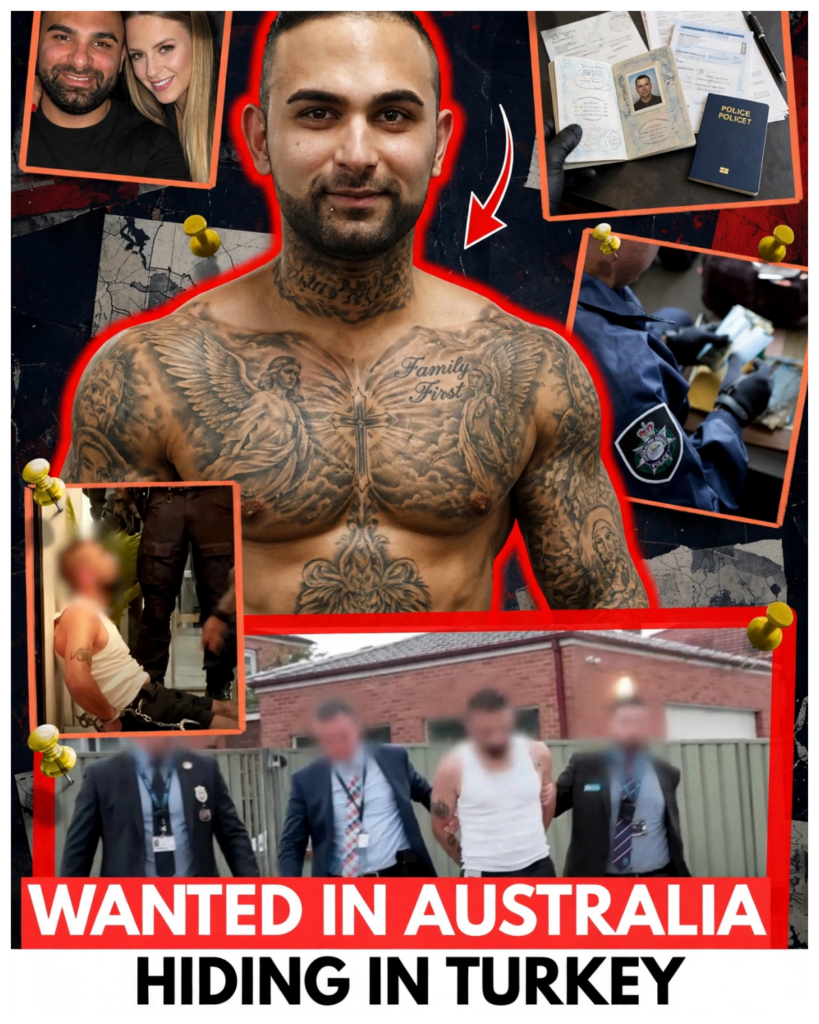
In January 2025, police in Sydney found a caravan packed with explosives parked in a quiet outer suburb.
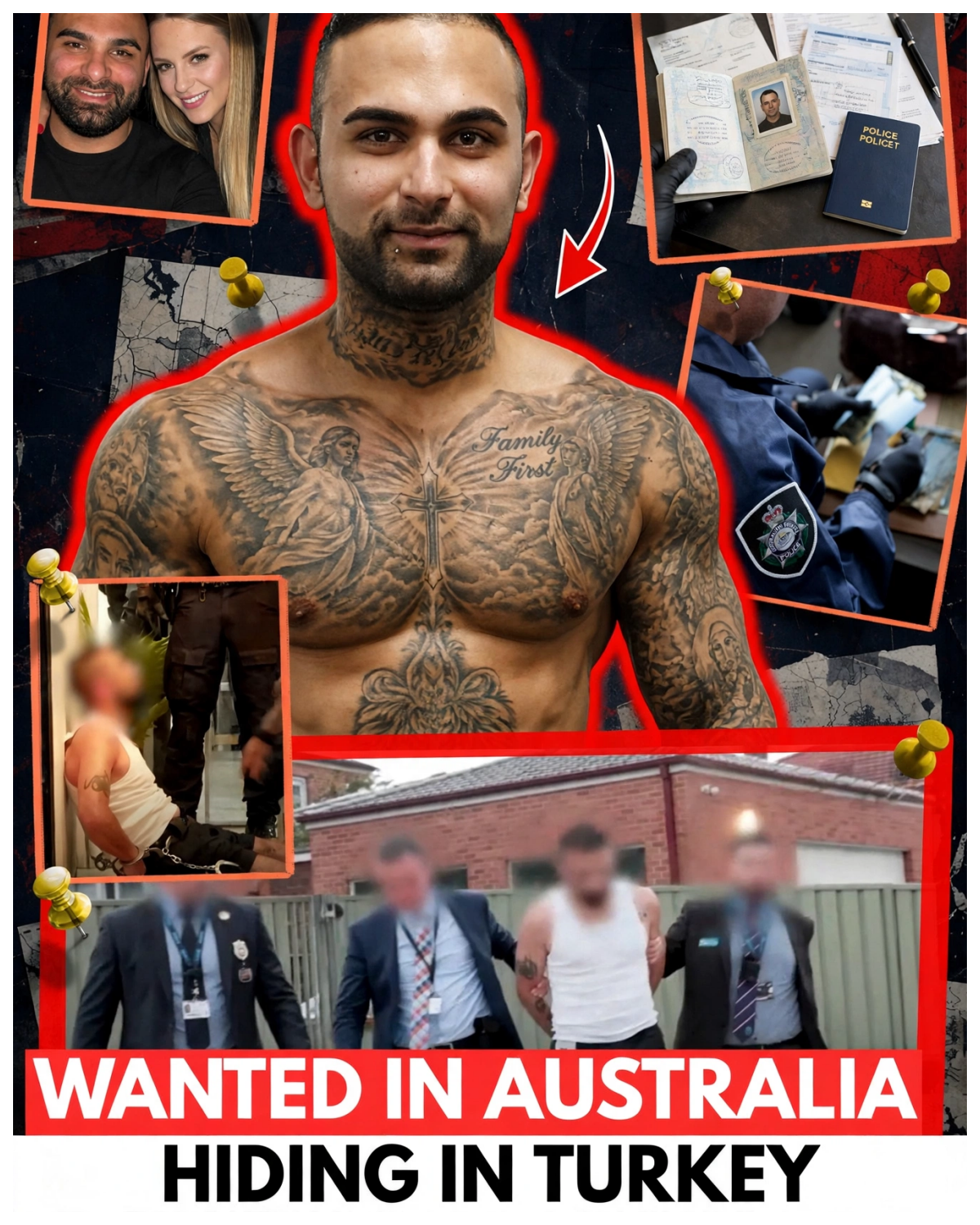
Inside, along with the explosive material, was the address of a synagogue.
The state premier stood in front of cameras and called it what it looked like, a potential mass casualty terrorist attack aimed at the Jewish community.
Months later, investigators say that’s not what it actually was.
According to the Australian Federal Police, the caravan wasn’t the beginning of an attack.
It was staged on part of a manufactured crime wave.
Allegedly organized by a man facing his own serious drug trafficking charges who police say was trying to buy himself leniency by giving them something bigger to chase.
His name is Sad Erhan Aka.
He’s been on the run since 2023, and as of the most recent reporting, Australian authorities have placed him among the country’s most wanted fugitives.
Before we go further, a note on how this video is put together, because this case demands more care than most.
Everything here is drawn from AFP statements, court reporting, and documentary journalism, including Aka’s own on camera interview given from wherever he’s currently hiding.
The alleged campaign connected to this case involved real documented anti-semitic vandalism targeting real synagogues and real people regardless of who ultimately ordered it or why.
We’re not going to describe that material in detail and nothing in this video should be read as minimizing the genuine fear it caused.
Where aka’s own account differs from what police allege or from what remains formally unproven, we’ll say so directly.
He’s a fugitive who has spoken publicly in his own defense, not a convicted man, and this video treats him accordingly throughout.
Before any of this, aka was a Sydney gym owner charged in 2022 with conspiring to import a commercial quantity of illegal drugs.
He was granted bail.
He didn’t show up to court.
What police say happened between his disappearance and the discovery of that caravan is the subject of an active ongoing investigation.
One that’s reportedly reached from a boat pickup off Thursday Island to a television interview filmed somewhere in Turkey.
In this video, we’ll go through what’s actually documented about Sad Aka, the drug charges that first put him in the justice system, his escape from Australia, the caravan discovery, and the broader wave of attacks police say were connected to it, and his own recent first ever public account of what he says actually happened.
If you’re new here, this channel covers organized crime and major criminal cases across Australia and New Zealand using court records and verified public reporting.
No dramatizing, no glorifying, and on a case like this one, no shortcuts on accuracy.
Subscribe and turn on the bell if you want to see where this one goes.
We’ll start with a gym in Sydney and a drug charge that on its own would have been a fairly ordinary story.
Before he became one of the most wanted men in Australia, Sate Erhan Acha ran a gym in Sydney.
Available reporting on his background before 2022 is limited.
This account hasn’t been able to establish through independently verified sources detailed information about his upbringing, family, or how he first became involved in the drug trade that would eventually define his public record.
What is confirmed is where his documented legal history actually begins with a serious drug importation charge that on its own would have made him a significant but relatively conventional figure in Sydney’s organized crime landscape well before anything connected to explosives or anti-semitic vandalism entered the picture.
In 2022, AKA was charged with conspiring to import a commercial quantity of illicit drugs.
Reporting on the case describes the alleged quantity at roughly 600 kg along with a separate charge of recklessly dealing with the proceeds of crime.
It’s worth being precise about what these charges represent at this stage of the account.
Serious allegations reflecting what police believed was a significant drug trafficking operation, but allegations that had not at this point been tested at trial.
Aka was granted bail by the New South Wales local court in March 2022.
What happened over the following year illustrates a pattern worth watching closely because it directly shaped everything that came afterward.
Acha’s bail conditions weren’t static.
In May 2023, more than a year after his initial release, those conditions were varied, requiring him to surrender his passport.
Crucially, the varied conditions still permitted him to travel interstate, specifically to Queensland.
It’s worth sitting with that detail because it represents the specific gap in his bail arrangement that would ultimately allow him to leave the country entirely.
A passport can prevent someone from booking a commercial flight overseas.
It does considerably less to prevent someone determined to leave by other means once they’re legally permitted to reach a state with extensive coastline and maritime access to international waters.
Aka has since offered his own explanation for why he made the decision to flee.
Given directly in a televised interview, the first public account he’s provided since disappearing.
According to that account, his decision to leave Australia wasn’t purely about avoiding the drug charges themselves.
He said he also feared becoming a target of other criminals once his situation became more precarious.
This account can’t independently verify that specific claim, and it’s worth treating it with the same caution this channel applies to any fugitive’s own explanation for their conduct.
A genuine possibility, but also a convenient one, arriving from a man with an obvious interest in presenting his flight as motivated by self-preservation rather than a calculated effort to escape prosecution entirely.
Whatever his actual reasoning, AKA did not appear at a scheduled court date at Sydney’s Downing Center local court on 28th September 2023.
By that point, according to later reporting, he was already in the process of leaving the country.
There’s a further detail worth including here because it became part of the broader public conversation around Aka even before the caravan discovery made him a household name.
According to reporting connected to opposition criticism of the government’s handling of his case, aka had at some point posted deeply offensive material to social media referencing Islamic beliefs about martyrdom in a way widely condemned as both inflammatory and anti-semitic in its implications.
This account isn’t going to reproduce the specific content of that post.
Doing so would serve no purpose beyond repeating language designed to provoke, and this channel doesn’t consider that necessary to understand its relevance.
What matters for this account is simpler.
Aka had already generated public concern and political criticism before the events connected to the dural caravan even took place, establishing him in the eyes of at least some public officials as someone whose conduct extended well beyond an ordinary drug trafficking case.
By the time AKA failed to appear in court in September 2023, he’d already built a public profile considerably more complicated than a typical fugitive drug offender, a wanted man with a documented history of inflammatory public statements about to disappear from Australia entirely into a sequence of events that would eventually connect his name to one of the most serious and widely reported criminal investigations the country had seen in is to understand what happened after Sai Aka disappeared from Australia in September 2023.
It helps to understand the environment his eventual reappearance in the headlines actually stepped into.
Beginning in late 2023, following the start of the Israel Gaza war, Australia experienced a genuinely alarming escalation in anti-Semitic incidents, graffiti, vandalism, and eventually arson, striking synagogues, businesses, and private homes connected to Sydney and Melbourne’s Jewish communities.
By the time investigators had fully mapped what was actually happening, it became clear this wasn’t a single unified campaign with one motive behind it.
It was several distinct overlapping threads investigated separately that most Australians initially experienced as one continuous terrifying wave.
It’s important to separate those threads clearly before returning to a specifically because conflating them would misrepresent what each individual case actually involved.
In August 2025, Prime Minister Anthony Albanzi announced that Australia’s intelligence services had determined Iran’s government was directly responsible for two specific 2024 attacks.
The October arson of a kosher delicatessan near Bondi Beach and the December arson of the Adas Israel synagogue in Melbourne which caused an estimated $45 million in damage and injured a member of the congregation.
According to reporting on the investigation, both attacks were directed through a local intermediary, a Nomad’s Motorcycle Club chapter president named Sed Mousawi, using the online alias James Bond, allegedly paid by Iranian linked handlers to arrange the arson through local criminal contacts in an operation genuinely directed by a foreign government.
Australia responded by expelling Iran’s ambassador.
This specific threat of attacks has nothing to do with site aka and this account isn’t going to suggest otherwise.
A separate cluster of incidents investigated by a dedicated New South Wales task force called Strikeforce Pearl was eventually attributed to a further alleged ring leader, 27-year-old Tar Zahab, charged in September 2025 with directing a string of attacks on Jewish schools and the private home of a Jewish community leader.
This too is a separate case from AKAS involving separate suspects and separate court proceedings.
It’s against this genuinely confusing multi-threaded backdrop, a period NSW police commissioner Karen Webb described at the time as involving suspects who appeared local to Sydney and in some cases appeared to have simply been paid.
That the specific incident connecting to Sad Aka took place on 19th January 2025.
A caravan was discovered on a rural property in Dural in Sydney’s outer northwest.
Inside, according to police, was a quantity of explosive material along with the address of a synagogue.
NSW Premier Chris Mins described it at the time in the starkkest possible terms.
The discovery of a potential mass casualty event and in his words, terrorism.
What investigators eventually concluded months later was that the Dural Caravan wasn’t a genuine attack in preparation at all.
According to the AFP, it was staged deliberately manufactured to look like exactly the kind of imminent terrorist threat it was initially treated as.
The stated purpose, according to AFP Commissioner Chrissy Barrett’s later public comments, wasn’t ideological.
It was transactional.
Investigators alleged that whoever was ultimately responsible for organizing the caravan’s placement was doing so specifically to generate a major resource inensive investigation.
One significant enough to create leverage for a separate personal benefit, reduce criminal charges, or some other form of leniency in an entirely unrelated case.
Barrett offered a further example of the same underlying pattern during the same public comments, describing a separate instance in which a criminal had fabricated an entirely different plot involving highpowered firearms, specifically in exchange for an offer to trade information for reduced drug trafficking charges.
This is the specific mechanism investigators allege connects directly to AKA.
According to the AFP, the person ultimately responsible for orchestrating the dural plot wanted changes to their own criminal status while deliberately maintaining distance from the scheme itself, hiring local criminals, paying them for specific tasks rather than participating directly in a way that could be traced back to them through ordinary evidence.
It’s a genuinely unusual criminal strategy, one this channel hasn’t documented in quite this form across any other case in its broader coverage of Australian organized crime.
Not violence carried out to settle a score or protect territory, but violence and vandalism manufactured specifically as a bargaining chip aimed not at a rival criminal organization, but at the justice system itself.
AXA’s own account of his involvement given directly to the ABC’s Four Corners program in his first ever televised interview offers a version of events that both confirms and complicates the AFP’s broader theory.
He told the program he had in fact personally intervened with the caravan itself, describing it as something that had been moving between an illicit buyer and seller, which he says he diverted and then reported directly to the AFP, specifically in an effort to secure more lenient treatment on his own outstanding drug charges.
It’s worth being precise about what this specific admission actually represents.
AXA isn’t denying involvement with the caravan entirely.
He’s offering a narrower account of that involvement, casting himself as someone who intercepted and ultimately disclosed a threat in a calculated bid for his own benefit rather than the person who originally arranged for the caravan to be loaded with explosives and left with a synagogue’s address inside it in the first place.
Where aka draws a firmer line is around the broader wave of incidents police have connected to the same underlying scheme.
The vandalism, the graffiti, the other acts investigators allege were part of the same manufactured crisis.
According to his own account, a number of these additional incidents have been attributed to him by police in ways he directly disputes, describing the allegations as inconsistent with his own timeline of events.
This account can’t resolve that dispute.
What it can say is that Aka’s own version of events delivered from wherever he’s currently hiding accepts a specific narrow role in relation to the caravan itself while rejecting the broader characterization of him as the architect of everything connected to it.
There’s a further institutional detail worth including here because it illustrates how sensitive this information was, even within law enforcement once it first emerged.
According to later reporting, a senior New South Wales police officer signed a non-disclosure agreement in February 2025 after being told directly by the AFP that the suspected motivation behind the jural plot was to influence ongoing criminal prosecutions.
That detail, the true alleged purpose of one of the most publicly alarming domestic security incidents in recent Australian history was apparently known to at least some senior police figures well before it became public and was deliberately kept confidential during that period.
This account can’t establish the full reasoning behind that decision, but it’s worth noting as a genuine point of tension in how this entire case was ultimately handled and communicated to the public.
It’s worth reflecting briefly on what this specific allegation that a wanted drug trafficker staged a fake terrorist plot targeting a religious minority community purely to gain leverage in his own legal proceedings actually represents.
Distinct from the broader question of aka’s guilt or innocence on any specific charge.
If the AFP’s theory is accurate, it describes someone treating genuine documented fear within a vulnerable community as a disposable tool, useful only in so far as it generated enough police attention to be traded for a lighter drug sentence.
Whether or not every specific detail of that allegation is eventually proven against AKA personally, the broader pattern Commissioner Barrett described organized criminals paying for staged hate crimes and false terrorism tips specifically to manipulate their own prosecutions represents a genuinely disturbing evolution in how some Australian organized crime figures have apparently come to view the country’s counterterrorism and hate crime response infrastructure not simply as a threat to evade, but as a system sophisticated and reactive enough to be deliberately exploited.
What remains unresolved at the point this account was put together is the central legal question underlying everything covered here.
Whether Sai Aka will ever actually be extradited to face the drug charges that started this entire sequence of events, let alone any charges connected to the caravan itself.
He remains, as of the most recent reporting available, outside Australia, having given his own account publicly while still evading the authorities seeking his return.
Site Acher’s initial contact with Australian law enforcement over drug offenses didn’t happen through a conventional investigation.
It traces back to Operation Ironside, the three-year undercover operation in which the AFP working with the FBI secretly ran an encrypted communications platform called Anom, marketed to organized crime figures worldwide as a secure way to conduct criminal business, while every message passing through it was actually being monitored by police.
When Operation Ironside’s true nature became public in 2021, it was described at the time as one of the most significant organized crime operations in Australian and global law enforcement history, ultimately leading to charges against thousands of people internationally.
AKA’s own initial charge dealing with more than $100,000 in proceeds of crime carrying a maximum penalty of 20 years traces directly back to evidence gathered through that same operation.
Before the more serious conspiracy charge involving an alleged 600 kg of drugs was added.
The specific mechanics of Aka’s escape, once his bail conditions permitted interstate travel to Queensland in 2023, have since become the subject of their own dedicated AFP investigation.
Separate from the original drug case entirely, Operation Heracus, a specific task force investigating a suspected criminal syndicate that helps serious organized crime figures leave Australia undetected, worked to reconstruct exactly how Aka left the country and who helped him do it.
According to that investigation, Aka was collected via an atsea transfer boarding a vessel crewed by two men before the group sailed from Thursday Island, a small island at the very northern tip of Queensland, close to the maritime border with Papa New Guinea on 21 September 2023.
It’s worth pausing on the specific geography here because it explains why this particular escape route worked as effectively as it apparently did.
Thursday Island sits at one of the more remote, sparsely monitored points of Australia’s maritime border.
Considerably harder to police continuously than a commercial airport or a major seapport.
A fugitive determined to leave the country by boat from precisely this location could reasonably expect to avoid the kind of routine border security checks that would have stopped him from booking a commercial flight.
The exact gap in his bail conditions this account has already identified.
The group reached Phuket, Thailand on 2 November 2023.
A journey of roughly 6 weeks by sea, ending in a country with wellestablished tourist infrastructure that would have allowed Aka to move relatively inconspicuously before eventually relocating, according to later reporting, to Turkey.
It took the IFP roughly 18 months to bring formal charges against anyone connected to that specific escape.
In March 2025, investigators arrested a 57year-old man from Barara near Bundberg in Queensland.
Alleged to have been one of the two crew members who collected a during the at sea transfer, he was charged with people smuggling and with intentionally providing material support to a member of a criminal organization and appeared before the Bundberg magistrate’s court the following day.
A search of a property near Bundberg conducted as part of the same operation recovered laptops and mobile phones which investigators indicated contained early evidence connecting the man to what was described as offshore criminal syndicate facilitators.
People involved based on that description in arranging escapes of this kind as an ongoing service rather than a one-off favor extended to a specifically.
It’s worth reflecting on what this detail adds to the broader picture because it suggests Acha’s escape wasn’t an improvised one-time arrangement cobbled together in a moment of panic.
It points instead to something closer to established infrastructure, a functioning, if clearly covert, network capable of moving a wanted person out of Australia by sea, coordinating a mid- ocean vessel transfer, and getting him to a foreign country within a matter of weeks.
All while evading detection until police pieced the operation together roughly 18 months after the fact.
AFP Commander Naomi Binstead commenting publicly on the Bundberg arrest made a point of addressing exactly this kind of assistance directly that criminals facing severe charges and the prospect of lengthy sentences will go to extreme lengths to evade justice and that anyone who helps them do so should expect to face serious criminal consequences themselves.
This account is worth pausing on that specific warning because of what it reveals about how the AFP has come to view cases like AKAS more broadly.
It’s not simply an individual fugitive investigation.
It’s treated as evidence of a broader ongoing vulnerability in Australia’s border security.
A demonstrated capacity for organized crime figures facing serious charges to purchase their way out of the country entirely using exactly the kind of maritime routes and remote departure points this specific case has now exposed in detail.
Whatever the outcome of the Bundberg man’s own case, the broader investigation into how and by whom this kind of escape gets arranged appears to remain active.
What happened to Aka once he actually reached safety overseas complicates the picture further rather than resolving it.
This wasn’t a fugitive who simply disappeared into anonymity once he’d successfully fled.
Within roughly 18 months of arriving in Phuket, his name had become central to one of the most significant domestic security investigations in recent Australian history.
Connected, according to AFP allegations, to a staged terrorism plot targeting a religious minority community, carried out specifically to manipulate the same justice system he’d already fled from.
And within roughly 2 years of his escape, he’d given a televised interview in his country of refuge, directly addressing both the drug charges and the caravan allegations on his own terms.
A level of public visibility that sits in genuine tension with the basic goal of a fugitive attempting to avoid extradition.
It’s worth considering what that specific choice speaking publicly on camera while still evading capture actually suggests about Aka’s own assessment of his situation.
A fugitive determined to remain hidden indefinitely would typically have strong reasons to avoid exactly this kind of high-profile media exposure, which inevitably draws renewed attention from the authorities pursuing him.
That Aka chose to speak anyway, offering his own account of events rather than remaining silent suggests either genuine confidence that his current location places him beyond effective extradition regardless of how much public attention he draws, or a calculated belief that shaping the public narrative around his case, presenting himself as someone who intervened to prevent a genuine attack rather than the person who orchestrated one, serves his own long-term interests, even at the cost of reminding Australian authorities exactly where, in general terms, he can be found.
By July 2026, according to the most recent available reporting, that calculation hadn’t yet been tested against a successful extradition.
Archer remained outside Australia, having been formally placed among the country’s most actively sought fugitives by the newly appointed AFP commissioner.
A designation reflecting at minimum that Australian authorities consider his return a genuine ongoing priority.
Whatever practical obstacles have kept that priority from being realized so far, Australia and Turkey aren’t strangers to each other.
Legally speaking, when it comes to fugitives, the two countries have maintained a formal bilateral extradition treaty since it entered into force in November 2003.
A genuine functioning legal framework requiring what’s known as dual criminality, meaning the conduct someone is wanted for has to constitute a genuine criminal offense under both countries laws before extradition can proceed.
On paper, there’s nothing preventing Turkish authorities from arresting Aka and beginning the formal process of returning him to Australia to face his outstanding charges.
In practice, this channel has already documented in its coverage of the Comancherto’s own leadership crisis that Turkey has functioned repeatedly as a genuine haven for Australian organized crime figures.
Specifically, not despite the existence of a formal extradition treaty, but seemingly regardless of it.
Duak Nakuru, the commoner’s own former Supreme Commander, fled to Turkey after leaving Australia in 2011 and wasn’t arrested there until January 2023, a gap of well over a decade.
In October 2023, Turkish authorities detained 37 full patch commoner members in a single operation in Istanul.
A scale of arrests that only makes sense if a genuinely significant number of Australian organized crime figures had already established themselves in the country over a sustained period, comfortable enough in their perceived security there to build an actual presence rather than simply passing through.
It’s worth asking why a country with a functioning extradition treaty and a demonstrated recent willingness to make large-scale arrests connected to Australian organized crime has nonetheless developed this kind of reputation as a place where fugitives can settle for years, sometimes over a decade before facing consequences.
Part of the answer lies in the practical mechanics of how extradition treaties actually function separate from their existence on paper.
Requests have to be prepared, transmitted through diplomatic channels, and assessed against both count’s domestic legal requirements.
A process this channel’s earlier research indicates typically involves provisional arrest warrants, formal documentation review, and judicial proceedings within Turkey itself.
All of which take time and all of which depend on Turkish authorities actually knowing where a specific fugitive is and prioritizing the request once they do.
There’s a further more specific reason worth considering.
Drawing on broader reporting about Turkeykey’s approach to extradition more generally, Turkey has its own complicated higholume relationship with extradition requests internationally, shaped significantly by its own decadesl long conflict with Kurdish separatist groups, its position along major drug trafficking and migration routes passing through the country, and more recently its own mass pursuit of alleged supporters of the movement it holds responsible.
Ible for the 2016 coup attempt.
A country managing that volume and complexity of its own extradition priorities, cooperating with dozens of other nations simultaneously, doesn’t necessarily treat every individual foreign request with the same urgency.
Particularly for a fugitive like aka wanted primarily on drug trafficking charges rather than anything connected to the specific categories of crime Turkeykey’s own law enforcement priorities are most actively focused on pursuing internationally.
None of this excuses or fully explains AKA’s specific case and this account isn’t in a position to say definitively why Turkish authorities haven’t yet acted on whatever formal extradition request Australia may have submitted.
What it does establish is a pattern this channel has now documented across multiple separate Australian organized crime figures.
Turkey isn’t simply a country AKA happened to end up in by chance.
It’s a destination with an already wellestablished, apparently reliable track record of providing genuine extended safety to fugitives from exactly this world.
Safety that’s ultimately proven temporary in some documented cases, but only after years, sometimes over a decade, of the country functioning as a genuine refuge, regardless of the formal legal mechanisms that should, in theory, have made that refuge considerably less secure.
It’s worth connecting this specific pattern to something this channel discussed in its earlier coverage of the Common Chero leadership crisis.
Mark Battlele fled to the United Arab Emirates rather than Turkey specifically, but the underlying logic was identical distance combined with a destination country’s own limited practical incentive to prioritize a specific Australian extradition request over its own domestic concerns can provide years of genuine safety even where a formal legal mechanism for extradition technically exists.
Butle was eventually extradited back to Australia in August 2022 after six years proving the system can eventually work, but also demonstrating just how long eventually can actually take in practice.
There’s a specific tension worth naming here, one that applies directly to how aka’s own case should be understood by anyone following it closely.
His placement on Australia’s most wanted list and the AFP’s public commitment to pursuing his extradition represents a genuine formal declaration of intent.
This isn’t a case authorities have quietly deprioritized or abandoned.
But intent and outcome are two different things.
And this channel’s own documented history of Turkey, specifically functioning as a haven for fleeing Australian organized crime figures, suggests genuine caution is warranted before assuming AKA’s return is imminent.
However serious the allegations against him, and however much political and public pressure continues building around his case specifically, there’s a further complication worth raising, one connected directly to the unusual nature of what Aka is actually alleged to have done.
Most fugitives fleeing Australia to avoid prosecution try to disappear as completely as possible, minimizing their public profile to reduce the risk of being located.
Aka’s own conduct, giving a televised interview, publicly disputing specific allegations against him while accepting others, effectively litigating his own case in the media from wherever he’s currently hiding, represents a genuinely unusual strategy for someone in his position.
It’s worth considering what that strategy might actually be aimed at achieving beyond simple self-justification.
A fugitive who successfully shapes public perception of his own case, presenting himself as someone who intervened to prevent a genuine attack motivated by a reasonable, if self-interested, desire for leniency rather than the architect of a cynical hate crime hoax may be attempting to influence not just public opinion, but the eventual legal proceedings themselves.
Should extradition ever actually succeed, a jury’s perception of a defendant formed years before any trial actually begins isn’t something formal legal process can fully insulate against.
And Aka’s own choice to speak publicly in detail on his own terms suggests someone thinking several steps ahead of his current situation rather than simply hoping to remain hidden indefinitely.
Whatever the truth of that specific calculation, the practical reality as of the most recent reporting available remains unchanged.
Site Aka is in Turkey, formerly sought by Australian authorities, protected by exactly the kind of geographic and procedural distance that’s already provided years and in some documented cases over a decade of genuine safety to other Australian organized crime figures who chose the same destination before him.
There’s a specific difficult distinction worth sitting with at this point in the account because it’s easy to lose amid the details of Actur’s escape, his interview, and the ongoing question of extradition.
Whatever the truth of the AFP’s theory about who ordered the dural caravan and why, the fear it generated within Sydney’s Jewish community was genuinely, unambiguously real.
A synagogue’s address inside a caravan packed with explosives isn’t a hoax in the sense that word usually implies, even if the plot was never operationally close to being carried out.
The discovery itself and the broader wave of vandalism and arson surrounding it produced exactly the kind of sustained fear a community targeted by hate crimes actually experiences.
Regardless of what investigators eventually determined about the underlying motive, this is worth stating plainly because the specific allegation against Aka that this was staged, organized crime exploiting a counterterrorism response rather than genuine ideological hatred driving an attack could be misread as somehow minimizing what actually happened.
It shouldn’t be.
AFP Commissioner Chrissy Barrett made a point of addressing this directly in her own public comments on the case, stating clearly that the investigation’s findings shouldn’t in any way diminish the fear and anxiety the Jewish community experienced or the genuinely vicious nature of the broader wave of attacks connected to this period.
Attacks that, as this account has already established, included both this alleged stage plot and separately attacks now formally attributed to actual Iranian state sponsorship.
Two very different underlying motives in different specific incidents produced the same lived experience for the community targeted by both months of genuine justified fear.
Synagogues and businesses set a light.
Families uncertain whether the next attack might be the one that finally caused real harm.
It’s worth reflecting on what it means specifically for a community’s fear to become useful to someone entirely unconnected to the reasons that fear normally exists.
Anti-semitism as a genuine documented social problem has its own history and its own real perpetrators.
This channel’s own research surfaced in the course of investigating a specifically an entirely separate case involving actual state-directed terrorism carried out by a foreign government using local intermediaries for reasons connected to genuine if deeply harmful ideological and geopolitical motives.
What the allegations against aka describe is something different and in some ways more corrosive to public trust a criminal allegedly motivated by nothing more than his own legal jeopardy.
Calculating that a community’s genuine vulnerability to hate crime could be weaponized as a tool for his own benefit with no connection to any belief system at all beyond an assessment of what would generate maximum police resources and public alarm.
AFP Commissioner Barrett’s broader public comments on this pattern are worth taking seriously as more than commentary specific to AKA’s individual case.
She described this specific tactic, criminals paying others to carry out anti-semitic or terrorism adjacent incidents specifically to divert police attention or manipulate their own prosecutions as something investigators believe has happened more than once.
Citing a separate example involving a fabricated firearms plot used to negotiate reduced drug charges.
If accurate, this suggests something genuinely troubling about how at least some Australian organized crime figures have come to understand and exploit the country’s post October 2023 security environment, not as a system to be avoided, but as a system sophisticated and reactive enough, particularly around anything connected to anti-semitism or terrorism specifically, to be deliberately triggered and then leveraged for entirely unrelated personal advantage.
There’s a further institutional dimension worth returning to, one this account raised earlier, but that deserves fuller consideration here.
A senior New South Wales police officer reportedly signed a non-disclosure agreement in February 2025 after being told by the AFP that the suspected motivation behind the dural plot was to manipulate prosecutions, information that remained confidential for a period before eventually becoming public.
It’s worth considering the genuine tension this specific decision reflects rather than treating it as straightforwardly sinister or straightforwardly justified.
Investigators managing an active evolving case connected to both organized crime and community safety face real competing pressures.
Premature public disclosure of a working theory can compromise an ongoing investigation, tip off remaining suspects, or generate exactly the kind of public panic authorities are trying to manage responsibly.
At the same time, a community that had spent months living through genuine sustained fear arguably had a real interest in knowing as soon as reasonably possible that at least one major threat of that fear campaign had been assessed by investigators as manufactured for financial and legal advantage rather than reflecting a genuine organized ideological threat specifically targeting them.
This account isn’t in a position to resolve that tension definitively.
And it’s worth being honest about that rather than picking aside the evidence doesn’t clearly support.
What can be said is that the delay itself became part of the broader public conversation around this case.
Once it eventually came to light, another layer of complexity in an already difficult story where even the process of investigating and communicating about a staged hate crime plot generated its own separate questions about institutional transparency and public trust.
There’s a final reflection worth offering, one that connects this specific case back to the broader pattern this channel has now documented across dozens of organized crime figures in Australia and New Zealand.
Most of the cases this channel has covered involve violence, drug trafficking, or extortion carried out for conventional criminal purposes, territory, profit, revenge, internal discipline.
AKA’s alleged conduct, if the AFP’s theory is accurate, represents something categorically different.
Crime deployed not for its own sake, but as a deliberate act of psychological and institutional manipulation, aimed not at a rival criminal organization, but at the machinery of the state itself, using a vulnerable community’s genuine fear as the specific instrument of that manipulation.
Whether or not every detail of that allegation is eventually proven against aa personally in a courtroom, the broader pattern commissioner Barrett described organized crime figures treating counterterrorism and hate crime response systems as exploitable resources rather than genuine threats to evade represents a development this channel hasn’t previously documented in quite this form and one that raises questions considerably larger than any single fugitive’s eventual fate.
The caravan sat beside a dural property for 12 days before anyone found it.
When a member of the public finally discovered it on 19th January 2025, what they’d stumbled onto was industrial explosives roughly 40 years old packed alongside anti-semitic material addressed in every sense at a specific synagogue.
It’s worth sitting with that specific detail about the explosives age because it complicates the picture in a way worth understanding clearly.
40-year-old industrial explosive material isn’t the kind of thing a sophisticated, well-resourced terrorist operation typically relies on for a genuine planned attack.
It’s closer to what someone might source if the actual goal wasn’t detonation at all, but discovery creating a scene alarming enough to generate exactly the scale of response it eventually did without necessarily requiring functional mission ready explosives to achieve that effect.
By the time in Wales Police’s Strike Force Pearl brought charges against 14 people connected to the broader wave of attacks on 10 March 2025, investigators had expanded their understanding of the scheme well beyond the caravan alone.
The same broader campaign, according to police, connected to an arson attack on a child care center in Marubra along with offensive graffiti spread across multiple locations.
Ununice Wales Police Deputy Commissioner David Hudson made a specific point of clarifying in the same public comments where these charges were announced that none of the 14 people actually arrested had displayed any form of anti-semitic ideology themselves.
While stressing in the same breath that the danger the community faced from the arson and explosives involved was genuinely unambiguously real.
Regardless of what was actually motivating the people who’d carried it out, it’s worth pausing on what that specific combination, genuinely dangerous conduct carried out by people with no ideological stake in the outcome at all, actually means for how a community is supposed to process and respond to this kind of threat.
14 people had been arrested.
The actual ring leaders behind the scheme, according to police statements from the same day, hadn’t been described as living both domestically and internationally.
A detail that fits precisely with everything this account has already established about Actur’s own situation.
Safely overseas while facing formal Australian charges.
AFP Deputy Commissioner Barrett’s characterization of the whole affair was blunt, an elaborate scheme contrived by organized criminals working across borders who wanted to cause fear specifically for their own personal benefit.
What she described elsewhere as twisted selfserving criminality.
There’s a broader dimension worth exploring here, connected to how genuinely confusing this entire period was for ordinary Australians trying to understand what was actually happening to their country’s Jewish communities in real time before investigators had fully untangled the separate threads.
This account has already traced the Iranian state-directed attacks, the alleged AKA connected staged plot, the separate Zahab case.
Public speculation filled the gap with genuinely wide-ranging theories.
Some suspected Iran was behind the entire pattern, which as this account has established, turned out to be accurate for a specific subset of the attacks, even if not for all of them.
Others speculated China might be involved, attempting to destabilize a Western democracy through manufactured domestic unrest.
Some voices within Australia’s pro Palestinian movement suggested without evidence that Israel itself might be orchestrating attacks against its own diaspora community calculated to pressure the Albanese government into a more supportive position during the Gaza war.
None of these theories except the confirmed Iranian connection to two specific 2024 attacks has been substantiated by the investigations this account has documented.
But their circulation illustrates something worth taking seriously in the genuine absence of clear, timely information.
A security crisis this complex and multi-threaded will inevitably generate exactly this kind of speculation.
Regardless of how carefully investigators are actually working to establish the truth behind closed doors, this is where the earlier detail about the New South Wales police officer’s non-disclosure agreement takes on its fuller significance.
For a period of weeks at minimum, senior police were aware that at least part of this broader crisis had been assessed as manufactured for financial and legal advantage.
Information that had it been public sooner might have meaningfully changed how some of these competing public theories developed and spread.
Whether earlier disclosure would have been operationally responsible given the ongoing investigation or whether it represented an information gap that allowed genuinely damaging speculation to circulate longer than necessary isn’t a question this account can resolve definitively.
It’s worth naming as a real structural tension in how modern security crises get communicated to the public, particularly ones involving multiple separate genuinely different threats unfolding simultaneously and for a period indistinguishably.
Premier Chris Mins and Police Minister Yasmine Catley’s joint statement issued alongside the strike force Pearl arrests captured something important about how authorities ultimately chose to frame this entire episode once more of the picture had become clear.
Acknowledging directly that these acts had produced genuine fear and anxiety within the Jewish community.
Regardless of the specific, sometimes cynical motives eventually uncovered behind individual incidents.
It’s a framing worth holding on to as this account approaches its conclusion because it resists a temptation this kind of story can otherwise create.
Treating the revelation that some of this was staged as somehow making the whole affair less serious when the lived experience for the community targeted throughout was by every account consistently and genuinely traumatic.
Whatever combination of state sponsored terrorism, organized crime opportunism, and copycat vandalism ultimately produced it.
What remains at the point this account was put together is a genuinely unresolved picture across multiple fronts.
Simultaneously, some individuals connected to this broader wave of attacks have been charged and are working through Australia’s court system.
Others including the actual alleged ring leaders behind at least the dural connected scheme specifically remain at large reportedly overseas protected by exactly the kind of geographic distance this account has already documented as a recurring systemic challenge across multiple separate Australian organized crime cases.
And the broader question this entire case raises, how a country’s security and law enforcement infrastructure should respond when the same infrastructure built to protect a vulnerable community becomes itself a target for cynical manipulation by people entirely unconnected to the hatred that infrastructure exists to guard against.
Doesn’t have a clean settled answer in this account or in the broader public conversation still working through everything this period actually revealed.
Say acha’s story as this account has traced it doesn’t offer the kind of resolution most cases this channel covers eventually reach.
There’s no conviction to report.
No sentencing hearing bringing the central allegations to a formal legal conclusion.
No confirmed end to a manhunt that’s now stretched across nearly 3 years.
What exists instead is a fugitive still overseas, still speaking publicly in his own defense, still formerly sought by a country that’s placed him among its most actively pursued targets with no clear indication, as of the most recent reporting available, of when or whether that pursuit will actually succeed.
It’s worth returning one final time to what K and KPI said with confidence about AKA specifically separate from the broader security crisis his name has become attached to.
He was charged in 2022 with serious drug trafficking offenses based on evidence connected to one of the largest undercover operations in Australian policing history.
He fled the country in 2023 using a genuinely sophisticated escape route that appears to have relied on an established, if covert, network specializing in exactly this kind of departure.
He has, according to AFP allegations, been connected to the staging of a fake terrorist plot allegedly organized specifically to manipulate the same justice system he’d already evaded.
Though his own account given directly and publicly accepts a narrower role in that specific incident while disputing the broader characterization of him as the architect of everything connected to it.
None of this has been tested at trial.
All of it remains in the most precise sense allegation rather than established fact.
And this account has tried to hold that distinction consistently throughout, even where doing so makes for a less tidy story than a confident, unqualified account of his guilt would provide.
There’s a broader reflection worth offering about what this case actually represents.
Beyond the specific question of AK’s own eventual fate, this channel has now documented a genuinely wide range of organized crime figures across Australia and New Zealand.
Gang leaders directing violence from behind bars.
Chapter presidents waging territorial wars, fugitives fleeing exactly the kind of consequences AKA is currently evading.
What sets this case apart from nearly everything else this channel has covered isn’t the underlying criminal history, serious as it is.
It’s the alleged method treating a vulnerable community’s genuine fear of hate motivated violence as a resource to be manufactured and exploited not for any ideological purpose but purely as leverage against the state’s own justice and counterterrorism systems.
If the AFP’s account is accurate, it describes a genuinely novel and disturbing evolution in how sophisticated organized crime figures have learned to navigate a security environment built specifically to protect people like the ones this scheme allegedly targeted.
It’s worth being honest about what this account can’t tell you because the honest gaps matter here as much as the confirmed facts.
This channel doesn’t know whether Sai Aka will ever actually be extradited or whether Turkey will prove in his specific case to be the kind of temporary refuge it eventually was for figures like Mark Battlele or the kind of considerably longerterm one it apparently was for Duax Nakur.
It doesn’t know how the specific charges connected to the caravan plot will ultimately be resolved, if aka is ever brought back to face them, or whether his own public account accepting a narrower role while disputing the broader allegations will hold up against whatever additional evidence Australian prosecutors have assembled.
And it doesn’t know what happens next in the broader still active investigations into the other threads this account has carefully tried to keep separate.
The Iranian directed attacks, the Zahab case, and whatever remains of Strike Force Pearl’s work identifying the international ring leaders police say haven’t yet been arrested.
What this account can offer in place of that resolution is the same standard it’s tried to apply throughout an honest account of what’s actually been established, clearly separated from what remains allegation, speculation, or a fugitive’s own self-interested version of events.
Sydney’s Jewish community experienced a genuinely traumatic period across late 2024 and into 2025, shaped by multiple distinct threats that arrived for those living through them as one indistinguishable wave of fear.
Synagogues burning, a caravan packed with explosives, graffiti and vandalism appearing with alarming regularity.
Untangling exactly which specific incident traced back to which specific cause.
Genuine state sponsored terrorism in some cases.
Alleged cynical criminal opportunism in others took investigators months and in some respects remains an ongoing process even now.
That untangling matters for the sake of accuracy and for holding the right people accountable for the right conduct.
But it shouldn’t be mistaken for evidence that any part of what that community actually experienced was somehow less real, less frightening, or less deserving of a serious sustained response, regardless of what eventually turned out to be motivating any individual piece of it.
There’s a final thread worth pulling through as this account closes, one that connects Asha’s case to the broader pattern this channel has documented across its coverage of Australian organized crime more generally.
Time and again, this channel has traced figures who built genuine power and influence within criminal organizations only to find that power ultimately couldn’t protect them from arrest, betrayal, or violence once the pressure against them became serious enough.
Asha’s case adds a different variation to that pattern.
Someone facing exactly that kind of serious pressure who allegedly chose not simply to flee it, but to actively manufacture an entirely separate crisis, weaponizing a community’s genuine vulnerability specifically to create the kind of chaos and diverted attention he apparently calculated might work in his favor.
Whether that calculation ultimately succeeds, whether distance, time, and a formal extradition treaty that’s already proven slow to act against other Australian fugitives in Turkey specifically will keep Aka beyond reach indefinitely.
Or whether he eventually joins the list of figures this channel has documented, finally being returned to face the charges they fled, is a question this account genuinely cannot answer today.
This channel covers organized crime and major criminal cases across Australia and New Zealand using court records and verified public reporting rather than speculation.
On a case like this one touching genuine hate crime, real community trauma, and allegations that remain formally unproven against a man who has spoken publicly but never faced a courtroom, that standard matters more than usual, not less.
Subscribe and turn on the bell if you want to see where this one and the broader investigation still working to identify everyone actually responsible [music] eventually goes.


