On the bottom shelf of a storage room inside the Fort Worth Police Department, there were two brown cardboard bankers boxes that almost nobody had touched in years.
The room sat beside a small windowless cubicle that belonged to the department’s cold case unit, and it held close to a thousand files, each one an unsolved killing, the oldest of them reaching back to 1959.
Most of those boxes looked the same from the outside.
Faded marker on the end panel.
Corners crushed soft by decades of being shifted, stacked and shifted again.
Lids that sigh when you lift them.
Inside these two boxes was paper that had gone the color of weak tea.
Typed police reports with the faint blue ghosts of carbon copies.
Interview summaries written on manual typewriters.
The letters struck unevenly.
An e here and there punched clean through the page.
Rusted staples bleeding orange into the corners.
Photographs with scalloped white borders.
An autopsy report.
Hand-drawn maps of a bowling alley parking lot.
The names of hundreds of people, most of whom had grown old, moved away, or died since anyone last read them.
The name written on those boxes was Carla Walker.
There is a comfortable story we like to tell ourselves about the people who commit the worst crimes imaginable.
We picture them as drifters, as shadows that pass through a town and disappear into the highway.
We tell ourselves that the man who does something unspeakable on a Saturday night must be gone by Sunday morning, swallowed up by distance, never to be seen again.
The truth is usually quieter and far more disturbing.
Killers do not vanish into thin air.
More often, they simply go home.
They mow the lawn on Saturday afternoon.
They clock in for their shift on Monday.
They sit in a church pew on Sunday.
They fix the neighbor’s car.
They return a stranger’s lost wallet and get thanked for it in the local newspaper.
And all the while, in a cardboard box on a bottom shelf, the evidence of what they did sits in the dark, waiting.
This is the story of one of those boxes.
It is the story of a 17-year-old girl who left a high school Valentine’s dance in a powder blue dress and never came home.
It is the story of a city that stopped leaving its doors unlocked.
Of a family that kept her bedroom exactly as she had left it and of a little brother who spent his entire adult life hunting for the man who took her.
It is the story of a suspect who sat across a table from detectives just weeks after the crime, told them a simple lie, passed a polygraph test, and walked out the door to live the next 46 years in freedom about a mile from where it happened.
And it is the story of how a stain on a bra strap so faint you could barely see it survived nearly half a century folded inside a paper evidence bag until science finally caught up to it.
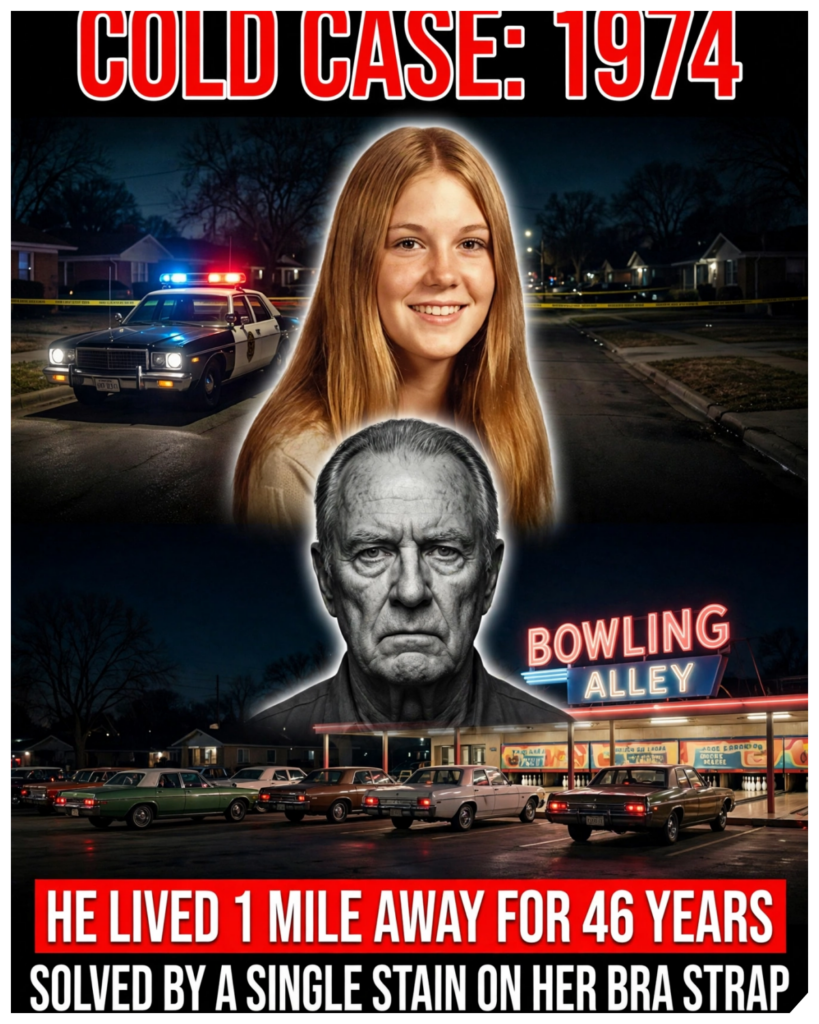
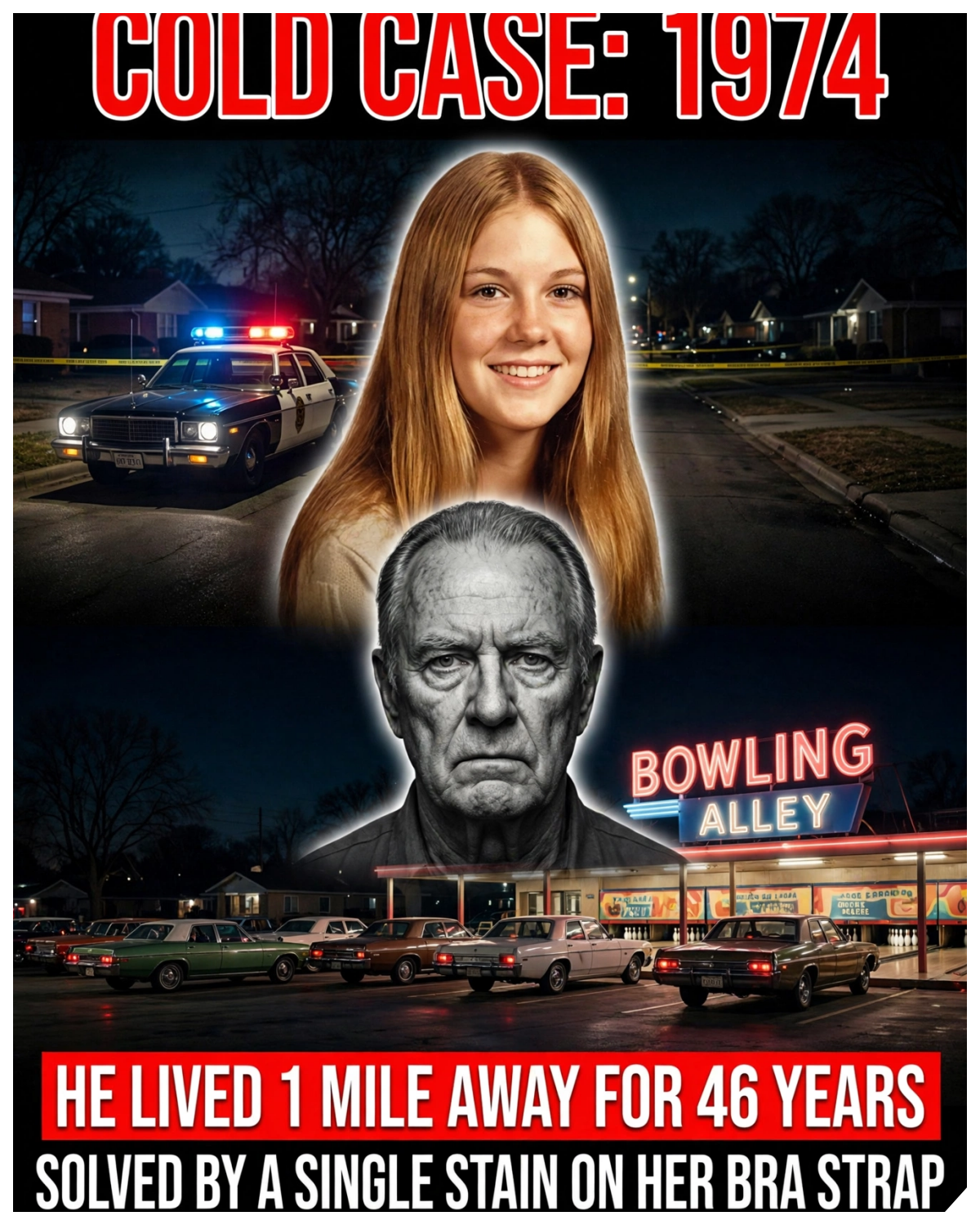
The nightmare began a little after midnight in the early hours of Sunday, February 17th, 1974 in the parking lot of Brunswick Ridgely Bowl on the west side of Fort Worth, Texas.
This is the file on the murder of Carla Jan Walker.
To understand what was taken that night, you have to understand who Carla was.
She was born on January 31st, 1957 to Leighton and Doris Walker.
Her father was a retired lieutenant colonel in the United States Air Force, a disciplined, steady man who had settled his family in Benbrook, a quiet community folded into the far western edge of Fort Worth.
Carla had an older sister Cindy who was 18 in the winter of 1974 and a little brother Jim who was 12.
She was small, 4′ 11 in tall with a thick mane of honey blonde hair that fell past her shoulders.
She was a junior at Western Hills High School and a cheerleader.
And the people who knew her described the same thing over and over again.
A girl who smiled at everyone, not just her friends, everyone.
The quiet kids, the kids who ate lunch alone.
Decades later, a woman who had gone to Western Hills and barely knew Carla would remember more than anything that the popular girl used to say hello to her in the hallway and how good that made her feel.
Carla was in love.
Her boyfriend was Rodney McCoy, a lean, good-natured kid who played quarterback for the Western Hills football team.
He had given her a promise ring.
The two of them talked about going to Texas Tech University together, and Carla told her closest friends she had no doubt that one day she and Rodney would be married and raising a family of their own.
To understand the night itself, you also have to understand the place and the time.
Fort Worth in 1974 was a city of roughly 400,000 people, less than half the size it is today.
It sold itself as a safe, familyoriented town, the kind of place where kids rode bikes until the street lights came on and parents didn’t think twice about it.
In neighborhoods like the Walkers, people didn’t lock their front doors.
Screen doors slapped shut on spring evenings.
Families gathered around the dining room table for dominoes.
Teenagers spent their weekend nights cruising Camp Bowie Boulevard, looping the Benbrook traffic circle, pulling into burger stands with the windows rolled down and the radio turned up.
There were no cell phones.
If you needed the police, you picked up a rotary phone and dialed the operator.
There were no security cameras on the corners of parking lots.
There were no license plate readers along the highways.
One of the detectives who would work this case later remembered that the police department did not even have computers.
Everything lived on paper in drawers in the memories of the men who worked the streets.
On the evening of Saturday, February 16th, 1974, Rodney McCoy pulled up to the Walker home in Benbrook to take Carla to the Western Hills Valentine’s Day dance.
He was driving his mother’s car, a 1969 Ford LTD.
When Carla came down the stairs from her bedroom, she was wearing a powder blue dress and the promise ring he had given her.
Rodney pinned a cor to her dress.
It is the kind of moment that families photograph that fathers pretend not to be emotional about.
The dance was held in the school cafeteria which students had transformed with pink streamers and paper hearts.
The theme that year was love is a kaleidoscope.
A live band played through the night.
When it ended at around 11:30, Rodney and Carla weren’t ready for the evening to be over.
They picked up another couple and did what Fort Worth teenagers did on a Saturday night.
They cruised Camp Buouie.
They looped the Benbrook traffic circle.
They stopped at a couple of the local hangouts, Mr.
Quick Hamburgers and a Taco Bell.
Eventually, they dropped their friends off.
And sometime after midnight, now in the first hours of Sunday, February 17th, Rodney pulled into the parking lot of Brunswick Ridgely Bowl so Carla could use the restroom inside.
When she came back out and climbed into the passenger seat, the two of them began to kiss.
Carla leaned back against the passenger door, using her purse as a pillow.
Then the door behind her flew open.
A man was standing there.
Rodney would later remember only fragments.
A tall figure with short brown hair wearing a vest.
Under hypnosis, months later, he would add one more detail, a brown or tan cowboy hat.
The man had a pistol and he began to beat Rodney over the head with it again and again.
According to the affidavit police would file decades later, the attacker told Rodney, “I am going to kill you.”
Carla was screaming at him to stop hitting Rodney.
Somewhere in the violence, the pistols magazine came loose and dropped onto the asphalt.
The man pulled Carla out of the car.
The last thing Rodney heard her say as he slid toward unconsciousness was an instruction that would haunt him for the rest of his life.
Rodney, go get my dad.
When Rodney came too, it was around 1:00 in the morning.
He was alone in the car, slumped in the driver’s seat, his head split open, blood running down his face.
He drove to the Walker house, which was less than a mile away, so fast and so frantically that he jumped the curb and stopped on the front lawn.
Inside, the house was still awake.
Leighton and Doris Walker were sitting at the dining room table playing dominoes with relatives.
Cindy and 12-year-old Jim were in the living room watching television.
Then came the pounding on the front door, and there was Rodney, bleeding, almost incoherent with terror, shouting to Mr.
Walker that someone had Carla, that they were going to hurt her.
Leighton Walker grabbed his pistol and raced to the bowling alley.
Doris picked up the family’s rotary phone, dialed the operator, and asked to be connected to the police.
Patrol officers arrived at Brunswick Ridgely Bowl within minutes.
Their flashlight beams swept across the parking lot.
And there on the pavement, they found two things that would define the next 46 years.
Carla’s purse, the one she had been resting her head on moments before, and next to it, a pistol magazine, a clip for a 22 caliber Ruger handgun dropped by the man who had taken her.
Officers fanned out through the surrounding streets in their squad cars, sweeping the side roads and the darkened lots along Camp Bowie.
When the sun came up on Sunday, more officers joined the search.
Helicopters circled the city.
Men in the passenger seats scanning the fields and creek beds through binoculars.
At Western Hills High School on Monday morning, detectives walked the hallways, stopping students, asking who might have wanted to hurt Carla.
They poured over contact sheets of the photos taken at the dance, studying every face in the background, looking for anyone who didn’t belong.
At home, the walkers waited.
Years later, Cindy would explain that in their world at that time, the idea that Carla might already be dead simply did not register.
They were so unfamiliar with that kind of crime that they half expected a car to pull up and drop her off and for life to go on.
That hope lasted until Wednesday, February 20th, 1974.
That day, two officers assigned to the search were driving a remote two-lane road near Benbrook Lake, roughly 5 mi southwest of the bowling alley.
They noticed a culvert, a concrete tunnel built beneath the road to carry runoff water from one side to the other, and they pulled over to look inside.
Carla Walker was lying on her back in the culvert.
Her face and her neck were covered in scratches and deep bruises.
Her powder blue dress was torn in several places and stained with blood.
Blood that investigators would later determine had come from Rodney’s head wounds.
Her bra had been pushed up.
Her underwear and panty hose had been wadded together and left at the mouth of the culvert.
The scene was processed the way scenes were processed in 1974.
Photographers worked with flash equipment documenting the body, the concrete, the surrounding ground.
Investigators bagged her clothing.
And here, in a decision that would matter enormously decades later, her dress, her bra, and her other garments were packed away in paper evidence bags, not plastic, and sent to the department’s evidence storage where they would remain.
The autopsy told the rest.
Carla had been strangled.
Because there were no liature marks around her neck, the medical examiner concluded the killer had used his hands.
She had been beaten.
She had been sexually assaulted.
And there was something else, something that hinted at a level of planning and cruelty that terrified everyone who learned of it.
There was morphine in her system.
The evidence indicated that Carla had not been killed that first night.
She had been kept alive, held captive somewhere for about 2 days before she died.
Leighton and Doris Walker were asked to come to the morg to identify their daughter.
12-year-old Jim went with them.
He waited in the hallway while someone walked his parents down the corridor.
And then he heard his mother scream.
He would describe it almost 50 years later as a sound he had never heard a human being make, something closer to an animal.
And he said it would stay with him for as long as he lived.
The next morning, the murder of Carla Walker covered nearly the entire front page of the Fort Worth Star Telegram.
Her funeral was held at the Western Hills Church of Christ.
More than,250 people came, far more than the small sanctuary could hold.
Her classmates filed past her open casket, overwhelmed, and underneath the grief was something new, something Fort Worth had not felt in quite this way before.
Fear.
Teenagers stopped cruising Camp Bowie Boulevard.
Some girls refused to leave their homes after dark.
The editor of the Western Hills yearbook, who babysat in the neighborhood, had to call her parents the moment she arrived at every job just so they knew she had made it.
The Western Hills PTA organized self-defense classes taught by two men who held black belts in jiu-jitsu, and they filled up.
City officials formed a task force pulling detectives from police departments across the area.
The pressure on them was enormous, and the clock was running.
In homicide work, the first 72 hours matter most.
Memories fade, evidence degrades, suspects get their stories straight.
By the time Carla’s body was found, those first 72 hours were already gone.
And the truth was that the task force had very little to work with.
There were no usable fingerprints identified on Carla’s body or her clothing.
The blood on her dress was Rodney’s.
Investigators did find traces of bodily fluid, but in 1974, forensic science could do almost nothing with them.
The most a crime lab could typically offer with biological traces in that era, was conventional corology.
Blood typing, which could only place a man into a broad category shared by a large share of the male population.
It could exclude some people.
It could never point to one.
The idea of identifying a single human being from a microscopic stain was not just impossible in 1974.
It was not even science fiction yet.
The first use of DNA in a criminal case was still more than a decade away.
So, the detectives did what detectives had always done.
They worked the phones and they wore out their shoes.
The task force set up a 24-hour tip line.
In the downtown police headquarters, officers sat at metal desks with cups of lukewarm coffee.
Taking calls through the night from citizens who were sure they knew who had killed Carla Walker.
The tips poured in and each one had to be run down.
One caller said Carla had been killed by a pair of marijuana dealers.
Another said it was a carnival worker from the Fort Worth Stock Show in Rodeo.
Someone pointed to a quiet young man who often bowled by himself at Ridgely Bowl, the very place she was taken.
There were stories about a boy who supposedly got into an argument with Rodney at Mr.
Quick hamburgers the night before the dance and one anonymous man called in claiming he knew the killer personally and that the killer had never meant for Carla to die.
He would not give his name.
He never called back.
Every one of those leads went somewhere and every one of them went nowhere.
The detectives looked hard at the boy who had been in the car.
Rodney McCoy was the last person to see Carla alive and in any homicide that alone puts you on the list.
He had a head wound that no one could fake, and his account never wavered.
But in a town looking for answers, suspicion has a way of attaching itself to whoever is closest.
Decades later, Rodney would say in court that the real killer had left a cloud of suspicion hanging over him for all those years.
Shortly after graduating, he left Texas entirely and went to work on an oil rig in Alaska, telling his family he needed to get as far away from Fort Worth as he possibly could.
The task force even brought in a hypnotist, hoping to unlock more of what Rodney had seen through the blows to his head.
The session produced one new detail, that cowboy hat.
When the hypnotist brought him out of it, the boy broke down and wept.
One of the detectives, Jim Mter, would remember him as a scared kid, torn apart, tormented by the belief that he hadn’t done enough to save the girl he loved.
Then the investigators noticed something that chilled them.
Almost exactly one year earlier on February 7th, 1973, a young woman named Becky Martin had failed to come home after a night class at the South Campus of Tarant County Junior College.
Her body was found nearly 7 weeks later, so badly decomposed that the medical examiner couldn’t determine how she had died.
But it was where she had been found that caught the task force’s attention.
She had been left in a culvert just outside the city limits.
Two young women, two culverts, almost exactly one year apart.
Privately, the detectives began to wonder whether they were looking for a man who had done this before.
Publicly, they said nothing.
By March, a month after the murder, the task force had one solid piece of physical evidence that pointed toward a specific person, and that was the magazine from the parking lot.
Firearms examiners determined that it belonged to a newer model, 22 caliber Ruger pistol.
The detectives asked the Federal Bureau of Alcohol, Tobacco, and Firearms to give them the names of everyone in the Fort Worth area who had purchased that model.
The list came back with a couple dozen names.
The task force set out to interview every single one of them.
One of the names on that list belonged to a 31-year-old truck driver who lived in West Fort Worth.
His name was Glenn Samuel Mccurley.
In the spring of 1974, detectives went to Mccurley’s home to ask him about his gun.
He was cooperative.
“Yes,” he told them.
He had owned a 22 Ruger, but it had been stolen, he said about 6 weeks earlier, taken out of his pickup truck while he was fishing.
“He hadn’t reported the theft,” he explained, because he was an ex-convict.
He had done time for stealing a car, and he didn’t want anything to do with the police.
He mentioned that his wife had been away in West Texas visiting her family 6 weeks earlier, right around the time Carla Walker was taken.
Then Mccurly did something that in 1974 carried real weight.
He agreed to come downtown and take a polygraph examination and he passed.
The task force crossed his name off the list.
Today we know what investigators of that era often did not fully appreciate.
Polygraph results are not reliable proof of truth or deception, which is why they are generally inadmissible as evidence in American courtrooms.
A calm liar can pass.
A frightened innocent person can fail.
But in the spring of 1974, a past polygraph and a plausible story were enough to send a detective on to the next name.
Years later, Jim Mter would admit how much it pained him to say it.
But after that interview, nobody on the task force thought about Glenn Mccurly again.
Nobody would think about him again for 46 years.
The investigation ground on through the spring.
The tip line rang less often.
The red circled maps and the lists of names stopped growing.
Supervisors began quietly reassigning detectives back to their regular case loads, to the fresh homicides that kept coming in every week.
The task force was never formally disbanded.
It simply faded the way so many investigations do, not with a decision, but with a slow exhaustion.
By late spring of 1974, the murder of Carla Walker was a cold case.
At Western Hills High School, Carla’s classmates refused to let her disappear.
They raised money for a memorial.
A tile plaque of a cougar, the school’s mascot, set into the floor of the front hallway.
Black ropes hung from metal stansions around it so that no one would walk across it.
Her childhood friend Connie Karns Meyers would later explain that the whole point was to make sure Carla was never forgotten to create a place where people would stop and remember who she had been.
But time is relentless, even with memorials.
In the spring of 1975, Carla’s class graduated and scattered.
By the fall of 1976, when her little brother Jim arrived at Western Hills as a freshman, her name was no longer spoken in the hallways the way it once had been.
New students laughed and chatted their way past the cougar plaque without a glance.
Jim tried to avoid walking past it.
Some days he couldn’t, and he would come upon it suddenly and feel the whole weight of it land on him again.
[clears throat] Inside the Walker house, the grief did not fade.
It just went underground.
Jim would remember that every morning his mother slipped into her bathroom, stepped into the shower without turning the water on, and wept where she thought no one could hear.
His father, the career military officer, never cried in front of him.
But for years after Carla’s murder, Jim said he didn’t see his father smile either.
The family kept Carla’s bedroom exactly as she had left it.
Her car stayed parked in the driveway year after year.
People who lived in the neighborhood would drive past and see it sitting there, a quiet monument everyone understood.
And Leighton Walker refused to stop looking.
Strangers called the house over the years, often anonymously, claiming to know something about who had killed his daughter.
He talked to every one of them.
He wrote everything down and kept his notes in a small metal box about the size of a cigar box.
Names, addresses, circles drawn on maps where some caller had told him the killer lived.
He told his son he would not rest until the man who did this was behind bars.
When Jim turned 16 and got his driver’s license, he joined his father’s hunt.
On the anniversary of Carla’s death, he would sometimes drive to the Brunswick Ridgely Bowl and prowl the parking lot, watching for anyone who seemed out of place.
He took boxing lessons at the Panther Boys Club.
He wrestled and played football.
He ran long miles through the neighborhood.
He was training, he would later admit, for the day he came face to face with the man who killed his sister.
He had a plan for that day, and it did not involve calling the police.
On some of those long runs, Jim’s route took him down Vicory Boulevard past a little street called Mark’s Place.
On Mark’s Place, in a small tan, one-story house lived Glenn Mccurly and his family.
Jim had no idea who they were.
Mccurley’s oldest son was 2 years behind Jim at Western Hills High School.
They were neighbors in every sense that matters.
Decades later, Jim would wonder aloud whether their families had stood in the same grocery store line or idled side by side at the same red light on Camp Bowie Boulevard or eaten at neighboring tables in the same Mexican restaurant.
The walkers held a big family garage sale every year that drew people from all over the neighborhood.
Jim has said he always suspected Mccurly might have wandered through one of them, browsing the tables in the driveway of the family he had destroyed.
To understand how a man could live that way, you have to understand who Glenn McCurley had been before that night and who he became after it.
He was raised in West Texas, the oldest of three boys.
His father, Glenn Mccurly, Senior, had served in the army during the Second World War and later worked as an insurance adjuster.
According to someone who knew the family, the father was proud of his two younger sons who were good students and athletes and saw his eldest as undisiplined, a troublemaker.
As a teenager, Mccurly was sent to the West View Boys Home in southwestern Oklahoma, a church sponsored home for boys whose families couldn’t manage them.
It did not straighten him out.
In February of 1961, at 18, he stole a car in Abalene, abandoned it, and stole another.
The state highway patrol chased him and shot out one of his tires.
He drove onto a vacant lot, tried to run on foot, and was caught almost immediately.
He pleaded guilty and received a 2-year sentence.
He was released early in the spring of 1962.
He moved to Midland and there he met a blonde high school student, an earnest girl, the daughter of an oil field worker.
They married in a Baptist church on February 16th, 1963.
Pause on that date for a moment.
February 16th was Glenn McCurley’s wedding anniversary.
11 years to the day after his wedding.
On the night of February 16th, 1974, with his wife away visiting her family in West Texas, Carla Walker went to the Valentine’s dance.
The couple had two sons.
Mccurley drove trucks first for the postal service and in 1972 he moved his family to West Fort Worth where he took a job hauling pre-fabricated concrete slabs to construction sites.
His wife went to work at the daycare center of their church, Ridgely West Baptist, where she would spend more than three decades caring for other people’s children.
Parents adored her.
Mccurly built a reputation, too.
He was not as warm as his wife, but people thought well of him.
In his spare time, he mowed the lawn at the church and handled repairs around the building.
He fixed neighbors car engines and rewired their faulty outlets.
He built picnic tables and barbecue pits and sold them.
Later in life, when he stopped driving trucks full-time, he did handyman jobs and maintenance work at a fitness club where a co-orker remembered him as a man who could fix anything.
Dryers, treadmills, any machine you put in front of him.
One acquaintance did recall a habit of his of pointing out pretty girls, but said he never said anything crude about them.
Once a woman wrote a letter to the Fort Worth Star Telegram thanking Glenn McCurley and his wife for returning her lost wallet.
The world, she wrote, needed more people like them.
The decades rolled forward.
The 1970s became the 1980s.
Through those years, a terrible string of murders of young women unfolded across Fort Worth.
Enough that the police formed yet another task force and residents packed self-defense seminars by the thousands.
None of those cases were connected to anyone at the time.
They too went cold.
We will come back to them carefully because some of them would one day reappear in the shadow of this story.
The 1980s became the 1990s and the 1990s became the 2000s.
Hair went gray.
The detectives who had worked the Carla Walker task force retired one by one.
Rodney McCoy built a life far from Fort Worth, carrying what he carried, and the McCuries stayed exactly where they were.
Same street, same church, the same phone number.
Mccurley would later boast for 50 years.
That detail is worth sitting with because it tells you something about the psychology of a man who gets away with a crime like this.
He did not flee.
He did not change his name.
He stayed a mile from the parking lot, raised his children, went to church, and grew old.
Criminologists who study offenders who evade capture for decades describe a process of compartmentalization where the crime is sealed off from the daily self, rationalized, minimized, or rewritten in memory until it barely feels like it belongs to the person living the ordinary life.
Whether Mccuri ever truly forgot or simply learned to live beside the knowledge, only he knew.
What we do know is that when the moment of reckoning finally came, the story he told would not match the evidence in important ways, and he would cling to a version of that night in which he was not a monster at all.
Meanwhile, the people who loved Carla were running out of time.
In 1987, Leighton Walker died of a heart attack.
He never learned the name he had spent 13 years chasing.
His metal box of notes passed to his son.
Jim Walker had built his life around that box.
He studied at Sam Houston State University, reading books on serial killers and taking courses in abnormal psychology to understand what he called the criminal mind.
After graduation, he applied to the Fort Worth Police Department with a very specific plan.
Become a detective, get his hands on his sister’s files, and find her killer himself.
But at the academy firing range, he noticed something wrong with his eyesight, and doctors diagnosed a congenital eye condition.
He was forced to leave the academy.
He went to work in security for a defense contractor and later as a vocational rehabilitation counselor for the state of Texas.
Over the years, his vision steadily deteriorated until he needed a guide dog to get around.
He never stopped.
He went through his father’s notes looking for anything that had been missed.
In 2015, Doris Walker died.
She too went to her grave without an answer.
Jim bought his parents’ house and moved into it with his wife.
He said he wanted to be there at that address in case someone ever developed a conscience at 3:00 in the morning and came to the door to confess.
And he kept calling the Fort Worth Police Department’s cold case unit.
Over and over and over and over, he got the same answer.
Nothing new.
We’ll call you if anything breaks.
In January of 2018, Jim Walker called again.
He was 56 years old.
He left a voicemail.
This time, a detective named Leah Wagner called him back.
Wagner had joined the Fort Worth Police Department in 2000, worked patrol, made detective in 2013, and moved into homicide, working active cases.
In 2018, she transferred into the cold case unit where at the time she was the only person on staff.
Some officers can’t stand cold case work.
The endless hours hunched over halfleible reports chasing witnesses who have died or forgotten.
Wagner loved it.
She has described the thrill of the moment when the pieces finally fit.
When you solve something that nobody before you could.
When Jim got her on the phone, she admitted she knew nothing about his sister’s case.
He told her everything, and he said something she would not forget.
If the man who killed Carla was still alive, he was getting old.
They were running out of daylight.
Wagner walked into the storage room next to her cubicle and found the two brown banker’s boxes on the bottom shelf.
She began to read, but before she could get far, her supervisors pulled her away to take over the active case load of a detective who had fallen seriously ill.
The boxes waited another year.
In January 2019, Wagner returned to the cold case unit and asked for help.
Her supervisors sent her a reserve officer named Jeff Bennett.
Bennett worked in commercial construction by day and had volunteered with the department since 1997, mostly working nights in patrol, responding to 911 calls.
He had told his superiors he wanted to try detective work.
Wagner handed him the Carla Walker boxes.
Bennett carried them home to his office and read them obsessively, sometimes through the night, every police report, the autopsy, every summary of every interview from 1974.
When he was done, he had built a list of roughly 80 people he believed were worth interviewing again.
Wagner and Bennett invited Jim and Cindy to police headquarters.
Jim came with his guide dog, a black Labrador named Cassie, who lay quietly at his feet.
The detectives asked whether the family had any theory about who had done it.
They didn’t.
Cindy, by then a grandmother of four, told them she was still afraid to let her grandchildren out of her sight.
Wiping her eyes, she said all the family wanted was to know who and why.
The detectives began working through Bennett’s list.
They tracked down Rodney McCoy, now living near Austin, and interviewed him again.
They posted an appeal on the department’s Facebook page and got a couple dozen responses.
One woman insisted her ex-husband had grown up near Carla and kept a collection of newspaper clippings about the murder that he reread from time to time.
The ex-husband was able to prove he had been out of town that weekend.
Another dead end in a case built of them.
What Wagner and Bennett needed was not another tip.
They needed the killer’s DNA.
And somewhere in the department’s evidence storage, there was a chance it still existed.
Carla’s dress and the other clothing she wore that night had been carefully packed in paper bags back in 1974.
Paper matters.
Plastic traps moisture and moisture breathes bacteria and mold that destroy biological material.
Paper breathes.
Whoever bagged that evidence in 1974 had without knowing it given it the best possible chance to survive.
But there were two problems.
After 45 years, no one could say whether any DNA on that clothing was still intact enough to produce a full genetic profile.
And testing it could cost the department as much as $20,000.
Money that would almost certainly go to active cases instead.
The breakthrough that solved this problem did not come from inside the police department.
It came from a podcast.
In 2017, a Fort Worth aerospace technician and true crime enthusiast who goes by the pseudonym Vincent Strange decided to start a podcast about unsolved Texas murders.
He chose Carla Walker for his first working out of a bedroom in his home with inexpensive recording equipment.
He interviewed Jim and Cindy and some of Carla’s friends.
The show was called Gone Cold and Jim himself narrated it.
Its audience was small, but one of the people listening was a retired postal service mail clerk named Deianne Kikondal who had gone to Western Hills with Carla.
They hadn’t known each other well, but Carla had always smiled at her in the hallway, and Kaikand Doll had never forgotten it.
Listening to the podcast, she wished there were some way to repay that kindness.
So, she flew to Nashville for Crime Con, a massive true crime convention, carrying 80 copies of a pamphlet she had written about Carla’s case.
She walked the hallways handing them to anyone who might help, including Paul Holes, the retired investigator who had helped crack the Golden State Killer case and was hosting a true crime series for the Oxygen Network.
Holes was intrigued.
In April 2019, his producers called Wagner and Bennett with an offer.
Oxygen would pay $18,000 to cover DNA testing on Carla’s clothing.
At a laboratory in California, technicians examined the garments.
The dress yielded nothing usable.
But on the strap of Carla’s bra, they found a stain so faint it was barely visible to the naked eye.
It was intact.
It was uncontaminated.
And from it, the lab developed a full male DNA profile.
After 45 years in a paper bag, the man who killed Carla Walker had a genetic signature.
The profile was uploaded to Kotus, the FBI’s combined DNA index system, which holds the profiles of millions of convicted offenders and arrestes.
Cotus works by comparing a set of specific locations on the genome, short tandem repeats, against everyone in the database.
If the killer had ever been required to give a DNA sample after an arrest or conviction, his name would come back.
It didn’t.
Cotus returned no match.
Glenn McCurley’s only conviction was for stealing a car in 1961, decades before DNA databases existed.
As far as Cotus was concerned, the man did not exist.
The next step was genealogy.
Investigators turned to a Texas lab that performed genealogical analysis, hoping to find the killer’s relatives instead of the killer himself.
That attempt failed, too.
Paul Holes devoted an episode of his television series to the case.
An episode about a search that had come up empty and that it seemed was the end of the road.
But after the episode, Holes introduced Wagner and Bennett to David Middleman, the chief executive of Aram, a forensic laboratory in the Woodlands just north of Houston.
Had built its approach around forensic grade genome sequencing, a method designed to pull usable genetic information out of samples that are tiny, degraded, or mixed.
The exact kind of material that defeats traditional testing.
Middleman believed his lab could succeed where the others had failed.
There was a catch.
So much of the brast strap sample had been consumed by the earlier rounds of testing that there was barely enough left for one final attempt.
The cautious choice would have been to preserve what remained and wait maybe years for an even better technology to arrive.
If Aram failed, there would be nothing left to test ever.
Wagner and Bennett chose to roll the dice.
They shipped the last of the sample to Aram to understand what happened next.
It helps to understand how forensic investigative genetic genealogy works.
Cotus looks at a few dozen markers, enough to confirm identity, but useless for finding relatives.
Genome sequencing, by contrast, reads hundreds of thousands of single nucleotide polymorphisms, tiny variations scattered across the genome.
Those markers can be compared against public genealogy databases like Gdematch, where people who have taken consumer DNA tests have chosen to upload their data and allow law enforcement matching.
The software looks for stretches of shared DNA measured in units called centmorggans.
The more DNA two people share, the closer their relationship.
A second cousin shares one amount.
A third cousin shares less.
From those distant matches, genealogologists work backward, building family trees out of public records, birth certificates, marriage licenses, obituaries, census records, cemetery listings.
They search for the point where the trees of different matches converge, the common ancestors, and then work forward again through the generations.
Branch by branch looking for a man of the right age in the right place at the right time.
On the morning of July 4th, 2020, while much of the country was preparing for Independence Day, David Middleman called Jeff Bennett.
Aram had connected the DNA from Carla’s brast strap to a specific family tree.
The surname, he said, was Mccurly.
Bennett opened his binders and took a breath.
He asked whether anyone in that family tree was named Glenn Samuel Mccurly.
Yes, Middleman told him.
There was a Glenn Samuel Mccurly Senior, but he had died in 1972, 2 years before Carla was killed.
Was there a Glenn Mccurly Jr.?
Bennett asked.
Middleman went to check.
He called back later that day.
There was.
Glenn Samuel Mccurly Jr.
Had been living in Fort Worth at the time of the murder.
The genealogy had narrowed the entire population of North America down to the sons of one man, three brothers, and one of those three names was already sitting in the 1974 file.
The man on the list of 22 Ruger owners.
The man who told detectives his gun was stolen while he was fishing.
The man who passed a polygraph and was forgotten.
He was still alive.
He was 77 years old and he was still living in West Fort Worth, about a mile from the parking lot of Brunswick Ridgely Bowl.
A genealogy match is not proof.
It is a lead, a very powerful one.
But no prosecutor will take a family tree into a courtroom and ask a jury to convict a man of capital murder because his distant cousins uploaded their DNA to a website.
Before they could arrest anyone, Wagner and Bennett needed a direct comparison.
Glenn McCurley’s own DNA matched against the stain on Carla’s bra strap and they needed to get it without tipping him off.
First, they ran a background check.
It turned up almost nothing.
Aside from the stolen car in 1961, when he was 18, Mccurley had no record of trouble with police that they could find.
For nearly 60 years on paper, he had been a model citizen, a churchgoer, a handyman, a grandfather, a man who returned lost wallets.
The detectives also faced a practical reality.
Mccurley was 77 years old and his health was failing.
If he died before they could confirm the match, Carla’s family might never get a definitive answer.
They were, as Jim Walker had warned, running out of daylight.
So they turn to one of the oldest and most effective tools in cold case work, surreptitious DNA collection.
It is the reason investigators in these cases so often find themselves watching an elderly man finish a cup of coffee or waiting for him to drop a cigarette butt or following his garbage to the curb.
The law is settled on this point.
In 1988, in a case called California versus Greenwood, the United States Supreme Court ruled that once a person places trash at the curb for collection, they have given up any reasonable expectation of privacy in it.
Whatever is in that bin, police can take.
The arrest affidavit records it in a single plain sentence.
In July of 2020, the same month made the connection.
Police officers collected trash from a bin sitting on the street outside Glenn McCurley’s house.
Picture what that bin contained.
The ordinary debris of an ordinary life in a tan one-story house on a workingclass street.
Food wrappers.
Paper towels.
Tissues.
The kinds of items that carry a person’s saliva or skin cells without his ever thinking about it.
Collected in sealed evidence bags, logged, documented, and sent to a laboratory where technicians extracted DNA from what Glenn McCurley had thrown away.
The forensic process at that stage is meticulous.
The DNA is extracted, then copied millions of times through polymerase chain reaction, PCR, a technique that amplifies even a tiny amount of genetic material into enough to analyze.
Then the lab compares the short tandem repeat markers, the same markers Cotus uses from the trash against the profile from the bra strap.
Location by location, marker by marker.
If even one doesn’t match, the man is excluded.
They all matched.
Leah Wagner received confirmation.
The DNA recovered from Glenn Mccurley’s trash matched the DNA left on Carla Walker’s bra in February 1974.
After 46 years, the detectives were almost certain they knew who had killed Carla Walker, but they wanted it airtight.
A sample taken directly from Mccurley under documented conditions with his consent would be nearly impossible for any defense attorney to challenge.
On September 10th, 2020, Wagner and Bennett drove to the house on Mark’s place and knocked on the door unannounced.
Mccurley and his wife invited them in and sat with them in the living room.
The detectives were recording.
The conversation was friendly, almost neighborly.
Mccurly talked about his years driving trucks.
His wife talked about her decades at the church daycare, about their family, about the hard things they had been through, about her husband’s cancer, and the surgery he had recently undergone.
Finally, in his raspy voice, Mccurly asked what the detectives had come to talk about.
Wagner told him they were going to take him way back to 1974 to a young woman kidnapped from a bowling alley.
Before her husband could answer, Mccurley’s wife said she knew exactly who they meant, Carla Walker.
She remembered where the Walkers lived.
She remembered that they had kept Carla’s bedroom the same and her car parked in the driveway for years.
She said it had been heartbreaking to drive by and see it.
Wagner explained that they had reopened the case and were going back to everyone who had been interviewed in 1974 and the record showed.
She said that detectives had talked to Mr.
Mccurley.
Mccurley told them the same story he had told in 1974 almost word for word 46 years later.
He had spoken to police back then because of the gun.
The gun had been stolen and never recovered.
His wife had been out of town visiting family.
He hadn’t killed anyone.
He didn’t know Carla Walker.
Wagner asked if he would give a DNA sample.
It would be the easiest way, she said, to rule him out.
He hesitated.
Then he picked up a pen, signed the consent form, and opened his mouth, and Wagner swabbed the inside of his cheek.
As he did, his wife told the detectives she hoped they found out who did it.
That girl, she said, deserved to be remembered as someone who mattered.
The swabs went to the lab.
On September 16th, Leah Wagner received the result.
The DNA from Glenn McCurley’s mouth matched the DNA from Carla Walker’s brast strap.
There was no longer any doubt.
On the afternoon of Monday, September 21st, 2020, unmarked cars pulled up outside the small tan house in far west Fort Worth.
The officers who stepped out wore bulletproof vests.
They were members of the Delta team of the US Marshall’s North Texas Fugitive Task Force.
A unit trained to arrest high-risk suspects.
They drew their weapons and spread out around the house.
One carried a battering ram in case the door had to come down.
Two moved into the backyard to cut off any escape.
There would be no escape and no need for the battering ram.
The officer in charge, a 22-year veteran named Travis Edelman, walked up onto the front porch and rang the doorbell.
The door opened and there stood a 77year-old man in a gray polo shirt, blue jeans and black dress shoes with white socks.
He was 6’3 and heavy, but he looked frail, his white hair brushed back, his eyes sunken.
Edelman confirmed his name and told him he was under arrest.
Mccurly looked bewildered.
He turned toward his wife, who had come up beside him, leaning on a cane.
As the officers put him in handcuffs, she told them her husband was sick with cancer and had a doctor’s appointment that day.
Edelman told her gently and firmly that her husband had to come with them.
He was arrested without incident.
The man who had kept his secret for 46 years was led down his own front walk and driven downtown.
At police headquarters, Glenn Mccurly waved his right to have an attorney present.
For several minutes, he sat alone in a small interview room, bare walls, a table, a camera recording everything.
Then Leo Wagner and Jeff Bennett walked in.
Wagner asked whether he remembered them.
She laid a photograph on the table.
It was Carla.
They were there, she told him, to talk about the murder of this young woman.
Mccurly glanced at it and said he didn’t know who she was.
Bennett asked him to really look and to say for certain that he didn’t know her.
Mccurly picked up the photograph and studied it and said he had never seen her before in his life, that he wouldn’t recognize her if she were standing right beside him.
This is the first stage of almost every interrogation of a long hidden offender.
Total denial.
For a man who has told the same lie for nearly five decades, the lie is not just a structure he has lived inside.
It holds up his marriage, his church, his reputation, his entire sense of who he is.
Admitting the truth means tearing all of it down at once.
Wagner pressed.
Carla was 17.
She told him she had a family.
She had a boyfriend she planned to marry.
And he had taken all of that from her.
She reminded him he was sick and asked how he intended to make things right before he died if he couldn’t admit what he had done.
Bennett asked the question that hung over the entire investigation.
There had been a lot of murders of young women in Fort Worth in those years.
He said they needed to know whether Mccurley was a serial killer or whether this had been one terrible night.
Mccurley denied everything.
For more than an hour, he did not move.
Then Wagner changed her approach.
Instead of confronting him, she turned to the one relationship that had defined his adult life.
She said it must have been hard keeping this from his wife all these years.
More than 50 years of marriage, his best friend, someone he did everything with, told everything to.
And this one secret carried the entire time.
Bennett added that they knew he wanted to get it off his chest.
It had been too long.
Carla’s family deserved answers.
This is the second stage, and it is where long buried confessions so often begin, not with guilt for the victim, but with exhaustion and with fear about what happens next.
Mccurley’s first words of surrender were not about Carla at all.
Barely audible, he asked whether this meant the electric chair, whether he would hang, and he said that if he went to prison, there would be no one to take care of his wife.
Wagner told him his son would look after her because she believed Mccurly had raised him to be that kind of man.
Mccurley stared at the floor, his eyes filled with tears.
And then, after 46 years, he said it in effect, “All right, I guess I did it.”
What came next is the third stage and perhaps the most revealing about the psychology of the man because even as he confessed, Mccurly could not bring himself to tell the truth.
He said he had spent several hours that February day drinking whiskey and beer that he drove around parking in lots and ended up at what he called the bowling ball place.
And then he told a story in which he was the hero.
He claimed he had heard a girl screaming in a nearby car, that a big young man had her pinned against the door and was jerking her around, and that he had gone over to help.
He said he scuffled with the boy, pulled the girl away, and led her to his own car.
He claimed she was grateful, that she hugged him and thanked him, and that [clears throat] what happened next was consensual.
He said he had choked her afterward because he was afraid she would tell on him.
But he insisted she was alive when he left her, standing on her own against a car near a building down by a Mexican restaurant at a red light.
Every element of that story collided with the evidence.
Rodney McCoy had been beaten unconscious with a pistol, not rescued.
Carla had been held for about 2 days, drugged with morphine, and left in a culvert miles away.
A culvert Mccurly never mentioned at all.
The detectives told him that people would have a very hard time believing his version.
Bennett, listening to details that didn’t fit Carla’s case, began to wonder whether McCurley was confusing her murder with a different one.
He asked directly whether there was another girl.
Mccurley said no.
He had only done it that one night.
Bennett asked whether he was sure.
Mccurly said he was pretty sure.
Psychologists who study offenders like Mccurly recognize this pattern.
A confession that is half admission and half self-justification.
The offender acknowledges the outcome he cannot escape because the DNA has made denial impossible while rewriting the motive and the circumstances to preserve some shred of a decent self-image.
He is not a predator in his own telling.
He is a good Samaritan who made a mistake.
It is a story he may have been telling himself in one form or another for decades.
In one fragment of the recorded interview that would later be played in court, McCurley came closer to the truth than anywhere else.
I took advantage of her, I guess, he said.
The next day, Tuesday, September 22nd, 2020, the Fort Worth Police Department held a crowded news conference to announce the arrest.
Jim Walker stood beside the detectives.
Asked for his reaction, he answered with two words.
Thank you, Jesus.
He said the word that had come into his mind when he heard was simply finally.
And he marked the time precisely.
46 years, 5 months, and 3 days, and now at last, a name and a face.
Then he did something few people in that room expected.
He spoke to Mccurley’s family and said the walkers did not hate them, that they were praying for them, that none of this was their fault.
Mccurley was charged with capital murder.
His court-appointed attorneys entered a plea of not guilty.
They argued that the DNA work was flawed and that his confession had been coerced.
Prosecutors persuaded a judge to set his bond at $500,000, arguing that his age and illness could not erase the horror of what had been done to Carla or what it had done to the city.
In May 2021, prosecutors announced they would seek life in prison rather than the death penalty.
In June 2021, at a pre-trial hearing, there was a moment in the courthouse hallway that no one could have scripted.
Jim Walker asked his wife to guide him over to Mccurley’s adult son, who had come to court with his mother.
Jim introduced himself as Carla Walker’s little brother.
The son struggled to speak, then broke down and said he was sorry.
Jim, who had spent his youth training his body for the day he would face his sister’s killer, found that he felt no anger at all.
He told the younger man it was not his fault.
He put his arms around him and told him he was not responsible for his father’s sins and that his father had devastated his family just as surely as he had devastated the walkers.
The trial began in August 2021 in the courtroom of Judge Elizabeth Beachch in Tarant County.
Rodney McCoy, now a man in his 60s, took the stand and described the last night he saw Carla and the last words he heard her say.
Jim Mter, the retired detective from the original 1974 task force, testified about the investigation that had come so close.
Leah Wagner and Jeff Bennett walked the jury through the bra strap, the genealogy, the trash, the cheek swab.
Prosecutors Kimberly Deavinon and Emily Dixon unfolded Carla’s powder blue dress in front of the jurors.
They played 3 hours of the recorded interrogation and then they revealed one more piece of evidence.
When police searched Mccur’s home after his arrest, they found his .22 Ruger.
The gun he had told detectives in 1974 was stolen while he was fishing.
The gun he had repeated was stolen in 2020.
It had been hidden inside his house the entire time, tucked into a compartment above a door.
On the morning of Tuesday, August 24th, 2021, the third day of trial, at about 8:40 a.m., 78-year-old Glenn Mccurly was brought into Judge Beach’s courtroom, sworn in, and told the court he wanted to change his plea.
He waved his right to a jury.
When the judge asked how he pleaded, he answered that he was guilty.
Judge Beachch sentenced him immediately to life in prison.
What followed was not a verdict, but something the Walker family had waited even longer for, the chance to speak.
Carla’s sister, Cindy, took the stand and told Mccurly she wished he had come clean long ago.
She told him he had made choices that night, many choices, and every one of them had been his.
Jim Walker chose to stand directly in front of the man who killed his sister.
He told Mccurley that he believed he had done this to other families too and that he needed to confess and give them the answers he had finally given the walkers.
Mccurley kept his eyes on the floor.
Afterward, Rodney McCoy spoke about the suspicion Mccurley had left hanging over him for nearly 50 years.
And Jim standing outside the courtroom said there had been a lot of healing in that room that day.
Glenn Mccurley died in state custody on July 15th, 2023 of natural causes.
He was 80 years old.
He had spent less than three years behind bars.
He died without answering the question Jeff Bennett had asked him in that interview room.
In the years since his arrest, Fort Worth cold case detectives have said publicly that they looked at McCurley as a possible person of interest in several other unsolved killings of young women in the area, including the 1973 murder of Becky Martin, found in a culvert almost exactly a year before Carla.
To be absolutely clear, he was never charged with any of them.
Nothing has been proven.
And in a prison interview, he flatly denied harming anyone else.
Those families are still waiting.
Their files are still in boxes.
But this story should not end with Glenn Mccurly.
He has had enough of our attention.
For 46 years, he had the one thing he stole from Carla time.
So, let us end with her.
Carla Jan Walker was 17.
She was 4’11 with honey blonde hair and a promise ring on her finger.
She was a cheerleader who smiled at the kids nobody else noticed.
And that smile was remembered so long and so well that one of those kids a lifetime later walked the halls of a convention center with 80 pamphlets because she wanted to repay it.
Carla wanted to go to Texas Tech.
She wanted to marry the boy she loved.
She wanted a family.
She deserved a long, ordinary, beautiful life with gray hair and grandchildren and a hundred more Valentine’s dances.
She was remembered by a father who filled a metal box with notes until his heart gave out.
By a mother who wept in a dry shower every morning.
By a sister who spent her life afraid to let the children she loved out of her sight.
By a boy who carried that night to Alaska and back.
And by a little brother who lost his eyesight but never lost the trail and who kept making the same phone call for decades until someone finally called him back.
She was remembered by a detective who picked up a voicemail and a volunteer who read two boxes through the night.
By whoever in February 1974 chose a paper bag instead of a plastic one.
By a scientist willing to gamble on the last fragment of a stain.
Jeff Bennett went on to found a nonprofit to raise money for DNA testing in other Fort Worth cold cases.
Jim Walker joined its board.
Killers count on silence.
They count on time.
They count on the dust settling over the boxes, on the witnesses growing old, on the families giving up and the detectives retiring.
Glenn Mccurley counted on all of it.
And for 46 years, he was right.
But time is not mercy.
Time is only waiting.
The truth was folded into a paper bag on a February morning in 1974.
And it waited for science.
And it waited for memory.
And it waited for someone who would not stop calling.
Her name was Carla Jan Walker.
And she was someone