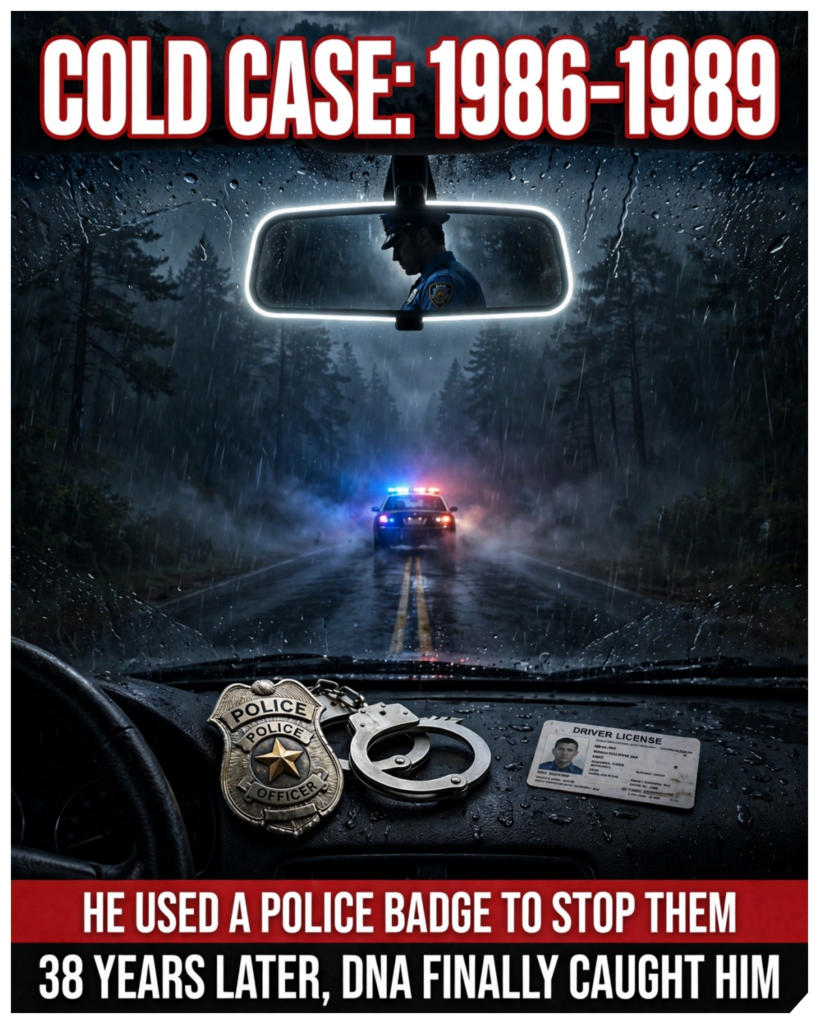
The Colonial Parkway Murders.
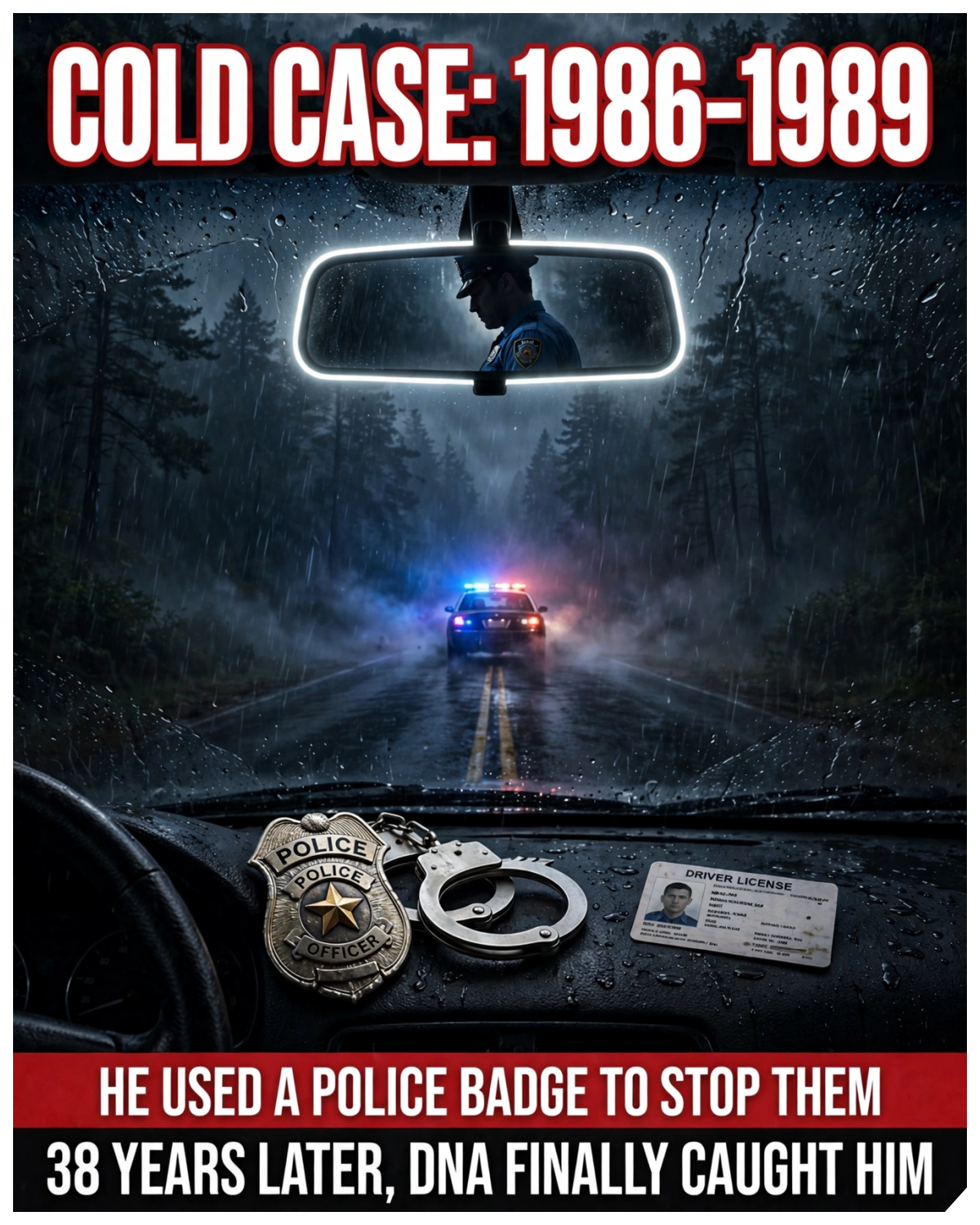
The 38-year hunt for the rogue badge.
Stretching across 23 mi of coastal Virginia, connecting the historic colonial settlements of Jamestown, Williamsburg, and Yorktown, lies the Colonial Parkway.
Managed by the National Park Service.
It was engineered not merely as a roadway, but as a deliberate escape from modern civilization.
There are no commercial billboards, no neon roadside signs, no painted yellow lane dividers, and no overhead street lights.
Instead, the road is paved with a specialized aggregate of exposed river gravel, giving it the appearance of an endless cobblestone trail winding through maritime pine forests, tidal salt marshes, and sheer bluffs overlooking the wide, brackish expanse of the York and James Rivers.
During the day, it is a tranquil scenic corridor frequented by tourists and historians.
But after twilight, when the heavy coastal fog rolls in from the Chesapeake Bay, the parkway becomes a ribbon of near total darkness, swallowed by the shadow of the trees and the hollow, rhythmic hum of tires vibrating across gravel.
For generations of young people living on the Virginia Peninsula, the secluded unlit pullouts along the river bluffs were known as lovers lanes, places where college students from the College of William and Mary, young sailors stationed at the massive naval bases in Norfol and Newport News, and local couples could park in privacy beneath the canopy of trees to talk and look out across the water.
Between the autumn of 1986 and the late summer of 1989, that romantic sanctuary was transformed into a corridor of terror.
Over a three-year span, eight young people across four separate couples were systematically targeted, ambushed, and killed in or near their vehicles along the Parkway and its adjacent waterways.
In every single incident, the crime scenes exhibited an eerie, methodical uniformity that baffled local detectives and federal agents alike.
Vehicles were found pulled over neatly into dark turnouts or abandoned along access ramps.
Driver side windows were rolled down exactly 2 to 3 in.
Glove compartments were found hanging open as if the driver had reached inside to retrieve a vehicle registration or proof of insurance.
Purses were rummaged through, yet cash, credit cards, expensive wristwatches, and jewelry were left untouched on the seats.
Most chillingly, there were no shattered windows, no bullet holes through the windshields, and no signs of high-speed pursuit or violent impact.
It was as if every couple had willingly pulled over, shut off their engines, and rolled down their windows for someone they believed possessed the unquestioned authority to command them in the dead of night.
For 38 years, an agonizing suspicion hung over the Virginia Peninsula that the Colonial Parkway killer was an active duty law enforcement officer, a federal park ranger, or an impostor brandishing a flashing blue light and a polished badge.
The investigation became one of the largest and most complex multi- agency cold case manhunts in FBI history, spanning the National Park Service, the Virginia State Police, multiple county sheriff departments, and behavioral profilers at Quantico.
Over 100 suspects were interrogated, surveillance files swelled into thousands of pages, and generations of detectives retired with the victim’s photographs still pinned to their desks.
Then in January 2024, the silence of nearly four decades was finally shattered.
Utilizing advanced forensic genetic genealogy and highresolution biological sequencing on evidence preserved across 35 years, federal and state authorities stood before a national press gallery to announce an extraordinary breakthrough.
The Phantom of the Parkway had finally been identified through scientific certainty.
This is the official record of the Colonial Parkway murders, the four couples whose lives were stolen in the dark, and the 38-year pursuit of the predator who hid behind the badge.
To understand the atmosphere of terror that gripped the historic triangle in the late 1980s, one must begin on the morning of Sunday, October 12th, 1986, at the Cheetah Manex overlook along the York River.
Around 9:30 that morning, a civilian jogger moving down the Parkway noticed something unusual.
Near a secluded turnout known as the Naval Weapons Station overlook.
Several yards down a steep wooded embankment dropping toward the riverbank, half submerged in thick brush, sat a white 1980 Honda Civic.
The vehicle had clearly left the roadway, but there were no skid marks on the gravel and no collision damage to the front bumper.
When federal park rangers and Virginia State Police investigators descended the steep slope and peered through the misted glass of the Honda, they were met with a scene that immediately signaled a savage, calculated crime.
Inside the vehicle were the bodies of two young women, 27-year-old Kathleen Thomas and 21-year-old Rebecca Andowski.
Kathy Thomas was a trailblazer.
She was a 1981 graduate of the United States Naval Academy at Annapapolis.
A member of only the second graduating class in history to admit women.
Brilliant, athletic, and fiercely driven, Cathy had achieved the rank of lieutenant, serving as a highle aid to a two-star rear admiral at the Norfolk Naval Station.
She had recently left active duty to pursue a career as a civilian stockbroker and had won the deep respect of everyone in her command.
Rebecca Dowski, known to her friends as Becky, was an honors student in her senior year at the College of William and Mary in Williamsburg, working in the university’s business library and preparing for a career in finance.
The two women had been dating in secret, navigating an era when LGBTQ individuals face severe personal and professional ruin if their relationships were discovered.
For Kathy and Becky, the secluded overlooks of the Colonial Parkway offered one of the few safe havens where they could spend an evening together, away from the scrutiny of the military and the campus.
The autopsy conducted by the legendary Virginia chief medical examiner Dr.
Marcela Fiero revealed the horrific brutality of their final moments.
Both women had been attacked from inside or immediately adjacent to the vehicle.
They had been bound, strangled to the point of unconsciousness, and their throats had been severed from ear to ear with a heavy blade.
Cathy’s hands bore deep, bone deep defensive wounds, indicating that she had fought violently for her life and Becky’s life inside the confines of the front seat.
Yet, it was the staging of the vehicle that horrified seasoned federal agents.
The killer had thoroughly dowsed both women and the interior of the Honda with commercial diesel fuel.
Matches had been dropped into the upholstery, but because diesel fuel possesses a high flash point and requires extreme heat or pressure to ignite, the fuel had failed to catch fire.
The killer had then shifted the Honda into neutral, walked to the front of the vehicle, and physically pushed it over the lip of the embankment into the brush, hoping it would plunge into the cold waters of the York River to destroy all forensic evidence.
When detectives examined the interior of the car, they noticed the first anomalous clues that would echo through the decades.
Cathy’s wallet was resting in her purse.
Her credit cards were present and cash was sitting untouched.
The glove compartment was unlatched.
There were no signs of robbery and no evidence of sexual assault.
Cathy’s service issue 9mm sidearm was missing from the vehicle, but her military identification remained intact.
The killer had arrived quietly, exerted lethal control, attempted to incinerate the scene, and walked away into the dark forest without taking a dime.
The murder of Kathy Thomas and Becky Dowski shocked the Commonwealth of Virginia.
The FBI immediately assumed federal jurisdiction because the crime had occurred on the federally owned property of the Colonial National Historical Park.
Detectives combed the shoreline, deployed sonar boats into the York River, and interviewed hundreds of sailors, students, and park employees.
But as the months passed, leads evaporated into the mist, and the investigation settled into a restless, uneasy, quiet.
11 months later, in September 1987, the phantom struck again.
This time the horror shifted roughly 20 m south across the James River into rural Isisle of White County.
On the morning of Monday, September 21st, 1987, a passing motorist traveling along Route 17 near the foot of the James River Bridge noticed a black 1984 Ford Ranger pickup truck parked in an isolated gravel turnout at the entrance of the Ragged Island Wildlife Management Area.
The truck belonged to 20-year-old David Knobbling, a hard-working, popular young father who worked in his family’s construction and landscaping business in Hampton.
When an aisle of White County Sheriff’s deputy approached the idling truck, he discovered an eerie, disturbing tableau.
The truck’s engine was off, but the ignition key was turned to the accessory position.
The windshield wipers were running, sweeping rhythmically across dry glass.
The driver’s side door was unlatched and the window was rolled down several inches.
Resting on the dashboard in plain view was David Knobbling’s wallet containing cash and identification.
In the passenger seat lay a woman’s jacket and a purse belonging to 14-year-old Robin Edwards.
Robin was a middle school student who had slipped out of her home on Sunday evening to meet David.
The two were social acquaintances from the neighborhood and had driven to the scenic shoreline of Ragged Island to sit in the truck and talk.
For 3 days, search and rescue dogs, helicopter units, and volunteer searchers scoured the dense marshlands, sawrass, and tidal mudflats of Ragged Island.
Then on Wednesday, September 23rd, a civilian searcher walking the shoreline along the James River spotted two bodies washed up near the high tide line, resting face down in the surf nearly a mile from where the pickup truck had been parked.
David Knobbling and Robin Edwards had both been executed with a 38 caliber handgun.
David had been shot twice, once in the shoulder and once in the back of the head.
Robin had sustained a single fatal gunshot wound behind the ear.
Both victims were partially undressed, but their clothing showed no signs of a struggle in the marsh, suggesting they had been marched out onto the beach in the darkness at gunpoint before being killed.
Isle of White detectives and the Virginia State Police were struck by the terrifying similarities to the Cheetum Annex murders of Kathy Thomas and Becky Dowski.
While the location was on state- managed land rather than a federal parkway, the fundamental operational blueprint was identical.
An isolated lover’s lane setting near water, a vehicle neatly parked with its window cracked and glove box disturbed, wallets and cash left completely untouched, and two young victims forced away from their vehicle and executed.
The community was now seized by panic.
Rumors circulated that a serial predator was hunting couples on the peninsula.
Young people avoided scenic river overlooks and local sheriff’s departments urged drivers not to pull off the road after midnight for any reason.
Yet 7 months later in April 1988, the nightmare returned to the Colonial Parkway itself.
On Saturday evening, April 9th, 1988, 20-year-old Richard Keith Call, known to everyone as Keith, arrived in his cherry red 1982 Toyota Celica, to pick up 18-year-old Cassandra Lee Haley for their very first date.
Keith was a handsome, dedicated college student who worked long hours alongside his father in local business.
While Cassandra, a freshman at Christopher Newport College in Newport News, was vibrant, outgoing, and excited for her evening out.
They attended a movie, stopped at a popular local gathering spot to talk with friends, and were last seen driving toward the Colonial Parkway around 1:30 in the morning on Sunday, April 10th.
Later that morning, federal park rangers patrolling the parkway near the York River came across Keith’s red Toyota parked at the York River overlook near the entrance to the Naval Weapons Station.
Less than 2 mi from where Kathy Thomas and Becky Dowski had been murdered 18 months earlier.
The vehicle was unoccupied.
The driver’s side door was unlocked.
The keys were lying on the front seat.
Keith’s wallet was resting on the console, completely untouched, with $20 in cash visible.
Cassandra’s purse was placed neatly on the floorboards, its contents intact.
Most shockingly, investigators found Keith and Cassandra’s street clothing, their jeans, shirts, jackets, and shoes neatly folded and piled in the back seat of the vehicle along with Cassandra’s wristwatch.
Search teams launched a massive multi-week operation that would become one of the most exhaustive searches in the history of the Commonwealth.
Blood hounds tracked human sent from the red Toyota down toward the river’s edge where the trail abruptly ended at the waterline.
Divers from the Navy and state police spent weeks dragging the murky bottom of the York River.
Thermal imaging planes flew grid patterns across thousands of acres of federal forest.
Keith Call and Cassandra Haley were never found.
Not a trace of their bodies, their personal belongings, or their remains has ever been recovered.
They had vanished into thin air from the edge of the river, leaving behind a perfectly staged vehicle with folded clothes and untouched wallets.
By the summer of 1988, the historic triangle was living under a virtual siege.
The FBI officially established a multi- agency task force bringing together behavioral profilers from Quantico, investigators from the National Park Service, the Virginia State Police, the Naval Investigative Service and local sheriff’s offices.
Behavioral analysts John Douglas and Jim Wright reviewed the three crime scenes and arrived at a terrifying preliminary profile.
The killer was meticulous, organized, possessed intimate knowledge of the geography and patrol schedules of the parkway, and almost certainly used a position of perceived authority to approach his victims without raising alarm.
Young women throughout southeastern Virginia began carrying whistles and locking their car doors at red lights.
The Virginia State Police instituted an unprecedented public directive informing motorists that if an unmarked vehicle attempted to pull them over on the parkway or rural highways at night, they were legally permitted to turn on their hazard lights, slow to a safe speed, and continue driving until they reached a brightly lit public service station before stopping.
It was a stunning public admission that law enforcement could no longer guarantee the safety of an ordinary traffic stop.
Then in September 1989, the killer struck for the fourth time.
On Tuesday, September 5th, 1989, the day after Labor Day, 21-year-old Daniel Lowour and 18-year-old Anna Maria Phelps set out from Richmond, Virginia, traveling southeast toward Virginia Beach.
Daniel was driving his blue 1972 Chevrolet Nova to help Anna Maria, who was dating Daniel’s brother, move into an apartment near the coast.
They had loaded the car with clothing, personal belongings, and a set of heavy industrial electric blankets.
Around 2:00 in the morning on September 5th, Daniel’s Chevy Nova was spotted by a state trooper.
The car was sitting on an access ramp leading away from the westbound lanes of Interstate 64 near the new Kent County rest stop, just a few miles north of the Colonial Parkway.
The vehicle was facing the wrong direction, pointed back up the ramp as if the driver had attempted an illegal turn or had been pulled over by a vehicle blocking the exit.
When investigators approached the Nova, the sickening hallmarks of the previous three crime scenes repeated themselves with surgical precision.
The vehicle’s driver side door was unlocked.
The driver side window was cracked down 2 in.
Daniel’s wallet was resting on the front seat, completely untouched, filled with cash.
Anamaria’s purse was open on the floorboards, but her money and identification were present.
The luggage in the back seat had been rummaged through, but the most distinctive missing item was a set of heavy electric blankets that had been packed for the move.
Daniel and Anamaria were nowhere to be found.
For six agonizing weeks, their families waited for news while search teams combed the dense hardwood forests of New Kent County.
On October 19th, 1989, two local deer hunters walking through a heavily wooded logging tract roughly a mile from the abandoned rest stop spotted a mound of brush and leaves.
Approaching the depression, they discovered the remains of Daniel Lowour and Anamaria Phelps.
Their bodies had been placed side by side, covered in the missing electric blankets, and hidden beneath fallen tree branches.
Due to the high humidity, autumn heat, and scavenging by wildlife, the remains were largely skeletonized.
But Dr.
Marcela Fiero identified fatal sharp force trauma on Anamaria’s bones, consistent with the knife wounds inflicted on Kathy Thomas and Becky Dowski 3 years earlier.
With the discovery of Daniel and Anamaria, the count had reached eight victims in four separate double homicides.
All occurring within a 30 mile radius, all tied together by identical vehicle staging, cracked windows, untouched money, open glove boxes, and absolute control.
The multi- agency task force faced an investigative nightmare.
The crimes crossed multiple jurisdictional boundaries.
The Colonial Parkway was federal land under the National Park Service and the FBI.
Ragged Island was state land under the Isisle of White Sheriff’s Office and the Virginia State Police.
And the new Kent County rest stop fell under state troopers and county deputies.
Inter agency rivalries, differing evidence protocols, and territorial infighting began to hamper the investigation.
Critical clues were compartmentalized in separate file cabinets.
Over the ensuing decades, investigators scrutinized more than 100 potential suspects.
They looked at active duty and retired park rangers who patrolled the 23 mile corridor.
They investigated local sheriff’s deputies who worked night patrols in York and Isisle of White counties.
They investigated rogue security guards from the nearby Chetum Annex and Naval Weapons Station.
They looked at commercial watermen who owned boats capable of navigating the tidal shallows of the York and James Rivers.
They reviewed long haul truckers who frequented the I64 rest stops.
Time and again, promising suspects were brought into interrogation rooms.
Polygraphs were administered and alibis were checked.
Yet, no arrest was ever made.
For the families of the eight victims, the decades that followed were an unrelenting siege of grief and frustration.
Bill Thomas, the brother of Kathy Thomas, became an outspoken, tireless advocate for the families, forming an alliance with Joyce Call Mcmmerry, the sister of Keith Call and the surviving members of the Knobbling, Dowski, Edwards, Lauour, and Phelps families.
They held annual vigils along the Parkway, lobbyed state legislators, and publicly challenged the FBI to maintain active resources on the case.
In 2009, a devastating scandal shook the investigation when it was discovered that a former FBI evidence technician had improperly removed dozens of graphic black and white crime scene photographs from the Kathy Thomas and Becky Dowski murder scene, which had subsequently leaked onto true crime internet forums.
The leak was an unspeakable violation for the grieving families, but it had an unintended powerful consequence.
It forced the FBI’s national leadership to conduct a comprehensive internal audit of the entire Colonial Parkway case file.
The bureau committed hundreds of thousands of dollars to reataloging, resecuring, and modernizing every single piece of physical evidence preserved across 30 years.
Every drop of biological fluid, every clothing fiber, every cigarette butt, and every fingerprint was transferred into modern climate controlled preservation vaults at the FBI laboratory in Quanico, Virginia.
Detectives knew that they were waiting for science to catch up to the killer.
That scientific revolution arrived in the late 2010s with the advent of investigative genetic genealogy.
Following the historic 2018 capture of the Golden State Killer, the FBI’s Norfolk Field Office, led by special agent in charge Brian Dugan, paired with the Virginia State Police and the aisle of White County Sheriff’s Office to execute a bold final strategy.
They pulled the physical evidence recovered from the body and clothing of 14-year-old Robin Edwards at Ragged Island in 1987.
In 1987, forensic DNA was primitive.
Scientists could do little more than test for broad blood typing.
And the biological sample recovered from Robin had sat in state evidence vaults for over three decades.
But under the supervision of state and federal forensic specialists, the biological material was submitted for advanced single nucleotide polymorphism sequencing, extracting a highresolution billions of base pair genetic profile from degraded microscopic cells.
The resulting genetic profile was uploaded into consumer genealogical databases.
Forensic genealogologists began the monumental task of constructing reverse family trees.
They traced hundreds of family lineages branching out from Virginia, the Carolas, and the Mid-Atlantic.
Combing through centuries of census sheets, birth certificates, military service logs, and maritime registries.
By late 2023, the vast genetic branches converged with mathematical precision onto a single ancestral lineage in southeastern Virginia.
The genealogologists [clears throat] narrowed the tree down to a single individual who was the correct age, possessed intimate knowledge of the waterways, lived in the immediate vicinity of the crime scenes, and had spent his life on the peninsula, a man named Alan Wade Wilmer, Senior.
When federal agents and state troopers pulled the historical dossier on Alan Wade Wilmer, Senior, the pieces of the 38-year puzzle fell into place with chilling accuracy.
In the late 1980s, Alan Wilmer was in his early 30s.
He did not wear a police badge, but he possessed the ultimate tool of mobility and evasion on the Virginia Peninsula.
He was a lifelong commercial fisherman, oysterman, and clamor who lived and worked on the water.
Wilmer owned a small, highly customized commercial fishing skiff and a larger wooden watercraft named the Denny Wade, which he mored at marinas along the James River and the Chesapeake Bay.
Because of his trade, Wilmer had unrestricted, unmonitored access to every tidal creek, marshland, and hidden inlets surrounding Ragged Island and the Colonial Parkway.
He knew the tides, the currents, and the sandbars better than any law enforcement officer.
He was an avid hunter who belonged to local hunting clubs, was an expert marksman, and was known to frequent the dense logging tracks in New Kent County where Daniel Lowour and Anamaria Phelps were discovered.
Most critically, historical records revealed the vehicle Wilmer drove in the late 1980s.
A distinctive two-tone blue and white 1966 Dodge truck with wide commercial side mirrors, a loud exhaust, and custom personalized Virginia license plates that read EM RAW, his initials, spelled backward.
Witnesses from the 1980s had repeatedly told detectives about seeing a blue pickup truck idling near the Parkway pullouts and along Route 17 near Ragged Island.
But in the pre-digital era, the lead had been lost in the mountain of paperwork.
Investigators moved swiftly to obtain a direct reference sample to confirm the genealogical match.
Detectives learned that Alan Wade Wilmer, Senior, had died in December 2017 at the age of 63, having lived out his final years in Lancaster County on Virginia’s northern neck.
Working with the state medical examiner’s office, detectives located preserved biological tissue from Wilmer’s autopsy and submitted it to the Virginia Department of Forensic Science for direct short tandem repeat comparison against the 1987 crime scene evidence.
On January 8th, 2024, the scientific results were finalized.
The DNA extracted from Alan Wade Wilmer, Senior, was a direct, irrefutable, onetoone match to the biological evidence recovered from the body of Robin Edwards at Ragged Island in 1987.
The statistical certainty of the match surpassed one in several quadrillions.
There was no margin for error.
The man who executed David Knobbling and Robin Edwards on that lonely shoreline had finally been named.
Furthermore, the genetic match yielded an immediate second breakthrough that stunned state detectives.
Wilmer’s DNA was an exact match to the biological evidence recovered from a completely separate unsolved cold case homicide in the city of Hampton.
In June 1989, just 3 months before Daniel Lowour and Anamaria Phelps vanished, 29-year-old Terresa Lynn Spa Howell was abducted after leaving a popular local nightclub in Hampton.
Her body had been discovered hours later in a wooded area behind a nearby motel.
She had been assaulted and strangled.
For 35 years, Terresa How’s murder had sat in cold case storage, completely disconnected from the Colonial Parkway investigation.
Science proved that Alan Wade Wilmer Senior was her killer.
On the afternoon of Monday, January 8th, 2024, officials from the FBI Norfolk Field Office, the Virginia State Police, the aisle of White County Sheriff’s Office, and the Hampton Police Division stood before an auditorium packed with national journalists and the surviving family members of the victims.
Standing beneath photographs of David Knobbing, Robin Edwards, and Terresa Howell.
Officials formally announced that Alan Wade Wilmer Senior was the confirmed killer in the 1987 Ragged Island double homicide and the 1989 Hampton murder.
The announcement brought an overwhelming wave of mixed emotions for the families who had fought for nearly four decades.
There would be no courtroom trial, no formal guilty verdict, and no opportunity to watch the killer face sentencing from a judge.
Alan Wilmer had escaped earthly justice by dying in his bed 6 years before the science caught up to him.
Yet, the unmasking of Wilmer fundamentally altered the narrative of the Colonial Parkway murders.
It proved that the killer was not an invisible ghost and not an untouchable badge, but a predatory commercial fisherman who used the cover of darkness, the seclusion of lover’s lanes, and the quiet waterways of coastal Virginia to hunt human beings.
The FBI and the Virginia State Police made it explicitly clear that the investigation is far from over.
Advanced genetic sequencing continues on biological evidence, hairs, and microscopic trace materials recovered from the remaining three scenes.
The October 1986 murder of Kathy Thomas and Becky Dowski, the April 1988 disappearance of Keith Call and Cassandra Haley, and the September 1989 murder of Daniel Lowour and Anamaria Phelps.
Federal agents are actively tracking Wilmer’s historical movements, his employment logs, his hunting companions, and his watercraft across the 1970s and 1980s, determining how many other unsolved cold cases across the Mid-Atlantic bear his bloody signature.
Today, along the scenic curve of the Colonial Parkway, the cobblestone aggregate continues to hum beneath the tires of passing vehicles.
The Cheetah Manex overlook still looks out across the wide gray waters of the York River, but the shadow that hung over the road for 38 years has finally begun to lift.
The resolution of these cases stands as a monument to the unyielding memory of families who refused to be silenced, the procedural brilliance of forensic geneticists who unlocked the secrets of degraded DNA, and the dedicated detectives who kept their solemn promise that no victim would ever be abandoned to time.
Kathleen Thomas, Rebecca Dowski, David Knobbing, Robin Edwards, Richard Keith Call, Cassandra Haley, Daniel Lowour, and Anna Maria Phelps are remembered today not for how their lives were stolen in the darkness of the Virginia Pines, but for who they were, beloved sons, daughters, sisters, brothers, scholars, athletes, and trailblazers whose voices finally broke through 38 years of silence to demand the truth.
If you believe that the memory of victims must be protected, that no cold case should ever be abandoned, and that forensic science will always pierce the darkest deceptions, please take a moment to subscribe to the Cold Record.
Turn on notifications so you never miss our in-depth forensic investigations, and share your thoughts on the 38-year hunt for the Colonial Parkway killer in the comments below.
Thank you for watching and


