PART 1: THE ENVELOPE
The Church of San Lorenzo had not been this full since the funeral of Matteo Valenti’s father.
It was the same crowd, Matteo thought, standing at the altar in a black tuxedo that fit him like armor. The same hard-faced men in the pews. The same perfume of lilies and gun oil. The same silence that wasn’t really silence at all, but a held breath, a room full of people waiting to see who would flinch first.
Six years ago, they had gathered here to bury Vittorio Valenti, gunned down outside a bakery on Mulberry Street by men who worked for the Albanese family. Today they had gathered to watch his son marry Serena Albanese.
That was how wars ended in their world. Not with forgiveness. With paperwork and a priest.
Matteo was thirty-four years old. He had run the Valenti family for six years, longer than anyone had expected him to survive. He controlled the docks of Red Hook, the trucking routes through New Jersey, and the loyalty of nearly four hundred men. He had buried eleven of those men during the war with the Albanese. He had buried three of them himself, with his own hands, in places their mothers would never find.
He was tired. Bone-deep, soul-deep tired. And so, when old Don Carlo Albanese had come to him in the spring with an offer of peace sealed by a marriage, Matteo had said yes without hesitating.
He didn’t love Serena. He barely knew her. She was beautiful in the way polished marble is beautiful, cool and flawless and impossible to warm. She had smiled at him exactly four times during their engagement, and every one of those smiles had stopped at her teeth.
But six weeks ago, she had told him she was pregnant. And when she said the words, standing in the garden of her father’s estate, Matteo had felt something unfamiliar crack open in his chest. A child. Something in his life that would not be built on blood.
That was why the wedding had been moved up by three months. That was why he was standing here now.
“Easy, brother,” said a low voice beside him. “You look like you’re waiting for a firing squad.”
Dario Valenti, his younger brother and best man, gave him a crooked grin. Dario had always been the charming one. Lighter eyes, quicker laugh, the son who made their mother smile while Matteo made their father proud. He had been Matteo’s right hand since the day they buried their father. There was no one alive Matteo trusted more.
“In our family,” Matteo murmured, “is there a difference?”
Dario laughed softly and clapped him on the shoulder.
The organ swelled.
The doors at the back of the church swung open, and Serena Albanese stood framed in the white winter light, her father’s arm in hers. Her gown was a river of ivory silk and hand-sewn pearls. Her veil fell to the floor like mist. The guests rose with a rustle of fabric, and every head turned to watch her walk.
Matteo watched too. He kept his face perfectly composed. He told himself that this was enough. Peace was enough. The child was enough.
Serena was halfway down the aisle when the tray fell.
It was a terrible sound in that vast stone room: a crash of silver and a bright explosion of shattering crystal, champagne flutes bursting across the marble floor near the side chapel where the catering staff stood waiting for the reception. The organ faltered. Fifty men in the pews moved at once, hands sliding under jackets.
Matteo turned his head.
A young woman stood over the wreckage in a black catering uniform, white blouse, black apron, her dark hair pulled back in a plain knot. She was perhaps twenty-eight. She was shaking so badly he could see it from the altar.
But she wasn’t looking at the broken glass. She was looking at him.
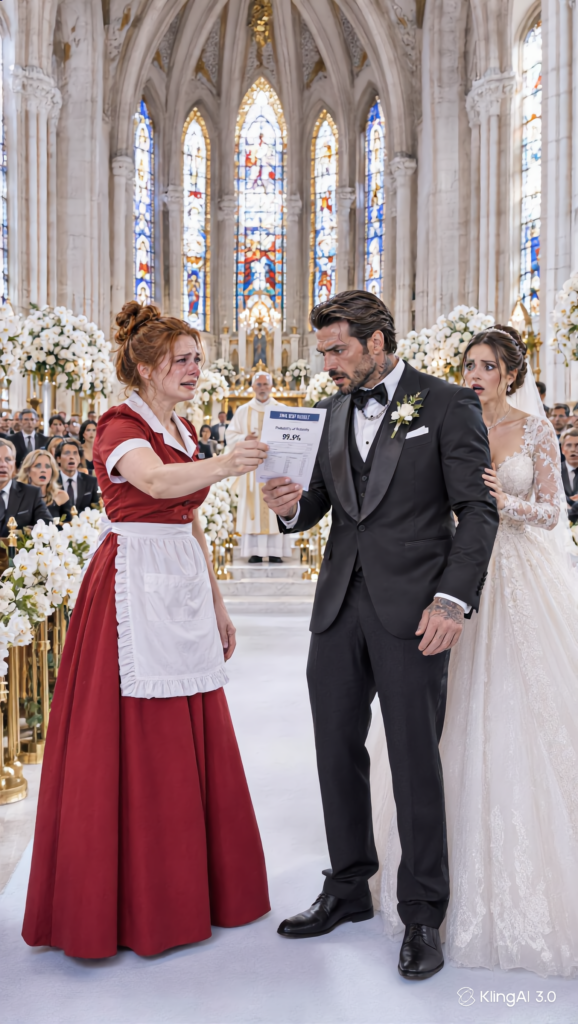
And then she did something no one in that church would ever forget. She stepped over the shards of crystal, walked out into the center aisle in front of five hundred people, and started toward the altar.
“Stop her,” someone hissed from the Albanese side.
Two of Don Carlo’s men stepped into the aisle, big men in dark suits, and moved to cut her off.
“Leave her.”
Matteo hadn’t raised his voice. He hadn’t needed to. The two men froze where they stood.
The waitress kept walking. Past the frozen bride, who had stopped dead in the aisle with her bouquet clutched against her chest. Past old Don Carlo, whose weathered face had flushed dark with fury. Past the rows of killers and their wives. She walked until she reached the bottom step of the altar, and she stopped there, looking up at Matteo Valenti with eyes the color of strong coffee, rimmed red with exhaustion and fear.
She was holding a sealed manila envelope against her chest. Her knuckles were white.
“Mr. Valenti,” she said. Her voice was raspy but clear, and in the stunned silence it carried to every corner of the church. “My name is Rosa Marín. I’m sorry. I didn’t know how else to reach you.”
“Matteo.” Serena’s voice came from behind the girl, sharp as a knife. She had left her father’s side and was walking fast now, her silk skirts hissing on the marble. “Have your men take this woman out. She’s obviously disturbed.”
Matteo didn’t look at his bride. He looked at the waitress.
“You have one minute,” he said quietly.
Rosa swallowed hard. She climbed the first step so that only he could hear her, and when she spoke again, her voice was a whisper.
“Until three weeks ago, I worked as a phlebotomist at the Halloway Clinic on Park Avenue. I drew blood. Six weeks ago, I drew blood from your fiancée for a prenatal paternity test. A private one. Paid in cash. She didn’t use her real name, but I recognized her from the engagement photos in the papers.”
The air around Matteo seemed to go very still.
“A paternity test,” he repeated.
“The clinic is owned by a company that belongs to the Albanese family. When I asked questions about the results, I was fired the same afternoon. Two days later, men broke into my apartment and took my laptop. Last week, a car followed me home from the bus stop three nights in a row.” Her voice cracked. “But I made a copy of the report before they took everything. I couldn’t go to the police. Half of them are on someone’s payroll. And I couldn’t get near you. Your people turned me away at your office twice. So I took a job with the caterer.”
She held out the envelope.
“Your bride is pregnant, Mr. Valenti. The baby isn’t yours.” Her eyes flicked, very briefly, to something over Matteo’s shoulder, and then back to his face. “And that isn’t the worst thing in this envelope. Please. Read it before you say your vows.”
Serena had reached the foot of the altar. Her face, under the gossamer veil, had gone the color of chalk.
“She’s lying,” Serena said. Her voice trembled for the first time since Matteo had known her. “Matteo, she’s a liar. Someone paid her to humiliate me. To humiliate my father. Don’t you dare open that in front of our families.”
Matteo took the envelope.
He broke the seal. He drew out three folded pages, and in the cold light falling through the stained glass windows, he read them.
The first page was the clinic’s intake form, with a false name and a real signature he recognized. The second page was the lab report. The language was dry and clinical: Non-invasive prenatal paternity analysis. Alleged father, Sample A. Alleged father, Sample B.
Sample A was his. He knew because he had given it himself, without question, six weeks ago, when Serena told him her doctor wanted to rule out genetic complications. He had thought she was being careful. He had thought she was being a mother.
Probability of paternity, Sample A: 0%.
Matteo’s eyes moved down the page.
Probability of paternity, Sample B: 99.98%.
Sample B had a name attached. Whoever had submitted it had been careless, or arrogant, or simply never imagined that anyone would look.
The name was D. Valenti.
The world went silent.
Matteo didn’t feel the cold anymore. He didn’t hear the murmur running through the pews or the old Don’s angry voice or the priest asking nervously what was happening. He heard nothing at all except the slow, heavy thud of his own heart.
He turned the page.
The third sheet wasn’t from the clinic. It was a photocopy of a handwritten note, in a looping, feminine hand. Rosa must have found it tucked into the patient file. Four lines, written on Serena’s monogrammed stationery:
D, after the toast, it will look like his heart. Doctors always say stress. Father will accept you once the papers are signed. We’ll finally have everything. S.
After the toast.
The reception. The champagne. The heart attack that every doctor would blame on a man who had spent six years at war.
Matteo lifted his eyes from the page.
Serena was staring at him, frozen, her lips parted, the bouquet trembling in her hands. And in her eyes, he saw it. Not shock. Not outrage. Recognition. The terror of someone watching a carefully built house collapse.
Slowly, very slowly, Matteo turned around.
His little brother was no longer smiling.
Dario stood at the altar exactly where he had been standing a moment ago, but his right hand had slid beneath his tuxedo jacket. The easy charm had drained from his face, leaving something Matteo had never seen there before. Something cold. Something that had been waiting a very long time.
“You should have just said I do, brother,” Dario said softly.
And he drew his gun.
PART 2: BLOOD ON MARBLE
There is a moment, right before violence, when the whole world holds still. Matteo had lived inside that moment many times. He knew its weight. He knew its silence.
He had never once imagined it would be his brother on the other side.
Dario’s pistol came up level with Matteo’s heart. Five hundred people gasped at once. In the pews, men leapt to their feet, guns flashing out of shoulder holsters on both sides of the aisle, Valenti and Albanese, every muzzle swinging wildly, nobody sure who to aim at.
“Nobody move!” Dario roared. “Everybody stay exactly where you are!”
Rosa Marín was still standing on the first step of the altar, directly between the two brothers. She was three feet from the gun. Matteo saw her go rigid.
“Dario,” Matteo said quietly. His voice was steady. His hands hung loose at his sides. “Put it down.”
“So you can do what? Forgive me?” Dario laughed, and the sound was raw and cracked and terrible. “You don’t forgive, Matteo. I’ve watched you not forgive for six years.”
“Why?”
It was the only question that mattered, and it came out of Matteo like something torn loose.
“Why?” Dario’s eyes were wet and blazing. “Because Papa gave you everything. The family. The name. The respect. I was the spare. The pretty one. The one you send to charm the politicians and the bankers while the real man runs the business. I’ve stood behind you for six years, brother. Six years of yes, Matteo. Of course, Matteo.” His hand tightened on the pistol. “Serena saw me. Serena chose me. And her father would have accepted me, after a respectful period of mourning. One family. One crown. And nobody would have had to fire a shot.”
“Except the poison in my glass,” Matteo said quietly.
Dario’s jaw tightened. “It would have been painless.”
Behind Matteo, someone sobbed. It was Serena. She had sunk down onto the altar steps in her ivory silk, her face in her hands.
“Carlo.” Matteo didn’t turn his head, but his voice carried down the aisle to the old Don. “Did you know?”
Don Carlo Albanese stood frozen in the aisle, his weathered face grey with shock. He looked at his daughter. He looked at the younger Valenti brother with a gun in his hand. And Matteo watched the old man’s face crumble as he understood.
“No,” the old Don whispered. “God help me. No.”
“Then tell your men to put their guns down.”
For one terrible second, the old man hesitated. Then he raised a shaking hand. “Do as he says. All of you. Lower your weapons.”
Slowly, reluctantly, all down the Albanese side of the aisle, the guns began to drop.
Dario’s face twisted. His plan was evaporating in front of him, and Matteo saw the exact moment he understood it. The moment desperation replaced calculation.
“Then I’ll do it the old way,” Dario said.
His finger moved on the trigger.
Rosa Marín moved first.
She didn’t run. She didn’t scream. She did the only thing she could reach: she seized the heavy silver candlestick from the altar beside her and swung it with every ounce of strength in her small body against Dario’s wrist.
The gun fired. The sound was cataclysmic inside the stone church. The bullet went wide, shattering a panel of stained glass high above the altar. A rain of colored glass came down like burning jewels.
Matteo was already moving. He crossed the distance between himself and his brother in a single stride and drove his shoulder into Dario’s chest. They went down together onto the marble steps in a tangle of black wool and fists. The gun skittered away across the floor. Somebody screamed. Somebody else fired a shot into the ceiling.
And then the church exploded into chaos.
It was not, Matteo would understand later, a gunfight between families. It was something worse. Some of the men in Valenti colors drew on their own brothers. Dario had not been alone. He had spent months quietly buying loyalty, and now a handful of his men tried to finish what he had started. Shots cracked across the nave. Guests dove beneath the pews. Old women screamed. The priest crawled behind the altar on his hands and knees.
Dario tore free of Matteo’s grip, rolled, and scrambled toward the sacristy door, dragging Serena by the arm. Three of his men closed ranks behind them, firing to cover their escape.
Matteo lunged after him, but a bullet cracked into the marble an inch from his hand, and when he looked up, he saw a gunman in a grey suit leveling a pistol not at him, but at the girl crouched beside the altar.
At Rosa.
Matteo didn’t think. He threw himself across her, wrapped both arms around her, and rolled them both behind the solid stone base of the altar as the bullets chewed into the marble where they’d been. He felt something hot and sharp tear across the back of his shoulder.
Then Tomás, his oldest soldier, a silver-haired giant who had served his father for thirty years, fired twice from the front pew, and the gunman went down.
The shooting stopped as suddenly as it had begun.
The sacristy door hung open. Dario and Serena were gone.
It took Matteo’s men ninety seconds to secure the church. Two of Dario’s gunmen were dead. A third had surrendered, weeping. Four guests were wounded, none of them badly. Don Carlo Albanese sat in the front pew with his head in his hands, an old man who had lost his daughter twice in one morning.
Matteo knelt behind the altar. Rosa was sitting with her back against the stone, her face white, her uniform spattered with candle wax and dust. She was staring at the blood soaking through the shoulder of his tuxedo.
“You’re hit,” she whispered.
“It’s a scratch.” He looked at her hands. They were cut from the broken glass, bleeding in thin lines across the palms. “You hit my brother with a candlestick.”
She stared at him. Then, to his astonishment, she let out a short, shaky, half-hysterical laugh. “He was going to shoot you.”
“Most people,” Matteo said quietly, “would have let him.”
The laugh died on her lips. Something shadowed her face, something old and painful, and she looked away.
“Boss.” Tomás crouched beside them. His voice was low and grim. “Dario had a car waiting behind the rectory. They’re gone. And there’s something else.” He hesitated. “Half the guys he bought are still out there. We don’t know which ones. We don’t know who we can trust.”
Matteo understood perfectly. His brother had just tried to kill him, and the family he had spent six years holding together was cracking open beneath his feet. Anyone in his organization could be Dario’s. Anyone at his house. Anyone guarding his cars.
He looked at Rosa.
“They know who you are,” he said. “They know you brought the envelope. Dario will want you dead before this day is over.”
Her face went whiter still, but she didn’t break. “I know.”
“Then you’re coming with me.”
Tomás drove them out of the city in his own battered pickup truck, the only vehicle Matteo trusted. No phones. No bodyguards. Just the three of them crammed into the cab, heading north through the grey January afternoon toward a hunting cabin in the Adirondacks that Matteo’s father had bought forty years ago under his mother’s maiden name. Nobody alive knew it existed except Matteo and Tomás.
And Dario, Matteo thought grimly. But Dario had always hated the cabin. Too cold. Too far from the city. Too quiet.
Rosa fell asleep halfway there, slumped against the window, her bandaged hands curled in her lap. Matteo watched her in the fading light. Her face was softer in sleep, younger. There was a small scar at the corner of her mouth. A cheap silver medallion of Saint Christopher hung on a thin chain around her neck.
“You know who she is, boss?” Tomás asked quietly, his eyes on the road.
“A phlebotomist. A waitress.”
Tomás was silent for a moment. “Marín,” he said. “There was a kid named Sammy Marín. Nineteen years old. He was working the counter at Giordano’s Bakery the morning your father was shot.”
Matteo went very still.
Six years ago. Mulberry Street. His father had been gunned down by the Albanese on the sidewalk outside a bakery. And in the war that followed, Matteo had sent men to burn that bakery to the ground in reprisal, believing the Albanese had used it as a meeting place. He’d been told it was empty when it burned.
It hadn’t been empty.
“He was her brother,” Tomás said quietly. “She was twenty-two. She identified the body.”
Matteo looked at the sleeping woman beside him, at the small silver medallion resting against her throat, and the cold, hard thing he had kept locked inside his chest for six years cracked straight down the middle.
She had walked into a church full of killers and saved the life of the man who had killed her brother.
The cabin was dark and freezing and smelled of old pine and woodsmoke. Tomás went out to check the perimeter. Matteo lit a fire in the stone hearth, and Rosa sat on the floor in front of it with a wool blanket around her shoulders, watching the flames.
When he finally sat down across from her, she spoke without looking up.
“You know,” she said. “I can see it in your face.”
“Yes.”
“I hated you for six years,” Rosa said quietly. “I used to imagine what I’d say to you. What I’d do to you. When I saw that name on the test, Valenti, my first thought was, Good. Let them destroy each other. Let him drink the poison.”
Matteo said nothing. He let her speak.
“But then I thought about Sammy.” Her voice wavered. “He used to give the leftover bread to the homeless guys on Grand Street every night. He’d say, Rosie, the world’s ugly enough without us adding to it.” She finally looked up at him, her dark eyes shining with tears in the firelight. “If I let them kill you, I’d just be one more person adding to it. And I couldn’t do that to him.”
The fire crackled. Matteo felt something burning behind his own eyes, something he hadn’t felt since he was a boy.
“I gave the order to burn that bakery,” he said. His voice was rough. “I was told it was empty. I never checked. I never asked. And I never once said his name.” He held her gaze. “I’m sorry, Rosa. I know it means nothing. I know it changes nothing. But I am so sorry.”
She looked at him for a very long time.
“It doesn’t mean nothing,” she whispered. “Nobody ever said it before.”
Outside, in the black, frozen forest, a branch snapped.
Then another.
Matteo’s head came up. Tomás should have radioed. Tomás always radioed.
He reached for the pistol on the table beside him, and at that exact moment, the cabin’s front window exploded inward in a hail of glass and gunfire.
PART 3: THE LAST TOAST
Matteo hit the floor and dragged Rosa down with him behind the heavy oak table, bullets punching through the log walls above them, splinters and plaster raining down. The firelight leapt wildly. Somewhere outside, men were shouting.
“They followed us,” Rosa gasped.
“Not followed.” Matteo’s voice was flat and cold. “Dario knew about the cabin. He hated it. I thought he’d forgotten.” He checked his magazine. Nine rounds. “How many voices?”
She listened, trembling. “Three? Four?”
The shooting stopped. In the sudden silence, a familiar voice called out from the dark tree line.
“Matteo!” It was Dario. “Your old man’s dead out here. Tomás. I’m sorry. He was always loyal.”
Matteo closed his eyes. A muscle jumped in his jaw.
“Send out the girl,” Dario called. “That’s all I want. Give me the girl and the envelope, and you and I can talk like brothers. Like Papa would have wanted.”
Rosa’s hand found Matteo’s in the dark. It was ice-cold and shaking.
He squeezed it once. Then he leaned close to her ear.
“There’s a root cellar under the kitchen floor,” he whispered. “It opens to the woodshed behind the house. When I start shooting, you go. You run downhill to the road and you don’t stop.”
“No.”
“Rosa.”
“No.” Her eyes blazed in the firelight. “I didn’t walk into that church so you could die in a cabin in the woods. I’m not leaving you.”
He stared at her. This small, stubborn, impossible woman.
“Then stay low,” he said, “and stay behind me.”
He rose to his knees behind the table.
“You want the envelope, Dario?” he called. “Come and get it. Just you and me. Like when we were boys.”
There was a long silence. Then the front door creaked open, and Dario stepped into the firelit room alone, a pistol in his hand, his wedding tuxedo torn and filthy, his eyes wild.
They faced each other across the ruined cabin. Two brothers. One father’s blood.
“You could have had anything,” Matteo said quietly. “All you ever had to do was ask.”
“I didn’t want it given to me,” Dario said, his voice cracking. “I wanted to take it. Just once. I wanted to be the one people were afraid of.”
“And Serena’s child?”
Dario faltered. For one instant, the brother Matteo had grown up with flickered behind his eyes. “Mine,” he whispered. “My son. Or daughter. I’ll never know which, now, will I?”
Then his face hardened, and the gun came up.
Two shots cracked in the small room, so close together they sounded like one.
Dario Valenti staggered back against the doorframe. He looked down at the red spreading across his white shirt, and then up at his brother with an expression of pure, childlike surprise. He slid slowly to the floor.
Matteo was on his knees beside him before he knew he had moved.
“Dario.” His voice broke. “Dario, look at me.”
His brother’s eyes found his. His lips moved. “Tell… Mama…”
He didn’t finish.
Matteo knelt in the broken glass and the firelight, holding his little brother’s head in his lap, and for the first time since he was nine years old, he wept.
Rosa came out from behind the table and knelt beside him. She didn’t say anything. She just put her arms around him and held on while the fire burned down and the snow began to fall through the broken window.
Tomás was not dead.
They found him an hour later, lying in the snow behind the woodshed with a bullet through his thigh, cursing in Sicilian and very much alive. Dario had lied. Even at the end, he had been a liar.
The two men who had come with Dario fled into the woods when the shooting stopped. They were found within the week. Matteo did not ask what happened to them.
Serena Albanese was found at Newark Airport two days later, boarding a flight to Lisbon with a forged passport. Her father did not send men after her. He sent a lawyer, and a check, and a single letter Matteo never saw. She went to live with distant relatives in Portugal. Some months later, Matteo heard, she gave birth to a healthy daughter. He sent no gift. He sent no message. But he made sure, quietly and permanently, that no one in either family would ever lay a hand on the child.
Don Carlo Albanese came to see Matteo three weeks after the wedding that never happened. The old man was stooped and grey and looked ten years older.
“My daughter shamed my name,” he said, standing in Matteo’s study with his hat in his hands. “Your brother shamed yours. The peace is broken.” He hesitated. “But I do not want any more sons in the ground. Do you?”
Matteo looked at him for a long time.
“No,” he said finally. “No more.”
They shook hands. No priest. No marriage. Just two tired old enemies agreeing, at last, to stop.
Spring came to Mulberry Street.
On the site where Giordano’s Bakery had once stood, a new building rose. It was a small community clinic, three stories of red brick with big bright windows, offering free blood work, vaccinations, and checkups to anyone who walked through the door. Nobody knew who paid for it. The deed was held by a trust with a name no one recognized.
Over the front door, carved into a slab of white stone, were four words:
THE SAMUEL MARÍN CLINIC
Rosa Marín stood on the sidewalk on opening day and stared at the name for a very long time. Then she turned around.
Matteo stood a few feet behind her, in a plain dark coat, with no bodyguards in sight. His shoulder had healed. The grief in his eyes had not, not entirely. Perhaps it never would.
“You did this,” she said.
“I can’t give him back to you,” he said quietly. “I can’t undo what I did. But he gave bread to people who were hungry. I thought he’d want the building to keep doing something like that.”
Rosa walked over to him. She looked up at the man she had spent six years hating, the man she had saved, the man who had held his brother as he died and then held her through the long, cold night afterward.
“They need a phlebotomist,” she said. “I hear the pay is terrible.”
A slow smile spread across Matteo Valenti’s face, the first real smile anyone had seen on it in years.
“I hear the director,” he said, “is a very difficult man to work for.”
“Then I’ll have to keep a candlestick handy,” Rosa said.
He laughed. It was a rusty, unfamiliar sound, and it startled them both.
A year later, in a tiny stone chapel by the sea, with no orchids, no armed guards, and only six guests in the pews, Matteo Valenti stood at an altar for the second time in his life. The bride wore a simple white dress and a small silver medallion of Saint Christopher at her throat. She walked down the aisle on Tomás’s arm, the old soldier limping proudly and weeping openly.
When the priest asked if anyone present knew any reason why these two should not be joined, the chapel was perfectly silent.
Rosa glanced up at Matteo, a spark of mischief in her dark eyes.
“No envelopes this time,” she whispered.
He took her hands, the same hands that had carried the truth into a church full of killers, and held them as though they were the most precious things he had ever touched.
“I do,” Matteo said.
And for the first time in his life, he meant every word.
THE END


