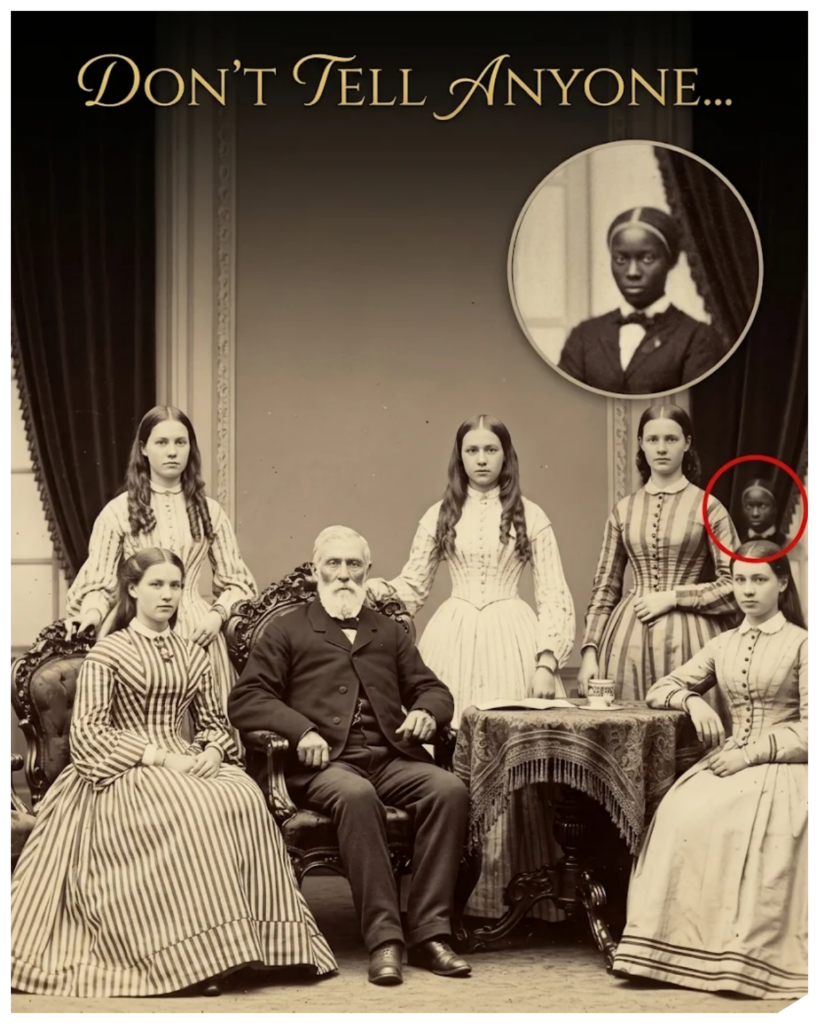
THE WOMAN BEHIND THE LOCKED DOOR KNEW THE SECRET OF THE THREE SISTERS
But the greatest shock was still to come: the woman behind the locked door was not merely the baron’s imprisoned wife—she was the only person who knew which of the three girls had been born into the Alencar family, and which had been brought into the mansion under a false name.
Ana stood motionless.
Baron Henrique watched her with an expression that was difficult to interpret.
His fingers tightened around the photograph.
“How much did you hear?”
“Nothing, senhor.”
“Do not lie to me.”
Ana lowered her eyes.
“I heard someone calling for help.”
The baron walked toward his desk.
“Then forget what you heard.”
“But—”
“Forget it.”
His voice was quiet, yet there was something terrifying about it.
He placed the photograph inside a drawer and locked it.
Then he sat down.
“Do you know why I employed you, Ana?”
She shook her head.
“Because Rosa is getting old. Because the girls need assistance. And because I believed you were an intelligent young woman who understood the importance of discretion.”
He leaned forward.
“Do not make me regret that decision.”
Ana nodded.
The baron dismissed her.
But she knew she could not simply forget.
Someone was imprisoned inside the mansion.
Someone who knew her name.
Someone who had mentioned the daughters.
And now there was a possibility that the three young women were living under an identity that was not entirely theirs.
That afternoon, Ana found Clara in the garden.
The youngest daughter was sitting beneath an enormous mango tree, holding an unopened letter.
“Senhorita Clara?”
The girl quickly hid it.
“Yes?”
“Are you all right?”
Clara forced a smile.
“Of course.”
Ana sat a short distance away.
“May I ask you something?”
“That depends.”
“Have you ever seen your mother?”
Clara stopped breathing.
For several seconds, she stared at Ana.
Then she whispered:
“Why are you asking?”
Ana carefully explained what she had heard.
Clara’s face became pale.
“You heard her?”
“Yes.”
The girl began crying.
“I knew it.”
Ana looked at her.
“Knew what?”
Clara opened the letter.
It contained a small drawing of a dove.
Beneath it were three words:
“I am still here.”
“Every few months,” Clara explained, “someone leaves a message inside my bedroom. I never see who does it.”
“Who do you think sends them?”
“My mother.”
Ana felt a chill.
“Have you told your sisters?”
“Beatriz believes the messages are traps. Isabel thinks our mother may have been alive at some point, but she does not know whether she is still alive.”
“And you?”
Clara looked toward the mansion.
“I believe she is inside.”
THE THREE SISTERS
That evening, Ana was summoned to the daughters’ private sitting room.
Beatriz stood near the window.
Isabel was sitting beside the piano.
Clara held the letter.
“We need to talk,” Beatriz said.
Ana closed the door.
Beatriz approached her.
“Clara told us what you discovered.”
Ana nodded.
“I am sorry. I did not want to frighten anyone.”
“You have not frightened us,” Isabel replied. “You have confirmed something we have suspected for years.”
Beatriz looked at her sisters.
Then she began telling Ana the story.
Their mother, Helena, had supposedly died when Clara was only a few months old.
The baron had announced that she had become ill and passed away in a distant house.
There had been no funeral.
No grave.
No body.
Only a sealed coffin that nobody was allowed to approach.
At the time, Beatriz had been six years old.
She remembered her mother being taken away during the night.
She remembered screaming.
She remembered her father holding her by the shoulders and telling her that Helena would never return.
But years later, Beatriz began finding letters.
Some were hidden inside books.
Others were placed beneath her pillow.
They all carried the same symbol: a silver dove.
“Why didn’t you tell anyone?” Ana asked.
“Who would believe us?” Beatriz replied. “My father controls the local authorities. He has friends among the judges and the police. Every person who questions him eventually disappears from our lives.”
Isabel approached the piano.
“There is something else.”
She opened a small drawer.
Inside was an old family portrait.
It showed Henrique, Helena, and three little girls.
But one of the girls had been scratched out.
“Who did that?” Ana asked.
“Father.”
“Why?”
“We do not know.”
Beatriz looked toward the door.
“Last year, I found a document in his study. It contained three names and three birth dates. One of the names was crossed out.”
Ana felt her heart beating faster.
“What were the names?”
“Beatriz de Alencar. Isabel de Alencar. Clara de Alencar.”
“Those are your names.”
“Yes. But beside Clara’s name, there was another surname.”
“Which one?”
Beatriz swallowed.
“Monteiro.”
Clara began crying.
“Father always told me I was born at the mansion.”
Isabel took her hand.
“He told all of us different things.”
Ana looked at the photograph.
“Perhaps your mother can explain.”
Beatriz shook her head.
“We need to reach her without our father knowing.”
THE OLD SERVANT’S CONFESSION
At midnight, Ana went to Rosa’s room.
The old woman was sitting beside a small oil lamp.
She looked as though she had been waiting.
“Come in,” she said.
Ana closed the door.
“Rosa, I need the truth.”
The old servant sighed.
“I know.”
“Who is Helena?”
Rosa looked down.
“She was the baron’s wife. She was also the only person in this house who ever treated the servants as human beings.”
Ana remained silent.
“She used to visit the kitchen,” Rosa continued. “She knew our names. She asked about our children. She helped people when they were sick. She hated the way the baron treated everyone.”
“What happened?”
“She discovered that he had been hiding documents about the family’s inheritance.”
Rosa paused.
“Documents that proved several properties had been taken from their rightful owners.”
“Did she confront him?”
“Yes. And she made a terrible discovery.”
“What?”
“Henrique had been using the names of his daughters to conceal financial transactions. He had created false birth records, changed family documents, and transferred property into names that did not belong to the people listed.”
Ana frowned.
“Why would he do that?”
“Because he believed his daughters would inherit everything one day. But if the true family records were discovered, his arrangements would collapse.”
Rosa looked toward the window.
“Helena found proof that the youngest girl had not been born to the baron and his wife.”
Ana’s eyes widened.
“Clara?”
Rosa nodded.
“Clara was the daughter of Helena’s sister, Mariana Monteiro. Mariana died shortly after childbirth. Helena adopted the baby and brought her into the mansion.”
“Why?”
“Because Mariana had been threatened by men who wanted her family’s land. Helena promised to protect the child.”
Ana remembered the word Monteiro.
“So Clara is not the baron’s biological daughter?”
“No. But Helena loved her as much as the other two.”
“Did Henrique know?”
Rosa looked at Ana.
“He knew from the beginning.”
“Then why did he keep Clara?”
“Because the girl was the legal heir to a valuable property that Henrique wanted to control.”
Ana felt sick.
“That is why he never allowed her to leave.”
Rosa nodded.
“Exactly.”
“Then what about Beatriz and Isabel?”
The old woman hesitated.
“That is the part I have never been able to understand.”
Ana leaned forward.
“What do you mean?”
“Helena once told me that one of the girls was not who everyone believed her to be.”
“Which one?”
“She never told me.”
Rosa opened a small wooden box.
Inside were several letters tied with a faded ribbon.
“Your mother—”
Ana stopped.
“Helena,” Rosa corrected herself. “She asked me to keep these safe.”
Ana took the letters.
“Why didn’t you give them to the daughters?”
“Because the baron searched every room. I was afraid he would discover them.”
Ana opened the first letter.
It was addressed to Beatriz.
The second was addressed to Isabel.
The third was addressed to Clara.
But there was a fourth envelope.
It had no name.
Only a sentence:
“To the daughter who must never learn the truth from her father.”
Ana looked at Rosa.
“What does this mean?”
The old servant began trembling.
“I don’t know.”
But her eyes suggested otherwise.
THE SECRET ROOM
The following morning, Ana and Beatriz devised a plan.
The baron left the mansion every Thursday to inspect his plantations.
He usually returned before sunset.
They had approximately six hours.
Rosa would distract the household staff.
Isabel would remain in the music room, ready to signal if the baron’s carriage returned early.
Clara would wait near the east-wing corridor.
And Ana and Beatriz would search for the hidden passage beneath the study.
They began by examining the floor.
The baron’s desk stood above a large Persian carpet.
When they moved it, they discovered a small iron ring.
Beatriz pulled it.
A wooden panel opened.
Beneath it was a narrow staircase.
The smell of damp earth rose from below.
Ana held a candle.
“Should we go down?”
Beatriz nodded.
They descended carefully.
At the bottom, they discovered a corridor lined with shelves.
There were boxes, books, documents, and several old photographs.
Some showed the baron with men whose faces Ana recognized from the local political establishment.
Others showed Helena standing beside a woman who looked remarkably like Clara.
On one shelf was a small wooden cradle.
And beside it lay a child’s bracelet.
Beatriz picked it up.
“That belonged to Clara.”
Ana examined the bracelet.
A tiny inscription had been engraved inside.
For Mariana’s daughter, with love.
Beatriz looked toward Ana.
“Mariana.”
The name matched Rosa’s story.
They continued searching.
At the end of the corridor stood a heavy iron door.
It was locked.
Ana tried the handle.
Nothing.
Beatriz noticed a small keyhole.
Then she remembered the photograph of her mother.
The silver dove.
She removed a pendant from her neck.
It had belonged to Helena.
Its shape matched the symbol carved into the iron door.
Beatriz pressed it against a small indentation beside the lock.
There was a click.
The door opened.
Inside was a narrow room.
A single bed stood against the wall.
A small table held a glass of water.
And on the wall were dozens of drawings.
Three little girls.
A woman holding their hands.
A house surrounded by flowers.
A family that appeared happy.
Beatriz began crying.
“She was here.”
Ana approached the bed.
A blanket lay folded at its foot.
On the table was a fresh piece of bread.
Someone had been inside recently.
Then Ana noticed a piece of paper beneath the glass.
It contained a message:
“My daughters, if you have found this room, your father has already begun the final part of his plan. Do not trust the papers he gives you. Do not sign anything. And whatever happens, never allow him to separate you.”
Beatriz covered her mouth.
“The final part of his plan?”
A sound came from the corridor.
Footsteps.
Someone was coming.
Ana extinguished the candle.
They hid behind the door.
The footsteps stopped.
Then a man’s voice spoke.
“Beatriz?”
It was Henrique.
“Are you down there?”
Beatriz closed her eyes.
The door slowly began opening.
THE BARON’S PROPOSAL
But the door did not open completely.
A second voice interrupted.
“Henrique, the carriage has arrived.”
It was the baron’s secretary, Dr. Álvaro Mendes.
Henrique hesitated.
Then he closed the door.
“Stay here,” he ordered.
His footsteps moved away.
Ana and Beatriz waited until the corridor was silent.
Then they returned upstairs.
They had barely reached the study when Isabel rushed toward them.
“Father is back.”
“Already?” Beatriz whispered.
“Yes. And he has brought guests.”
The three sisters gathered near the staircase.
In the main hall stood two men.
One was Dr. Álvaro.
The other was a wealthy landowner named Gustavo Brandão.
He was nearly forty-five years old and had been trying to marry Beatriz for months.
Beatriz had rejected him repeatedly.
But the baron had continued encouraging the arrangement.
Henrique greeted his daughters.
“Come here.”
They approached reluctantly.
“I have excellent news,” he announced.
“Gustavo has agreed to make an offer for your hand, Beatriz.”
Beatriz stiffened.
“I have already told you that I do not wish to marry him.”
The baron’s smile disappeared.
“This is not a discussion.”
Gustavo stepped forward.
“Your father and I have reached an understanding.”
Beatriz looked at him.
“I have not.”
Henrique raised his voice.
“Enough.”
He turned toward Isabel and Clara.
“You will both remain in your rooms tomorrow. I do not want anyone interfering with the arrangements.”
Clara looked at him.
“Why are you doing this?”
The baron approached her.
“Because I know what is best for this family.”
Clara stepped backward.
“You have never told us the truth about anything.”
The hall became silent.
Henrique’s face hardened.
“Be careful, girl.”
For the first time, Clara did not lower her eyes.
“Where is our mother?”
The baron slapped his hand against the staircase railing.
“Your mother is dead!”
“No!”
Clara’s voice broke.
“We heard her!”
Henrique stared at her.
Then he turned toward Ana.
“You.”
Ana remained still.
“Did you take them into the east wing?”
Nobody answered.
The baron looked toward Dr. Álvaro.
“Search their rooms.”
The secretary nodded.
Henrique then delivered an announcement that changed everything.
“Tomorrow morning, Beatriz will sign the marriage agreement. Isabel and Clara will be sent to a private estate in the countryside. I have already arranged everything.”
Beatriz looked at her sisters.
They understood.
Their father intended to separate them.
And once they were apart, nobody would be able to help the others.
THE WOMAN WHO KNEW THE REAL INHERITANCE
That night, Rosa entered Ana’s room carrying a candle.
“We must act now.”
Ana stood.
“What happened?”
“Henrique has ordered the servants to prepare the east-wing room for a transfer.”
“Where are they sending the girls?”
“I don’t know.”
Rosa handed her a small key.
“This opens the old chapel.”
Ana frowned.
“What is inside?”
“Something Helena left before she was imprisoned.”
“Why didn’t you tell me earlier?”
“Because I needed to be certain you could be trusted.”
Rosa looked directly into her eyes.
“Tomorrow, if Henrique takes the girls away, he will destroy the last evidence of their true identities.”
Ana took the key.
“What evidence?”
“The original birth records.”
Rosa explained that Helena had discovered a secret arrangement involving the baron’s inheritance.
Years earlier, Henrique had used the identity of his daughters to hide the ownership of several properties.
But there was a document that could expose everything.
It was a family register signed by Helena, her sister Mariana, and the local priest.
It proved that Clara was Mariana’s daughter.
It also established that Clara had a legitimate claim to the Monteiro estate.
But there was another detail.
The register identified a fourth person.
A child whose existence had been hidden.
“Who?” Ana asked.
Rosa shook her head.
“I never saw the name.”
“Where is the document?”
“In the chapel.”
Ana looked toward the corridor.
“Then we must get it.”
THE NIGHT OF THE FINAL CONFESSION
At midnight, Ana entered the chapel.
The mansion was silent.
The moonlight passed through the stained-glass windows, casting pale colors across the stone floor.
She found a small wooden altar.
Behind it was a loose panel.
Inside lay a leather folder.
Ana opened it.
The first document was Clara’s original birth record.
The second was a letter from Mariana.
The third was a handwritten statement signed by Helena.
Ana read it slowly.
“If my husband ever discovers the truth, he will attempt to separate the children. He believes that controlling their identities will give him control over their inheritance.”
Ana turned the page.
Then she found a document with four names.
Beatriz.
Isabel.
Clara.
And a fourth name.
Ana Maria de Souza.
Ana stared at it.
Her own name.
Her hands began trembling.
She read the next line.
“The child of Mariana’s sister, entrusted to Helena’s protection, must never be allowed to grow up believing that she was abandoned.”
Ana felt the floor move beneath her.
She read the name of the mother.
Rosa de Souza.
The old servant.
Ana’s mother.
She had been brought into the mansion not merely as a maid.
She was the daughter of a woman connected to the very inheritance Henrique had stolen.
The document continued:
“Ana is the fourth daughter of this family by blood, and the rightful witness to the arrangement that was made before her birth.”
Ana covered her mouth.
Before she could understand what it meant, a voice came from the chapel entrance.
“Now you understand why I hired you.”
She turned.
Baron Henrique stood in the doorway.
Dr. Álvaro was beside him.
And behind them stood Beatriz, Isabel, and Clara.
Their hands were tied.
The baron smiled.
“Give me the documents, Ana.”
Ana clutched the folder.
“Why did you bring me here?”
“Because your mother believed she could hide the truth forever.”
Rosa appeared behind him.
Her face was wet with tears.
“Ana, listen to me.”
Henrique turned.
“Silence!”
Rosa stepped forward.
“No. Not anymore.”
The baron looked at the old servant.
“You have forgotten your place.”
Rosa lifted her chin.
“My place is beside my daughter.”
Ana stared at her.
“Mother?”
Rosa began crying.
“Forgive me.”
The young maid felt her heart break.
All her life, she had believed her mother had been an ordinary servant who knew nothing about the Alencar family.
Now she understood that Rosa had been protecting her.
But the baron was not finished.
He walked toward the altar.
“Give me the folder.”
Ana refused.
Henrique raised his hand.
Dr. Álvaro moved toward her.
Then Clara suddenly shouted:
“STOP!”
Everyone turned.
The youngest daughter had managed to free one hand.
She was holding a small silver object.
The same dove pendant.
She pressed it against a hidden mechanism in the altar.
A compartment opened.
Inside was a second document.
Henrique’s face went completely white.
“How did you find that?”
Clara looked at him.
“Mother told me.”
She removed the document.
It was a sealed letter.
And at the top was a sentence that made the baron stagger backward.
“To my daughters, and to the man who believes he owns them.”
The letter contained the final truth.
Henrique reached toward it.
But Clara stepped away.
“Do you want to know what it says, Father?”
The baron said nothing.
Clara unfolded the paper.
Then she began reading aloud.
“Henrique, if you are hearing these words, then you have failed to keep the truth hidden.”
She looked up.
“Mother says that you are not the rightful owner of this mansion.”
Henrique lunged forward.
Ana screamed.
And just as Dr. Álvaro reached for Clara, a loud voice echoed from behind the chapel doors.
“Nobody moves.”
The doors opened.
A group of uniformed officials entered.
At their head stood a magistrate carrying an official warrant.
But what shocked everyone was the person walking beside him.
A woman in a dark dress.
Her hair was streaked with silver.
Her face was thin.
And around her neck hung the silver dove.
Helena.
The baron’s wife.
Alive.
She looked directly at her daughters.
Then she turned toward Henrique.
“I believe it is time,” she said quietly, “for everyone to hear the truth.”
And what Helena revealed next would destroy the baron’s carefully constructed family history forever.
👇 LIKE this story and COMMENT “JUSTICE” to see CHAPTER 3. The final chapter reveals the truth about the four daughters, the stolen inheritance, and the terrible secret the baron had kept for seventeen years.