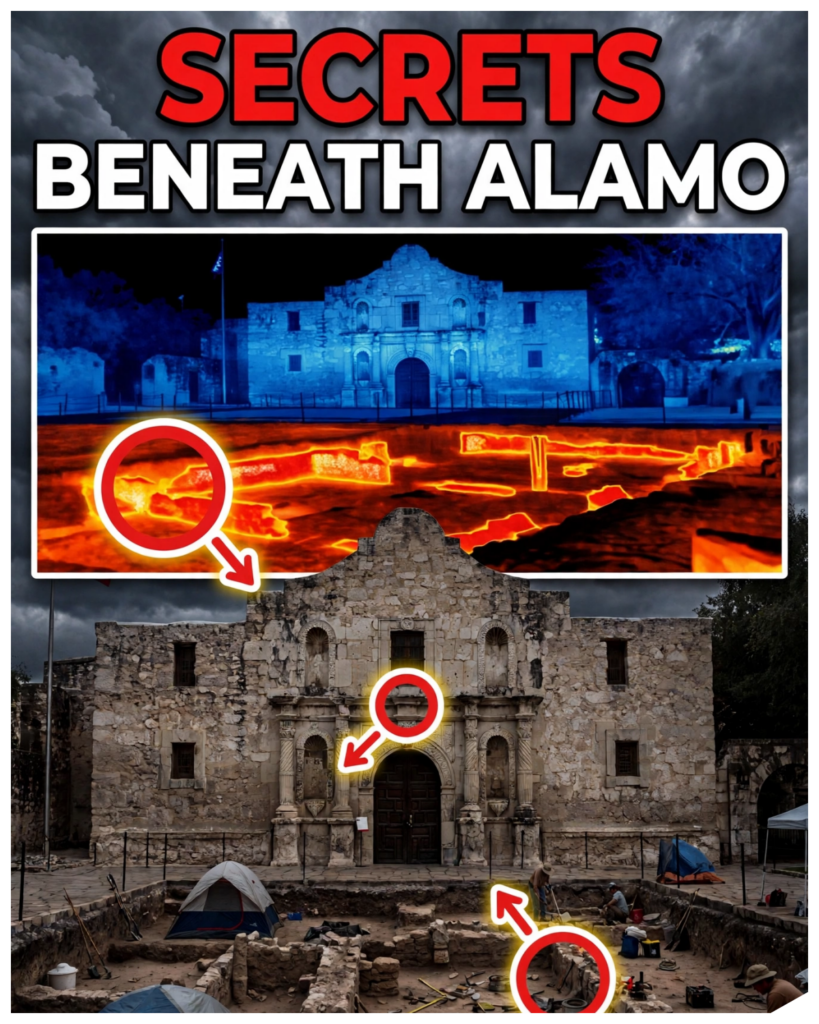
Beneath the flagstones of a crowded plaza in South Texas, the ground is being opened one square pit at a time.
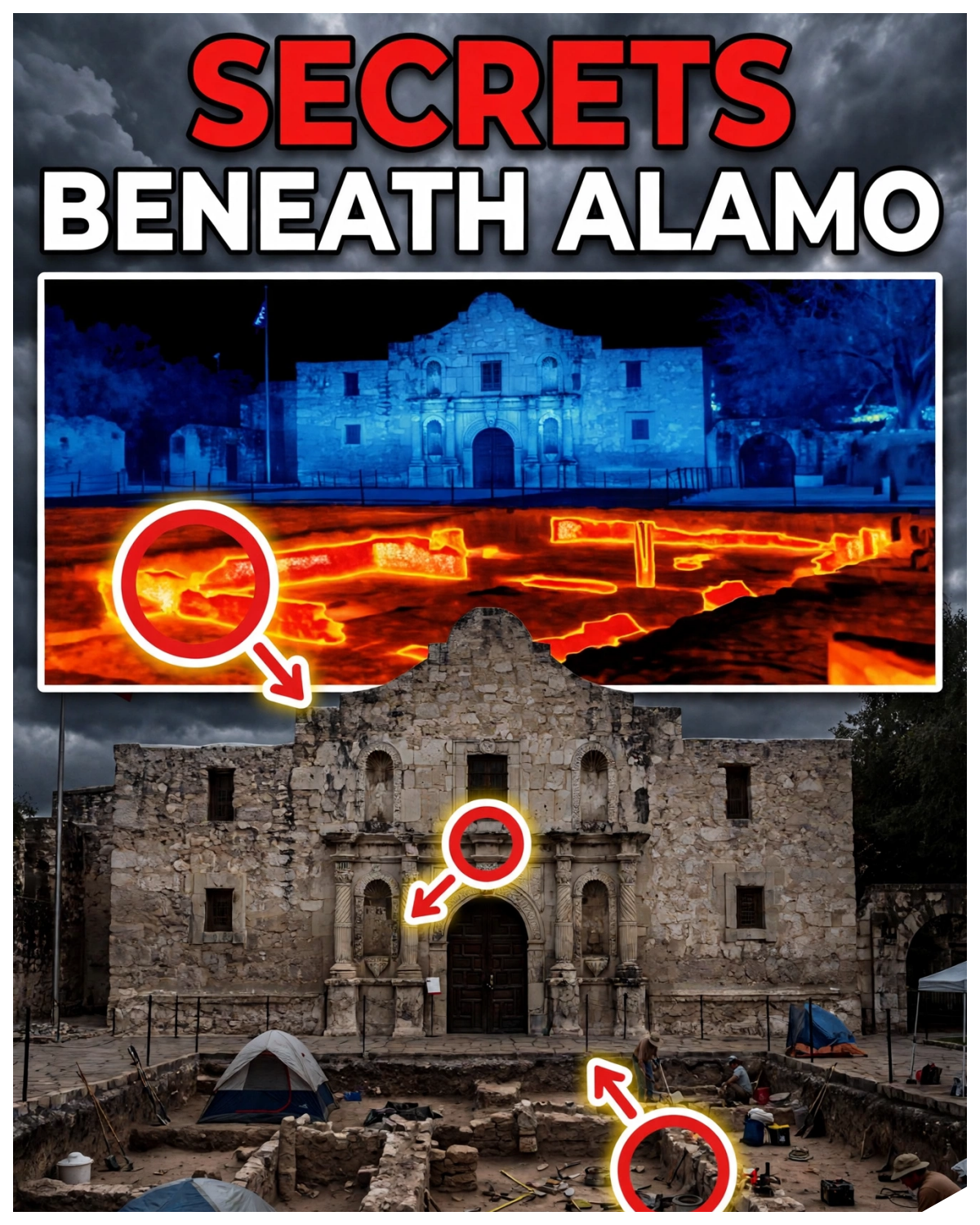
Crews kneel three feet down while tourists and traffic move past overhead.
Above them stands the Alamo, which draws more than 2.5 million visitors a year.
You would not find that tidy chapel here in 1836.
You would find a walled compound, a church with no roof, and a battle that lasted one morning.
23 in under the flagstones, a line of sundried adobe bricks.
At the edge of the old fort, the tip of a French-made Mexican sword.
Beneath the church floor, the bones of three people, one of them an infant.
And then came the detail that made no sense.
Three feet down, a 4-PB bronze cannonball sitting in ground everyone believed had been scraped clean.
The accepted answer, it’s the chapel.
But that church had no roof in 1836.
The curved top came in 1849.
Into the gap rushed theories, a sealed fort under the pavement, ashes, and a cathedral tomb.
A story someone once kept simple.
Then in December 2015, the Texas Historical Commission rolled ground penetrating radar across nine grids of the plaza, an X-ray for dirt.
For generations, this story was written in legend.
Now it would be written in soil.
What came out of that ground did not hand anyone the answer they wanted.
So what do the buried walls beneath Alamo Plaza actually reveal?
Hold on to that cannonball.
We’ll come back to it, but first you need to see what it’s up against.
Picture the Alamo.
You already see it.
A pale limestone front, that curved hump on top, a flag, a line of tourists in the sun.
School children learn it as a story about a small chapel, a last stand, and men who died inside those walls.
People call it the Shrine of Texas Liberty.
And the story told there fits in a few minutes.
A mission, a siege, a final morning, a legend.
That story carries more than facts.
It carries identity.
It carries pride.
Change one piece of it and people notice.
Yet plenty of visitors say the same thing when they arrive.
Is that it?
And honestly, they have a point.
Because the chapel was never the fort.
The Alamo in 1836 was a walled mission compound and the church was one corner of it.
The scene in your head, defenders crouched inside a stone church, doesn’t match the ground.
Nobody lied to you.
Exactly.
The picture just got edited one layer at a time.
Remember what the hook told you?
That church had no roof in 1836.
The famous curved top, the one on every postcard and movie poster, was added in 1849, 13 years after the battle.
So, the Alamo most people picture is partly a later edit, a shape the building acquired after the shooting stopped.
The defenders never saw it.
Walk the plaza and you’ll feel it.
The church sits like a trophy at the edge of a modern downtown, hemmed in by storefronts and traffic.
A fort should have an inside.
So where is it?
The walls, the gate, the barracks, the cannon positions.
Their footprint lies under streets, under the Crockett and Wworth buildings, under the plaza itself, a battlefield buried under a downtown.
For decades, nobody could say what was still down there.
Maps disagreed.
Accounts disagreed.
Even the location of the south gate was argued over.
Christy Miller Nichols told Fox News in 2016 that there were several different maps and lots of different interpretations of where that gate stood.
None of this was a hobby project.
The Texas General Land Office, the city of San Antonio, and the Alamo Trust launched a redevelopment plan the trust puts at $550 million.
New paving, a new museum, and before anyone poured new concrete, somebody had to look under the old.
That’s the promise behind this story.
What do the buried walls actually reveal?
The honest answer is stranger than they found the fort.
They found pieces that might be walls.
They found the dead.
They found the leftovers of a fight.
And they found evidence that the wall everyone wanted most may be gone.
To find out, the state needed a machine that could see through the pavement.
The machine was ground penetrating radar.
A cart rolls across the surface, sends signals down, and records what bounces back.
Nine grids.
December 2nd, 2015.
Every strange reflection became a question mark on a screen.
And the screens lit up, but not with what anyone expected.
The survey was run by the Texas Historical Commission, and the principle is simple enough to picture.
Anything buried that differs from the soil around it, a pipe, a footing, a pit, sends the signal back differently.
On the screen, it shows up as a curve, a smudge, a bright line where there should be nothing.
Archaeologists read those shapes the way a doctor reads a scan.
Useful, never final.
To understand what the radar was looking at, you have to go back before the battle.
The Alamo began in 1718 as a mission.
Indigenous builders raised it from limestone, and the quarry that supplied that stone was only confirmed in 2025, the most famous building in Texas.
And we found its quarry last year.
A mission means people lived here.
A working community with rooms, floors, and water.
An irrigation channel and a seakia ran through the grounds.
Keep that in your pocket.
It comes back.
Floors, hearths, store rooms, a water channel.
Ordinary life packed into the same ground the battle later crossed.
That detail will matter when the trays start filling up.
Then the mission became a fort.
In 1835, cause fortified the compound, including a palisade.
Remember that date?
It’s about to cause trouble.
A palisade is a fence of timber stakes.
Fast to build, fast to lose.
The Alamo wasn’t built as a fortress.
It was a mission that got turned into one.
And a repurposed place is a messy place.
Then came the battle.
And then came the part nobody puts on a postcard.
The US Army ran a depot here.
Later, the Grenette store.
And then Hugo and Schmeltzer moved into the old compound.
A low barrack was leveled in 1871.
A fort became a depot.
A depot became a store.
A store became a street.
Each owner buried the last.
So the team dug where the radar pointed.
First, they found rails.
Street car rails from a line that ran here between 1878 and 1933.
The radar had picked them up, and a trench confirmed it.
It was a good test.
The machine saw something real.
It just wasn’t the fort.
It was the city that came later.
Here’s the catch.
Radar doesn’t see walls.
It sees changes.
A pipe, a block of fill, a line of rail, all look like trouble on the screen.
A radar survey is a list of suspects.
The trowel is the verdict.
Then on July 22nd, 2016, about 23 in below the flagstones, south of the Crockett building, a crew hit adobe bricks.
Sundried mud laid in a line, mission era material under a walkway where tourists pass every day.
The headlines said the team might have found the west wall of the compound.
Then came a sentence that should have made everyone slow down.
Neesa Anderson of the firm Pape Dawson said, “We’re not convinced that it is the west wall.”
Not convinced about the headline find Adobe in a mission could be a rampart or it could be runes, the quarters where native residents lived.
The most famous bricks in the plaza might be someone’s home.
Stone turned up, too.
A possible footer, the base of a wall, may be tied to the south wall or the gate.
The language from people on site stayed careful.
Possible, might, maybe.
That’s the vocabulary of people who know how easily a plaza can fool you.
Headlines ran ahead of them anyway.
Fox News asked whether archaeologists were close to finding the main gate.
Another claimed they believed they had found the gate and the south wall.
Each was a fair reading of a careful sentence, and each asked the plaza for more than it had given.
Then in August, the dig turned up something small, the tip of a sword, a French-made Mexican briquette, the short saber Mexican soldiers carried.
Sam Nesmouth dated it to a window between October 1835 and February 1836, and it lay where archaeologists believe the South Wall once ran.
A soldier’s weapon lost at the edge of the fort.
It felt like proof, except that window opens in 1835, the same year cause fortified the place.
The sword tip might have been lost during that work months before the assault or during the assault itself.
Metal can’t tell you which.
A real sword in a real place from a real moment and it still couldn’t answer the question everyone wanted answered.
That’s the problem with small finds.
They are real and they are quiet.
While the archaeologists argued over bricks, a bigger problem sat in plain view.
The Alamo story is full of things everybody knows and a surprising number of them don’t have the evidence you’d expect.
The line in the sand, the moment a commander draws a line with his sword, it rests on a single late secondhand account from 1873, nearly four decades after the battle.
Treat it as legend.
Even the number of defenders is unsettled.
Researchers site 189 known defenders.
The senotaph in the plaza carries 187 names.
Then the hardest question after the fighting, what happened to the bodies?
The traditional answer says the defenders were burned on funeral ps.
Markers placed in 1917 and 1918 put those ps along the Alamita, today’s East Commerce Street.
And that’s where certainty ends.
The sites are built over.
The exact spots are unproven.
Where did the ashes go?
One theory says a sarcophagus at San Fernando Cathedral.
Another points to Oddfellow Cemetery.
Both are unverified.
And one idea, the Ivy hypothesis, suggests some Tahhano defenders may have been buried instead of burned.
It’s a hypothesis, not an established fact.
Famous story, thin evidence.
Now you can see why the dirt matters.
The stories can’t settle these questions.
The ground might.
Archaeology can’t dig up what lies under a street.
The Alama is now East Commerce Street, built over for generations.
If the py sites sit under asphalt, they are not just unproven, they may be unreachable.
By the end of that 2016 dig, the team had logged about 1,700 artifacts.
Mission life, the army depot, scraps of the century after, and no clean answer about where the walls ran.
The plaza was talking.
It just wasn’t saying what anyone expected.
And in 2019, the digging moved somewhere far more sensitive.
Into the church itself.
The archaeologists stepped inside the building everyone photographs and they did what archaeology does best.
They read the dirt.
Soil builds up in layers like pages in a book and the oldest pages sit at the bottom.
Dig carefully, one layer at a time, and you can read the story backward.
Inside and around the church, the team recorded 22 layers, 22 chapters.
And at the bottom, they found the church’s foundations set directly on natural hard pan, the original ground.
For once, no guessing.
Then in August, the trowels stopped.
Bones, human remains under the floor of the church, in the monk’s burial room, and under the nave.
By December, the General Land Office confirmed evidence of three individuals.
Three people buried inside the Alamo.
One was an infant.
Picture a team kneeling on the church floor, brushes in hand, working around something very small.
In that moment, the project stopped being about where the walls stood.
It became about who was lying under them.
So, who were they?
Careful here.
The burials are unidentified.
Not confirmed as soldiers, not confirmed as native residents, not confirmed as anyone.
The honest answer is that nobody knows yet.
And that’s where the institutions collided.
The Takpilam Quilt Nation, a native group, says it learned about the remains through an anonymous tip and an open records request.
That is their account of how they found out.
A dig inside the most protected building in Texas, and the first word reached a native group by tip and paperwork.
Work around the burials was halted.
The state’s plan had a schedule.
The dead had never agreed to one, and a lawsuit was coming.
Why does that matter so much?
Because human remains are not pottery.
They carry legal weight, ethical weight, and in a place like this, emotional weight.
Every decision about them needs permission.
And permission means someone gets to say no.
Archaeologists wanted the evidence.
A native group wanted a voice.
The state wanted a schedule.
All three had a claim.
They were not asking for the same thing.
But the church was only part of the puzzle.
The bigger question was still out on the plaza.
So, the team went back for the prize everyone had been chasing since the radar first lit up.
The south wall, the main gate.
What would real proof of a wall look like?
A continuous line of stone or adobe footing running straight, tied to a layer from 1836, matching the maps.
That was the standard.
Everything else was a suspect.
Here is what they had to work from.
The Sanchez Navaro map, which shows the Lunette, a defensive position near the gate.
Sergeant Everett’s 1848 quartermaster map where the missing walls are drawn as dashed lines.
Even in 1848, the wall was already a ghost.
And Sanborn maps from 1877 and 1896, which marked a saloon foundation and the old Asakia.
Utility trenches had already exposed both.
For once, paper and dirt agreed.
But on the south wall, three mat makers across three eras still would not settle it.
The investigation, which the Alamo Trust called the Mission Gate and Lunette Archaeology Investigation, opened roughly 7,500 square ft of plaza, a huge hole in the heart of downtown San Antonio, aimed at one thing.
Find the line where the fort’s wall crossed the ground.
They found things.
Metal, glass, ceramics, small pieces of lives that had passed through.
They did not find the wall.
No intact wall line, no clean footing, nothing you could point to and say that’s the south wall of the Alamo.
Imagine standing at the edge of that pit.
You have the maps, you have the coordinates, you have decades of arguments writing on one excavation, and what the ground shows you is fill and grading.
No line, no wall, just proof that someone well over a century ago got there first.
The team’s preliminary answer came out in January 2023, and Lindley gave it to Texas Public Radio without sugar.
When the old structures were torn down in the late 1880s, the city graded the entire area, then spread fill across the surface to level the plaza.
Read that again.
The wall wasn’t hidden.
It was erased.
Not by time, not by weather, by a city with a plan.
The south wall of the Alamo wasn’t waiting under the pavement like a time capsule.
It was scraped off the earth in the late 1880s so a plaza could be flat.
That is a preliminary interpretation, not a closed case, but it fits what the dirt showed.
Think about what that means for everything the dig did find.
Metal, glass, ceramics, all of it scattered through fill.
The grading did not just remove walls.
It may have shuffled the evidence.
A fragment in that soil might not sit where it fell.
And any layer has to be read with suspicion.
That is why the archaeologists keep reaching for words like preliminary.
It sounds like a defeat.
It wasn’t.
It was the answer to a different question.
The old story assumed the walls were waiting under the plaza, intact.
The dirt said no.
The fort did not survive as a monument.
It survived, if it survived at all, as fragments.
And that changes the search.
If the city scraped the surface flat, the question stops being where the wall stood.
It becomes what the scraping missed.
There was one clue.
Near the spot where the southgate should have been, the team found a hard compacted surface in the ground.
The Center for Archaeological Research at UTSA reported it.
They did not remove it.
They left it preserved in place.
A floor, a road, a yard.
Nobody can say yet, but it was ground that somehow escaped the grading close to a gate people have argued over for decades.
Hold that thought because it quietly rewrites the title.
The buried walls beneath Alamo Plaza do reveal something.
They reveal that the walls were taken.
By the dig’s preliminary reading, the south wall was lost to a city leveling a plaza, not to a legend, to a grade line.
So the dig moved to the long barrack.
And here, finally, the soil started giving investigators material that looked like battle.
Layers of charcoal rich soil.
Musk balls 63 caliber.
The Alamo Trust’s own weekly updates tied them tentatively to 1836.
Tentatively, that word matters.
It’s the line between evidence and a headline.
Why the caution?
Because a burned layer is tempting.
It looks like a battle, but fires happen in ordinary life, too.
From hearths to rebuilding.
The soil can’t tell you who struck the match.
The musk balls tilt the odds toward a fight, but they still can’t give you a day.
The team did not claim more than the layer allowed.
Here’s the trick archaeologists use to put dates on dirt.
The newest object in a layer sets the floor.
If a layer holds something made in 1850, it can’t be older than 1850, no matter what story you want from it.
That’s why one scrap of glass can sink a big theory.
Meanwhile, the artifacts piled up.
Valware pottery tied to this mission.
Puebla polychrome painted pottery from Mexico.
Guerrero points stone tips tied to native tool makers.
Gunflints, the little stones that sparked a musket with notches at the heel.
Every tray held a different chapter.
And here’s the twist hiding in the trays.
Much of what comes out of this ground isn’t battle.
It’s ordinary life.
The famous morning of 1836 is a thin stripe in a very thick cake.
And the numbers got big.
In 2025, the University of Texas at San Antonio reported roughly 250,000 artifacts from the Long Barrack project, some of them untouched since the 1700s.
Some outlets have stretched that number to the whole site.
It belongs to the Long Barrack.
Still, think about the scale.
A quart of a million small pieces of a place everyone assumed had been paved flat.
Picture those pieces on storage shelves, bags, and trays, each with a number, each from a spot someone mapped.
Pottery shirts, stone points, bits of glass, a few musk balls.
Individually, nothing.
Together, a record of who lived here, who fought here, and who built a city over both.
Notice the pattern.
Every time, a headline gets ahead of the evidence.
Wall, gate, battle.
And every time, the people holding the trowels pull it back.
Possible, tentative, preliminary.
That gap between the story people want and the sentence the evidence can support is the real mystery running through this whole dig.
Credit where it’s due.
The trust has posted weekly updates from these digs and the word tentatively keeps showing up.
That’s how honest archaeology sounds.
It’s also why it never sounds as exciting as the headline.
Which brings us back to the trench from the start.
March 5th, 2026.
What came out of the ground was 4 lb of solid bronze found about 3 ft down.
Lindley later said it plainly.
March 5th is when we pulled it out of the ground.
The Alamo Trust announced it on March 19th.
The next day after the dig, March 6th, was the 190th anniversary of the battle.
The dirt handed back a piece of 1836 on the eve.
Why did it matter?
Because armies leave fingerprints.
Kobby Lam, the Alamo’s senior researcher and historian, explained it to Fox 7 this way.
The Mexican army was using bronze shot.
The Texans largely used iron.
So, a bronze ball is in all likelihood a message from one side of the battle.
The trust put the odds at about 99%.
Not certain, very, very likely.
Then, in June, a second one surfaced.
Iron.
Lam told Archaeology magazine that the bronze ball most likely belonged to the Mexican army and the iron one to the Texans.
The trust also reported four fragments of exploding shot.
Hollow rounds built to burst apart.
Four fragments means something burst here.
Two armies, two metals, one patch of dirt.
Now, here’s the part that keeps this from being a neat victory lap.
A cannonball is not a wall.
It doesn’t tell you where the gate stood.
It doesn’t tell you where the defenders fell or where the dead were taken.
It tells you one thing, and it tells it with force.
The battle did not vanish when the plaza was leveled.
It survived in pockets the grading missed.
The fort had been erased.
The fight had not.
And in August, another quiet turn.
The team reported a compacted khiche surface, a hardpacked layer of limestone rich soil, which the trust interprets as a mission era floor.
Interprets, not proves.
The same ground that gave up cannonballs is giving up places where people once lived and worked.
Mission and fort, home and battlefield.
The layers don’t care which one visitors came to see.
So, here’s what researchers have confirmed plainly.
Adobe bricks under the plaza, a Mexican sword tip, mission floors, an irrigation channel, three burials inside the church, a quarter of a million artifacts from one project, two cannonballs.
Here’s what they haven’t confirmed.
An intact battle era wall line, the exact South Gate, the identity of the dead, the Pers.
Keep both lists in your head.
Every one of these finds raises the same uncomfortable question.
Who decides what happens to what’s under the plaza?
Because while the trials worked, a second fight was running alongside them in a courtroom, in a commission meeting room, and in the offices of the people who run the state.
The fight had moved from the trench to the capital.
Go back to September 2020.
Right in the middle of Alamo Plaza stands the Senate, the memorial to the defenders.
The redevelopment plan had called for moving it.
On September 22nd, the 15 member Texas Historical Commission voted 12-2 against moving it.
Vice Chair John Crane abstained.
Chair John now put the logic in one sentence.
Monuments to the fallen are placed where they fell.
That sounds like common sense until you remember what the dirt has been saying.
Nobody can say for sure where the funeral ps burned.
The monument stayed.
It was restored in place and rededicated on November 11th, 2025.
It still carries 187 names, while researchers count 189.
The stone is certain.
The list is not.
Notice what that vote assumes.
It treats the plaza as hallowed ground with a known edge, a place where the dead fell and the monument belongs.
The archaeology keeps pulling at that edge.
The south wall is gone.
The pers are unloc.
The compound’s outline is still argued over and within two years of that vote, a dig would open 7,500 square ft of the plaza and fail to find the south wall.
Meanwhile, Tap Pylum took the burial question to court.
It sued in 2019.
It lost in federal court in 2020.
It lost in state court in 2021.
Then came a settlement.
Tap Pylum is now invited to the meetings of the committee that deals with the remains.
It doesn’t have a seat.
Invited.
No seat.
A native group with a stake in the mission’s history gets to listen.
Whether that’s a fair compromise or a polite way of saying it’s not your decision depends on who you ask.
And behind every argument sits a fact that got overlooked for a long time.
The Alamo began as a mission and indigenous builders raised it from limestone.
Their story is the oldest layer in the ground.
For generations, it was the layer nobody put on the postcard.
Now, it’s the layer people argue about hardest.
Think about who was here first.
Indigenous builders raised these walls.
Mission residents lived in those rooms.
Whatever else the plaza holds, it holds people the legend rarely names.
In October 2025, the fight stopped being about dirt and bones and became about people.
First came a social media post marking Indigenous People’s Day.
It was deleted.
Land Commissioner Don Buckingham’s response was blunt.
Woke has no place at the Alamo.
Then on October 23rd, Lieutenant Governor Dan Patrick sent a letter about Kate Rogers, the Alamo Trust’s CEO.
He pointed to her 2023 dissertation at USC and called it incompatible with the telling of the history of the Battle of the Alamo.
She resigned that same day.
On November 17th, she sued Patrick Buckingham and the trust’s board.
Hope Andrade replaced her.
Stop and look at the timing.
The site’s own CEO is gone after a state leader letter attacked her dissertation.
Months later, archaeologists lift cannonballs out of the same ground.
The institution that runs the site, the officials who oversee it, and the people digging it up are pulling in different directions over one question.
Who gets to tell the story?
Keep one thing straight.
Nobody has shown that her ouster touched the dig itself.
What’s documented is the sequence.
A deleted post, a letter, a resignation, a lawsuit.
What that means for how the story gets told is a question, not a finding.
And the project that set all of this in motion keeps moving.
The Alamo Trust puts the redevelopment at $550 million.
CNN reports closer to $700 million.
A new museum is planned for the Crockett and Woolworth buildings.
When does it open?
Fall of 2027, say some reports.
Spring of 2028, say others.
Even the opening date is disputed.
Whenever that museum opens, somebody has to write the card beside the bronze cannonball.
Mexican army, probably.
Fired in the battle, very likely.
And the three people under the church floor, unidentified.
Every honest label will need words like probably, likely, and not yet.
That’s an uncomfortable thing to put on a shrine.
Picture a visitor reading that card.
Probably, likely, not yet.
It won’t sound like the legend.
It will sound like science.
And that may be the harder thing to put in a shrine.
Not a lie, but an honest maybe.
So, who benefits when the simple story survives?
Anyone who wants a monument instead of a question.
And who benefits when the dirt keeps talking?
Anyone who wants the past to be a record instead of a possession.
Nobody in this fight is a cartoon villain.
The state, the city, the trust, the archaeologists, and native groups are all protecting something.
A plan, a permit, an identity, a promise to the dead.
The trouble is that they’re not all protecting the same thing.
There’s one more thing about that March date.
The anniversary of the battle is the day the Alamo story gets retold at full volume in speeches on screens across Texas.
And on the eve of it, the dirt quietly offered a correction nobody had scheduled.
The ground does not care about anniversaries.
It only keeps what it kept.
And the biggest questions are still down there.
Where were the funeral ps?
Where did the ashes go?
Who were the three people under the church floor and the infant among them?
Where exactly was the south gate?
Was the 2016 adobe the west wall of the compound or the rooms where the mission’s native residents lived?
Nobody has closed any of those loops.
Nobody has even settled who gets to close them.
So what exactly has become harder to defend three things that the Alamo was just the chapel, that the fort is waiting intact under the pavement?
And that the story of the dead is finished.
That does not prove the wildest versions of the old legends.
It doesn’t prove a cover up either, but it does make the simple version very hard to defend.
There are two lazy ways to read all this.
One says the Alamo story was a lie.
It wasn’t.
The battle happened and the cannonballs back that up.
The other says nothing has changed.
It’s still just the chapel.
That fails, too.
What the ground shows is a real battle in a place far bigger, messier, and more contested than the postcard.
If the south wall had turned up intact, the story would have ended in a plaque on the sidewalk.
Instead, the plaza gave back something messier, a pile of evidence that different people read differently.
Somewhere in that ground, there are layers that have been dark since the late 1880s, and nobody can promise what they’ll say.
A tel, a scan, one more cannonball, and the story could crack again.
Go back to the trench one more time.
A crew in gloves, kneeling 3 ft down.
A trowel scraping.
Somewhere above them, a stroller rolls over the flagstones and a guide points up at the hump.
Nobody overhead knows what that trowel just touched.
That distance between what the crowd sees and what the dirt holds is the real size of this story.
It is not a distance of feet.
It is a distance of centuries.
So come back to the plaza.
The tourists drift past the facade, cameras up, still asking the same question.
Is that it?
The flagstones under their feet look solid.
They look permanent.
They’re not.
Under them lie a leveled fort, a buried mission, an asakia, street car rails, a saloon foundation, a floor of hardpacked khiche, three people nobody has named, and charcoal from a fire that may or may not be the battle.
Now picture two cannonballs side by side on a lab tray, one bronze, one iron.
Likely the shot of two enemy armies from the same battle that finally came to rest in the same ground.
Everyone thought the Alamo was the chapel.
The chapel was only the part that stayed standing.
Dust drifts across the flagstones.
Look closer from above now.
The church, small and pale, sitting inside the invisible outline of a fort that no map fully agrees on, no wall has yet proved, and no one has finished drawing.