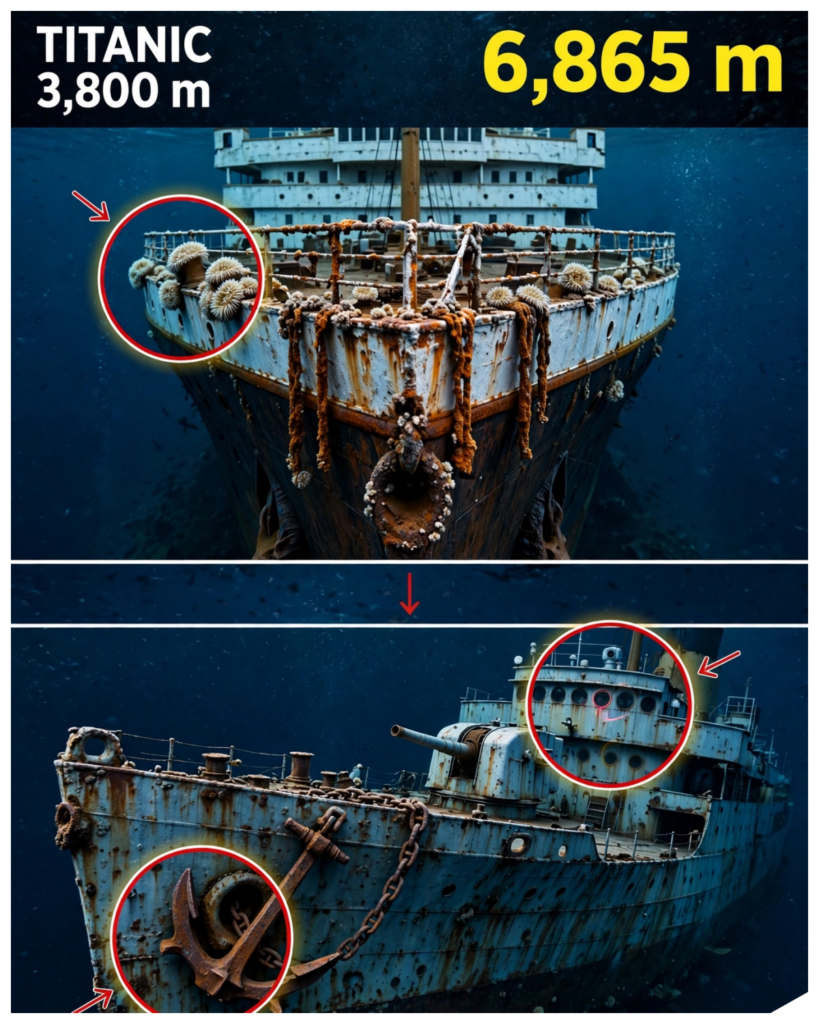
Turn Mount Fuji upside down, push it into the Pacific, and its summit would stop at roughly the depth of Titanic.
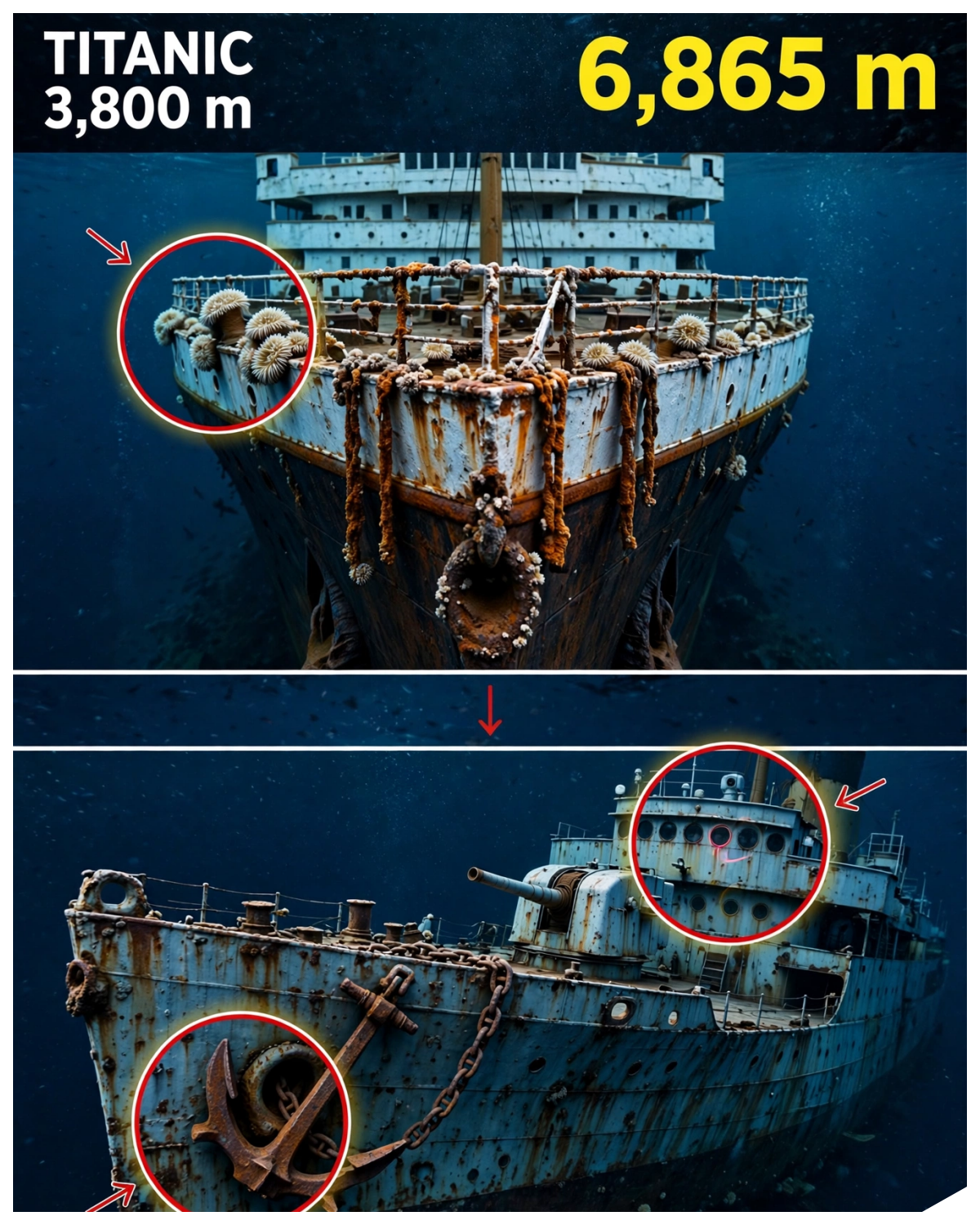
The deepest shipwreck ever found, USS Samuel B.
Roberts, lies most of a second Fuji below that.
She was a destroyer escort about 93 m long, built in Texas in a hurry, and lost off the Philippines in a single morning in October 1944.
In June 2022, a submersible with two people inside reached her.
Every headline gave the same figure, nearly 7 km.
So, what does deepest shipwreck ever found actually measure?
The ship, the sea, [music] or the people who went looking.
Hold on to that question.
The number from the title will [music] mean something different each time we go deeper.
Start at 0 m [music] at the surface because that is where the number begins.
Samuel B.
Roberts was a John C.
Butler class destroyer escort.
Her keel was laid at Brown ship building in Houston on the 6th of December 1943.
She was launched on the 20th of January 1944.
Do the subtraction 45 days from Keel to water.
Ships like her were meant to be cheap, quick to build, and plentiful.
They hunted submarines.
They screened slow escort carriers.
Compared with a fleet destroyer, she carried about half the guns and less than a third of the torpedoes.
Her hull was thin steel plating, not armor.
Nobody designed her to fight a battleship.
She was commissioned on the 28th of April, 1944 under Lieutenant Commander Robert W.
Copeland, a naval reservist who had practiced law in Tacoma, Washington before the war.
Count forward from that date to the 25th of October, 180 days.
That is her entire career.
On the morning of the 25th, she was part of a group with the radio call sign Taffy 3.
Six small escort carriers, three destroyers, four destroyer escorts off the east coast of the island of Sama.
Their job was to cover the landings in Lee Gulf.
Out of the San Bernardino Strait came the Japanese center force under Vice Admiral Teo Kurita with four battleships, among them Yamato, the largest afloat, and a screen of heavy cruisers, light cruisers, and destroyers.
Copelan spoke to his crew over the ship’s loudspeaker.
In his own account of the battle, published after the war, he gives the words, “This will be a fight against overwhelming odds from which survival cannot be expected.
We will do what damage we can.
At about 20 to 8, without waiting for orders, he took his ship in behind the destroyer Herman toward the Japanese cruisers.
He held his guns and went for a torpedo attack.
Around 8:00, a stray shell struck the mast and the falling wreckage jammed the torpedo mount.
The crew cleared it.
At roughly 2 nautical miles, she fired her three torpedoes at the heavy cruiser Chokai.
A lookout reported a hit.
The records studied after the war do not confirm one.
Then the guns.
From about 10 8 she engaged the heavy cruiser Chikuma at ranges that closed to under three nautical miles.
Her chief engineer, a left tenant named Trobridge, bypassed the safety limits on the engines, and the ship reached about 28 knots.
One more calculation.
In roughly 35 minutes, her two 5-in guns fired more than 600 rounds.
That was nearly all the 5-in ammunition she carried.
600 divided by 35 is about 17 rounds a minute from two guns loaded by hand.
One shell every 3 or 4 seconds for more than half an hour.
Thin steel worked both ways that morning.
Several American accounts of the battle say that heavy armor-piercing shells sometimes passed straight through these light hulls without exploding.
Their fuses were set to burst inside a battleship.
A destroyer escorts plating was not enough to set them off.
That kept her afloat longer than anyone could have expected.
It did not keep her afloat.
At 851, a cruiser shell put a boiler out of action.
Her speed fell to 17 knots and the [music] hits came more regularly.
At about 9:00, shells that American accounts credit to the battleship Congo stopped her remaining engine.
She was dead in the water.
Copeland gave the order to abandon ship and she sank later that morning.
She had a crew of about 224.
About 89 were killed in the battle.
Others died during the two days that followed in the water waiting.
The survivors spent about 50 hours there before a patrol craft escorting landing craft found them.
Copeland counted 120 men rescued.
The two cruisers she had fired on did not survive the day either.
Chokai and Chikuma were both lost after air attacks that same morning and so was the heavy cruiser Suzuya.
Their crews belonged to the same arithmetic.
Later that morning, Kurita broke off the action and turned north.
The landings in Lee Gulf went on.
Here is what the chart showed before anyone went looking.
The battle of Sama was fought over deep water.
East of the island, the seabed falls away toward the Philippine trench, one of the deepest places in any ocean.
Every position written down that morning was taken from a moving ship, often under fire, by navigators who had other things to do.
That is the cost of a position written under fire.
It gives you a search box, not a point.
For 75 years, that was all anyone had.
In October 2019, the research [music] vessel Petrol operated by Vulcan Inc.
And led by Robert Craft found the wreckage of a Fletcher class destroyer off Samurma at more than [music] 6,000 m on the edge of an undersea cliff.
It was the deepest shipwreck ever located at the [music] time.
It was also at the extreme limit of what Petrol’s remotely operated vehicle could reach.
Think about how such a machine works.
It hangs from a cable.
Every extra meter of cable [music] is weight the ship above has to carry and steel that the current can push sideways.
At some depth, [music] the machine can still arrive, but it can no longer do the work.
For Patrell, the cliff edge was [music] that depth.
No hull number was visible.
Two nearly identical destroyers [music] had gone down in that battle.
Johnston and Hull.
Naval historians thought the wreck [music] was probably Johnston.
Probably is not a name.
So, the first time the record [music] moved, it measured a machine.
6,000 m was not where the war had put a ship.
It was where an ROV ran [music] out of reach.
The record moved again in 2021, and this time it measured something else.
Victor Vesco is a retired naval officer and the founder of a company called Kaledan Oceanic.
His submersible limiting factor carries two people and was built to reach the bottom of any ocean.
By then it had already been to the deepest point of all five.
It does not hang from a cable.
It goes down on its own and comes back on its own.
According to the Naval History and Heritage Command, his first two dives on the Samar site, each about 8 hours long, found nothing new.
On the third, he followed a trail of debris down a furrow in the cliff face almost 300 m below the 2019 site.
He found the forward 2/3 of a destroyer.
The hull number was plain to read 557 Johnston.
The announcement came in April 2021.
The depth was given as about 6,456 m, a little under 6 1/2 km.
Johnston had been commanded by Commander Ernest Evans, the first Native American in the Navy to receive the Medal of Honor.
The Navy’s history command counts 184 of her 329 men lost in the battle and the two [music] days after.
Notice what had happened to the number.
The wreckage Petrol saw in 2019 was at the top of the cliff.
The ship itself had gone further, sliding down the slope after it reached the seabed.
The new record did not measure where Johnston [music] sank.
It measured where the slope had delivered her.
The question from the start is still open.
What does deepest [music] shipwreck ever found measure?
So far, a machine’s reach and a slope.
Samuel B.
Roberts had still not been located.
The Navy’s historians expected her in even deeper water.
The search for her began on the 17th of June, [music] 2022.
It was a joint effort by Caladan Oceanic and IOS expeditions.
Vesco piloted.
Beside him sat a French sonar specialist, Jeremy Moriz.
[music] For this expedition, a French firm called Deep Ocean Search had built a sidescan sonar to mount on the submersible itself.
That detail matters more than it sounds.
[music] Vesovo explained the problem to Guinness World Records in plain terms.
Sonar cannot really tell [music] the difference between rock and metal.
On a side scan image, anything hard throws a shadow.
A boulder does, a hull does.
At that depth, the only way to know which is to go down and look, and every look costs a full dive.
On the 18th of June, they identified debris from [music] her three tube torpedo launcher.
It was the same kind of mount that had jammed at 8:00 in October 1944 and been cleared.
Then the main wreck Guinness reports that the first two descents to [music] find her came up empty and the third found her.
In all the expedition made six [music] dives between the 17th and the 24th of June.
Two of them were spent on another ship which we will come back to.
This is what the published images [music] show and nothing more.
Samuel B.
Roberts rests on a slope.
She is in two pieces.
[music] The stern separated from the rest of the hull by a few meters.
She reached [music] the bottom bow first and the impact buckled part of the hull.
The damage from a large shell is [music] visible.
So is the fallen mast and her hull number is still readable on the side.
4 1 3.
Beso described the aft section as extremely [music] damaged and said the ship had taken an enormous amount of punishment during the battle.
Both rudders are gone.
The forward [music] section is in better condition with the bridge intact and most of the guns in place.
The team’s rule on these dives, in Veso’s own words about Johnston, was look, don’t touch.
Their data went to the Naval History and Heritage Command.
The site is protected under the Sunken Military Craft Act.
The last known survivor of the ship, Adred Lenoir, had died in March 2022, 3 months before [music] the find.
The name had already outlived the ship once.
Samuel B.
Roberts was a coxin who received the Navy Cross after his death for his actions at Guadal Canal.
The Navy gave his name to later ships as well.
In April 1988, the frigot USS Samuel B.
Roberts struck a mine in the Persian Gulf and the blast opened a hole about 15 ft across.
On board was a plaque honoring the crew of the destroyer escort.
The frigot stayed afloat.
The plaque is now at the National Museum of the United States Navy.
Now the depth gauge can be read properly.
Start with the vehicle because the vehicle is the reason anyone saw this ship at all.
The two people in limiting factor sit inside a sphere of titanium about 90 mm thick.
Nothing else on the submersible needs to hold back the sea.
Everything outside the sphere is either solid or filled with fluid or built to let the water in.
Only the sphere holds air and only the sphere has to win.
Every 10 m of seawater adds roughly one atmosphere of pressure at about 6,865 m.
That is close to 690 atmospheres.
[music] In other units, about 10,000 lb on every square in or about 700 kg on every square cm.
A small car resting [music] on a fingernail everywhere on the hull of the submersible at once.
Go back to the comparison from the beginning.
Titanic lies at about 3,800 m.
Divide one depth by the other and you get about 1.8.
The pressure on this wreck is close to double the pressure on Titanic.
And the time between the sinking and the first look is 77 years and 8 months.
From a morning in October 1944 to a week in June 2022.
And that depth figure has its own history.
The first reports in June 2022 said 6,895 m or 22,621 ft.
Guinness World Records later published 6,865 [music] after the figure was recalibrated by 30 m.
You will still find both numbers online, often in the same article.
That is not anyone getting it wrong.
At these depths, nobody lowers a tape.
A pressure reading is converted into meters [music] using assumptions about the water above, its temperature, its salt, [music] its density.
Adjust the assumptions and the answer moves.
30 m out of 6,895 [music] is less than half of 1%.
The record is real.
Its last two digits are an [music] estimate.
Read the title again with what you now know.
Deepest shipwreck ever found.
In 2019, [music] that phrase measured the reach of an ROV.
In 2021, it [music] measured how far a slope had carried a broken destroyer.
In 2022, [music] it measured a submersible, a new sonar, three descents, and a pressure reading corrected [music] after the fact.
Not one of those numbers tells you where the war put a ship.
Every one of them tells [music] you how far down someone was able to look.
So the deepest shipwreck ever found is not the deepest shipwreck of the Battle of Sama.
It is only the deepest one anyone [music] has reached so far.
Vesco said it himself.
There could be even [music] deeper wrecks than Johnston and the Sami B.
The battle tells you where to start.
Remember the two dives that were not spent [music] on Samuel B.
Roberts?
They went looking for the escort carrier Gambia Bay [music] below 7,000 m.
They found nothing they could confirm.
As for Hull, the team did not search at all.
Nobody had reliable data on where she went down.
Gambia Bay had sunk a little after 9 that morning.
One of the carriers the escorts were trying to cover.
Most of her crew were rescued.
As far as any public announcement [music] says, her hull has never been seen since.
Her position for now is a line in a log written under fire and a slope that keeps going down past every record so far.