But a handful of experts did handle the artifacts and inspect the photos and their first impressions suggested they were not fakes.
I’ve actually also seen seen an object.
I’ve had it in my hands.
I shown it around actually people.
I know what it looks like.
And I showed it to to a colleague of mine who is an archaeologist and his first reaction was this feels and looks authentic.
Imagine standing before an ancient object.
So small that it could fit comfortably inside the palm of your hand, yet carrying the possibility of rewriting our understanding of the earliest centuries of Christianity.
Imagine [music] discovering a collection of mysterious books sealed away for generations in the rugged landscape of Jordan, far from the great libraries, temples, and cities where ancient knowledge was usually preserved.
Their pages are not made of parchment or papyrus.
Their words are not written with ink.
Instead, their secrets are associated with metal, symbols, [music] ancient languages, and images whose meaning remains fiercely disputed.
For years, these objects have circulated through archaeological and religious discussions, attracting believers, [music] historians, skeptics, and researchers from around the world.
Some have described them as potentially extraordinary witnesses to an ancient religious tradition.
Others have warned that the entire story may represent one of the most elaborate archaeological frauds of recent times.
But what makes these objects so [music] fascinating is not simply their appearance.
It is the question they raise.
Could tiny books discovered in Jordan preserve memories from the world in which Christianity was born?
Could their mysterious symbols tell us something about the beliefs of ancient communities?
Or are we looking at modern creations carefully designed to imitate the distant past?
Before we continue into this remarkable mystery, make sure you subscribe to [music] Prophecy and Stone.
Turn on notifications and join us as we explore the discoveries, controversies, and ancient [music] history.
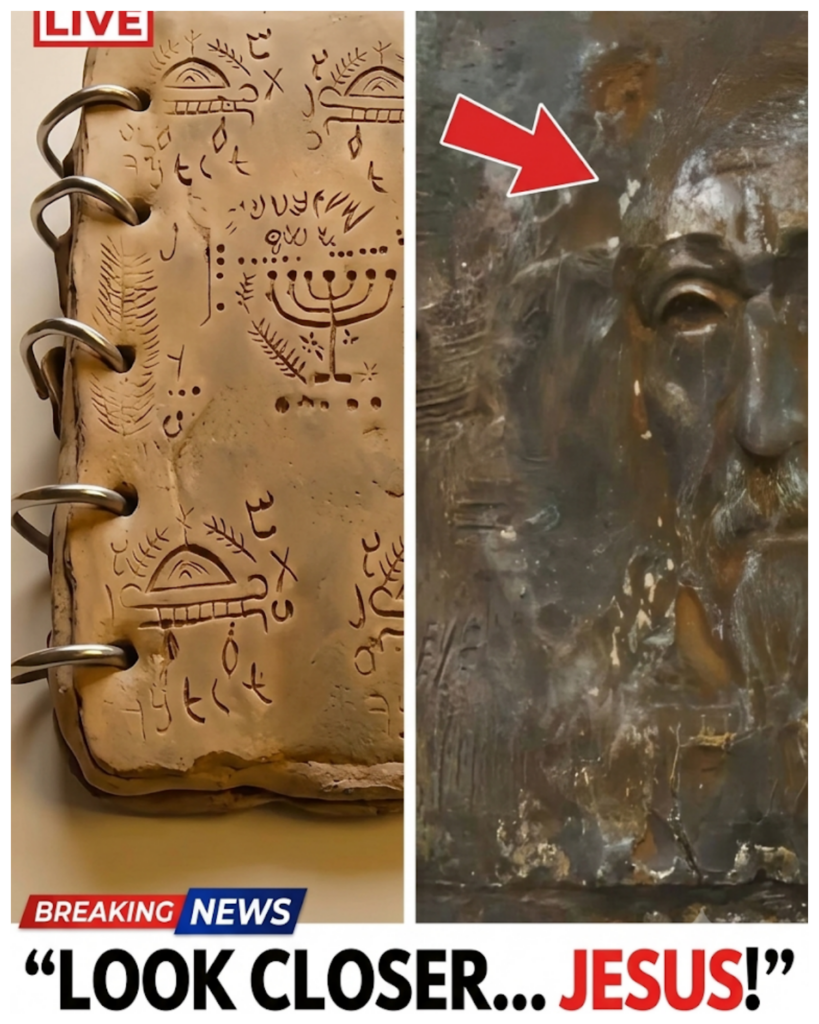
The objects commonly known as the Jordan cotices entered public attention more than a decade ago after claims emerged that dozens of small lead books had been discovered inside a cave in Jordan.
According to the story surrounding their discovery, the books were supposedly found in a remote location and were associated with an ancient Jewish Christian community.
Their pages were made from sheets of lead folded and bound together with metal rings.
At first glance, they seem almost impossibly ancient.
Tiny metal pages covered with mysterious symbols, strange geometric markings, human [music] figures, images resembling religious scenes, and among the most intriguing claims was the suggestion that some of the imagery might somehow be connected with Jesus and the earliest followers of Christianity.
Yet, there is an enormous difference between something looking ancient and actually being ancient.
That distinction would become the center of the controversy.
Jordan occupies an extraordinary position in biblical history.
The region east of the Jordan River appears repeatedly in the biblical narrative.
It was connected with ancient kingdoms, prophets, [music] Israelite history, and the world surrounding the ministry of Jesus.
The Gospel of John tells us that Jesus crossed the Jordan and returned to places where John the Baptist had previously ministered.
Matthew also describes the region around the Jordan as a place where John preached and baptized.
This geographical setting makes the discovery of an alleged early Christian collection particularly compelling.
If the cotices were genuinely ancient, they could potentially provide an unusual window into religious ideas circulating during the earliest centuries of Christianity.
But there is an important problem.
The claimed discovery circumstances themselves have been questioned and the archaeological provenence of the objects has never been established to the satisfaction of mainstream scholarship.
That means researchers cannot [music] simply examine the objects and declare them authentic.
They must ask where [music] they came from, who possessed them, when they were made, what language they use, and whether the materials behave like genuine [music] ancient metal.
Perhaps the most sensational aspect of the cotices is their imagery.
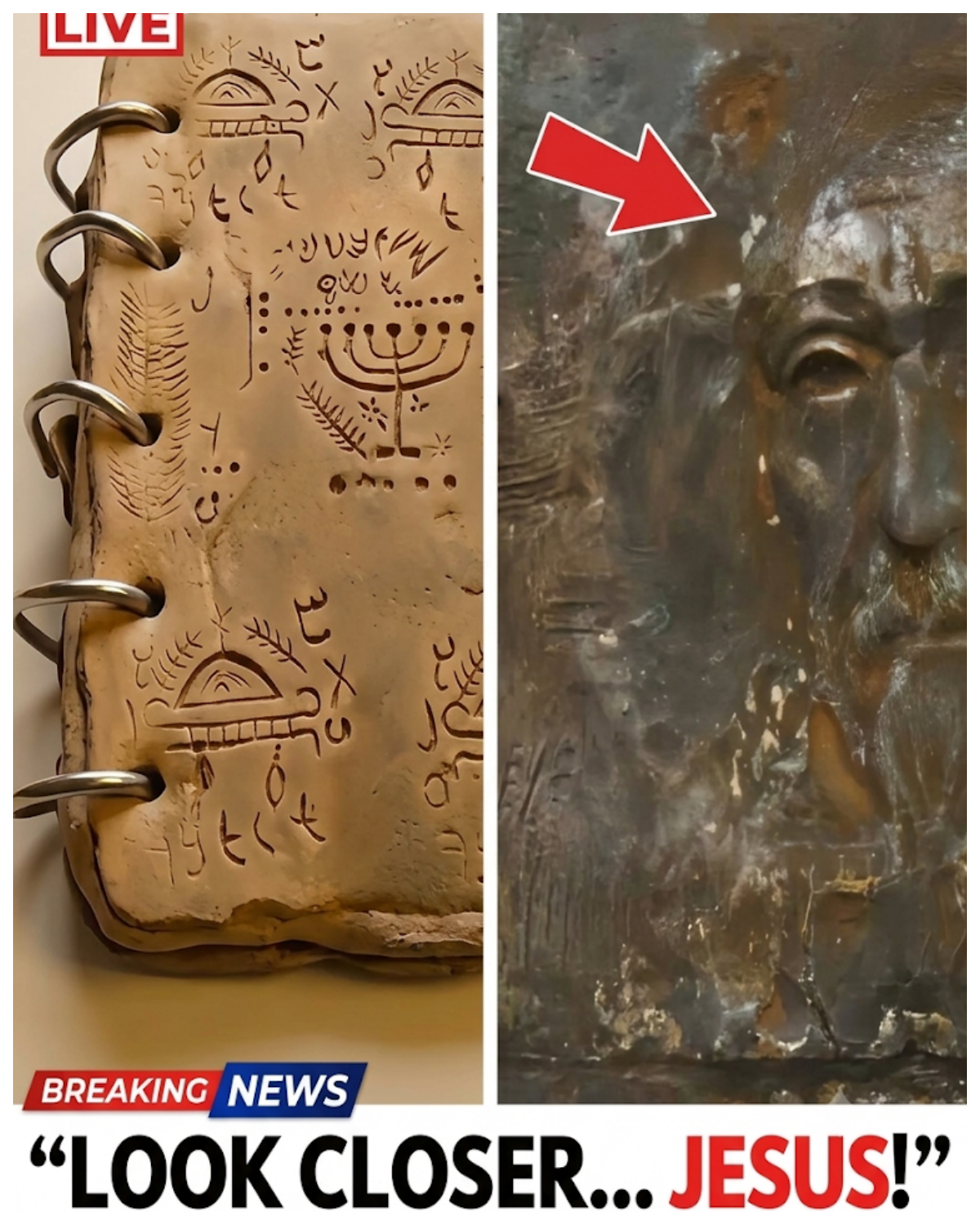
Some photographs associated with the objects appear to show human [music] figures, animals, architectural forms, and symbols that have been interpreted in dramatically different ways.
One image has been described by some observers as potentially representing Jesus.
But here we must slow down.
Ancient religious imagery can [music] be extraordinarily difficult to interpret.
A figure with outstretched arms could represent a deity, a worshipper, a symbolic figure, or something entirely different.
A structure resembling a temple or church does not automatically prove that the object depicts a Christian building.
Even the interpretation of a cross-like symbol requires caution.
The cross became [music] the defining symbol of Christianity, but similar geometric forms existed in many cultures long before Christianity.
Therefore, seeing a symbol that resembles a cross is not enough to establish a connection with Jesus.
[music] The real question is whether multiple independent pieces of evidence point toward the same conclusion.
The title of this mystery contains a claim that deserves careful examination.
Could these books actually be older than the Bible?
The answer depends upon what we mean by the Bible.
The biblical writings were composed over many centuries.
Some books of the Hebrew Bible originated long before the first century.
The New Testament, meanwhile, was written during the first generations of Christianity.
Therefore, saying that the lead books are older than the Bible is historically imprecise unless a specific biblical text and specific date are being compared.
And this is where sensational claims can become misleading.
If the cotices were genuinely from the first century, they would still not necessarily be older than the Hebrew scriptures.
However, they could potentially be contemporary with the earliest Christian writings.
That would still make them extraordinary.
Mainstream scholars have generally treated the Jordan lead cotices with deep skepticism.
Questions have been raised about their inscriptions, their iconography, their production techniques, and especially their provenence.
Some researchers have argued that the objects contain combinations of symbols that do not fit comfortably within the historical context they are supposed to represent.
Others have suggested that the metalwork techniques and inscriptions raise serious concerns about authenticity.
There have also been claims of scientific testing supporting their antiquity.
But such claims must be distinguished carefully from independently verified peer-reviewed research.
This is one of the most important lessons from archaeology.
Scientific language can sound convincing, but an isolated test does not automatically authenticate an artifact.
A genuinely ancient object can be misinterpreted.
A modern object can contain ancient material.
And an artifact with an uncertain history cannot be securely understood merely because it appears old.
So why do these tiny books continue to fascinate people?
Because they occupy the intersection of archaeology, faith, history, and mystery.
Christianity emerged within a world already filled with Jewish traditions, Roman power, Greek culture, and diverse religious movements.
The earliest Christians left behind manuscripts, inscriptions, buildings, burial sites, symbols, and eventually magnificent churches.
Yet much of the ordinary material culture of those first communities has disappeared.
That is why any alleged artifact connected to the earliest Christians immediately attracts attention.
It promises something extraordinary.
Physical evidence from a period that still contains enormous historical questions.
The New Testament itself reminds us that the earliest Christian message was transmitted through testimony and written records.
Luke begins his gospel by explaining that he investigated the events carefully so that his reader could have confidence concerning the things that had been taught.
History, therefore, matters, evidence matters, and careful investigation matters.
There is also an important spiritual lesson hidden within this controversy.
Christian faith does not require believers to accept every sensational archaeological claim.
The Bible never instructs Christians to believe something merely because it sounds miraculous or mysterious.
Instead, scripture repeatedly emphasizes truth and discernment.
Proverbs 18:1 17 says, “The one who states his case first seems right until the other comes and examines him.”
That principle applies remarkably well to archaeology.
When an artifact appears to confirm something we already believe, our desire for confirmation can become stronger than our commitment to evidence.
The Jordan lead cotices therefore deserve examination, not blind acceptance and not careless dismissal.
If future research were ever to establish that some of these objects genuinely originated in the first centuries of Christianity, their historical importance would be enormous.
They could provide evidence about how certain ancient communities understood their faith, how they represented sacred figures, and how religious traditions developed during a transformative period in history.
But until their authenticity and provenence are firmly established, the responsible conclusion remains much more cautious.
The mysterious image cannot simply be declared an ancient portrait of Jesus.
The books cannot confidently be presented as undisputed Christian documents and the claim that they are older than the Bible requires significant qualification.
Perhaps that is what makes the Jordan cotices so fascinating.
They remind us that archaeology is not simply about discovering ancient objects.
It is about learning how to distinguish genuine history from interpretation, genuine evidence from speculation, and authentic discoveries from objects whose stories may be more modern than they appear.
Some mysteries disappear when evidence finally reveals the truth.
Others survive because the evidence itself remains incomplete.
For now, the Jordan cotices remain trapped in that uncertain space between possibility and proof.
They may represent an extraordinary chapter of ancient history.
They may be misunderstood artifacts, or they may be something far less ancient than the dramatic claims surrounding them.
But one thing is certain.
Whenever humanity uncovers objects connected with the earliest days of Christianity, the discovery forces us to look again at the ancient world and to ask how much of its story still lies hidden beneath the sands, stones, and forgotten landscapes of the Middle East.
And perhaps the greatest mystery is not simply what these tiny books contain.
It is how much remains for us to discover.
Thank you for watching and we see you in the next video.
