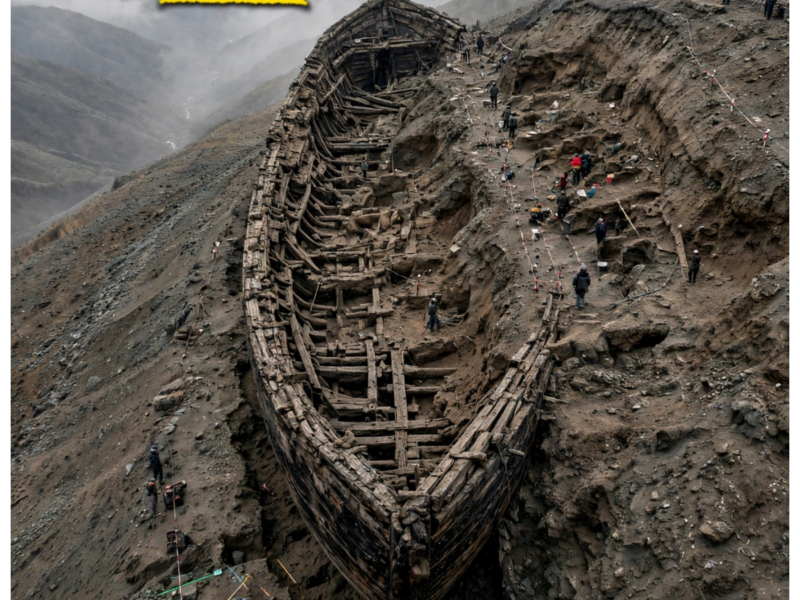
In the autumn of 2026, on a bare hillside in the far east of Turkey, a few kilometers from the border with Iran, a drilling rig was pushing a steel tube down into the earth.
Around it stood a small group of researchers, Turkish archaeologists from a university in the city of Civas, American volunteers, local workers, and a few officials keeping an eye on everything.
On the horizon to the north rose the white cone of the highest mountain in Turkey, Mount Ararat.
And under their feet was a strange long mound of earth and rock, more than 150 m long, shaped like the hull of a ship.
The drill went down 1 m, 5 m, 9 m.
And when the core came back up, the head of the excavation, a professor of archaeology named Sanker Attilla, found something in it that made the whole team stop.
Small dark fragments, black, brittle, charred.
They looked like burnt wood.
Within days, the photographs were all over the world.
A professor holding a black fragment between his fingers.
News sites in English, Spanish, Italian, Portuguese, and Turkish carried the story.
Charred wood found deep inside the formation that some believe is Noah’s ark.
The fragments were packed and sent to a laboratory for carbon 14 dating to find out how old they were and to identify the species of tree they came from and to search for traces of something that every reader of Genesis would recognize.
Pitch Bitchmen, the black tar with which the Bible says the ark was covered inside and outside.
As this documentary is being made, the results are not yet public and millions of people are waiting for them.
But this is not the first time that someone has come down from a mountain in eastern Turkey holding a piece of wood and saying, “This could be the ark.”
In the summer of 1955, a French industrialist named Fernan Navara climbed high on the slopes of Mount Ararat with his 11-year-old son, Raphael.
He had been there before, and he was obsessed.
On the northwest side of the mountain at more than 4,000 mters where the glacier fills the hollows of the rock.
He lowered himself into a creasse in the ice at the bottom.
He later wrote, “Under the water and the ice, he saw a dark beam of wood, hand cut, squared, black with age, he hacked a piece off with an axe and carried it down the mountain.”
In France, he announced that he had touched the ark of Noah.
He wrote a book about it called I Found Noah’s Ark.
It became a bestseller.
The wood was tested and the answer it gave was not the one he wanted.
And long before Navara, long before the drill at Durupanar, people were already climbing mountains in this part of the world to bring back pieces of the ark.
A priest of Babylon wrote about them 300 years before Christ.
A Jewish historian of the first century wrote that the remains of the ark were still shown to visitors.
An Armenian bishop, according to legend, received a plank of the ark from an angel.
And that plank is still kept today in a golden reoquary in the treasury of the Armenian church.
For more than 2,000 years, the wood of the ark has been searched for, claimed, venerated, and tested.
And every time the same question has come back, is this it?
Tonight, we are going to follow the evidence.
We will open the book of Genesis and read exactly what it says about how the ark was built and what it was made of, including a word that appears nowhere else in the Bible and that nobody has ever been able to translate with certainty.
We will put it side by side with the Babylonian flood stories which describe the building of the boat in astonishing technical detail down to the exact quantities of bumen poured into the kils.
We will follow the ancient witnesses, Babylonian, Jewish, Christian, Armenian, and Muslim, who claimed that the remains of the ark could still be seen in their own time.
And we will ask what they were really looking at.
Then we will climb Mount Ararat with the modern ark hunters from the legends of the First World War to Fernan Navara and his beam of wood and we will see what the laboratories said.
We will learn how carbon dating actually works, what it can prove and what it cannot, and why a piece of charred wood is scientifically much more interesting than a piece of fresh wood.
We will go to Durupanar to the drilling of 2026 and look honestly at what the researchers have found, what their critics say, and what each possible result of the laboratory test would really mean.
And finally, we will look at the ancient boats that have actually survived for thousands of years, buried in the sand of Egypt and the mud of the Sea of Galilee to ask the most basic question of all.
Could wood from the time of the flood survive at all.
As always on this channel, we will separate what the evidence clearly shows, what scholars still argue about, and what we may never know.
So, settle in.
We are going back to the mountains of Ararat to look for the wood of the ark.
If we want to know whether a piece of wood could have come from the ark.
The first thing we have to ask is simple.
What was the ark made of?
And for that we have to go back to the text itself.
The sixth chapter of the book of Genesis.
God tells Noah that the end of all flesh has come because the earth is filled with violence.
And then he gives him the instructions.
Make yourself an ark of gopher wood.
Make rooms in the ark and cover it inside and out with pitch.
This is how you are to make it.
The length of the ark 300 cubits, its breadth 50 cubits, and its height 30 cubits.
Make a roof for the ark and finish it to a cubit above and set the door of the ark in its side.
Make it with lower, second, and third decks.
That is all.
A few verses and yet almost every word in them has been argued over for centuries.
Let us begin with the wood.
Gopherwood.
In Hebrew, the word is gopher.
And here is the problem.
This word appears exactly once in the entire Hebrew Bible in this verse and nowhere else.
It is what scholars call a hapax legon.
A word said only once.
There is no other passage to compare it with, no other context to help us understand it.
Nobody knows for certain what gopherwood was.
The ancient translators already struggled with it.
The Greek translators of the Septigant in Egypt did not try to identify the tree.
They wrote that the ark was made of squared timbers.
The Latin Vulgate of St.
Jerome in the 4th century wrote smooth timbers.
The Aramaic translations of the Jews of Babylon interpreted it as cedar.
Medieval Jewish commentators suggested Cyprus because Cyprus was famous for resisting rot and water.
Some modern scholars have suggested that gopher might be a scribal variant of kofheer, the Hebrew word for pitch used in the same verse.
So that gopher wood would mean something like pitched wood or resonous wood.
Others have connected it with an Acadian word for a kind of reed boat.
And others think it may be a technical shipb building term borrowed from another language, a word that the ancient writer knew and that we have lost.
What matters for us is this.
If someone finds a piece of ancient wood and says that it comes from the ark, there is no biblical description of the species to compare it with.
Cyprus, cedar, pine, oak, all have been proposed.
The text does not settle it.
The second material is clearer.
Pitch in Hebrew, kofheer.
Cover it inside and outside with kofhe.
The verb and the noun come from the same root which means to cover.
And this word has a very close relative in aadian, the language of Babylon and Assyria.
The Babylonian word for bitmen is kru.
Bammen is a natural asphalt, a thick black substance that oozes out of the ground in certain places where oil lies close to the surface.
Mesopotamia was full of it.
In the middle Euphrates at a place called Hit in what is now western Iraq, there are bumen springs that have been used since prehistoric times.
The Greek historian Heroditus described them and said that the bumen used to build the walls of Babylon came from there.
Archaeologists have found bitmen used in Mesopotamia for more than 6,000 years as mortar for bricks, as glue for mosaics, as waterproofing for baskets, drains, bathrooms, and boats, and boats were cked with it for thousands of years.
The reed boats and wooden boats of the Tigris and Euphrates and of the Persian Gulf were coated with bumen to make them waterproof.
Archaeologists working in Kuwait and in Oman have even found fragments of bumen with the impressions of reeds and ropes still visible on them.
The remains of ancient boats from the fifth and third millennia before Christ, the oldest evidence of seafaring boats in the region.
So when Genesis says that the ark was covered inside and outside with kofhe, it is describing exactly the way boats were built in the world of Mesopotamia.
And that will be important when we come back to the drill at Durupanar because one of the things the researchers are looking for in their fragments is bitammen.
Now let us look at how the Babylonian flood stories describe the building of the boat because here Israel’s neighbors give us far more detail than the Bible does.
In the 11th tablet of the epic of Gilgamesh, the tablet that George Smith read in the British Museum in 1872, the hero Utnapishtam tells how he built his boat in just 7 days.
On the fifth day, he laid out its shape.
Its floor was 1 acre in area.
Its walls were 120 cubits high and each side of its deck was 120 cubits long.
He gave it six decks, dividing it into seven levels, and divided each level into nine compartments.
He drove water plugs into its middle and then he gives the quantities of the materials as if he were reading from a builder’s account book.
3 * 3600 measures of raw bitmen, he says, I poured into the kiln.
3 * 3600 measures of oil the workman carried and the text describes the ceiling of the hull with that bumen poured hot from the furnace.
In the Gilgamesh version, the boat is a giant cube.
But in 2014, a curator at the British Museum, Irving Finkele, published a small clay tablet that gave a different picture.
It had been brought to the museum by a man whose father had acquired it in the Middle East after the Second World War.
It dates to around 1750 before Christ, more than a thousand years before the Gilgamesh tablets of Nineveh.
Finkele called it the ark tablet.
In it, the god speaks to the flood hero Atrahasus and gives him detailed technical instructions for building the boat.
And the boat is round, a giant coracal, the kind of circular boat made of woven rope and reads and coated with bumen that people in Iraq used on the rivers until the 20th century.
The tablet specifies the quantities.
So many units of palm fiber rope, so many wooden ribs, and then the bitumen in enormous quantities for the outside of the boat and the inside.
With the amounts carefully calculated, Finkel and his colleagues worked out that the boat described on the tablet would have had a floor area of about 3600 m and that the bumen alone would have weighed many tons.
And in one line, the tablet describes the animals going into the boat two by two.
So here is what the ancient texts say about the materials of the ark.
The Babylonians, Israel’s neighbors, described the boat of the flood as a vessel of wood and rope sealed with huge amounts of bumen.
Genesis describes an ark of an unknown wood.
Gopher covered inside and outside with kofheer, a word directly related to the Babylonian word for bumenumen.
The shape is different in each story.
A cube in Gilgamesh, a circle in the ark tablet, a long rectangle in Genesis, but the materials are the same.
Wood and the black pitch of Mesopotamia.
And there is one more detail in Genesis that is easy to overlook.
Make rooms in the ark, God says.
The Hebrew word translated rooms is kin.
Its usual meaning is nests, like the nests of birds.
Some scholars think it was a technical term for compartments or cells.
Others have suggested that the text originally read Can reads and that the ark was meant to be built of wood and reads together just like the boats of Mesopotamia.
It is a tiny change in the Hebrew letters and it would make the ark of Genesis even closer to the boats described by the Babylonians.
And the Mesopotamians did not only write about boats in their myths.
They wrote about them in their account books because Israel’s neighbors were among the first great shipbuilders in history and their clay tablets.
Let us see how boats were actually made in the age when the flood stories were first told around 2300 years before Christ Sargon of Akad the first great emperor of Mesopotamia boasted in one of his inscriptions that he made the ships from Malua from Magan and from Dilman at the quay of his capital Akad.
Malua was the land of the Indis Valley civilization in what is now Pakistan.
Magan was Oman.
Dilman was Bahrain.
Merchant ships were sailing between the cities of Mesopotamia and India more than 4,000 years ago.
A few centuries later under the kings of the third dynasty of the scribes of the royal administration kept detailed records of everything the state owned and used.
Thousands of these tablets survive and some of them are about boats.
They list the boats of the state, their capacity and units of grain, the workers who built and repaired them, the days of labor, and the materials, timber, palm fiber, reads, ropes, and bumen measured carefully because it was expensive and essential.
Some texts specify how much bumen was needed to coat a boat of a certain size and even distinguish between different qualities of bumen, raw and refined, mixed with other materials to make it stronger and easier to apply.
That is the world in which the Babylonian flood stories were written.
When the poet of Gilgamesh lists the measures of bumen poured into the kiln or when the ark tablet calculates the quantities needed for the hull, the writers are using the language of real shipyards and real accounts.
The flood boat of the Babylonians was imagined as the greatest boat ever built using the same materials and methods as the boats on the Euphrates only on a gigantic scale.
And the Bible too uses the language of ship building.
A length, a breadth, and a height.
Three decks, a door in the side, a roof finished to a cubit above, rooms or nests, or perhaps reads and pitch inside and out.
Scholars have pointed out that the proportions of the ark in Genesis, six times as long as it is wide, are much closer to the proportions of real wooden ships than the cube of Gilgamesh or the circle of the ark tablet.
Whoever wrote the measurements of Noah’s ark was thinking of a vessel that could actually float.
How big would that vessel have been?
If we take the common cubit of about 45 cm, the ark of Genesis would be about 135 m long, 22 m wide, and 13 m high, around 450 ft long.
That is an enormous wooden ship by any standard.
And here, modern history gives us an interesting comparison.
In the early 20th century, ship builders in the United States pushed wooden ship construction to its absolute limits.
In 199 in the state of Maine, a shipyard launched a six-masted schooner called the Wyoming.
It was about 137 m long from the tip of its bow sprit to its stern.
One of the largest wooden ships ever built.
It was built of yellow pine with iron straps and braces to strengthen the hull.
And even so, the Wyoming flexed in heavy seas so much that its planks worked loose and it leaked constantly.
It needed pumps running all the time.
In 1924, it disappeared in a storm off the coast of Massachusetts with its entire crew.
Ship historians often point to the Wyoming as a sign of how difficult it is to build a wooden hull of that size.
Critics of the ark story use it as an argument that the ark could not have been built.
Supporters answer that the ark did not need to sail, steer, or cross oceans against the wind.
It only needed to float, more like a barge than a ship, and that its proportions are remarkably stable.
When the creationist organization Answers in Genesis built its full-size replica in Kentucky, the Ark Encounter opened in 2016.
It was built with modern engineering, steel connections, and concrete foundations because it was built to stand on land and to receive millions of visitors, not to float.
For our question, the important point is this.
A real ark built of wood in the ancient world would have needed an enormous amount of timber and an enormous amount of pitch to make it watertight.
If anything of it survived, it would not be one small fragment.
It would be a vast quantity of wood and bumen spread over a structure more than a hundred meters long.
That is the scale of evidence that a discovery would eventually need to show.
What would remain of such a vessel after thousands of years?
The reeds and ropes would rot first.
The wood would follow unless it was protected.
And the bitumen, black, heavy, nearly indestructible, might last the longest of all.
Which brings us to the first person in history who claimed to know where the remains of the boat of the flood could be found and what people were taking from it.
Around the year 280 before Christ in the city of Babylon, a priest of the god Marduk named Barasus wrote a history of his country in Greek for the new Greek kings who had inherited the empire of Alexander the Great.
His book is lost but later writers quoted pieces of it and one of those pieces tells the story of the flood.
In Barasa’s version, the flood hero is called Zeissos, the Greek form of the old Sumerian named Zeasudra.
A god warns him in a dream.
He builds a ship, takes on board his family, his friends, and the animals, and survives.
When the waters go down, the ship runs ground in the mountains.
Zuos leaves the ship, makes a sacrifice, and disappears, taken to live with the gods.
And then Barasus adds a sentence that is, as far as we know, the oldest claim in history that the remains of the boat of the flood still existed.
A part of the ship, he says, still remains in the mountains of the Cordwayans in Armenia.
And some people scrape off pieces of the bumen and carry them away and use them as amulets.
Ride that carefully.
Barasus does not say that people were taking wood.
He says they were taking bitmen.
Pitch the black coating of the ship.
They were wearing it as a protective charm against evil.
What were they really scraping off the mountain?
We do not know.
But we know that the mountains of the Corduans, the region south of Lake Van and above the Tigris, the land later called Gordin or Corduene are rich in natural deposits of asphalt and oil.
In some places in that region, black bit bumen seeps naturally out of the rock.
It is very possible that the pilgrims of Barasa’s time were scraping natural bitmen from a rock outcrop that local tradition identified as the remains of the ship.
To a pilgrim black pitch on a mountain in the land where the ship was said to have landed would have looked exactly like the pitch of the ark.
Three centuries later in Rome, the Jewish historian Flavius Josephus quoted Barasus’ words in his history of the Jewish people and he added testimony of his own.
The Armenians, he says, call the place where Noah came out of the ark the place of descent, and the remains of the ark are shown there by the inhabitants to this day.
He quotes other writers, too.
A Greek scholar named Nicolaus of Damascus, the court historian of King Herod, who wrote that on a great mountain in Armenia called Baris, a man carried in an ark came to rest on the summit, and that the remains of the timber were preserved for a long time.
And elsewhere in his work, Josephus mentions a region on the Tigris called Karin given to a king of Adiabin where he says the remains of the ark in which Noah escaped the flood are still shown the remains of the timber.
Fourth of first time a writer speaks clearly of wood and from that point on the witnesses multiply.
In the second century after Christ, a bishop of Antioch in Syria named Theophilus wrote a book defending the Christian faith against a pagan friend.
In it, he mentions the ark of Noah and says that its remains are to this day shown in the mountains of Arabia, as he calls them, using a broad term for the lands east of Syria.
In the 4th century, Epiphanius, the bishop of Salamis on the island of Cyprus, wrote in his great book against heresies that the remains of Noah’s ark are still shown in the land of the Cardans, the same region as Barasus, more than 600 years later.
And John Chrysstm, the greatest preacher of the early church, the Archbishop of Constantinople, said in one of his sermons, “Do not the mountains of Armenia testify to it where the ark rested?
And are not the remains of the ark preserved there to this very day for our admonition?”
In the seventh century in Spain, the scholar Isidor of Seville wrote in his encyclopedia, “The etmologies which became one of the most read books of the Middle Ages that the ark came to rest on the mountains of Ararat in Armenia where traces of its timbers are still shown today.”
So for more than a thousand years from Babylon to Constantinople to Spain, writers repeated the same idea.
The remains of the ark could still be seen.
But notice what none of them say.
None of them claims to have seen it himself.
Barasus heard about the pilgrims.
Josephus heard what the Armenians said.
Theophilus, Epiphus, Chrysstum and Isidor are repeating a tradition.
These are reports of reports and they do not even agree on the place.
The mountains of the Cordoans, the mountain called Baris, the land of Karen on the Tigris, the mountains of Arabia, Armenia, and some places did more than show the remains.
They kept them.
In the Armenian church, there is a story from the 4th century written down by a fifth century historian known as Foustus of Bzantium.
St.
Jacob, the bishop of Nibus, wanted to see the ark with his own eyes.
He climbed the mountain, but each time he fell asleep from exhaustion and woke up to find himself back at the bottom.
At last, an angel appeared to him in his sleep and told him that the ark could not be reached by human beings, but that because of his faith, he would receive a piece of it.
When Jacob woke up, a plank of wood was lying beside him.
That plank, according to the Armenian church, is the relic kept today in the treasury of the cathedral of Etchiadzin, the mother church of Armenia near Yeravan, a dark fragment of wood set in an ornate reoquary of gold and silver with the withd of the ark on it.
It has never been scientifically tested and the church does not need it to be for believers.
It is a relic not a laboratory sample.
The Armenian tradition of the arks wood did not stay only in the cathedral.
On the northern slope of Mount Ararat above the village of Auri stood the monastery of St.
Hakob dedicated to the same bishop who had received the plank from the angel.
Local tradition said that Akuri was the place where Noah after leaving the ark planted the first vineyard as Genesis tells.
For centuries, the monks of St.
Hakab lived on the mountain of the ark, guarding the memory of the story and welcoming the pilgrims who came to pray at the foot of the holy summit.
On the 20th of June 1840, a powerful earthquake shook the region.
A huge section of the northern face of Ararat collapsed.
An avalanche of rock, ice, and mud swept down the great gorge of Akuri and buried the village and the monastery.
Almost everyone in the village was killed.
The monastery of St.
Hakob and whatever it held disappeared under the debris.
The scar of that collapse is still visible on the mountain today.
We do not know exactly what the monks of St.
Hakabe kept in their church.
But for a mountain whose monks believed the ark lay on the summit above them, and whose patron saint had brought down a plank of it, it is easy to imagine that pilgrims, monks, and builders carried wood up and down its slopes for more than a thousand years.
Shrines, crosses, shelters, relics.
Every one of them one day a possible fragment of the ark for someone who found it in the ice on Mount Judy above the Tigris.
The mountain that the Syriak Christians and the Quran identify as the landing place of the ark.
The Christians of the region built a monastery known as the monastery of the ark.
According to a Syriak chronicle, it was struck by lightning and destroyed by fire in the 8th century.
In the 10th century, the Muslim historian al- Masudi wrote that the place where the ark rested on Mount Judy could still be seen.
And in the 12th century, the Jewish traveler Benjamin of Tudela, passing through the town of Jazzerat Iben Umar, the modern city of Cizre at the foot of Mount Judy, wrote down the local belief that the caiff Umar Iban al-Katab had taken the remains of the ark from the top of the mountains and built a mosque out of them.
The Quran itself has something to say about the materials of the ark and about its remains.
In the chapter called the moon, it describes the flood in a few powerful verses.
We opened the gates of heaven with pouring water and we made the earth burst with springs and the waters met for a matter already decreed.
And then and we carried him on a vessel of planks and nails in Arabic alwah waduser.
Planks and something that holds them together.
Classical commentators debated what ducer meant.
Some said nails.
Others said the cords or fibers used to bind the planks or the caulking pressed between them.
Either way, the Quran describes the ark as a vessel built of joined wooden planks.
And the next verse says, “And we left it as a sign.
Is there anyone who will take heed?”
In another chapter, the Quran says that God saved Noah and the people of the ship and made it a sign for all the worlds.
What did that sign mean?
Some early Muslim commentators understood it as the story itself preserved as a lesson for humanity.
But others understood it more literally.
In the great commentary of the historian Al Tabari written around the year 900, there is a report attributed to Katada, a scholar of the first Islamic century who said that God preserved the ark on Mount Judai until the first generations of the Muslim community saw it.
In other words, according to this tradition, the remains of the ark were still visible on Mount Judah in the earliest days of Islam and then disappeared.
It is the same pattern again.
Visible once, seen by earlier generations, then gone.
Just like the Jewish traveler’s story of the caiff who built a mosque from its timbers.
Just like the Christian monastery on Mount Judai that burned.
Just like the bitumen that Barasus’ pilgrims scraped away.
Think about what that last story means.
In the 12th century, the people of Cizray did not believe the ark was still on the mountain.
They believed that it had already been carried down centuries earlier and reused as building material.
If there was ever any wood of the ark on Mount Judy, local tradition itself said that it was gone.
And this is a pattern that appears again and again.
Every place that claimed the ark also claimed that pieces of it had been taken away.
Bitchmen scraped off for amulets, planks carried down as relics, timbers used for a mosque.
The memory of the ark in the ancient world was not of an intact ship waiting on a mountaintop.
It was of fragments of black pitch, of dark wood, of relics carried away by pilgrims, monks, and rulers.
Which means that anyone who goes looking for the wood of the ark today is following a very old path.
And in the 20th century, a new kind of pilgrim set out on it, not monks, but explorers.
And they took their fragments not to a church, but to a laboratory.
For most of history, nobody climbed to the summit of Mount Ararat.
The great volcano rises more than 5,100 m above sea level, and its upper third is covered by a permanent ice cap.
The Armenian monks who lived on its slopes believe that God did not allow anyone to reach the top.
Medieval travelers like William of Rubric and Marco Polo were told the same thing.
The ark is up there, people said, but no one can climb to it.
The first recorded ascent came only in October of 1829 when a German professor, Friedrich Parrot, and a young Armenian deacon, Kashatur Abboian, reached the summit on their third attempt.
They found snow and ice, no ark.
But from that moment on, the mountain was open, and the search for the wood of the ark began in earnest.
In 1876, a British scholar and politician named James Bryce, who would later become ambassador to the United States, climbed Ararat alone, the last part of the way after his companions had turned back.
High on the mountain above 13,000 ft, far above the last trees, he found a piece of wood about 4 ft long and 5 in thick, which had clearly been cut with a tool.
He broke off a piece and brought it home.
Bryce was careful.
He did not claim it was from the ark, but he did write that he could not explain how a cut piece of timber had come to lie so high on a mountain where no trees grow.
That question, how did the wood get there, will come back in 1883, after an earthquake in the region, newspapers around the world published a sensational story.
A group of Turkish commissioners sent to inspect avalanche damage on Ararat had supposedly found a huge dark wooden structure sticking out of a glacier and had even walked inside it.
The story spread through the newspapers of Britain and America.
No photograph, no official report, and no piece of wood was ever produced, and most historians consider the story a journalistic invention or a wild exaggeration.
Then came the most famous ark legend of all.
Many people say that during the First World War, a Russian pilot flying over Ararat spotted the ark half submerged in a lake of melted ice and that Thesar sent two companies of soldiers to find it who measured it, photographed it, and sent their report to St.
Petersburg where it was lost in the chaos of the revolution.
That story did not come from Russian archives.
It first appeared in 1940 in a small American magazine called New Eden in an article attributed to a Russian pilot named Vladimir Roskavitzki.
Years later, the man who wrote it admitted that the story was largely fiction, an inspirational tale with a few facts mixed in.
No record of the expedition has ever been found in Russian military archives.
Yet, the story is still repeated today in books, in videos, and on the internet as if it were history.
And that brings us back to Fernan Navara.
Navara was a French businessman who had become fascinated by the ark after serving in the Middle East.
He made several expeditions to Ararat in the 1950s.
In 1955 on the northwest side of the mountain in a creasse in the glacier at more than 4,000 m, he found the dark squared beam we heard about at the beginning.
He cut a section about 1 and 1/2 m long and brought it back to France.
In 1969, he went back with an American group called the Search Foundation, and they recovered more pieces of wood from the same area.
The first tests seemed to support him.
A forestry institute in Madrid and other laboratories examined the wood, its color, its density, its degree of fossilization, and estimated that it was about 5,000 years old.
Navara announced to the world that the wood was from the age of Noah.
But those early estimates were not radiocarbon dates.
They were based on the appearance and condition of the wood, which can be very misleading.
Wood that has been frozen in ice and soaked in water for centuries can look far older than it is.
When the wood was tested with radiocarbon dating, the method that measures the decay of carbon 14, the results were very different.
Several laboratories, including laboratories at the University of California and the University of Pennsylvania, tested samples of the Navara wood.
The dates they produced clustered between roughly the 7th and the 9th centuries after Christ.
The wood was about 12 or 1300 years old.
Old certainly, but not 5,000 years, not the age of Noah.
Supporters of the ark responded that the radioarbon dates were wrong.
That the flood had changed the amount of carbon in the atmosphere, that the samples had been contaminated.
But the dates from several independent laboratories agreed with one another, and they also agreed with something historians already knew.
In the early Middle Ages, Mount Arat was a holy mountain for the Armenian church.
There were monasteries on its slopes like the monastery of St.
Hakab above the village of Akuri destroyed in the earthquake of 1840.
Armenian Christians believe the ark was on the summit and pilgrims and monks went up the mountain to pray.
Many historians and even some ark researchers have suggested that the wood found by Navara came from a small shrine, a hermitage or a commemorative structure built high on the mountain by medieval Christians.
Perhaps even a structure built to mark or imitate the place of the ark.
That would explain everything.
A cut squared beam wood carried up to a height where no trees grow and a date in the 7th to 9th centuries exactly the period when Christian Armenia was flourishing.
It would also explain the wood that James Bryce found in 1876.
Wood does not grow on the upper slopes of Ararat.
Every piece of wood found up there was carried there by someone.
Many people say that the wood of Noah’s ark has already been found on Ararat and dated to 5,000 years old.
It hasn’t.
The wood that was found on Ararat was real wood, and some of it is truly old.
But every piece that has been tested by radioarbon in independent laboratories has come back from the historical period, not from the time of the flood.
The search did not stop.
In the Cold War, American spy planes photographed a dark shape in the ice on the northwest corner of the mountain, known as the Ararat anomaly.
The astronaut James Irwin, who had walked on the moon, led expeditions in the 1980s.
In 2010, a group of evangelical researchers from Hong Kong announced that they had found a wooden structure in a cave high on the mountain with rooms and beams.
Other Christian researchers who had worked with them later accused the local guides of having brought the wood up from somewhere else.
No independent scientific analysis of that wood was ever published.
So after almost two centuries of climbing, Mount Ararat has given ark hunters many stories, a few pieces of medieval wood and no confirmed trace of the ark.
And that is why in the 21st century, the s moved away from the snowy peak to a hill 30 km to the south and to a new kind of tool, not an iceax, but a drill and a laboratory.
And at the center of that laboratory is a method that every ark hunter has to face sooner or later, carbon 14.
In the late 1940s at the University of Chicago, an American chemist named Willard Libby had an idea that would transform archaeology forever.
High in the atmosphere, cosmic rays coming from space constantly strike the air.
When they do, they turn a tiny amount of ordinary nitrogen into a special slightly heavier form of carbon.
Carbon 14.
It is radioactive, which means that it is unstable and slowly turns back into nitrogen over time.
This carbon 14 mixes with the rest of the carbon in the air and becomes part of the carbon dioxide that every plant breathes in.
So every tree, every blade of grass, every reed takes in a small steady amount of carbon 14 while it is alive.
And every animal and human that eats plants takes it in too.
But when a living thing dies, it stops taking in new carbon.
And from that moment, the carbon 14 inside it begins to disappear slowly at a fixed rate.
After about 5,730 years, half of it is gone.
After another 5,730 years, half of what was left is gone, and so on.
Scientists call this the half-life.
Libby realized that if you could measure how much carbon 14 remains in a piece of wood, bone, or cloth, you could calculate how long ago the plant or animal it came from had died.
A clock built into every living thing.
But how could he prove that it worked?
He needed samples whose age was already known, and he found them in the land of Israel’s great neighbor, Egypt.
Among the first objects Libby tested were pieces of wood from the tombs of Egyptian pharaohs of the old kingdom, whose reigns historians had already dated from Egyptian records.
The radioarbon results matched the historical dates.
The method worked.
Libby published his results in 1949.
In 1960, he received the Nobel Prize in Chemistry, and almost immediately, radiocarbon dating was used on biblical subjects.
In the early 1950s, the linen cloth in which some of the Dead Sea scrolls had been wrapped was dated by Libbyy’s method, and the results confirmed that the scrolls were ancient from around the time of Christ, as the scholars had argued from the handwriting.
Since then, the method has been improved enormously.
And it is important to understand both what it can do and what it cannot.
First, radiocarbon dating does not measure when a piece of wood was cut, carved, or used.
It measures when the tree stopped absorbing carbon from the air.
For a single tree ring, that is the year that ring grew.
For a beam cut from the heart of an old tree, the inner wood may be hundreds of years older than the moment the tree was felled.
Archaeologists call this the old wood problem.
If a builder in the year 800 used a beam cut from the center of a 400-year-old cedar, the radiocarbon date of that beam could come out around the year 400.
Second, the amount of carbon 14 in the atmosphere has not always been exactly the same.
It varies slightly over time because of changes in the sun’s activity and the Earth’s magnetic field.
Libbyy’s early dates assumed it was constant and some of them were off by a few centuries.
To correct this, scientists built calibration curves.
They measured the radiocarbon content of individual tree rings whose exact year was known, counting back ring by ring through overlapping series of longived trees like the bristle cone pines of California and the ancient oaks preserved in the bogs and rivers of Europe.
Today, the international calibration curve known as intcal goes back continuously for more than 12,000 years using tree rings alone and much further with other records.
That continuous record is important for our story.
Some supporters of a young earth have argued that the flood changed the amount of carbon in the atmosphere so drastically that all radiocarbon dates before it are unreliable.
But the tree ring record runs year after year without a break through the whole period when the flood is usually placed in biblical chronologies around 4 to 5,000 years ago.
If there had been a global catastrophe that reset the carbon in the atmosphere, scientists would expect to see a sudden jump in the tree rings.
They do not see one.
Third, contamination.
Wood that has been buried for a long time can absorb modern carbon from groundwater, from plant roots, from soil bacteria, or from careless handling.
Even a tiny amount of modern carbon can make an ancient sample look younger.
A tiny amount of very old carbon from coal or from bitumen can make a sample look older.
That is why laboratories clean samples with a series of chemical baths before testing them and why careful researchers send samples to more than one laboratory.
And fourth, radiocarbon dating has a limit.
After about 50,000 years, so little carbon 14 is left that it can no longer be measured reliably.
That is not a problem for the ark, which would be, according to any biblical chronology, only a few thousand years old.
In 1977, a new technique called accelerator mass spectrometry was developed.
Instead of waiting to count the radioactive decay of the atoms, it counts the carbon 14 atoms directly.
This means that a sample of just a few milligrams can now be dated.
A tiny fragment of charcoal, a single seed, a thread of linen, radioarbon has been used on religious relics before, and one famous case shows both the power of the method and the passion it can provoke.
In 1988, the Catholic Church allowed a small piece of the Shroud of Turin, the linen cloth that many believe wrapped the body of Jesus to be cut off and divided between three laboratories in Oxford, in Zurich, and in Tucson, Arizona.
Each laboratory worked independently, their results agreed.
The linen dated to between about 1260 and 1390 after Christ, the period in which the shroud first appears in historical records in France.
The announcement shocked many people.
Some defenders of the shroud argued that the sample had been taken from a medieval repair or that a fire in the 16th century had contaminated the cloth with modern carbon.
Scientists responded to those arguments and the debate continues to this day among supporters of the shroud.
The Catholic Church itself has never officially declared the shroud to be authentic or inauthentic, and it continues to allow its veneration as an image that invites people to prayer.
The lesson for the ark is clear.
A radiocarbon date can be precise and reliable and still not end the discussion.
Those who hope for a certain answer will question a result they do not like.
Those who doubt will question a result they do not expect.
That is why the method used, the number of laboratories and the openness of the data matter as much as the number itself.
And that is why the charred fragments from durupinar are scientifically more interesting than they might sound.
Charcoal is one of the most durable materials in archaeology.
When wood burns without enough oxygen, it turns into charcoal, which is mostly pure carbon.
Bacteria and fungi, which normally destroy wood, cannot feed on it.
That is why charcoal survives in the ground for tens of thousands of years, in the hearths of prehistoric caves, in the destruction layers of ancient cities, in the burnt houses of Jericho and Hazor and Latches.
Archaeologists in the land of the Bible date most of their destruction layers using charred wood and charred seeds.
If the fragments found at Durupanar are true charcoal, they are exactly the kind of material that can survive for thousands of years and give a reliable radiocarbon date.
But even a perfect date can only answer one question.
When did this tree die?
It cannot tell us who cut the tree, why it was burned, or whether it was ever part of a boat.
A date of 5,000 years ago would tell us that a tree died 5,000 years ago.
It would not by itself tell us that it was part of the ark.
That is why the researchers are also trying to identify the species.
Under a microscope, wood and even charcoal preserve the structure of the treere’s cells.
Specialists can often tell whether it was oak, pine, cedar, juniper, pop popppler, or another tree.
If the wood belongs to a species that grows naturally around durupinar, it could easily be local firewood or the remains of a building.
If it belongs to a species that does not grow in the region, that would raise interesting questions.
And they are searching for bumen.
Here too, modern science has a powerful tool.
Bumenumen from different oil fields has a different chemical fingerprint.
By analyzing the molecules in a sample of ancient bumen, specialists can often tell where it came from.
The French geocchemist Jacqu Kona spent decades analyzing ancient bumen from across the Middle East and showed that the bumen used to caulk boats in the Persian Gulf more than 4,000 years ago came from specific sources in Mesopotamia and Iran.
Bumen on a piece of wood from Derupinar with a fingerprint that matched a known ancient source would be a genuine scientific discovery.
Its absence would not prove anything either way.
So when the results from the laboratory finally come back, there will be several questions on the table, not one.
How old is the wood?
What tree did it come from?
Is there any bumen?
And where did it come from?
And most importantly, what was this wood doing 9 m under a hill in eastern Turkey?
To answer that last question, we have to go to Durupanar itself.
The Durupanar formation lies near the small Kurdish village of Usuzeni in the province of Agri in the district of Dogubayazit about 30 km south of the summit of Mount Ararat.
It sits on a hillside at about 2,000 m above sea level in a valley surrounded by higher mountains.
And it is undeniably a strange shape, a long raised mound of earth and rock pointed at one end and rounded at the other.
About 150 to 165 meters long depending on how it is measured.
Seen from the air, it looks very much like the hull of a ship.
According to local accounts, the shape became much more visible after earthquakes in the region in the 1940s when heavy rain and ground movement washed away the soil around it.
In 1959, a Turkish army captain named Ilhan Durupanar noticed it while examining aerial photographs taken for a mapping survey.
The formation still carries his name.
We told the first part of its modern story in our previous documentary.
The American photoggramometry expert Arthur Brandenburgger who said he had no doubt that it was a ship.
The expedition of 1960 sponsored in part by Life magazine which dug into the side of the mound with dynamite and found only earth and rock.
The American nurse anesthetist Ron Wyatt who spent decades promoting the site as the ark.
The salvage expert David Fold who first supported Wyatt and later together with the geologist Lorren Collins published a scientific article in 1996 concluding that the formation was a natural geological structure and the decision of the Turkish government in 1987 to declare the site a national park with a visitor center on the hill above it.
For many years after that, most geologists considered the case closed.
A natural formation, a rock outcrop over which mud and debris had flowed down the slope, creating a shape that just happened to look like a boat.
Formations of a similar shape exist elsewhere in the region.
It is worth remembering what happened to the earlier claims of wood at Durupanar because they are part of the story, too.
In the 1980s, Ron Wyatt claimed that he had found petrified wood in the formation and even pieces of what he called a deck timber with the grain of the wood still visible.
He also claimed that a metal detector had revealed lines of iron in a regular pattern which he interpreted as the remains of rivets or metal fittings from the ark and in a village a few kilometers away called Kazan.
He pointed to a group of huge standing stones with holes carved through their tops and said that they were drogue stones.
Anchors that would have hung from the back of the ark to keep it steady in the waves.
Those claims did not hold up.
When the samples Wyatt presented as petrified wood were examined by geologists, they turned out to be rock with no cellular structure of wood at all.
The lines of iron were explained by the natural iron minerals that are common in the rocks of the region and by the way the detector had been used and the standing stones of Kazan are now generally considered to be ancient monuments of the local cultures of the region.
Some of them later carved with Christian crosses by Armenian Christians.
Large stones with holes are found in many places used for tethering animals for weights or for religious purposes.
Even David Fold, who had worked with Wyatt and had spent years promoting the site, eventually concluded, together with the geologist Lorence Collins, that the formation was natural.
Their article, published in 1996 in a geological education journal, had a blunt title.
It called the site a bogus Noah’s ark and a common geological structure.
This history is important.
It means that when new claims about wood at Durupanar appear, the scientific world remembers the claims of petrified wood that turned out to be rock.
That is one of the reasons why the reaction to the charred fragments of 2026 has been so cautious and it is why the laboratory results matter so much.
This time the fragments are being sent to a radiocarbon laboratory which can give a clear objective answer to at least one question.
If it is wood, how old is it?
To understand why geologists explain the shape the way they do, it helps looks look at the valley itself.
The Durupanar formation lies on a slope below higher ridges in a landscape shaped by volcanic activity from the Ararat Massie, by earthquakes, and by enormous movements of earth and rock.
In mountainous regions like this, after heavy rain or melting snow, whole sections of saturated soil can start to slide downhill as a thick mud flow, carrying rocks, earth, and anything else in its path.
When such a flow meets an obstacle, a hard outcrop of rock, it can split and flow around it and then partly over it, leaving behind a raised elongated mound, rounded at one end and narrowing at the other, aligned with the direction of the flow.
Geologists who studied Durupinar argued that this is exactly what happened.
A core of harder rock, a mud flow moving down the slope and centuries of erosion that sharpened the outline.
They pointed to the minerals of the formation, including ironrich materials like lemonite, which give the soil its color and can produce strong readings on metal detectors.
And they noted that the formation is not made of different material from its surroundings as a buried artificial structure would be, but of the same earth and rock as the hillside around it, arranged in a particular shape.
The ark researchers answer that the radar and the soil chemistry tell a different story with internal structures and organic carbon that a simple mud flow would not explain.
That is the real scientific debate today.
Not whether the shape looks like a ship, which everyone agrees it does, but what lies inside it, and how it got there.
And that is also why the depth of the charred wood matters.
9 m is deep.
In a valley where mud flows and landslides have buried and rearied the ground again and again over thousands of years, a piece of charred wood at that depth could have been buried at a time very different from when the tree died.
Understanding the layers around the wood, the strategraphy as archaeologists call it will be just as important as the date of the wood itself.
But in the 21st century, the site came back to life with new people and new technology.
An American researcher named Andrew Jones working with a team called Noah’s Ark Scans began using ground penetrating radar and other geohysical instruments to look inside the mound without digging.
Ground penetrating radar sends radio waves into the earth and records the echoes that bounce back from layers, rocks, cavities, and buried objects.
Jones and his team claimed that the scans showed things that should not be there in a natural formation.
Straight lines, right angles, layers that looked like decks, spaces that looked like corridors or chambers several meters below the surface.
At the same time, Turkish universities became involved.
Researchers from Istanbul Technical University and from Agri Ibrahim Cessan University together with American colleagues collected soil and rock samples from inside and outside the formation.
According to what was announced in 2023, some samples suggested human activity in the area in a period somewhere between about 5,500 and 3,000 years before Christ.
Later, the Noah’s Ark Scans team announced soil analyses showing that the ground inside the formation contained considerably more organic carbon than the soil around it, which they interpreted as possible evidence of decayed wood or other organic material.
Their claims were widely reported by Fox News, the Jerusalem Post, and other outlets.
In the summer of 2026, a new field season began with Turkish government approval under the direction of Professor Chanker Atila of Civas Kumhurette University.
According to the published reports, a team of about 20 people collected around a thousand soil samples from different depths inside and outside the formation, carried out new radar surveys, and for the first time drilled cores deep into the mound.
During that season, the team also reported finding pottery near the site and noted that there are at least two ancient settlements in the area around the formation.
And then came the charred wood found at a depth of about 9 m and sent for carbon 14 dating.
So far that is the evidence.
Now let us hear the other side.
Many geologists remain convinced that Durupanar is a natural formation.
They point to the geology of the area which is full of landslides, mud flows and volcanic deposits and to the fact that the material of the formation is consistent with the surrounding rock and soil.
A Turkish geographer who has studied the region said publicly that in the studies carried out so far, no satisfactory information or evidence had been reached to show that the formation is anything other than natural.
Radar specialists not involved in the project have pointed out that ground penetrating radar images are notoriously difficult to interpret and that natural layers and fractures in rock and soil can produce lines and angles that look artificial.
And some of the strongest skepticism comes from people who fully believe in a historical ark.
Answers.
In Genesis, the creationist organization that built the full-scale ark encounter replica in Kentucky, has published articles arguing that Durupanar is not the Ark.
In the very week that the wood was announced, its founder, Ken Ham, released a video arguing that the discovery has a big problem that no one is talking about.
Within the community of people searching for the ark, there is no agreement at all that this is the right place.
Even the research team itself has been careful in its official statements.
Professor Attilla has not announced that the ark has been found.
The team has said that it is waiting for the laboratory results before drawing conclusions.
According to some reports, the full analysis of all the samples from the 2026 season will not be complete until 2027.
While the world waits, the internet has not been patient.
In the days after the announcement, videos appeared on YouTube with titles claiming that the results were already in, that the wood had been proven to be from the ark, that scientists were stunned.
Some of them gathered hundreds of thousands of views in a single day.
But as this documentary is being made, no laborer report on the charred wood from Durupanar has been published and the research team itself has said that it is waiting for the results.
That is worth remembering whenever a new headline appears.
A real result will come with a laboratory name, a date with a margin of error, a description of the sample and how it was cleaned, and ideally the confirmation of more than one laboratory.
A thumbnail saying the results are in is not a result.
So what would each possible result mean?
Let us think it through honestly.
Suppose the charred wood comes back from the last few hundred or thousand years.
Then it is almost certainly from human activity in the historical period, firewood, a building, a field fire, perhaps buried by a later landslide.
That would be a serious blow to the idea that the formation contains an ancient boat, at least at that spot.
Suppose it comes back much older, tens of thousands of years, then it would most likely be wood that was buried naturally in a landslide or a mud flow long before human history.
It would tell us a lot about the geology of the valley and nothing about a boat.
And now suppose the result that many people are hoping for.
Suppose the wood comes back around 5,000 years old, around 3,000 years before Christ.
Would that prove that Durupanar is the ark?
Here, archaeology gives us a very important piece of context.
5,000 years ago, the highlands of eastern Turkey, Armenia, Georgia, and northwestern Iran were home to one of the most widespread cultures of the ancient world.
Archaeologists call it the Kura Arax’s culture after two rivers of the Caucasus.
Its people lived in villages of round and rectangular houses made distinctive black and red burnished pottery, herded sheep and cattle, and spread across the highlands between roughly 3,500 and 2,500 years before Christ.
The Ararat plane and the area of Dogubazit were part of their world.
Those villages had hearths.
They had wooden roofs and posts.
They had fires.
A piece of charred wood from around 3,000 years before Christ, found in a valley where the research team itself says there are ancient settlements and pottery could very easily come from the daily life of the people who lived there.
It would be fully consistent with the claim that there was human activity in the area at that time.
But by itself, it would not show that the wood came from a boat.
To make that argument, the researchers would need much more.
Wood shaped and joined in a way that only a ship builder would use.
Wood from a species that does not grow in the area.
Bammen or pitch on the wood with a chemical fingerprint from a distant source.
And above all, all of this published in detail with the raw data so that independent scientists can test it.
That is not skepticism against the Bible.
It is simply how evidence works for any claim about any discovery.
And it is exactly the standard that the ancient texts themselves invite us to apply.
Because as we have seen, the ancient world was already full of people showing pieces of the ark.
Pitch from the mountains of the Corduans, timbers on Mount Baris, a plank from an angel, a mosque built from the ark on Mount Judy, a beam in the ice of Ararat.
Every generation has had its fragment.
The question is whether this time will be different.
And to answer that, there is one more question we have to ask.
Could a wooden boat from 5,000 years ago survive at all?
Wood is one of the most fragile materials in archaeology.
Exposed to the air, the rain, and the sun, it is attacked by fungi, bacteria, and insects, and it rots away in a few decades.
Even in the ground, if the soil is damp and full of oxygen, most wood disappears within a few centuries.
That is why in most excavations in the Middle East, archaeologists find stone walls, pottery, metal, and bone, but almost never the wooden roofs, doors, furniture, and boats that were once everywhere.
And yet, some wooden boats have survived for thousands of years.
Not many, but enough to show us exactly what conditions it takes.
And the most famous of them all comes from the land of Israel’s great neighbor, Egypt.
In May of 1954, a young Egyptian archaeologist named Kamal El Malak was clearing debris along the south side of the Great Pyramid of Giza, the pyramid of the Pharaoh Kufu, built around 2500 years before Christ.
Under the rubble, he found a row of enormous limestone blocks sealed with plaster.
He made a small hole in one of them and looked inside with a mirror and a flashlight.
And as the air from the pit came out, he said later he could smell the scent of cedar wood.
Inside the sealed pit lay a ship, not a model, a real ship taken apart into 1,224 pieces, stacked carefully in 13 layers with the ropes and mats beside them.
It had been buried there next to the pharaoh’s pyramid about 4 and a half thousand years earlier.
It took the Egyptian restorer Ahmed Ysef Mustafa more than 10 years of patient work to understand how the pieces fitted together, building small models first to work out the method.
When the ship was finally reassembled, it was more than 43 m long.
Its planks were not nailed.
They were sewn together with ropes passed through holes in the wood, a technique that made the hull flexible and watertight when the wood swelled in the water.
And most of the wood was cedar.
Cedar of Lebanon brought to Egypt from the mountains of the Levant, the same mountains whose Cedars King Solomon would later bring to Jerusalem to build the temple.
For decades, the ship of Kufu was displayed in a museum beside the pyramid.
In 2021, it was moved in one piece on a special remotec controlled vehicle to the new Grand Egyptian Museum.
The ship of Kufu survived for 45 centuries.
Why?
Because it was sealed.
Sealed in a dry pit in one of the driest climates on Earth, protected from rain, from oxygen, from insects under limestone blocks and plaster.
Those are almost perfect conditions for the preservation of wood.
The Egyptians buried other boats, too.
At Abbidos in upper Egypt in the year 2000, archaeologists found a fleet of 14 wooden boats buried in the desert near theerary enclosure of one of the earliest kings of Egypt from around 3,000 years before Christ.
They are among the oldest planked boats ever found.
Once again, desert sand kept them.
The second of perfect conditions is the opposite of a desert.
Water and mud.
In 1982, a Turkish sponge diver working off the southern coast of Turkey near a cape called Ulu Burun told archaeologists that he had seen strange metal biscuits with ears lying on the seafloor.
They were copper ingots shaped like stretched oxhides.
They belonged to a ship that had sunk there around 1,300 years before Christ in the late Bronze Age, the time of the pharaohs of the New Kingdom and the Canaanite city states.
Over 11 years of underwater excavation, archaeologists of the Institute of Nautical Archaeology recovered its cargo, 10 tons of copper and a ton of tin, enough to make 11 tons of bronze, glass ingots, ebony from Africa, ivory, gold jewelry from Canaan, and more than 150 Canaanite jars, many of them full of a resin from the Terabinth tree.
And under the cargo, protected by the sand of the seafloor, part of the wooden hull itself had survived.
It was made of cedar.
Its planks were joined with a technique called mortise and tenon.
Wooden tongues fitted into slots in the edges of the planks and locked with pegs.
More than 3,300 years old.
And then there is the boat from the Sea of Galilee.
In January of 1986, after a long drought, the water level of the Sea of Galilee dropped dramatically.
Two brothers from a kabutz on the western shore, Moshe and Yuval Lufen, were walking along the exposed lake bed when they noticed the faint outline of an oval shape in the mud.
It was the hull of an ancient boat.
What followed was one of the most dramatic rescue operations in the history of archaeology.
The wood was completely water logged, as soft as wet cardboard.
If it dried out, it would crumble.
The archaeologists and volunteers worked day and night for 11 days as rumors spread that it was the boat of Jesus and crowds gathered.
They encased the entire hull in a cocoon of polyurethane foam, floated it out onto the lake, and towed it to the shore.
Then it was placed in a pool filled with a special wax solution, polyethylene glycol, which slowly replaced the water in the wood.
The conservation took 11 years.
Radiocarbon dating and the style of construction showed that the boat had been built and used between about the first century before Christ and the first century after Christ, the time of Jesus.
It was a simple fishing boat, a little more than 8 m long.
Repaired again and again and made from at least 12 different kinds of wood, including cedar and oak, as if its owners had patched it with whatever they could find.
Nobody claims that it belonged to Jesus or his disciples, but it is exactly the kind of boat that the gospels describe on the Sea of Galilee.
Today, it is displayed at a museum at Kabutskinosar.
It survived for 2,000 years because it was buried in mud at the bottom of a lake.
Without oxygen, the bacteria and fungi that destroy wood could not live.
The land of the Bible has its own examples.
The deserts around the Dead Sea are among the driest places on Earth, and their caves have preserved materials that would have vanished anywhere else.
In 1961, in a cave high in a cliff above a dry riverbed called Nahal Mishmar near the Dead Sea, Israeli archaeologists found a horde of more than 400 objects of copper, scepters, crowns, and mace heads of extraordinary craftsmanship.
They had been wrapped in a straw mat and hidden in a crevice in the cave.
The mat survived.
Radioarbon dating of the mat showed that it was made in the fourth millennium before Christ, more than 5 a half thousand years ago.
In other caves of the same desert, the hiding places of Jewish rebels from the revolt of Bar Kokba against Rome in the second century after Christ, archaeologists found wooden bowls, keys, combs, baskets, sandals, and textiles, all preserved by the dryness of the air.
And of course, the Dead Sea Scrolls themselves written on parchment and papyrus survived for 2,000 years in the caves of Kuman for the same reason.
A straw mat 5 and a half thousand years old in a dry cave by the Dead Sea.
It shows how much depends not on the material itself, but on where it lies.
In the right place, even straw can outlast empires.
In the wrong place, even the strongest timber disappears in a lifetime.
There is one more place where ancient wood survives.
Ice.
In se September of 1991, two German hikers in the Alps on the border between Austria and Italy found a human body melting out of a glacier at more than 3,000 m.
It turned out to be a man who had died there about 5,300 years ago.
Scientists called him, and with him preserved in the ice, were his tools and weapons.
A copper axe with a handle of U wood.
A long bow also of U nearly 2 meters long.
Arrows with shafts of viburnum and hazel.
A frame of a backpack made of hazel and larch.
Wood 5,300 years old preserved in the ice of a high mountain that is about the age of the flood in many biblical chronologies.
So it is possible.
Wooden objects from that time have survived, but only in exceptional conditions.
Sealed in a dry pit in the Egyptian desert, buried in mud underwater, without oxygen, frozen in glacier ice, or turned into charcoal by fire.
Now, think about the places where people have searched for the ark.
The glaciers of Ararat are a possible preserving environment, and that is exactly why ark hunters searched there for so long.
But every piece of wood tested from Ararat so far has come back medieval.
Mount Judy is a dry rocky mountain exposed to rain and snow where any wood on the surface would have rotted away within centuries and where local tradition itself says the ark was carried away long ago.
And Durupanar is a hillside of earth and rock at 2,000 m exposed to freezing winters, spring rain, earthquakes, and landslides.
Could wood survive 9 m deep inside such a hill if it were sealed in wet clay without oxygen?
Possibly if it had been charred more easily.
Fresh uncharred timber in the open air of that valley for 5,000 years would be very unlikely.
And that brings us back to the most durable material in the whole story.
Not the wood, the pitch.
Bammen does not rot.
It can crack.
It can be buried.
It can be scraped away.
But it does not feed bacteria and fungi the way wood does.
Archaeologists have found bitmen on Mesopotamian objects and boats that are six and 7,000 years old.
If any material from a great boat sealed inside and outside with pitch had survived for millennia, the pitch might well be the last thing left, which is exactly what the priest of Babylon told us more than 2,300 years ago.
In the mountains of the Corduans, people were not finding planks.
They were scraping off the black bumen of the ship.
Whether that bumen came from the ark, from a natural seep in the rock, or from something else entirely, we will never know.
But it is a remarkable thought.
Of everything that the ancient world said about the remains of the ark, the oldest testimony of all describes exactly the material that science tells us would have survived the longest.
So let us return one last time to that hillside in eastern Turkey to the drill and to the professor holding a small black fragment between his fingers.
And let us do what we always do on this channel.
Let us separate what we know, what is likely, and what remains uncertain.
Here is what we know.
We know that the book of Genesis says the ark was made of gopher wood, a word that appears nowhere else in the Bible and whose meaning is unknown and that it was covered inside and outside with kofheer, a word closely related to the Babylonian word for bitumen.
We know that Israel’s neighbors in Mesopotamia told the story of the flood long before Genesis was written and that their texts the epic of Gilgamesh and the ark tablet described the boat as a vessel of wood and rope sealed with enormous quantities of bitmen.
We know that a Babylonian priest Barasus wrote around 280 years before Christ that people scraped bitmen from the remains of the ship in the mountains of the Cordwayans and used it as amulets.
We know that Josephus, Theophilus of Antioch, Epiphanius, John Chrysstum, and Isidor of Seville all repeated the tradition that the remains of the ark could still be seen.
But none of them saw it themselves, and they did not agree on the place.
We know that the Armenian church keeps a relic of wood that it venerates as a piece of the ark, and that Jewish and Muslim traditions said the remains of the ark on Mount Judy had been carried away and reused long ago.
We know that the wood brought down from Mount Ararat by Fernon Navara in the 1950s and60s was real and old.
But that radioarbon dating by several laboratories placed it in the early medieval period, roughly the 7th to 9th centuries after Christ, the time when Armenian Christians had shrines and monasteries on the mountain.
We know that the famous story of the Russian expedition to the ark in the First World War, first appeared in an American magazine in 1940.
And that its author later admitted it was largely invented.
We know that the Durupanar formation was identified in 1959, that many geologists, including a man who once promoted it, concluded that it is a natural formation, and that a new research team has reported radar anomalies, soil with high levels of organic carbon, ancient settlements, and pottery nearby, and now charred wood about 9 m below the surface, which has been sent for carbon 14 dating.
And we know that so far no scientific publication has shown that durupinar is the remains of a boat.
And we know that wood can survive for thousands of years, but only in special conditions.
In a sealed pit in the desert, like the ship of Kufu, in mud without oxygen, like the boat of the Sea of Galilee and the wreck of Ulubun, in glacier ice, like the tools of Atsi, or as charcoal.
Here is what is likely.
It is likely that the charred wood from Durupanar is genuinely old because charcoal is one of the most durable materials there is and because it was found deep under the surface.
It is likely that the region around Durupanar was inhabited by people in ancient times since the researchers themselves report settlements and pottery nearby and since the highlands of eastern Turkey were home to the Kura Arax’s culture around 5,000 years ago which means that even an ancient date for the wood could have an ordinary human explanation such as a hearth a house or a fire.
It is likely that many of the remains of the ark shown in the ancient and medieval world were something else.
Natural bumen seeping from the rocks of the cordian mountains, wood from chapels and shrines built by pilgrims, relics venerated in good faith, and it is likely that the long search for the ark from Barasus to Durupanar tells us as much about human faith and longing as it does about the ark itself.
And here is what we do not know.
We do not know what gopherwood was.
We do not know where the ark came to rest.
The ancient texts point to several different mountains and Genesis itself only says the mountains of Ararat, a whole region.
We do not know what the laboratory will say about the age of the charred wood from Durupanar, what tree it came from, or whether it carries any trace of Bmen.
We do not know whether the radar anomalies inside the formation are natural or artificial.
And we do not know whether any physical remains of the ark could have survived the thousands of years since the flood if they ever existed.
So what does this mean for believers?
The ark does not depend on a piece of wood.
Neither Judaism nor Christianity nor Islam has ever made faith in the stories of Noah depend on finding the boat.
The Quran even says that God left the ship as a sign for the worlds and Muslim commentators have understood that sign in different ways as the memory of the story itself or as the remains that people once claimed to see.
For many believers, if the wood of Durupanar turns out to be 5,000 years old, it will be a thrilling confirmation.
And if it does not, their faith will be exactly where it was.
For historians and scientists, the test of durupinar is a test of method, a careful date, a species identification, a chemical analysis of any bitumen, all published openly so that other laboratories can check the results.
If the evidence is strong, it will survive that scrutiny.
If it is not, it will join the long list of fragments of the ark that the world has seen before.
And for all of us, there is something moving in the long chain of people who have searched.
A priest of Babylon who wrote about pilgrims scraping black pitch from a mountain.
A bishop who climbed until he fell asleep and woke with a plank beside him.
A Victorian scholar who found a cut timber far above the trees and could not explain it.
A French businessman who lowered himself into a creasse with an axe.
A Turkish professor holding up a black fragment from 9 m underground.
For more than 2,000 years, people have been looking at the mountains of Ararat and asking the same question.
Is it still there?
In this series, we have followed the evidence from the enemies and neighbors of the Bible’s people.
From the jar of Cana Aud to the stone of Mata.
From the staley of MPa to the stone of Teldan.
From the silver scrolls of Jerusalem to the wall of Balam.
From the flood tablet of Nineveh to the mountains where the ark came to rest.
And tonight we have followed the wood of the ark itself from the bumen of the Babylonians to the laboratories of the 21st century.
When the results from Darupinar are published, we will come back to this story and look at them with you carefully and honestly.
If you want to be here when that happens, consider subscribing so you do not miss it.
Next time we travel to Egypt and to a discovery made by accident by a local woman digging in the ruins of a forgotten city.
In 1887, at a place called Tel Elarna on the banks of the Nile, she found a cache of clay tablets.
They turned out to be the diplomatic letters of the pharaohs written by the kings of Babylon, Assyria, the Hittites, and the citystates of Canaan more than 3,000 years ago.
And in those letters, the king of Jerusalem writes to Pharaoh again and again, begging for soldiers because the land is being overrun by a mysterious people.
The letters call the Habiru.
Who were the Habiru?
And could their name be connected with another name, the name that the Bible gives to Abraham and his descendants, the Hebrews.
That is the story of our next documentary.
Until then, thank you for joining us on the slopes of Ararat, in the mountains of the Corduans, in the pyramids of Giza, on the shore of the Sea of Galilee, and on a hillside in eastern Turkey, where a drill is still searching for the wood of the ark.
And tell us in the comments what do you think the laboratory will find.