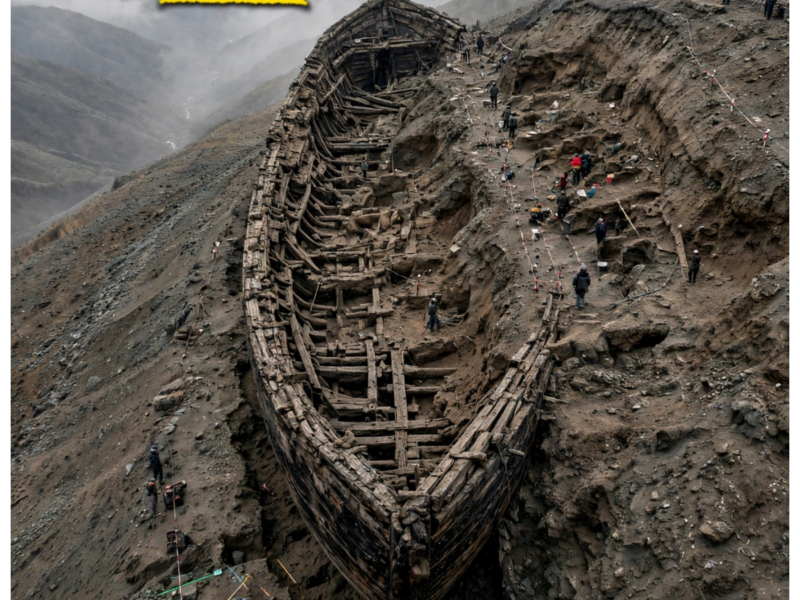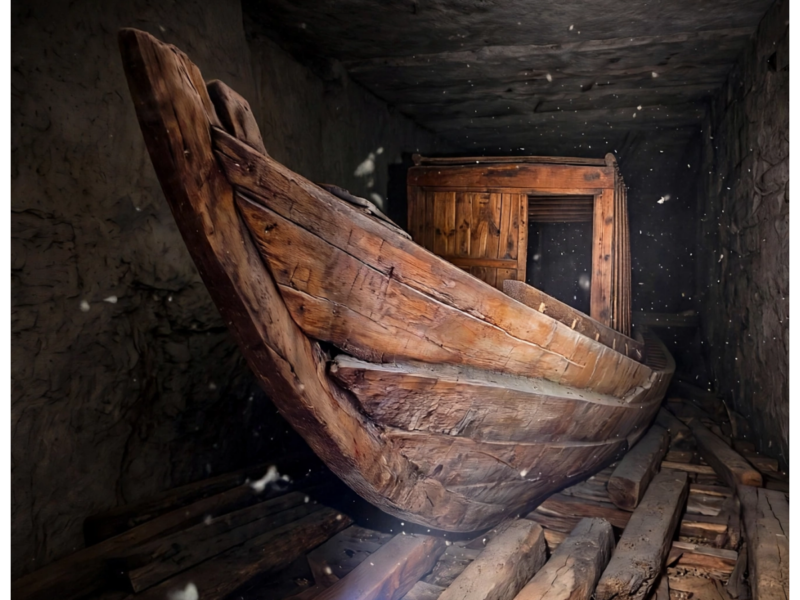
Syria’s longest river has receded, parching trees and leaving families of local farmers without 3 minutes ago.
A discovery beneath the Euphrates River forced the world to look twice as hidden layers were exposed.
What emerged was not random debris, but signs of something constructed, sealed, and forgotten.
Stone formations appeared where no records existed.
Ancient stairways descended into darkness.
Mud mounds rose as if pressure had been held back for centuries.
Each finding led to another unfolding not as chaos but as a sequence step by step, layer by layer.
This is no longer just about a river changing.
It is about what is being revealed.
Before we continue this exploration, tap like to support this investigation.
Subscribe to the channel and comment this prayer below as we uncover the truth together.
Lord, reveal the truth because some discoveries were hidden for a reason.
Along the Euphrates, entire stretches are vanishing at once.
Not thinning, collapsing.
Sections that carried steady currents weeks earlier now lie broken, split open into cracked mud corridors that drop sharply into exposed depths.
What makes this different is direction.
Satellite imagery does not show water migrating outward toward the river banks.
Instead, it shows water disappearing vertically.
In multiple locations, the river seems to drain downward as if the ground beneath it has lost the ability to hold pressure.
This is not erosion caused by wind or heat.
It is not evaporation accelerated by temperature.
It is a structural failure occurring below the surface.
Researchers examining these images notice something unsettling.
The collapse does not move smoothly along the river’s length.
It happens in segments, isolated zones that fail almost simultaneously, separated by stretches that remain intact for a time.
This uneven pattern suggests that what is changing is not the climate above, but the integrity of what lies underneath.
In other words, the riverbed itself is no longer stable.
Scientists have pointed to familiar factors.
Climate change reducing rainfall, upstream dams restricting flow, and decades of water extraction for agriculture and industry.
All of these contribute to stress on the river.
But even when combined, they do not fully explain what is being observed.
Climate models do not predict sudden vertical drainage.
Dam activity does not account for localized collapses that bypass surrounding terrain and water extraction alone cannot explain why ancient sediment layers untouched for thousands of years are now being exposed all at once.
This forces a shift in perspective.
The central question is no longer why is the Euphrates drying up.
That question assumes a surface level cause.
The more urgent question is what is failing beneath it.
Rivers do not simply disappear downward.
Unless something below them changes unless pressure is released, containment weakens, or long-held balance gives way.
Before the river collapses, the ground speaks first.
Along the banks of the Euphrates, residents describe a sensation that arrives without warning and leaves without explanation.
It is not violent.
Buildings do not shake.
Objects do not fall.
Instead, it moves quietly, rising through the soles of the feet, up the legs, sometimes pressing into the chest.
A brief, controlled trembling that lasts only seconds, yet lingers in the body far longer, carrying the unmistakable feeling that something beneath the ground has shifted.
This sensation is not isolated.
Seismologists reviewing available data confirm that these movements do not register as tectonic earthquakes.
There are no fault line ruptures, no seismic waves traveling through the crust, no aftershocks to follow.
The ground moves, but without the signature of any known natural seismic event.
The vibrations remain localized, brief, and tightly clustered along sections of the river that soon experience sudden and dramatic collapse.
The sequence repeats with disturbing consistency.
First the vibration, then the collapse.
In multiple locations, witnesses report that the vibrations are followed by something even more unsettling.
Not the rush of draining water, not the whistle of wind through rock, but a deep metallic resonance rising from beneath the surface.
The sound does not echo outward into the open air.
It presses inward.
Those who hear it struggle to describe it as sound at all.
It feels more like pressure, like the air itself is trembling.
Some compare it to the dragging of heavy metal deep underground.
Others say it resembles chains shifting under extreme tension.
Many can only say that it does not sound natural.
Unlike environmental noise, this resonance does not fade with distance.
It does not bounce off surrounding terrain.
Instead, it seems to pass directly through the body, vibrating in the chest cavity, creating a sensation that feels internal, intimate, and impossible to escape.
This physical response is what disturbs witnesses the most.
It is not something they merely hear.
It is something they feel.
Authorities and experts have offered cautious explanations, subterranean air displacement, collapsing cavities, sudden pressure changes within sediment layers.
Yet none fully account for the timing or the striking uniformity of the reports.
The sounds are not random.
They occur near collapse zones and they often cease once the riverbed gives way as if the pressure responsible has finally been released.
For many observing these events, the association becomes difficult to dismiss.
Release the four angels who are bound at the great river Euphrates.
Revelation 9:14.
The verse does not describe vibration.
It does not describe sound, but it does describe restraint in a moment when restraint is removed.
Whether read symbolically or literally, the language becomes impossible to ignore when pressure, movement, and release unfold together in the same place.
At the very least, what is happening beneath the Euphrates is not silent.
And what comes before collapse is not accidental.
Something below is adjusting and what follows next.
What follows the vibration is not collapse alone.
It is release.
After the water disappears from certain sections of the Euphrates, the riverbed does something unexpected.
Instead of drying quietly, the surface begins to move.
Bubbles break through the mud, rising in clusters as if gas trapped deep below is forcing its way upward.
The ground churns, swells, and then reshapes itself in real time, turning what was once a flowing channel into a living, shifting surface.
Witnesses describe thick, murky bubbles forming where the river once ran strongest.
These are not isolated bursts.
In some locations, the bubbling continues for hours, accompanied by visible movement in the sediment.
Shortly after, mud mounds begin to appear.
They rise slowly at first, then take shape with surprising speed.
Some reach noticeable height within a single day.
What makes these formations especially unsettling is where they appear.
The mounds do not emerge randomly across the riverbed.
They rise precisely in areas that previously carried the deepest, fastest currents.
Places that should have been scoured clean by centuries of flowing water are now pushing material upward from below.
This reversal movement rising instead of eroding challenges, conventional expectations of river behavior.
Geologists examining the phenomenon have proposed several explanations.
One theory points to trapped gas pockets, possibly methane, released as pressure shifts when water weight is removed.
Another suggests sediment compaction, where long buried layers rebound upward once the overlying mass disappears.
A third considers liquefaction, where saturated sediments temporarily behave like fluid under stress.
Yet each explanation falls short when tested against the full pattern.
Gas release does not typically produce consistent mound formation in specific repeating locations.
Sediment rebound should occur gradually, not with sudden localized surges.
Liqufaction requires external shaking, which is notably absent here.
No earthquakes, no strong vibrations, no triggering events large enough to account for the scale and speed being observed.
The most difficult aspects to explain remain the same.
Timing, location, and rate.
The bubbling begins almost immediately after water loss.
The mounds rise rapidly, and they do so only in select zones as if responding to something structured beneath the riverbed.
This suggests that the process is not merely chemical or mechanical, but spatial connected to what lies below, not just what is happening above.
Ancient riverbeds are layered archives of pressure, weight, and time.
The Euphrates has pressed down on its foundations for thousands of years.
When that pressure changes suddenly, the response is rarely gentle.
But even with that understanding, the behavior of these mud mounds remains unusual.
They do not look like natural remnants of erosion.
They look like reactions.
Something beneath the river is no longer holding still.
As the Euphrates continues to expose what lay beneath it, the discoveries move from unstable ground to unmistakable construction.
What first emerges are stone staircases, not fragments, not scattered blocks, but intact steps revealed beneath the former riverbed.
They do not slope naturally with the terrain.
They descend deliberately.
Each step is symmetrical, evenly spaced and sharply defined.
The edges are clean.
The angles are precise.
These are not formations shaped by water over time.
They are cut.
Erosion leaves randomness behind.
These stairs show intention.
The staircases descend straight downward into darkness, disappearing beyond the reach of natural light.
There are no decorative carvings, no inscriptions, no markers of habitation.
Their purpose is not to invite attention, but to allow passage controlled, limited, and deliberate.
The deeper the steps go, the colder and heavier the air becomes, suggesting that these stairways were designed to lead far below the river itself.
Beneath the stairs, ancient tunnels begin to appear.
These tunnels extend deep underground, maintaining consistent width and alignment over long distances.
They are not crude shafts or collapsed caverns.
Their walls are smooth, their ceilings stable.
In several locations, the tunnels turn at right angles, maintaining symmetry and orientation as if laid out according to a plan.
This level of precision rules out accidental formation.
What makes these tunnels even more unsettling is their resemblance to descriptions found in historical records.
Ancient sources speak of subterranean passages beneath Babylon.
Hidden routes used not by merchants or civilians, but by royalty.
Some accounts describe underground crossings beneath the Euphrates itself, allowing controlled movement between fortified areas without exposure above ground.
These passages were said to be sealed, concealed, and known only to those in power.
Yet the tunnels now emerging do not fully match even those descriptions.
They do not connect to marketplaces.
They do not open into living quarters.
They do not show signs of regular traffic or trade.
There are no remnants of tools, no storage areas, no evidence of daily human use.
Instead, the tunnels appear isolated, cut off from surrounding structures leading downward rather than outward.
Their layout suggests restriction, not efficiency.
Access, not convenience.
This distinction matters.
When humans build for trade, they prioritize movement.
When they build for residence, they leave traces of life.
But when they build to control, contain, or conceal, the architecture changes, entrances narrow, pathways descend, visibility disappears.
Everything about these tunnels suggests that they were not meant to be frequently used, only accessed when necessary, and by few.
The Euphrates has flowed over these structures for centuries, perhaps millennia, pressing them into silence.
Now, as the river retreats, these hidden paths are being revealed not as ruins of daily life, but as reminders of something deliberately placed beneath the river itself.
Before we go deeper, tap like to support this investigation.
Subscribe to the channel and share your thoughts in the comments below.
Because what lies at the end of these tunnels may explain why they were hidden for so long.
Deep within one of the ancient tunnels, beyond the point where natural light can no longer reach, excavators encountered an object that immediately altered the direction of the investigation.
It was a sword not lying on the ground, not broken or discarded.
The blade was driven vertically, embedded deep into solid stone as if forced downward with deliberate intent.
The hilt remained visible above the surface, worn by time, but unmistakably intact.
There were no decorative engravings, no jeweled fittings, no markings that would suggest ceremony, rank, or display.
This was not an object meant to be admired.
It was meant to stay where it was.
The positioning of the sword is what unsettled researchers the most.
Weapons abandoned in antiquity are typically found horizontally dropped, buried, or lost in collapse.
Ceremonial blades are placed on altars, in tombs, or alongside the dead.
This sword followed none of those patterns.
It was planted, anchored, fixed in place with force strong enough to pierce stone.
Stone does not yield easily.
To embed a blade this deeply would have required extraordinary effort, specialized tools, or a method beyond simple human strength.
The surrounding rock shows no signs of cracking or chiseling.
The stone appears compressed around the blade, as if the sword was driven in before the surface fully hardened, or as if pressure was applied in a way that defies normal mechanical explanation.
This raises an unavoidable question.
Why place a sword here at all?
The tunnel where it was found does not resemble a defensive position.
There are no choke points, no fortifications, no signs of combat.
The sword does not guard an entrance, nor does it block passage.
Instead, it stands alone, deeper than any practical human use would require.
Its purpose appears symbolic, functional, or both, but not marshall.
In ancient traditions, swords were more than weapons.
They represented authority, judgment, and restraint.
A sword placed upright, fixed into stone, often symbolized a boundary, something set, something enforced, something not meant to be crossed.
In this context, the sword does not appear to mark ownership.
It marks limitation.
Investigators began to describe it not as a weapon, but as a marker, or more precisely, as a seal.
The deeper one descends into the tunnel system, the more the environment changes.
Air pressure shifts, temperatures drop, movement feels restricted.
Within that descent, the sword stands as a fixed point.
An object placed at a specific depth in a specific location for a specific reason.
Its stillness contrasts sharply with the instability observed above as if it were meant to hold something in place rather than strike outward.
This symbolism finds a chilling parallel in scripture.
And I saw an angel coming down from heaven having the key of the abyss and holding in his hand a great chain.
Revelation 20 to1.
The verse speaks of authority over confinement, of restraint applied not through chaos, but through order.
Whether read literally or symbolically, the image aligns with what is found here.
An object placed not to kill, but to bind, not to attack, but to control.
The sword embedded in stone does not tell a story of battle.
It tells a story of containment.
And the fact that it is being revealed now raises a question that cannot be ignored.
If this was meant to remain fixed, what has changed to allow it to be seen?
Beyond the tunnels and sealed markers, the cave system opens into chambers that were never meant for passage, but for participation.
Deeper inside, investigators encounter rooms unlike anything found near the river above.
These chambers are wider, deliberately shaped, and covered in wall carvings that stretch from floor to ceiling.
The imagery is repetitive and unmistakably ritualistic.
Scene after scene depicts human figures bound at the wrists and ankles.
Their bodies are positioned not in rest or burial, but in tension, as if suspended between resistance and surrender.
In several carvings, other figures appear surrounding them, taller, distorted, indistinct.
From the bound bodies, something is shown rising upward.
The carvings do not clearly define what is being extracted, but the intent is clear.
Whatever is leaving the body is being drawn away, lifted out, and transferred elsewhere.
In the final panels, human forms are no longer fully human.
They appear fused into stone faces, frozen, limbs, rigid, bodies becoming part of statues identical to those found deeper underground.
The imagery does not resemble worship in the traditional sense.
There are no symbols of reverence, no offerings, no gestures of praise.
Instead, the scenes convey process, procedure, transformation, as if the walls were documenting a sequence rather than telling a story.
Scientific analysis of the chamber surfaces deepened the concern.
Samples taken from the stone walls revealed traces of hallucinogenic compounds embedded in the mineral layers.
These substances are not native to the surrounding geology and show signs of repeated exposure, not a single event.
Alongside them, researchers identified protein residues that could not be matched to any known human, animal, or environmental source.
The proteins were complex, degraded, and inconsistent, suggesting biological material that does not fit established categories.
These findings coincided with a troubling pattern among the excavation team.
Multiple members began reporting intense nightmares shortly after extended exposure to the chambers.
Sleep paralysis became common with individuals describing the sensation of being watched or restrained while unable to move.
Others experienced dissociative episodes, periods of lost time, confusion, or heightened suggestability.
Some described entering a translike state while inside the chambers, feeling compelled to remain longer than planned.
The effects were not isolated to one person or one incident.
They appeared across different roles, backgrounds, and levels of skepticism.
Medical evaluations showed no shared illness, no toxins in the bloodstream, no neurological conditions that could account for the symptoms.
Yet, the psychological strain intensified with each descent.
On several occasions, work was halted entirely.
Team leaders cited growing emotional instability, impaired judgment, and concern for safety.
Researchers who had spent years in extreme environments described the site as fundamentally different, not dangerous in the conventional sense, but oppressive, as if the space itself exerted influence rather than merely existing.
The murals, the chemical traces, and the psychological effects all point in the same direction.
These chambers were not passive spaces.
They were designed to alter perception, weaken resistance, and facilitate something that goes beyond physical confinement.
What was taking place here did not end.
When the walls were carved, it lingered.
Keep watching because deeper still lies a formation that may explain why these rituals were performed and why this place was sealed beneath the river in the first place.
At the deepest level, explorers are able to reach beneath the Euphrates River.
The discovery takes on an entirely different character.
This is no longer a passage to be explored or a structure to be measured.
What emerges here feels deliberate, prepared, not abandoned.
As layers of sediment fall away, a broad subsurface hollow is revealed, and within it stands a formation that does not resemble architecture, but arrangement.
Stone figures rise directly from the riverbed, positioned in a perfect circle.
Their placement is exact.
The spacing between each figure is equal.
Their height, posture, and proportions are identical.
The stone itself appears to come from the same source, shaped by the same method, as if the figures were produced together, not over time.
Nothing about them suggests individuality.
Everything suggests repetition.
What defines the formation most clearly is absence.
There are no markings, no symbols, no inscriptions, no faces carved in reverence, fear, or identity.
These figures were not created to be recognized.
They were created to participate.
They do not face outward and they do not orient toward a central altar.
Instead, each figure faces the next forming a closed loop beneath the river.
The effect is immediate and unsettling.
The circle does not invite attention.
It encloses it.
It does not display meaning.
It contains it.
Researchers familiar with ancient ritual spaces note something deeply unusual.
Ceremonial sites of worship almost always declare hierarchy.
A god above, a priest below, a direction of power.
This formation rejects all hierarchy.
Every figure is equal.
Every position is identical.
No single point commands authority.
The power, if there is any, exists only within the circle itself.
As investigators step closer, the atmosphere changes.
The temperature drops sharply, far beyond what depth or residual moisture can explain.
Instruments record irregular cold pockets that appear to concentrate toward the center of the formation.
At the same time, those present report a growing heaviness and oppressive pressure that cannot be measured yet is felt immediately.
Movement becomes hesitant.
Breathing slows.
Speech diminishes as if the space itself discourages sound.
The sensation intensifies near the center.
The stone figures show no signs of erosion from centuries beneath flowing water.
Their surfaces remain smooth, preserved, almost sealed.
They do not appear ancient in decay, but ancient in purpose.
They stand as if the ritual has not ended, only paused.
Biblical language offers a haunting parallel, one centered not on chaos, but on control.
And he laid hold on the dragon, that old serpent, which is the devil, and Satan, and bound him a thousand years.
Revelation 20:2.
The verse does not describe violence.
It describes restraint imposed through order, through structure, through enclosure.
The formation beneath the Euphrates reflects that same logic.
Everything about it suggests limitation rather than release.
Across cultures, circles have been used not merely to mark space, but to separate realities, to hold something in place, to prevent movement, to sustain a boundary.
Here, the circle does not protect those standing outside it.
It isolates whatever stands within.
These figures do not tell a story of worship.
They tell a story of ritual containment.
And the most unsettling detail is not what the formation holds, but when it is being revealed.
Because if this circle was constructed to restrain something, then its exposure raises a question no one is prepared to answer.
What happens when a ritual meant to hold no longer remains hidden beneath the river?
As the Euphrates exposes what was hidden beneath its waters, similar disturbances begin appearing far beyond its banks.
Reports of unexplained trumpet-like sounds have surfaced across multiple continents.
Witnesses in the United States describe deep, resonant tones echoing through clear skies with no visible source.
In parts of Europe, the sounds are recorded late at night, low, metallic, and sustained, lasting long enough to unsettle entire communities.
Across the Middle East, similar phenomena are reported.
Vibrations in the air, tones that seem to come from nowhere, and an overwhelming sense that the environment itself is reacting.
These events are not isolated.
They occur thousands of miles apart, yet share striking similarities.
The sounds arrive suddenly without warning.
They do not correspond to storms, aircraft, seismic activity, or industrial sources.
In many cases, experts offer theories, atmospheric pressure shifts, distant mechanical noise, but no explanation fully accounts for the consistency or global reach of the reports.
At the same time, extreme weather intensifies.
Unseasonal blizzards strike regions unprepared for snow, freezing infrastructure and halting daily life.
Elsewhere, catastrophic floods overwhelm cities within hours, submerging roads and homes that had never experienced such water levels before.
In contrast, prolonged droughts tighten their grip on entire regions, cracking the land and exhausting water supplies.
These events are not occurring in a single pattern or climate zone.
They are happening everywhere, often backto back, often without historical precedent.
What unites these phenomena is not their form, but their behavior.
They emerge suddenly.
They lack a clear singular cause and they are distributed across the globe.
The video does not claim that these signs point to one simple explanation.
It does not assert that every sound or storm is supernatural.
Instead, it asks a broader question, one rooted in timing and convergence.
When ancient boundaries weaken, when hidden structures emerge, and when the world itself begins to behave unpredictably, coincidence becomes harder to assume, scripture frames such moments not as chaos, but as communication.
Surely, the Lord God does nothing unless he reveals his secret to his servants.
Amos 3:7.
Throughout history, warnings rarely arrive as a single event.
They appear in patterns, in echoes, in parallel movements that draw attention not to one place, but to the moment itself.
Whether viewed through faith, history, or observation, the alignment of these signs invites reflection rather than dismissal.
The Euphrates is revealing what lies beneath it.
The world is experiencing signs above it.
The final question is not whether these events are real, but whether humanity is willing to recognize them as connected.
Before you leave, tap like to support this investigation.
Subscribe to the channel and share your thoughts in the comments below.
Thank you for watching and for staying alert as the story continues to unfold.
These are not shallow surface fractures.
They cut downward, revealing instability that water had concealed for centuries.
In some regions, the earth appears to have lost its internal support altogether.
Rather than eroding gradually from above, sections of the riverbed collapse inward as if the foundation itself is giving way.
The behavior suggests stress coming from below, not merely the absence of water above.
Local witnesses describe faint vibrations beneath their feet shortly before sudden drops in water level occur.
These are not earthquakes.
They are not landslides.
They are localized shifts, subtle movements that ripple through the ground as though pressure beneath the surface is changing position or being released.
Scripture describes moments when the foundations of the earth are shaken, not as random disasters, but as signs that deeper forces are at work.
Psalm 82:5.
In Revelation 16:12, the Euphrates is not said to fade slowly, but to be dried up, as if restraint itself is suddenly removed.
This points to abrupt change, not gradual decline.
Today, a river long marked in scripture as a boundary is destabilizing from below.
The water that once covered and stabilized the ground is retreating.
The pressure it provided is weakening, and what was hidden beneath the riverbed is beginning to surface.
These events do not offer simple answers, but they raise a question.
Scripture invites us to consider.
When foundations shift, are we witnessing natural change or a warning meant to awaken those who are watching.
When the land beneath the Euphrates River began to crack and lose its internal support, a new discovery emerged.
When the water disappeared, the land itself began to shift.
Mud begins to rise.
In places that were smooth and undisturbed only hours earlier, thick mounds of earth appear overnight.
These formations do not slowly build over time.
They rise suddenly as if something beneath the surface is pushing upward.
In some areas, the pressure becomes visible.
Short bursts of wet mud break through the ground, briefly erupting before collapsing back into place and leaving raised marks across the riverbed.
Geologists studying these events point out something unusual.
The mud does not behave like known mud volcanoes.
There is no gas source feeding the eruptions.
No geothermal activity beneath the area.
No chemical process that explains the pressure.
Even more concerning, there is no historical record of this kind of repeated mud activity along the Euphrates.
The timing matters.
These mud mounds appear only after the river loses its weight.
When water once pressed down on the ground, the riverbed remains stable.
As that pressure disappears, movement begins from below.
The pattern suggests a response, not a coincidence.
This looks less like erosion and more like release.
Erosion slowly wears material away from the surface.
What is happening here pushes material upward as though the ground beneath the riverbed is adjusting to the sudden loss of restraint.
In scripture, restraint is described as something that holds forces in place until an appointed time.
When that restraint weakens, what was once silent begins to move.
The rising mud does not reveal what lies beneath, but it does reveal that the ground is no longer still.
And when the earth itself begins to respond after restraint is lifted, it raises a serious question.
Are we only witnessing pressure escaping or something long held back beginning to surface?
What makes these developments impossible to ignore is that the pattern is no longer isolated to one region.
Similar ground failures are now appearing across the United States, unfolding in ways that echo what is happening along the Euphrates.
Across the country, reports continue to increase of sudden sink holes opening without warning, deep ground fissures tearing through land once considered stable, unexpected mud eruptions, and rapid land subsidance affecting entire neighborhoods.
California, Texas, and Arizona have each experienced moments where the earth shifts beneath roads, homes, and infrastructure, leaving communities stunned by how quickly stability disappears.
In many cases, these events occur without major earthquakes or obvious surface triggers.
The ground simply gives way, as if something beneath it is no longer holding firm.
What once felt solid becomes unreliable almost overnight.
Scripture speaks directly to moments like this.
All the foundations of the earth are shaken.
Psalm 82:5.
The verse is not written to inspire panic, but to describe a warning, a signal that deeper forces are at work.
When what once seems stable begins to move when the same signs appear across continents, the question changes.
It is no longer just about isolated geological events.
It becomes a broader question.
Scripture invites us to consider.
Are we witnessing coincidence or convergence?
As the water of the Euphrates continues to retreat, another layer of the past begins to surface.
What emerges is not metal, not stone, but life once buried beneath sediment and time.
Along newly dried sections of the river, preserved crocodile bodies and fossilized remains are being revealed, exposed after centuries of concealment.
These remains tell a quiet but unsettling story.
They were buried slowly, sealed naturally beneath layers of mud and silt.
Over time, the absence of oxygen and constant pressure dehydrated the bodies, preserving them in a state rarely seen.
These creatures did not die recently.
They belong to another age, one that passed long before modern records, yet remained hidden beneath flowing water until now.
They are not monsters.
They are not signs of myth coming to life.
But they are reminders.
Reminders that rivers do not only carry water.
They carry memory.
For centuries, the Euphrates covered these remains, keeping them out of sight.
As the water recedes, what was buried is revealed, not by human excavation, but by the removal of a natural covering.
Scripture often uses ancient beasts as symbols, not of fantasy, but of chaos restrained by God.
Creatures of great strength appear throughout the Bible as representations of forces that exist, yet are held in check.
Their presence reminds humanity that order is not accidental and that restraint plays a central role in maintaining balance.
When rivers recede, scripture shows that more than geography changes, what was hidden comes into the open.
This is true physically as ancient remains rise from the riverbed.
And it is true spiritually as buried truths, forgotten histories, and suppressed realities resurface when coverings are removed.
The appearance of these preserved creatures does not announce destruction.
It announces exposure.
It shows that time does not erase the past.
It only conceals it.
What lies beneath remains intact, waiting for the moment when restraint is lifted.
The past is not gone.
It has never been gone.
It waits beneath the surface, silent and unseen until the waters that once hit it are no longer there to hold it down.
As the Euphrates continues to withdraw, another unsettling discovery comes into view.
Where water once flowed uninterrupted, openings now appear along the river banks.
Holes, cavities, cave-like entrances emerging from the exposed earth.
For centuries, they remained invisible beneath moving water.
Now they stand open to the air.
These openings do not resemble random erosion pockets formed by rushing currents or collapsing soil.
Their edges are intact.
Their shapes are defined.
They appear less like damage and more like entrances.
Mouths into the earth that water once sealed shut.
The river did not create them.
It concealed them.
Researchers examining the sites note something that deepens the mystery.
Several of these openings remain structurally stable even as the surrounding riverbank shows signs of collapse and erosion.
While nearby ground fractures and gives way, the entrances themselves hold their form.
This suggests they were not formed recently, nor carved by the retreating water.
They were already there.
For generations, the Euphrates covered these openings, hiding them beneath its flow.
Water acted as a seal, masking what lay beneath and preventing direct access.
Only now, as the river loses its volume and weight, does that seal weaken, allowing what was once hidden to come into view.
Throughout history, caves have served many purposes.
Shelter, storage, burial, refuge.
But these openings raise a different question.
They appear where no known settlements were recorded in places long assumed to be nothing more than riverbank and sediment.
Their sudden exposure challenges assumptions about what the river has been concealing.
Scripture often speaks of things hidden beneath the earth, revealed only when coverings are removed.
The act of uncovering is not portrayed as destruction, but as disclosure.
When what was sealed is exposed, it forces a reckoning with what lies beneath.
These cave openings do not explain themselves.
They offer no inscriptions, no immediate answers, but they make one thing clear.
The Euphrates is not only revealing remnants of the past.
It is opening passages that were never meant to be seen until now.
Closer inspection of the cave entrances reveals something even more unsettling.
What first appeared to be simple openings in the riverbank begin to show patterns that do not align with natural erosion.
The shapes are not jagged or irregular.
They are controlled.
The entrances display symmetry.
Smooth arcs curve inward with consistent radius.
Straight edges meet at clean angles.
Dimensions repeat from one opening to another, even when separated by distance.
Nature is capable of complexity, but it does not repeat geometry with intention.
Erosion, fractures, water tears.
Time breaks down material unevenly.
What it does not do is produce uniform shapes that follow measurable design.
These cave mouths do not look broken.
They look formed.
Researchers studying the entrances note that the edges appear carved rather than cracked.
There is no sign of chaotic collapse, no splintering, no debris pattern that would suggest random failure.
Instead, the stone transitions cleanly from surface to void, as if shaped deliberately before being sealed and forgotten.
Across multiple locations along the Euphrates, the measurements align too closely to be dismissed as coincidence.
Widths match, curves mirror one another, angles repeat.
Even as surrounding ground collapses and erodess, these entrances maintain their structure, reinforcing the idea that they were not created by the river’s retreat.
This shifts the question entirely.
It is no longer about age alone.
Ancient formations can still be natural, but intentional geometry suggests purpose.
Someone or something shaped these spaces before water ever flowed over them.
Scripture often draws a distinction between what is formed and what is broken.
Formation implies intention.
Breaking implies decay.
These entrances bear the marks of formation, not destruction.
They do not look like accidents.
Uncovered by drought.
They look like designs revealed by the removal of a covering.
The Euphrates once hid these shapes beneath constant flow.
Now that the water has retreated, the geometry speaks for itself.
The river is not exposing ruins created by erosion.
It is uncovering structures that were already there waiting.
The question is no longer whether these openings are ancient.
The question is whether they were made on purpose, and if so, why they were hidden for so long.
Among the newly exposed riverbed, another discovery appears quiet, almost unremarkable at first glance, yet carrying unusual weight.
Scattered across the dry ground are thousands of small, smooth stones.
They do not glitter.
They do not draw attention the way ruins or fossils do, but they stop those who notice them.
These stones are not sharp or broken.
They are rounded, worn smooth in a way that goes beyond simple erosion.
Their surfaces suggest deliberate shaping, handled, turned, and refined over time, not rushed, not accidental.
Each stone bears the mark of intention.
In the ancient world, stones like these were not ordinary.
Long before written contracts or signed documents, promises were sealed in stone.
When people sought reconciliation, they shaped stone together.
When peace was declared, stones were set aside as witnesses.
When covenants were made, stone endured where words could fade.
A promise carved in stone was meant to last beyond the lifetime of the one who made it.
Shaping stone was slow work.
It required patience, presence, and commitment.
A vow could not be rushed.
It demanded time, effort, and agreement.
These stones represent moments when people believed promises mattered enough to be physically formed by hand.
For generations, the Euphrates hid these stones beneath its waters.
Flowing currents covered them, smoothing them further, burying their purpose beneath layers of time and forgetfulness.
Empires rose and fell above them.
Wars were fought along the river’s banks, and still these stones remained unseen, silent witnesses beneath the surface.
Now, as the water recedes, they are visible again.
Their reappearance feels timely.
As the river pulls back, it does more than expose land.
It removes a covering.
And with that covering gone, the stones force a confrontation with what they once represented.
Promises made, agreements spoken, commitments entered into with seriousness and hope.
As the water retreats, so do the excuses that allowed those promises to be forgotten.
What was once buried under distraction, distance, and time is now lying in plain sight.
The stones do not accuse.
They simply exist, asking to be noticed.
Scripture often connects water with covering and exposure.
When water is removed, truth is revealed, not always loudly, sometimes quietly, through objects that carry memory rather than spectacle.
These covenant stones do not predict destruction.
They do not announce judgment.
Instead, they point backward toward vows once made and slowly abandoned.
They suggest that before major change comes remembrance.
Before movement forward, there is a reckoning with what was left behind.
The Euphrates hid these stones for generations.
Now they are visible again.
And their presence raises a simple unsettling question.
If old promises can resurface when the water recedes, what commitments, personal, spiritual, or collective, are we being asked to remember?
Now the Euphrates is not introduced casually in scripture.
It appears at the very beginning flowing from Eden itself placed at the center of humanity’s first home.
From the start, this river marks the space where God’s order meets the wider world.
It is not just a source of water, but a line that defines where provision ends and testing begins.
As history unfolds, the Euphrates continues to serve the same role.
Empires rise along its banks, kingdoms fall near its waters.
Again and again, scripture places moments of transition, conflict, and decision at this river.
It becomes a boundary not only between lands, but between states of spiritual condition.
The Euphrates separates stability from uncertainty, restraint from release, waiting from fulfillment.
This pattern does not disappear with time.
When the Bible reaches its final book, the Euphrates appears again and its role remains consistent.
In Revelation, the river is not described as slowly shrinking or naturally fading away.
It is described as being dried up.
The language is deliberate.
Drying implies removal.
It implies that something which once held, restrained, or delayed is no longer doing so.
Scripture presents restraint as an act of mercy.
Boundaries exist not because God is distant, but because timing matters.
Throughout the Bible, moments of restraint are followed by moments of revelation.
What is held back is not gone.
It is waiting.
This is why the Euphrates is never treated as random geography.
It is a marker, a signal, a line drawn repeatedly by God at moments when history is about to shift.
From Eden to Revelation, the river stands where transitions occur.
When the Euphrates changes, scripture teaches us to pay attention, not to panic, but to discern.
The river’s role is not to announce dates or predict outcomes.
Its role is to signal that a boundary is moving.
And when boundaries move, decisions follow.
The drawing of the Euphrates in Revelation does not end the story.
It prepares the way.
It marks a threshold between what has been restrained and what is about to be revealed.
That is why this river matters, not because of fear, but because of timing.
And when a boundary so carefully placed throughout scripture begins to shift, the question is no longer whether it is important, but whether we are prepared to recognize what that shift means.
Scripture makes one point unmistakably clear.
No one is given the authority to calculate the exact moment of Christ’s return.
Dates and hours are deliberately withheld.
But absence of timing does not mean absence of warning.
Jesus himself explained that before the end, signs would appear not hidden in secret, but visible to those willing to watch.
He compared them to labor pains, irregular at first, then closer together, then impossible to ignore.
What we are witnessing today does not stand alone.
Across different regions, different cultures, and different systems, similar patterns are unfolding.
Stability is weakening.
Structures once assumed permanent are showing stress.
The physical world reflects this shift as much as the social and spiritual one.
When the same types of disruption repeat across nations, scripture encourages discernment rather than dismissal.
The changing state of the Euphrates fits within this larger pattern.
It does not function as proof, nor does it demand a single interpretation.
Instead, it acts as a signal, one more piece in a broader landscape of change.
Scripture consistently shows that God speaks through convergence.
When multiple warnings appear together, they form a message clearer than any isolated event ever could.
These moments are not designed to provoke fear.
Fear paralyzes.
Scripture never calls God’s people to panic.
It calls them to readiness.
Readiness is not anxiety about the future.
It is clarity about the present.
It is living awake, alert, and grounded in truth rather than distraction.
Throughout the Bible, moments of revelation follow moments when coverings are removed.
When illusions fall away, reality becomes visible.
Comfort fades, but understanding grows.
This exposure is not punishment.
It is mercy.
It allows time to respond before consequences become unavoidable.
The question of Christ’s return is not meant to pull attention toward speculation.
It is meant to redirect focus inward.
Scripture repeatedly shifts the emphasis from when to how.
How are we living?
How are we treating one another?
How firmly are we rooted in what is true rather than what is convenient.
When signs appear, they are not invitations to predict the future.
They are invitations to examine the present, to reassess priorities, to realign what has drifted, to remember what matters before movement accelerates further.
The river does not announce an ending.
The ground does not speak in dates.
The signs do not shout instructions.
They whisper awareness.
The real question is not whether Jesus is coming back soon.
The real question is whether we are living as though his words still matter.
Because when God allows signs to surface, he is not testing our ability to interpret mysteries.
He is testing our willingness to listen.
And listening, scripture reminds us, is where readiness begins.
Jesus’s return, the second coming.
Christians believe that the return of Jesus Christ will be unmistakable.
Unlike his first coming, which was quiet and humble, his return will be public, visible, and undeniable.
Scripture consistently presents the second coming as an event that affects all people, not just believers.
It will not happen in secret, nor will it require interpretation or debate.
When it occurs, the Bible teaches that the entire world will know.
This belief is rooted in Jesus’s own words.
In the Gospel of Matthew, he spoke openly to his followers about a future moment when the Son of Man would appear in the sky with power and glory accompanied by angels in a trumpet call.
These images are meant to communicate authority, completion, and divine action rather than to provide a timetable.
Jesus emphasized certainty, not scheduling.
The final moments of Jesus’s earthly life reinforce this expectation.
After his resurrection, he spent time with his followers, teaching and preparing them before ascending into heaven.
According to the book of Acts, his departure was not described as an ending, but as a pause.
The message given to his followers was simple and direct.
The same Jesus who ascended would return in the same manner.
Christianity teaches that Jesus is currently exalted in heaven, awaiting the moment appointed by God for his return.
Early Christians initially expected this return to happen very soon.
Living under persecution and hardship, they hoped Jesus would come quickly to restore justice and end suffering.
Over time, as years passed and generations changed, believers began to understand that readiness mattered more than immediiacy.
Jesus had already warned them that the timing of his return was known only to God.
Their responsibility was not to calculate dates, but to remain faithful.
As Christianity developed, believers turned their attention to the final book of the Bible, Revelation, seeking insight into what the future might hold.
Revelation is written in a symbolic and poetic style, rich with imagery that can be difficult to interpret literally.
It describes both present realities and future hope, including a vision of a world transformed, where suffering ends, and God’s presence is fully known.
Different interpretations of revelation have emerged throughout history.
Some Christians believe Jesus will return suddenly to gather believers before a period of global turmoil, after which he will reign on Earth.
Others understand the symbolic language differently, viewing the thousand-year reign as a metaphor for a long period of spiritual influence rather than a literal time frame.
Another view sees the return of Jesus coinciding with the end of human history and the beginning of eternal life in a renewed creation.
Despite these differences, mainstream Christianity agrees on what matters most.
The Bible does not encourage believers to obsess over timelines, signs, or theories.
Instead, it offers assurance.
The return of Jesus is not portrayed as a threat to those who trust him, but as a promise of restoration.
Scripture repeatedly points toward a future where pain, injustice, and death no longer exist.
The closing vision of the Bible emphasizes comfort rather than fear.
It describes God wiping away every tear and removing sorrow, mourning, and pain.
This promise shapes how Christians understand the second coming.
It is not only about judgment but about healing, not only about endings, but about renewal.
Ultimately, the belief in Jesus’s return calls Christians to live with hope and purpose.
Rather than speculating about when it will happen, they are encouraged to focus on how they live now.
Loving others, seeking justice, and remaining faithful.
The certainty of Jesus’s return is meant to inspire perseverance, not anxiety.
Christianity teaches that history is moving toward restoration, not chaos.
The second coming is not the collapse of meaning, but its fulfillment.
For believers, it represents the moment when God’s promises are completed and all things are made new.
Thanks for watching.
Don’t forget to subscribe and keep an eye out for our next video.
Leave a comment and let us know what you think.
Revelation.
Strange, unexplainable sounds have been captured, echoing from the cave.
Some claim it’s wind.
Others say it’s the unmistakable scream of beings begging for release.
The chilling recordings have gone viral.
Yet, no scientific explanation has silenced the fear that what lies beneath is not of this world.
Is this the very moment the Bible warned us about?
Could the Euphrates, long a symbol of ancient power, now be the stage for the end time drama foretold in Revelation 9?
The Euphrates River, stretching over 700 m begins in the highlands of eastern Turkey and winds its way through Syria and Iraq before finally emptying into the Persian Gulf.
It is more than just a geographical feature.
The Euphrates has been a lifeline for civilizations, a cradle of culture and commerce and a key water source for the region for over 6 millennia.
But its significance runs deeper.
The Bible names it as one of the four rivers flowing out of Eden in Genesis 2 10:14, placing it directly in the context of humanity’s divine origin.
From Eden to Empire, the Euphrates has always marked the edge between the sacred and the profane.
Historically, it served as a boundary between mighty kingdoms.
Assyria to the east, Babylon to the south, and later the Roman Empire to the west.
Battles that changed the shape of the ancient world were fought along its banks.
It was a political frontier, but also a prophetic one.
In Revelation 16:12, the Bible fortells, “The sixth angel poured out his bowl on the great river Euphrates, and its water was dried up to prepare the way for the kings from the east.”
And again in Revelation 9:14, a voice commands the sixth angel, “Release the four angels who are bound at the great river Euphrates.”
The river is not merely background.
It is central to God’s unfolding plan.
Other scriptures echo this theme.
Isaiah 11:15 speaks of the Lord drying up the Euphrates with a scorching wind, a sign of divine intervention.
Jeremiah 46:10 ties the river to a day of vengeance, a holy act of judgment where the Lord wields his sword.
The Euphrates in scripture becomes a symbol not just of sustenance or boundary, but of transition from one age to another, from mercy to wrath.
Today, that symbolic power is manifesting in real visible ways.
Satellite imagery from international monitoring agencies shows that the Euphrates has already lost over 60% of its water flow compared to the last century.
Climate change, damning upstream in Turkey, and poor water management have all accelerated its decline.
Some projections estimate that if current conditions persist, the river could dry up entirely by 2040.
But this is more than an environmental crisis.
It’s aligning perfectly with prophecy.
The literal drying of the Euphrates in our time mirrors the prophetic warnings of revelation, transforming global headlines into spiritual wake-up calls.
As one of the world’s oldest rivers recedes, it is not just revealing ruins.
It’s exposing the reality of ancient truths.
The Euphrates was once the boundary of empires.
Now it may be the dividing line between this world and the next.
In the midst of the Euphrates River’s alarming decline, one particular discovery has ignited a global firestorm of intrigue, a cave system uncovered beneath the receding riverbed.
In recent years, a viral video shocked a significant drop in the Euphrates River revealed a mysterious opening beneath its riverbed.
What startled viewers even more was the presence of a carved stone stairway descending into darkness.
The stairs are unnaturally precise, evenly spaced, symmetrical, and framed by large stone blocks that appear to form the entrance of a subterranean structure.
To many, it didn’t resemble a natural formation, but a deliberate construction.
Could this be an ancient tunnel or something far more significant?
The idea of a tunnel beneath the Euphrates isn’t new.
Classical sources from the first century describe similar structures under the ancient city of Babylon.
Diodoris Cicculus, a Greek historian, wrote that Queen Seami Ramis, a legendary ruler of Assyria, commissioned a tunnel beneath the river to secretly travel between her palaces.
Another account by Philostratus spoke of a subterranean bridge beneath the Euphrates that connected Babylon’s two halves, a feat of architecture largely forgotten by modern minds.
Though some scholars debate the accuracy of these claims, they do provide a historical precedent for the kind of structure that seems to have now reappeared beneath the Euphrates.
If such a tunnel was real and has now resurfaced, what was its purpose?
Here, the Bible offers a shocking possibility.
Revelation 9 14:15 describes a specific location beneath the Euphrates where four angels are bound.
These are not the cherubic messengers often depicted in stained glass, but dark beings, agents of divine judgment who have been held in confinement until an appointed time.
Release the four angels who are bound at the great river Euphrates.
The voice commands the sixth angel.
And the four angels who had been kept ready for this very hour and day and month and year were released to kill a third of mankind.
The structure revealed beneath the river now draws eerie parallels with this prophecy.
Could the tunnel be their prison?
Jude 1 6 adds to this chilling narrative, describing angels who did not stay within their own position of authority but left their proper dwelling.
And he has been kept in eternal chains under gloomy darkness until the judgment of the great day.
If this passage refers to the same beings, then this tunnel beneath the Euphrates may not just be a relic of ancient infrastructure.
It may be the holding cell of supernatural entities destined to be unleashed.
Several residents claim to have heard strange and unsettling noises at night near the opening.
Some describe low moaning sounds.
Others say they’ve heard high-pitched screeches echoing from deep underground.
These sounds are not fleeting.
They rumble with a resonance that lingers, shaking the air and unsettling all who hear them.
Witnesses describe the noises as unnatural, chilling, and impossible to trace to any visible source.
The most unsettling part, these sounds are emerging from areas where biblical prophecy says fallen angels are held.
Audio engineers and geologists have been brought in to investigate.
Some suggest these are natural acoustic reverberations, the result of wind or shifting rock echoing through subterranean cavities.
Others theorize collapsing tunnels or groundwater movement beneath ancient stone.
However, none of the scientific explanations fully align with the recordings.
The tonal patterns appear rhythmic and consistent, not random or geological.
Moreover, no seismic activity or structural shifts were recorded during the time of the audio capture.
With standard tools offering no satisfactory answers, even some scientists admit the sounds defy simple categorization.
As these explanations fall short, many turn to scripture.
In Revelation 9, the Apostle John describes the moment when the fifth trumpet sounds.
Smoke arose and from it came locusts upon the earth.
These locusts are no ordinary insects.
They are demonic entities released from a bottomless pit.
Some scholars have connected this imagery to the strange noises under the Euphrates, interpreting them as the first signals of an opening abyss.
If the prison of the fallen angels is beginning to fracture, these could be their cries echoing through the layers of the earth.
The theory grows more disturbing when tied to Revelation 9:13:15, which follows closely after the locust plague.
Here the sixth trumpet is sounded and a voice commands, release the four angels who are bound at the great river Euphrates.
What if the noise is not just a coincidence but a divine signal?
The very beginning of this prophecy coming to life.
Trumpet sounds have long carried symbolic weight in scripture used to announce war, judgment, or the arrival of God’s presence.
Could these echoes be the precursor to the trumpet that triggers the release?
Some even believe the sound itself resembles a trumpet, not one blown by human lips, but a deep vibrating call that pierces the silence of the night.
If so, it is not simply a sound of fear.
It may be the first audible evidence that the heavenly timeline is accelerating.
In 2022, a remarkable archaeological discovery shocked the academic world and stirred the attention of prophecy watchers alike.
As the waters of the Mosul Dam reservoir in northern Iraq receded due to extreme drought, an ancient city emerged from beneath the Euphrates extended flood plane.
What was revealed stunned the team of researchers.
An extraordinarily wellpreserved three 400year-old metropolis believed to be part of the once powerful Matani Empire.
The excavation conducted under urgent conditions before the site was once again submerged unveiled massive stone structures, towering defensive walls.
The layout and engineering of the city displayed advanced knowledge for its time.
Particularly notable were the colored plaster walls remnants of vibrant red and blue paints that had somehow survived centuries beneath water.
Scholars identified the city as Zakiku, a significant political and economic hub during the second millennium B.CE.
Te While the Matani Empire is not directly named in the Bible, it flourished in the same region and period as early Israel.
It stood among the empires that worshiped foreign gods, engaged in ritualistic practices, and often posed a spiritual and military threat to God’s people.
Its proximity to biblical lands and its involvement in the ancient pagan world makes it deeply relevant to the prophetic narrative.
In Ezekiel 27 and32, the prophet laments the judgment upon cities filled with pride, trade, and idolatricities that boasted of their strength, but ultimately fell under divine judgment.
Though Ezekiel names Ty and others, the themes easily extend to cities like Zakiku, powerful, wealthy, and spiritually dark.
Why does this matter now?
Because this city didn’t just erode into view over time.
It was hidden and then revealed only after the Euphrates began to dry.
That detail echoes a deeply unsettling pattern.
The Bible speaks often of that which is hidden being brought to light in the last days.
In Revelation, the great city of Babylon is described as a dwelling place of demons, a haunt for every unclean spirit.
Its collapse is tied to the endtime judgment.
The sudden surfacing of Zakiku under the Euphrates may not be the fulfillment of that exact prophecy, but it certainly stirs the question.
Is God allowing forgotten places of wickedness to reemerge as a warning to the modern world?
The structures match Revelation’s language about great cities fallen under judgment temples to false gods, strongholds of sorcery, and centers of corruption.
Their discovery beneath receding waters mirrors the literal and symbolic revealing of evil long buried.
These ruins, hidden for centuries, come to the surface only as the Euphrates approaches the point of biblical crisis.
As the Euphrates River continues to recede, it isn’t only ancient cities and mysterious caves being revealed from regions in Iraq and Turkey.
Claims of gold deposits in oil reserves surfacing from beneath the exposed riverbed.
In some areas, locals report seeing glittering mineral formations within dry channels, while other sources speak of valuable sediment being transported by the shrinking current.
Even more striking are claims of underground oil reserves long hidden now becoming accessible due to the dropping water levels.
According to a well-known Islamic hadith, the prophet Muhammad foretold, “The hour will not come to pass before the Euphrates uncovers a mountain of gold over which people will fight.
99 out of every hundred will be killed, and every man among them will say, “Perhaps I may be the one who will survive.”
This chilling prophecy describes not only the uncovering of treasure but a massive global conflict fueled by greed and desperation.
It is said to be one of the key signs of the end times in Islamic esquetology.
The fact that both gold and oil symbols of wealth and power are allegedly being exposed as the Euphrates dries gives pause.
Whether the prophecy refers to literal gold, valuable resources like oil or both, the significance is clear.
An unveiling of material riches in the final days that sparks deadly conflict.
As the world edges closer to economic instability, such a scenario no longer feels far-fetched.
Remarkably, the Bible offers a parallel warning.
In Revelation 18, the fall of Babylon the Great, a symbol of godless wealth and world power, is met with mourning by the merchants of the earth.
The merchants of the earth will weep and mourn over her because no one buys their cargos anymore.
This is not just a collapse of a city or economy.
It is the end of an age dominated by greed, corruption, and human empire.
The exposure of a mountain of wealth beneath the Euphrates, followed by chaos or even war, would mirror the judgment of Babylon, where material prosperity is swept away as divine justice is executed.
The mystery deepens with claims of conspiracy and cover up.
In local Iraqi communities, whispers abound that regional governments are aware of the discoveries, but are deliberately concealing them.
Some allege that sites have been sealed off, excavation halted, and media access restricted under the pretext of environmental protection.
The relative silence of mainstream global news only adds to the suspicion.
If nothing of value were found, why the secrecy?
And if something truly significant has emerged, why is the world not being told?
Whether these stories are true, exaggerated, or misunderstood, one fact remains.
The Euphrates is drying, and with it, secrets long buried are coming into view.
The warnings in both Islamic and Christian prophecy converge around this river, pointing to material obsession as a trigger for judgment.
In a world hungry for wealth and driven by conflict, the idea of people fighting over exposed treasure does not sound mythical.
It sounds imminent.
Could this be a final test for humanity?
A divine mirror held up to our deepest desires?
As the Euphrates reveals its hidden riches, we are left with a sobering question.
Will we see these signs as opportunities or omens?
The mystery of the four angels bound at the great river Euphrates is among the most haunting prophecies in all of scripture.
These beings are mentioned in Revelation 9:13:19 where the sixth angel sounds his trumpet and a voice commands, “Release the four angels who are bound at the great river Euphrates.
Their state of being bound is crucial.
It implies restriction, confinement, and most importantly, judgment.
Unlike the holy angels who are free to carry out God’s will, these four have been held back, prepared for a specific moment in time.
Their captivity suggests that they are not messengers of mercy, but instruments of wrathfallen angels awaiting their divine summons.
When they are released, the result is catastrophic.
The text describes them as leading an army of 200 million mounted troops, an unfathomable number, whether taken literally or symbolically.
These four angels are not passive observers.
They wield military authority on a scale that suggests global impact.
Their mission is direct and terrifying.
To kill one-third of mankind.
This event marks one of the most devastating judgments in the end time narrative, and it raises a chilling question.
Who or what are the soldiers they lead?
The identity of the 200 million horsemen, has long been debated.
Some interpret them as a literal army, potentially referencing a future coalition from the east, perhaps a geopolitical superpower like China or a global military alliance.
In a modern context, the description could even apply to mechanized warfare.
Tanks, drones, chemical weapons, things that would have appeared monstrous and otherworldly to a first century observer like Jon.
Others, however, take the view that this army is not human at all, but a demonic force summoned from the abyss directly under the command of the four fallen angels.
Scriptural and historical evidence lends weight to this supernatural interpretation.
The creatures described in Revelation do not resemble normal cavalry.
They ride horses with lion’s heads, and from their mouths comes fire, smoke, and sulfur.
Their tails are like serpents with heads that can wound.
This grotesque imagery aligns more closely with demonic entities than with earthly soldiers.
Additionally, Revelation 9 3 describes a previous plague of locust from the abyss, symbolizing a spiritual corruption unleashed on mankind.
These locusts were not allowed to kill, only torment.
But with the four angels and their army, the restraint is gone.
Death follows in their wake.
Ancient art also offers fascinating parallels.
Assyrian carvings, many of which have been recovered near the Euphrates River, depict winged creatures with lion heads and animallike bodies.
These beings were revered as guardians and symbols of divine power.
But to the Israelites and in later prophecy they represented spiritual opposition and idolatry.
Their monstrous forms echo the hybrid horror of the horsemen described by John.
Could these carvings be distorted memories of ancient encounters with real dark spiritual beings?
What’s crucial to understand is that this chaos is not random.
It’s not evil run a muck.
It is God’s controlled judgment.
Just as in the book of Job, where Satan could only act within the limits God allowed, so too here, these angels are released only at the precise hour, day, month, and year that God has appointed.
The judgment is devastating, but it is still under sovereign command.
Evil does not operate independently.
Even the most malevolent forces are used by God to fulfill his purposes.
This event is not simply about destruction.
It’s a final warning to humanity, a last call to repentance.
The scale of the army, the vivid symbolism, the spiritual weight, all of it drives home a singular message.
God is not mocked and judgment will come.
The release of these four fallen angels marks a turning point in human history.
And once that trumpet sounds, there is no turning back.
Across the globe, people are hearing it a sound that defies explanation.
Deep echoing trumpet-like blasts resonating from the skies have been reported in cities such as Shanghai, Prague, Dallas, and even Jerusalem.
Videos documenting these sounds have flooded social media over the past decade.
Each one capturing what sounds like a low metallic horn reverberating through the atmosphere, often lasting for minutes without a visible source.
Some witnesses describe the sound as chilling and apocalyptic.
Others say it feels like a warning, a trumpet in the sky.
What makes these events more than mere internet curiosities is the consistency across geography and time.
These aren’t isolated cases.
From the snowy fields of Canada to the streets of Israel, from urban skylines to remote farmland, the reports share key elements.
The sound is loud, directionless, and often associated with unease or a sense of divine presence.
Meteorological and seismic experts have offered various explanations ranging from shifting tectonic plates to atmospheric pressure fluctuations, but none have been conclusive.
The sounds often occur on clear days with no geological activity or weather patterns to support the natural explanations.
For many, the first thought that comes to mind is biblical prophecy.
In Matthew 24:31, Jesus foretells, and he will send out his angels with a loud trumpet call, and they will gather his elect from the four winds from one end of heaven to the other.
Trumpets are deeply significant in the Bible.
They are instruments of divine communication used to signal judgment, war, or the arrival of God’s presence.
In the book of Revelation, each of the seven trumpets introduces a new phase of judgment upon the earth.
So, when strange trumpet-like sounds begin filling the skies in real life, it’s not surprising that many see them as supernatural signs, could these be preludes to something greater?
Jesus gave a cryptic but powerful warning in Matthew 24:37.
As it was in the days of Noah, so it will be at the coming of the son of man.
In Noah’s day, people were living their lives as normalating, drinking, marrying, while a great judgment was preparing to unfold.
The flood didn’t come without warning, but few paid attention.
Today, the sounds that pierce our skies may serve a similar purpose.
They are not the event itself, but a call to wake up, to pay attention, to discern the times.
In each location where these sounds have occurred, reactions have ranged from fascination to fear.
But among the spiritually discerning, there is a growing sense that these global anomalies represent more than acoustic mystery.
They reflect a worldwide spiritual shakinga, subtle but escalating unveiling of something divine breaking into our dimension.
Whether one believes these are atmospheric phenomena or heavenly signals, their timing gamut war, pandemic, political collapse, and the drying of the Euphrates cannot be ignored.
These are not just strange noises.
They are trumpet blasts without a trumpet, warnings without words, a divine language echoing through the fabric of the earth.
And as prophecy aligns with reality, the only question that remains