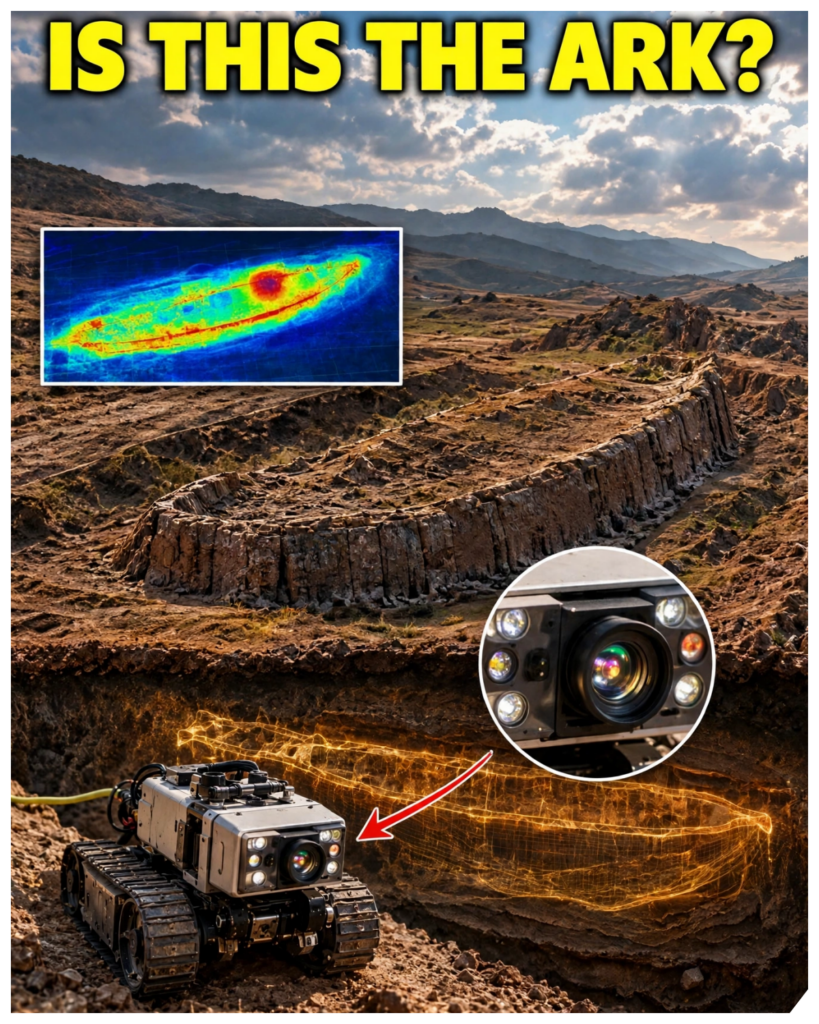
This is what happened when a small camera robot named Gopher was lowered 18 m into the ground at the Duropinner Formation in eastern Turkey.
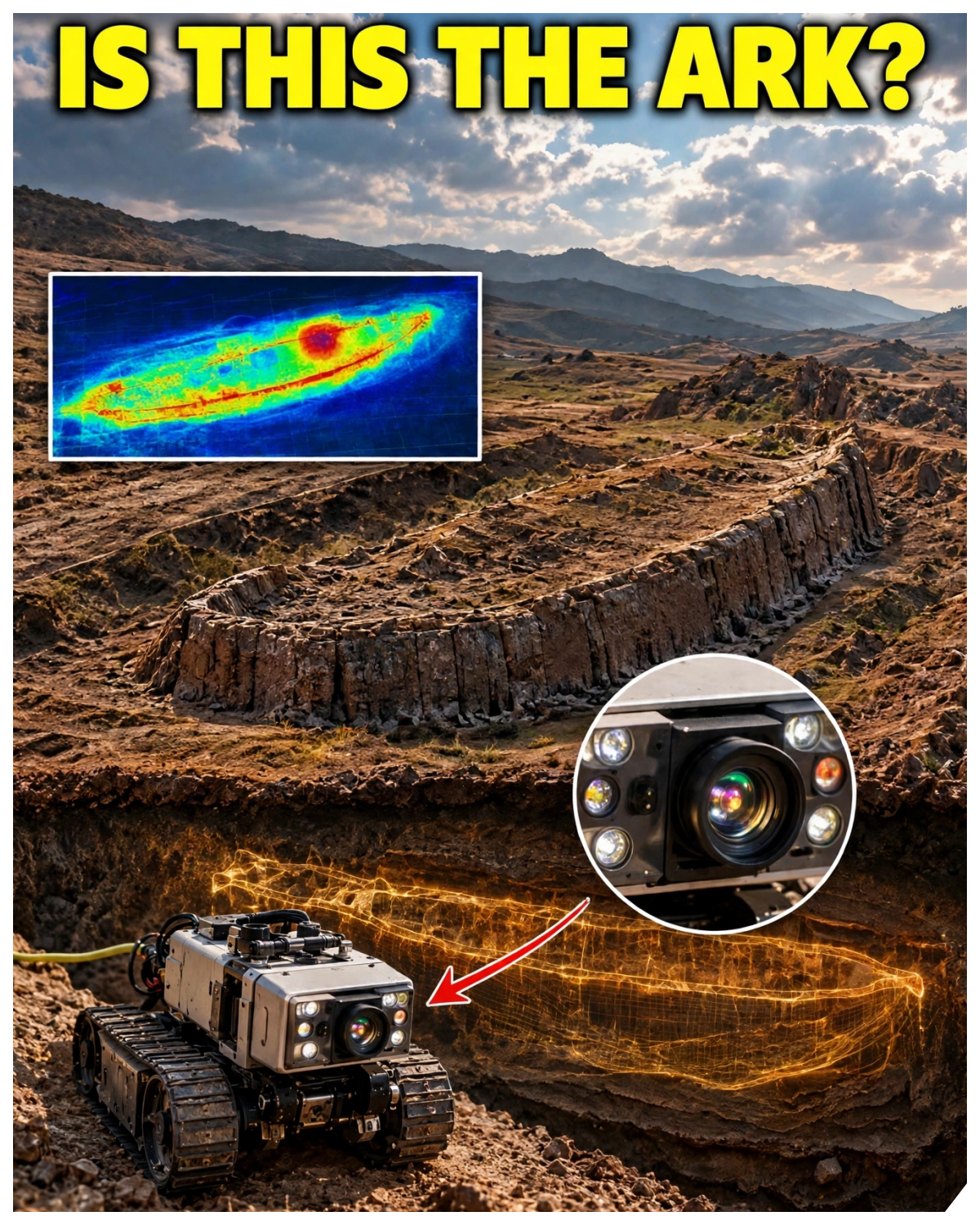
A boatshaped site that some believe holds the remains of Noah’s Ark.
Its operators posted the footage online and labeled it a first look inside Noah’s Ark.
Over the next few minutes, we’ll trace where this site came from, who sent the robot down, what its camera actually recorded, and why the archaeologist running the investigation calls the Arkfound headlines misleading.
The real story lives in the gap between what was filmed and what’s being claimed, and that gap is wider than most headlines admit.
The year was 1959 and a Turkish army captain named Ilhan Durupanar was carefully working through Turkish Air Force photographs taken during a NATO mapping mission.
One frame showed a long rounded shape that looked uncannily like a ship.
That shape sits near the town of Doayazit in Ara province on the flank of Mount Tenderek.
Sources put its distance from Mount Ararat anywhere from 21 to 29 km, which places it in the region where Genesis says the ark came to rest.
Its sheer size is a big reason the shape drew so much attention.
Supporters put the length at about 515 ft and argue that this matches the biblical description, although other sources measure the formation at 164 m or 538 ft.
Photos of the site ran in Life magazine in 1960.
And that September, a team from the Archaeological Research Foundation traveled out to inspect it firsthand.
George Vandean was part of the group, joined by photoggramometry professor Arthur Brandenburgger and Captain Durupanar himself.
Two days of digging and even dynamiting turned up nothing but soil and rocks, which led the team to deliver a blunt verdict, calling the formation a freak of nature and not man-made for most people that settled the matter.
Yet, the site refused to stay forgotten.
Ron Wyatt, an amateur explorer, rediscovered the site in 1977 and started promoting it as Noah’s Ark 8 years later.
In 1985, David Foldold and geoysicist John Bombgardner joined Wyatt on an expedition out to the formation itself.
According to one account, Turkish scientists and officials examined Wyatt’s evidence in 1986 and concluded that the formation was the remains of the ark after which a visitor center went up nearby.
Faceold’s book, The Ark of Noah, followed in 1988.
The site carried real danger, too, which became clear in 1991 when visitors traveling alongside Wyatt were kidnapped by Kurdish guerillas and held for 3 weeks.
What nobody expected came next.
Fosold visited the site in 1994 with Australian geologist Ian Plemer and walked away, convinced the formation was not a boat.
And in 1996, he co-wrote a paper with geologist Lawrence Collins, whose title left little room for doubt.
Bogus Noah’s Arc from Turkey exposed as a common geologic structure.
One of the site’s loudest champions had apparently turned against it.
Yet, the story doesn’t end there.
June Daws, Faceold’s biographer, said he went on believing he had found the ark until his death in 1998.
And Wyatt died the following year.
This next detail might be the strangest one in the whole debate.
Lawrence Collins was an anti-reationist, while Andrew Snelling is a young earth creationist.
Two people on opposite sides of the argument over the Bible and science who both described Durapinar as an entirely natural formation.
That’s where things stood for decades, right up until a new team arrived carrying new technology.
Today’s story centers on Noah’s Ark Scans, a group founded in 2021 in Roseville, California by Andrew Jones.
Jones makes no secret of where he stands, and his own words leave no doubt.
I believe this is Noah’s ark.
Earlier soil sampling in 2024 had already turned up differences between the inside and outside of the formation according to Jones with three times more organic matter inside 38% more potassium and shifts in pH.
Official approval from Turkish authorities arrived in June 2026.
Professor Sanker Atila, an archaeologist at CAS Kumury University, directs the investigation alongside Noah’s arc scans.
While the radar survey fell to Dr.
Kosro Baktar of Bactar Research and Engineering.
About 90 days of fieldwork followed starting at the end of June and stretching into September as the team mapped the formation, scanned beneath it with ground penetrating radar, and drilled for core samples, reported sample counts, don’t agree with each other, Jones told Fox News the team gathered more than 300 soil samples from different depths inside and outside the formation.
While other reports put the total closer to 1,000 samples drawn from about 150 locations, nearly 60 ft down is how deep the samples came from.
According to Jones, a few early measurements turned heads.
Preliminary readings suggested soil from inside the formation carries about 40% more carbon than soil outside it.
And Jones told Newsweek the team hit layers rich in organic material along with a hard layer at 4 to 5 m that broke a drill bit.
The radar results pushed things further.
Noah’s Arc scan says its data show linear features, right angle intersections, and spaces resembling corridors and chambers with Jones describing preliminary data that don’t show a simple homogeneous solid rock signature.
Even Professor Aila sounded upbeat in late August, saying the data were raising the likelihood day by day that the site is Noah’s Ark.
That optimism set up the next step, which meant trying to look inside the empty spaces the radar had suggested.
That job fell to Gopher, a small camera equipped robot designed by Australian engineer Dr.
Robert Ross of LRO University.
Built to travel through narrow underground spaces without largecale excavation.
It can capture highresolution footage and collect soil samples along the way.
Gopher was reportedly repurposed from wildlife burrow exploration.
And Ross has built this kind of machine before, having co-developed Wombot, a robot that explored 30 wombat burrows in Tasmania.
Nobody has confirmed whether Gopher descends directly from Wombot.
Down it went into an 18 m bore hole aimed at the spots where radar had picked up voids and those right angled shapes.
On September 24th, 2026, Noah’s Ark scans posted the footage on X with a caption reading, “First look, footage from inside Noah’s Ark.”
The mission did not go smoothly.
Gopher’s wheels struggled on the very loose sediment below, which left the robot unable to properly look around, and the team admitted that engineers are now modifying its mobility system so it can maneuver better and capture clearer video.
None of that dampened the team’s confidence.
Its members say the footage supports what they believe the scans showed all along, namely that there is no rock or bedrock in the structure.
Within days, the story had spread far beyond the dig site.
One widely shared headline said the team claimed to have 100% confirmed the resting place of the four 300year-old vessel.
And videos across YouTube announced that Gopher’s camera had revealed the truth.
What that camera actually revealed is a very different matter.
The footage leaves a long list of things unshown.
One critic pointed out that no ship’s timber, no hull, no artifacts, no inscriptions, no independent lab dating, and no peer-reviewed archaeological report has been produced.
And his summary was blunt.
A camera in a drill hole does not turn an unverified claim into a discovery.
Mainstream geology hasn’t budged on any of this.
Geological experts maintain that Durapanar is a natural rock formation shaped by erosion with no independently verified archaeological evidence that it was ever a vessel.
And as one report noted, unusual underground shapes alone would not prove the mound is Noah’s ark.
Geography raises its own problem because critics point out that the site sits in a valley while Genesis 8:4 says the ark came to rest on the mountains of Ararat.
That four [snorts] 300year figure from the viral headline [music] deserve scrutiny too since it comes from biblical chronology rather than a lab result.
Older findings have been stretched as well.
Researchers from Istanbul Technical University and AI Ibrahim Chachchen University dated samples from the area to between 3,500 and 5,000 years old.
A result often shared as proof even though Professor Fuk Kaya, who announced it, said the dating alone does not make it possible to say the ship is there and that long-term study is needed.
The group’s own messaging has shifted over time.
Deutschevela noted that Noah’s Ark scans first presented decomposed ark remains as a hypothesis and has since hardened its interpretation of the radar data.
The most telling voice belongs to the man leading the investigation.
By late September, Professor Aila was calling headlines that declared the Ark definitively found misleading, and he stated that no wood, nails, or man-made ship material proven to belong to the Ark had been found.
Strip away the headlines and here’s what we actually know.
A small robot was lowered into an 18 meter bore hole at a boat-shaped formation that has fascinated people since 1959 where it filmed loose sediment in the dark and struggled to move.
The team behind it believes that footage supports its radar data.
While critics say it proves nothing about an ancient ship.
As of late September 2026, no definitive result had been announced, which means the question remains open.
Lab analysis runs through the winter of 2026 and into 2027, focusing on soil composition, organic material, and possible wood remains.
The findings are slated for a book titled Durupan Formation 2026 research along with three international scientific papers.
Those results will say far more than any camera in a boar hole ever could.
They might strengthen the case or they might back up what the 1960 expedition concluded more than 60 years ago that this formation is a freak of nature.
Either way, the honest answer to the promise in this video’s title is that Gopher’s camera didn’t reveal the truth.
It revealed how much we still don’t know.
Tell us in the comments what you think lies beneath Durupinar.