PART 1: The Notice on the Wall
The notice hung beside the flour barrels in Dunmore’s General Store in Juniper Bend, Wyoming Territory, written in the careful, upright hand of a man who had rewritten it eleven times.
WANTED: A wife of gentle disposition and refined manners, to keep house and share the table of a respectable rancher. Inquire of W. Callender, Sweetwater Ranch.
Wyatt Callender had chosen every word to sound like the kind of woman his late father would have approved of. Soft. Proper. The sort of wife who would turn a lonely ranch house into a home.
He had not, for one moment, considered how it might read to a woman like Josephine Tate.
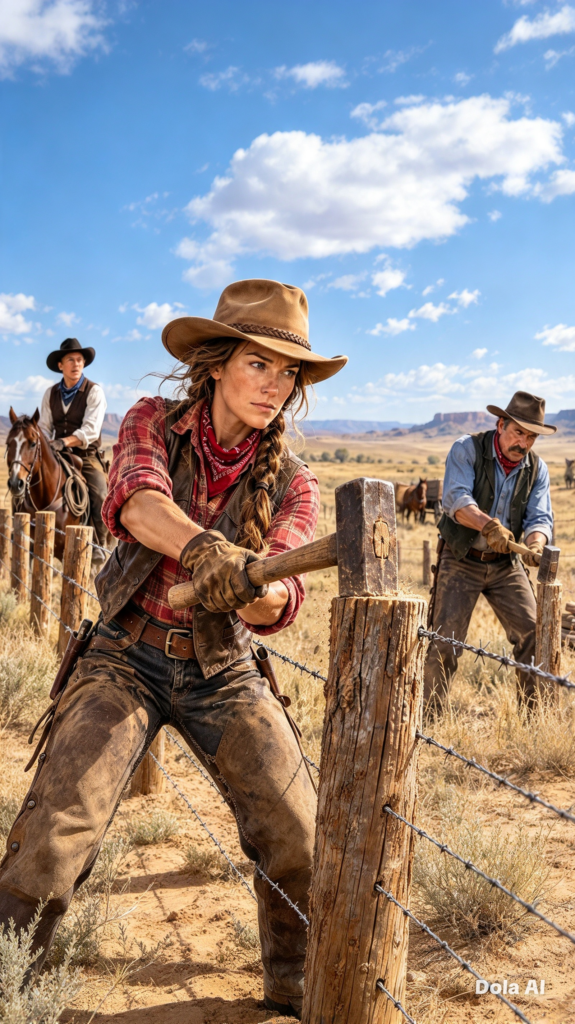
She found him at the counter on a raw March morning in 1884, while he was paying for nails. She wore a canvas work coat, split-leather gloves, and boots caked with fresh red mud from a fence she’d mended on the road into town. She was tall, broad through the shoulders, with a sun-browned face, a thick dark braid, and gray eyes as steady as a level.
“I’ve come about your notice, Mr. Callender.”
She pulled off a glove and held out her hand. It was rough with calluses, hard-won from work a great deal less gentle than embroidery.
“I can keep a house when I need to,” she went on. “But I’ll be honest with you from the start. I know a great deal more about fence posts and cattle than I do about needlework.”
The store went quiet. Old Dunmore stopped weighing coffee. Two cowhands by the stove turned to watch.
Wyatt looked at her for a long, uncomfortable moment. He saw the obvious competence in her. And he saw his father’s voice in his own head, reading the terms of a will.
“I’m obliged you came all this way, Miss Tate,” he said. “But I’m looking for a wife. Not a ranch hand. I’ve got men enough to mend fences. What I need is someone to make that house a home.”
Somebody by the stove snickered.
Josephine’s face didn’t change. Only her jaw tightened, very slightly.
“A house can be a home, Mr. Callender,” she said, much more calmly than he deserved, “and still have a woman in it who knows one end of a post-hole auger from the other.” She drew her glove back on. “But I understand plainly when I’m not wanted. I won’t waste any more of your morning.”
She walked out. The bell over the door jingled behind her.
Wyatt stood there with a sack of nails in his hand, feeling, for reasons he couldn’t name, that he had just made a very large mistake.
The trouble had started three months earlier, in the lawyer’s office above the bank.
Thaddeus Callender had died in the winter, and his will held a condition that had struck Wyatt like a fist. Wyatt would inherit Sweetwater Ranch only if he married before his twenty-sixth birthday, the coming May. If not, the whole of it would pass to his uncle, Silas Callender.
“Your father believed a man needs a steady partner before he’s handed a great deal of land,” the lawyer had explained, not quite hiding his sympathy. “He worried you’d bury yourself in the work, the way he nearly did before your mother came along.”
Uncle Silas, sitting in the corner, had said nothing at all. But Wyatt had seen him look out the window toward Sweetwater’s green bottomlands with something very like hunger.
So Wyatt had written his notice. And now the first woman to answer it had walked out with her chin up while half the town watched him make a fool of himself.
She came back three days later.
Not to the store. To the ranch. She rode straight onto Sweetwater on a rangy buckskin mare and found Wyatt exactly where everyone in the county knew he’d be every morning: at the east boundary, fighting with a sagging line of fence.
She swung down without waiting to be asked.
“I’ve been turning your notice over since Tuesday, Mr. Callender. I decided it deserved a proper answer.”
He straightened, wiping his hands. “Miss Tate—”
“You want a wife to make your house a home. Fine. I’m only asking what you think will become of that home when these fences fall down and your cattle drift onto Pell land every winter.”
“I have hands for fence work.”
“Hands who’ll leave the minute Augustus Pell offers them better wages,” she said. “The way half your father’s old crew already did.”
That landed. Wyatt said nothing.
“I’m not asking to be your hired hand,” Josephine said. “I’m saying a wife who actually understands this land might be worth a great deal more to your father’s legacy than one who keeps a tidy parlor.”
His pride was already bruised from the store, and now this woman stood on his own ground telling him plainly where he’d gone wrong. It made him say something he would spend the next month both regretting and defending.
“If fence work matters so much to you, Miss Tate, let’s settle it.” He pointed down the line. “I’ll wager you can’t build a better fence than my best man along this east boundary by the end of the month. If you win, I’ll reconsider your application myself. Honestly and fairly. If you lose, you drop your objections and let me run my own courting.”
“Done,” she said, before he’d even finished, and stuck out her hand.
He shook it, startled by the strength of her grip.
“But it’ll be a proper contest,” she added. “Judged by someone with no stake in it. I won’t have you saying later that a woman’s posts don’t count the same as a man’s.”
“Agreed,” Wyatt said.
And as he watched her ride away with the same easy confidence she’d arrived with, he began to suspect he’d just wagered something far riskier than a fence line.
The news reached Uncle Silas within days.
He rode over to Sweetwater with the peculiar calm of a man who would inherit everything if his nephew failed to marry in time, and offered to serve as the neutral judge, with an eagerness Wyatt found far more complicated than family kindness.
“I’ll judge fairly, Wyatt, whatever you suspect of me,” Silas said, walking the east line with a gaze so proprietary it made Wyatt’s skin crawl. “Though I’ll observe that a woman capable of beating your best man at fence-building might be exactly what your father’s will never actually ruled out.”
“The will says a wife, Uncle. It doesn’t say what kind.”
“Indeed it doesn’t,” Silas said, in a tone that left Wyatt unsure whether his uncle wanted him to win the bet or lose it.
The east boundary, Josephine explained during one of their increasingly frequent working conversations, had been disputed for nearly two years by Augustus Pell, the richest rancher in the valley. Pell claimed the territorial survey supported his own generous reading of where Sweetwater ended and his land began.
“Pell’s been waiting for exactly this kind of distraction,” she said, driving a post with considerably more force than it needed. “A young rancher rushing to marry before a deadline. Hands leaving for better pay. An inheritance fight with his own uncle. That’s precisely the chaos a man like Pell knows how to use while nobody’s watching the markers.”
“You think he’s counting on this fence never being finished,” Wyatt said slowly.
“I think a man who’s spent two years disputing a boundary wouldn’t mind dragging it out forever. Which is exactly why I mean to win this fair and square, Mr. Callender. Whatever either of us privately hopes.”
The contest began the following Monday under Silas’s watchful, unreadable eye. Josephine took the north half of the disputed line. Wyatt’s best hand, a reliable, unhurried man named Mateo Ruiz, took the south.
And Wyatt found reasons, almost every single day, to ride out and watch.
“You’re not supposed to help either side, Mr. Callender,” Josephine called on the third morning, without looking up from the hole she was digging with quick, practiced efficiency.
“I’m not helping anyone. I’m making sure it’s run fairly.”
“You’re making sure you can watch me work,” she said, with a frankness that left him without a single denial. “Which I don’t especially mind. So long as you understand that watching won’t change how badly I mean to win.”
By the second week, her section had pulled far ahead of Mateo’s. Years on her family’s small spread had taught her tricks that a steady hand like Mateo had never needed to learn: how to set a corner brace so it would hold through a hard freeze, how to read a slope so posts stood true. Wyatt found himself watching the growing gap with an emotion much more complicated than competitive worry.
“I’ll admit I expected it to be closer,” he said one evening, riding beside her as she headed home. “I don’t say that to insult you. I say it because I’m starting to understand how badly I misjudged what your skill meant when I read your name on that notice.”
“Most people misjudge skill when it’s wearing a woman’s boots,” she said. Her tone held less bitterness than honest weariness. “I quit taking it personally around sixteen.” She glanced sideways at him. “Though I’ll confess it’s rather satisfying watching you change your own mind about it.”
In the third week, a freak late-spring blizzard tore down out of the Wind River Range and flattened nearly a quarter mile of Josephine’s carefully built fence, along with a good stretch of Mateo’s.
Wyatt rode out at dawn and found her already working, alone, soaked to the skin and shaking with cold, determined to save what she could before the deadline closed in.
“You can’t rebuild a quarter mile by yourself before the month’s out,” he said, swinging down. “Storm or no storm.”
“You’re not supposed to help anybody, Mr. Callender,” she said, throwing his own words back at him with a tired, visible amusement.
“I’ve decided the contest matters a lot less to me than making sure you don’t work yourself into the ground trying to win it on principle.” He was already hauling a fallen post upright. “Disqualify me if you have to, Miss Tate. I won’t stand by and watch you wear yourself out over a bet I made from nothing but wounded pride.”
They worked side by side all that day. Late in the afternoon, too exhausted to keep up her usual reserve, she finally told him why the bet mattered so much.
“My family’s land borders Pell’s too,” she said, tamping earth around a post. “On our south line. He’s been pushing my father to sell for two years. The same patient squeeze he’s putting on your east boundary.” She straightened, her face streaked with mud. “I need what this bet could win me a great deal more than revenge, Mr. Callender. A real partnership with Sweetwater, whatever shape it takes, is the only thing big enough to make Pell leave my family alone.”
“You never told me,” Wyatt said quietly. He saw, with uncomfortable clarity, how close his pride had come to costing them something far bigger than a fence contest.
“I don’t usually lead with my family’s desperation,” she said, “when a man’s already decided I’m not fit to marry. I’d rather win on my own skill than anyone’s pity.”
Three nights later, just as Josephine’s section pulled decisively ahead, she couldn’t sleep.
Something felt wrong. She saddled her buckskin under a thin sliver of moon and rode out to the east line, telling herself she only wanted to check her corner braces after the last frost.
She heard it before she saw it: the dry snick of wire cutters, and the low, rhythmic thud of posts being wrenched from frozen earth.
She slid off her horse and crept forward through the sagebrush.
Two men worked in the dark along her finished section. They had already torn out nearly two hundred yards. Posts lay scattered like broken bones down the slope toward the creek bed. One of the men held a lantern hooded under his coat, and in its thin light she saw a face she knew.
Clete Varner. Augustus Pell’s foreman.
Josephine’s hands balled into fists. She knew she should ride for help. Ride back to Sweetwater, wake Wyatt, wake the hands. But by the time anyone came, there’d be nothing left of a month’s work but splinters in a creek.
She stepped out into the open.
“That’s enough, Clete.”
Both men spun around. The lantern swung wildly, throwing crazy shadows across the snow.
Then Varner laughed. “Well, if it ain’t the Tate girl. Out here alone in the dark.” He came toward her slowly. “You know, Mr. Pell’s been real patient with your daddy. Real patient. But he’s about done waiting.”
“Get off this land.”
“This land?” Varner’s grin widened. “That’s the whole question, ain’t it? Whose land this is.” He stopped a few feet away. “Accidents happen out here, Miss Tate. A woman alone. A bad horse. A fall in the dark. Nobody’d ever wonder.”
Josephine didn’t step back. “Wyatt Callender would wonder.”
“Callender?” Varner spat into the snow. “That boy can’t even find himself a wife.”
Behind her, the second man moved. She heard the slow, deliberate click of a rifle hammer drawing back.
Josephine went very still.
The cold barrel touched the back of her neck.
“Now,” Varner said softly, “let’s you and me take a little walk down to that creek.”
PART 2: The Man Who Chose Sides
“I wouldn’t,” said a voice from the dark.
Every head turned.
Wyatt Callender sat his gray gelding at the edge of the lantern light, his Winchester leveled at the man behind Josephine. He had seen her saddle up from his bedroom window, the lantern moving down the east road at an hour no sane rancher rode, and something cold had clutched at his chest. He’d followed.
“Lower that rifle,” Wyatt said. “Real slow.”
The man hesitated. Varner looked at Wyatt, then at the Winchester, then at Josephine, calculating.
“Two of us, Callender,” Varner said. “One of you.”
“Three,” came another voice.
Mateo Ruiz rode out of the sagebrush on Wyatt’s left, a shotgun across his saddle. He’d heard Wyatt leaving and come too.
Varner’s grin faded.
The man behind Josephine slowly lowered his rifle.
“This is a misunderstanding,” Varner said, backing toward his horse. “We were checking our own boundary.”
“With wire cutters,” Wyatt said. “At midnight. Get off my land, Varner. And tell Pell that if anyone touches Miss Tate again, I won’t be talking to the sheriff. I’ll be talking to him.”
The two men mounted and rode hard into the dark.
The moment they were gone, Josephine’s knees went out from under her.
Wyatt was off his horse before she hit the snow. He caught her by the shoulders and held her up. She was shaking violently, not just from cold.
“You came,” she whispered.
“Of course I came.” His voice was rough. “What in God’s name were you thinking, riding out here alone?”
“I was thinking about my fence,” she said, and to her own humiliation, she started to cry. Not loudly. Just quiet, furious tears she couldn’t stop.
Wyatt didn’t say anything. He simply pulled her against his chest and held her there, his chin resting on her hair, while Mateo politely studied the stars.
The next morning, Wyatt arrived at the wrecked section not as a neutral observer but as a full partner. He left his own crew entirely and set about helping Josephine rebuild what Pell’s men had destroyed.
Silas rode out to inspect the damage, his expression unreadable. “You’re supposed to stay neutral, Wyatt.”
“I’ve decided neutrality matters a lot less than making sure Augustus Pell doesn’t win by cheating what honest work was meant to decide.” Wyatt drove a post with more force than it needed. “Disqualify the bet if you must, Uncle. I won’t stand by while sabotage settles what skill was supposed to.”
Silas studied his nephew for a long moment. Something shifted behind his careful face.
“The contest stands,” he said at last. “Repairs from the sabotage won’t count against Miss Tate’s time.” He paused. “Whatever I may have privately hoped for this arrangement, your father would never have wanted cheating to decide his son’s future.”
He turned his horse and rode away. Wyatt watched him go, more uncertain than ever about what his uncle truly wanted.
That evening, at the Tates’ small kitchen table, Josephine’s father, Amos, set down his fork with the deliberate air of a man who had rehearsed this conversation several times.
“You’ve looked happier these last weeks than I’ve seen you in years,” he said. “Even with how tired you come home.”
“I’m not building that fence to win Wyatt Callender’s approval, Pa.”
“I don’t doubt your reasons.” A slow, knowing warmth came into Amos’s weathered face. “I only notice that a man doesn’t usually ride out at midnight with a rifle to protect a fence. Unless something a good deal more important than a boundary line is growing between him and the woman building it.”
Josephine looked away.
She didn’t tell her father what had happened that night. She didn’t tell him how it had felt to stand in the snow with a rifle at her neck, or how it had felt, a few minutes later, to be held so tightly against Wyatt Callender’s chest that she could hear his heart pounding as hard as hers.
The last week came. Josephine’s section was nearly finished, despite the storm and the sabotage. Mateo’s was still well behind.
Wyatt worked beside her through those final exhausting days. And somewhere between one post and the next, he understood that whatever the contest officially decided, something far bigger than a fence had already been settled between them.
“I don’t think I’m working beside you just to help you win a bet anymore, Miss Tate,” he said on the second-to-last evening, setting the final post of a long, hard stretch. “I think I’m working beside you because I’ve discovered, later than I should have, that I don’t much want to stop once it’s over.”
She leaned on her shovel and looked at him. “That’s a considerable admission for a man who once told me plainly he needed a wife, not a ranch hand.”
“I’ve decided that particular distinction made a lot less sense than I thought when I wrote it.” He met her eyes. “I’d like to take it back. Formally. Whatever the contest decides.”
She didn’t answer. But she didn’t look away either. And for a long moment, in the red light of the sinking sun, neither of them said anything at all.
Then, on the morning the contest was to be judged, Augustus Pell rode onto Sweetwater.
He didn’t come alone. He brought Sheriff Hollis Grant, a nervous lawyer from Cheyenne, Clete Varner, and six hired men, all armed. They reined up along Josephine’s finished fence in a long, deliberate line.
Pell was a heavy, silver-bearded man in a fine sheepskin coat. He took his time dismounting.
“Morning, Callender. Miss Tate.” He nodded pleasantly. “I’m afraid there’s been a problem with your little contest.”
He gestured to the lawyer, who unrolled a survey map across his saddle with shaking hands.
“According to the territorial survey filed in Cheyenne,” the lawyer said, “this entire fence line sits forty yards inside Mr. Pell’s property. It’s trespass. Mr. Pell has a court order for its immediate removal.”
Wyatt’s face went white with fury. “That survey’s a lie. This boundary’s been in my family for twenty years.”
“Then prove it.” Pell smiled. “The sheriff here will enforce the order this morning. Clete, start pulling posts.”
Varner grinned and swung down with his wire cutters.
Josephine stepped directly in front of her fence.
“You’ll have to go through me.”
Pell sighed. “Sheriff?”
Sheriff Grant looked deeply unhappy. “Miss Tate, I’m sorry. The papers are legal. I’ve got to ask you to step aside.”
Wyatt turned to the one man who could stop this. The one man who had sworn to judge the contest fairly.
“Uncle Silas. Say something.”
Silas sat his horse at the end of the line. He looked at the fence. He looked at Pell. He looked at his nephew.
And he said nothing at all.
Pell’s smile widened. “Your uncle and I had a long talk last week, Callender. Seems he’s come to see things my way. After all, if this contest fails and you don’t marry by May, Sweetwater goes to him.” He spread his hands. “And Silas and I have already agreed on a very fair price.”
The words hit Wyatt like a blow to the stomach.
He stared at his uncle. “Is that true?”
Silas met his eyes for a long, terrible moment.
Then he reached slowly into his coat.
PART 3: The Line That Was Always There
Every man along that fence tensed. Varner’s hand dropped to his pistol.
But what Silas Callender drew from his coat wasn’t a gun.
It was a thick roll of yellowed paper, tied with faded red ribbon.
He swung down from his horse, walked to the lawyer, and unrolled it right on top of Pell’s map.
“Yes, Wyatt. It’s true,” he said quietly. “Augustus came to me last week with an offer. A good one. All I had to do was see that this contest failed.” He looked at his nephew, and there was something raw and ashamed in his face. “And God help me, I nearly took it. I’ve wanted this land since I was a boy, watching your father get everything and me get nothing.”
Pell’s smile faltered. “Silas, what are you doing?”
“But then I watched your men tear down that girl’s fence in the night,” Silas went on, ignoring him. “And I watched my nephew ride out with a rifle to protect her. And I got curious. So I spent my evenings these last three weeks in the county land office, going through the original records.” He tapped the yellowed paper. “This is the original 1861 territorial survey. The first one ever filed. Before anybody had a reason to lie about it.”
The Cheyenne lawyer leaned over the old map. The color drained out of his face.
“That’s the original survey,” Silas said, his voice carrying across the whole line. “It puts the Sweetwater boundary forty yards east of where your so-called survey claims, Augustus. Onto your land. Not ours.” He looked at the fence. “Miss Tate’s fence doesn’t sit on your property. It sits exactly where the boundary has always been. Your claim was never legitimate. Not for one single day.”
Silence fell along the fence line.
“That’s forged,” Pell said. But his voice had lost its smoothness.
“It carries the seal of the territorial surveyor general,” Silas said. “And a certified copy is already on its way to the court in Cheyenne. Along with a sworn statement from me about the offer you made last week.” He looked at Sheriff Grant. “I imagine the court will find that very interesting, Hollis.”
The sheriff studied the old map for a long time. Then he looked up at Pell, and the reluctance had left his face.
“Augustus,” he said, “I’m going to have to ask you and your men to get off this land. And I’m going to need Clete Varner to come with me. Miss Tate and Mr. Callender have a story about some wire cutters and a rifle at midnight I think the judge will want to hear.”
Varner went for his horse. Mateo Ruiz was already standing in front of it, his shotgun resting easily in the crook of his arm.
“I wouldn’t,” Mateo said pleasantly.
After Pell had ridden away, red-faced and silent, and the sheriff had taken Varner off in handcuffs, Wyatt walked slowly over to his uncle.
For a long time, neither of them spoke.
“Why?” Wyatt finally asked.
Silas looked out along the finished fence, straight and true in the morning sun.
“Because I watched that young woman rebuild two hundred yards of fence after a blizzard and a sabotage, and never once complain,” he said. “And I watched you change, Wyatt. I watched you go from a proud, scared boy writing foolish notices into a man who’d stand with a rifle in the dark for someone he cared about.” He sighed. “That’s what your father wanted for you. Not a decoration in the parlor. A partner. And I realized I wanted that for you more than I wanted this land.”
Wyatt held out his hand. After a moment, Silas took it.
They finished the last quarter mile of fence together: Josephine, Wyatt, Mateo, and even Silas, working side by side instead of against each other. The terms of the original contest had come to matter far less than simply finishing the boundary right.
As the sun went down, Wyatt set the final post.
“I believe you’ve won this contest more thoroughly than any of us planned, Miss Tate.”
Josephine looked down the long, straight line of the finished fence, glowing gold in the last light.
“I think we both won something a good deal bigger than the contest,” she said.
The next week, Silas delivered his official verdict before half the county, packed into the Juniper Bend courthouse. Josephine Tate had won the fence contest decisively. And the court, having reviewed the 1861 survey, confirmed the Callender and Tate boundaries and threw out Augustus Pell’s claim entirely. Within a month, facing charges for conspiracy and fraud, Pell had sold his land and left the territory.
Mateo Ruiz, who had spent the entire contest quietly rooting for Josephine even while officially competing against her, took his loss with far more humor than most men would have.
“I’ll admit I never expected to lose a fence race to a woman,” he told anyone at Dunmore’s store who would listen. “Let alone be glad about it. Miss Tate beat me fair and square, blizzard and sabotage included. The whole town owes her an apology for ever doubting her.”
“You’re a better loser than most men I’ve seen, Mateo,” Wyatt told him, clapping his shoulder.
Mateo grinned. “I’d rather lose honestly to real skill than beat a woman everybody underestimated. Besides, I figure I’m getting a much better boss out of it than I started with.”
Two evenings later, Wyatt found Josephine at the south boundary of her family’s land, the line Pell could never threaten again. He dismounted, and there wasn’t a trace left of the wounded pride that had marked their first meeting.
“I’ve spent weeks thinking about how to properly apologize for that notice,” he said. “And I’ve decided the only honest apology is to ask you plainly, now that I understand what I nearly turned away that first morning.”
He took off his hat.
“I don’t need a wife instead of a ranch hand, Josephine. I need a partner who happens to be a great deal better with an auger than I am. One I’ve discovered, slower than I should have, that I love more than any fence we could ever build.”
He went down on one knee in the packed earth of the boundary they had fought so hard to secure.
“Josephine Tate, will you marry me? Properly and honestly. As exactly the woman you already are.”
“I believe I will, Mr. Callender,” she said, and pulled him back up before he’d finished kneeling. “Though I’ll expect a say in every fence we ever build together for the rest of our lives.”
He laughed, and then he kissed her, there on the boundary line, while the sun went down red and gold over the Wind River Range.
They were married that autumn, standing exactly on the boundary line their quarrel had settled. Half the guests stood on what had been Callender land, and half on what had been Tate land, an arrangement Josephine insisted on, to show how two disputed properties had become one shared future.
Mateo Ruiz stood as Wyatt’s best man.
Silas Callender gave the toast. He admitted publicly that his nephew’s marriage notice was the worst-written document he had ever had to judge, and that the best possible outcome had come out of it anyway.
“I’ve learned something, watching these two,” he said, raising his glass. “The best marriages rarely arrive the way either party pictured them. Sometimes the woman a man truly needs looks nothing like the notice he wrote.”
He smiled at Josephine.
“And everything like the one who proved him wrong, one honest post at a time.”