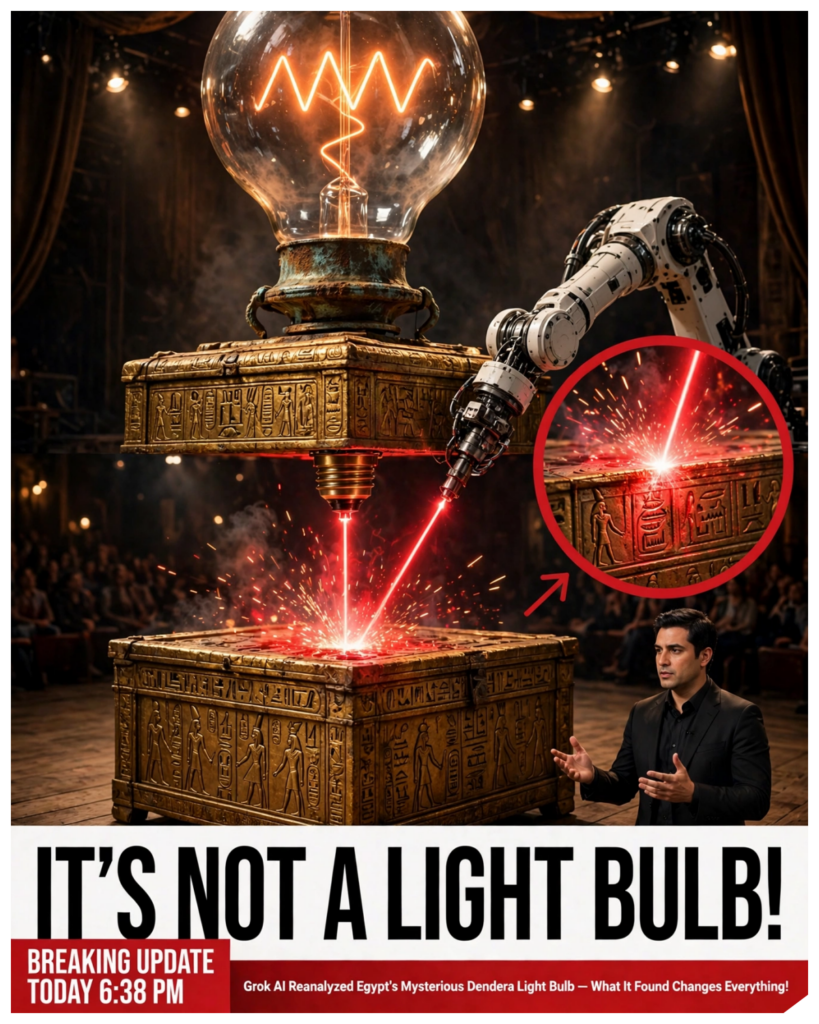
What if one of ancient Egypt’s most puzzling carvings has been in plain sight for over 2,000 years, and it looks oddly like something we’d only expect to find in a modern lab?
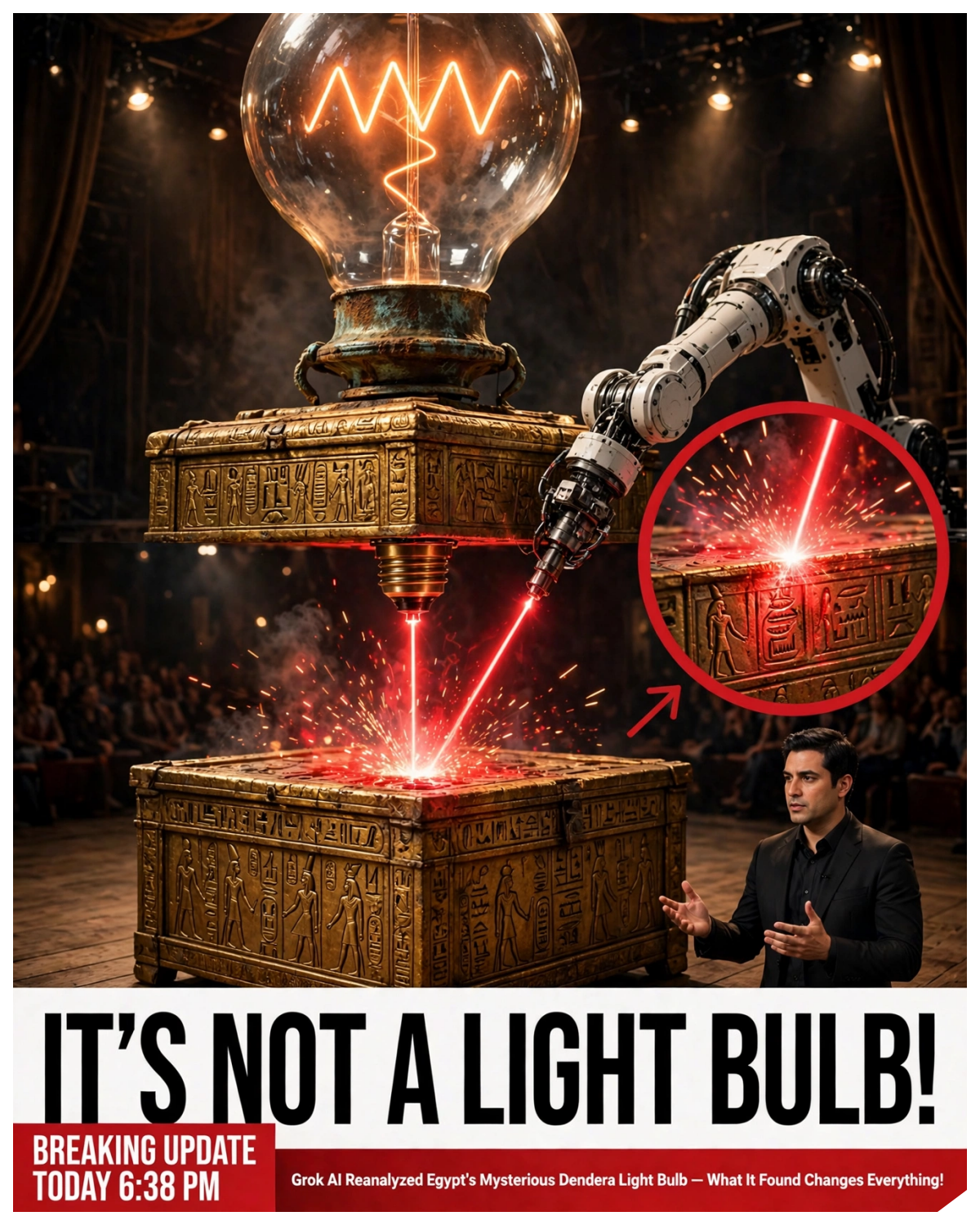
Inside the temple of Hatheror at Dender, down in a crypt the public was never meant to see, a snake emerges from a lotus flower wrapped inside an enormous bulbshaped form.
To some historians, it’s simply an old religious emblem tied to creation and the power of the gods.
But to others, it looks remarkably like a light bulb or an early vacuum tube.
For more than 60 years, the image has sat at the center of one of the most bitter arguments in ancient history.
Was it nothing more than a symbol?
Or could it hold knowledge historians still can’t quite explain?
Now, artificial intelligence has stepped into the argument.
Grock AI combed through research, photographs, measurements, old records, and technical details on the Dendera carving, and what it concluded has raised some surprising questions.
So, what did the AI really find?
And why is this ancient image once more forcing people to ask how much we truly understand about ancient technology?
I’m Ambrose Wild.
And before we get to what the machine found, you should see exactly what it was looking at.
There are actually three of these scenes, and the priests who carved them left a caption beside each one.
That caption matters more than almost anything else in this story, and we’ll come back to it.
But to anyone walking into that crypt with a flashlight today, the first impression is hard to shake.
A long swollen oval stretches sideways across the wall, wider at one end and narrowing at the other.
Inside it, a snake rises in a wavy line from a lotus flower, its head reaching toward the far tip.
At the narrow end, the lotus stem runs down into what looks to modern eyes like a socket.
Under the oval stands a pillar holding it up.
In two of the scenes, a small figure with a sundisk on his head lifts the oval as well.
And in all three, a full-sized man stands behind the lotus.
Put a photograph of that next to an old glass bulb and the comparison almost makes itself.
The oval is the glass.
The snake is the glowing filament.
The pillar is a stand.
That’s the version that’s spread around the world.
Egyptologists read the same wall very differently.
The snake has a name.
He’s Humptus, a form of Horus, sometimes linked with the sun god Rah, and his name means Horus, uniter of the two lands.
In Egyptian art, he often appears as an upright snake rising out of a lotus, usually riding on a sacred boat.
And the lotus itself was a symbol of creation, rebirth, and the sun.
The oval around the snake has a name, too.
The texts call it the HN, a container that may stand for the womb of the sky goddess Nut, the enclosure of the sky where the sun is born.
And the pillar is a deage pillar, one of the oldest symbols in Egypt, tied to the god Osiris and to stability itself.
So read that way.
The scene shows the sun god being born out of a flower inside the body of the sky.
That reading fits the temple around it, too.
The walls at Denderea are covered with gods, goddesses, offerings, and sacred boats.
And one more mythological scene shouldn’t surprise anyone.
But it doesn’t make the resemblance go away.
If the carving is only a myth, why does the whole arrangement line up so neatly with a piece of equipment that wasn’t invented until the 1800s?
Is that just a trick of modern eyes trained to see bulbs everywhere?
Or is the resemblance pointing at something the myth was built around?
People have been fighting over that question for decades.
And to see why it refuses to die, you have to know a little about the building it’s carved into.
The temple of Hatheror sits a short distance from the town of Denderea, and it’s one of the best preserved temples anywhere in the country.
Hatheror was a goddess of love, music, joy, and motherhood, and pilgrims traveled huge distances to worship her here.
The complex covers roughly 40,000 square meters, all of it closed in by a massive mudbrick wall.
Construction of the temple standing today began in 54 BC under Tommy I 12th in the late years of Greek rule over Egypt.
The great hall of columns at the front was finished later still under the Roman Emperor Tiberius and later Roman rulers kept adding to the site including gateways under Domission and Trajan.
The digging isn’t over either.
In March 2023, a limestone sphinx, possibly showing the emperor Claudius, turned up in the complex.
The famous Dendera Zodiac, a carved map of the sky, was cut out of a temple ceiling by the French in 1820, and the original now hangs in the Louver in Paris.
Egyptologists date that zodiac to the 1st century BC, but the ground under the temple is far older than the stone on top of it.
There’s evidence of a building on this exact spot around 2,250 BC, possibly started under the Old Kingdom Pharaoh Pepe I.
Another temple stood here around 1,00 500 BC during the 18th dynasty.
And the oldest building still standing in the complex is a birthhouse from the reign of the pharaoh Nectton Nebo II, built roughly three centuries before the main temple.
So when the Tomies built their temple, they weren’t starting a new religion.
They were rebuilding a holy place with roots in the old kingdom.
And old images and old stories came along with it.
That matters because a symbol carved in the first century BC could be carrying an idea that’s far older than the wall it sits on.
Which raises a question nobody can fully answer.
How old is the idea inside that oval?
What comes next is the part that still bothers people.
The carving was never put on a public wall where crowds could see it.
It’s underground.
Beneath the temple lies a system of crypts.
12 chambers in all, and these were far from ordinary rooms.
Only priests who had gone through special initiation were allowed in.
And the crypts were used to store sacred vessels and the divine images carried in ceremonies.
One of the reliefs down there shows Pepe I, that same old kingdom pharaoh, offering a small statue to four images of Hatheror.
So, the temple kept a record of its own past right there in the crypts.
The rooms are small and the corridors are tight, and almost no daylight reaches them at all.
The walls, though, are covered in carvings as fine as anything in the halls above, and they’re more crowded and more strange.
Gods in boats, gods on pillars, a monkey gripping knives.
The light carvings are down here.
Each of the three scenes is split into two halves, carved in two different rooms, one in the southern crypts and one in a second chamber.
So, the scene appears six times over, all of it in the darkest part of the building.
That’s exactly what bothered researchers.
If this was just another religious picture, why hide it where almost nobody would ever stand in front of it?
Why put the brightest looking image in the whole temple in rooms with no light?
Keep that question in mind because the answer turns out to be written right next to the bulbs.
For a long time, almost nobody outside Egyptology paid any attention to these rooms.
The turning point came in 1966.
Walter Gah, an electrical engineer from Austria, happened to see photographs of the crypt carvings.
Gan came to the photographs as an engineer with no lost civilization to prove and he looked at them the way an engineer looks at a circuit.
What he saw was a glass bulb with a snake winding through it like a discharge running down a tube and a lotus stem ending in what looked like a socket.
He even read the DJ pillar as an insulator, the kind of part that keeps live electrical components apart.
Garn worked with two Austrian writers, Peter Crasser and Reinhard Habbeek, and the three of them pushed what became known as the electric thesis, the claim that the reliefs show real ancient technology.
The device Gahn kept coming back to was the Crooks tube.
William Krooks and others developed these glass tubes in England between about 1,869 and 1,875.
Building on earlier tubes made by Heinrich Gistler in 1857.
Geiseler’s tubes held only a weak vacuum and filled with a colorful glow, a lot like a modern neon sign.
You pump most of the air out of a glass tube, run a high voltage through it, and a beam of electrons flies from one end to the other.
The electrons themselves are invisible, but where they hit the glass, it glows, usually a yellowish green.
And experiments with these tubes later helped show that the mysterious cathode rays were streams of electrons.
That glow led to one of the biggest discoveries in physics.
On the 8th of November 1895, the German physicist Wilhelm Ronken was running a crooks tube wrapped in black cardboard when he noticed a screen across the room glowing faintly.
Something was coming through the cardboard, and he soon found it could pass through books and paper, too.
He discovered X-rays.
Two years later in 1897, Ferdinand Brawn built the first cathode ray tube.
And that line of invention led to the big boxy television sets that filled living rooms for most of the 20th century.
So Garn’s question was a fair one to ask.
Was the match with a crooks tube a coincidence?
Or was the carving a picture of technical knowledge that everyone else had filed away as mythology?
Supporters went looking for more clues, and they thought they found one in the temple texts.
One inscription describes poles covered with copper plates set up to break the storms.
To an engineer, that sounds a lot like a lightning rod.
But the scholar Bolo Stern pointed out that those copper topped poles stood lower than the temple gateways beside them.
And he concluded the whole installation was magical protection rather than a technical one.
He also noted that no electrical equipment of any kind has ever been found in Egypt.
Gah never had a final answer.
But almost 60 years later, his question would end up in front of an artificial intelligence.
Before that though, the argument took a turn into something much more practical.
How did anyone work down there at all?
Every carving and painting in those crypts had to be laid out, cut, and colored in rooms that get almost no sunlight.
The same problem shows up in tombs all over Egypt, where painted walls still look crisp after thousands of years.
So, how did the artists see what they were doing?
The standard answer comes in two parts.
First, polished metal mirrors catching sunlight at the entrance and bouncing it deeper inside.
Second, oil lamps wherever the mirrors couldn’t reach.
On paper, that works.
But the further in you go, the more questions pile up.
Every time reflected light changes direction, it loses strength.
So, by the time it turns a few corners into the back of a crypt, there isn’t much left.
And lamps bring their own trouble.
A flame burning for hours in a tiny closed room eats oxygen, and burning oil gives off smoke that should leave a black film on the ceiling.
When researchers tested the crypt ceilings for carbon, several spots showed none of the soot you’d expect if lamps had burned there day after day.
That doesn’t prove electric light, but it does make the textbook answer look a little thin.
This idea has a strange history of its own.
The British astronomer Norman Loier once mentioned in passing a colleague’s joke that electric lamps would neatly explain the missing lamp black in Egyptian tombs.
It was a throwaway line and the electric thesis has been quoting it ever since.
The other side has answers to and they’re worth hearing.
The archaeologist Kenneth Feder points out that if the Egyptians had used bulbs, we’d expect to find what bulbs leave behind.
Things like shards of glass, metal sockets, and burned out filaments.
Not one has ever turned up, and to Federa, mirrors are simply the explanation that needs the fewest extra assumptions.
He also notes that the Egyptians knew that adding salt to their torches cut down the soot.
Historian Spencer McDaniel argues that the artists likely used castor oil lamps which burn clean and archaeologists have dug up ancient Egyptian oil lamps in huge numbers.
And at Dendera itself, the ceiling of the great hall is caked in thick black soot.
Most of it, McDaniel says, came much later from squatters who lived in the temple and explorers who tooured it with torches.
Egypt’s Supreme Council of Antiquities began restoring the temple in 2005, paused in 2011, and picked the work back up in 2017.
By March 2021, it had finished cleaning the Great Hall and bringing back the original colors on its walls and ceilings.
So, the Soot argument cuts both ways, and the light question, as you’ll see, ends up somewhere neither side expected.
Then, the debate grew wider than one temple.
Researchers started pulling in a second ancient object, one from a completely different country.
In 1936, during excavations at Kujut Rau near Baghdad, a set of small clay jars came out of the ground.
Wilhelm Koig, then the director of the Iraq Museum, looked at the pieces and suggested they might be a battery.
According to William Hafford, an archaeologist at the Penn Museum, Koig never saw the object whole or in the ground where it was found.
The main jar is about 14 cm tall.
Inside sits a copper cylinder sealed with bumen, a tar byproduct of crude oil, and inside that cylinder is an iron rod.
Some of the related jars hold several copper or bronze cylinders instead.
It likely dates to sometime between the 3rd century BC and the 3rd century AD when the Paththeanss and later the Cisanians ruled the region.
When people built copies and filled them with something acidic like vinegar or grape juice, the copies produced electricity.
Koig and later researchers measured about 0.8 to 2 volts from replicas.
In 2005, the television show Mythbusters wired 10 replicas together, filled them with lemon juice, and got around 4.5 volts.
That’s a tiny amount of power by modern standards.
But it showed the basic design could work like a simple galvanic cell.
Some have suggested it could have been used for electroplating, laying a thin coat of one metal over another, and the idea still draws new work.
In 2026, an independent researcher named Alexander Bases proposed that each jar was really two batteries in one with the clay itself acting as a separator and a second source of voltage for an estimated 1.4 volts per unit.
And the timing is almost too neat.
The likely dates of the Baghdad jars overlap with the years the Denderea temple was going up.
So the question changed.
It was no longer whether ancient people could have known anything about electricity.
If a clay jar could produce a current, how far could that knowledge have gone?
And could it have reached a priest in Upper Egypt?
There’s a catch, and it’s a big one.
Hafford argues the jars were ritual vessels meant to trap evil spirits, and that the iron rods may simply be nails.
The archaeologist, Elizabeth Stone, has said she doesn’t know anybody in the field who thinks it’s a real battery, and the originals can’t be retested.
Many artifacts from the Iraq Museum disappeared in the looting of 2003.
And today, what’s left of the Baghdad Battery is mostly photographs, reconstructions, and the argument itself.
Still, the jar made the Dendera debate bigger than one wall.
It turned it into a question about what the whole ancient world might have known.
And that’s the question that eventually landed on an AI.
On the 9th of July 2025, Elon Musk’s company XAI unveiled Grock 4 in a late night live stream.
Musk called it the smartest AI in the world and said it was better than PhD level in every subject.
X AI claimed it had the top score on a test called humanity’s last exam.
A set of extremely hard problems built to stump machines.
The heavy version which sends several AI agents at one hard problem cost $300 a month.
Whatever you think of claims like that, it was the kind of tool people were bound to point at old mysteries.
That same year, the Dendera carving got that treatment.
Grock was fed an academic data set built around the reliefs, research papers gathered over many years, photographs, measurements, translations of the inscriptions, and technical records.
Then it was asked to look at the carving from more than one angle.
One question was what the image means.
The other was whether its structure could also be read as a working technical design.
That shift is the whole point of the exercise.
Art history looks at a carving and asks what it symbolizes.
Engineering looks at the same carving and asks how it’s built, how big each part is, and how the parts relate to each other.
A drawing can look like a bulb by accident, but matching the proportions of a real tube by accident is much less likely.
So, the analysis used photoggramometry, which simply means taking very precise measurements from highresolution photographs.
It measured the length and width of the oval where the snake sits inside it, the size of the base below, and the balance of the whole design.
Then it set those numbers against the real proportions of working vacuum tubes, including crooks tubes.
By that measure, some of the key proportions differed by less than 5%.
On its own, one matching ratio means very little.
Grock’s point was that a group of close matches showing up together is hard to write off as pure chance.
A statistical comparison also found the similarities clustering in a repeating pattern.
And this next detail is easy to miss.
Grock never claimed it had found proof that ancient Egypt used electricity.
It found a pattern in the measurements, and it said so carefully.
That leaves the real question open.
If the proportions hold that steady, what were the carvers actually copying?
The answer has been sitting on the wall the whole time in those captions.
Next to each bulb, the priests wrote down what it was.
Above one snake, the text reads, “Words spoken by Harumptus, the great god who dwells in Dendera.”
Another caption lists the object as gold and precious stones, three palms high.
Another reads, “Gold, height one cubit,” which is about the length of a forearm.
One scene even lists the figures inside it.
Harumptus in his container on the nightboat with four figures inside it.
Nearby are a frogheaded god named Weep, described as a protector against rebels and enemies and that monkey holding its knives.
One statue of Hassopus is even called the hidden of form protected in his shrine.
There’s nothing in them about wires or lamps.
They read like an inventory.
Egyptologists understand the reliefs as pictures of real cult statues made of golden gems kept down in those crypts with their materials and their exact sizes written next to them.
Which may be why the proportions hold so steady.
If so, the carvers were recording real objects with real measurements the way a museum catalog would.
And the darkness was the point.
The priests treated the crypts like the duat, the Egyptian underworld.
The statues stored there were called the bodies of the gods.
And the Egyptians believed those bodies came back to life when they were brought up and touched by light on the temple roof.
So the bulb really was about light.
It was the light of the sun, the same light those gold statues waited in the dark to meet.
And the snake rising from the lotus has been showing it to us for more than 2,000 years.
I’m Ambrose Wild.
And if you want more videos like this one, where we follow an ancient mystery all the way down to what the evidence really says, there’s plenty more on this