The last man who had put a hand on Roman Balendi’s arm without permission had spent the following winter learning to eat with his left.
So, when a woman in a yellow sundress, a faded denim jacket, and one very muddy cowboy boot crossed a hay-strewn dance floor in front of 300 people, took the mafia boss’s hand in both of hers, and announced that he should marry her, his men stopped breathing.
Luca Moretti slid a hand toward the inside of his jacket. Dante took a single step forward, and Roman Balendi, 36 years old, feared from Chicago to the Canadian border, looked down at the stranger who was swaying slightly and smelling of peaches, and at the one thing none of his people had ever seen him do in public.
He laughed. What he said next would change both their lives, and it all began with a jar of homemade wine and a very bad idea.
Daisy Whitmore was 26 years old, and she had exactly two weaknesses. The first was her late grandmother’s peach wine.
The second was making bold decisions about 40 seconds before thinking them through. Most of the time the second weakness was harmless.
It had gotten her a ribbon for the biggest pumpkin at the county fair in a year when she had no business growing pumpkins, and it had gotten her bitten by a goose she was trying to rescue from a fence.
Once it had gotten her a dented truck and a very awkward conversation with a state trooper.
It had never, until the autumn that this story begins, gotten her engaged to a man she could not have picked out of a lineup.
She lived and worked at the Larkspur Inn, a rambling, creaky, wonderful white farmhouse with a wraparound porch and eight guest rooms, set on 40 acres just outside Bozeman, Montana.
The inn had been in the Whitmore family for four generations. It came with a red barn that leaned a to the left, a small apple orchard on the east slope, and a view of the Bridger Mountains that made tourists stop in the middle of the driveway and forget to park.
It also came with a roof that needed replacing, a boiler that groaned like a sick cow, and a bank loan that her father Walt pretended not to think about at the dinner table every single night.
Daisy did nearly everything the inn needed. She cooked breakfast for the guests at 6:00 in the morning, kept the books at night with a pencil behind her ear, mended the pasture fence when the elk knocked it down, and pruned the apple trees every winter with numb fingers and a thermos of coffee.
She had a degree in agricultural business from Montana State and a standing offer from a cooperative in Seattle that she had never quite managed to say yes to.
Two winters earlier, her grandmother Pearl had gotten sick, and Daisy had come home for what was supposed to be a few months.
Then the months turned into a year, and the year turned into a funeral on a bright cold morning when the whole valley showed up in their good boots.
After that, there were simply too many things that only Daisy knew how to do, and nobody ever asked whether she wanted to keep doing them.
She did not complain because complaining was not how she had been raised, but there was a small, quiet ache she carried everywhere.
The kind you stop noticing the way you stop noticing a stone in your shoe.
Her ex-boyfriend Brent had left for Denver the spring after Nana Pearl got sick, and the last thing he said on the porch was that Daisy would never leave this valley because she was too afraid of being anyone but the girl who fixed things.
It had hurt more than she let on. Mostly because he was not completely wrong.
She had started to believe that her life was a very good one that happened to be on hold, and that she had no idea who would press play.
Her cousin Tess showed up on the porch the evening of the Harvest Festival with two paper cups and a plan.
Tess was 24, a dental hygienist with the confidence of a woman who has seen everyone’s worst teeth, and she had been working on Daisy for a month.
“You haven’t danced since the funeral,” she said, pressing a cup into Daisy’s hands. “You haven’t worn a dress since the funeral.
You smell like apple wax and boiler. The Hail Ridge Harvest Festival has a live band, a pie contest, and a mechanical bull that a man named Gus has promised not to turn all the way up.
You are coming, and you are going to have fun, and that is not a request.”
“I have breakfast at 6,” Daisy said. “Your mother is doing breakfast. I already asked her.”
“Mom is doing breakfast.” She said, and I quote, “If that girl doesn’t go dancing, I’m going to put sleeping pills in her cocoa and carry her there myself.”
That was how Daisy found herself in a yellow sundress and her good boots riding down a gravel road in Tess’s little hatchback with a Mason jar of Nana’s peach wine tucked between her knees, because she refused to show up anywhere empty-handed.
Hail Ridge Ranch was the kind of place that had been a working cattle spread for a hundred years and had recently been turned into a very expensive version of itself.
There were string lights over the long tables and a red and white striped tent for the pies.
A band in matching hats played on a stage built from hay bales and reclaimed barn wood, and a wide plank dance floor stood in the middle of it all, glowing in the dusk.
Daisy took one look at the lights and felt something unclench in her chest that she had not known was clenched.
She had a wonderful time. She won second place in the pie contest by default when the first place winner disqualified herself over a store-bought crust.
She danced the two-step with an 80-year-old rancher named Mr. Albright who told her she was the best partner he’d had since Eisenhower.
She traded sips of Nana’s wine with the women from the quilting circle who declared it dangerous and drank another round.
By the time the sky went dark purple, Daisy had a flushed face, a loosened braid, and a warm floating feeling that anything was possible so long as she kept smiling.
She first noticed him standing alone by the edge of the dance floor, and what she noticed was how badly he fit.
Everyone else at the festival wore denim, plaid, or something with fringe. He wore a dark button-down shirt open at the collar and charcoal trousers that had definitely been cut for him, and shoes so polished that the string lights slid off the toes.
He stood very straight with his hands clasped loosely in front of him, as though he were attending a funeral and was waiting for someone to tell him when to leave.
He was tall and broad in the shoulders with dark hair that had been combed back and clearly told to stay there, and a jaw like something a sculptor had gotten bored with halfway through.
He did not look at the dancers. He looked at the exits and then at the people near the exits and then at the sky.
Around him there was a perfect circle of empty space. Daisy, who had never in her life let empty space go to waste, thought he looked like a man who had been abandoned at the party by his own ride.
Nana Pearl had always said that nobody should be left standing alone at a celebration because a person who stands alone at a celebration begins to believe they are the problem.
So, Daisy took one more sip from the Mason jar, which was not the sort of sip Nana would have approved, handed the jar to Tess, and marched across the dance floor.
“Hi,” she said, planting herself directly in front of him. “You should dance. The man looked down at her.
Up close, his eyes were a dark gray-brown, the color of creek stones, and about as readable.
No, thank you. He said politely. His voice was low and even, with the faintest rasp underneath.
It’s a good song. I’m sure it is. Everybody’s dancing. I noticed. You don’t look like you’ve noticed anything.
You look like you’re waiting for a bus that’s been canceled. She tilted her head.
Come on. One dance. Nobody’s going to look at your shoes. They are looking at my shoes right now.
He said, glancing past her at the nervous cluster of men in dark jackets standing a careful distance away, and then back at her, as if he were trying to work out what kind of creature she was.
But no. Thank you. Enjoy your evening. He assumed that was the end of it.
Daisy folded her arms. Are you always this grumpy? Or is somebody paying you to ruin parties?
Behind her, somebody dropped a plastic cup. Roman Balandi could not have said how long it had been since anyone had spoken to him that way.
People spoke to him carefully. They spoke to him in measured sentences, in softened requests, and in the pleasant bloodless tones of men who had calculated exactly how much he could take from them.
They did not tell him he had the face of a canceled bus. His security team, which had gone rigid at the edge of the floor, waited for a signal.
Luca, his consigliere and oldest friend, a lean, sharp-featured man with a face made for disapproval, let out a single breath that sounded very much like a wheeze.
And then Roman did something unexpected. He did not signal anyone. He turned and looked at the girl with a kind of grave attention, as if she were a puzzle he had been handed in the dark.
“Those shoes,” Daisy went on, because the wine had made her fearless and the music had made her chatty, are the most expensive thing at this entire party, and I include the ball.
You have a shirt that probably costs more than my truck, and you are standing next to a perfectly good band looking like the band owes you money.
Do you even like music? Do you have a favorite song? Have you ever once in your life tapped your foot?
I tapped it in 1999, Roman said, at a wedding. It was an accident. She stared at him and then she laughed, a real, loud, delighted laugh that went straight up into the lights.
He’s funny. She called over her shoulder to Tess. The grumpy man is funny. She turned back and patted his arm.
The way you would a horse that had just done something clever. He went completely still.
And for 1 second, Luca’s hand really did move, but Roman gave the smallest shake of his head, and the hand went back down.
I’m Daisy, she said. In case you were going to ask, which you weren’t, Roman Roman what?
Just Roman will do. Fine, just Roman. I’m going to go dance with a man who’s 80 years old and has better rhythm than you, and if you change your mind, I’ll be right over there.
She pointed at the floor with great dignity, wobbled a bit, caught herself, and walked away with her braids swinging.
Roman watched her all the way across the boards. Boss, Luca said quietly, appearing at his elbow.
Do you want me to find out who she is? No, Roman said. He sounded faintly surprised to hear himself say it.
Leave her alone. She doesn’t know who I am. That, said Luca, is exactly what concerns me.
Roman had come to Hillridge Ranch that evening for 1 reason. He was 36 years old, the head of the Balendi family, and for 7 years he had run an empire out of Chicago that touched trucking, restaurants, parking structures, and a very quiet portfolio of real estate.
Men feared him because he was careful, and because his father Salvatore had been shot on the steps of a church when Roman was 29, and Roman had spent every day since making certain that nothing in his life could ever be used against him.
He had no wife, no children, and no weekends. He had learned from his father that enjoyment is leverage, that an enemy who sees you happy has found the place to press.
And so he had trained his face to give away nothing. He had been good at it for so long that he had forgotten there was ever a time he’d had to try.
The business at the ranch was simple on paper. The owner, a smooth, round-faced man named Garrett Hale, was selling a large parcel of the old pasture along with its water rights, and Roman wanted it.
The land was in a high, quiet valley, two states and a world away from Chicago.
And he had been thinking lately, and with a certain unspoken weariness, about owning one place where no one knew his name.
Hale had been very cooperative. He had shaken Roman’s hand twice, poured him a drink that Roman did not touch, and promised to have all the papers ready within the week.
Something about it had felt too easy, and Roman did not trust easy. He was still standing by the dance floor, thinking this over and trying not to watch the girl in the yellow dress, when the band announced a fiddle contest.
A crowd formed. The girl was in the middle of it, clapping out of rhythm and shouting encouragement at a teenager whose bow was smoking.
Somewhere in the second song she lost a boot. It sailed across the floor and landed in a bale of hay, and Daisy hopped on one foot after it with a grim determination of a woman who had decided that nobody was going to take this boot from her.
Roman realized that the corner of his mouth had lifted. And he made it stop.
An hour later, he was standing near the decorated stage, listening to Hale explain a drainage issue with the South pasture, when he felt a small, warm hand slide into his.
He looked down. Daisy had come out of nowhere. Her braid had given up entirely.
Her cheeks were pink. And she smelled like peaches and wood smoke and the faint sweetness of someone who had been laughing for several hours.
She held his hand in both of hers like it was something she had found on the ground and meant to keep.
Hale, mid-sentence, shut his mouth with a click. The people nearest the stage went quiet one by one until the quiet spread outward in a ring, and the only sound left was the band, which had not yet noticed and was cheerfully playing something about a truck.
“You,” Daisy told him with the solemn dignity of the very drunk, “should marry me.”
The nearest guests did not breathe. Lucas’ hand was inside his jacket now, and he did not even look embarrassed about it.
Dante, Roman’s enormous, quiet bodyguard, had moved so close to her left shoulder that Daisy could have leaned back and used him as a wall.
Roman raised one eyebrow. “Is that a proposal?” “Absolutely.” She nodded so hard her hair fell into her face, and she blew it out of the way.
“I would be a wonderful wife. I can cook. I make a pie that took second place today, and the first place lady cheated.
I can fix a fence. I can drive a tractor and a stick shift and a horse.
I don’t snore, I’m told, although I’m only ever told by my cat. And I only argue when I’m right.
And when you’re wrong. That has never happened. Somebody in the crowd made a strangled noise.
Roman looked at the girl who was holding his hand and at the ring of frightened faces around them and at Hail who had gone the color of old milk and something in his chest which had been locked for 7 years turned over like an engine catching on a cold morning.
He laughed. It was low, rusty, and completely genuine. And it startled him more than it startled anyone else because he had no idea he still had one in him.
His men stared at him as if he had started speaking Latin. A woman near the front clutched her husband’s arm.
Then he leaned in close enough that only she could hear and in a voice that had gone warm in a way nobody had ever heard he said, “No take-backs.”
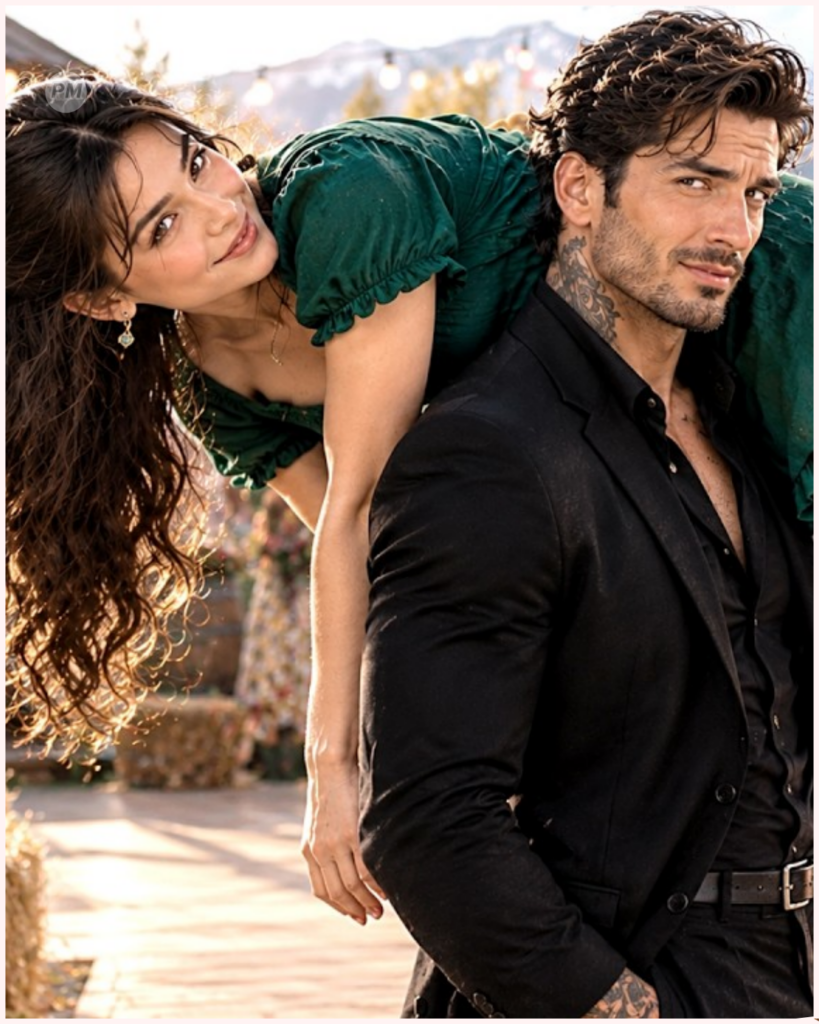
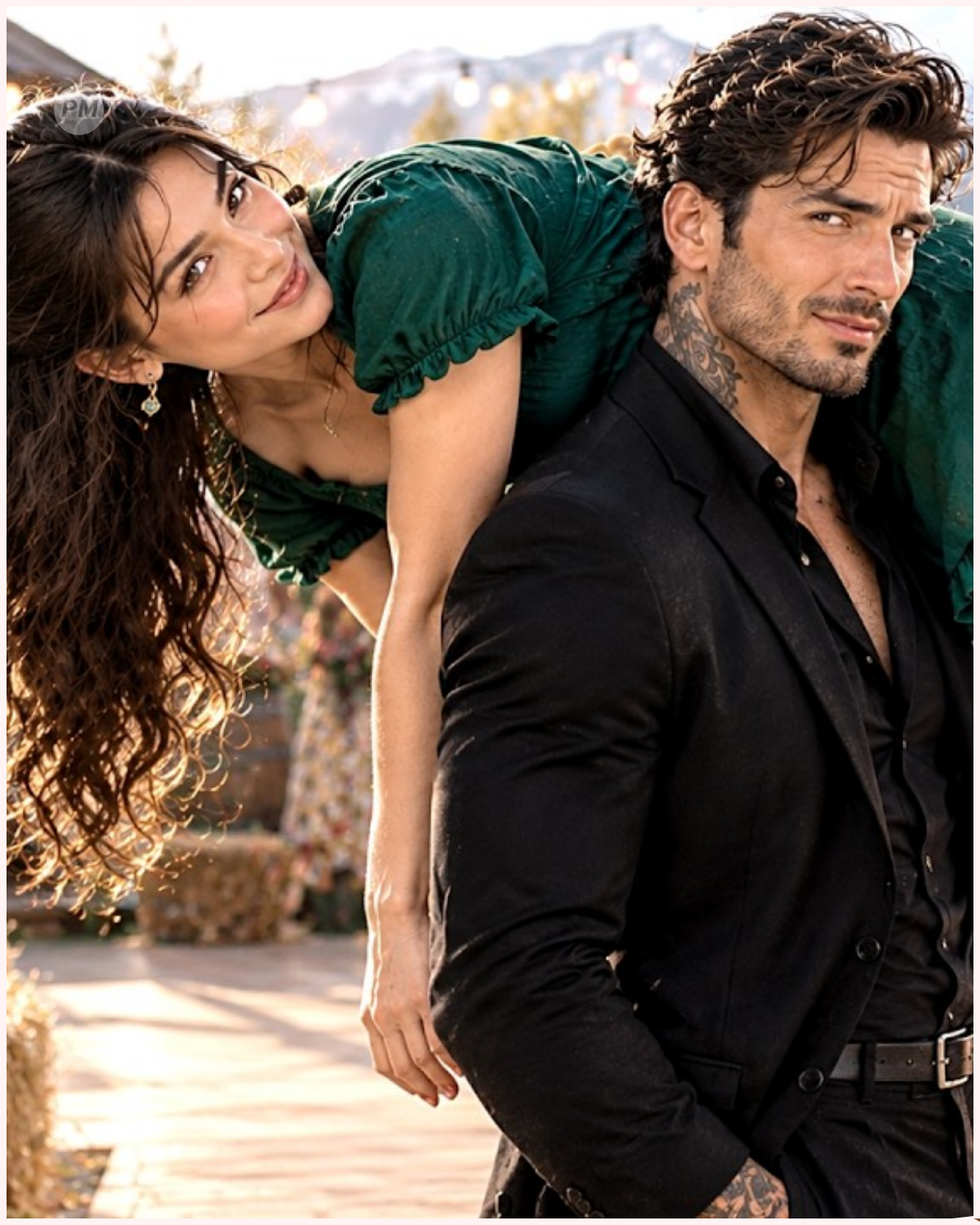
Daisy opened her mouth to answer. She never got the chance. Roman bent, caught her around the waist as easily as lifting a lamb, and swung her up onto his shoulders.
Daisy shrieked, grabbed two fistfuls of his expensive hair, and then, discovering that she was perfectly safe and perched up above 300 people with the whole glowing ranch spread out below her, began to laugh until she was crying.
The crowd erupted. Someone whooped. The band, finally understanding, switched into a ridiculous, triumphant tune.
And Daisy, flying high above the dance floor with her one remaining boot kicking in the air, flung out one arm like a conquering general and declared to the entire Harvest Festival, “My future husband is finally proving himself useful.”
Roman walked her once around the dance floor, steady as a tree, with his hands wrapped firmly around her ankles.
For the first time in years, he did not care that everyone was watching him smile.
Daisy woke the next morning in her childhood bedroom with a headache like a marching band and a vague uneasy sense that she had done something remarkable.
She lay very still staring at the ceiling fan trying to assemble the evening from scattered pieces.
There had been a band. There had been a pie. She remembered losing a boot and finding it again and she was fairly sure there had been a man with Creek Stone eyes who had refused to dance.
After that, the memories turned into a long warm blur that smelled like peaches and then she was lying here with her dress still on and one boot dangling off her foot.
Good morning sunshine. Said Tess from the doorway holding her phone in front of her like a candle.
Before you look at this I want you to know I love you and very proud of you and I have already drunk your coffee in preparation for your mood.
What did I do? Tess held up the phone. On the screen in slightly shaky vertical video was a woman in a yellow sundress being carried around a dance floor on the shoulders of a very tall man.
Her fists raised in the air screaming something about her future husband. The caption read in bright capital letters Farm Jerk Crew poses to the most terrifying man in Montana.
It had 400,000 views. Daisy stared at it. Then she dropped her phone which is not even the phone in question and put both hands over her face.
I looked him up. Tess said gently sitting on the edge of the bed. His name is Roman Belanger.
He’s from Chicago. He runs a family of and I’m quoting an article here businesses that have long been the subject of federal interest.
Nobody has ever convicted him of anything. A lot of people seem to have gotten very quiet about him.
The guy who commented on my video says his own cousin crossed Belanger once and moved to Portugal.
I told the mafia he was a cancelled bus. Daisy whispered into her palms. You did said Tess with the reverence of a woman watching a great historical event.
You really really did. It was at that precise moment that her mother’s voice floated up the stairs calm as a church bell and said, Daisy, honey, you have a visitor.
He brought flowers. Your father is on the porch with the with his coffee. Come down whenever you’re ready, but I wouldn’t take too long.
Daisy did not scream. She wanted that on the record later when she told the story.
She simply got out of bed, put on the first clean shirt she found, ran a brush through her hair so hard it hurt, and walked down the staircase of the Larkspur Inn with the stiff careful gait of a woman approaching a firing squad.
Roman was standing at the bottom of the porch steps. In the daylight he looked even more out of place than he had under the string lights.
A tall man in a charcoal jacket on a farmhouse lawn with a rooster pecking near his shoe.
He had a bouquet in his hands. It was not florist flowers. It was a rough untidy armful of wild lupine, yarrow, black-eyed Susans, and a few stalks of purple aster tied with what looked like a piece of baling twine.
His knees were damp and there was a clot of dirt on his left cuff that he had clearly tried to wipe off.
Behind him parked on the gravel was a black SUV with two silent men inside it and a third man, Dante, standing at a respectful distance with the expression of someone who had been told to hold very still.
Her father, Walt Whitmore, sat on the porch swing with his coffee mug and the placid look of a man who had seen a great deal of weather.
He was 61, built like a fence post with a gray mustache and a bad heart he did not discuss.
He had said exactly four words since the SUV pulled in and they were, “Morning.
Coffee. Sit. Good morning, Daisy.” Roman said. He said it formally, like a man reading a treaty.
Hi. She came down one step and then stopped. Why your knees wet? I picked these myself.
He looked down at the flowers with an air of faint accusation. Dante offered to call a florist.
I said no. It seemed important that they come from the valley. It turns out that wildflowers grow in places that are very close to a ditch.
Her mother, standing in the doorway with a dish towel, made a small noise that was either a cough or a laugh.
Daisy’s resolve broke somewhere around the baling twine. Mr. Bellandi, [clears throat] she began, I’m so sorry.
I was out of my mind. I’d had nearly an entire jar of my grandmother’s wine, and it is not a drink.
It is a weapon. I didn’t remember half of what I said. I’m told I said some very rude things about your shoes, and I want you to know that I would never normally propose to a person I’d known for 3 minutes, and I absolutely did not mean any of it.
And you are completely released from every word I said. You owe me nothing. Please, please forget it happened.
Roman listened to all of it without interrupting, which she would later realize was one of the first signs of how different he was.
He let her run all the way out of breath. Then he climbed one step so that they were closer and spoke very quietly.
I’m not going to hold you to anything you said while you were drunk. He told her.
I want to be very clear about that. A promise made in that condition isn’t a promise.
It isn’t fair to either of us. And you owe me nothing. He paused. But I haven’t laughed like that in 7 years.
I would like the chance to take you on a proper date with you sober and me behaving.
If you say no, I’ll take my flowers and my dirty knees and leave you alone, and your father can go back to deciding whether to shoot me.
“I was thinking about it.” Said Walt from the swing. “I know you were, sir.”
She looked at the tightness in his shoulders and the tiredness under his eyes and saw that he held the bouquet slightly away from himself, the way people hold a baby they are afraid of dropping.
“Can I ask you something first?” She said. “And you have to tell me the truth.”
“Yes.” “Are the things people say about you true?” He did not look away. She would remember that afterward as the moment the whole thing really began.
“Some of them.” Roman said. “Not all, and not the ones you’re probably imagining. But some of them are true, and I won’t pretend they aren’t.
I will never lie to you, Daisy. There will be things I can’t tell you, and when that happens, I’ll tell you that I’m not telling you.
That’s the best I can offer.” Nobody on the porch moved. Then Daisy took the flowers from his hands, buried her face in them for a moment, and said into the lupine, “That’s a better answer than my last boyfriend gave me about where he’d been on Tuesday.”
“Is that a yes?” “It’s a maybe with potential.” She lifted her chin. “Dinner?” “A public place?”
“With bread?” “I like bread.” That, to the great satisfaction of everyone on the porch, was how Daisy Whitmore ended up agreeing to her first date with the most dangerous man in the Northwest, and how her mother came to press a warm slice of apple pie into his hand before he left, and how Roman Bellande, who could not remember the last time he had been fed by someone who wasn’t paid to do it, ate the entire slice standing in the driveway and told June it was the best thing he had ever put in his mouth.
He’s scared of my mother. Daisy whispered to Tess watching from the window. Everyone’s scared of your mother.
Said Tess. She makes pie like it’s a hostage situation. The first date was dinner in a small loud steakhouse in downtown Bozeman where Roman arrived early, sat with his back to the wall and brought two bodyguards who ate in the far corner without looking up.
Daisy ordered the biggest steak on the menu and a basket of rolls and talked for 90 minutes straight about the orchard, the leaky roof, and a barn cat named Gerald who had once gotten stuck in a drainpipe and been rescued by the entire volunteer fire department.
Roman asked questions. He asked real ones, short and attentive, and then he listened to the answers with an intensity that was almost uncomfortable as if every word she said were being saved somewhere.
By the time the bill came, she realized she knew nothing about him except the shape of his jaw and the fact that he took his coffee black.
The second date was a trail ride at sunrise on borrowed horses along the ridge above the inn.
Daisy had grown up on horseback and sat her bay mare as naturally as breathing.
Roman sat a gentle old gelding named Pumpkin like a sack of flour in a very expensive coat.
He held the reins with both hands in the posture of a man negotiating with a bomb.
You’re doing fine. She called back to him over her shoulder. I am being carried, Roman replied, against my will by an animal with the personality of a refrigerator.
Pumpkin’s very sensitive. He can smell fear. Then he can smell it from here to Wyoming.
She laughed so hard she almost slid out of the saddle and he watched her do it with an expression she could not read.
When they reached the top of the ridge, the whole valley opened below them in the early light.
Patchwork fields, silver river, mist rising from the creek bottoms, and neither of them said anything for a long time.
Roman sat very still. “There’s nowhere like this in Chicago,” he said at last. “There’s no place in the whole city where it’s quiet enough to hear yourself think.”
“Is that what you do there? Think?” “It’s most of what I do.” He gave her a small, tired smile.
“Other people’s problems, mostly.” “Every single day there is a new person who needs something from me.
It’s been that way so long I don’t know how to be in a room with someone who doesn’t.”
Daisy turned in her saddle and looked at him. “I don’t need anything from you, Roman,” she said, “except for you to get off that horse before Pumpkin falls asleep.”
“He’s 30. He naps standing up.” The third date was the Gallatin County Fair, where Roman won her a stuffed goat at the ring toss by dint of sheer ruthless mathematical precision, and she won him a goldfish she named Salvatore after a long and surprisingly solemn consultation.
When he told her, on the Ferris wheel, that his father’s name had been Salvatore, her eyes went round with horror, and she apologized so thoroughly that Roman had to put a finger to her lips.
Then he found himself telling her, with the wheel creaking and the lights glittering below, things he had never told another living person.
He told her about the church steps, the November wind, and the way the gunshot had sounded like a door slamming.
He told her about being 29 years old and discovering, in the space of 1 hour, that the whole world was now his responsibility.
He told her that his father had taught him never to be seen enjoying anything.
Daisy did not say that she was sorry. She did not say anything for a while.
She just slipped her hand into his, and when the Ferris wheel stopped at the top with the whole fairground spread out like a handful of scattered jewels, she rested her head against his arm.
“My Nana used to say,” she told him softly, “that grief is just love with nowhere to go.”
“I think that’s what happens to all of it. All that care your father had for you.
It has to go somewhere. It went into you.” Roman sat very still. He did not trust himself to speak.
His hand tightened around hers, and for the length of one slow revolution of the Ferris wheel, he allowed himself, for the first time in seven years, to simply be held.
Her father found him on the porch late that same night after Daisy had gone upstairs.
Walt did not come out with a shotgun. He came out with two mugs of black coffee and sat down on the swing.
And the two of them looked at the dark orchard for a long time without speaking.
Finally, Walt said, in his dry, unhurried voice, “My daughter has been looking after everybody in this valley since she was 14.
Her grandmother, her mother, me, the damn cat. Nobody has looked after her in a long time.
I don’t care what you are. I don’t care what the newspapers say about you.
I care what you do when the porch light’s off.” “Yes, sir,” said Roman. “That’s it.
I’ve got nothing smarter to say, sir. I’ll be what she needs me to be, or I’ll leave.
Those are the options I’m offering myself.” Walt studied him for a long moment over the rim of his mug.
“She’s got a loan on this place,” he said finally. “That’s not your business. I’m telling you so you know I know you could solve it with a phone call, and that if you do, she’ll never forgive you.
I have no intention of doing it, Roman said. I would sooner cut off my own hand.
The older man grunted, which Roman correctly interpreted as the highest honor the Whitmore family could bestow, and drank his coffee.
By the middle of September, the apples were coming ripe, and the whole valley smelled like cider.
Daisy had started seeing Roman three or four evenings a week, and she had also started, to her private alarm, looking forward to the sound of his SUV on the gravel.
He kept a small rented cabin up the road, two bodyguards in a truck at the end of her driveway, and his worries to himself, though she could see them gathering in the lines around his eyes.
On a Thursday evening, just before sunset, she came out of the orchard with a basket on her hip, and found him sitting on the tailgate of her pickup, surrounded by papers.
He was not alone. Lucas stood beside him in a gray suit that looked wildly wrong between the apple trees.
Holding a leather folder with a pained expression of a cat in a bath. A third man, thin and nervous with wire glasses and a briefcase, hovered nearby.
Roman rubbed the back of his neck, and when he saw her, tried and failed to look relaxed.
I’m sorry, he said. I didn’t mean to take over your truck. We were driving past on the way to dinner, and Mr.
Pruitt here needed somewhere flat to read the final documents, and your tailgate was the only flat surface with 3 miles.
Hail Ridge, Daisy said. She set the basket down and wiped her hands on her jeans.
The pasture deal. We close Friday morning. $11 million. The whole north parcel and all the water rights that go with it.
Mr. Pruitt is my lawyer, and he’s reading the water rights abstract one more time because I’ve had a bad feeling about it all week.
It’s the same abstract I’ve read four times, Mr. Balendi,” said Pruitt, a little shrilly.
“It’s clean. It’s right off the state database. The senior priority is on the ditch.
The claim is active, and there’s nothing to worry about.” Daisy would swear later she had not meant to look.
She was just standing there brushing apple leaves off her sleeve, and the abstract was lying open on the tailgate with the last of the daylight across it.
And she was a person who read everything. Her eyes fell on a line near the top, stopped, went back, and read it again.
“That’s not right,” she said. All three men turned. “I’m sorry,” she said, and she really was, because she saw the way Pruitt’s face tightened.
“I’m being rude. I shouldn’t have looked. But that claim number, the one that starts with a 41 and then the letters, that’s the Martin Creek Basin prefix, and Hale’s Ditch hasn’t been in the Martin Creek Basin since 2011, and the priority date, 1891, that’s the number four ditch, and it was severed.”
Nobody said anything. “Severed,” said Luca, very slowly. “It means the water right got separated from the land and sold to somebody else.”
She flushed, aware of how it sounded, and then lifted her chin, because the fact was the fact.
“My family has been in the Martin Creek Water Users Association since 1888. My father spent 11 years in front of the water court fighting over a ditch share, and I went to every hearing since I was 15, because my mother couldn’t stand the sound of lawyers, and somebody had to take notes.
The number four ditch was one of the claims in that fight. It was abandoned and then purchased outright by the association in 2011.
The decree is in our office. The whole binder still on the shelf in there.
Garrett Hale doesn’t own that senior water. He hasn’t owned it for 15 years. Pruitt made a small dry sound in the back of his throat.
Roman stood very still. The orchard was quiet apart from a mockingbird complaining in the old Harrelson tree.
And when he finally spoke his voice had dropped into a register Daisy had not heard before.
Level and cold and perfectly controlled. Show me. She led all three of them through the back door of the inn past her mother’s kitchen in the ancient office that smelled of dust, cedar, and decades of accounting.
The binder was where it had always been. On the third shelf from the top, a fat gray thing labeled Martin Creek with her father’s handwriting on the spine.
Daisy flipped it open, ran her thumb down an index tab, and laid it on the desk.
The decree was there in black type, notarized, stamped with the seal of the Montana water court.
Hale’s claim was listed under abandoned and transferred with a date. Beneath it, in her father’s tiny block capitals, was a note, “W.E.
1.” Luke bent over it and read in silence for a full minute. Then he looked up at Roman and there was something in his face that had not been there when he walked in.
“Boss,” he said, “If you closed on this, we would have wired $11 million for a pasture with no water rights.
It’s worth maybe a tenth of that, and the wire would have gone through with the shell company, which means the money trail would be sitting in front of every federal auditor in the northwest by Monday.
Hale would have taken the money and disappeared,” Roman said. He had not taken his eyes off Daisy.
“And someone would have made certain and right people notice the transaction. “Somebody wanted you embarrassed and under a microscope,” said Luca, “in the same week.”
Pruitt had gone gray. He began, in a small voice, to say that the state record had shown the claim as active, that he had every reason to believe, and that surely there must be some kind of clerical error.
Roman did not shout at him. He did not have to. “Monday morning,” he said, “you will drive to the Water Court Clerk’s office with Mr.
Moretti, and you will pull the decree yourselves. You will find out why your database shows something that a 26-year-old farm girl can disprove from her father’s bookshelf.
And you will find out who changed it.” “I’m so sorry,” Daisy said, mortified into the silence.
“I didn’t mean to take over your meeting. I just get like this about irrigation.
My mother says I should be locked in a barn.” Luca took off his glasses and rubbed the bridge of his nose.
“Boss,” he said, in the tone of a man filing a formal complaint, “I would like to officially request that we hire her.”
“No,” said Roman, “not even part-time.” “She’s not an employee, Luca.” Roman said it quietly, without looking at him.
He was still staring at Daisy as though he had just watched her hold up a mountain with one hand, and she realized with a sudden prickle that he was not angry or even surprised.
He looked impossibly a little afraid. “She’s the first person in 7 years who has done something for me without wanting anything back.”
Daisy did not know what to say, so she did what she always did when she did not know what to say, which was go to the kitchen, cut a large piece of apple pie, and put it in front of him with a fork.
Later, much later, after the lawyers had gone and Luca had been persuaded to eat a slice himself, and Dante had somehow ended up holding a mixing bowl and being instructed in the art of beating eggs.
Roman found her out on the porch swing watching the stars come out. Neither of them spoke for a long while, and then Roman said in a voice that had no polish left on it.
“I have men who have worked for me for 20 years, and none of them would have caught that.
You saw it in 30 seconds standing in the dirt with a basket on your hip.”
“It’s just ditches, Roman.” “It’s $11 million and a good deal of my life.” He took a hand and turned it over studying the callus along her palm.
The old burn scar on the heel of her thumb. “When you walked out to me at that ranch, you called me a canceled bus.
I thought you were the most foolish person I’d ever met. I think I was wrong about which of us was the fool.”
She leaned her head on his shoulder. “You’re very polite when you’re being dramatic.” “I’m trying to tell you something.”
“I know.” Daisy said. “I’m just letting you work up to it.” After that night he began without ever saying so to rearrange his life around her.
He did it quietly at first, the way a man might move a chair a few inches closer to a fire.
He started arriving at the end at 6:00 in the morning to eat her breakfast in the kitchen.
He drove into town to buy her a new set of pruning shears when he noticed her old ones had a cracked handle, and when she scolded him for it, he said he had only wanted to see if he could be trusted with a hardware store.
And on the first Saturday of the apple harvest to the delight of every living creature on the property, he showed up in work boots and a flannel shirt and announced that he had come to help.
It was a disaster. It was also the most fun Daisy had had in years.
Roman, it turned out, was hopelessly bad at picking apples. He bruised them, he dropped them, he climbed the picking ladder with great tactical seriousness and then froze at the third rung, gripping the sides with white knuckles while a very small girl from the neighboring farm shouted advice from below.
“You’re doing it wrong.” The girl informed him. “You twist them. You have to twist them.”
“I am twisting.” Roman said through his teeth. “Not like that. Like you mean it.”
Daisy laughed so hard she had to sit down in the grass and Dante, who had been assigned the neighboring row, was seen to turn away with his shoulders suspiciously shaking.
By noon Roman had picked a grand total of 11 apples, three of which were rotten, and he accepted the little girl’s verdict that he was a very nice man who was not good at fruit with the dignity of a monarch accepting the surrender of an army.
A hired hand named Cole Dawson turned up that afternoon to help with the cider press.
Cole was 28, a neighbor’s son, handsome in a sunburned, dependable way with a truck, a dog, and a habit of calling Daisy Daze that he had picked up in the third grade.
He and Daisy had gone to school together. He carried crates for her. He fixed a hinge on the press.
He told a story about a runaway goat that made her laugh until she cried.
Roman, from the far side of the orchard, watched every minute of it with the unmoving attention of a hawk on a fence post.
He did not say a word. He simply began, one by one, to carry every crate in the orchard himself, including the ones Cole had been about to lift, with a face like carved stone.
“Roman.” Daisy said finally, coming up behind him with her hands on her hips. “Are you jealous of a man who owns 11 goats?”
“I’m not jealous.” He set down a crate with great precision. I’m observant. Of what?
Of the fact that he calls you Days. And that he stands too close. And that he has a dog, and dogs are a transparent attempt to appear trustworthy.
He paused. I could have bought a dog. She stared at him. Then she stepped up on a crate so that she was tall enough, took his face between her muddy hands, and kissed him square on the mouth the first time she had kissed him hard and bright and unmistakable in front of Cole, the little girl, the old tree, and God.
Roman went absolutely still. Then his arms came around her and lifted her clean off the crate, and the kiss deepened into something quiet and shaken.
And when he finally set her down, his hands were not quite steady. He’s just a friend, she said, a little breathless.
You don’t get to be jealous of a friend. You can be jealous of nobody.
Do you understand? There’s nobody. There had better not be, said Roman softly in a voice that made her stomach drop through the floor.
Because I have no idea what I’d do. Cole Dawson, to his enormous credit, gave a small rueful salute, took his dog, and left.
That same week, a boy turned up at the Larkspur Inn looking for work. He was 19, thin as a rake with black hair, a nervous smile, and a hand-me-down jacket.
He said his name was Enzo and that he had come out west from Ohio after a bad winter.
Daisy hired him on the spot because the harvest was in full swing, because he looked like he hadn’t eaten properly in days, and because her mother took one look at his sunken cheeks and said he needed feeding.
Daisy noticed things about Enzo, though. She noticed that his boots were new and his hands were soft.
She noticed that he did not know how to hold a picking ladder or what a Haralson apple was, and that when she mentioned the word Ohio, he answered a half second too slowly.
She also noticed that he kept looking at the road. She considered all of it quietly for 2 days.
Then she brought him a thermos of cocoa one cold morning, sat beside him on an overturned crate, and said, “You don’t have to tell me, but you don’t have to be scared of me, either.”
Enzo looked at the ground. He did not say anything. He only held the cocoa with both hands as though he had forgotten what warmth was for.
And Daisy, who had suspected exactly what she suspected and decided on the spot to do the foolish, soft, stubborn thing anyway, let him stay.
On Monday morning, the clerk at the water court pulled the original decree, and it said exactly what the binder said.
The state database had been altered 11 days earlier by a user account that traced back to a shell company in Denver.
By the time Lucas’ people went looking for Garrett Hale, he had cleaned out his accounts and vanished.
The trail led, as Roman had half feared it would, to a man he had been avoiding for nearly 10 years.
Matteo Rinaldi was 54, silver-haired and generous with his smile and his enemies’ misfortunes. He ran a smaller family out of Denver, and he had never forgiven Salvatore Bellandi for the death of his younger brother.
A girl on Roman’s shoulders in a viral video was more than he had ever hoped for.
He did not want 11 million dollars. He wanted to learn what Roman Bellandi was afraid of, and that morning, by way of a courier, he sent his own answer straight to the Larkspur Inn.
It arrived at noon, a wooden crate of Idaho peaches, ripened perfect, packed in tissue paper.
The card tucked inside was typed on thick cream stock and said only, “Lovely things grow in small places.”
Daisy read it twice in the kitchen. A chill ran through her that was nothing to do with the October wind.
She set the crate on the counter, not touching the fruit, and called Roman. And in less than 20 minutes, his SUV came up the drive faster than anyone had ever driven on the gravel.
He came through the back door, still in his coat, took one look at the crate, and went white around the mouth.
He did not speak for a long time. Then he took [clears throat] her by both shoulders and said, in a low, shaken voice, “Sit down, Daisy.
I need to tell you something, and I need you to hear all of it before you decide anything.”
He told her everything. He told her about Mateo and the dead brother, and the 10 years of waiting.
He told her about the forged water right, which had never been about land at all, and how he had lain awake the last three nights working out exactly how close the man had been to getting what he wanted.
He did not soften it. He told her that he had put her in danger simply by being seen with her.
He told her that if she chose to walk away now, he would arrange for her entire family to be protected, quietly and permanently, and he would never contact her again unless she asked him to.
“I won’t put you in a cage,” he said. His hands were shaking, and he pressed them flat on the kitchen table to stop it.
“I won’t ask you to leave this place or hide or give up 1 hour of your life for my sake.
This is your home. I will build a wall around it if I have to, but the choice is yours, Daisy.
It’s the only thing I want in the world to be yours.” She looked at him for a long time.
The kitchen clock ticked. “Roman,” she said finally. “When you were standing on my porch with those awful flowers and I asked you if you’d ever lie to me.
What did you say? That I never would. And you just told me all of it, even the parts that make you look like the villain in somebody’s nightmare.
She stood up, came around the table, and sat down in his lap, which was not at all what he had expected, and put her forehead against his.
I proposed to you drunk in the sundress in front of 300 people. I know that.
And I told you the next morning that you didn’t owe me anything. But I’m not here because of that.
I’m sober right now. I’ve been sober for weeks. I’m staying because I want to.
I’m staying because you drove across a valley in the dark to bring me a bad hardware store present, and because you were afraid on a ladder, and because you told me the truth when it would have been so much easier to just keep quiet.
Don’t you dare try to send me away to protect me. That isn’t your decision.
Roman closed his eyes. When he opened them, they were bright, and he did not try to hide it.
You’re the bravest person I’ve ever met, he whispered. I’m the most stubborn, she corrected.
But I’m going to have conditions. Name them. Nobody sleeps in my house with a gun.
No one follows me to church. I get to keep running my own life. And if one of your men stands in my kitchen, he has to peel something.
Dante, who had been standing in the doorway the entire time with his arms folded and his face blank, said in his rumbling, unhurried voice, I’m good at peeling.
That was how the Larkspur Inn acquired the quietest and most heavily armed apple peeler in the history of Montana.
For the next 2 weeks, Roman’s men were everywhere and nowhere. They parked at the end of the road.
They walked the property at night. Dante made, with grim determination and under Daisy’s supervision, a pie crust that her mother pronounced acceptable, which was the highest praise June Whitmore had ever given a man.
Roman moved into the guest room above the garage over her father’s mild objection, and the two of them spent a great many evenings on the porch swing talking about everything except the thing hanging over their heads.
It happened on a Friday afternoon, nine days after the peaches, on the county road in the golden light that comes just before the sun drops behind the mountains.
Daisy had volunteered to drive the pickup into town for a load of cider jugs.
She had refused an escort because Dante was in the middle of a pie crust and because nothing had happened for nine days, and she had begun to hope nothing would.
Two miles from the inn, a gray van came out of a farm lane and blocked the road and a second car slid in behind her, and before she had time to hit the horn, her door was open and a hand was clamped over her mouth.
She fought. She was strong from years of hauling hay, and she kicked and bit and managed to put one boot heel squarely into somebody’s knee, but there were four of them, and the man who finally pinned her arms was enormous.
They taped her wrists, pulled a bag over her head, and threw her into the back of the van.
As the doors slammed shut in the dark with her heart slamming against her ribs, she heard a familiar voice behind her say in a cracked miserable whisper, “I’m sorry.
I’m so sorry. I didn’t know they’d do it like this.” The van drove for perhaps 40 minutes, and when it stopped, the bag came off.
She was in a single-room log cabin, old and sacking, with a wood stove, a broken table, and a window that looked out over a long gray reservoir with the last of the sunset bleeding across it.
She knew the place. It was the old Hail Ridge Line Shack, the one at the far end of the north pasture where the ditch headgate met the water, abandoned for years.
Matteo Rinaldi stood by the window with his hands behind his back, looking out at the water.
He turned when she was dragged forward, and he smiled. “Miss Whitmore,” he said pleasantly, “I do apologize for the rough ride.
I did tell them to be gentle. I’ve heard so much about you. Please, sit.”
“I’d rather stand,” said Daisy, whose mouth was dry as paper. “Who’s the delinquent with the me?”
“That,” said Matteo, “is my nephew’s cousin.” He nodded at the corner where Enzo stood with his back against the wall and his face the color of ash.
“And my nephew, of course, you know. He’s been very helpful. He’s the one who told us which road you’d take.”
Daisy looked at the boy. Enzo would not meet her eyes. Tears were running openly down his face.
She did not scream at him. She did not even feel the anger she thought she should.
All she felt was a deep, bone-weary sadness and a clear, cold understanding of what the last 3 weeks had really been.
“You were never from Ohio,” she said gently. “No, ma’am,” Enzo whispered. “You were sent to watch me.”
“They said it was only to watch. My uncle said nobody would get hurt.” His voice cracked.
“I didn’t mean to like it there. I didn’t mean to like your mother’s pie.”
“Enough,” said Matteo mildly, and Enzo flinched like he had been struck. “Boy, you may stand outside with the others.
This is not for children.” But Enzo did not go outside. He did not move at all.
Roman came at sunset, as promised. Mateo had made the call himself laughing over a satellite phone with a single instruction.
Come to the line shack alone. Bring the signed transfer papers for the Chicago trucking company and the Belande Holdings and kneel in front of witnesses in the dirt.
In return, the girl would walk home. Luca had begged him not to go. Roman had listened to Luca’s argument with a face like iron.
And then he had said that there was nothing on earth he would not trade for her.
And that if his consigliere could find a clever way to arrive from the back, he had until sunset to do it.
He walked up the old ranch road with the light behind him. One man in a dark coat with a leather folder in his hand.
He stopped 20 ft from the cabin. Six of Mateo’s men spread out in the grass with rifles.
Daisy stood in the doorway with her hands still taped. Her face scraped and dusty.
Her braid hanging half out. And the sight of her went through Roman like a blade.
He saw the bruise on her jaw and thought quite calmly that he would destroy everything that had ever touched her.
Then he saw her chin come up and her mouth shape the words, “I’m okay.
I’m okay. Don’t you dare. You look well, Roman.” Mateo called coming out onto the porch with a pistol held loosely at his side.
“Romance suits a man, Roman. Whatever it is you have decided to call this. Let her go.”
First the papers, then the kneeling. I’d like it to be dramatic. My brother died on his knees, you know, in a parking structure you leased.
Mateo smiled. Everyone says the Belandes never apologize. Roman looked at Daisy. Then he looked at the dirt and his feet.
And for a single terrible moment the whole clearing waited. He took one step forward.
And then he lowered himself slowly onto one knee in the dust and set the folder down on the ground.
“I’m kneeling.” He said softly. “Take what you want. All of it. The company, the money, the name.
Just let her walk to my men and then do whatever you like to me.”
“Romand, don’t!” Daisy cried. “Don’t you do this for me. Don’t you dare.” “Quiet.” Said Matteo.
He had gone pale with the sweetness of it. He stepped down from the porch, savoring every step, and turned, and with a sudden gesture, held out his pistol, but first to the boy who had crept up quietly behind him.
“Nephew, you’ve been such a disappointment to the family, haven’t you? This is your chance.
Finish him. Prove that you’re a Rinaldi.” Enzo took the gun in both hands. It trembled.
He stood with it pointed at the ground, at the dust, at the man kneeling in front of him, and he looked at Daisy standing in the doorway with her taped hands, and Daisy looked back at him.
She did not beg or plead. She only said very softly, the way she might have spoken to a frightened colt, “Enzo, you don’t have to be who they say you are.
You’ve been picking apples with me for 3 weeks. You know who you are.” The boy’s breath hitched.
Something moved across his face. Shame and longing and the desperate dawning of a choice, and then he let the gun fall into the dirt.
“No.” He said. His voice was small and clear. “No, Uncle. I won’t.” Matteo stared at him.
For a moment, nobody breathed. Then the old man’s face twisted into something ugly and wild, and he snatched the pistol back out of the dust, and with a roar, he swung it up, not at Roman, but at the girl in the doorway.
Roman moved before anyone could think. He came up off his knee in a single movement, throwing himself across the clearing and between the barrel and Daisy.
The shot cracked across the reservoir. It took him in the left shoulder and spun him halfway around, and he went down on one knee again, but this time with a gun in his right hand that nobody had seen him draw.
At the same instant, from the sagebrush behind the cabin, Luca and Dante and four of Roman’s men burst out of the dark like wolves, and the clearing exploded into shouting.
It was over in less than a minute, and it felt like an hour. Matteo’s men had expected a single frightened man with a folder.
They had not expected Dante, who took two of them down with a body that seemed to be made of fence posts, or Luca, who proved to be astonishingly accurate for a person who complained about everything.
Four of the six dropped their rifles almost at once. Matteo himself lunged for the pistol again and staggered, and Roman, bleeding through his coat, met him halfway and drove him to the ground.
In another breath, he was kneeling on the old man’s chest with a barrel pressed against his temple, and his face was the face nobody in Chicago had ever wanted to see.
“My father,” Roman said in a voice that was almost gentle, “never apologize to anyone.
I’ll tell you what he did teach me. He taught me how to finish things.
Roman.” It was Daisy. She had gotten her wrist preed somehow with a rusty nail from the doorframe, and she was standing 3 ft away with blood on her sleeve and both hands raised, shaking from head to foot, but she was not afraid of him.
“Roman, look at me. Please. Not him. Not like this. He put a gun on you.
I know. I know he did.” She came closer, slowly, until she was kneeling in the dirt beside him.
And she laid her hand over the one that held the pistol. “If you do this, you’ll be the man he said you were, and I don’t want that man.
I want the one who picked wild flowers out of a ditch and got scared on a ladder.
I’m asking you as the girl who proposed to you stupid drunk in front of a crowd, please come back to me.”
For a long moment, nothing moved in the clearing but the wind off the water.
Roman’s hand trembled. Then, very slowly, he lowered the gun and let Daisy take it from his fingers.
Sirens came up the ranch road a minute later. Her father had called the sheriff the instant Daisy failed to return, and Sheriff Anna Reyes, a stocky, unflappable woman who had grown up two farms over, arrived with four cruisers and a state patrol unit to find the scene of a kidnapping already neatly secured.
Mateo Rinaldi was arrested on the spot for kidnapping, attempted murder, and fraud, and his men were put face down in the sagebrush.
Enzo, the boy nobody had told to stay, stood in the middle of it all with his hands up and his gun in the dirt.
And when the deputies approached, Daisy stepped in front of him and said clearly, “This one is going to testify.
He’s the reason any of us are alive.” Sheriff Reyes looked at Roman bleeding against a fence post with his hand pressed to his shoulder, and then at the farm girl in her torn jacket holding his arm.
“Mr. Belandi,” she said dryly, “I’m going to need a statement.” “Of course.” Roman straightened with enormous effort.
He looked around at his men, at the sheriff, at the deputies, and at Dante, who had Mateo’s last rifleman in a headlock and looked faintly embarrassed about it.
When he spoke, his voice carried clearly across the whole clearing, quiet and absolute and not to be argued with.
I want everyone here to hear this, so no one is confused. This woman is under my protection.
And she is part of my family. She is mine. Not because I own her.
Because nobody could. But because I would burn down every building I have ever touched to keep her safe.
And I would rather spend my whole life learning to keep her the right way.
Anyone who forgets that will answer to me. Roman. Daisy whispered, you’ve been shot. I noticed.
He gave her a lopsided exhausted grin. No takebacks, remember? He ended up in Bozeman Deaconess Hospital that night with 11 stitches and a lecture from a young resident who clearly had no idea whom she was lecturing.
Daisy refused to leave the room. She sat [clears throat] in a hard vinyl chair holding his good hand still in her muddy boots and long after midnight when the corridor had gone quiet.
Roman turned his head on the pillow and said in a voice she had never heard before, rough and cracked straight through.
When I heard that shot, I thought it was you. For one second I thought I had lost the only thing in my life that was ever mine.
Daisy put her head down on his arm and cried finally for the first time in the whole terrible day.
And Roman held her against him with the one good arm he had and neither of them said anything for a very long time.
The winter that followed was gentle. Matteo Rinaldi pleaded guilty in January. Garrett Hale was picked up trying to board a flight in Salt Lake City and talked for three days.
Enzo with Daisy’s mother standing behind him in the courtroom holding an apple pie like a shield received probation and a stern judge’s instruction to find honest work.
And he returned to the Larkspur Inn the very next morning with his duffel bag.
Roman bought the real Hail Ridge Ranch at the foreclosure sale with every water right properly deeded and signed a contract with Daisy’s family fair and square and in front of lawyers to buy every apple and every jug of cider the Larkspur Inn could produce for his restaurants in Chicago.
The bank loan disappeared by spring. The new roof went up in April. Walt Whitmore shook Roman’s hand on the porch the day the last shingle was nailed down, held on for a long moment and said gruffly that the boy could stay.
The Harvest Festival came around again almost a year to the night. Hail Ridge Ranch was lit the same way the string lights, the hay bales, the band in their matching hats.
Only this time it belonged to Roman Balandi who had insisted on keeping every tradition including Gus and his mechanical bull.
Daisy wore the same yellow sundress and her good boots and she carried no Mason jar of wine at all.
Near the end of the evening when the band slowed down, Roman found her by the decorated stage where it had all begun.
He took her hands in his. His left shoulder had healed. Though he sometimes rubbed it when it rained, Luca, Dante, and Enzo were standing nearby along with Walt and June and Nana Pearl’s quilting circle and every one of them was pretending badly to look at the stars.
“Last time,” Roman said, “you proposed to me. I’d like the record to show that I said yes within a few seconds.
You said no take-backs.” “I did.” “And I meant it.” He drew a small box from his pocket then paused.
“I never gave you the chance to be sober for it. So, I’m asking you now in front of all these people who love you with no wine, no wager, and no crowd to cheer us on.
I’m asking because you taught me what a life looks like when it’s lived out loud.
“Will you marry me, Daisy Whitlock?” Daisy looked at the ring and at his face and at the string lights that had once seemed to her like the beginning of a very bad idea.
She was smiling through tears she did not bother to hide. “Only if you promise,” she said, “to carry me on your shoulders again.”
Roman laughed, that low, rusty, wonderful sound. Then, instead, he gathered her up into his arms and held her high against his chest while the whole festival went up in a roar around them.
“No take-backs,” he whispered into her hair, and Daisy kissed the mafia boss who had once been too serious to dance, knowing that the best love stories do not begin with perfect plans.
Sometimes they begin with a tipsy proposal, an unexpected answer, and a man who finally discovered that the bravest thing he would ever do was love someone who made him feel free.
If you enjoyed this gripping mafia romance, like, comment, and subscribe for more stories of dangerous love, shocking twists, and unforgettable heroines.