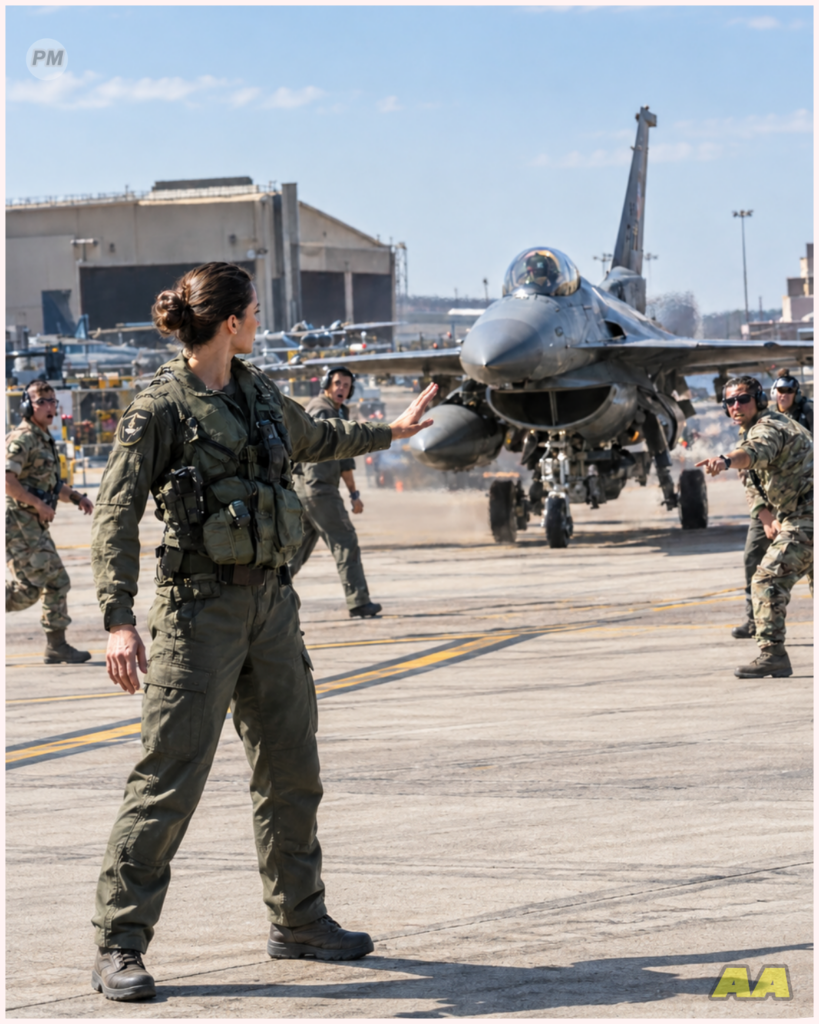
The base didn’t stop for her. That was the first thing anyone noticed, or rather, didn’t notice.
Major Diane Galloway stepped through the front gate of Vance Air Force Base on a Tuesday morning in late October carrying a single duffel bag and a leather folder tucked under her arm.
No escort. No announcement over the PA. The security officer checked her ID, compared it to a printed list, and waved her through with the same flat expression he gave delivery drivers.
She preferred it that way. The base was alive with the energy of a new class cycle.
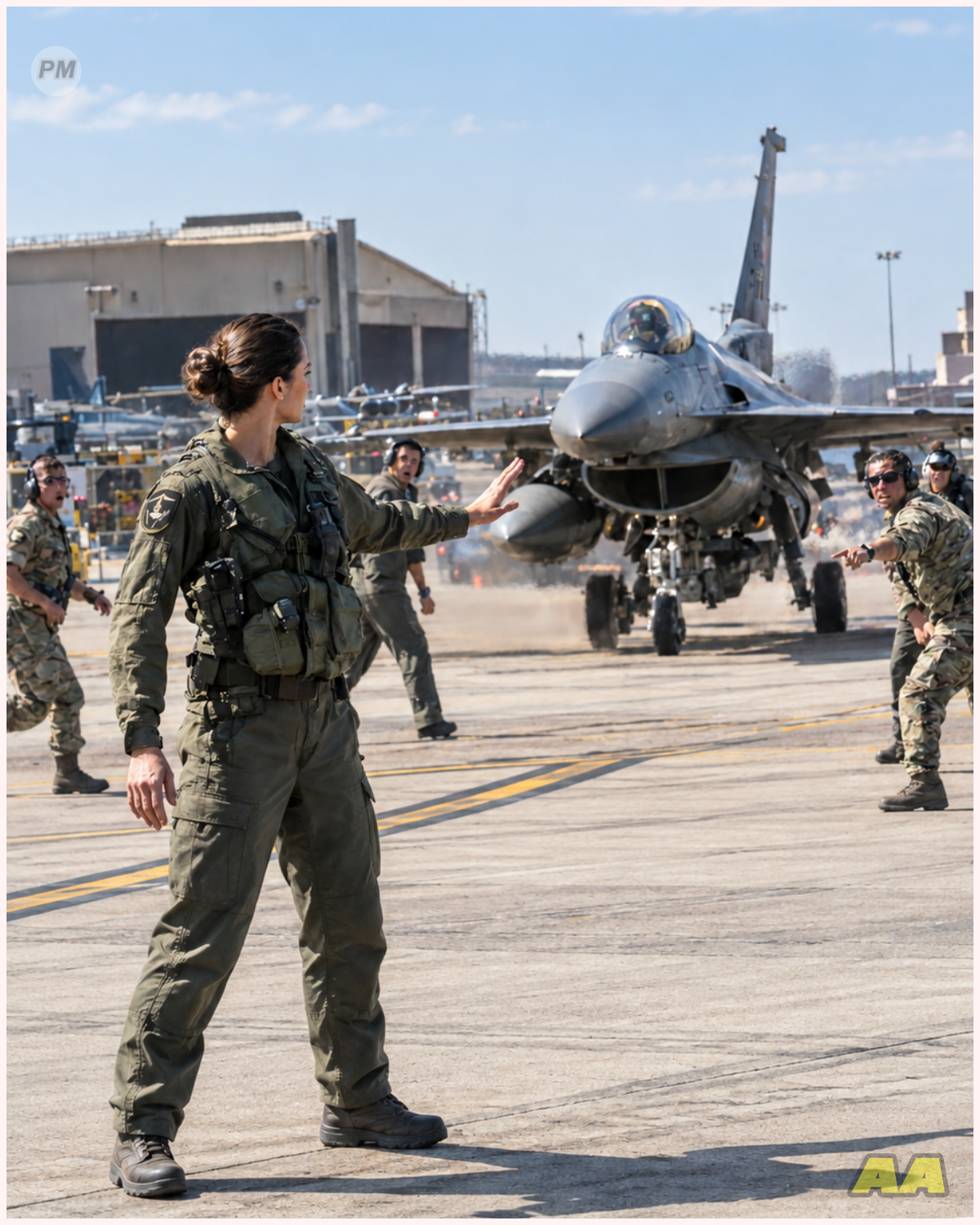
18 student pilots had arrived the week before, young, sharp-eyed, and already sizing each other up like athletes before a championship game.
Their laughter carried across the tarmac as Diane walked the long path toward the instructor building.
She watched them from a distance without slowing down. She noticed the one who stood slightly apart from the group, tall, arms crossed, watching the others with quiet calculation.
She filed that away and kept walking. Her office was small. One window, one desk, one chair that squeaked when she sat in it.
A previous instructor had left a motivational poster on the wall, a fighter jet banking hard over a sunset with the words push your l i m i t s printed in bold across the bottom.
Diane looked at it for a moment, then turned to her desk without touching it.
She spent the first two hours reading personnel files. Not the impressive parts, not the test scores and commendations.
She read the incident notes, the near misses, the moments where a student had flinched, overcorrected, or gone silent under pressure.
Those were the pages that told the truth. By noon, she had a working picture of every student in the class.
She ate lunch alone in the cafeteria, and that was when the first real judgment came.
Two senior instructors sat two tables away, both men, both with the easy, loud confidence of people who had never felt out of place in any room they’d entered.
One of them, Captain Ray Breslow, glanced over at her and leaned toward his colleague.
That the new instructor they brought in for flight fundamentals. Apparently, “Huh?” Breslow picked up his fork.
“Looks more like a librarian than a throttle jockey.” His colleague laughed. Diane heard every word.
She took a sip of her coffee, set the cup down carefully, and returned to reading the file open beside her tray.
That evening, after the base had gone quiet and the hallways of the instructor dormitory were empty, Diane sat on the edge of her bed in the dark for a long moment.
Then she reached under the mattress and pulled out a flat metal case, the kind used for documents, not weapons, though it had survived conditions meant for both.
She set it on her lap without opening it immediately. Outside, a training jet taxied slowly across the far runway, its navigation lights blinking red and green in the dark.
She watched it through the window. Then she opened the case. Inside was a single folded document, official, government-issued, with a classification header at the top that had been partially redacted with thick black ink.
Below the redaction, in precise military type, was a citation. She had not read it in four years.
She didn’t read it now, either. Her eyes settled on the bottom of the page, where three lines remained fully visible beneath the redacted body of text.
Demonstrated extraordinary judgment under direct fire conditions. Actions prevented catastrophic loss of life. Saved the squadron.
She stared at those three lines for exactly the amount of time it took the taxiing jet to disappear around the far hangar.
Then she folded the document, placed it back in the case, and slid it under the mattress.
She lay back on the bed and stared at the ceiling. Tomorrow she would meet the class officially.
Tomorrow she would stand at the front of a room full of people who had already decided what she was, what she could offer, what she knew, what she was worth.
She had stood in front of rooms like that before, in briefing tents with sand coming under the door, in command posts where the electricity cut out mid-sentence, in cockpits where the instruments were lying and the ground was rising, and the only thing between 19 lives and a hillside was a single correct decision made in the space of a breath.
She had stood in all of those rooms. She could stand in one more. She closed her eyes.
Somewhere across the base, in the student barracks, Cadet First Class Marcus Holt was still awake, still studying, still sharpening the edges of an ambition that had never once been told it had a ceiling.
Neither of them knew yet what the next few weeks would cost them. The classroom smelled like dry erase markers and ambition.
18 students were seated when Diane walked in at 800 exactly, not a minute early, not a second late.
She set her folder on the desk, uncapped a marker, and wrote one thing on the whiteboard.
A jet doesn’t care how good you think you are. She turned around. 18 faces looked back at her, some curious, some politely skeptical, and one in the second row near the window openly unimpressed.
That one was Marcus Holt. She had recognized him immediately as the student she’d clocked from the tarmac the day before.
Up close, he was even more deliberate, every feature composed, every posture choice intentional. He had the look of someone who had been the smartest person in every room he’d ever entered and had quietly come to expect it.
“Flight fundamentals begins today.” Diane said. “Not in a jet. Here. Because most of the mistakes that kill pilots happen before they ever touch a throttle.”
She moved through the opening material steadily, threat assessment frameworks, situational awareness protocols, the specific cognitive patterns that caused experienced pilots to make fatal errors under stress.
She didn’t perform. She didn’t try to impress. She taught the way a surgeon operates, precisely, without waste.
For 40 minutes, the room was with her. Then Marcus raised his hand. “Instructor Calloway.”
His voice was respectful on the surface, calibrated underneath. “I have a scenario question.” “Go ahead.”
“You’re flying close air support. Your hard deck is 1,200 ft. You’ve got a multi-threat environment, two active MANPADS on the northern ridge, a technical vehicle moving fast on the valley floor, and your wingman’s communication just dropped.
Your targeting system is giving you a degraded solution on the vehicle. You’re in a 7° dive.
What’s your decision sequence?” He sat back slightly. The room shifted. It was a sophisticated question, layered, technical, and designed with the specific architecture of a trap.
Several students glanced at each other. Breslow’s comment from the cafeteria had circulated by breakfast.
The class had already made its assessment. Diane didn’t pause. “First decision is altitude discipline.
You don’t break the hard deck regardless of the targeting solution because a degraded hit is recoverable and controlled flight into terrain is not.
Second decision is threat priority. The MANPADS are your survival problem. The vehicle is your mission problem.
You don’t solve the mission problem if you’re not alive to make the next pass.
Third decision is communication protocol. Your wingman’s radio drop is either equipment or interference. You execute a visual check pass before assuming incapacitation.
Fourth decision is the targeting solution. Degraded doesn’t mean unusable. You assess the cone of error against the collateral damage radius and make a weapons release call based on that math, not on the system’s confidence rating.
She held his gaze. In a 7° dive with those threat conditions, the entire decision sequence takes approximately 4 seconds.
If it’s taking you longer, you started too late. The room was completely silent. Marcus’s expression hadn’t changed, but something behind his eyes had shifted.
A small, precise recalibration, like a scope being adjusted by a single click. “That answer comes from somewhere specific,” he said.
Not a challenge this time, something else. “Most answers do,” Diane said, and moved on to the next slide.
She finished the session without incident. The remaining material landed well. She could feel the classes’ engagement shifting from polite to genuine as the hour progressed.
By the end, three students were asking follow-up questions that went beyond the curriculum. She answered each one with the same flat, unhurried precision.
When she dismissed the class, the students filed out with the slightly dazed energy of people who had expected one thing and received something entirely different.
Marcus didn’t file out. He stayed in his seat until the room was empty. Diane was gathering her materials, back half turned when he spoke.
Were you ever in theater? She stopped. Not because the question surprised her, she had been waiting for some version of it since the moment she wrote the scenario answer on the air.
She stopped because she was deciding something. What to give, what to keep. She picked up her folder.
“Class tomorrow is 7:45,” she said. “Don’t be late.” She walked out. Marcus sat alone in the empty classroom for a long moment, staring at the whiteboard where her opening line was still written.
“A jet doesn’t care how good you think you are.” He read it twice. Then he pulled out his notebook and wrote something down, not course material, something else.
Three words. He didn’t show anyone what he’d written. But that night, for the first time since arriving at Vance, Marcus Holt couldn’t sleep.
The aircraft had a name before it had a problem. Iron Veil was an F/A-18 variant fitted with a next generation adaptive interface system, an onboard diagnostic AI designed to monitor, assess, and in certain failure conditions, restrict pilot control authority.
It was part of a broader Air Force modernization program. Three bases had the aircraft.
Vance had one. And for 6 weeks, that one had been sitting in Hangar 7 like a locked room nobody could figure out how to open.
It wasn’t mechanical. Maintenance had confirmed that three separate times, every physical system checked out.
Hydraulics, avionics, engines, electrical clean across the board. The problem lived in the adaptive interface, which kept flagging errors that didn’t correspond to any detectable fault.
When pilots attempted to run the full systems authorization sequence, the procedure required before the aircraft would release flight control to a human, the AI would process the input, run its assessment cycle, and then simply stop.
No override. No error code beyond a single blinking amber light on the left console that no one in the manual could locate a reference for.
Three senior instructors had attempted the authorization sequence. All three failed. The base commander, Colonel Adler, was running out of patience and explanations.
The aircraft represented a significant training asset, and it had been unavailable for nearly half a class cycle.
He had submitted two requests to the manufacturer’s technical team. Both responses said the same thing.
System operating within design parameters. No fault detected at diagnostic level. Which was either reassuring or completely unhelpful, depending on your perspective.
On a Thursday morning, 10 days into the new class cycle, Diane was handed an assignment sheet by the operations coordinator.
She looked at it without expression. “They want me to evaluate Iron Veil.” “Not fly it.”
The coordinator said quickly, as if preempting an objection. “Just evaluate. See if you can identify what the other instructors might have done differently during the authorization sequence.
Fresh eyes.” Diane nodded, folded the sheet, and walked to Hangar Seven. Chief Master Sergeant Dale Oakhafer was waiting beside the aircraft, a compact, precise man with 22 years of aircraft maintenance experience and the specific kind of patience that comes from spending two decades fixing things that shouldn’t have broken.
He had personally overseen both maintenance checks on Iron Veil and had developed a professional grievance against the aircraft that bordered on personal.
“She’s all yours.” He said with the tone of someone handing over a problem they were glad to be temporarily rid of.
Diane walked a slow circuit around the aircraft first. She wasn’t checking for physical faults.
Maintenance had handled that. She was looking at the aircraft the way she looked at her students, reading what it was telling her rather than what she expected to find.
Then she climbed in. Okafor watched from the tarmac, arms crossed. A junior crew member beside him had pulled out his phone before catching Okafor’s look and putting it away.
Inside the cockpit, Diane did not immediately begin the authorization sequence. She sat with the aircraft for almost 90 seconds systems at standby, hands in her lap, doing nothing that would appear on any checklist.
Okafor frowned. The junior crew member exchanged a glance with a colleague. Then she began.
Her inputs were unhurried and completely methodical. She moved through the pre-authorization checks in a sequence that was technically correct but ordered differently than standard protocol, not wrong.
Just a specific interpretation of the procedure that prioritized certain system handshakes ahead of others.
It was the kind of sequence you develop through experience with a particular aircraft type rather than through the manual alone.
Two minutes in, the amber light on the left console flickered. At 3 minutes, the adaptive interface ran its assessment cycle, the same cycle that had stalled every previous attempt.
It didn’t stall. At 4 minutes and 18 seconds, every flagged system cleared simultaneously. The authorization complete tone sounded, a clean, ascending two-note signal that Akhafer had not heard from this aircraft in 6 weeks.
Full control authority transferred to the cockpit. Akhafer’s radio crackled. The tower operator, who had been monitoring the hangar feed out of routine habit, came on the line.
Akhafer, are you seeing green across the board down there? Akhafer was already staring at the indicator panel visible through the hangar’s monitoring station window.
Every light was green. He keyed his radio slowly. Yeah, he said, I’m seeing it.
Diane climbed out of the aircraft with the same unhurried composure she’d carried in. She handed Akhafer a single handwritten note, four lines, her observations on the authorization sequence, and a suggested adjustment to the standard procedure checklist.
Then she told him she’d file a formal report by end of day, and walked out of the hangar toward the cafeteria.
Akhafer stood on the tarmac holding the note. He looked at the aircraft. He looked at the note.
He looked at the door Diane had walked through. He keyed his radio again. I don’t know what she did, he said to the tower, but it’s green across the board.
By dinner, every crew chief on the flight line had heard the story. By the next morning, the students had, too.
The base had its own nervous system. Not the official one, not the command structure, or the reporting chain, or the communication protocols.
The real nervous system, the one that carried information through hallways and break rooms, and the 2-minute window between a briefing ending and the next one starting.
And the information moving through it now had a name attached. Callaway. It started with the Iron Veil story, which took less than 24 hours to reach every corner of the base in a form that had already grown slightly larger than the original event.
By the second day, the detail about her sitting in the cockpit without touching anything for 90 seconds had become a minute 45.
By the third day, some versions had her talking to the aircraft. Nobody added that detail maliciously.
It simply attached itself to the story the way details do when a story outgrows the facts that started it.
But curiosity, once ignited, doesn’t stay contained. A records administrator named Specialist Tara Blount, not the most discreet person on the base, though she would have argued otherwise, ran Diane’s service number through a public military personnel archive during her lunch break.
What she found was unusual enough that she mentioned it to two people before she’d finished her food.
The record existed. That part was normal, but large sections of it, not just a classification marker at the top, but entire chronological blocks spanning an 18-month period, were restricted above the standard instructor access level.
Not sealed entirely, just walled off. The kind of wall that meant the information existed, but wasn’t for most people.
That absence said more than a record full of text. The whispers got more specific 2 days later when a Pentagon communications officer, Major Leon Ferris, arrived at Vance as part of a joint exercise coordination team.
Ferris was experienced, composed, and not given to visible reactions. He had been at Vance for 6 hours when he walked past the instructor board in the main corridor, a whiteboard where current instructor names and room assignments were listed, and stopped walking.
His colleague, who had been mid-sentence, turned around. “You all right?” Ferris was staring at a single name on the board.
“Yeah,” he said after a moment, “fine.” That evening at dinner, someone who had seen Ferris stop at the board asked him if he knew instructor Calloway.
The table was casual, the question offhand. Ferris picked up his water glass. “I can’t discuss that,” he said, and changed the subject with the practiced ease of someone who had given that answer before.
He said nothing else about it for the duration of his stay, but the person who had asked the question told two others before the night was over.
Marcus Holt was not part of the rumor network. He found rumors inefficient. He preferred primary sources.
He had been building a file, not officially, not with any authorization, just in a plain notebook he kept in his jacket pocket, since the day Diane had answered his scenario question with the precision of someone who had lived it.
He wasn’t trying to undermine her. He wasn’t sure what he was trying to do.
He only knew that the feeling she produced in him, a specific unfamiliar unease, like standing on ground he thought was solid and feeling it shift slightly underfoot, was a feeling he didn’t know how to categorize, and he didn’t leave things uncategorized.
He found one piece of information through entirely legitimate means, a decommissioned Air Force incident report from 2014, filed in a public defense archive as part of a policy review document.
The mission details were fully redacted. The outcome was redacted. The location was redacted. Two things were not redacted.
The call sign assigned to the lead aircraft, Ghost Lead. And the name of the pilot, D.
Callaway. Marcus sat with that page for a long time. He didn’t share it with anyone.
He put it in his notebook and closed it and went to evening training. But during the final simulator session, his instructor noted something in the evaluation log that had never appeared in Marcus’s file before.
Student appeared distracted. Performance uncharacteristically inconsistent in final sequence. Recommend monitoring. Marcus didn’t see the evaluation log, but he felt the session.
He knew something had moved in him. Some certainty he’d carried without examining it had developed a crack.
He didn’t know yet if that was a weakness or the beginning of something else entirely.
He went back to his room and opened the notebook again. Ghost Lead. He stared at the name until the lights out signal came over the PA.
Command had been planning the exercise for 3 weeks. It was called Redline Echo, a multi-aircraft intercept scenario run entirely within the advanced simulation facility using full-scale cockpit pods with live electronic warfare jamming built into the environment.
18 students would be divided into three flights and tasked with neutralizing a layered air defense network while managing communication degradation and changing threat conditions in real time.
The exercise was designed to be hard. It was designed to expose gaps. Nobody expected it to break down the way it did.
The students were sharp at the start. Marcus led his flight with the controlled efficiency that had made him the class’s acknowledged top performer, and his two wingmen tracked his calls cleanly.
The other flights performed at roughly expected levels. Some hesitation, some communication lag, but nothing catastrophic.
Then, at the 11-minute mark, the electronic warfare package escalated beyond its programmed parameters. It was a systems malfunction, not a designed element of the exercise, not an instructor decision.
A calibration error in the jamming module caused the U output to spike significantly beyond its intended range.
Inside the simulation, the student pilots lost most of their avionics simultaneously. Communications between flights collapsed.
Two students, suddenly flying blind in a degraded cockpit environment, defaulted to procedures that contradicted each other and created a simulated midair conflict flag.
A third student froze entirely, hands off the controls, staring at a screen full of error indicators.
Marcus, to his credit, kept calling, but with no communication reaching the other flights, his calls went into silence.
In 11 minutes, the scenario was effectively over. Every objective was lost. But the malfunction didn’t stop when the simulation ended.
The U jamming module’s output was still elevated, and it was now bleeding real frequency interference into the base’s communication infrastructure.
Not catastrophically. The base had isolation protocols, but two actual aircraft currently in the traffic pattern began receiving ghost signal returns on their approach systems.
Ghost returns on approach. The specific dangerous scenario where an aircraft’s instruments show false traffic that isn’t there, causing pilots to maneuver away from a phantom and potentially into something real.
In the observation room above the simulation floor, Diane was watching. She had been watching the entire exercise without speaking.
That was standard. Instructor intervention wasn’t authorized during redline scenarios. But when the base communication officer, two seats down from her, picked up his radio with the specific urgency that meant something had crossed from simulation to real, she was already moving.
She didn’t take the radio from him. She sat beside him and she said, “Let me talk to the aircraft.”
He looked at her for half a second. She looked back. He handed her the radio.
Her voice, when she keyed the mic, was completely flat. Not emergency flat, not the compressed stillness of someone suppressing panic.
Genuinely flat. Calibrated. The voice of someone who had spoken in worse conditions than this and knew that tone was the first thing a pilot in a degraded situation needed to hear.
“Vance Tower, Iron Rider flight, this is instructor Callaway on guard. I have your ghost signals.
Stand by for correction sequence.” She walked the two approach aircraft through a specific instrument cross-check procedure, a non-standard sequence that isolated the corrupted frequency input and allowed the pilots to separate real returns from false ones.
While she was doing that, she was simultaneously issuing a frequency isolation call to the base communication center, identifying the exact spectrum range where the yield bleed was occurring.
From the first word she spoke to the moment both aircraft confirmed stable approaches, 7 minutes passed.
Seven minutes. The simulation floor below was completely silent. 18 student pilots were standing in their cockpit pods or sitting on the floor, some still wearing headsets, watching through the observation window as an instructor they had spent two weeks underestimating talked two real aircraft safely home with the unhurried precision of someone filing routine paperwork.
When it was over, Diane set down the radio and looked at the communications officer.
Your isolation protocol needs a faster trigger threshold on the EO module. I’ll put it in the incident report.
He nodded. He didn’t seem entirely sure what to say. She stood up, smoothed her jacket and walked to the door.
Colonel Adler was standing in the doorway. He had arrived during the last two minutes and had watched the final sequence from the threshold without making a sound.
My office, he said quietly. Yes, sir, Diane said. He stepped aside to let her through.
The door closed behind them both. Colonel Adler’s office had a view of the main runway.
He didn’t sit behind his desk when Diane came in. He stood at the window with his hands clasped behind his back and watched a training flight execute a touch-and-go in the middle distance.
She stood at ease near the door and waited. I read your record, he said finally.
As much of it as my clearance allows. Yes, sir. There’s a significant portion I can’t access.
Yes, sir. He turned from the window. His expression wasn’t what she’d expected. Not the careful scrutiny she’d prepared for.
Not skepticism or calculation. He looked tired in the way of someone who had spent a time carrying a question they hadn’t known how to ask.
“Are you here to teach or are you here because someone sent you?” “I’m here to teach,” she said.
“No one sent me.” He held her gaze for a moment, then nodded once, the kind of nod that was also a decision.
“All right,” he said. She was almost to the door when he spoke again. “The two aircraft you talked down today, both pilots asked who they were talking to.”
She paused. “What did you tell them?” “I told them an instructor,” he said. “That seemed to cover it.”
She left. Four days later, a government vehicle arrived at the base’s visitor entrance. No advance notice, or if there had been advance notice, it hadn’t reached the general population of the base.
A two-star general named Major General Arthur D. Stepped out, accompanied by a single aide.
He was 61 years old, heavy through the shoulders, with the deliberate movement of a man who had once been fast and had learned to trade speed for weight.
He had served in theater during the same period covered by Diane’s redacted record. He had commanded the ground element whose position had been marked on the targeting maps during the Ghost Lead incident.
He and Diane met in a conference room that had been cleared by Adler without explanation to the staff who normally used it.
The meeting was not recorded. The aide waited in the hallway. No one knew exactly how long it lasted.
Estimates from the base staff, who tracked such things, ranged from 22 to 30 minutes.
What the base staff did know was what happened when the door opened. General D.
Stepped out first. He turned and Diane followed him into the hallway. He extended his hand.
She took it. He covered it with his second hand, both hands around hers, the way a person holds something they nearly lost and are only now allowing themselves to acknowledge.
It had nothing to do with rank. It had nothing to do with protocol. It was the handshake of a man who had watched 19 soldiers come home from a hillside and spent 12 years knowing exactly why they had.
He said something to her quietly. She nodded once. Then he walked down the hallway toward the exit, and Diane walked in the opposite direction toward the classroom wing.
Word moved through the base’s nervous system within the hour. Someone had seen the general.
Someone else had identified him. A third person had accessed a public record that linked his command history to a specific operational period in a specific theater of operations.
A fourth person matched that period to the gap in Diane’s file. The picture assembled itself without anyone intending to assemble it.
By evening, enough pieces were in circulation that the outline was clear, even without the classified details that remained locked away.
An 11-minute window. A convoy cut off from support. A close air support aircraft with half its avionics destroyed by ground fire.
A single pilot who had remained in a combat environment that any reasonable evaluation would have called unsurvivable.
Flying a degraded jet at an altitude and speed that the textbook said couldn’t generate a targeting solution, and generating one anyway.
19 soldiers. All of them home. And a pilot who had filed her post-mission report with the same flat precision she brought to everything else, requested reassignment to training command, and never said another word about it to anyone who wasn’t already read in.
Marcus Holt heard the last piece of the story from two different sources in the same hour.
He sat on his bunk that night with his notebook open to the page that said ghost lead.
He stared at the call sign for a long time. Then he closed the notebook and put it in the drawer.
He didn’t need it anymore. The simulation bay was empty at 2300 hours except for the standby lighting and the low hum of systems on idle.
Marcus had badged in with his student access, which technically authorized after hours use of the facility for individual study.
He wasn’t sure what he was studying. He sat in pod three, the one assigned to his flight position during red line echo, and pulled up the recorded data from the exercise.
Not his own flight data, all of it. Every pod, every decision sequence, every moment where someone had frozen or overcorrected or called the wrong procedure.
He sat with it for two hours. What he saw, once he stopped watching it as a performance review and started watching it as something else, as evidence, was a pattern that included him.
He had been clean in the technical execution. His calls had been correct. His sequencing had been by the book.
And he had been, in three specific moments, choosing what would look right over what would work best.
The differences were small. A half-second delay on a wingman check because his own targeting solution was cleaner and he hadn’t wanted to break his rhythm.
A communication call worded for clarity rather than speed because the phrasing sounded more composed.
A threat prioritization that was defensible but was also, if he was honest, if he was really honest, the choice that kept his engagement record cleaner rather than the choice that best served his flight.
Nobody would have flagged those moments. His evaluations were excellent. His reputation was intact. But he had seen what Diane did with 7 minutes and a borrowed radio.
He had seen what precision without performance looked like. He requested the private evaluation session the next morning.
Diane said yes without asking why. They met in briefing room four at 1400 hours on a Friday.
She arrived with nothing except a coffee. He arrived with three pages of notes he had prepared covering the specific decision points he wanted to address.
She looked at the notes without picking them up and then looked at him. “Tell me about the first time you almost didn’t make a call you should have made.”
She said. He set the notes aside. He talked for 20 minutes. Not about Redline Echo, further back than that.
A training flight eight months ago before Vance when he had been the lead on a formation exercise and had identified a potential airspace conflict 40 seconds before it became critical.
He had resolved it. But for four of those 40 seconds, he had calculated how to resolve it in a way that wouldn’t appear in his evaluation as an error detection because the error had originated from his own flight plan.
4 seconds of protecting the record instead of flying the aircraft. “Nobody saw it.” He said.
“You saw it.” Diane said. He looked at her. “That’s why you’re here.” She said.
She walked him through his Redline data then, not with the data he’d reviewed with her observations from the observation room.
She identified the same three moments he had found himself plus one he had missed.
She described each one without heat, without judgement, and without softening the implications. “In a real environment,” she said at the third one, “you lose your wingman there.
Not probably, not maybe, you lose him because you were flying your record instead of flying your aircraft.”
He didn’t argue. He felt the words go in cleanly, the way a correct instrument reading goes in, not welcome necessarily, but undeniable.
When it was over, the room was quiet for a moment. Then he asked her the question he had been carrying for two weeks.
“Why didn’t you tell anyone who you were?” She set down her coffee. “Because who I am is not what I did,” she said.
“The citation, the record, the call sign, that’s a moment. 11 minutes. It happened and it’s real, but it’s not what I am.
What I am is what I do every day that isn’t that moment.” She looked at him steadily.
“And the best pilots I ever flew with understood that before they ever left the ground.
They didn’t fly to build a record. They flew to bring everyone home. When that’s the mission, really the mission, not the performance of it, you make different calls.
Better calls.” She stood and picked up her coffee cup. “You already know how to be good,” she said.
“That’s not the problem. The problem is you don’t quite trust good enough yet. You keep reaching for exceptional because you’re afraid good might not be enough.”
She paused at the door. “Good enough to bring everyone home is the only exceptional that matters.”
She left. Marcus sat in the empty briefing room for a long time. Then he opened a new page in his notebook.
Not the one with ghost lead on it, the other one, and wrote a single sentence that he would not show anyone for a very long time.
Outside the base was running its evening cycle. Jets on the flight line were being fueled for tomorrow’s training sorties.
The hangar where Iron Veil lived was lit from the inside, golden light spilling out under the door.
Tomorrow was graduation week. Marcus put his pen down and looked out the window. He thought about 19 soldiers on a hillside.
He thought about 11 minutes. He thought about what it meant to fly for something bigger than your own record.
And for the first time since arriving at Vance, he felt the particular, terrifying, clarifying feeling of understanding exactly what he was supposed to be doing.
Nobody scheduled the dawn flight. That was the first thing Okafor said afterward. He said it several times to several different people with the specific emphasis of a man who wanted the record to be accurate.
There was no flight order. No authorization logged before 4:45. He had come in early to complete a pre-cycle inspection on a different aircraft and had seen the lights on in hangar seven.
He had walked over. Diane was already in Iron Veil’s cockpit, running the pre-flight sequence.
The hangar doors were open to the pre-dawn dark. The tarmac outside was empty. The base’s morning cycle wouldn’t begin for another 90 minutes.
Okafor stood at the hangar entrance and watched. The aircraft taxied out at 4:52. No tower communication logged until she was already at the runway threshold, at which point she gave a standard position call that the overnight controller acknowledged with the vague attention of someone not expecting traffic.
She took the runway. And then she flew. Okafor walked out onto the tarmac as the aircraft climbed away from the field, its lights rising into a sky that was still more dark than light.
He stood with his hands in his jacket pockets and watched. He couldn’t evaluate what she was doing technically.
He was a crew chief, not a pilot. But he had spent 22 years around aircraft and the people who flew them, and he could read intent in the air the way a conductor reads intent in a musician.
He had watched a hundred pilots run morning solo flights, some crisp, some workmanlike, some that felt like training and some that felt like practice.
This felt like neither. The aircraft moved through the predawn sky with a quality of something finishing a thought.
Every maneuver connected to the next one without pause, without the slight hesitation that marks calculation.
It was not a demonstration. It was not an evaluation. It was a pilot and an aircraft in complete agreement with each other, moving through an environment they both understood completely, doing the thing they had always been built to do.
It lasted 23 minutes. She landed at 5:16, taxied back to hangar seven, and shut down.
Okafor was waiting at the bottom of the ladder. He didn’t say anything. He wasn’t sure what he would have said.
She climbed down, and when she reached the tarmac, she stood for a moment with her hand still on the ladder rail.
She looked at the aircraft the way you look at something you are leaving rather than something you have finished with.
Okafor would describe that look later as the only moment he had ever seen Dianne Callaway look like what she actually was.
Then she picked up her bag and turned toward the flight line. And stopped. The students were there.
Not all of them, not yet. Eight, then 12, then all 18 as the ones who had come first had clearly gone back and woken the others.
They were in various states of dress, some in uniform, some in PT gear, some in what they’d clearly thrown on in the dark.
They had come from the barracks, which meant someone had seen the aircraft lights and known.
Marcus was at the front. None of them had planned it. Diane could see that immediately.
It had the texture of impulse, of something that had simply happened because it couldn’t not happen.
They had watched the flight from the flight line fence. They had walked out to the tarmac as she landed without discussing it among themselves.
And now they were standing at attention. Not the rigid performance attention of a formal ceremony.
The other kind, the kind that has nothing to do with rules and everything to do with recognition.
18 student pilots, some of them barely awake, standing in the cold pre-dawn air in front of a woman they had spent 3 weeks learning to understand.
Diane looked at them. Akif standing behind and to her left, watched her face. She was quiet for a long moment.
The tarmac was still. The sky above the eastern tree line was just beginning to show the first gray of dawn, not light yet, only the absence of dark.
She did not salute. She did not give a speech. She did not perform the moment because she had never performed any moment, and she was not going to start with this one.
She simply looked at them, all of them, each of them, with the steady, specific attention of someone who had learned every student’s file before their first class and had not stopped watching them since.
Then she nodded once, picked up her bag, and walked toward the classroom building. Marcus watched her go.
Behind him, the class held their position for a few seconds after she had turned away, as if releasing the moment required a consensus none of them had to speak.
Then, one by one, they stood easy. No one said anything for a while. Finally, a student named Yuna Chen, who was standing two people to Marcus’s left, and who had said less than almost anyone during the class cycle, said quietly, “She was never hiding.”
Marcus looked at her. “We just weren’t looking right,” Yuna said. He thought about that.
He thought about 19 soldiers, about 11 minutes, about 4 seconds of flying his record instead of flying the aircraft, and the moment in a briefing room when someone had told him the truth about it without raising her voice.
He thought about an aircraft that had refused every authorization sequence until the right person climbed in, not because the system was broken, but because the system was doing exactly what it had been designed to do, waiting for a match it could trust.
The jet had always known. It had just taken everyone else a little longer. The sun broke the tree line as the class walked back across the tarmac, not in formation, just walking together in the early morning light.
Inside the classroom building, in a small office with a squeaking chair and a motivational poster she had never taken down, Diane Callaway opened her folder for the morning session.
The next class cycle began in 3 weeks. She had a lot of work to do.