The hunt was over
The hunt was over. The man who had kept the desert in fear for years was now blinking helplessly in the light of electric lights, returning to the civilization he hated so much.
The trial of Caleb Lester, which began in March of 2013, did not become the sensation [music] that journalists had hoped for.
There were no emotional confessions, no cries of remorse, and no attempts [music] to justify themselves in the courtroom.
The defendant, who had been shaved for the first time in 45 years and dressed in a [music] clean prison jumpsuit, was present at the hearings only physically.
His gaze was directed through the judge, through the jury, and through the walls, focusing on something only he [music] could see.
During the entire trial, Caleb did not say a single word. He did not respond to his lawyer’s appeals and did not show [music] any emotion when the prosecutor showed photos of underground cells and torture tools.
The forensic psychiatric examination which lasted several months came to an unequivocal conclusion. The suspect suffers from a deep form of paranoid schizophrenia [music] complicated by complete social maladjustment and the consequences of being raised in a totalitarian cult.
The jury [music] agreed with the doctor’s conclusions. Caleb Lester was found insane due to a severe mental disorder.
Instead of life imprisonment in a regular prison, the court decided to send him to the Patent State Hospital, [music] a closed psychiatric hospital for an indefinite period.
In their reports, the staff of the institution notes that Lester is a model patient, [music] but completely unreachable.
He spends his days sitting on the floor of his room and staring at a single point on the wall.
Sometimes he runs his finger along the soft upholstery [music] of the walls as if drawing invisible dungeon maps and continues to live in his cave where no one else has access.
Meanwhile, hundreds of kilometers away from the hospital at her parents’ home in Los Angeles, Rebecca Ellis was trying to return to a reality that had become alien to her.
Physically, she was safe. The wounds on her legs had healed. Her hair was growing back, and her weight was gradually returning to normal.
But mentally, she was still trapped in a stone sack. Rebecca’s parents, who had dreamed of this moment so much, faced a terrible truth.
Returning home was not the end of the nightmare, but only the beginning of a new struggle.
The family’s everyday life turned into a minefield. Rebecca categorically refused to sleep on the bed.
A soft mattress caused her panic attacks because for 2 years, her body had become accustomed to hard stone.
Every night, her parents found their daughter sleeping on the bare floor in the corner of the room, curled up in a fetal position without a pillow or blanket.
Nutrition became an even bigger problem. Rebecca could not eat hot food. The steam coming from soup or tea triggered her vomiting reflex.
She would only accept cold canned food, crackers, and water, pouring it only into a metal mug.
Psychologists explained this as deeply rooted in the habits imposed by the kidnapper. In the bunker, hot food was an unattainable luxury, and any comfort was considered a sin.
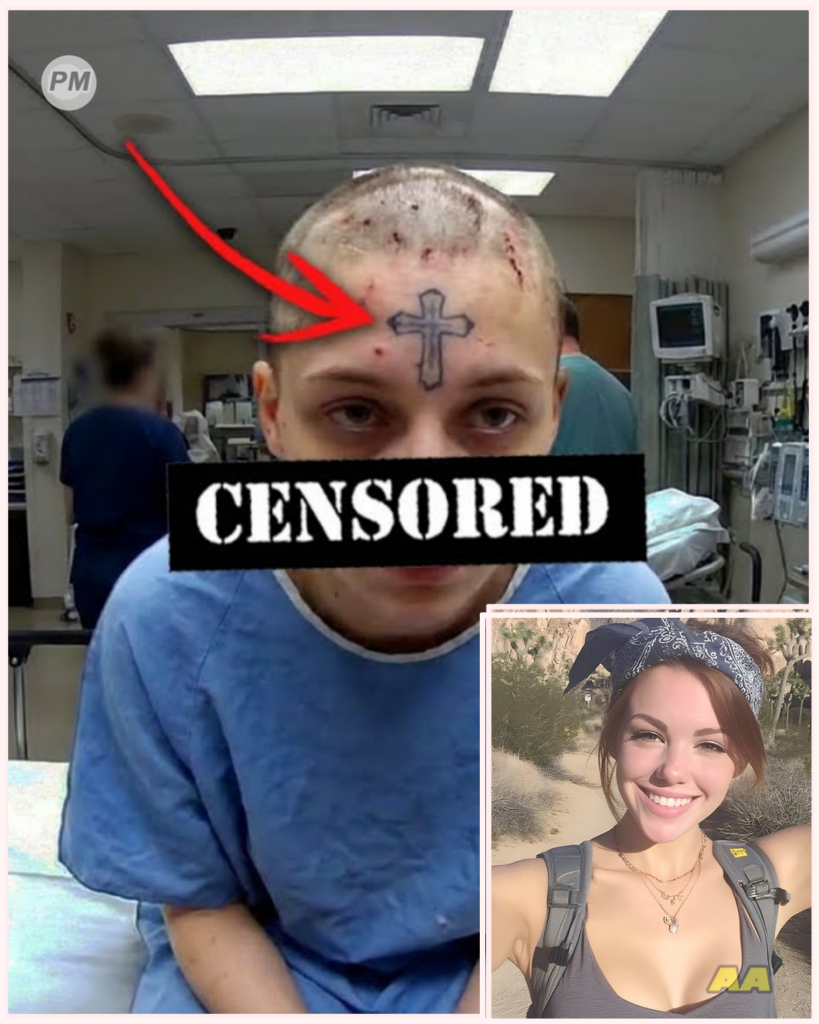
But the dark blue cross on her forehead remained the most terrifying reminder of her experience.
In the first months after her release, doctors offered to perform a laser tattoo removal procedure at the expense of charitable foundations.
Rebecca’s reaction was immediate and aggressive. She covered her forehead with her hands and started screaming, begging them not to touch the mark.
Medical records record her words during one of the therapy sessions. Without it, he won’t find me.
If you wash this off, I will be lost in the dark and my father will not come for me.
It was a classic manifestation of Stockholm syndrome intertwined with mystical fear. Caleb had so deeply integrated into her mind the idea that light is death and he is the only salvation that even after her release, she subconsciously waited for his return, considering the tattoo her only protection and a pass to eternal life.
For the parents, these words sounded like a sentence, but the doctors insisted on patience.
Forced removal of the brand could have completely destroyed her fragile psyche. The rehabilitation process lasted for four long years.
It was a titanic work of a team of psychiatrists, rehabilitation therapists, and a loving family.
Step by step, using the methods of cognitive behavioral therapy, and soft hypnosis, the specialists destroyed the mental walls that Caleb had built in her head.
The turning point came one summer morning when Rebecca went to the mirror herself, ran her finger over the rough scar on her forehead, and for the first time ever told her mother, “It’s ugly.
I want it removed.” The tattoo removal procedure was painful and lengthy. It took more than 12 sessions to break up the deeply embedded pigment.
The skin resisted, but with each visit to the clinic, [music] the cross became paler until it turned into a barely noticeable white scar that could be hidden by makeup.
Today, Rebecca Ellis leads a life that looks quite normal from the outside. She works in a small library, sorts books, and avoids publicity.
She has reconnected with her friends and even started traveling, although she never goes near deserts or mountainous areas again.
She eats a hot dinner with her parents and sleeps on the bed. However, the shadow of the past hasn’t disappeared.
It has just changed shape. If you walk into her room at night, you can see a detail that reveals the truth about the price of her survival.
Rebecca Ellis, who spent 2 years underground in complete darkness, is now terrified of the dark.
She sleeps only with a bright light on. She has powerful lamps in every room of her apartment.
And even on sunny days, she never closes the windows. For her, darkness is no longer a time for rest.
It is now the monster’s territory, and light is the only thing that keeps its ghost at bay.
The story of the girl from Joshua Tree Park is over. But for her, every night is a new reminder that some mazes are impossible to escape [music] from completely.


