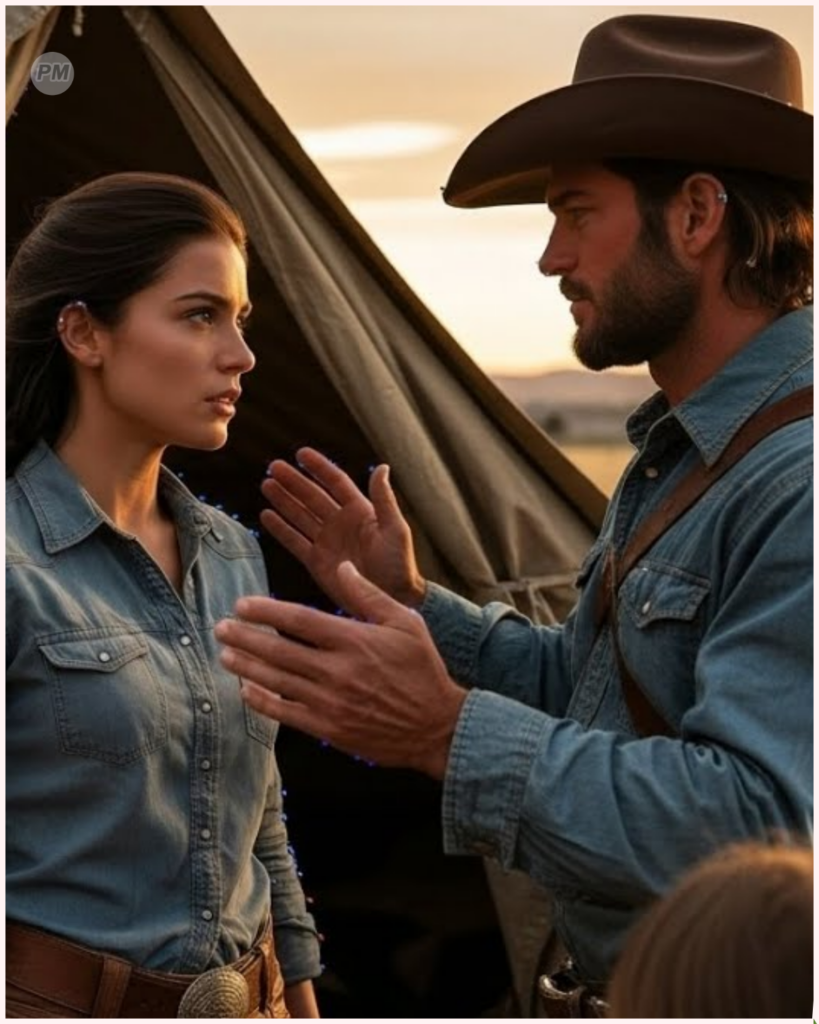
I can heat some here on the fire if you'd rather,…
I can heat some here on the fire if you’d rather, make it easier for washing up.
The consideration in the offer, the thoughtfulness of it, was almost more than Clara could process.
For 3 months, every small task had been a struggle, every basic need a challenge.
And now here was this man, this stranger, making sure there was warm water for washing, making sure the children were fed, offering them shelter and work and dignity.
It had to be too good to be true. In Clara’s experience, nothing came without strings, especially not from men.
But she was tired, so desperately tired, of fighting every moment of every day. Maybe, just maybe, she could accept this help.
Just for a little while. Just until she figured out what came next. Warm water would be appreciated, she said quietly.
Thank you. While Rowan heated water and finished preparing breakfast, Clara did her best to make her children presentable.
Their clothes from the night before were still damp, but wearable, and she dressed them carefully, trying to ignore how thin they’d become, how fragile they felt under her hands.
She combed Grace’s hair with her fingers, smoothed Samuel’s cowlick, helped Emma tuck in her dress.
They ate breakfast together around the small table, Clara and the children squeezing onto one bench while Rowan took the chair across from them.
It felt almost domestic, almost normal, like a real family having a real meal in a real home.
The feeling was so foreign after months of chaos that Clara had to focus on her food to keep from crying.
So here’s what I’m thinking, Rowan said once the children had demolished their portions and were eyeing the pot hopefully for seconds, which he served without hesitation.
Today we’ll get you settled in here properly. There’s blankets and such stored in the bunkhouse I can bring over.
Maybe another chair or two. Get your salvaged belongings dried out and sorted. Tomorrow, if you’re agreeable to my proposal, I’ll introduce you to Mrs.
Chen, and we can discuss the mending work. Clara swallowed her pride, her fear, her deeply ingrained suspicion.
That’s That would be acceptable. Thank you. Nothing to thank me for, Rowan said, but his eyes showed relief that she’d agreed.
You’ll be doing the ranch a service and earning your keep honestly. No charity involved.
After breakfast, Rowan left to tend to his regular duties. He was the foreman, after all, and had responsibilities beyond helping stranded widows.
But before he left, he showed Clara around the cabin more thoroughly, pointing out where various supplies were stored, explaining that the well was about 50 yards north and the outhouse was behind a stand of cottonwoods to the east.
I’ll be back this evening, he said from the doorway. Probably around sundown. If you need anything before then, the main ranch house is about a mile due east.
Just follow the creek. Mrs. Chen’s there, and she’s good people. Don’t be afraid to ask her for help if you need it.
Then he was gone, riding off on his sorrel mare, and Clara was left alone with her children in this cabin that felt simultaneously like salvation and like a trap she didn’t yet understand.
The day passed in a strange mixture of anxiety and relief. Clara kept herself busy cleaning the cabin, which was actually quite clean already, but gave her something to do, and sorting through the salvaged items Rowan had left on the porch.
He’d been right about most of it being ruined, but there were a few treasures that survived.
The tin box with their important papers, including the children’s birth certificates and her marriage certificate to Thomas.
The Bible, damp but readable. A small cloth doll that had been Emma’s, somehow caught on a shrub and not buried in mud.
Samuel’s wooden horse that Thomas had carved. Clara washed these precious few items carefully, reverently, laying them in the sun to dry.
These scraps of their old life, these small remnants of who they’d been before everything fell apart, felt more valuable than gold.
The children, freed from the constant stress of survival, played outside under Clara’s watchful eye.
She heard laughter, actual laughter, for the first time in months as they chased each other around the clearing, Grace’s delighted shrieks echoing off the cabin walls.
Even Emma loosened up, allowing herself to be 7 years old instead of the miniature adult she’d been forced to become.
In the afternoon, Clara washed their clothes in the creek, scrubbing them as best she could without soap, laying them on bushes to dry in the sun.
She washed herself, too, in the cold creek water that made her gasp, but also made her feel human again, removing 3 months of accumulated grime and desperation.
When Rowan returned at sunset as promised, he found them all sitting on the porch step, clean and fed.
Clara had figured out the cast iron pan and made a simple supper from the cabin stores, and looking more like a family than like refugees from disaster.
He stopped his horse a few feet away, taking in the scene, and something soft crossed his face.
You look settled, he observed. We’re managing, Clara replied, which was the most optimistic thing she’d said in months.
Rowan dismounted, reaching into his saddlebags. Brought some things from the bunkhouse, extra blankets, another pillow, some soap I thought you might need.
And Mrs. Chen sent over some clothes she thought might fit the children, hand-me-downs from the owner’s grandchildren, who visit sometimes.
Clara’s throat tightened. Charity again, dressed up as casual generosity, but charity nonetheless. She should refuse, should maintain her dignity.
But then she looked at her children in their worn, patched clothing and found she couldn’t form the words.
“That’s very kind of Mrs. Chen.” She managed. “She’s excited to meet you tomorrow.” Rowan said carrying the items inside.
“Fair warning, she’s a bit overwhelming at first. Talks a lot, moves fast, has opinions about everything, but she’s got a good heart and she runs that ranch house like a general runs an army.
You’ll like her once you get past the initial shock.” He helped Clara arrange the extra blankets on the bed, creating proper sleeping spaces for the children.
He set up the second pillow Clara had been planning to do without and placed the soap on the shelf near the water bucket with the same casual efficiency he brought to everything.
“There’s one more thing.” Rowan said when they were back outside, the children having gone to explore the creek one last time before dark.
He pulled a small leather pouch from his pocket, weighing it in his hand with an expression that suggested he was unsure how to proceed.
“This is awkward, but you mentioned having about $7 to your name. That’s not enough to get by on, even with the cabin and work.
So, I talked to Mr. Blackwood, the ranch owner, and explained the situation. He agreed to advance you the first week’s wages for the mending work.
It’s not much, maybe $10, but it should tide you over until you get properly established.”
He held out the pouch and Clara stared at it like it was a snake.
$10. Added to her seven, that was $17. More money than she’d had in her hand since Thomas died.
It represented food, supplies, security. It represented survival. But it also represented debt, obligation, the potential for strings she couldn’t see yet.
“I can’t accept that.” She said, even as every practical part of her screamed that she was being a fool.
“That’s too much. You I haven’t even done any work yet.” “It’s an advance.” Rowan said patiently.
“You’ll work it off. That’s how wages work, Clara. The ranch pays you, you do the work.
Mr. Blackwood’s just starting the cycle a bit early to help you get on your feet.”
“But what if I can’t do the work? What if Mrs. Chen decides I’m not suitable?
Then I’ll owe the ranch money I can’t repay.” Rowan sighed and for the first time she saw a flash of frustration cross his face.
“Why are you fighting this so hard? Why is it so difficult for you to accept help?”
“Because help always comes with a price.” The words burst out before Clara could stop them.
Three months of fear and suspicion and painful lessons learned rushing to the surface. “Because every time someone’s offered help before there were expectations, conditions, things I wasn’t willing to give.
So, forgive me if I’m wary of a man I barely know offering me money and shelter and work without understanding what he expects in return.”
The frustration vanished from Rowan’s expression, replaced by something that looked almost like pain. “I expect nothing.”
He said quietly. “Except that you take care of those children and give them a better life than sleeping in a tent.
That’s all. No other conditions, no hidden expectations, no debt beyond honest work for honest pay.”
They stood there in the gathering darkness, the pouch of money between them like a physical representation of the trust Clara was so afraid to give.
She wanted to believe him. God, she wanted to believe him, but fear was a powerful thing and she’d been afraid for so long she didn’t know how to stop.
“Mama?” Emma’s voice came from behind them and Clara turned to see her daughter standing in the doorway, Grace on her hip and Samuel holding her hand.
“Is everything all right?” The sight of her children clean, fed, safe in the doorway of a solid cabin instead of shivering in a collapsing tent made the decision for her.
She couldn’t let pride or fear cost them this chance. She couldn’t be so damaged by past experiences that she threw away their future.
“Everything’s fine, sweetheart.” Clara said, then turned back to Rowan and held out her hand for the pouch.
“Thank you for the advance. I’ll work hard to earn it.” Relief washed over Rowan’s face.
“I know you will.” He said simply, placing the pouch in her palm. His hand was warm, calloused, steady.
“Now, get those children to bed. Tomorrow’s going to be a busy day.” That night, with her children tucked into the bed with proper blankets and full bellies, with money in her pocket and the promise of real work tomorrow, Clara lay on her makeshift pallet near the dying fire and tried to understand what was happening.
She’d spent three months in survival mode, every decision driven by desperation, every day a battle just to see the next sunrise.
And now, suddenly, there was this cowboy, the stranger who’d appeared out of a storm offering them a life.
Not charity, he kept insisting, just help. Just the same kind of help his mother had received once, now being passed forward to someone else who needed it.
Could she trust it? Could she trust him? Clara didn’t know, but she knew she was tired of fighting alone, tired of watching her children suffer, tired of pretending she could do this all by herself.
Maybe it was time to take a leap of faith. Maybe it was time to believe that not everyone had ulterior motives, that some people really did help simply because it was the right thing to do.
Or maybe she was being a fool and tomorrow would reveal the catch, the hidden price, the inevitable disappointment.
But even if it did, at least tonight her children were safe and warm. At least tonight they’d gone to bed with full stomachs and clean clothes.
At least tonight they’d had one good day. Sometimes, Clara thought as sleep finally claimed her, one good day was all you could ask for.
And if tomorrow brought another good day and the day after that another, well, maybe eventually enough good days would add up to something like hope.
The next morning arrived with clear skies and birdsong. The storm’s violence erased by sunshine that poured through the cabin windows and painted everything gold.
Clara woke to find Emma already up and trying to help Grace get dressed and Samuel attempting to build up the fire with more enthusiasm than skill.
They were playing house, she realized, acting out the roles of a normal family in a normal home, something they’d been denied for so long it had become a game of pretend.
“Let me help with that, Sam.” Clara said gently, taking over the fire before he could accidentally burn the cabin down.
Within minutes she had a proper blaze going and was mixing up cornmeal for breakfast when she heard hoofbeats outside.
Rowan appeared in the doorway moments later, looking like he’d already been up for hours.
Probably had been. Ranch work started before dawn and didn’t end until after dark. “Morning.”
He said with that same calm friendliness he always showed. “Everyone ready to meet Mrs.
Chen?” Clara’s stomach flipped nervously. This was it, the real test. If Mrs. Chen didn’t approve of her, if the housekeeper decided Clara wasn’t suitable for the mending work, then all of this would fall apart.
They’d be back where they started, but somehow even more desperate because now Clara had tasted what security could feel like and would have to watch it slip away.
“Ready as we’ll ever be.” She said, smoothing down the borrowed shirt that she’d slept in, wishing desperately for something more presentable to wear.
She looked like a vagrant, she knew. Thin, worn, dressed in men’s clothing, her hair barely tamed into a braid.
Not exactly the image of a respectable seamstress, but Rowan just smiled. “Mrs. Chen doesn’t care much about appearances.”
He said, as if reading her mind. “She cares about whether you can sew a straight seam and whether you’ll show up when you say you will.
Everything else is just noise.” The ride to the main ranch house was accomplished with all four of them on Rowan’s patient mare, who seemed utterly unfazed by the unusual load.
Clara held Grace in front of her while Emma and Samuel clung to Rowan’s waist and they made their way slowly along the creek path he’d indicated yesterday.
The Dusty Spur ranch house appeared through the trees like something out of a storybook, a sprawling structure of dark wood and stone, two stories tall with a wrap-around porch and actual glass windows that reflected the morning sun.
It was easily the finest building Clara had seen since leaving Kansas City and the sight of it made her acutely aware of how far she’d fallen in the world.
Once she’d lived in a house not entirely unlike this one. Once she’d been respectable.
“Don’t let it intimidate you.” Rowan murmured as he helped her dismount. “It’s just a house.
Big, but still just a house.” Before Clara could respond, the front door banged open and a small, formidable woman emerged onto the porch like a general surveying her troops.
She was Chinese, Clara realized with some surprise. Not common this far west, but not unheard of either.
Her hair was pulled back in a severe bun. Her clothes were practical and spotless and her eyes were sharp enough to cut glass as they assessed the newcomers.
“So.” Mrs. Chen said in accented but perfectly clear English, her hands on her hips.
“This is the widow and children Rowan tells me about, the ones living in a tent, nearly died in the storm.
Yes?” Clara felt heat rush to her cheeks. Hearing her situation summarized so bluntly, so publicly, was mortifying.
But she lifted her chin and met Mrs. Chen’s gaze directly. “Yes, ma’am. I’m Clara Jennings.
These are my children, Emma, Samuel and Grace.” Mrs. Chen descended the porch steps with surprising speed for someone who looked to be in her 60s, circling Clara like a hawk examining prey.
Clara fought the urge to fidget under that intense scrutiny, keeping her spine straight and her expression calm, even though her heart was hammering.
“Too thin,” Mrs. Chen announced. “All of you, too thin. But that can be fixed.
What cannot be fixed is lazy or dishonest. So, let me ask you straight. Are you lazy?”
“No, ma’am,” Clara said firmly. “Are you dishonest?” “No, ma’am.” “Can you sew?” “Yes, ma’am.
I can sew, mend, darn, embroider, and do basic tailoring. My mother taught me from the time I was 5 years old.”
“Good.” Mrs. Chen turned to the children, who were pressed against Clara’s legs, clearly intimidated by this whirlwind of a woman.
Her expression softened slightly. “You, oldest girl, you know how to wash dishes?” Emma nodded mutely.
“You speak up when spoken to, child. Do you know how to wash dishes or not?”
“Yes, ma’am,” Emma squeaked. “I can wash dishes.” “Then you can help in the kitchen while your mother works.
Boy, you know how to gather eggs?” Samuel’s eyes widened. “There’s chickens?” “Of course there’s chickens.
What kind of ranch doesn’t have chickens? Can you gather eggs without breaking them?” “I I think so.”
Mrs. Chen’s lips quirked in what might have been amusement. “Then you will learn. And the little one, she stays with mother, yes?
Too young for work.” “Yes,” Clara said. “Grace stays with me.” Mrs. Chen nodded decisively.
“Good. Then is settled. Come, I show you the workroom. Rowan, you stop hovering like nervous father.
I will not eat them. Go do your actual job.” Rowan caught Clara’s eye, and she saw reassurance there, encouragement.
“You’ll do fine,” he said quietly. Then louder to Mrs. Chen, “I’m going. I’m going.
Try not to terrify them too much on the first day.” “I only terrify people who deserve terrifying,” Mrs.
Chen called back, already ushering Clara toward the house. “These people need help, not terror.”
“I know different.” And just like that, Clara found herself swept into the ranch house through a spotless kitchen that smelled like fresh bread and coffee, down a hallway lined with photographs of stern-looking people, and into a sunlit room at the back of the house that was clearly set up for sewing work.
A large table dominated the center of the room, surrounded by baskets overflowing with clothing that needed mending.
A sewing machine, an actual treadle sewing machine, sat against one wall, and shelves held neat rows of thread, buttons, patches, and other supplies.
It was a seamstress’s dream, and Clara felt her fingers itch to start working. “This is the mending room,” Mrs.
Chen said unnecessarily. “As you see, there is much work. The ranch hands, they are hard on clothes, always ripping, tearing, losing buttons.
The old seamstress, she left 6 months ago to get married, and since then the pile only grows bigger.
Mr. Blackwood, he has been after me to find someone new, but good help is hard to find in Wyoming.”
She fixed Clara with that sharp gaze again. “So, here is what I offer. You mend what needs mending, alter what needs altering, and occasionally sew new things when required.
Shirts mostly, sometimes curtains or linens for the house. You work 4 days a week, mornings until afternoon.
This gives you time for your own children and your own household. I pay $2 per week, plus you keep the cabin rent-free, plus meals while you work here.”
She paused. “Is this acceptable?” Clara’s mind reeled. $2 a week was decent wages, not generous, but fair.
Add in the free cabin and meals, and it was more than decent. It was the kind of steady income she’d been desperately seeking for 3 months and finding nowhere.
It was security. It was survival. It was a future. “It’s more than acceptable, Mrs.
Chen,” Clara said, her voice thick. “It’s generous. Thank you.” “Not generous, practical,” Mrs. Chen corrected briskly.
“I need seamstress, you need work. Everyone benefits. Now, we see if you actually have the skills you claim or if you are all talk.”
She pulled a shirt from the nearest basket, a work shirt with a torn sleeve and missing buttons.
“Fix this. Show me your work.” Clara took the shirt, examined the damage, and moved to the shelves to select thread and buttons.
Her hands were shaking slightly from nerves, but once she sat at the table with needle and thread, once she made the first stitch, muscle memory took over.
She’d been sewing since childhood, had spent countless hours at her mother’s side learning every technique, every trick.
Her mother had insisted she develop a skill she could rely on, a way to earn money if life ever got hard.
Her mother had been wiser than Clara had realized at the time. She worked in silence, aware of Mrs.
Chen watching her every move with those sharp eyes. She repaired the torn sleeve with tiny, nearly invisible stitches, reinforcing the weak spots.
She replaced all the buttons, making sure they were sewn on securely with the thread wrapped properly.
When she finished, she handed the shirt back to Mrs. Chen for inspection. The older woman examined it closely, turned it inside and out, tugged on the repair work, tested the buttons.
Finally, she nodded. “Good. Very good. Your mother taught you well.” Relief flooded through Clara.
“Thank you, ma’am.” “Stop thanking me and start working,” Mrs. Chen said, but her tone was less sharp now, almost approving.
“You have 3 months of backlog to catch up on. Emma, come. I show you the kitchen, and you wash the breakfast dishes.
Samuel, you come, too. Learn where the chicken coop is. Little Grace, you stay with Mama, yes?
I bring you some toys to play with.” And just like that, Clara found herself employed, her children occupied with age-appropriate tasks, and the overwhelming pile of mending transforming from terrifying to merely daunting.
She worked steadily through the morning, developing a rhythm, sorting the items by urgency and type of repair needed.
Mrs. Chen came and went, bringing coffee at one point, lunch at midday, a hearty stew with fresh bread that Clara ate gratefully while Grace napped on a blanket in the corner.
Emma reported that the kitchen work wasn’t too hard, and that Mrs. Chen had let her taste the cookies that were cooling.
Samuel came back with a basket of eggs, beaming with pride at not having broken a single one.
It felt almost surreal, this sudden shift from desperate survival to something that resembled normal life.
Clara kept waiting for the other shoe to drop, for someone to laugh and tell her it was all a joke, that she couldn’t really have this job, this cabin, this chance.
But the hours passed, and nothing terrible happened. She just worked, and her children helped, and Mrs.
Chen approved of their efforts without being effusive about it. When the afternoon light started to fade, Mrs.
Chen appeared in the doorway. “Enough for today,” she announced. “You have worked well. Come back Thursday morning, same time.
I will have more for you.” Clara gathered her children and their few belongings, feeling dazed by how well the day had gone.
As they prepared to leave, Mrs. Chen pressed a bundle into her hands. “What’s this?”
Clara asked. “Clothes for you and the children. I told you, hand-me-downs from Mr. Blackwood’s grandchildren who visit sometimes, and some things from the missionary barrel that don’t fit anyone else.
Is not charity,” she added sharply before Clara could protest. “Is practicality. You cannot work in men’s clothes that fall off.
You need proper dress. The children need proper clothes. You take these, you wash them, you alter them to fit if needed.
This is sensible, yes?” “Yes,” Clara whispered. “Thank you, Mrs. Chen.” “Stop thanking me,” Mrs.
Chen said, but her eyes were gentler now. “You just work hard and take care of those babies.
That is thanks enough.” Rowan was waiting outside to take them back to the cabin, and the ride back was filled with the children’s chatter about their day, the chickens, the kitchen, the cookies, all of it spilling out in an excited tumble.
Clara held the bundle of clothes and felt something unfamiliar stirring in her chest. Hope.
It was hope, fragile and tentative, but real nonetheless. At the cabin, as Rowan helped them down from the horse, Clara found her voice.
“Rowan, I I don’t know how to express what this means to us. The job, the cabin, all of it.
You’ve given us back our lives.” Rowan looked uncomfortable again with the gratitude. “I told you, Clara, I’m just passing forward what was done for my mother once.
Besides, you earned that job yourself. Mrs. Chen doesn’t hire people out of pity. She hired you because you’re good at what you do.
But you made it possible,” Clara insisted. “You brought us here, introduced us, gave us the chance.
That matters.” “Then make the most of it,” Rowan said simply. “Build a good life for those children.
That’s all the thanks I need.” He tipped his hat. “I’ll check on you tomorrow.
Make sure you have everything you need. For tonight, rest. You’ve earned it.” He rode off into the gathering dusk, and Clara stood watching him go, this mysterious cowboy who had appeared in a storm and somehow transformed everything.
She didn’t understand him, didn’t understand what drove him to help strangers, what made him so determined to see them settled and safe, what he really wanted from all of this.
But maybe, Clara thought as she herded her children inside to explore the bundle of clothes, maybe she didn’t need to understand it all right now.
Maybe it was enough to accept the help, do the work, and take each day as it came.
Maybe for once in her life she could just let someone be kind without interrogating their motives or waiting for the inevitable betrayal.
Maybe this time things really could be different. That night her children fell asleep in their new to them clothes, full bellies, and clean skin surrounded by the solid walls of the cabin that was starting to feel like home.
And Clara lay awake listening to them breathe, feeling the weight of the $2 she’d earned today tucked safely in the tin box under the bed.
And allowed herself to believe that they were going to be all right. They were going to survive this.
More than survive. They were going to live again. And it was all because of one cowboy who had refused to ride past a struggling family, who had seen their need and done something about it, who had given them back not just shelter, but dignity.
Clara fell asleep with a prayer of gratitude on her lips and the sound of hope beating steadily in her chest.
Quiet, but persistent as a heartbeat, promising that better days were coming if she just had the courage to reach for them.
The weeks that followed fell into a rhythm that Clara hadn’t experienced since before Thomas died.
A predictable, steady pattern of days that didn’t revolve around crisis or desperation. She woke each morning to sunlight streaming through the cabin windows instead of wind tearing at canvas.
She dressed her children in proper clothes that fit, clothes that weren’t held together by patches and prayers.
She made breakfast from supplies that didn’t have to be rationed down to the last crumb.
Four mornings a week she walked the mile to the ranch house with her children.
Grace riding on her hip and the older two skipping ahead. Their voices bright with the kind of careless joy that children should always have, but that hers had been denied for so long.
Mrs. Chen would be waiting on the porch, imperious and efficient. Already planning the day’s tasks with the precision of a military campaign.
The work itself was satisfying in a way Clara hadn’t expected. There was something deeply peaceful about sitting at that big table in the sunny workroom, needle and thread in hand, transforming torn and worn clothing back into serviceable garments.
Each repaired seam, each replaced button, each carefully darned sock represented order restored, problem solved, usefulness returned to things that had seemed beyond saving.
Sometimes Clara wondered if she saw herself in those torn shirts and worn pants. Something damaged that could be mended with patience and care.
Something that could be made whole again if someone just took the time to work at it, stitch by careful stitch.
Mrs. Chen was a demanding employer, but a fair one. Quick to point out mistakes, but equally quick to praise work well done.
She seemed to have endless energy despite her age, constantly in motion, overseeing not just Clara’s work, but the entire household operation with the efficiency of a woman who had been running things for so long she could do it in her sleep.
Emma thrived in the kitchen learning from Mrs. Chen with the eager attention of a child starved for knowledge and purpose.
The older woman taught her how to knead bread. How to season soup. How to tell when meat was properly cooked.
Emma absorbed it all with a seriousness that was both endearing and heartbreaking. As if she understood that these skills might someday mean the difference between survival and starvation.
Samuel had found his calling with the chickens, developing a rapport with the birds that amused everyone who witnessed it.
He’d named them all. Ridiculous names like General Feathers and Lady Cluckington and talked to them as he gathered eggs, treating each one like a personal friend.
The ranch hands teased him gently about it, but Clara could see the affection in their eyes when they watched her son carefully carrying his egg basket.
His thin chest puffed out with pride at being trusted with important work. And Grace, still too young for real tasks, had been adopted by the entire household as a kind of communal pet.
She played in the workroom while Clara sewed, sometimes napping on the blanket Mrs. Chen had provided, sometimes playing with the wooden toys that mysteriously appeared.
Gifts from ranch hands who claimed to have whittled them during slow evenings, but who turned bashful when Clara tried to thank them.
But it was Rowan whose presence shaped their days in ways both obvious and subtle.
Though Clara was trying very hard not to think too much about what that meant.
He came by the cabin most evenings, usually with some practical excuse, checking that the roof was sound, bringing firewood he claimed was extra from the bunkhouse supply, fixing the shutter that had started to hang crooked.
Always there was a reason, a justification for the visit that had nothing to do with simply wanting to see them.
Clara pretended to believe these excuses just as Rowan pretended they were true, and they maintained this careful fiction because the alternative acknowledging that he was visiting simply because he wanted to, because he cared about them, because something was growing between them that neither was quite ready to name was too dangerous to examine directly.
The children had no such reservations. They adored Rowan with the uncomplicated enthusiasm of young people who recognized genuine kindness when they encountered it.
Samuel especially had attached himself to the foreman with an intensity that worried Clara sometimes.
The boy followed Rowan around whenever possible, pestering him with questions about horses and cattle and ranch work, absorbing every word like it was gospel truth handed down from on high.
One evening in late September, as the Wyoming summer was finally surrendering to autumn’s cooler embrace, Rowan arrived at the cabin with his usual excuse about checking something or other, but this time he had a surprise that made Samuel actually shriek with excitement.
“You remember that mare that foaled back in June?” Rowan asked, and Samuel nodded so vigorously Clara worried he’d hurt his neck.
“Well, Mr. Blackwood decided the colt needs someone to gentle him proper, get him used to being handled before we start serious training.
Thought maybe you’d like to help with that, Sam. If your mother agrees, of course.”
Samuel’s eyes went so wide Clara could see white all around the irises. “Really? You mean it?
I could help with a real horse?” “Hold on.” Clara interjected, her maternal instincts immediately raising alarm.
“Samuel’s 5 years old. Isn’t that too young to be working with horses? What if he gets hurt?”
“I’ll be with him the whole time.” Rowan assured her, his tone calm and reasonable.
“We’re just teaching the colt to accept a halter, to let us touch him. Basic gentle handling, nothing dangerous.
But it’s important work and Sam here strikes me as someone who’d be good at it.
Patient, kind, not prone to sudden movements that would spook the animal.” He looked at Samuel with an expression of such genuine respect that Clara felt something twist in her chest.
“What do you say, son? Think you can handle that responsibility?” Samuel was practically vibrating with eagerness, but he turned to Clara with a pleading expression that she had absolutely no defense against.
“Please, Mama. I’ll be so careful, I promise. I’ll do everything Rowan says exactly right.
Please.” Clara looked from her son’s desperate hope to Rowan’s steady confidence and felt herself giving in despite her better judgment.
“All right.” She said slowly, “but at the first sign of danger, the first moment I think it’s not safe, this arrangement ends.
Understood?” “Understood.” Rowan agreed solemnly, while Samuel launched himself at Clara in a hug so fierce it nearly knocked her over.
“Thank you, thank you, thank you.” The boy babbled against her shoulder. “I’ll be so good, Mama.
You’ll see. I’ll be the best horse helper ever.” Watching Samuel’s joy, Clara felt tears prick her eyes.
This was what childhood should look like. Excitement over new experiences, trust in adults who promise to keep you safe, hope for tomorrow.
For so long her children had lived in a state of perpetual anxiety, never knowing if they’d eat that day, never certain they’d survive the night.
And now, slowly they were remembering how to be children again. “There’s something else.” Rowan said, and Clara turned her attention back to him.
He looked uncharacteristically uncertain, his hat in his hands. His weight shifting slightly. “There’s a church social in Green River next Saturday evening.
Music, dancing, food. The whole town turns out for it. I was wondering if maybe if you’d like to go.
With me. All of you.” He added quickly. “The children, too, of course. It’d be good for them to meet other families, start feeling like part of the community.”
Clara’s heart did something complicated in her chest. A skip followed by a flutter followed by a plunge into her stomach.
A church social. With Rowan. That was that was courting. That was the kind of thing a man did when he was interested in a woman as more than just someone he was helping out of Christian charity.
“I don’t know.” She said carefully. “People will talk.” “People are already talking.” Rowan countered.
“Widow living alone in a cabin with three children, foreman visiting most evenings, mysterious arrangement with the ranch.
Believe me, Green River’s had plenty to gossip about already. Might as well give them something worth gossiping over.”
“But I don’t have anything suitable to wear to a social.” Clara protested, grasping for objections because the alternative was admitting that she wanted to go.
That the idea of spending an evening with Rowan doing something that wasn’t related to survival or practicality made her feel something she’d thought was dead and buried with Thomas.
“Mrs. Chen mentioned she’s got a dress she thinks would fit you.” Rowan said, and Clara realized this had been planned, discussed, arranged between the two of them before he ever came to ask her.
The thought should have annoyed her. People making decisions about her life. But instead it felt oddly touching.
They’d thought about her, cared enough to plan this, wanted to see her have something nice.
“Mama, can we go?” Emma asked, appearing in the doorway where she’d clearly been eavesdropping.
“There’ll be other children there? And music? I’ve never been to a real dance, Samuel added, abandoning all pretense that he hadn’t been listening, too.
Papa always said he’d take us when we got settled, but then He didn’t finish the sentence.
He didn’t need to. They all knew how that story ended. Clara looked at her children’s hopeful faces, at Rowan’s careful expression that tried to hide how much her answer mattered to him, and felt the last of her resistance crumble.
“All right,” she said softly. “We’ll go.” “Thank you for the invitation.” The smile that broke across Rowan’s face was like sunrise, bright and warm and transformative.
“Good,” he said simply. “That’s real good. I’ll come by Saturday around 6:00 to fetch you all.”
After he left, Emma immediately began pestering Clara about what they’d wear, what the dancing would be like, whether there’d be cake.
Samuel wanted to know if there’d be other boys his age, if they’d like him, if they’d think it was impressive that he was helping with a horse.
Even Grace seemed to sense the excitement, dancing around the cabin in circles while singing nonsense songs.
Clara tried to share their enthusiasm, but underneath the anticipation was a current of anxiety she couldn’t quite suppress.
She’d been a widow for only 4 months. Was it too soon to be seen in public with another man?
What would people think? Would they judge her? Whisper that she’d dishonored Thomas’s memory? Spread rumors that she’d been involved with Rowan even before her husband died?
That night, after the children were asleep, Clara sat by the fire and let herself think about Thomas properly for the first time in weeks.
She’d been so focused on survival, then on adjusting to their new circumstances, that she’d pushed her grief aside, packed it away in some corner of her mind where it wouldn’t interfere with the practical necessities of keeping her children alive.
But now, in the quiet darkness, she let herself remember. Thomas’s laugh, deep and genuine.
The way he’d sing off key while doing chores. His absolute certainty that they were going to build something wonderful out west, that their future was bright and boundless.
His gentleness with the children, his ambitious plans, his fundamental goodness. She’d loved him. She still loved him, in the way you love someone who shaped your life and gave you your children and then left a Thomas-shaped hole in the world when he departed.
But that love was complicated now by the reality of what had come after. The desperate struggle to survive.
The moments when she’d been angry at him for dying, for leaving her alone, for dragging them out west to pursue his dreams, and then abandoning her to deal with the nightmare those dreams became.
Was it a betrayal to feel something for Rowan? To look forward to seeing him each evening, to notice the way his eyes crinkled when he smiled, to feel safe in his presence in a way she hadn’t felt safe in months?
Was it wrong to be attracted to his quiet strength, his steady reliability, the way he treated her children with genuine affection rather than obligation?
Clara didn’t know. She suspected Thomas, generous soul that he’d been, would have wanted her to find happiness again, would have wanted their children to have a father figure in their lives.
But knowing what Thomas would have wanted and allowing herself to pursue it were two very different things.
Saturday arrived faster than Clara expected, marked by a flurry of preparation that took over the entire cabin.
Mrs. Chen had indeed provided a dress, a simple calico in deep blue with cream-colored buttons, slightly worn but clean and well-maintained.
It was too large in some places and too small in others, but Clara had the skills to alter it, working late into the night by firelight to take it in at the waist, let out the hem, adjust the sleeves.
When she finally tried on the finished product, Emma gasped. “Mama, you look so pretty.”
Clara examined herself in the small, cracked mirror that hung near the door, the only mirror in the cabin.
The woman looking back at her was thinner than she remembered, her face more angular, her eyes older.
But the dress fit well, and with her hair washed and properly braided, she looked almost like her old self.
Almost like a woman who might reasonably attend a social function rather than a desperate widow living in a tent.
The children were equally transformed. Mrs. Chen had provided clothes for them, too. A dress for Emma in yellow cotton that made her look suddenly grown-up, proper pants and a shirt for Samuel that weren’t patched or too large, a tiny dress for Grace with ruffles at the hem that made the little girl twirl with delight.
When Rowan arrived at 6:00 as promised, Clara saw his eyes widen slightly as he took them all in.
“Well,” he said after a moment, “don’t you all look fine.” He’d clearly made an effort himself.
His shirt was clean and pressed, his pants free of the dust and dirt that usually marked his workdays, his boots polished, his hair still damp from washing.
He’d even shaved, revealing a strong jawline that Clara realized she’d never properly seen beneath the usual stubble.
The ride into Green River took about 40 minutes, all of them squeezed onto Rowan’s mare and a second horse he’d borrowed for the occasion.
Samuel rode with Rowan, chattering excitedly about the horse training they’d been doing. Emma rode with Clara, uncharacteristically quiet, nervous about meeting other children after so long in isolation.
Grace dozed in Clara’s arms, worn out from the excitement of the day. Green River on a Saturday evening was transformed from the dusty, rough town Clara remembered from her desperate days seeking work.
Lanterns hung from storefronts and trees, casting a warm glow over the main street. The church, a modest white building with a simple steeple, had its doors thrown open, and music spilled out into the evening air.
People dressed in their Sunday best walked in groups toward the church, calling greetings to neighbors, laughing at shared jokes.
Clara felt her stomach clench with anxiety. These people knew her, or knew of her, the desperate widow with three children who’d been living in a tent on the outskirts of town.
They’d seen her at her lowest, watched her struggle and fail to find work, probably gossiped about her situation over dinner tables and at other social gatherings.
What would they think seeing her here now, dressed properly, arriving with Rowan Tate, who was well respected in the community?
“Hey,” Rowan said softly, touching her arm gently. “You’re doing that thing where you worry about what people think.
Stop it. You have as much right to be here as anyone.” “Easy for you to say,” Clara murmured.
“You weren’t the one they all watched falling apart.” “No,” Rowan agreed. “But I was the one everyone gossiped about when my mother died and I was living rough, doing odd jobs, sleeping in barns.
People love to talk, Clara, but they also love seeing someone rise back up. Give them that story instead of the tragedy they’ve been telling.
Show them you’re not defeated.” The conviction in his voice steadied her. Clara took a breath, adjusted Grace on her hip, and walked toward the church with her head high and her children beside her.
The social was held in the church hall attached to the main building, a large room with wooden floors perfect for dancing, long tables laden with food contributed by various families, and a small stage where three musicians were already warming up with fiddle, guitar, and banjo.
The room was crowded with people Clara vaguely recognized, ranch families from the surrounding area, townspeople, the merchants she’d approached during her desperate job search.
Several heads turned when they entered. Clara felt the weight of curious stares, heard the whispers that immediately started.
But before her anxiety could fully take hold, Mrs. Chen materialized at her elbow like a protective guardian.