The insurgent commander laughed as he watched the Americans scramble on his radio. Feed laughed because >> reloading.
>> He had already ordered his men to move in and finish them. 30 armed fighters closing in on 12 trap seals, no air support, no escape route, no mercy.
He had built this trap perfectly. What he never calculated, what no one calculated was the single pair of eyes already watching him through a rifle scope from the darkness above.
This is the story the military buried and tonight you’re going to hear all of it.
Before we go any further, if you’re new here, please subscribe to this channel and hit that notification bell so you never miss a story like this one.
And drop a comment right now telling me what city you are watching from. I want to see how far this story travels.
Now, let’s go back to that storm. The rain had been falling for 6 hours straight by the time the first distress call came through.
Not a clean radio transmission, not a coordinated emergency broadcast, just a voice broken, exhausted, pressing itself through layers of static and interference, whispering three words that no military commander ever wants to hear.
Send help, please. And then silence. Inside the command tent at Ridgeoint Outpost, nobody moved for a full 3 seconds.
3 seconds where every man in that room understood exactly what those words meant. Three seconds where the weight of the situation settled onto every set of shoulders like wet concrete.
Then everyone started talking at once. Captain Evan Ror slammed his fist onto the operations table hard enough to rattle the satellite phone sitting near the edge.
He was a big man, former Ranger, before he made Captain the kind of officer who had seen enough bad situations to know when a situation was sliding from bad to catastrophic.
This was catastrophic. Get me confirmation on that signal. He barked not at anyone in particular, just at the room.
Somebody tell me that’s not Bravo, team. Sergeant First Class Dennis Harlo was already bent over the communications equipment, his headset pressed against one ear, his other hand twisting the frequency dial with practice precision.
His face told the story before his mouth did. The color had drained from it completely.
Sir, it’s Bravo. That’s Sergeant Callaway’s voice. I’d know it anywhere. Ror turned and stared at the tactical map spread across the center table.
12 colored pins marked Bravo team’s last confirmed position deep in a valley roughly 11 km northeast of the outpost.
An area that military planners had labeled as moderate risk based on intelligence gathered 72 hours prior.
Moderate risk. That was the phrase that kept circling back through Ror’s mind. Moderate risk.
12 of his best men were trapped in a moderate risk valley with what sounded like a firefight consuming them alive.
“What’s the weather doing?” He asked. Lieutenant Carmen Oay the base’s weather and aviation officer didn’t even look up from her screen.
She had been watching the storm system since it rolled in from the west 3 hours ago.
Sir ceiling is at 200 ft and dropping. Wind gusts hitting 45 mph. Nothing is flying in or out of this base for the next 4 hours minimum.
Possibly six. Possibly six,” Ror repeated. His voice was flat, empty, the voice of a man calculating odds he already knew were terrible.
“What about ground support?” Asked Major Phil Garrett, the second ranking officer in the tent.
“He was newer than Ror Sharp and ambitious, the kind of officer who led with confidence, even when that confidence outpaced his judgment.
We could mobilize Delta Squad, get them moving toward that valley within the hour through 11 km of hostile terrain, Ror said slowly.
In a storm that grounds every piece of air cover we have moving toward a firefight we don’t have eyes on yet.
Is that what you’re suggesting throughout Phil? Garrett didn’t back down. I’m suggesting we do something.
Sitting here while 12 SEALs get overrun is not a strategy, Captain. Neither is sending 12 more men to die in a valley we can’t see.
The argument ignited immediately. Voices layered over voices. Someone was pulling up satellite imagery from 8 hours earlier, already outdated, already useless.
Someone else was trying to reach the regional command center for authorization on a rapid response team.
A third voice was repeating over and over that the extraction helicopters couldn’t lift off and wouldn’t be able to for hours.
It was loud. It was panicked. And it was going nowhere. And in the middle of all of it, standing near the back of the tent beside a folding table stacked with supply manifests and logistics forms, a woman stood quietly and listened.
Dr. Mara Vance had been at Ridge Point outpost for 11 days. She had arrived on a Tuesday, carried her own bag from the transport vehicle without asking for help, set up her workspace in a corner of the supply tent without drawing attention, and had spent the following week doing exactly what her contractor badge said.
She did logistics analysis, inventory counts, supply chain assessments, the kind of work that keeps a Ford operating base functioning but never appears in any briefing or award ceremony.
She was 41 years old, medium height with dark hair pulled back in a practical bun that had nothing to do with aesthetics and everything to do with function.
She wore no jewelry. She spoke only when spoken to, and even then her answers were precise and brief.
Most of the officers on base had developed a habit of looking right through her.
She was logistics. She was background. She was furniture. But right now, standing near the back is that tent, she was not looking at the supply manifests.
She was looking at the tactical map. Her eyes moved across it with the kind of focus that doesn’t come from curiosity.
It was the focus of someone reading something they already partially knew, filling in gaps, confirming assumptions, tracing lines that others in the room hadn’t yet identified.
She studied the valley. She studied the roads leading in and out. She studied the elevation markers that most people in the room were treating as geographic decoration rather than tactical intelligence.
No one noticed. The radio crackled again. This time the voice was different. It wasn’t whispering anymore.
It was trying to shout through pain and interference. And the combination turned the words into something barely recognizable as language.
Ridge point. This is Bravo Actual. We have six wounded, two critical. We are pinned at coordinates.
A burst of static then gunfire audible in the background. Close and rapid. We have machine gun positions north and east.
Estimated 30, possibly more tangoes. We cannot move. I say again, we cannot move. Send help.
We are running out of time. The tent went absolutely silent. 30 insurgents, machine gun positions, six wounded, two critical, and four hours minimum before anything could fly.
Ror stood with his hands pressed flat on the table, staring at the map, and in his expression was something that career military men rarely allowed others to see.
The look of a man who doesn’t know what to do. We need to reach regional command, Garrett said.
But even he sounded uncertain now the confidence gone thin. We need authorization for we need a miracle, Harlo said quietly from the corner.
He wasn’t being dramatic. He was being honest. It was then that Maravan spoke. She didn’t raise her voice.
She didn’t move from where she was standing. She simply said clearly and without urgency, “May I see the coordinates from the transmission?”
The room didn’t go silent. The room went confused. Heads turned. People looked at her the way you look at a piece of furniture that has suddenly started speaking.
Garrett was the first to respond. “Excuse me, the coordinates Bravo actual transmitted,” Mara said.
“I’d like to see them.” Garrett’s expression moved through several phases, rapidly surprised dismissal, then a kind of condescending patience.
“Ma’am, this is an active tactical situation. I’m going to have to ask you to I heard the transmission,” she said.
She wasn’t arguing, she was clarifying. He gave a partial grid reference before the static cut in.
I’d like to see what you have confirmed. Ror looked at her for the first time.
Really looked at her. Not the way he’d looked past her everyday for 11 days, but actually looked.
Something in her voice had caught his attention. Not the content, the tone, the steadiness of it.
“Harlo,” he said carefully. “What did we get on the coordinates?” Harlo read the partial grid reference out loud.
Mara walked to the table. Nobody stopped her. She looked at the map for about 4 seconds.
“They’re here,” she said, placing one finger on a point in the valley. “Not here.”
She moved her finger about a centimeter northeast of where the pins were placed. The terrain elevation shifts at this line, which means the machine gun positions to the north, he mentioned, would need to be placed here and here to cover the approach angles.
And if they have east coverage as well as then command control for the ambush is almost certainly at this elevated point.
It’s the only position that gives line of sight coordination across both fire lanes. Nobody said anything.
She stepped back from the table. Garrett found his voice first. Where exactly did you get that kind of analysis from logistics?
Contractors don’t brief tactical. I’m not briefing. She said, “You asked what I think. I told you.
What you do with it is your business. Intel analysts don’t fight wars.” Another officer said from across the tent, “Lieutenant Mark Hler, young and sharpedged and deeply uncomfortable with someone outside the hierarchy inserting themselves into his professional space.”
His voice carried a sneer so automatic he probably didn’t notice it himself. No offense intended.
She looked at him, none taken, and that was it. She turned and walked back to her corner.
The argument resumed. Garrett was back on the radio trying to reach regional command. Harlo was running through the communications frequencies trying to get a cleaner line to Bravo team.
Ror was staring at the map with the look of a man chewing on something he couldn’t quite swallow.
2 minutes later, a runner arrived at the tent entrance. A young specialist who had been manning the exterior communications post through the rain.
He was soaking wet and breathing hard. “Sir,” he said, looking at Ror. “Updated intel from the drone pass we managed before the ceiling dropped.
Confirms multiple heat signatures in the valley. At least 28, possibly more concentrated in three clusters consistent with he checked his notes fire team positioning with command element at elevated point northeast quadrant.
Ror turned his head slowly and looked at the map. Then he looked at the corner where Mara Vance was standing, watching with no expression whatsoever.
She had been right. On 4 seconds of looking at an outdated tactical map with no drone data and only a partial grid reference, she had been right.
The enemy positions were exactly where she said they’d be. Captain McGarrett said, drawing Ror’s attention back.
Regional command is requesting a status update. They want us to hold position and await aerial reinforcement.
ETA on breakin weather is still 4 to 6 hours. 4 to 6 hours. Ror looked at the map.
Two critical wounded in that valley. A team of 12 men that had been in a firefight for he checked the clock already 37 minutes.
Even the best trained unit in the world has a ceiling on how long it can hold against 30 armed fighters with machine gun positions in a terrain advantage.
37 minutes in and they were already whispering on the radio. What are our ground options?
He asked. None viable, Garrett said flatly. Not in this weather, not without air cover.
Any ground team we send becomes another trapped unit. Then what are we doing? Hler said and for the first time his arrogance was replaced by something raw.
We’re just sitting here while they Nobody is just sitting here, Ror said sharply. Keep working the problem.
But every man in that tent knew the truth underneath those words. They were running out of options.
They were running out of time. And in 4 to 6 hours, there might not be 12 men in that valley to rescue anymore.
It was in that moment, that specific moment, when the tent was full of the sound of men struggling against a situation that had no visible solution, that Mara Vance did something unusual.
She put down the supply manifest she had been holding. She walked to the equipment shelf on the far wall and picked up a large weatherproof pack that no one had paid any attention to because it looked like every other contractor’s equipment bag in the outpost.
She pulled it on with the easy familiarity of someone who had done it 10,000 times.
Then she turned to Ror, not to Garrett, not to Hler, to Ror specifically, as if she had already identified who in the room was actually in charge of the decision-making.
“Captain,” she said, “I need the confirmed coordinates for Bravo team’s position and the last known heading on the enemy command element.”
The tent went still again. Ror stared at her. “Why?” “Because I’m going to go get your men out,” she said simply.
The silence that followed that statement lasted almost five full seconds. Then it broke into pieces.
Hesler laughed. Not a kind laugh, a sharp, disbelieving one. You’re going to go get them out.
You, a logistics contractor, alone in that storm. Yes, lady. There are 30 armed insurgents between here and that valley.
Our best tactical minds in this tent have determined that your best tactical minds in this tent are waiting for a break in the weather.
She said. And there was no harshness in it, no anger, no attempt to wound.
It was just a statement of observable fact. I’m not waiting. Garrett stepped forward. This is completely outside any authorized.
So is letting 12 Navy Seals die because you’re afraid of the rain, she said.
And that landed differently. That landed in a place that had no comfortable comeback. Ror hadn’t moved.
He was watching her with an expression that had shifted entirely from the one he’d been wearing for the last 40 minutes.
It wasn’t confidence in her. Not yet. It was something closer to recognition. The slow, unsettling recognition of encountering something you weren’t prepared for.
What’s in the pack? He asked quietly. She looked at him steadily. What I need.
That’s not an answer. No, she agreed. It’s not. Another silence shorter this time. Even if I wanted to authorize a solo ground operation, which I don’t, and which is a massive violation of about 14 different protocols, how do you expect to close 11 kilometers of hostile terrain alone in this storm without a spotter, without backup, without Captain?
She said it quietly, but it cut through everything. You have 12 men in that valley.
Two of them are critically wounded. In 4 hours, the window closes. Either I walk out this door right now, or you spend the next 4 hours hoping the weather clears and your men hold on long enough to be worth rescuing.”
Ror’s jaw tightened. She picked up a small radio from the shelf base issue standard range.
She checked the frequency, confirmed it was working, and tucked it into her jacket pocket.
“I’ll maintain radio contact when it’s safe to do so,” she said. “When you hear from me, it’ll be from Bravo Team’s position.
And if we don’t hear from you. She looked at him. Something in her face shifted just barely, just at the edges.
Not a smile exactly, but something adjacent to it. Something ancient and professional and completely unafraid.
Then I was never here, she said. Check my badge. I’m just logistics. She turned and walked to the tent entrance.
No one stopped her. Hler started to say something. Captain, you can’t seriously be considering.
But Ror raised one hand without turning around and Hesler went quiet. They all watched the tent flap swing back into place behind her.
The rain hammered against the canvas overhead. Garrett cleared his throat. Captain, we need to formally document that we did not authorize.
Shut up, Phil. Sir, I said shut up. Ror turned back to the map. His face was unreadable.
Get back on the radio to Bravo team. Keep trying. Tell them to conserve ammunition and hold their position.
And her? Harlo asked from the corner. His voice was careful like a man stepping around something he couldn’t see clearly.
Ror looked at the tent flap still swinging slightly, the rain beyond it coming down in solid sheets.
Monitor that frequency, he said finally, the one she took, and keep it between us.
Nobody asked any more questions after that because somewhere out in that storm walking into 11 km of hostile terrain alone in the dark carrying a pack that nobody had thought to inspect, Dr.
Maravans had just disappeared. And in the tent at Ridge Point outpost, 11 military professionals sat with the uneasy electric feeling of men who have just realized that they may have dramatically, completely, and catastrophically misjudged someone.
The tactical clock on the wall read 043 minutes elapsed since the first transmission. Two critical wounded, 30 armed fighters, one woman walking into the dark, and a radio that no one dared stop monitoring.
Harlo pressed the headphones tighter against his ears. His hands weren’t entirely steady. Around him, the tent hummed with the activity of men trying to solve an impossible problem through the official channels of military protocol and chain of command and proper authorization and all the structures that had been built precisely for moments like this one.
But in the back of his mind and in the back of every mine in that tent was the same quiet impossible question.
Who was she? Because logistics contractors don’t read tactical maps in 4 seconds. They don’t identify enemy command positions from partial grid references and outdated topographic data.
They don’t pack equipment bags that make a sound like the one hers had made when she’d shifted it onto her back.
The dense, heavy, purposeful sound of something assembled for a specific function. They don’t look at 30 armed fighters between them in a kill zone and respond with the calm, settled expression of a person who has already done the math and found the answer acceptable.
Harlo had been in the army for 19 years. He had been in bad rooms before, rooms where men with real skill and real experience were trying to solve real problems.
And the heir carried that particular charge, the charge of competence under pressure of expertise engaging with crisis.
He had felt that charge in this tent tonight for the first time in a woman who was supposed to be counting supply manifests.
And now she was gone into the storm and the radio sat silent and the clock kept moving.
Outside the rain fell harder. 11 km northeast. 12 men were holding a collapsing perimeter against 30 guns and running low on everything, ammunition, blood, time.
And somewhere between them and the outpost in the darkness in the rain, a woman who had introduced herself as logistics was moving through terrain that professional soldiers had declared impassible.
Moving without hesitation, moving without noise, moving like someone who had done this before. In the tent, no one spoke for a long moment.
Then work said quietly to no one in particular, “Keep working the problem.” But his eyes never left the radio.
The radio stayed silent for 11 minutes. 11 minutes during which Captain Evan Ror did not sit down, did not drink the coffee someone placed near his elbow, and did not stop staring at the frequency indicator on the communications board.
11 minutes during which the tent operated around him like a machine running on increasingly desperate fuel voices, going back and forth to regional command fingers, tracing the same inadequate routes across the same outdated maps, the same arguments, cycling through the same dead ends.
Garrett had gotten through to the regional operations center twice. Both times the answer was identical.
Hold position. Await weather clearance. Do not risk additional personnel. The words were professionally delivered and completely useless.
Harlo was running on his fourth frequency sweep trying to punch through the storm interference and get a cleaner signal from Bravo team’s position.
What he was getting instead was static fragments and occasionally disturbingly the sound of sustained automatic weapons fire bleeding through the background of the signal like a wound that wouldn’t close.
They were still fighting. That much was clear. For how much longer was the question nobody in the tent was willing to say out loud?
44 minutes elapsed, then 45. Then the radio crackled. Not the Bravo team frequency. The other one, the one Ror had quietly told Harlo to monitor.
The one that belonged to the small base issue unit currently inside the jacket pocket of a woman 11 km away in a storm.
One transmission, six words, clean and flat, and completely without drama. Moving. Confirm Bravo position unchanged.
Out. Harlo yanked his headset off one ear. Sir Ror was already at his shoulder.
Six words. But packed into those six words was the information that nobody in the tent had been able to confirm for the last 45 minutes.
She was alive. She was moving. And she wanted to know if the team’s position had shifted.
Ror took the secondary handset. He hesitated for exactly one second. The hesitation of a man who is about to do something he cannot undo.
Something that creates an official connection between this base and an unauthorized solo operation in hostile territory.
Then he keyed the transmitter. Position unchanged. Six wounded. Two critical. Unknown ammo status. You are still He stopped.
He almost said alone. He didn’t. You are still our only contact. Static. Then copy out and silence again.
Garrett had heard it. He turned from the communications board with an expression that mixed frustration with something that looked despite itself like reluctant attention.
She’s actually out there. Yes, Ror said. Sir, I have to be on record stating that this is completely You’re on record, Ror said without inflection.
Keep working your angle. I’ll work mine. Garrett stared at him for a moment, then turned back to the regional command frequency.
He was a man who operated within structure because structure had always worked for him.
This situation had no structure. That made him dangerous in a specific way. Not malicious, but rigid.
And rigidity in a collapsing situation tends to make things worse. Ror knew this. He kept one eye on Garrett for the next 20 minutes while the clock moved and the rain hammered and the secondary radio stayed silent.
53 minutes elapsed since first contact. Inside the valley, 11 km away from where Ror was standing inside a geography that had become a killing ground.
Over the last hour, Sergeant Firstclass Daniel Callaway was doing what seals do when everything else fails.
He was improvising. Callaway was 38 years old and had been in the Navy for 16 of them.
He had been in Fallujah. He had been in three rotations through Afghanistan. He had done close protection work in Yemen that he was not allowed to discuss under any circumstances with any person for the rest of his natural life.
He was not easily rattled. He was rattled now. Not because of the firepower raid against them, not because of the weather, the terrain, or the impossible math of 12 men against 30.
He had faced worse numbers with less equipment. What was rattling him? What had been steadily rattling him for the last 53 minutes was the two men lying behind him who needed a surgeon and were getting rocks and field dressing instead.
Petty Officer Marcus Webb had taken a round through the right shoulder that had done something complicated to the joint that Callaway’s team medic Kowalsski kept describing with increasing grimness as bad.
He was conscious barely and every time the firefight peaked, he would try to move and Kowalsski would have to physically stop him.
The other critical specialist, Joey Reigns, 24 years old, second deployment, had been talking about his daughter every spare moment for the last 3 weeks, had taken shrapnel in the left side during the initial ambush.
The bleeding was controlled. The infection risk in this terrain, in this rain over the time they had been lying still was not.
22 years old when he joined, 24 now. He kept asking Callaway in a quiet, steady voice whether they were going to get out.
Callaway kept saying yes. He was not certain this was true. The machine gun nest to the north had been consistently suppressing the northeastern escape route for 50 minutes.
Every time Callaway’s team tried to move in that direction or in any direction, the fire density increased in a way that told a clear story.
The people on the other end of those guns knew what they were doing. This wasn’t undisiplined fire from fighters getting lucky.
This was coordinated suppression from someone who understood tactical positioning, which meant someone up there had military training.
Real training that made it worse. Kowalsski, Callaway said in a low voice, crawling to where his medic was crouched over Web.
Give me an honest number. How long? Kowalsski looked up. His face, even in the darkness and rain, communicated the answer before the words did.
Webb needs a surgical team inside 90 minutes. Reigns. He paused. Reigns is more stable, but I don’t like the fever starting.
90 minutes. Callaway moved back to his position and picked up the radio. They had been making transmissions every 10 minutes short, precise, trying to thread the minimum necessary communication through the maximum amount of interference.
The base had confirmed receipt twice. Regional command had confirmed receipt once in a message that told them with extreme professional politeness that they were working the problem and to maintain position.
He had used considerably less polite language in response to that. Team, listen up, he said, keeping his voice below the rain.
Around him, nine men shifted to attention without moving from their positions. The discipline was automatic.
These were seals, even pinned down, even exhausted, even scared. They held form. He was proud of them in a way that felt inappropriate to express given the circumstances.
We’re holding 90 minutes. That’s the window for Web. We hold. We conserve. We don’t take any engagement.
We don’t have to take questions. No questions. Good. And Martinez, what’s the status on the east gun?
Petty Officer Secondass Elena Martinez, the youngest person on the team at 26 and the one Callaway trusted most in a close quarters engagement, had been watching the Eastern position for the last 20 minutes with a patience that had to be supernatural given the circumstances.
It’s cycling, she said. Whoever’s running it is disciplined. Short burst covering pattern. They’re not wasting ammunition.
They’re waiting for us to move. So, they’re expecting us to run. They’re expecting us to try.
They set this up too well to think we’re not going to eventually panic and make a break for it.
What happens if we don’t move at all? Then eventually they push forward it. Martinez said probably within the next hour.
They’ve been holding distance because they don’t know exactly how many we are or what we’re holding.
But that patience has a limit. Callaway processed this. His mind was running the numbers it had been running for 53 minutes, reaching the same answer every time, which was that they were in a situation with no good exits.
Only exits that were varying degrees of bad. Any movement from the command position? He asked, mumbing visible, but they’re directing.
When we take fire from northeast fills in 30 seconds later, that’s someone with eyes on both positions and a radio or a phone.
Or a phone, she agreed. 1 hour 3 minutes elapsed and then something changed. Martinez went still.
The particular stillness that a trained operator goes, still not frozen, not scared, but locked.
Every sense redirected to one input. She put her hand up in a slow, deliberate gesture that meant, “Stop everything.”
The team went quiet. The firing from the north had stopped, not paused, not cycling into a lull.
Stopped. The silence from the north position was total and sudden. And in a firefight that had been running continuous for over an hour, total sudden silence is not a neutral thing.
It means something has changed. Callaway’s hand tightened on his rifle. What just happened? He said barely a breath.
Martinez was scanning through her optics. North gun is down. I can’t see why. No movement visible.
It’s just quiet. Mechanical failure. Possible. Or she didn’t finish the sentence. The east guns stopped.
Same kind of stop. Same total complete absence where 60 seconds before there had been sustained fire.
The rain filled the silence where the guns had been. And it was the most disorienting sound Callaway had heard in 16 years of military service.
Two guns. Two simultaneous silences. Mechanical failure didn’t do that. Ridge point, he said into the radio, his voice low and very controlled.
This is Bravo actual. We have an anomaly. North and east positions have gone quiet.
No visible cause. Can you confirm any asset movement our direction? Any asset at all?
The response from Ridge Point came back fast. Fast enough that someone had been waiting by that radio.
Bravo actual. We have no authorized assets in your vicinity. I say again, no authorized assets.
No authorized assets. Callaway and Martinez looked at each other across the darkness. Did they just say no authorized?
Martinez asked. That’s what they said. Then what? Just a single sharp sound split the air from the elevated position to the northeast.
The one Callaway’s team had been unable to approach because it was the coordination point for both fire teams.
The position from which someone with a radio had been directing 30 fighters against 12 men for over an hour.
One sound, then silence again, and then a voice came through on the frequency they used for inter team emergency coordination.
A voice that none of them recognized. Female, calm, with the measured steadiness of someone who is not in crisis because they have decided in advance that crisis is not an option.
Bravo actual, do not expose your position. I am Overwatch. Confirm your critical wounded status.
Nobody moved for a moment. Then Callaway keyed his radio with a hand that was against his explicit professional wishes, not entirely steady.
Who is this? Confirm your critical wounded status first, the voice said. He looked at Kowalsski.
Kowalsski held up two fingers, two critical, one at 90 minutes, one stable. Copy. I need you to hold your position for approximately 6 minutes.
Do not move toward any position that has gone quiet. There are still active elements.
Do you copy? I copy. Callaway said, “Who are you?” A pause. Not a long one.
The kind of pause that a person takes when they’re deciding how much information is appropriate to give.
Your exit strategy, the voice said. 1 hour 9 minutes elapsed. Back at Ridgeoint Outpost, the tent had developed a new atmosphere.
It wasn’t the panicked argument of the first hour. It was something stranger. A kind of suspended disbelief.
A room full of professional military men trying to reconcile what they were hearing on the secondary radio with everything they knew about what was possible.
The transmission from Bravo team had come through on the main frequency simultaneously with the exchange on the secondary one.
Harlo, who had been monitoring both, had gone very quiet in a way that Ror recognized as the quiet of someone absorbing information they can’t immediately categorize.
“She’s in contact with them,” Harlo said. “I know,” Ror said. “She’s calling herself overwatch.”
“I know, Captain.” That Harlo stopped, started again. “That means she’s in a sniper position somewhere above that valley.
That’s what Overwatch means in that context. I know what it means, Dennis. Harlo looked at him.
How does a logistics contractor end up in a sniper position above a kill zone 11 km from this base in under 70 minutes, sir?
Ror had no answer for that. Or rather, he had an answer. And the answer was unsettling enough that he wasn’t prepared to say it out loud yet.
Because saying it out loud meant accepting a set of implications that went well beyond tonight’s situation, beyond this outpost, beyond this mission.
Instead, he said, “Keep monitoring. Keep it off the regional frequency.” Garrett had caught enough of the exchange to be dangerous.
He crossed the tent with the specific energy of a man who has decided that events have moved past the point where he can professionally afford to stay quiet.
Captain, I need to be clear about something. Whatever is happening out there, if it goes wrong, if she gets those men killed or gets herself killed or creates an international I understand the exposure, Phil.
Do you? Because right now the record shows that we allowed an unauthorized civilian to walk out of this base into a hostile engagement zone.
And if this goes sideways, if this goes sideways, Ror said, turning to face him directly.
We have 12 men dead in a valley and two critical casualties who didn’t get out in time.
That’s what goes sideways looks like if we do nothing, which was the other option.
He held Garrett’s gaze. So, let me know which exposure you’d rather explain. Garrett said nothing.
Ror turned back to the radio. 1 hour 14 minutes elapsed. In the valley, Elena Martinez had been doing what she did better than almost anyone on the team, which was watching and counting and calculating with the part of her brain that never stopped running, threat assessments, even when the rest of her was running on fear and adrenaline and field rations.
She had counted seven positions in the opening of the ambush, had identified the main command element by the pattern of radio transmissions, the way fire from one side would shift within seconds of contact on the other too fast for a coincidence coordinated by someone who could see the whole field.
Now she was counting something else. Silences. Dan, she said quietly. Callaway was beside her in 2 seconds.
She pointed without pointing the subtle redirection of gaze that trained operators use when they don’t want to give away what they’re looking at.
He looked, he counted. Three positions that had been active were now silent. The north gun, the east gun, and the command element on the high ground.
Three coordinated silences across a 6-minute window. That’s not random, he said. No, she agreed.
That’s sequential target elimination. The math of it was staggering. To take out a machine gun position wasn’t just killing the operator.
It was eliminating the crew, neutralizing the weapon, doing it silently enough that the other positions didn’t know to scatter.
And to do it three times in sequence in the dark, in the rain from a single overwatch position.
How many people are up there? Callaway asked. Martinez was quiet for a moment. Then she said something that under any other circumstances would have sounded absurd.
I think one. He stared at her. The shots are coming from the same bearing, she said.
I’ve been tracking the report. Same position each time. One position, one shooter. 1 hour 17 minutes elapsed.
The radio came back. Bravo actual. Primary and secondary fire positions neutralized. Command element neutralized.
Wow. You have a window. Northwest route 40 m to the tree line. Move your wounded first.
I will cover your movement. Callaway didn’t hesitate. He had spent the last 17 minutes building trust in a voice he’d never heard before, belonging to a person he’d never met, operating in a way that defied every structure he’d been trained within.
And he had watched three enemy positions go silent in sequence in the darkness. Trust isn’t always built over years.
Sometimes it’s built over evidence. Team, we are moving, he said. Web and reigns first.
Martinez Santos, you’re carrying. Everyone else covering formation. We go on my mark. He keyed the radio one more time.
Overwatch, we are preparing to move. Request confirmation. The northwest route is clear. Route is clear.
You have approximately 4 minutes before remaining elements reorganized. Move now. Moving now, Callaway said.
And Bravo Team 12 men, two of them carry the rest moving in the crouch controlled rush of people who have been told the window is 4 minutes and believe it completely began to move northwest through the rain.
Back at Ridge Point, Harllo picked up the transmission on the Bravo frequency and went rigid.
“Sir,” he said, and his voice had changed. The careful neutrality was gone. What was underneath it was raw and uncomplicated.
“Brovo team is moving. They’re moving northwest. She’s covering them.” Roar closed his eyes for exactly one second.
“Then get me air support status right now, the moment that ceiling breaks.” “Already on it,” Lieutenant Oay said from across the tent.
She had been watching the weather data with the focused intensity of someone who understood that her numbers had people’s lives attached to them.
Sir, I’m seeing a possible break forming. Wind speeds dropping in the northeast corridor if it holds.
And I mean if we could have a viable extraction window in about 35 to 40 minutes.
35 to 40 minutes. Make it happen. Ror said. Sir, I can’t make weather happen.
Make the helicopters ready to go the second it does. Lieutenant, that’s what I mean.
Yes, sir. Garrett was quiet. He had been quiet since the conversation about exposure. He stood near the far side of the tent with his arms crossed in the expression of a man who was watching events unfold in a direction he did not anticipate and does not have a protocol for.
In some corner of himself, the corner that existed before rank and career management and operational caution.
He was watching the secondary radio with the same attention as everyone else. 1 hour 22 minutes elapsed in the valley.
Bravo team hit the tree line with web and rain still breathing, still alive, and the northwest route behind them staying quiet.
Callaway ran the count twice to make sure 12. All 12 moving intact. He keyed the radio.
Overwatch bravo team is in the tree line. All personnel accounted for two critical mobile.
What is your position? He a pause. Continue northwest. Extraction point is is 2 km.
Do not stop. What about you? Callaway said another pause longer. I’ll be fine, she said.
Keep moving. That’s not an answer, he said. And somewhere in the back of his mind, he heard the faint echo of Ror saying the same thing in the tent 90 minutes ago, getting the same non-answer back.
And somehow that parallel made him trust her more rather than less. No, she agreed.
It’s not. Keep moving, Sergeant. He kept moving because the window was 4 minutes and Web was bleeding and Reigns was feverish and there were still active elements somewhere in that valley who hadn’t gotten the message yet.
He kept moving, but he kept the radio in his hand. And every 30 seconds, he listened for the sound of a shot from the high ground behind him.
A single measured sound in the rain. And each time he heard one, he knew she was still up there, covering them, alone.
1 hour 29 minutes elapsed. At Ridge Point, the secondary radio carried her voice one more time.
Ridgeoint Bravo team is 2 km from extraction point. Recommend you have air ready to move the moment the ceiling breaks.
Too critical. Require immediate surgical care. Ror was at the radio before the transmission finished.
Copy that. Air is standing by. We are monitoring your frequency. He paused then in a different register.
Not command voice, not operational voice. Something more direct than either. Are you clear? A silence that lasted 4 seconds.
Working on it, she said, and the radio went quiet. Harlo pulled the headset off completely and set it on the console and just sat there for a moment with his hands flat on the surface in front of him.
19 years, he said. Not to anyone, not requiring a response. Just 19 years. Nobody asked him what he meant.
They all knew what he meant. Hler Lieutenant Mark Hler, who had laughed in the tent 93 minutes ago, who had said, “Intel analysts don’t fight wars.”
Who had watched a woman walk out of this tent into a storm with the comfortable dismissiveness of someone who had never been wrong about something like this before, stood near the back of the tent and said nothing.
His face was the face of a man doing a particular kind of accounting. The kind that happens when you realize a thing you dismissed as impossible has been quietly, methodically, and completely doing the impossible while you stood around waiting for authorization.
He didn’t say anything. There was nothing to say. 1 hour 31 minutes elapsed and somewhere out in the dark above a valley that had been a killing ground and was now going quiet, a woman who had arrived at a Ford operating base 11 days ago with a logistics badge and a pack nobody had thought to inspect was moving through terrain that professional soldiers had called impassible.
Working on it. She had said the rain kept falling, the radio kept breathing, and in the tenant ridge point outpost, 11 military professionals sat in the specific silence of people waiting for something they have stopped, but pretending they can control.
1 hour 33 minutes elapsed. The radio had been quiet for 2 minutes when Harlo broke the silence in the tent without meaning to.
He wasn’t saying anything to anyone. He just exhaled a long controlled exhale that carried the weight of everything he’d been holding in his chest for the last 90 minutes and the sound of it made three people turn and look at him.
She said working on it, he said quietly. What does that mean working on it?
Nobody answered him because nobody knew. And not knowing at this particular moment with the rain still hammering and the clock still moving and two critically wounded men pushing through jungle two kilometers from an extraction point was its own specific kind of torture.
Ror had not moved from the radio. He was standing with one hand on the edge of the console and his eyes on the frequency indicator.
And if you’d asked him what he was thinking, he would have said he wasn’t thinking he was listening.
There’s a difference. Thinking is what you do when you have options. Listening is what you do when someone else is making the decisions and all you can do is wait to find out how they went.
He was listening. Garrett had eventually sat down, not in defeat exactly, but in the particular surrender of a man who has run out of useful things to say and has enough self-awareness to recognize that saying useless things in this room right now would cost him something he wasn’t prepared to spend.
He sat near the regional communications board and kept his hand near the transmitter in case authorization for something came through.
It hadn’t. It wouldn’t not in time for it to matter. Hesler stood near the tent entrance with his arms at his sides.
He’d been standing there for 20 minutes. He hadn’t explained why, and no one had asked.
1 hour 35 minutes elapsed. What none of them knew what the tent at Ridgeoint Outpost had no way of knowing was what had happened in the 62 minutes since Mara Vance walked out into the storm.
She had moved fast, not recklessly. Fast the way water moves fast, finding the path of least resistance through terrain that resists everything else, adjustingly, wasting nothing.
She had covered the 11 km in 51 minutes, which was not a logistics contractor’s timone.
It was not even a standard infantry time. It was the time of someone who had trained for exactly this kind of movement in exactly this kind of terrain, possibly in exactly this kind of weather, and had the muscle memory to prove it.
She had found the elevated position without a map. She had oriented by the sound of the guns, the north position, the east position, triangulating from audio alone in a rainstorm with wind gusts that were doing their best to strip sound of its directional information.
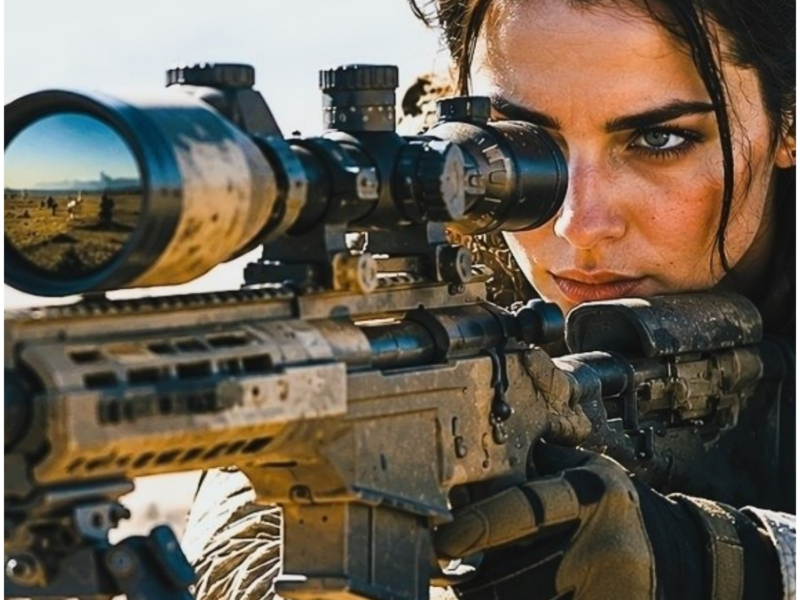
She had climbed to a point 30 m above the valley floor, settled into a position behind a natural rock formation that would have taken a trained spotter 20 minutes to identify, and had opened the pack.
The rifle she assembled was not standard issue. It was not anything in the inventory of any contractor logistics firm operating out of a forward base in this region.
The components were precision machined and had been maintained with the careful consistent attention of someone for whom maintenance is not a task but a practice.
The scope was third generation thermal imaging, the kind of equipment that lets you see heat signatures through rain and darkness with the clarity of early morning light.
She had taken 60 seconds to settle to regulate her breathing to let her heart rate drop to the number she needed it at.
Not because she was nervous, because physics doesn’t accommodate nerves. A heartbeat at the wrong moment moves the muzzle 1/5if of a millimeter and at the distances she was working 1/5if of a millimeter is the difference between ending a threat and creating a sound that tells every other threat exactly where you are.
She breathed. She settled. She looked through the scope and she began. 1 hour 37 minutes elapsed.
The first shot had taken the north gun positions operator cleanly and the gun had gone silent before the sound of the shot reached the valley floor, absorbed by the rain and the wind and the general noise of a firefight that had been running for over an hour.
The other fighters at that position had 2 seconds of confusion before the second shot removed that confusion permanently.
The east position had been slightly more complicated. There was a fighter there, young alert, running on adrenaline, who had been scanning the high ground at irregular intervals with enough intelligence and enough instinct to make him dangerous.
He had been doing something that most of his colleagues were not. He had been thinking about the possibility of an overwatch position, not because he’d been told to, because he was the kind of person who thinks three moves ahead, even in a crisis.
He had been looking in almost exactly the right direction. Almost. She had adjusted her position 6 in to the left and taken him first.
The command element on the high ground had been the most complex engagement of the sequence.
Three fighters, one radio operator, one person who was clearly directing the tactical picture from a position that had good line of sight on both fire lanes.
She had needed three shots in 8 seconds, which required a sequence of target selection, trigger pull, minimal repositioning, and reacquisition that was by any objective measure extraordinary.
25 targets. Total elapsed shooting time 7 minutes and 40 seconds. Zero misidentified shots. Zero warnings given away to the remaining elements.
By the time Bravo team started moving northwest, the battlefield’s coordination had collapsed. The remaining fighters, roughly five scattered in positions that had lost their command signal, and their understanding of what was happening, were doing what disorganized fighters do.
They were pulling back, regrouping, trying to figure out what they were dealing with. What they were dealing with was the absence of 30% of their force in under eight minutes and no visible explanation for how.
She gave them something to think about while Bravo team moved. 1 hour 39 minutes elapsed.
Callaway’s team hid the extraction point at 1 hour and 41 minutes. It was a cleared area barely adequate.
The kind of space that helicopters accept reluctantly under pressure. Web was breathing, but the sound of it had changed in the last 10 minutes.
Shallower, faster, the s sound of a body working harder than it should to do what a body should do automatically.
Reigns had stopped asking if they were going to make it. He was concentrating on staying conscious, which Kowalsski had told him firmly was the most useful thing he could do right now.
Callaway set the perimeter with seven men and kept Martinez beside him because he trusted her right of the situation more than his own right now.
He was running on too much adrenaline and not enough sleep in the specific mental load of having been responsible for 12 lives in a firefight for the last hour and 40 minutes.
“Talk to me,” he said to her. “We’re clear behind us,” she said. “Whatever she did, it held.
I haven’t heard organized movement in the last 12 minutes.” “Whatever she did,” he repeated.
“Yeah.” He looked at her. She looked back. Neither of them had words for it.
For the math of it, one person, one rifle, a 7-minute window, and the silence that followed.
They had both seen extraordinary things in their careers, things that didn’t fit into the normal distribution of what people could do under pressure.
This was outside even that distribution. This was somewhere else entirely. Did you get a count?
He asked on the shots? Yeah, she had. She had been counting from the moment the north gun went silent because counting is what she does the way Callaway talks through problems.
And Kowalsski runs injury assessments in his head. And Web before the shoulder used to recite baseball statistics when he was scared a habit that had started in his first deployment and become the team’s strange comfortable background music.
25, she said, give or take one. Could be 24, not less than that. 25.
25 targets, one shooter under 8 minutes. Who is she? Martinez asked. It was the same question Harlo had asked in the tent.
The same question that had no answer yet. I don’t know, Callaway said. His radio crackled.
Ridge point. Ror’s voice strained but controlled. Bravo. Actual. What is your status? You see extraction point.
All 12 web is deteriorating. We need that bird right now. Weather window had opened 4 minutes ago.
Air is inbound. ETA 9 minutes. 9 minutes. Callaway looked at Kowalsski who was bent over web with both hands busy.
Kowalsski glanced up, registered the 9 minutes, gave a single tight nod. 9 minutes was going to be tight.
Copy. 9 minutes. Callaway said. Ridge point. What is the status of our overwatch? A pause.
Longer than the tactical situation required. Unknown, Ror said. One single word. And in that word was a whole conversation that the radio frequency couldn’t carry the weight of not knowing the specific fear of a man who has sent someone into a situation he couldn’t control and is waiting to find out the cost.
Unknown. Callaway repeated. She went quiet approximately 7 minutes ago. We’ve been trying to raise her.
7 minutes. Callaway turned and looked back the way they’d come, which told him nothing because there was nothing to see, only rain and dark in the terrain that had been trying to kill his team for the last 100 minutes.
She was still shooting when we hit the tree line, he said. She covered our movement all the way to this position.
I know, Ror said. Keep your your frequency open. 1 hour 43 minutes elapsed. The tent at Ridge Point had gone quieter than it had been all night.
Not the quiet of resolution, the quiet of waiting for a specific piece of information that has not arrived and whose absence is beginning to mean something.
Harlo had been keying the secondary frequency every 60 seconds for the last 7 minutes.
Each time he keyed it, he gave her call sign, the one she’d used when she first transmitted, which was no call sign at all, just overwatch, and waited 3 seconds for a response.
Each time, nothing. Could be radio silence by choice, Oay said carefully from her station across the tent.
She was trying to be useful. She was trying to offer a possibility that was better than the alternatives.
If she’s still in a position with active elements nearby, she wouldn’t transmit. That’s true, Harlo said, and then said nothing else because the other explanation was also true and he wasn’t going to say it, and nobody else in the tent was going to say it.
And so it just sat there in the middle of the room like something that takes up space without being acknowledged.
Roar keyed the secondary transmitter himself. He didn’t give a call sign. He said in the clearest, most direct voice he owned, “Mara, report in.”
Static. “Mara, this is Ridgeoint.” “Well, report in.” Static. Garrett looked at him from across the tent.
For once, his expression had nothing in it that was about protocol or authorization or professional positioning.
It was just a face, a person’s face, watching another person ask a question into a radio and not get an answer.
Captain,” he said quietly. “I know,” Ror said. He set the transmitter down. He pressed both hands flat on the console and stood there for a moment in the specific posture of a man who is not allowing himself to feel the thing he is feeling because there are still 9 minutes until the helicopter reaches Bravo team and he needs to be operational for 9 more minutes.
Then the radio crackled. Not the secondary frequency, the Bravo team frequency. And the voice that came through it was not Callaway’s.
It was hers. Bridge point. This is Overwatch. I am at the extraction point. The tent exhaled.
It was not dramatic. It was not loud. It was the sound of air leaving a room that had been holding it for 7 minutes.
Quiet and collective and enormous in its smallness. Harlo put both hands over his headset and pressed it against his ears as though that would make the signal clearer.
Copy that overwatch. Say again your status. I am at the extraction point. All Bravo team personnel are confirmed.
I am a pause brief. The kind of pause that someone takes when they are deciding how specific to be about something.
I am functional. Functional. Not fine. Not uninjured. Functional. Ror picked up the transmitter. Copy that.
Air is 7 minutes out. Can you confirm the LZ is clear? LZ is clear.
I’ll hold perimeter until extraction is complete. Callaway heard her voice on his frequency before he saw her emerge from the dark.
She came from the south side of the extraction point, moving with a slight adjustment in her weight, that his trained eye caught immediately, and that she was clearly not advertising.
She had the rifle broken down and stowed the pack back on in the same expression she’d had in the tent when she looked at the tactical map focus present completely interior.
She stopped near the perimeter, not in the center of the group, near the edge, the position of someone who is still scanning, still working, not done yet.
Overwatch, Callaway said. She looked at him. Are you hit? A brief pause. Minor. Define minor.
Functional,” she said, which was exactly what she told Ridge Point. And he understood immediately that this was as specific as she was going to be, and that pressing it further would not get him more information.
Okay, he said he was going to leave it there. He almost left it there.
Then he said 25, though. She looked at him steadily. We counted the shots, he said.
Roughly 25. She said nothing. From one position, he added, one shooter. Still nothing. Who are you?
He asked. And he meant it differently than he had on the radio. He meant it the way you ask a question when you already know the shape of the answer but can’t quite believe it fits.
She looked at him for a moment, then she looked past him at Kowalsski still bent over web at Martinez running perimeter at the eight other men who had been in a killing ground 90 minutes ago and were standing here now.
Somebody who was in the area, she said. And before he could respond to that, the sound of rotors began to come through the rain from the northwest, and the world shifted from the terrible stillness of waiting to the organized chaos of extraction, and there was no more time for questions.
1 hour 51 minutes elapsed. The helicopters came in fast and low. The pilots pushing the edge of what the weather would allow.
And the crew chiefs were hanging out the doors before the skids fully touched, pulling web aboard with the focused efficiency of people who understand that seconds matter in a way that has nothing to do with abstract urgency.
Reigns went up next than the rest of Bravo in order of priority. Callaway was the last of his team to board.
He stopped at the door and looked back. She was standing at the edge of the LZ, not moving toward the helicopter, not signaling readiness to board, just standing there watching the extraction complete with the pack on her back and the rain coming down and the expression of someone who has done the thing they came to do and is now considering what comes next.
Get on the bird, the crew chief shouted over the rotor noise. Callaway looked at her.
You’re coming, he said. It wasn’t a question. She looked at the helicopter. She looked at him.
Something crossed her face. Not reluctance exactly, but the brief calculation of someone running a set of options that nobody else in the situation has access to.
Then she walked to the helicopter and got on. The crew chief pulled the door and they lifted.
2 hours 1 minute elapsed. The flight back to Ridge Point took 11 minutes. For 11 minutes, 12 men who had been in a firefight for nearly 2 hours sat in the shuttering interior of a helicopter and did the things that people do in the immediate aftermath of surviving something they weren’t certain they’d survive.
Some of them were quiet. Some of them were checking each other. Martinez had her hand on Web’s wrist, monitoring his pulse with her fingers, her eyes tracking his face for the signs that Kowalsski had told her to watch for.
Reigns had finally stopped asking if they were going to make it. He was asking in a voice that was thin but coherent whether anyone had called his wife.
We’ll call her from the base. Callaway told him. She’s going to hear your voice before the hour’s out.
I promise you that. Um Reigns closed his eyes. Okay, he said. Okay, good. Maravan sat near the rear of the helicopter and said nothing.
She had the pack between her feet and her hands resting on her knees and her eyes were forward.
The minor injury she had declined to elaborate on was doing something Callaway could see it in the controlled stillness of her posture.
The way you hold yourself perfectly still when movement costs something you don’t want to spend.
But she was upright and her eyes were clear and she was tracking everything that happened in the cabin with a peripheral awareness of someone who never fully stands down.
Santo sitting across from her looked at her for a long time. He was 29 years old and had been in the Navy for 8 years and had never been one for emotional expression in professional settings.
He was the kind of person who shows respect through action, not language. He looked at her, then he put his fist out, she looked at it, then she looked at him.
He held it there. She touched her fist to his once briefly and looked away.
It was the quietest exchange in the helicopter. It lasted 2 seconds. Nobody else in the cabin said anything about it, but Martinez saw it and Callaway saw it.
And in some way that defied the noise and the rain and the rotors and the exhaustion.
It said everything that the next several hours of debriefing and reports and protocol would attempt and fail to say properly.
2 hours 12 minutes elapsed. The helicopter touched down at Ridgeoint Outpost in the rain.
Webb was transferred to the base medical unit on a stretcher before the rotors stopped.
Rains followed. The medical team was ready. Ror had made sure of that had been on the medical officer for the last 40 minutes, making sure the surgical prep was in place the moment that weather window opened.
Callaway stepped off the helicopter and onto the landing pad and stood there for a moment with the rain hitting him and the rotors winding down behind him.
And he breathed. Just breathed. The specific breathing of someone who has been in a firefight for 2 hours and is learning incrementally that they are in fact out of it.
Ror was on the pad. He hadn’t sent someone. He was there himself, which told Callaway something about what the last two hours had been like in the tent.
They looked at each other. Ror’s expression did something complicated. He was a man who did not easily show what he was feeling in professional settings, but right now the relief was too large to contain within his face, and some of it was coming through around the edges.
Sergeant, he said. Captain Callaway replied, All 12. All 12. Ror put his hand on Callaway’s shoulder briefly.
Just briefly. Then he looked past him at the helicopter at the personnel coming off counting.
He was looking for her. She came off last. She stepped onto the landing pad and the rain hit her the same way it hit everyone else.
And she looked at Ror across the pad with the expression of someone completing a professional transaction.
He walked to her. He stopped 3 ft away. He was a big man and she was medium height.
And neither of those things had anything to do with what was actually happening between them, which was the moment where a man who has spent 2 hours on the wrong end of his own assumptions comes face to face with the reality of what he underestimated.
Dr. Vance, he said, Captain, she said, are you um I need to put this pack down somewhere, she said quietly.
And I need 20 minutes. He looked at her. He looked at the way she was holding herself.
He looked at the pack. I have a medic. 20 minutes, she said. Then I’ll answer your questions.
He held her gaze for a moment. Then he nodded. I’ll have someone show you to the medical bay.
I know where it is, she said, and she walked past him across the landing pad into the base without looking back.
He watched her go. Behind him, Callaway said she was already at the extraction point when we got there.
I know, Ror said. She came out of a different direction than we did. We came northwest from the valley.
She came from, he paused, working the geography in his head. South. South and elevated.
I know. 11 km from here in 50some minutes in that storm with whatever is in that pack.
Ror said nothing. Captain Callaway said in his voice had the careful quality of a man who has spent 2 hours testing reality and found it resistant to his assumptions.
25 confirmed hostile targets. Single shooter 7 minutes and 40 seconds. I had Martinez counting 7:40 by Rored.
Give or take. Ror turned and looked at the door she had gone through. The rain came down around them.
The helicopters wound down. Somewhere inside Web was on a table and surgeons were working and Reigns was asking for someone to call his wife and the team was being processed through debrief and medical in the organized machinery of aftermath.
And somewhere in that machinery, a woman with a logistics badge in a pack nobody had inspected was taking 20 minutes.
“Who is she?” Callaway asked. It was the third time tonight someone had asked that question.
Ror had no answer for it yet, but he was beginning to understand that the answer when it came was going to be something that didn’t fit inside any category he currently had for it.
“I don’t know,” he said. 2 hours 19 minutes elapsed. The rain was still falling.
And somewhere on the other side of that base, in a room that nobody had thought to guard, because nobody had thought it necessary, Mara Vance sat with her back against the wall and her pack open beside her and her eyes closed.
And she stayed very still, not sleeping, not unconscious. Just staying still in the way that a person who has been running at full capacity for two hours stays still when they finally stop letting the systems that have been suspended in favor of function begin to come back online one by one in the order that the body has long since learned to prioritize.
She had a graze along her left side below the ribs. It had happened somewhere in the movement between the third and fourth target engagements, a fragment, not a round from a secondary explosion, she’d misjudged by about 4 in.
4 in to the right and it was nothing. 4 in to the left. And this story ends differently.
It was 4 in to the right. So she was functional. She cleaned it herself.
She had done that before in worse conditions, in worse places, on worse injuries. She taped it with the field dressing from the pack and sat back against the wall and breathed.
25 targets. She said to herself, not with pride, not with anything that was about her own performance.
She said it because counting is how she accounts. Because every shot is a decision and every decision has to be owned by the person who made it.
And she had made 25 decisions tonight. And she was not in the business of letting them blur into abstraction.
25. Then she let them go because that is also part of the practice. You account for them and then you release them because carrying them is not the same as honoring them and the difference matters.
Outside the rain continued. Somewhere across the base, Webb was in surgery. Reigns was getting a phone put to his ear so he could hear his wife’s voice.
12 men were alive who by the math of 2 hours ago should not have been.
She pressed her head back against the wall and let herself be still. 20 minutes.
She had asked for 20 minutes. Outside her door, she could hear footsteps that were not casual.
Could hear the specific rhythm of people moving with purpose and urgency of a base processing the aftermath of a crisis.
Could hear faintly voices, some of them recognizable. Ror’s voice in a conversation he was having with someone she couldn’t identify using the careful modulated tone of a man who is asking questions he doesn’t yet have the framework to ask correctly.
She listened to the rain. She did not sleep. She waited because she knew with the same precision she’d used to read that tactical map from across the tent that the questions were coming and that the 20 minutes she’d asked for was not really about the grays along her left side.
It was about deciding what she was going to say and what she was never going to say at all.
2 hours 39 minutes elapsed. The knock on the door came exactly at 20 minutes.
Not 19, not 22, 20, which told her something about the man doing the knocking, that he was precise, that he respected what he said he would respect, and that he had been standing somewhere nearby, counting the time.
“Come in,” she said. Ror opened the door and stepped inside. He took in the room in one sweep the pack, the tape visible at the edge of her shirt where she dressed the grays herself the way she was sitting against the wall with the composed stillness of someone who has finished doing what they needed to do and is ready for what comes next.
His jaw tightened slightly when he saw the tape. He didn’t comment on it yet.
He pulled a single chair in the room away from the wall and sat down across from her.
He didn’t have a notepad. He didn’t have a recorder. He’d left those things outside deliberately, which she noted.
He looked at her for a long moment. She looked back. “Web is out of surgery,” he said first.
“Surgeon says he got there in time. Shoulder is going to need reconstruction, but he’ll have full use of it inside a year.”
“Good,” she said. “Reigns is stable. Fever is responding to antibiotics. He’ll be evacuated to the main medical facility tomorrow morning.”
“Good,” she said again. “The rest of Bravo team is being debriefed.” He paused. Callaway’s account of the engagement is detailed.
He and Martinez ran a count on the shots from your position. They have 25 confirmed.
She said nothing. 25 hostile targets. One shooter. 7 minutes and 40 seconds. He said it the same way Callaway had said it to him on the landing pad.
Not as an accusation, not as a question as Eiley, but as a fact being placed carefully on the table between them to see how she responded to it.
The count is approximately correct, she said. Approximately 25 confirmed. There may have been a 26th.
I wasn’t certain enough on the identification to include it. He stared at her. The thing behind his eyes was doing what it had been doing since she placed her finger on the tactical map 3 hours ago, cycling through frameworks, testing them against what he was observing, finding them inadequate, moving to the next one.
Dr. Vance, he said carefully, “I need you to understand that I am not recording this conversation and I am not here in an official investigative capacity.
I am asking you as the commanding officer of this base as a man who has 12 people alive tonight who were not going to be alive.”
His voice shifted slightly briefly just at the edge of something he didn’t allow himself to complete.
I am asking you who you are, what you actually are. She was quiet for a moment.
My badge says logistics contractor, she said. I know what your badge says. Then you have the official answer.
I’m not asking for the official answer. He leaned forward slightly. I’m asking you right now in this room.
She looked at him. The calculation she’d been running for the last 20 minutes, the one that had nothing to do with the grays on her side, was running its final sequence.
She had known this conversation was coming. She had known it since she walked out of the tent into the storm because walking out of the tent into the storm meant accepting that she could not walk back in and be invisible anymore.
That the invisibility was spent. The only question had been what she would say when it was spent.
“I was a contractor,” she said finally. “Before the current badge, I had a different one.
Before the different one, I had a service record. Before the service record,” she paused.
“There are some things that don’t have paperwork.” Ror absorbed this. What branch? That’s a complicated question.
Try to uncomplicate it. I started army, she said. Then things got more specialized. Then things got more specialized than that.
Then there was a program. She stopped. What kind of program? The kind that gets quietly discontinued when the political climate changes.
The kind where all the personnel follows get reclassified or destroyed depending on who’s asking and why.
The kind that the people who ran it will deny existed and the people who were in it know not to discuss.
Ror sat back. Something had shifted in his expression. Not surprise exactly by this point.
Surprise was a resource he had largely exhausted. Something closer to the feeling of a puzzle piece clicking into place in a way that changes what the whole picture looks like.
How long ago? He asked. 8 years since it was officially discontinued. And since then, she looked at him steadily.
I’ve been in logistics. A beat. Then, despite everything, something moved in Ror’s face that was almost almost a reluctant recognition of a particular kind of dark humor.
Right, he said. 2 hours 47 minutes elapsed. Garrett had not been waiting outside the door because Ror had specifically told him not to be.
He had however been waiting approximately 15 feet down the quarter which was close enough to reach quickly if needed and far enough to be technically compliant with being told to give them space.
When Ror came out, Garrett fell into step beside him immediately. “Well,” he said. “She’s a contractor,” Ror said.
Garrett stopped walking. Ror kept walking for two steps before he stopped and turned. Captain, with respect, that is not what I just spent 3 hours watching happen.
Phil Ror said quietly. There are things in this building right now that I cannot officially know, that you cannot officially know, that will be significantly better for everyone involved, including the 12 men who are alive tonight, if they remain in the category of things that were handled by someone with a logistics badge who happened to be in the area.
Garrett stared at him. You’re asking me to I’m not asking you anything. I’m telling you what I know.
What I know is that Dr. Maravan’s logistics contractor provided critical logistical support during a complex extraction operation.
That’s what happened. That is not what Phil Ror’s voice dropped to something very specific.
The voice of a man who is not threatening, not maneuvering, but communicating something real.
12 men, two of them are going home to their families because someone made a decision tonight that the official channels couldn’t make.
Whatever she is, whatever that program was tonight, it worked. And when I write my report, I am going to write a report that protects those 12 men and their families and this base.
And I need you to decide right now if you are going to help me do that or if you are going to be a problem.
A long silence, Garrett breathed in, breathed out. I need to see the communications logs from the secondary frequency, he said finally.
Already handled, Ror said. Another silence. She should be seen by the base physician, Garrett said.
If she’s injured, she dressed it herself. That’s not I know, Ror said. Go check on Bravo team.
Make sure the debrief is running clean. Garrett looked at him for a moment longer, then he turned and walked down the quarter.
He didn’t look back. Ror watched him go. Then he turned and walked the other direction back toward the command tent where the work of making a knight that defied documentation fit into the forms that documentation requires was waiting for him.
2 hours 58 minutes elapsed. Callaway found her an hour later. He had finished his debrief, had given the version of events that Ror had quietly calibrated the room toward before it started, which was accurate in its facts and careful in its framing, and had checked on Web in the surgical recovery room and on Reigns in the medical bay, where Reigns was on the phone with his wife and crying in a quiet private way that Callaway had the decency to not observe too closely.
He found her outside, standing near the edge of the base perimeter where the lights thinned out and the rain was still coming down, though lighter now.
The storm was pulling east. The worst of it was over. She heard him coming.
She always heard things coming. He was beginning to understand that about her. How’s your side?
He asked. Functional, she said. You keep using that word. It’s accurate. He stood beside her.
Not too close. The kind of distance that respects that some people need space around them as a default, not because they’re unfriendly, but because they’ve spent years in situations where having space around you is the difference between being alive and not.
Martinez wants to buy you a drink, he said. Something shifted in her expression just at the corner.
That’s kind. It’s not kind. She’s not a particularly kind person, professionally speaking. She’s the most dangerous person on my team and she doesn’t offer drinks to people she doesn’t respect at a foundational level.
It’s the highest compliment she gives. A pause. Tell her I appreciate it. Tell her yourself.
She’ll be around. Silence. The rain on the ground around them. The distant sound of the base settling back into its rhythms.
Callaway, she said. Yeah. Webb is going to need physical therapy for about 8 months after the reconstruction.
Don’t let him rush it. He’ll want to rush it. He looked at her. How do you know that men who get shoulder injuries always want to rush the physical therapy?
And men who’ve been in his kind of firefight want to get back faster than their bodies allow.
It’s predictable. You’re speaking from experience. I’m soing from pattern recognition, she said. But yes, 3 hours 9 minutes elapsed.
3 hours 22 minutes elapsed. The DIA agents arrived at 4:17 in the morning. They came in a vehicle that had no markings on it, which had a military forward base as its own kind of marking.
Two of them, both in civilian clothes, both with the particular bearing of people who operate in spaces that don’t appear on organizational charts.
They went directly to the command tent. They asked for work. They were not friendly, but they were not hostile.
They were professional in the way that people are professional when they have a task that they want completed quickly and quietly.
The senior agent he gave a name Morrison which Ror filed away with the sense that it was functionally decorative sat across the table from Ror and placed a single folder on the surface between them.
We understand you had an incident tonight. Morrison said we had a successful extraction. Ror said all 12 personnel recovered.
Two received urgent medical treatment. Both are stable. And the contractor who assisted with the extraction, Ror looked at him.
Dr. Mara Vance, logistics contractor. She was present at the base in her contracted capacity and provided support consistent with her role.
Morrison looked at him for a long moment. His expression said very clearly that he was aware this was not a complete picture and was evaluating how hard to push on it.
Captain Ror, he said, we’re going to need to speak with Dr. Vance directly. Of course, Ror said, she’s been cooperative with the post incident process.
Has she entirely? Morrison opened the folder. He turned it so Ror could see the contents.
There was a personnel file, or rather the ghost of one. A page that had clearly once held significant information and now held a name, a date of birth, and a series of redaction blocks so complete that the visible text was outnumbered by black bars by roughly 10 to1.
We have some questions about her service history, Morrison said. As do I, Ror said honestly.
Unfortunately, her file appears to have some gaps. Captain, those gaps are not accidental. I assume not.
Dr. Vance was associated with a program that was officially dissolved 8 years ago. She should not have been in an operational theater.
She should not not have had the equipment she apparently had with her. And she absolutely should not have conducted a unilateral engagement of this scale without 25 hostile targets.
Ror said Morrison stopped. 25. In under 8 minutes, my SEAL team was pinned two critical 40 minutes from losing their window for medical care.
Your official channels had told us to hold position and wait for weather clearance. He kept his voice even.
She didn’t wait. Morrison studied him. You’re defending her. I’m providing context. Ror said 12 of my people are alive.
I consider that the relevant metric. The relevant metric from our perspective involves the use of unregistered equipment engagement without authorization and the potential exposure of a program that was specifically classified to prevent Agent Morrison.
Ror leaned forward slightly. I need to ask you something and I need an honest answer.
He paused. Is she in trouble? Morrison was quiet. Because if the answer to that question is yes, I am going to have 12 Navy Seals with vivid recollections of a 2-hour firefight who will be very interested in discussing the chain of events publicly and in detail.
It was not a threat. Ror was careful about that. He delivered it as a statement of fact, a man explaining the natural consequences of a sequence of events not making a move in a negotiation.
The distinction mattered. Morrison closed the folder. We need to speak with her. He said again.
She’s available. Ror said 3 hours 48 minutes elapsed. They found her exactly where Callaway had left her near the edge of the perimeter.
She saw Morrison and his colleague coming from 60 m out and had approximately 15 seconds to decide how to receive this conversation.
She spent 12 of those seconds deciding and three of them composing her expression into something that communicated precisely nothing about what she’d decided.
Morrison stopped in front of her. He looked at her the way people who have been looking at a redacted file look at the person the file belongs to trying to reconstruct from the physical reality what the documentation refuses to provide.
Dr. Vance, he said Morrison, she said as if they’d met before. He hesitated just briefly.
You know me. I know the program you’re with, she said. I know the man who ran it before you.
How is Director Callahan? Another hesitation. Longer this time. The kind of hesitation that tells you that something you said has hit a frequency you weren’t expected to be on.
Director Callahan retired four years ago. I know, she said. I meant how is he personally?
Morrison stared at her. Then he said carefully, “He’s well.” “Good. Tell him Vance says hello.
He’ll know who I mean.” Morrison looked at her for a long moment. Then he looked at the colleague beside him, then back at her.
Something had shifted in his professional posture. The slight adjustment that happens when someone recalibrates a situation from one category to a different, more complicated one.
We need to discuss tonight, he said. I know, she said. Ask your questions. The engagement was necessary.
She said 12 personnel, too critical, no viable alternative within the available time window. I assessed the situation.
I had the means. I acted. You weren’t authorized. No, she agreed. I wasn’t. The equipment you used isn’t registered to any current.
No, she agreed again. It isn’t. Dr. Vance, you understand that from a formal accountability standpoint, what you did tonight creates significant agent Morrison, she said.
And her voice had the same quality it had had in the command tent four hours ago when she told Garrett that waiting was not a strategy, not aggressive, not dismissive, just absolutely direct in the way of someone who has calculated exactly where the line is.
I understand the accountability situation. I’ve been in it before. I’ll cooperate with whatever process you need to run.
File what you need to file, classify what you need to classify. I’ve been classified before.
He looked at her. You’re not concerned. I’m tired. She said, “That’s different from not concerned.”
A pause. Morrison looked at the perimeter behind her, then back. “Your file,” he said.
“The one we have. It ends abruptly.” “I know. There’s an 8-year gap between the program’s dissolution and tonight.”
“Yes, we’d like to know what you’ve been doing in that gap.” She looked at him with an expression that was the most human thing on her face since she’d walked into the command tent.
Not a smile, something underneath a smile. Something that had lived through 8 years of something that didn’t leave paper trails and had developed its own particular relationship with questions like this one.
Logistics, she said. Morrison stared at her. She looked back at him without blinking. 4 hours 2 minutes elapsed.
Morrison and his colleague were in the command tent with Ror for 47 minutes. What was discussed in those 47 minutes Ror never put into a report.
What he did put into a report was a two-page summary of the extraction operation which described the use of existing base resources and the professional performance of all personnel involved and which mentioned doctor Mara Vance in one sentence as having provided situational awareness support consistent with her contracted logistics role.
The report was filed at 6:18 in the morning. At 6:20, Morrison’s vehicle left the base.
At 6:23, Harlo found Ror in the command tent and said, “Sir, you need to see this.”
He handed Ror a printed sheet. It was a system access log, the automatic record the base database kept of file queries made in the last 24 hours.
Someone had queried Maravans’s personnel file, not from the base, from an external terminal. The access time stamp was 3:41 in the morning, right around the time Morrison and his colleague arrived.
They pulled her file before they even got here, Harlo said. I know, Ror said, which means they knew about her before we called anyone.
Yes, Harlo looked at him. They were already watching her. Ror looked at the log.
He thought about Morrison’s face when she said Director Callahan’s name. The half second of recalibration that a trained agent shouldn’t have let show.
Maybe, he said. Or maybe she was watching them. He set the log down. Either way, it’s above our pay grade.
Sir, above our pay grade, Dennis. Harlo was quiet for a moment. Then she’s still on the base.
I know. Morrison didn’t take her with them. No, he didn’t. Which means either they’re done with her or they decided it was cleaner to leave her where she was, Ror said.
Given that she’s officially just logistics, Harlo absorbed this. Is that what she is? Ror looked at the door of the command tent.
The rain had finally stopped. The first gray suggestion of morning was beginning to come through.
She’s whatever she decides to be, he said quietly. That’s what I figured out. She operates in the space between what’s official and what’s necessary, and tonight necessary one.
4 hours 21 minutes elapsed. Callaway had gone back to check on Reigns at 5 in the morning and found Martinez there already sitting in the chair beside the bed talking to Reigns in a low voice about something completely unrelated to the last few hours.
Baseball of all things, which Callaway registered as the team’s way of pulling people back into the ordinary world after the extraordinary one tries to swallow them.
He left them to it and went back to the corridor and almost ran directly into Hler.
Lieutenant Mark Hler, who had laughed in the tent five hours ago, who had said, “Intel analysts don’t fight wars with the automatic confidence of someone who had never been wrong about that particular category of thing.”
He looked different now, not humbled exactly, something more specific. The look of a person who has had the architecture of an assumption dismantled in real time and is still walking around in the space where the assumption used to be, figuring out what to build instead.
Callaway, he said. Hesler, is she? He started, stopped, tried again. Bravo team. Everyone’s going to be okay.
Webb needs time, Callaway said. Everyone else is on their feet. Hler nodded. He looked at the floor for a moment, then he looked up.
I said some things in the tent before she went out. I heard, Callaway said.
He had gotten the account from Harlo during the debrief. Intel analyst featured us to fight wars.
Hler said he said it back to himself the way you repeat a thing that has turned from an observation into an indictment.
I said that you did a silence. I’d like to Hler started. She doesn’t need your apology.
Callaway said not unkindly but directly. She doesn’t need anything from you. But if you want to do something useful with what you learned tonight, figure out how to be someone who doesn’t make that call before the information is in.
Hler was quiet. That’s what she did. Callaway said she waited until she had the information.
Then she acted on it. No announcement, no argument, no asking for credit. She just acted.
He looked at Hesler for a moment. That’s not nothing. And most people can’t do that.
Hler nodded slowly. Callaway walked past him toward the exit. 4 hours 37 minutes elapsed.
She was gone before sunrise. Ror didn’t know exactly when. He found out the way he found out most things that happened at the margins of official visibility from a detail that didn’t add up.
The bunk in the contractor quarters that had her name on the assignment board was made with a precision that was either the habit of someone who made beds that way automatically or the deliberate act of someone leaving no trace.
The supply manifests on her desk were stacked in a neat pile with a sticky note on top that read, “In clean handwriting, current inventory accurate as of 0400.
No discrepancies. The pack was gone. The logistics badge was on the desk beside the manifests.
Ror stood in the room for a moment. He looked at the badge. He picked it up and held it in his hand and looked at it.
The photograph of the name the contractor designation, all the official information that added up to a complete identity and told you almost nothing about the actual person.
He set it back down. He walked out of the room. At 7:12 in the morning, he filed an addendum to his report, noting that Dr.
Premier Vance had completed her contracted engagement at Ridge Point outpost and had departed the installation consistent with the terms of her logistics contract.
At 7:14, Harlo knocked on the command tent door. Sir, Bravo team is asking to see you, all 10 of them, the ones who can walk.
Anyway, Ror came out to find them assembled in the small open area between the medical building and the command tent.
Not a formal formation, just 10 men standing together, some of them still in field gear, some of them in base clothes, all of them with the particular quality that combat veterans have in the hours after a close call.
Not adrenaline anymore, not fear, but something settled and serious and quiet. Callaway spoke for the group.
We wanted to ask about Dr. Vance, he said before any official version, get set.
Ror looked at him. What specifically where she went? Whether she’s going to be. Callaway paused, chose his word carefully.
Whether she’s going to be okay in terms of what happens after this. Ror was quiet for a moment.
He looked at the 10 men in front of him. He thought about the right thing to say, which was also the true thing, which was also the only thing he had that was worth giving them.
I don’t know where she went, he said. I don’t know what happens to her next.
I don’t know enough about what she is officially to tell you whether the people who track those things are going to be a problem for her.
He paused. What I can tell you is that she walked out of this base last night without orders, without backup, without authorization, and she came back with all of you.
That is what I know. That is what I’m going to carry from this. Nobody said anything for a moment.
Then Martinez said she said to tell me she appreciated the drink. She never got a drink, Callaway said.
No, Martina said, but she said she appreciated it anyway. That sat in the morning air for a moment.
Then Ror said, “Get some rest, all of you. That’s an order.” They dispersed. He stood in the space they had vacated and looked at the perimeter of the base at the point where the light stopped and the jungle began at the line between the official world and everything beyond it.
She was already gone, but she had been there. And 12 men were alive to remember it.
That was enough. That had to be enough. He turned and walked back into the command tent where the paperwork of a night that refused to be paperwork was waiting for him.
The morning came in anyway, and different and steady, the way mornings always do. 4 days after the extraction, the rain had stopped, and the base had settled back into the rhythms that Ford operating bases settle into after a crisis.
Not normal exactly because normal never fully returns after something like that. But functional, the machinery of routine reasserting itself over the rawness of what had happened, the way scar tissue forms over a wound, not the original thing, but something that holds.
Webb had been evacuated to the main surgical facility 2 days prior. Reigns had gone with him, which Callaway had arranged specifically, so that Reigns wouldn’t be alone in a medical transport because Reigns was 24 years old, and had been asking about his daughter every 30 minutes.
And Callaway understood that some things matter more than operational efficiency. The rest of Bravo team was on standown officially for recovery assessment unofficially because Roar had looked at 10 men who had spent 2 hours in a kill zone and decided that the best thing the United States military could do for them right now was give them 4 days where nobody asked them to do anything harder than eat and sleep.
Callaway spent those four days doing something he rarely did thinking. Not operational thinking, not the kind that runs threat assessments and exit strategies and resource calculations in the background of everything else.
The kind of thinking that happens when an event refuses to stay in its category.
The kind that comes back at you at 2 in the morning when the base is quiet and the math of what you survived keeps insisting on being examined from angles you haven’t tried yet.
He kept coming back to the same number. 25 in the same window, 7 minutes 40 seconds.
And the same voice on the radio, calm and flat and completely without the particular quality that voices get when adrenaline and fear are competing for control of the larynx.
She had sounded like a person doing a task, a complex, highstakes, physically demanding task, but a task.
The way a surgeon sounds during a procedure, not cold, not robotic, but present in a way that has no room in it for anything except the work directly in front of them.
He had been in the Navy for 16 years. He had worked alongside some of the most skilled operators in the world.
He had never heard anyone sound like that under those conditions, not once. On the third day, Martinez found him sitting outside the barracks at 11 at night and sat down beside him without being invited, which was her standard approach to most situations.
You’re still running it, she said. Yeah, he said. Me, too. She was quiet for a moment.
I keep coming back to the east position, the fighter who was scanning the high ground.
What about him, Moa? He was looking in almost exactly the right direction, she said.
I watched him through my optics for about 8 minutes before the guns went silent.
He was methodical, sweeping the ridge line in the right pattern. If he’d extended his sweep another 10° north, “She’d already adjusted,” Callaway said, before he completed the sweep.
“Yes,” they sat with for a moment, the specific weight of a 10° margin and what it meant.
“She saw him scanning,” Martinez said. She identified that he was a threat to her position before he identified that there was a position to threaten.
In the dark, in the rain, through a scope. Yes. And she took him first before the machine gun operator.
She changed her sequence to address him first. Yes. That’s not Martinez stopped. She very rarely ran out of words.
She was running out of them now because the word she was looking for was a word that felt too large for a conversation between two people sitting outside a barracks at 11 at night.
The word was extraordinary and she wasn’t sure it was large enough. I know, Callaway said.
Day 4, 14 minutes past noon. Ror was in the command tent when Harlo came in with the look on his face that meant something had happened that required the full version of his attention.
Patrol found something. Harlo said in the valley. Rodriguez’s team ran a post incident sweep this morning as part of the standard clearance protocol.
He set a small evidence bag on the table. They found this at the original kill zone at the elevated position.
Ror picked up the evidence bag and looked at what was inside it. A military challenge coin.
Standard dimensions worn at the edges in the way that coins get worn when they have been carried for a long time in a pocket or a hand.
The metal softened by contact and time. On one face, a unit insignia that Ror recognized the shape of a general special operations design, but with a modification he didn’t recognize.
A small addition to the standard imagery, subtle enough that you’d miss it if you weren’t looking.
On the other face, a designation, not a unit number, not a battalion or division marker, a program identifier.
Ror stared at it. He had been in the army and then in command positions for 23 years.
He knew his unit designations. He knew his special operations history. He knew what existed and what had been discontinued and what the official record said about programs that had come and gone.
He did not recognize this designation. Where exactly in the position? He asked. Rodriguez said it was at the base of the rock formation like it fell from a pocket during movement.
Harlo paused. Or was left? Ror looked at him at him. You think it was intentional?
I think she doesn’t drop things accidentally, Harlo said. Based on everything I’ve seen over the last 4 days, I think she does things for reasons.
Ror turned the coin over in his fingers through the evidence bag. Looked at the designation again.
Pull everything we have on special operations programs discontinued in the last 10 years. He said, “Don’t go through official channels.
Use the historical records database, the open- source one. Sir, if the program is classified, the program is dissolved.
Dissolved programs sometimes leave traces in the historical record before the classification catches up. Look for the gap, the place where a program should be and isn’t.
Harlo nodded and left. Ror sat with the coin. 20 minutes later, Harlo came back.
He set a printed page on the table. On it was a section from a historical special operations compendium, the kind published by academic defense analysts drawing on declassified documents in congressional testimony records.
Most of it was familiar. One section was not. A program referenced twice in congressional appropriations testimony from 11 years ago in language oblique enough that it had clearly been designed to satisfy disclosure requirements while communicating as little as possible.
A special operations capability development initiative, unspecified mission parameters, unspecified personnel composition described in one testimony as addressing a critical gap in certain operational environments.
The program had a designation. It matched the coin. Ror read the passage twice. Then he said quietly to himself rather than to Harlo, “There it is, sir.”
Harlo said carefully. The testimony is from 11 years ago, but there’s something else. He pointed to a footnote, a small footnote, the kind that academic analysts include for completeness and that most readers skip.
It noted that the program based on subsequent appropriations records appeared to have been operationally active for approximately 3 years before being discontinued.
It noted that no public record existed of the program’s personnel composition, and it noted almost as an aside the kind of detail that seems minor until it isn’t that the program had been specifically designed to operate in environments where conventional military presence was either impossible or inadvisable using personnel who could quote sustain plausible nonoperational cover for extended periods.
Harlo let that sit for a moment. Then he said, “Logistics. Logistics.” Ror confirmed. The thing that had been forming in Ror’s mind since she placed her finger on the tactical map four days ago clicked fully into place.
Not a program that sent operators into the field in military capacity. A program that sent operators into the field as other things.
As contractors, analysts support staff logistics personnel. As people who are invisible because the system has been trained to look past them.
As people who carry a badge that says one thing in a pack that contains something else entirely.
A program designed to be deniable at every level. Not just the mission level, but the personnel level, the capability level, the existence level.
And when it was dissolved, when the political wind shifted and the budget moved and the decision was made to quietly close the file, the people in it didn’t stop being what they’d been trained to be.
They just stopped being official. They became, in the truest possible sense, ghosts with badges.
Ror set the coin down on the table. He understood something now that he hadn’t understood fully until this moment.
The 11 days she had spent at this base before the extraction were not random.
The assignment was not coincidental. She had been placed here or had placed herself here.
He wasn’t certain which and suspected the line between the two was blurrier than it appeared in a position where she could assess, observe, and if necessary act.
She had been watching the operational environment the same way she’d watched the tactical map in the command tent.
Quietly from the side of the room, waiting for the moment when the gap between what the official channels could do and what the situation required became wide enough to step through.
And when it did, she stepped through. Sir, Harlo said, and his voice had a quality in it that Ror had heard from him only a handful of times in the years they’d worked together.
Something reverent and a little raw. She left it on purpose. The coin. Yes, Ror said.
Why? Ror thought about this for a moment. He thought about a woman who operated in total deniability, who had walked out of a tent into a storm and come back with 12 men and left before sunrise without asking for anything.
Who had told a DIA agent with complete calm that she was just logistics. Who had made a bed with precision and left a sticky note about inventory accuracy and put her badge on a desk and walked out of the frame of the official picture completely.
She had not needed to leave the coin. She had chosen to because she wanted someone to know.
He said, not officially, not on a report, not in a file. She wanted someone to know that it was real, that they were real.
The program, the people in it, whatever they did, however it ended, they existed. He looked at the coin.
She left a record, the only kind she could leave. Harlo was quiet for a long moment.
There were others, he said, in the program. It wasn’t just her. No, Ror said it wasn’t.
What happened to them? Ror had no answer for that. The footnote didn’t say. The testimony didn’t say.
The coin said only what the coin said, which was that something had existed and that someone had carried proof of it for 8 years in a pocket or a hand worn smooth by time and contact and had left it in a valley in the dark as the only monument available to them.
He put the coin back in the evidence bag. He put the evidence bag in his desk drawer and locked it.
He did not put it in the report. Day 6, 7:43 in the morning. Callaway got the call about Web at 7:43.
The surgical facilities attending physician, a woman named Dr. Reyes, who communicated with the clipped precision of someone accustomed to delivering information that people need to act on, quickly told him that Web had come through the reconstruction procedure better than projected, that the joint integrity was strong, that with proper physical therapy, she emphasized proper the way doctors emphasize things that they know patients will resist, he had an excellent prognosis for full function.
Callaway listened to all of this, standing in the quarter outside the barracks with his hand pressed flat against the wall, which was his version of needing something solid to hold on to.
“How’s he doing otherwise?” He asked. “Not medically. How is he?” Dr. Reyes paused. It was a small pause.
The pause of a physician recalibrating to a question that isn’t on their standard assessment list.
“He’s been talking a lot,” she said, about the people who got him out. “He keeps asking the nursing staff if they’ve heard about an operation in the Northeast.
What do you tell him? We tell him to rest his shoulder. Another pause. He’s going to be fine, Sergeant, in the ways that count.
Callaway thanked her and ended the call. He stood in the corridor for a moment with his hands still on the wall and the simple enormous fact of Web being fine, sitting in his chest like something that had been compressed for 6 days and was only now allowed to expand.
Then he pushed off the wall and went to find Martinez. She was at the communications board running through frequency checks, which was what she did when she needed something procedural to occupy the part of her brain that otherwise ran the kind of loops that don’t help anyone.
She looked up when he came in. He didn’t say anything. She read his face.
“We said he’s going to be fine.” She looked at him for a moment. Then she turned back to the frequency board and made a small adjustment that didn’t need to be made and said very quietly, “Good.”
That was all, but it was enough. Day 7, 3:18 in the afternoon. The classified communication arrived at Ror’s terminal at 3:18.
It came through the secure channel encrypted at a level that required two authentication steps and generated an automatic access log that would be reviewed at the regional command level.
It was from a sender designation that he didn’t recognize a string of letters and numbers that corresponded to no unit or office in his contact directory.
He decrypted it. It was three sentences. Personnel filed for Vance M has been reviewed and updated per standard contractor rotation protocol.
Engagement at referenced installation is logged as completed. No further action required on your part.
No further action required. Not no action will be taken. Not the matter is closed.
No further action required on your part. Ror read it three times. Each time hearing something different in the careful architecture of those words.
It was a message designed to do two things simultaneously. To tell him officially that the institutional machinery had processed the event and moved on.
And to tell him in the space between the words that she was fine. That whoever had sent this message and he had a reasonable suspicion about who, given the description of Director Callahan’s retirement and the look on Morrison’s face when she said that name, had made a determination that the coin in his death drawer was going to stay in his desk drawer and the report was going to read the way it read and the 12 men who were alive were going to stay alive without anyone looking too carefully at the mechanism.
No further action required. He deleted the message for protocol, sat at his desk for a moment, thought about the woman who had stood in his tent with a supply manifest in her hand, and looked at a tactical map with eyes that were reading something nobody else in the room could see.
Then he got up and went back to work. Because that is what you do.
You carry the thing and you go back to work and you let the ordinary morning reassert itself over the extraordinary night the way mornings always do.
Day 12, routine patrol, northeast quadrant. Rodriguez’s team was four kilometers into their sweep when Santos found it.
He almost walked past it. It was not designed to be obvious. It was set at the base of a tree half covered by undergrowth.
The kind of placement that looks accidental if you’re moving through at patrol pace and intentional if you stop and look at it correctly.
Santo stopped because something in his peripheral vision caught the way something catches. When your training has taught your eyes to look for the things that don’t fit the natural pattern of an environment.
He crouched down. It was a small object, metal, roughly the size of a large coin, but not a coin.
A unit badge, the kind worn on a service uniform, not the kind carried in a pocket.
Old. The kind of old that comes from years rather than fabrication. The metal had the quality of something that had been handled, maintained, and ultimately released by someone who had decided that release was the right action.
On its face was a design he didn’t fully recognize. An eagle, but not the standard military eagle.
This one had its wings folded, not spread, as if it had landed, as if it had arrived somewhere, and was choosing to be still.
He picked it up carefully. He looked at it for a long time. Then he put it in his breast pocket against his chest and finished the patrol.
He didn’t tell Rodriguez. He didn’t log it. He didn’t put it in his patrol report.
He carried it back to the base. And when they returned, he sat in the barracks alone and took it out and looked at it again.
He was 27 years old. He had been in the Navy for 5 years. He had been in the firefight 6 days ago and he had helped Carrie Webb to the extraction point and he had watched Martinez count the shots from the overwatch position and he had heard the voice on the radio that said, “Do not expose your position.
I am Overwatch.” And he had felt the particular feeling of realizing that someone you will never meet has just done something that means you are going to go home.
He held the badge in his hand. He thought about the folded wings, the eagle that had landed, that had arrived and been still, and then presumably had left again, gone back to wherever eagles go when they are not being seen.
He understood in the way that young people understand things when they stop trying to categorize them and just let them be true that this was the second object she had left.
That the coin in the valley was one thing, a record, a monument, a piece of history pressed into metal and left in the place where history was made.
And this was another thing, something more personal, something that had been placed here on this road at this distance from the base in the knowledge that a patrol would find it.
In the knowledge that he would find it, or someone like him, someone who had been there, someone who would know what it meant.
It meant I was here. It meant this was real. It meant some things exist whether or not the official record says they do.
He sat with it for a while. Then he went and found Callaway. Callaway held the badge for a long time without speaking.
Martinez was there. She had a way of being in rooms when things of significance were happening, not through planning, but through instinct.
She looked at the badge over Callaway’s shoulder and said nothing. Callaway turned it over, looked at the back.
There was nothing on the back except the standard pinning mechanism worn with age. And one thing more, so small he almost missed it.
A single mark scratched into the metal was something thin and precise. Not letters, not numbers, just a shape, a small horizontal line with a slight upward curve at the right end.
He stared at it. What is that? Santos asked. Callaway thought about it. He thought about a woman who communicated in minimums.
Who said functional instead of fine exit strategy, instead of savior logistics, instead of everything else she actually was, who left coins and badges instead of names and explanations.
It’s a check mark, Martinez said quietly. That’s all it is. A check mark. Done.
Complete. Accounted for. All 12 of you checked off. Callaway closed his hand around the badge.
Day 14. Ror’s final entry in his personal journal. Not the official one, the one he kept in a civilian notebook that would never be reviewed or archived or submitted to any institutional process.
He wrote 12 men. Both critical survived. Webb will have full shoulder function. Reigns spoke to his daughter on video call yesterday.
She is 3 years old and apparently spent the entire call showing him drawings she had made.
He cried. I heard him through the wall. He paused then continued, “The coin is in my desk.
I have decided it will stay there. I don’t know exactly what she was or what the program was or where she is now.
I don’t know if there are others like her still out there moving through the spaces between what’s official and what’s necessary, carrying badges that say one thing and packs that contain another.
I don’t know if we’ll ever encounter her again or if last week was the only time her trajectory and ours will intersect.
What I know is this. When the system failed, when the weather grounded the air, when regional command said hold position, when every authorized channel told us that there was nothing to be done in time, she was already moving.
Not because she was ordered to, not because she was authorized to, because 12 people were going to die and she was the only person in range who could do anything about it.
And so she did. That’s it. That’s the whole of it. Some people exist outside the hierarchy, not because they rejected it, but because the hierarchy at a certain point couldn’t contain what they were trained to be.
So they move to the margins, the unglamorous margins where the work is invisible and the credit is non-existent and the only metric is whether the thing that needed to happen happened.
She is one of those people. I don’t know her real name. I don’t know her full history.
I don’t know what she carries from the years between the program and that tent and that valley and that silent morning departure, but I know what she did.
And I know that 12 families don’t have a hole in them tonight because of it.
That is the record I am keeping not in the official system here in this notebook in my handwriting for whoever eventually reads it for whatever it’s worth.
She was here. She was real. And the world is better because some people choose the silence over the credit, the margin over the center, the work over the recognition.
Because some people decide without drama and without announcement that when the system runs out of options, they will simply become the option the system didn’t know it had.
He closed the notebook. Outside the bass hummed its ordinary rhythms, voices, engines, the routine machinery of a forward operating bass in a quiet period doing what bases do when the extraordinary has resolved back into the ordinary and the clock is moving forward again.
Callaway was somewhere on the base with the badge in his breast pocket. Martinez was running a frequency check or cleaning her gear or doing something competent and exact.
Harlo was at the communications board. Hesler was somewhere doing the slow work of becoming someone who doesn’t make the call before the information is in, which is the hardest kind of work because it requires dismantling something you built in yourself and trusting that what replaces it will be better.
And somewhere that was not this base, not this valley, not any point on a map that anyone at Ridgeoint Outpost could confirm a woman who had been logged as a logistics contractor and then logged as departed was moving.
She did not have orders. She did not have authorization. She had a pack. She had a skill set that no program could fully create and no dissolution could fully erase.
She had the capacity to read a room full of panicking men and identify the one decision that mattered.
She had the patience to be invisible for 11 days and the precision to be decisive in 7 minutes and 40 seconds when invisibility was no longer the right tool.
She had the folded wing discipline of something that lands quietly, does what it came to do, and lifts again before anyone thinks to look up.
And she was out there in some margin of the world that the official maps don’t fully covered, doing what she had always done and would always do, waiting for the moment when the gap opened, when the system reached the edge of what it could handle.
When someone somewhere transmitted three words into a breaking radio signal and the world needed an answer that the world’s official structures could not provide, she would be there.
She would always be there. Not because anyone asked her to be. Not because any record required it.
Not because recognition or authorization or official sanction would ever find her in the spaces she moved through.
But because 12 people are alive who would not be alive. And somewhere in a desk drawer there is a coin worn smooth by years of being carried.
And somewhere on a patrol wrote. There is a place where an eagle landed and then lifted again.
And somewhere in a notebook, in a captain’s handwriting, is the only record that will ever fully tell the truth of what happened in that valley in the rain.
She was there. She is the reason they came home. And that is all she ever needed it to be.