Taught me how to shoot
Taught me how to shoot. How to think. How to survive. Hawthorne looked between Blackwood and Kira.
Understanding dawning. You trained her. That’s why she shoots exactly like you. 13 years ago.
Blackwood confirmed. Best student I ever had. Better than I ever was. Sir, what she did today, first saving us, it’s beyond anything I’ve seen.
25 confirmed kills in 8 minutes in jungle conditions against professional targets. That’s what 13 years of training looks like when you start with natural talent and add discipline.
Blackwood looked at Kira, quiet pride in his eyes. But this is her moment, chief, not mine.
I’m just the man who had the privilege of teaching her. Before anyone could respond, another officer approached.
Colonel Randall Prescott, facility commander, early 50s, sharp eyes that missed nothing. Miss Ashford, Colonel Blackwood, if you’ll both follow me, we need to complete the debrief.
They walked through underground quarters. Concrete walls, fluorescent lighting, the architecture of secrecy. Finally arriving at a briefing room where Prescott reviewed a tablet filled with preliminary reports.
“Miss Ashford,” he began, “I’ve been reading Chief Hawthorne’s account. 25 confirmed enemy kills from a single shooter at 800-plus meter ranges in jungle conditions.
It’s hard to believe.” “It’s accurate, sir,” Kira replied. Prescott studied her, then Blackwood, then back to her.
“I need to understand your background. Your file lists you as intelligence contractor with analysis specialization.
But what I’m seeing suggests capabilities more consistent with tier one special operations. Kiera walked him through her training.
Competition shooting from age eight, private instruction, specialized contractors, years of operational experience. She kept it vague, professional, revealing enough to satisfy curiosity without compromising operational security.
Blackwood interjected only once. “I taught her fundamentals, Colonel. Everything else, that’s her genius. Her dedication, her willingness to push past every limit.”
Prescott made notes, clearly thinking about implications, about capabilities, about how someone like Kiera fit into official structures that weren’t designed for people who operated outside them.
Then the alarm started, red emergency lights strobing through corridors, klaxons blaring, the sound of a facility shifting instantly from routine to crisis.
Prescott’s radio erupted with urgent traffic. “Sir, we have a situation. Enemy assault force approaching from multiple vectors.
Estimated force strength between 50 and 60 hostiles. They’re heavily armed and moving with tactical coordination.
Distance to perimeter, 800 m and closing.” The color drained from Prescott’s face. “This facility is supposed to be secret.
How did they find us?” “Sir, they knew exactly where we are. This isn’t random.
This is targeted.” Hawthorne appeared in the doorway, already checking his weapon. “How many defenders do we have?”
“15 personnel total, Chief. Only five combat ready. The rest are support staff, intel analysts, communication specialists, medical personnel.”
Hawthorne looked at his team, battered, exhausted, wounded. “My boys are maybe 60% effective, sir.
Against 50 plus hostiles, we’re outgunned.” Kiera was already standing, moving to the tactical display, studying terrain, enemy approach vectors, facility layout.
Her mind shifting from debrief mode to combat operations. The transition instant, automatic. “Colonel,” she said, “I need detailed topography of the area surrounding this facility.
Elevation data, vegetation density, natural choke points.” Prescott hesitated. “Ms. Ashford, you’re a civilian contractor.
Who has capabilities you need right now?” Kira’s voice was firm, professional. “Colonel, that enemy force will be in assault range in 10 minutes.
We don’t have time for protocol discussions. What do you need?” “I need them stopped.
Then show me the terrain and let me work.” Prescott pulled up satellite imagery, topographic overlays, real-time feeds.
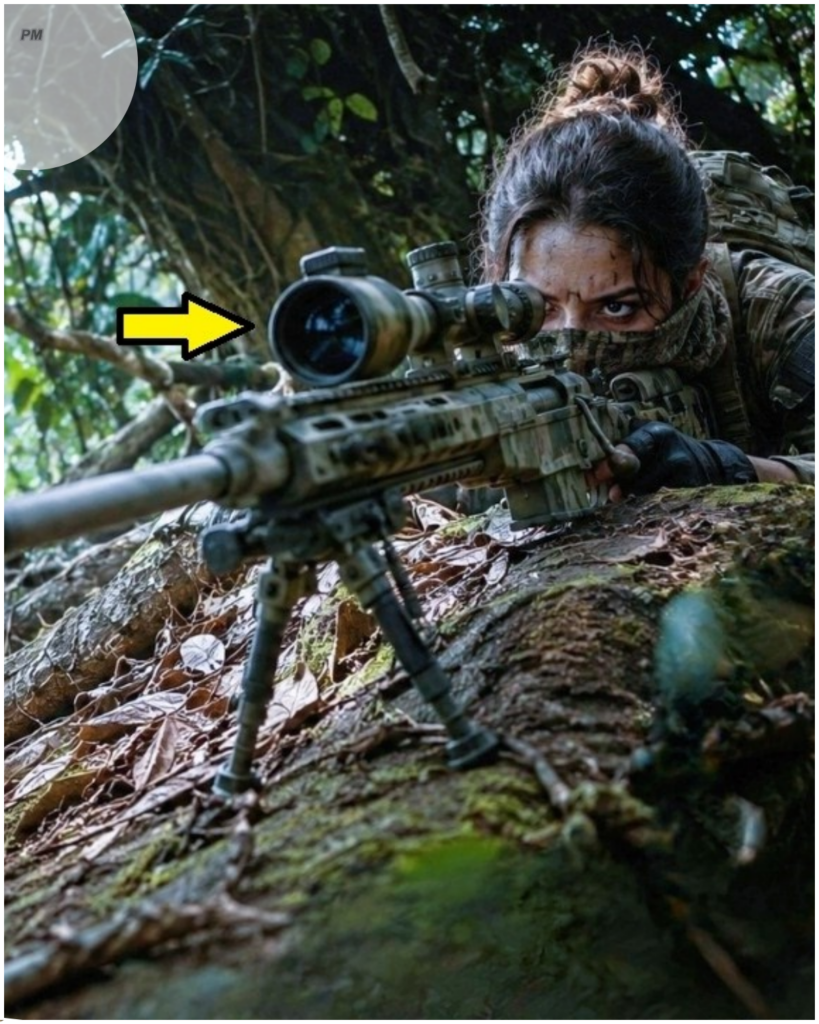
Kira studied everything with intense focus, calculating firing positions, sightlines, engagement ranges. “I need to get outside the perimeter,” she said.
“Elevated position with clear sightlines to enemy approach vectors. Same tactics as before. I’ll engage at long range, disrupt their assault coordination, eliminate high-value targets, buy time for your QRF to arrive.”
A staff officer protested. “That’s suicide. You’ll be completely exposed behind enemy lines with no support and no extraction plan.”
“I’ll be 900 m from their assault positions,” Kira corrected. “Concealed in jungle terrain. Engaging from a position they can’t easily locate or effectively return fire on.
It’s not suicide, it’s asymmetric warfare.” Hawthorn spoke up. “Colonel, I’ve seen what she can do.
If she says she can hold off that assault force, I believe her. My team will hold the facility perimeter.
We’ll create a defensive kill zone. She picks off their leadership and heavy weapons. We handle anyone who makes it through.”
Blackwood had been silent, watching, listening. Now he stepped him forward. Colonel Prescott, you and I served together.
Desert Storm. You remember that tank? Prescott nodded slowly, understanding passing between them. You’re still here because I pulled you from that burning vehicle.
Blackwood continued. I’m calling in that favor now. Let her work. I’ll coordinate from TOC, provide satellite intelligence, weather data, real-time updates, but she makes the tactical decisions.
That’s how we operate. Prescott looked at the tactical display, at the red icons representing enemy forces converging on the facility, at Kira standing ready, at Blackwood’s steady confidence.
Finally, he nodded. Do it. But Miss Ashford, if the situation becomes untenable, you extract immediately.
We can’t afford to lose someone with your capabilities over a facility that can be rebuilt.
Understood, sir. Kira grabbed extra ammunition, checked her gear, headed for the exit. As she moved past Hawthorne, he caught her arm.
Hey, K. He said quietly. You don’t owe us this. You already saved us once today.
Nobody would blame you for sitting this one out. Kira looked at him, saw genuine concern, genuine appreciation.
This isn’t about owing anybody anything, Chief. There are people in this facility who can’t defend themselves.
Support staff who never signed up for a firefight. They need someone to keep them safe.
That’s reason enough. She slipped out through a camouflage side entrance, moving quickly through jungle that was becoming familiar.
Behind her, she could hear the SEALs organizing the defense. Their voices calm despite desperate circumstances.