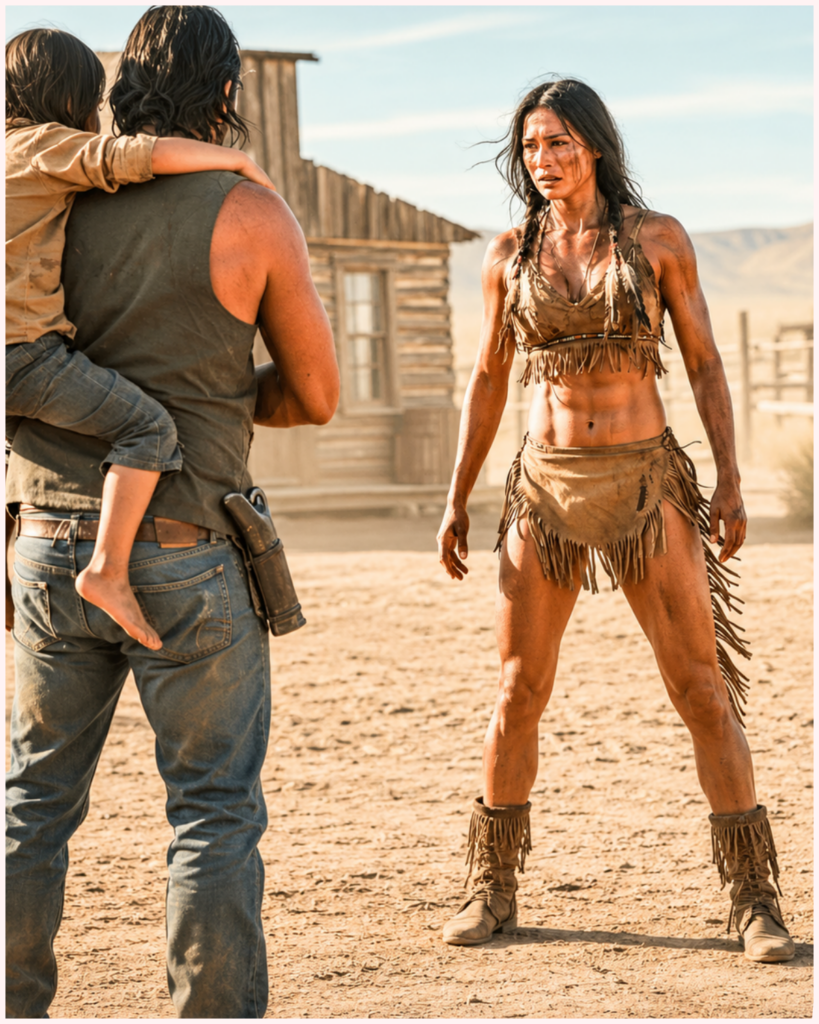
Autumn 1882, New Mexico. That afternoon, while riding out to check the northern fence line, Ethan suddenly stopped.
Out in the vast prairie, as wide and endless as the sea, one tiny image froze him in place.
An Apache boy, no more than 5 years old, barefoot, wearing tattered clothes, his face streaked with mud, and eyes dark, wild, and terrified like a lost little animal.
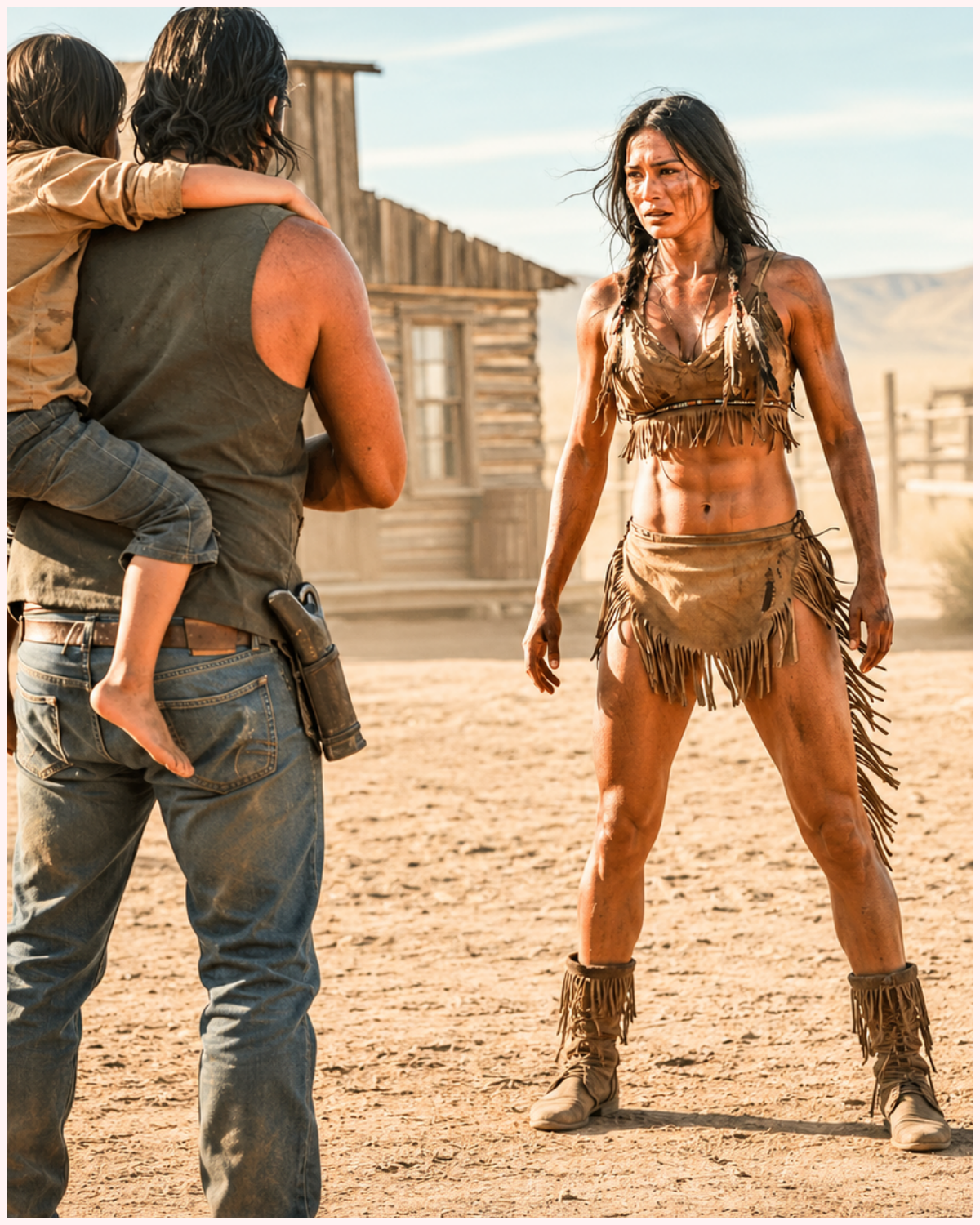
The boy trembled and stepped back when he saw Ethan, then collapsed onto the dry grass from hunger and exhaustion.
Ethan slowly approached, speaking in a deep, raspy voice he did not know he still had, the kind meant to comfort.
“It’s all right, little one. No one’s going to hurt you here.” Without hesitation, Ethan lifted the boy onto his horse and rode back to the cabin, fully aware that Apache were far from welcome in this town.
By the flickering firelight, he cooked porridge, gently cleaned the boy’s scraped-up feet, and handed him a small wooden horse, a gift Ethan had once carved for a son who never came into the world.
That night, as the child lay sound asleep by the fire, clutching the wooden horse like it was the whole world, Ethan stood in silence for a long, long time.
Something inside him, something buried beneath layers of loss and time, began to stir. Something he thought had died with the past.
The next morning, the first light of day slipped through the cracks in the wooden cabin and fell across the small face still sleeping by the fire.
The boy was clutching the wooden horse in his arms, as if afraid someone might take it away.
Ethan stood in the corner of the room, leaning against a wooden beam, watching that scene with a strange feeling he could not quite name.
For many years, this house had not known the breath of life. And now, even the faint breath of this child was enough to change everything.
But at the same time, doubt crept into his mind like nightfall after dusk. “What are you doing, Ethan?”
He asked himself. This child did not belong to him. He did not belong in Ethan’s world.
Keeping him meant inviting trouble. The townspeople did not need a big reason to hate the Apache.
And once they found out he was hiding a child, they would turn on him.
Some might even come and burn the ranch to the ground. That thought haunted him all morning as he led the horse out to the fields.
With every step, he argued with himself. Maybe he should alert the authorities. Maybe he should take the boy somewhere his people could find him.
But like a shadow, the memory of the son who never came into this world returned, the one he had carved wooden toys for, sewn tiny clothes for, and never once heard cry.
By the time the sun was high in the sky, the boy woke up and stumbled toward the door.
Seeing Ethan chopping wood outside the porch, he hesitated, then took a few steps forward, keeping his distance.
Those eyes filled with fear, guarded but also brimming with hope, seemed to pierce through the wall Ethan had built around his heart for the past 8 years.
“Are you hungry?” He asked. The boy nodded, barely. Ethan placed a bowl of warm porridge in front of him and sat across the table.
No words were spoken, just the soft clink of a spoon against the bowl and the wind whispering across the prairie.
But in that quiet moment, something invisible formed between them, a thread Ethan knew he could never break, no matter how hard he tried.
That afternoon, he tried placing the boy on the back of a horse. At first, the child was scared, but as the animal trotted gently across the grass, a small smile appeared on his lips, the first one since Ethan had found him.
It tugged hard at Ethan’s heart. When night fell and firelight danced on the cabin walls, Ethan sat alone, holding tightly to his old pocketknife.
He knew the decision had already been made, not out of pity, not out of guilt, but because of something deeper.
He could not bear to lose the chance to be a father one more time.
“You will stay here,” he whispered, looking at the sleeping child. “No matter what happens, I will protect you.”
In that moment, the choice was made, and he would bear full responsibility for this boy.
A day had passed since Ethan found the boy. The child was stronger now. His skin had regained some color, and he had started walking around the cabin, though his legs still trembled a bit.
He had not said a single word, but he clung to Ethan as if he were the only safe harbor left in the world.
Every time Ethan stepped out to the stables, the boy would sit by the window and watch, never letting go of his little wooden horse.
One afternoon, as the sun began to set and the cold wind of dusk swept across the land, Ethan was mending a broken section of fence behind the barn when he heard the distant sound of hooves.
Years of living in solitude had sharpened his instincts. He immediately grew alert, resting his hand on the revolver at his side, and stood still behind an old oak tree.
Down the narrow trail leading to the ranch, a woman appeared. She rode a bony, half-starved horse.
Her hair whipped wildly in the wind, and her dark eyes burned with exhaustion and despair.
Her buckskin shirt was torn, and a red mark still wrapped around her left wrist, left by rope.
When she saw the boy playing by the cabin window, she dropped the reins, collapsed to the ground, and cried out in a choked voice in Apache.
The boy heard that voice. He spun around and bolted for the door. In a heartbeat, he had flung himself into the woman’s arms, sobbing and calling out something again and again.
Ethan stayed still, his hand still on the gun, but then slowly lowered it. He did not need to understand their language to know the truth.
This was the boy’s mother. The woman Ethan would later learn her name was Takena, held her son tightly and wept.
She had wandered across the prairie for 8 days, searching for the child who had gone missing when their group had been scattered by patrol soldiers.
Fever, hunger, and despair had nearly claimed her life. But in her eyes, there was still a fierce light when she looked at Ethan.
“You saved him,” she said in broken English. “Thank you.” Ethan lowered his head and replied quietly, “No need to thank me.
I just did what was right.” When Takena staggered from exhaustion, he helped her inside the cabin, rekindled the fire, and gave her a bowl of warm porridge.
He knew full well that letting the two of them stay could bring serious trouble from the town where the Apache were seen only as enemies.
But then he said something even he did not expect to hear. “You and the boy can stay for as long as you need.”
Takena’s eyes paused on him, grateful but cautious. But when she looked at her son sleeping peacefully on the bed, still clutching the little wooden horse, she nodded.
That night, for the first time in 8 years, Ethan’s wooden cabin was no longer filled only with wind and creaking boards.
In the flickering firelight, there was the steady breathing of a child, the soft murmur of an Apache mother, and the quiet heartbeat of a man slowly finding a reason to live again.
In the days that followed, life in the little cabin began to take on a new rhythm.
Takena was still weak, but she did what she could, helping Ethan tidy up, cook meals, and care for Toma.
The boy, now able to speak a few more words in English, followed Ethan out to the stables every morning, trailing behind with wide, curious eyes.
The once-cold cabin was now filled with the warmth of life, even if the three of them had yet to say much to one another.
Then one evening, when the cold northern wind swept through the land, Toma started to cough.
At first, it was just a dry little rasp, but by the next morning, he was burning up in bed, struggling to breathe.
His tiny face flushed red, his lips cracked and dry, and the faint sound of “Ma”
“Pa” cut through Ethan’s heart like a knife. Takena panicked. She had seen this fever before in her tribe.
If they could not bring his temperature down quickly, the illness could take his life in just a few days.
There was no discussion. Together, they dove into a desperate fight for Toma’s life. Ethan ran to the creek, soaking cloths in cold water to lay across the boy’s forehead.
Takena burned leaves from her tribe’s medicine bag, brewing them into a bitter, dark liquid that she carefully dripped into her son’s mouth, drop by drop.
For 2 days and 2 nights, neither of them slept. Ethan stayed at the bedside, never letting go of the small, burning hand in his own.
Each time the fever dipped, even slightly, it felt like winning a battle. Once, when Toma was delirious and called out to him in his sleep, Ethan leaned in and whispered softly, “Papa is here.
I am not going anywhere.” In those tense hours, the distance between him and Takena quietly disappeared.
When her hands trembled from exhaustion, he gently laid his over hers, not saying a word, but letting her know they were fighting this together.
When he dozed off in the chair beside the bed, it was Takena who covered him with a blanket and smiled quietly.
On the third night, the fever finally gave in. Toma slept soundly, his breathing steady and deep.
Ethan collapsed into his chair with a long sigh of relief, while Takena sat beside her son, tears running down her cheeks, not from fear anymore, but from gratitude.
“No one has ever done this for my child,” she whispered. Ethan looked over at her, his voice rough and steady.
“He is not just your child now. He is ours.” In that moment, they both understood.
The invisible thread between them had become something real, not blood, not obligation, but a family built by choice and trust.
And there, in that small wooden cabin on the edge of the prairie, a home had quietly begun to take shape.
I am truly grateful for your your here. If this story stirred something in you, memories of dusty afternoons, the echo of hooves across the heart, consider subscribing to my channel.
So, each day we can sit together once more, and I will share with you another tale from the Old West.
Rumors spread quickly beyond the town. No one knew exactly who had seen the Apache woman buying salt and flour at the market, or the dark-skinned child running around near the stables, but within a few days all of Dry Hollow knew the truth.
Ethan Cole was harboring Apache under his roof. From the way people averted their eyes at the blacksmith’s shop to the whispers in the general store, and the looks of disdain from folks who once shook his hand, each felt like a small knife to the heart.
“That man’s lost his mind,” someone muttered. “They’ll slit his throat in his sleep,” said another.
But Ethan said nothing. He still went out to the fields each day, still led the horses to the creek, and each night he still sat down to tell Toma a bedtime story before sleep.
But not everyone spoke with words. One morning, when Ethan opened the barn, he found a sign nailed to the fence.
“Get out while you still can.” That very afternoon, someone hurled a rock through the cabin window, making Toma scream and burst into tears.
And then, as if they had all been waiting for a signal, the storm of hatred finally rolled in.
That evening, as the sun dipped below the blood-red horizon, the sound of hoofbeats echoed up the dirt path to the ranch.
Ethan stepped outside, resting his hand on the revolver at his side. In the dim light of dusk, 10 men rode in, guns slung at their hips, faces cold as stone.
Leading them was Sheriff Murdock, a man who had once shared whiskey with Ethan more times than either could count, yet now he could not even meet his old friend’s eyes.
“Ethan,” Murdock called out. “I do not want this to turn violent, but the town will not stand for an Indian living among us.
Hand them over, or leave this land.” The air was thick, heavy as lead. Takena stood behind the door, clutching her son tightly.
Toma trembled, burying his face in her shirt. Ethan stepped slowly down the front porch steps, stopping just a few yards away from the riders.
The fading sun painted deep shadows into the wrinkles on his face. “No,” he said, voice low and steady.
“They stay. This is their home, and mine.” “Ethan,” Murdock winced. “Do not make this worse.”
Ethan did not answer. Instead, he opened his coat, revealing the Colt revolver resting in its holster.
“If you want to get to them,” he said, slow and clear, “you will have to go through me first.”
Silence spread across the prairie like a heavy blanket. No one moved. No one reached for their trigger.
Finally, Murdock pulled his reins tight and motioned for the others to turn back. But the look in their eyes as they rode off was not defeat.
It was a warning. This was not over. As night fell, Ethan sat quietly on the porch, the gun resting by his foot.
The wind carried the scent of fire from the distant town, and in his chest stirred a feeling he knew too well, the feeling of a man who had chosen a path with no way back.
But this time, he was not alone. Inside that wooden cabin, there were two people he would die to protect.
Since the night those 10 riders surrounded the ranch and rode away, no one in town looked at Ethan Cole the same again.
Where once people would nod and tip their hats as he passed the entrance to Dry Hollow, now they turned their backs as if he carried some deadly disease.
Whispers trailed behind his every step, muttered just loud enough for him to hear. “Traitor.
Sleeping with savages. Gone completely mad.” At the general store, the shopkeeper refused to sell him a sack of flour.
At the livestock market, no one would buy his cattle, even at half price. Even the mailman, an old man who had shared countless dinners at Ethan’s table, now tossed his letters to the ground and walked away.
But the worst of all was the children. Every time Takena and Toma walked down the main road, stones were thrown, along with cruel, hateful words.
One afternoon, Toma came back to the cabin with a long scratch down his cheek and eyes red from shame.
Ethan knelt down to clean the wound, his hands trembling with rage and helplessness. “I am sorry,” he whispered.
“I should have protected you better.” But Takena only shook her head. “This is not your fault.
It is the price we pay.” In the weeks that followed, their lives turned into an invisible siege.
The town cut them off. No one hired Ethan for work. They burned part of his fence in the dead of night, slaughtered two of his cows, and nailed a sign to the front gate.
“Savages not welcome.” The cabin had become a symbol of scorn. No one came near.
No one offered help. Still, Ethan did not leave. Every morning, he rose early to repair the fence.
He planted more corn and barley in the dry earth. He taught Toma how to tie reins and start a fire.
Takena gathered herbs from the hills, quietly sewing new clothes for their son. They never spoke it aloud, but all three of them knew.
This cabin, this land, this family was no longer a place to hide. It was the one thing worth fighting for.
One night, the cold wind blew down from the north, carrying the scent of smoke from the distant town.
Ethan sat on the porch, his gun resting across his lap, eyes fixed on the flickering glow on the horizon.
He knew the townspeople were not finished. He knew the hatred still burned. But for the first time in his life, he was not afraid.
“We are staying,” he said, voice low and gravelly, “no matter what they think, no matter what they do, because this place, this is home.”
Takena sat beside him, her hand slipping into his. Toma leaned his head against Ethan’s shoulder, his tired eyes slowly closing.
And in that moment, even as the world turned its back on them, they found something greater than fear or prejudice.
They found each other. That summer came early and fiercer than anyone had expected. Hot winds swept across Dry Hollow like an invisible fire, carrying red dust and a tension that had never truly lifted since the day Ethan Cole stood against the entire town to protect his family.
But then, something happened that no one saw coming, something stronger than hatred. An outbreak.
It began with one child, then two, three. Within a week, half the town was running high fevers, coughing dry, and drifting into delirium.
The only doctor in the region panicked and fled to Santa Fe, leaving the people of Dry Hollow in chaos and fear.
Rumors spread like wildfire. “We are being punished. There is no medicine. No one knows how to cure it.”
Ethan heard the news from the mailman, the only one who still dared approach the ranch, though he no longer met Ethan’s eyes.
Ethan told Takena, and the moment she heard the symptoms, she shot to her feet.
In the red glow of sunset, her eyes no longer held fear or bitterness, only resolve.
“I know this illness,” Takena said. “In my tribe, we treated it with herbs, but I need a specific leaf.
It grows deep in the southern canyon.” Ethan nodded. “Then we go.” Without hesitation, the two began to pack.
But just before they left, a small voice spoke up. “I will go.” It was Toma.
He stood in the doorway, his eyes far more serious than any 5-year-old should have.
“I am small,” he said. “I can climb down the canyon easier.” Ethan wanted to say no, but in the end, he did not stop him, because he knew the boy was doing exactly what Ethan had taught him, to protect those who could not protect themselves, even if they had once caused him pain.
Three days later, Takena returned, her arms full of the healing leaves. They brewed the bitter medicine, showed those still strong enough how to bring down fevers, ease coughing, apply the herbs.
They went from house to house, ignoring the glares, the whispers, the judgment. And then, the miracle came.
The illness began to fade. One morning, the first person Ethan helped save, a little girl who had once thrown rocks at Toma, woke from her fever dreams.
Her mother fell to her knees at the doorstep of Ethan’s cabin, tears streaming down her cheeks.
“We were wrong,” she sobbed. “We were wrong about you.” Words spread like the wind.
One by one, people came to the cabin. Some brought bread, others brought wood and nails to repair the burned fences.
Even men who had once stood in the circle of 10 gunmen now bowed their heads on the porch they had once planned to burn.
An old man, hands shaking, placed a dusty bottle of bourbon on Ethan’s table. “We owe you more than our lives.”
That evening, for the first time since everything began, Ethan opened the ranch gate and saw the people of Dry Hollow walk in with smiles instead of hatred in their eyes.
And among them, Toma ran, laughing and playing with the same children who had once chased him away.
As the sun dipped below the grasslands, Ethan stood beside Takena. His hand reached for hers.
No words were spoken, but they both understood. They did not need forgiveness to live, but they had saved an entire town to be seen, to be understood.
And in doing so, they had healed wounds deeper than anyone could see. The following spring arrived as gently as a new breath on land once divided by hatred.
The wind no longer carried the scent of ash and smoke, but the fragrance of wildflowers blooming across prairies reborn after the plague.
And on the southern edge of Dry Hollow, once a symbol of contempt, Ethan Cole’s cabin had now become part of the community.
Each morning, the The of children’s laughter echoed around the stables. Toma, no longer known as that Apache kid, was now called the brave boy, the child who climbed down a dangerous cliff to bring back the leaves that saved the town.
The adults called him little brave. The other children fought for turns to play stick horse games with him under the golden Sunday.
Takina was no longer the insulted Apache woman. She was the healer of dozens of families.
Each week, she opened the cabin to teach women how to use herbs and care for wounds.
Some were hesitant at first, but her gentle smile and skilled hands eased every doubt.
No one called her a savage anymore. Now, they called her Miss Takina, the woman who saved their children.
And Ethan, the man once labeled a traitor, was no longer alone. Each morning, he rose early to walk the fields with Toma and returned home to work with Takina, mending fences and building new stables.
People came to help, leaving sacks of seed, loaves of bread, and words of thanks.
When the town hosted its spring festival, they invited the three of them as guests of honor, an unspoken apology.
One evening, as the sky blazed red at sunset, Ethan sat on the cabin porch, watching Takina gather herbs and Toma chase a puppy through the garden.
A soft wind stirred the chimes above, and for the first time in many years, Ethan felt no emptiness inside.
“Did you ever think,” he asked softly, “that we would have a family?” Takina looked up, a gentle smile spreading across her lips.
“No,” she said, “but maybe we did not find a family. Maybe we built one.”
The boy ran to them, climbed onto Ethan’s lap, and laid his head against his chest.
“I love you, Pa.” Ethan’s heart stopped for a moment. That word, one he thought he would never hear, had become real.
He held the child tightly, while Takina sat beside them, her hand finding his. No titles, no vows, but in that moment, they all knew.
This was a true family. In the distance, the church bells of Dry Hollow rang, but inside that small wooden cabin on the vast prairie, the most important sound was the rhythm of three hearts beating together, souls that had once been lost, now fully found.
They were no longer searching for a place to belong. They had built it themselves.
Hatred never heals. It only deepens the scars and traps us in darkness. Bullets may bring an enemy to the ground, but they will never bring peace to the heart.
Only love, the bravest force in a harsh world, and compassion, can break down the walls between us, because forgiveness is not forgetting.
It is choosing to move forward, lighter, together. It has been an honor to share this journey with you, my dear friends and loyal listeners of Wild West Storytelling.
I truly wish you a life filled with peace, joy, and happiness, wherever you are in this world.
I love you all. Let me know what you think of this story. Leave a comment down below.
Type the number one if you enjoyed this tale, and do not forget to subscribe to the channel for more thrilling stories from the Wild West.


