It's an old 10,000 ft runway built for B-52s durin…
It’s an old 10,000 ft runway built for B-52s during the Cold War, and it’s only 80 mi off my left wing.”
Samantha fired back, her eyes scanning the terrifying readouts on her engine indication and crew alerting system.
E I C A S. The hydraulic pressure for the backup flight controls was steadily dropping.
The explosion had severed a line. The lifeblood of the jet was bleeding out into the frozen air.
I don’t have the altitude or the hydraulic pressure to reach the mainland. It’s Shemma or the ocean.
Give me the Vector Argus 1. Vector 240. Mitchell ordered quietly. Distance is 82 mi.
Godspeed Falcon. Samantha banked the dying raptor heavily to the southwest. The crippled jet shuddered violently, protesting the maneuver.
Below her, the pristine blue sky vanished, replaced by an endless, swirling vortex of dark gray clouds.
She was sinking at 3,000 ft per minute. To reach Shemia, she would have to glide a heavy, unerodamic brick through a blinding winter storm, relying on failing instruments and a leaking hydraulic system.
The calculus of survival was simple. She had exactly 15 minutes to live. While Samantha wrestled with the failing hydraulics of Bulldog 3, the atmosphere inside the dimly lit cabin of the Argus 1 Awax plane was thick with tension.
Radar operators frantically coordinated with air traffic control at Anchorage Center to clear all civilian traffic from the Illusian corridor.
Colonel Mitchell hovered over his communications console, waiting for a secure line to connect to the Pentagon.
He needed authorization to land a highly classified, severely damaged F-22 Raptor at Irexen Air Station, a remote outpost that technically wasn’t open to standard military traffic.
The encrypted screen flickered and the stern face of Lieutenant General Arthur Vance, a highranking official at Air Combat Command, appeared.
General, we have a catastrophic class A emergency over the bearing. Mitchell reported immediately. Bulldog 3 suffered an uncontained engine failure.
Pilot is attempting a deadst stick glide toxen. General Vance frowned. Who is the pilot?
Captain Samantha Hayes. Call sign Falcon. Sir, with respect, I need base command to turn on their instrument landing systems right now.
She’s flying blind. Vance’s eyes widened slightly at the mention of the name. He turned away from the camera for a moment, typing something rapidly onto a secure terminal.
When he looked back, his expression had entirely changed. The bureaucratic sternness melted into a look of absolute rigid focus.
Colonel Mitchell, Vance said slowly. Are Higgins and Weaver currently flying escort for Captain Hayes?
Yes, sir. Bulldog one and two are on our wing. Patch my audio directly into their tactical frequency, Vance ordered.
Override their local comms aboard the Awax. A technician flipped a series of switches. You’re live with Bulldog Flight General.
High above the clouds, Higgins and Weaver were flying so close to Samantha’s crippled jet, they could see the charred, jagged metal peeling back from her right engine.
They heard the burst of static followed by the heavy authoritative voice of the general.
Bulldog one. Bulldog 2, this is General Vance, Air Combat Command. Listen to me very carefully.
You are currently escorting an asset of immeasurable value. You will do whatever Captain Hayes tells you to do.
You do not question her. You do not second guessess her. Higgins keyed his mic.
Confusion waring with his lingering panic. General sir, this is Bulldog one. With respect, she’s a rookie transfer from Edwards.
She’s bleeding hydraulic fluid and she’s trying to fly a crippled brick into a blizzard.
We need to order her to eject. Major Higgins, you will hold your tongue. Vance barked, his voice cracking like a whip over the radio.
Captain Hayes is not a rookie. Your squadron commander didn’t have clearance to read you her full file.
You want to know why she’s called Falcon? She earned that call signed 3 years ago during a joint DARPA and Lockheed Martin skunk works black project.
Higgins and Weaver fell completely silent. Even Samantha, struggling to keep the nose of her jet up, listened intently.
She hadn’t expected high command to breach her confidentiality protocol, but the situation was rapidly spiraling out of control.
Captain Hayes was the primary test pilot for the X62 A Vista program, Vance continued, his tone deadly serious.
But more importantly, two years ago, over a highly contested airspace in the Middle East, she was flying an experimental F-35 variant.
She suffered a total structural failure of the tail section, a mechanical failure that Loheed Martin engineers previously testified was 100% unservivable.
Weaver inhaled sharply. Every fighter pilot in the Air Force had heard rumors of the Syrian ghost, a pilot who had somehow glided an uncontrollable, tailless stealth fighter through hostile radar networks and landed it on a darkened dirt runway in friendly territory.
The incident was a legend whispered about in officers clubs from Nellis to Cadana. It was the aviation equivalent of a ghost story.
She didn’t eject, Vance said softly. She completely rewrote the emergency manual on asymmetric flight recovery by flying that doomed aircraft for 40 m fully manually without a single working flight computer.
She landed it, stepped out, and asked for a cup of coffee. The engineers gave her the call sign Falcon because they said the only way she could have flown that aircraft was if she physically bonded with it like a bird of prey.
Higgins stared through his canopy at the heavily damaged, smoking F-22 flying off his right wing.
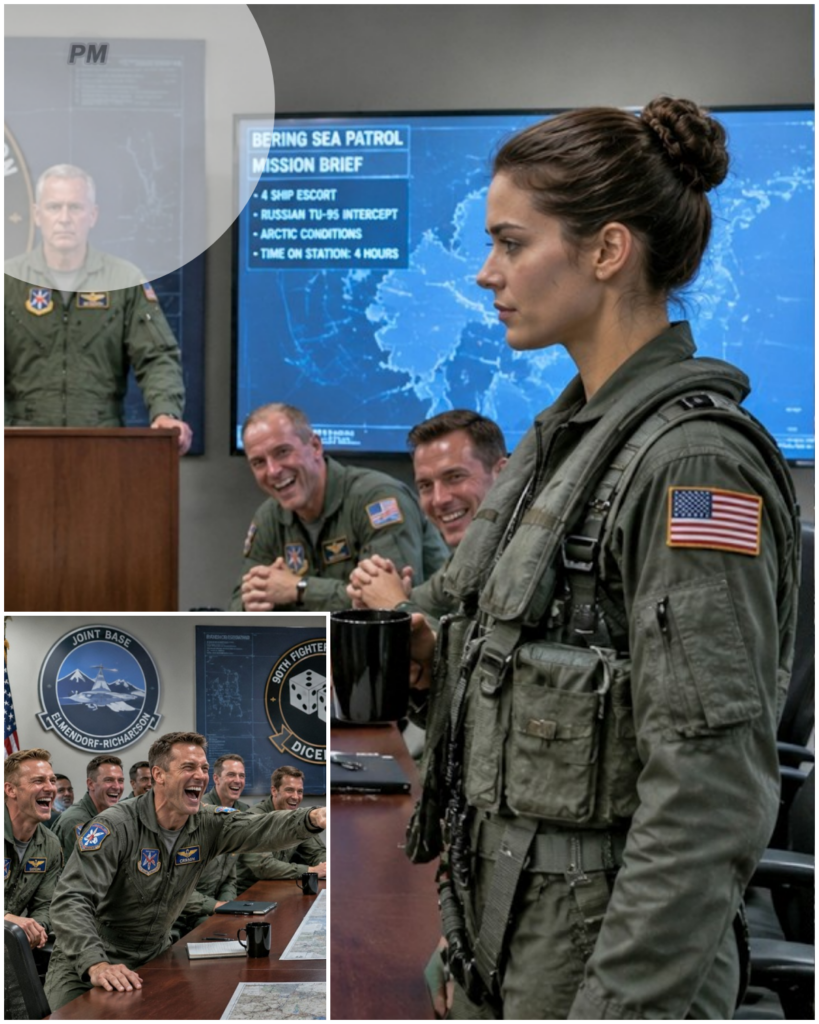
The quiet, unassuming woman he had mocked mercilessly just 3 hours ago was a living legend.
She was the ghost. So, Major Higgins, Vance finished. If Captain Hayes says she can land that dying bird on Shemya Island, you better make damn sure you stay out of her way and help her find the runway.
