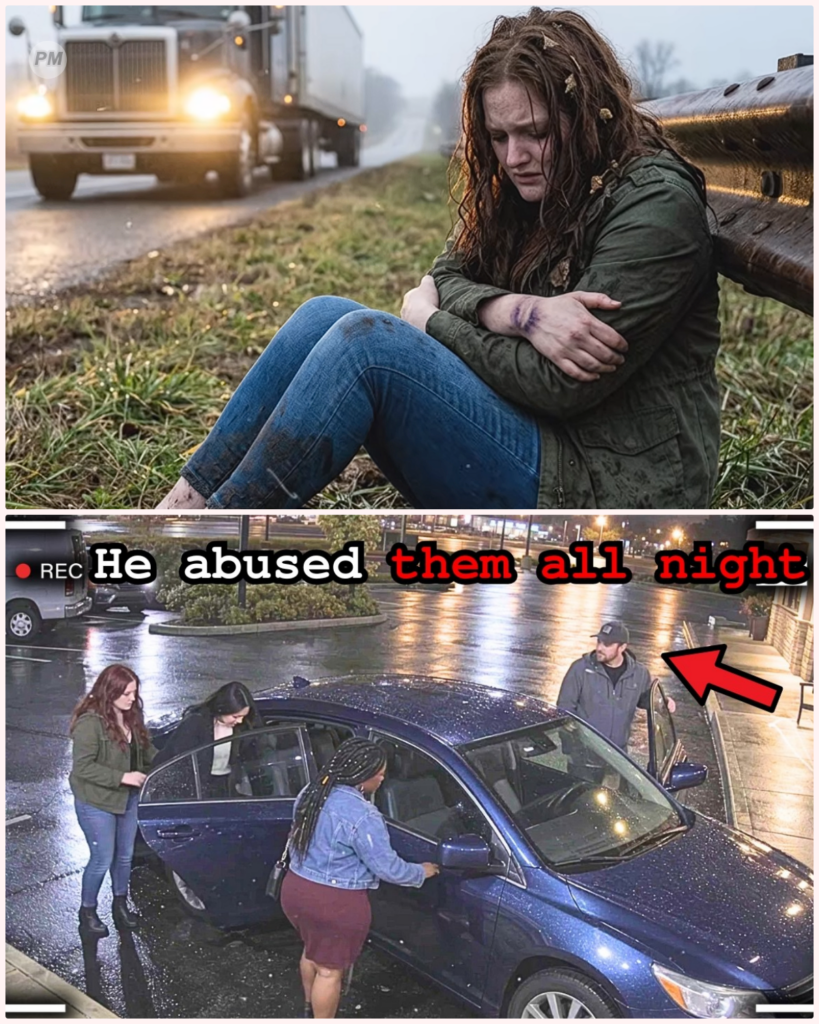
>> At 12:18 on a rain-soaked Sunday morning, three friends climbed into a blue sedan outside the Harbor Grill in Maple Ridge, Oregon.
The parking camera showed Deja Brooks opening the front passenger door. Maya Chen slid into the rear seat behind her.
Kristin Talbot paused beside the opposite door, looked across the lot, then got in. The driver closed the door and pulled away.
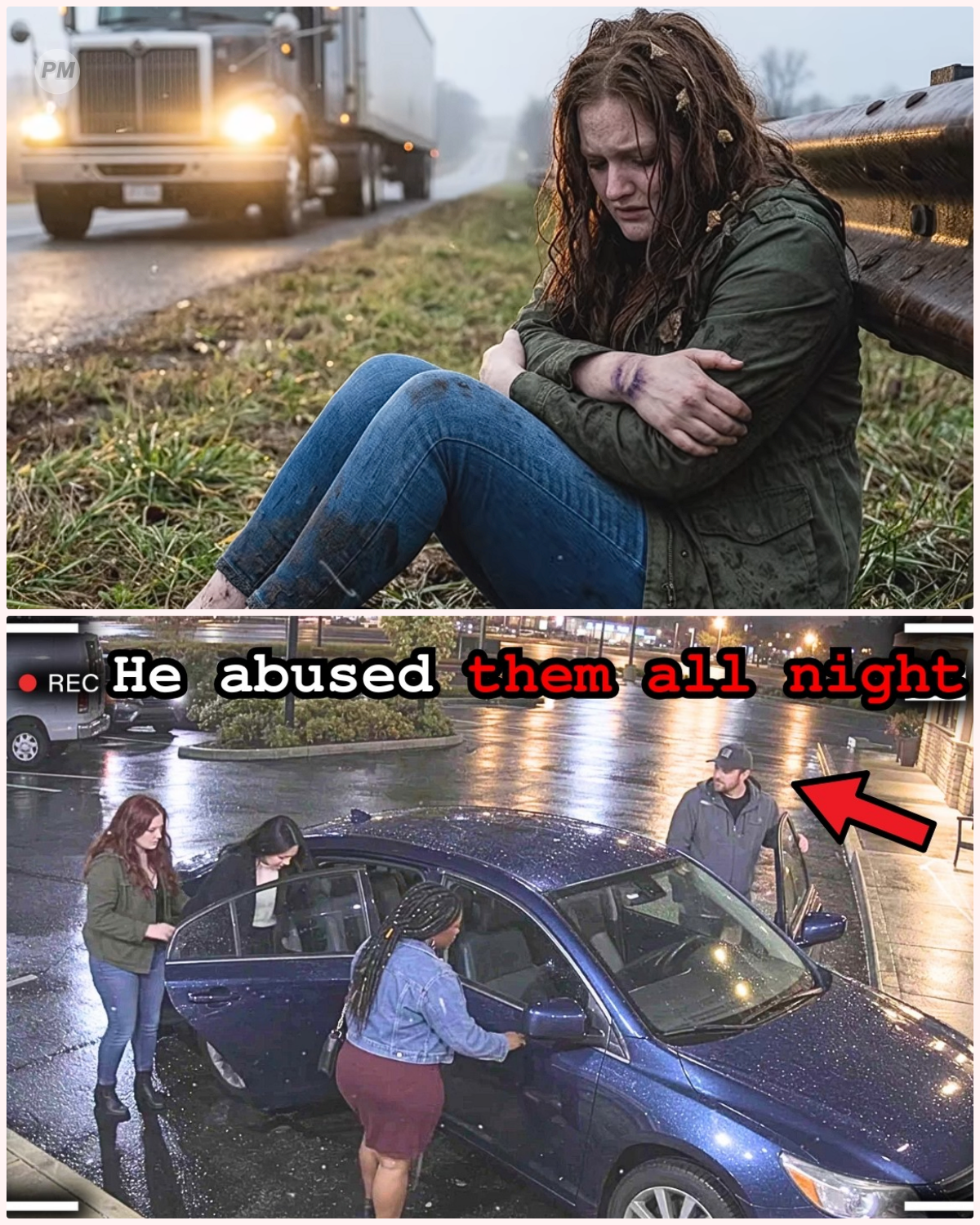
At 4:52, a trucker found Kristin barefoot on the shoulder of Route 16. She had mud in her hair, bruises around one wrist, and no memory of how she reached the highway.
She told the responding deputy that Deja and Maya were still inside the blue car.
Then she said there had been another vehicle. Minutes later, she insisted there had been only one.
By noon, detectives believed the survivor was hiding something. Two days later, they found Deja and Maya dead in an abandoned logging turnout.
The blue sedan was parked 9 miles away with its interior wiped clean. Its driver claimed Kristin had attacked her friends and fled.
For 11 days, the case appeared to depend on choosing which frightened person had lied.
Then a traffic analyst enlarged one corner of the restaurant footage and saw a headlamp moving behind a delivery van.
This is the story of how a second vehicle explained every contradiction in Kristin’s account.
Why the man driving the first car had prepared a witness before the crime began.
And how 3 seconds of reflected light dismantled an accusation built around the only woman who survived.
Kristin, Maya, and Deja met while working at the same outdoor equipment warehouse. Their friendship lasted 7 years and several changes of job.
Maya became a veterinary technician. Deja managed a coffee shop. Kristen worked as a payroll coordinator for a construction company.
They kept the first Saturday of each month for dinner, even when schedules forced them to meet close to closing time.
On April 6th, they chose the Harbor Grill because Deja had a gift certificate. Receipts showed they shared appetizers and each ordered one drink.
Staff described them as relaxed. At 11:46, Deja received a message from Travis Morrow, a former co-worker who sometimes drove for cash after bars closed.
Deja had used Travis twice without incident. His price was lower than three separate ride shares and rain had pushed wait times beyond 40 minutes.
She asked whether he could take them to three addresses. He replied that he was already nearby.
Travis arrived at 12:11 in a dark blue sedan registered to his older brother. The women paid their bill and walked outside.
A server locking the front door watched the women enter. Nothing in the scene suggested coercion.
What the server did not notice was the charcoal SUV parked behind a white delivery van at the north edge of the lot.
Travis’s intended route should have taken Deja home first, then Maya, then Kristen. Instead, phone location data showed the sedan turning east toward the Timber Roads.
Kristen remembered asking why. Travis said a crash had closed the bridge and he knew a faster route.
Her next memory came in fragments. Deja arguing from the front seat, a vehicle close behind them, the smell of sweet chemical cleaner, and someone pulling a hood over Kristen’s face.
At the hospital, those fragments changed each time detectives questioned her. She first described one man, then two voices.
She said Maya sat beside her, but later remembered Maya in another car. She claimed they stopped at a gas station, although no station camera showed the sedan.
She heard a dog barking, then said it might have been a recorded ringtone. Detective Rowan Hale wrote that Kristen appeared evasive.
Her toxicology screen found a sedative frequently prescribed for panic attacks. Kristen had no prescription.
An emergency physician explained that the drug could cause confusion, memory gaps, and suggestibility. Hale still believed she remembered more than she disclosed.
Travis reported to police voluntarily at 9:30 that morning. He said the women became argumentative after leaving the restaurant.
According to him, Kristen accused Maya of having an affair with Kristen’s former fiance. Deja asked him to pull over near a rest area.
Kristen struck Maya with a metal water bottle and ran into the trees when Travis tried to intervene.
He claimed Deja and Maya then accepted a ride from a passing SUV while he searched for Kristen.
That account conveniently included a second vehicle, but Travis could not identify its make, driver, or plate.
He said he drove home after failing to find Kristen. His brother’s sedan was not there when detectives arrived.
Travis claimed it had been stolen from the street. The story sounded improbable, yet one detail appeared to support it.
Investigators found a metal bottle in Kristen’s apartment with Maya’s blood beneath the cap. Kristen was still hospitalized when the bottle was collected.
She denied ever using it as a weapon. The blood was invisible and limited to a narrow groove.
Maya had borrowed the bottle during a hiking trip 2 weeks earlier and cut her thumb opening a food packet.
Photographs from that day showed a bandage on the correct hand, but detectives could not exclude a later assault.
The discovery shifted public attention toward Kristen. Online posts repeated Travis’s affair story. Reporters photographed officers leaving her apartment.
Her name appeared beside the word suspect before police had formally designated one. Deja’s phone complicated the timeline.
At 1:07 a.m., it sent Kristen a message. “Why would you do that?” The phone connected to a rural tower near the eventual recovery site.
Kristen’s phone was powered off at the time. Prosecutors later proved the message had been scheduled in advance using an automation app installed that evening.
Someone was manufacturing conflict between the women. Detectives found the blue sedan on Tuesday behind a shuttered feed store.
Rain had washed the exterior. The cabin smelled strongly of disinfectant. Luminol revealed broad wiped areas across the rear seat and cargo floor.
A small amount of Deja’s blood remained inside the passenger door speaker. Maya’s earring lay beneath the driver seat.
No usable fingerprints belonged to Kristen. Travis’s prints appeared on the wheel and trunk, which he explained by admitting he had driven the car.
He continued denying involvement in the deaths. He said Kristen’s missing fingerprints proved she wore gloves.
That interpretation lasted until technicians examined the seatbelt buckles. Cleaning fluid covered the smooth surfaces, but it not penetrated the narrow release mechanisms.
Inside the rear left buckle were skin cells belonging to Kristen and fibers from her green jacket.
Inside the rear right buckle were Maya’s cells. Both women had occupied the rear seat exactly as the restaurant footage showed.
The charcoal SUV remained unidentified. Kristen described its interior as tan, then gray. She remembered a cracked plastic vent and a small red light near the ceiling.
No witness recalled seeing the women transferred. Investigators mapped possible stops between the restaurant and logging roads.
At 12:43, a private home camera captured the blue sedan traveling east. 7 seconds behind it came a charcoal SUV with its left headlamp dimmer than the right.
At 12:58, a lumber yard camera recorded the same vehicles entering an unpaved access road.
Only the SUV returned. Its rear plate was obscured by mud, but the spare tire cover carried a pale crescent-shaped repair.
Analysts searched local insurance claims for rear-mounted spare damage. One match belonged to a 2008 charcoal SUV owned by Travis’s cousin, Caleb Morrow.
Caleb told police the vehicle had been in his garage all weekend. The garage had no walls and could be seen from an alley camera.
At 11:02 Saturday night, the SUV backed out. It returned at 3:46 Sunday morning. Caleb was driving.
When detectives obtained the SUV, its cargo area had been stripped. Seat covers were burning inside a metal barrel behind his workshop.
One fragment survived with a reddish-brown stain identified as Deja’s blood. Beneath the dashboard, investigators found a torn strip of green fabric matching Kristen’s jacket.
The cracked vent and red ceiling light were exactly where she had placed them. Her contradictions began to resolve into separate moments.
She remembered Maya beside her in the sedan. She remembered Maya in another vehicle because Maya had later been moved to the SUV.
The gas station lighting came from the lumber yard. The barking dog was real. A property owner half a mile away kept two hounds that barked whenever vehicles entered the access road.
The sedative explained why the odor remained broken. Receipts traced the drug to Caleb’s girlfriend who reported several tablets missing.
A disposable cup recovered from the sedan’s roadside route contained traces of the same compound and Kristen’s DNA.
Travis had offered the women bottled lemonade after they entered the car. Kristen drank more slowly than the others leaving her conscious longer.
Detectives reconstructed the attack through vehicle evidence rather than her memory. Travis drove into the lumber access road while Caleb followed.
When Deja demanded he turn around, Travis stopped near a locked gate. Caleb approached the passenger side.
Deja fought leaving blood inside the door speaker. Maya and Deja were forced into the SUV.
Kristen was restrained in the sedan. At some point, she freed one hand ran downhill through brush.
Tire impressions showed the SUV reversing toward the slope. Kristen reached a drainage channel too narrow for the vehicle.
She followed it west for nearly 4 miles before collapsing near Route 16. Travis and Caleb assumed she would not survive the cold rain or that the sedative would make anything she said unusable.
They were almost right about the second part. The motive began with payroll records. Kristen’s employer subcontracted hauling work to a company controlled by Caleb.
Three weeks before the murders, Kristen discovered duplicate invoices and checks endorsed into an account shared by both cousins.
She told Maya and Deja during dinner because she was afraid to report the theft alone.
Maya advised her to preserve copies. Deja knew Travis had worked for Caleb and said she could ask whether the invoices were legitimate.
Travis learned about the conversation through Deja’s message history after borrowing her phone at the coffee shop.
He and Caleb decided the three women possess the same information. The dinner arrangement offered a single opportunity to isolate all of them.
They built a story around Kristen because her recent breakup supplied believable conflict. Travis researched the former fiance through social media.
He planted Maya’s old blood on the bottle after entering Kristen’s apartment with a key copied months earlier when he helped Deja feed her cat.
Caleb installed the scheduling app on Deja’s phone after taking it at the logging road.
The plan required Kristen to disappear with her friends. Her survival left too many moving parts exposed.
Caleb was arrested first after the burning barrel search. Travis attempted to leave Oregon in a rented pickup and was stopped near the California line.
Inside his luggage, police found Kristen’s payroll flash drive, two of the women’s phones, and the dark cap visible in the restaurant footage.
Both men blamed each other. Caleb claimed he believed they were frightening the women into surrendering records.
Travis said Caleb killed Deja and Maya after losing control. Forensic evidence placed both men at the recovery site but could not assign every action.
Prosecutors charged them under joint criminal responsibility for kidnapping and aggravated murder. Kristen testified for 3 days.
The defense replayed every inconsistent interview. One attorney placed her statements in columns and asked why the jury should trust any version.
Kristen answered that she did not trust every memory, either. She described only what physical evidence later confirmed and refused to fill the remaining gaps.
That restraint strengthened her testimony. The state paired each fragment with an independent record. Cracked vent, the dog, the lumber yard lights, the seatbelt fibers, and the second vehicle.
What had sounded like changing stories became glimpses from different stages of the same night.
The restaurant video delivered the final visual proof. A technician stabilized the background and compared reflections in standing water.
When the blue sedan’s brake lights activated, another red glow appeared behind the delivery van.
The charcoal SUV rolled forward before Travis entered the driver seat. Caleb was already waiting.
The ride had never been spontaneous. Jurors convicted Travis and Caleb of two murders, three kidnappings, conspiracy, evidence tampering, and attempted murder.
Each received life without parole plus consecutive terms for the attack on Kristen. The construction company recovered part of the stolen money, but Kristen did not return to payroll work.
She moved from Maple Ridge and began using her middle name privately. She declined most interviews because coverage continued framing her survival as a mystery she owed the public an explanation for.
Deja’s family established a transport fund that pays for verified rides after late work shifts.
Maya’s clinic placed a bench outside its entrance with a small metal image of a dog.
Neither memorial mentions how they died. The parking footage remains difficult to watch because it looks like the beginning of an ordinary solution.
Three friends face a long wait in the rain. Someone they know offers a cheaper ride.
They open the doors one after another. At the far edge of the image, almost hidden by a van, a second headlamp turns on.
Police initially treated Kristen’s broken memory as evidence against her. In reality, the breaks preserved the shape of what Travis and Caleb had done.
One car, then another. One road, then a transfer. One survivor describing pieces investigators kept trying to force into a single journey.
There had always been two vehicles, and before any of the women entered the first one, the second was already waiting to make sure none of them reached home.
There was one more reason detectives had doubted Kristen so quickly. At the hospital, she repeatedly asked whether police had found a silver bracelet.
No bracelet appeared in the restaurant footage, and neither family recognized the description. Hale suspected she was inventing an object to support an imaginary second capture.
The bracelet was found beneath the SUV’s removed rear bench. It belonged to Deja and bore three engraved coordinates.
The warehouse where the women met, the campground from their first shared trip, and the Harbor Grill.
Deja had bought matching bracelets as a surprise and handed them out in the car.
Kristen’s bracelet disappeared during her escape. Maya’s remained clasped under one sleeve when she was found.
That detail mattered because Travis claimed the women were already fighting when he arrived. The bracelets show that Deja entered the car expecting a celebration.
A jeweler’s receipt placed the purchase that afternoon, and a draft message on her phone read, “Don’t let me forget the little boxes.”
Investigators found those boxes crushed beneath the sedan’s rear mat. Hale later acknowledged that he interpreted uncertainty as deception.
Interview recordings showed Kristen trying to correct herself whenever an image felt incomplete. Detectives often read those corrections as strategic changes.
A trauma specialist explained that sedatives and acute fear disrupt sequence before they erase sensory fragments.
Kristen could accurately remember the red ceiling light without knowing whether she saw it before or after the lumber yard.
The defense tried to turn that explanation into permission for unlimited invention. Prosecutors answered by charting only memories corroborated by evidence.
Of 23 sensory details Kristen volunteered before police located Caleb’s SUV, 19 were later verified.
She described adhesive residue on the rear window, a missing interior handle, pine needles on the floor, and a heater that clicked without blowing warm air.
All appeared in Caleb’s vehicle. The four unverified details were never presented as fact. Investigators also learned why Kristen alternated between hearing one male voice and two.
Audio from a hunting camera near the logging road captured Travis using Caleb’s phone on speaker.
At some moments, Caleb’s voice came through the sedan’s dashboard while he followed in the SUV.
At others, both men stood outside the car. Kristen’s covered head prevented her from distinguishing a speaker from a person beside her.
The hunting camera did not record faces. It captured engine noise, two sets of headlights, and a short exchange.
One man said, “She didn’t finish it.” The other replied, “Then keep her separate.” Toxicology showed Kristen’s blood concentration was less than half the level found in Deja and Maya.
Her decision to sip the lemonade rather than drink it quickly likely preserved enough coordination for her escape.
Searchers retraced the drainage channel in daylight. They found a torn shoelace, a button from Kristen’s jacket, and impressions where she crawled beneath a fallen cedar.
Near the highway, her bare footprints shortened and veered toward traffic. The pattern matched hypothermia and exhaustion, not a staged disappearance.
The trucker who found her testified that Kristen did not ask to flee police. She asked him to lock the doors because the other car might be behind her.
He wrote those words on the back of a fuel receipt before deputies arrived. That contemporaneous note predated every interrogation and made it difficult to claim detectives had planted the second vehicle theory.
Caleb’s internet history exposed how deliberately the cousins exploited anticipated disbelief. He searched combinations of drug memory unreliable, survivor accused missing friends, and clean blood car fabric.
Travis downloaded police interview videos and watched sections in which confused witnesses corrected timelines. They did not merely plan the physical crime.
They planned the story investigators might tell about whoever escaped it. Their greatest mistake was using two cars to create that confusion.
Each vehicle generated independent traces, fuel purchases, traffic images, tire patterns, wireless connections, and debris.
The sedan’s onboard system recorded a paired phone belonging to Travis. The SUV’s aftermarket stereo logged Caleb’s device.
Both systems registered at the lumber road within the same 3-minute interval. At 2:07 a.m., Maya’s fitness watch detected a final burst of movement beside the logging turnout.
At 2:11, Caleb’s SUV door sensor recorded the cargo hatch opening. The manufacturer stored diagnostic events locally, even without a subscription.
A technician recovered the data after replacing the vehicle battery. Those timestamps contradicted both defendants.
Travis said he left before midnight. Caleb said he never drove. Their own vehicles describe the sequence without relying on Kristen’s memory.
During closing arguments, the prosecutor placed a still from the restaurant camera beside a still from the home camera 40 minutes later.
In the first, only the nose of the SUV could be seen. In the second, it followed 7 seconds behind.
“The second car is small when the plan is still hidden,” she told jurors. “It becomes clear only after you know where to look.”
Kristen watched from the front row as verdicts were read. She did not look at either defendant.
Later, she said the convictions could establish what happened without restoring the portions of the night she lost.
She would never know the last words Maya or Daisia spoke, whether they understood she had escaped, or how long they waited for help.
That uncertainty became part of her life rather than a puzzle the trial could solve.
The evidence cleared her, but public corrections traveled more slowly than the original accusation. Some articles were updated without changing their headlines.
Archived posts continued repeating the affair motive years after police disproved it. The district attorney eventually released a timeline identifying Kristen as a surviving victim in every entry.
Hale apologized to her privately and later used the case in training on drug-facilitated crimes.
He emphasized a rule investigators had violated. Inconsistencies should be tested against evidence, not treated automatically as evidence itself.
The case now appears straightforward because the second SUV is known. Without it, the physical record looks impossible.
Kristen is restrained in one car, yet remembers another interior. Maya’s evidence appears in both vehicles.
Daisia’s scheduled message travels after the women are separated. The apparent impossibility was never in the witness.
It was in the assumption that all four people remained together. The footage corrects that assumption before anyone recognizes it.
Wet pavement reflects two separate sets of lights. Travis watches the women enter while the hidden SUV begins moving.
Kristen pauses at the rear door and looks in its direction. Perhaps noticing motion she will remember only as a headlamp.
Then she enters. The sedan carries three friends out of the visible frame. The SUV follows, nearly invisible, but already part of the journey.
Hours later, only Kristen reaches the road again, carrying a story broken into pieces by a drug chosen for exactly that purpose.
The men expected those pieces to contradict one another forever. Instead, every piece pointed to the vehicle they believed the camera had missed.