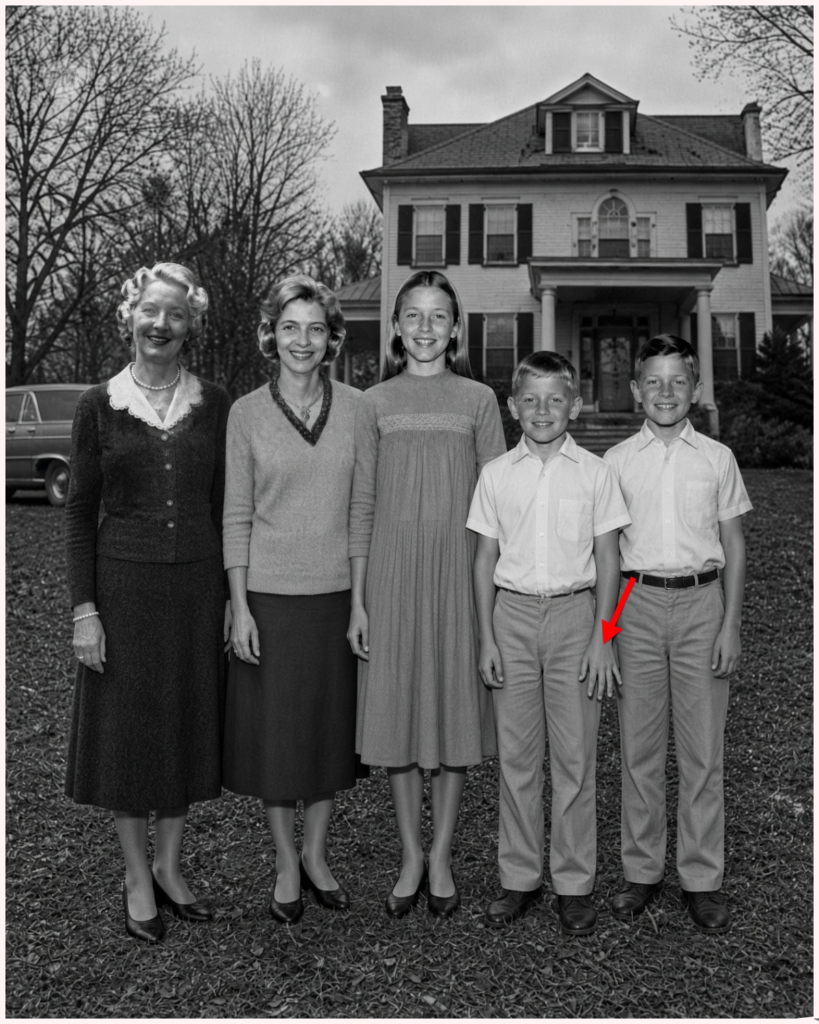
Dolores Miller Clark, the second wife, collapsed
Dolores Miller Clark, the second wife, collapsed. She had lived with him for four years, gone to church with him every Sunday, eaten dinner with him every night, slept beside him every night, and never known that her husband had shot his first wife, his mother, and his three children, and laid the bodies on sleeping bags in a ballroom.
[music] She was the sixth victim, not by a bullet, but by a lie that lasted four years of marriage and thousands of nights sleeping next to a murderer without knowing it.
They divorced in 1989. She never spoke publicly much about what she felt, [music] but her silence said more than any interview.
List was extradited to Union County, New Jersey, [music] and he kept denying even after the fingerprints matched.
Even after the FBI compared military records, even after the 1971 crime scene evidence matched the biometric traces of the man sitting in the interrogation room, Robert Clark would not die.
[music] He held on to that false name for months, refusing to admit he had ever been John List, [music] refusing to admit Breeze Null had ever existed, refusing to admit the five bodies in the ballroom had anything to do with him.
Finally, on February 16, 1990, facing a mountain of evidence that could not be denied.
Military fingerprints, gun permit fingerprints, [music] physical evidence from the scene, and the confession letter in his own handwriting.
John List admitted his true identity. [music] Robert Clark disappeared for the last time. The trial began on April 2nd, 1990 in Union County Superior Court in Elizabeth, New Jersey.
[music] 18 and 1/2 years after the murders. Defense attorney Elijah Miller did not deny that John List had killed five members of his family.
He could not deny it. The confession letter, the fingerprints, [music] and List’s own admission had removed every possibility of denial.
Instead, Miller argued that List suffered from obsessive compulsive disorder, that he had a fragmented personality, unable to face compounding hardship, and that he truly believed he was saving his family’s souls in a world he no longer understood.
Miller asked the court to find List guilty of secondderee murder without intent rather than firstderee.
On the other side, prosecutor Elellanar Clark tore that argument apart with the five-page letter list had left behind.
She read passage after passage to the jury. The plan to cancel the newspaper, the plan to call the school, the plan to close the bank accounts, the funeral instructions, the escape route.
She asked the jury, “Is this the behavior of a man who has lost control, or is this the plan of a man who calculated every detail from the temperature in the house to the music playing through the speakers, [music] then calmly walked out the door and started a new life?”
Elellanar Clark described List as cruel and calculating to the point of evil. She said he wanted a new life, so he simply closed all the old accounts and left.
Bank accounts, family accounts, accounts of living. Psychiatrist Steven Siming, who examined List by court order, offered a diagnosis just as cold.
He confirmed List had an obsessive personality, but added that there was no evidence of genuine remorse.
“He is a cold man,” Simring [music] said. Judge William Wartimer, who presided over the trial, later described list in six words that every document on the case, remorseless and without honor.
The trial lasted 7 days. The jury did not deliberate long. On April 12th, 1990, John Emile List was found guilty on all five counts of first-degree murder.
Judge Warttimerimer imposed five consecutive life sentences, one for each victim. Helen, Alma, Patricia, John Jr., Frederick.
Five names, five lives cut short. Five sentences stacked on top of one another to guarantee that John List would never walk out of prison.
He was 64 when he was sentenced. He would die in prison and he knew it.
John Liss did not accept the sentence. He appealed. His lawyers offered two arguments they believed were strong enough to overturn the verdict.
The first argument, post-traumatic stress disorder from military service in World War II, had impaired List’s judgment and made him unable to make a rational decision at the time of the murders.
The second argument, the five-page letter list left at Breeze Null was confidential information sent to his pastor covered by the privilege between congregant and shepherd and therefore should not have been used as evidence at trial.
Both arguments were rejected by the federal appeals court. On PTSD, the court concluded there was no clinical evidence that List lost the ability to understand his conduct at the time of the crime.
On the contrary, the meticulous planning from cancelling the newspaper subscription to lowering the temperature in the house proved he was fully lucid and in control of every detail.
On the letter, the court ruled that List had voluntarily left the letter at the scene with a note titled to the finder for whoever found it, an act that eliminated any claim of confidentiality.
He did not mail the letter to the pastor. He left it on the desk next to five bodies for police to find.
[music] That was not confidential information. That was a confession. The United States Supreme Court refused to hear the case.
Every legal door slammed shut. John List would die in a New Jersey prison, and no power on earth could change that.
In prison, List lived by the same pattern he had lived all his life. Disciplined, quiet, rule following, causing no trouble.
He went to chapel in prison every Sunday just as he had in Westfield, in Denver, in Richmond.
He prayed, he read the Bible, [music] and he waited in the way he told a reporter for the day he would meet his family again in heaven.
[music] In 2002, in the only interview he agreed to give publicly, reporter Connie Chung went to the New Jersey State Prison in Trenton to talk with John List.
This was the first time since his arrest in 1989 that he spoke directly to the media about the murders.
He was 76, white-haired, sitting in a visiting room in prison clothes, [music] and he told Chung things any criminal psychologist would analyze for years.
I wish I had never done what I did, he said. I have regretted my actions and [music] prayed for forgiveness ever since.
When Chung asked why he did not kill himself instead of killing his family, List answered with the same twisted religious logic he had written in the letter 31 years earlier.
He believed suicide would keep him out of heaven and if he [music] did not go to heaven, he would never see his family again.
He had to live so he would have a chance to reunite with the people he had killed with his own hands.
Then he said a sentence Chung later called the most chilling moment of her interviewing career.
