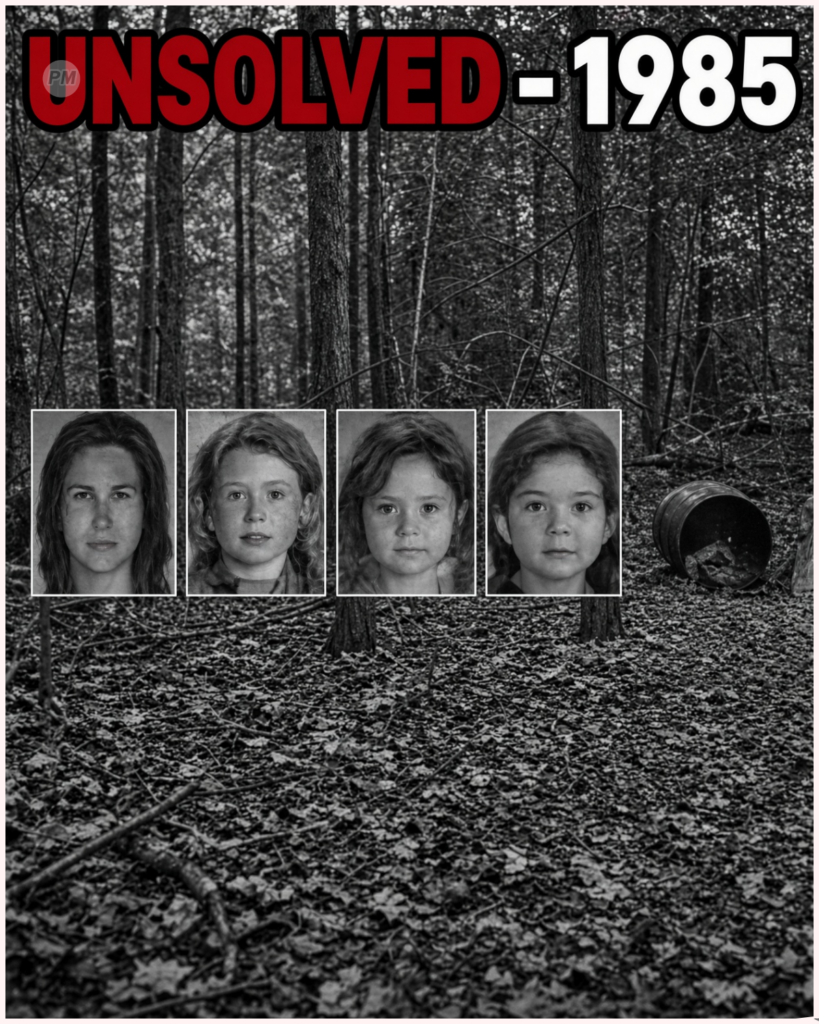
On November 10, 1985, a hunter walking through the woods near Bearbrook State Park in Allenstown, New Hampshire, spotted a 55gallon drum lying among the trees.
Inside were the bodies of a woman and a young girl wrapped in plastic bound with industrial electrical wire reduced to skeletons.
Police circulated composite sketches throughout New England. No one recognized them. No missing person reports matched.
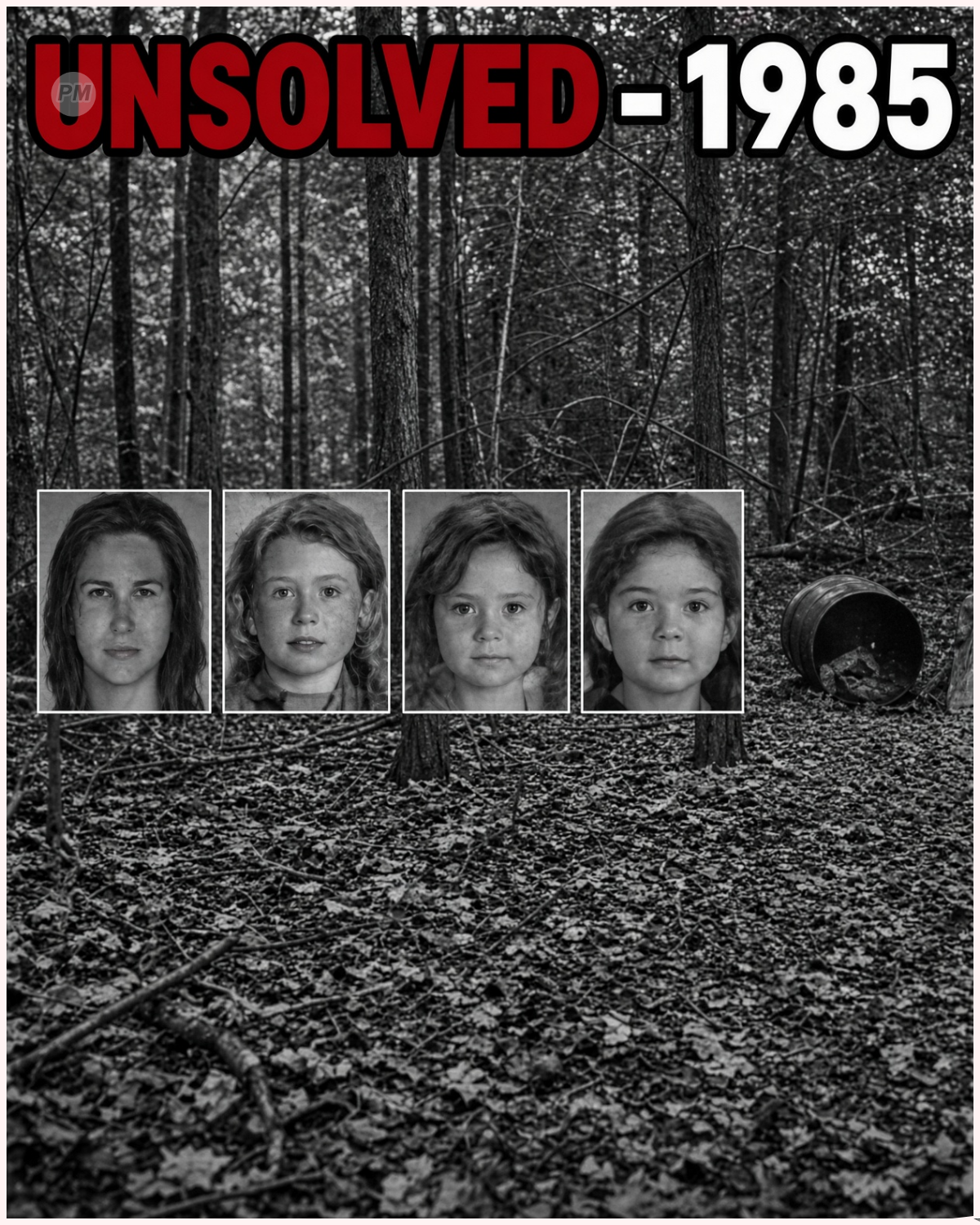
They were buried in the town cemetery, their headstone reading unknown. 15 years later, in 2000, a second drum was found less than 100 m away, [music] containing the bodies of two more young girls, disposed of in the same manner.
Four bodies, not a single name, no suspect. In any other state, four dismembered victims dumped in the woods would have been a national sensation.
But this was before the DNA era. And these four people had not only been murdered, but stripped of their very identities.
Their killer was still alive, still changing names, still killing others. No one knew. It would take 40 years.
A forensic technique that did not yet exist. A librarian searching family forums in the middle of the night.
A scientist building a 25,000 person family tree and a volunteer organization tracing obituaries from 2005 for the four skeletons in the New Hampshire woods to reclaim their names.
This is the story of the longest running cold case in New Hampshire history, of the killer who called himself Bob Evans, and of the ordinary people who refused to let four lives be forgotten.
If you are the kind of person who stays until the end, who wants to know not only what happened, but why it took four decades to give the dead their names back, you have come to the right place.
Subscribe to Cold Case Reopened. We dig into the cases everyone else has forgotten. When Allenstown Police opened the first drum in the fall of 1985, they found something no one in New Hampshire law enforcement was prepared to face.
Inside the industrial 55gallon metal drum, the kind commonly used in chemical plants were the bodies of an adult woman and a young girl.
[music] Both had been dismembered. Both were wrapped in black plastic bags and bound with industrial electrical wire.
Investigators later determined the wire came from the Carol Cable Factory, [music] a cable manufacturing facility that once operated in the New England area.
It was one of the first concrete physical clues and for years it remained one of the only ones.
[music] The cause of death for both victims was determined to be blunt force trauma to the head, not a [music] knife, not a gun.
Someone had beaten them to death with a heavy object. The woman was estimated to be in her early 20s, possibly 23 to 25.
The girl was estimated to be between 5 and 11 years old. There were no identifying documents, no recognizable jewelry, no clothing intact enough to trace.
The bodies had been in the drum for years, possibly since the late 1970s, possibly the early 1980s.
The time frame [music] was too broad to narrow a search, and no one in Allentown or any neighboring town had reported a young woman and a little girl missing during that period.
New Hampshire State Police had forensic facial reconstructions done, producing two composite sketches that were distributed throughout New England.
The sketches appeared in local newspapers on television news and were sent to police departments from Maine to Connecticut.
[music] No one called, not a single phone call. The two victims were buried at St.
John Baptist Cemetery in Allenstown, a small Catholic parish cemetery in a town of fewer than 5,000 people.
Their headstone carried no names, no birth dates, no death dates. Only a line confirming that two human beings had once existed and now lay here unidentified.
[music] The Allenstown community learned to live with the mystery. Towns people knew about the two bodies in the drum.
They talked about it at the coffee shop, at the post office, in backyards, but no one had answers.
And after a while, the questions began to fade. Not because people forgot, but because there was nothing new to say.
Then 15 years passed. [music] On May 9, 2000, a worker clearing land near the site of the first drum discovery found a second drum.
It lay less than 100 m from the original drum hidden behind a dense thicket of brush [music] that 15 years of unchecked growth had turned into a natural green wall.
Inside were the bodies of two more young girls, estimated ages 2 to 4 and 1 to three.
Same method, plastic wrapping, electrical wire, blunt trauma. Investigators quickly concluded the two drums had most likely been placed at the same [music] time in a single act by the same person.
They had shifted over the years, possibly by rainwater, possibly by animals, and quite possibly by local children.
Think about that for a second. For years, Allen’stown children had played in those woods, kicked balls, built forts, run among the tree trunks just dozens of meters from where four dismembered bodies lay.
No one knew. The discovery of the second drum turned the case from a mystery into a nightmare.
It was no longer two victims, but four. No longer a single murder, but the pattern of a serial killer.
[music] Investigators gave the four victims the nickname, the Allenstown 4. The FBI joined the investigation.
DNA from the four victims was collected and entered into the National Cotus database. Facial reconstructions were updated with newer, more detailed technology.
America’s Most Wanted aired a special segment on the case. Information was sent to the National Center for Missing and Exploited Children.
Nothing matched. DNA technology of the time could compare samples if a fat reference sample existed.
But it could not identify someone from zero when no one knew where to start looking.
It was a vicious circle. To identify the victims, you needed family DNA. But to find the family, you first needed to know who the victims were.
The case became New Hampshire’s most famous cold case. Every few years, the media returned, reprinted the sketches, retold the story, pleaded for tips.
Each time it ended the same way. Silence. [music] Four lives had been completely erased.
Not only robbed of life, but robbed of existence itself. No names, no past, no one to claim them.
No one to mourn them. And throughout all that time, their killer was still alive.
He was out there under another name in another city, possibly killing again. But no one knew.
While the four unidentified bodies lay in the Allenstown cemetery, and investigators ran into one dead end after another, the answer to who had killed them had actually once been very close.
In the late 1970s, a man calling himself Bob Evans appeared in Manchester, New Hampshire, the state’s largest city less than 20 m from Bearbrook State Park.
No one knew where he had come from. No one asked. Evans was hired as chief electrician at the Wombbeck Mills in Manchester, a large textile mill that had operated for more than a century.
He was skilled at his trade, reliable on the job, and seemed like an ordinary working man in an ordinary industrial city.
But Bob Evans was not his real name, and he was not ordinary. In February 1980, Evans was arrested in Manchester for writing a bad check dated December 21st, 1979 with insufficient funds.
In May 1980, he was arrested again for theft of electrical service. [music] In October 1980, he was arrested a third time for illegally diverting electricity.
Three arrests in 8 months, all under the name Robert T. Evans. And not once did Manchester police check the true identity of the man.
No fingerprints were compared. No background was run. He gave a name, police wrote it down, and the system accepted it.
[music] This was the late 1970s, early 1980s. There was no federal digital database, no automated identification system.
A man could walk into a new city, claim a new name, and start over without anyone questioning it.
And that is exactly what Terry Peter Rasmuson did repeatedly [music] in multiple places over multiple decades.
His real name was Terry Peter Rasmmanson, [music] born December 23, 1943 in Denver, Colorado, the fourth of five children.
The family moved to Phoenix, Arizona when he was young. Rasmuson grew up there, attended North High School in Phoenix, but dropped out after his sophomore year.
In April 1961, at age 17, he enlisted in the US Navy. The Navy trained him as an electrician, a skill he would use for the rest of his life, both in legitimate work and to conceal his crimes.
He served 6 years at West Coast bases and in Okinawa, Japan, before receiving an honorable discharge in July 1967.
After the military, Rasmuson moved to Hawaii and worked in his parents’ shoe store. On July 20, 1968, he married in Hawaii.
In 1969, the couple moved to Phoenix, where she gave birth to twin daughters. The family later moved to Redwood City, California, where Rasmmanson worked as an electrician in PaloAlto.
A son was born in 1970. A third daughter was born in 1972. Four children in less than 4 years.
From the outside, this looked like a normal family of a veteran, a skilled electrician, a father.
From the inside, the story was very different. [music] In 1973, Rasmosen was arrested in Arizona.
In June 1975, he was arrested again for aggravated assault. That same year, his wife decided to separate.
She left with the four children, and the Rasmuson family believed that was the last time they would ever see him.
In late 1974 or early 1975, Terry Peter Rasmuson disappeared from the lives of everyone who had ever known him.
No goodbye, no new address, no phone call. He simply ceased to exist under the name Terry Rasmuson.
From that point on, he began living under different names in different cities, building false lives, and leaving when the situation became inconvenient or dangerous.
Bob Evans in Manchester, New Hampshire, Curtis Mayo Kimble in California, Gordon [music] Jensen somewhere else, Jerry Mockerman when stopped by police in San Louis Obyspo, Lawrence William Vanner when he needed a cleaner identity.
Each name was a new shell, a new life, a new chance to approach people who would trust him.
Later, investigators would nickname him the chameleon killer. The chameleon that changes color to match its environment.
But the comparison was actually insufficient. A chameleon changes color to protect itself. [music] Rasmuson changed to hunt.
A criminologist later observed that what set Rasmuson apart from most serial killers was that he targeted people with whom he had emotional relationships.
Most serial killers target strangers. Rasmuson targeted girlfriends, women who trusted him enough to live with him, enough to bring their children into his home.
[music] He did not stalk victims on the street. He cooked dinner for them. And while Bob Evans was living in Manchester, New Hampshire in the late 1970s and early 1980s, being arrested for bad checks and electricity theft, going to work every morning at the Wombbeck Mills like an ordinary citizen, he was also doing things the world would not learn about for more than three decades.
A forest less than 20 m from Manchester was hiding the evidence. To understand what lay inside the two drums at Bearbrook State Park, one must go back to the late 1970s and trace the lives that were erased before anyone realized they had ever existed.
Marla Elizabeth Honeyurch was born and raised in California. She was 24 years old and used several different names, including Marla McWaters.
She had two daughters by two different fathers. Marie Elizabeth Vaughn, age six, and Sarah Lin McWaters, only one year old.
The last time anyone in the family saw Marlice and her two daughters was in November 1978.
[music] After that, all three vanished. No official missing person report was filed for years.
No search was launched. In a family whose members frequently lost contact, Mariza’s absence was not unusual.
People assumed she had moved away, started a new life. Somewhere else, [music] possibly with a new man.
No one suspected that she and her two daughters were dead, but Marla, Marie, and Sarah were not the only ones who disappeared into Terry Rasmuson’s orbit during that period.
[music] Somewhere else around the mid 1970s, Rasmuson met a woman named Pepper Reed. Reed was born in 1952, originally from Texas, [music] raised in Houston, where Rasmuson is known to have lived for a time after leaving his family in Arizona.
In 1976 in Orange County, California, Pepper Reed gave birth to a baby girl. [music] The birth certificate listed the father’s name as Terry Rasmmanson and the mothers as Pepper Reed.
The child was named Ria Rasmuson. After that, Pepper Reed vanished. There are no records of her after the late 1970s.
No address, no tax records, no driver’s license, no bank accounts. An entire life evaporated completely from every administrative system.
Authorities later came to believe Rasmuson had killed Pepper Reed, though her body has never been found.
As for Rehea, his biological daughter, she ended up in the drum at Bearbrook State Park.
She was about 2 to four years old when she died, killed by her own father in the same manner as the other three victims.
Blunt force trauma to the head, then dismembered, wrapped in plastic, and stuffed into a 55gallon metal drum together with Sarah McWaters, Marliza’s one-year-old.
Two children with no blood relation, dead side by side in the same metal drum, in the same forest by the same [music] hand.
And one of those two children was the killer’s own daughter. This is what investigators later called the most brutal aspect of the case.
Not the murders themselves, though those were horrific enough, but the fact that a father killed his own daughter, stuffed her into a drum with three strangers, dumped them in the woods, and continued living as if nothing had happened.
Rasmmanson did not stop after Bear Brookke. He could not stop. After killing Marlies, Marie, Sarah, and Ria sometime between roughly 1978 and 1981, he continued living in Manchester under the name Bob Evans.
And there he began a new relationship. Denise Bodton, 23 years old, lived in Manchester.
She met Bob Evans and they began living together. She had a baby daughter, only 6 months old.
On Thanksgiving 1981, all three Denise, her daughter, and Bob Evans disappeared from Manchester. Denise’s family did not file a missing person report.
They thought she had left for financial reasons, possibly to escape debt, possibly to start over somewhere else with her boyfriend.
[music] Denise’s father later identified Bob Evans from a photograph, confirming he was the man who had lived with his daughter.
Authorities believe Rasmuson killed Denise somewhere in California after the two left New Hampshire. Denise Bodin’s body has never been found, but Rasmuson did not kill Denise’s daughter.
He kept the little girl, named her Lisa, and posed as her father for years.
He took Lisa with him as he moved around California, living under various identities, working as an electrician in Los Alamos from March 1984 to May 1985 under the name Curtis Kimble.
In May 1985, he was arrested in Cypress, California for driving under the influence and endangering a child, but he never appeared in court.
In June 1986, he abandoned Lisa at an RV park in California and fled. The little girl, then about 5 years old, was found alone and placed in the foster care system.
She was adopted by a new family and grew up not knowing who her mother was or what had happened.
Rasmmanson was arrested in March 1989 for child abandonment, sentenced to 3 years in prison, served one year, and was parrolled in October 1990.
He violated parole the very next day and disappeared. For nearly 8 years, no one knew where he was.
Then in 2002, Rasmmanson resurfaced, this time under the name Lawrence William Vanner, living in Richmond, California, with a woman named Yun Jun, a Korean-American woman who was his live and girlfriend.
In June 2002, Yunsun Jun disappeared. In November 2002, police went to the house after receiving suspicious information and found Jun’s body in the garage.
She had been killed by blunt force trauma to the forehead, dismembered, and buried under hundreds of pounds of cat litter.
The medical examiner found a 3-in cut on a cervical vertebrae. Employees at a local pet store confirmed Rasmuson had purchased 10 25lb bags of cat litter in the weeks prior.
He pleaded guilty to secondderee murder and was sentenced to 15 years to life. In 2003, DNA testing revealed a truth no one had anticipated.
Rasmmanson was not Lisa’s biological father. The child he had kept with him for years and then abandoned.
That meant Lisa had been kidnapped. But from where, from whom, and who her mother was remained unknown.
Rasmuson refused to answer any questions. He did not speak. He did not cooperate. He simply sat in his cell and remained silent.
On December 28th, 2010, Terry Peter Rasmuson died in a California state prison of lung cancer.
He was 67 years old. He died under the name Curtis Kimble on prison records, not his real name.
At the time of his death, not a single [music] investigator in New Hampshire or anywhere else knew that this man was connected to the four bodies in the two drums at Bearbrook State Park.
No one knew he was Bob Evans. No one knew he had once lived in Manchester.
No one connected the pieces. A serial killer died in prison for one murder, while at least four other victims of his still lay unidentified in the cemetery of a small New Hampshire town.
And at least two more women, Pepper Reed and Denise Boden, remained missing with no one knowing where to look.
He took all the answers to the grave. 6 years after Rasmuson died in prison, and 31 years after the first drum was found, [music] answers began to arrive from a place no one expected.
In July 2016, the San Bernardino County Sheriff’s Office in California contacted New Hampshire authorities.
They were investigating the background of a deceased inmate known to them as Curtis Kimell and Lawrence Vanner, the man convicted of killing Yunsoon Jun.
While tracing his false identities, California detectives discovered that the man had once lived in New Hampshire under the name Bob Evans and that he was connected to unresolved cases in that state.
The call from California to New Hampshire was the turning point that three decades of prior investigation had been unable to produce.
But the information from San Bernardino was only the first piece. The second piece, the piece that changed everything, came from a scientific field that in 2016 most law enforcement agencies around the world had never even heard of, genetic genealogy.
To understand why this technique mattered, one must understand why traditional DNA had failed at Bearbrook.
Conventional DNA testing works on the principle of comparison. Police collect a DNA sample from a crime scene or a victim and compare it to criminal databases such as Cotus.
If there is a match in the system, there is a result. If not, deadlock.
In the Bearbrook case, the DNA of the four victims had sat in Cotus for years with no matches because their families.
The people who could have provided reference DNA did not know their relatives were dead and therefore never submitted samples.
Genetic genealogy solved that problem by taking a detour. Instead of direct comparison, the technique takes the DNA of a victim or suspect and uploads it to public genealogy databases such as Jed Match where millions of ordinary people have voluntarily submitted their DNA to research their ancestry or connect with distant relatives.
Algorithms search for matching DNA segments, not perfect matches, but partial matches that indicate two people share common ancestors.
From those results, a genetic genealogologist builds a family tree backward, starting from distant relatives, and narrowing until the identity of the person sought is determined.
[music] The process requires thousands of hours of work combining DNA analysis, public record research, obituaries, birth certificates, marriage certificates, and sometimes pure patience.
The woman at the center of this breakthrough was Barbara Ray Venttor, a genetic genealogologist who had retired from a career as a patent attorney and turned to genealogical DNA research.
Ray Venttor was not a government employee, not a police officer, not a traditional forensic scientist.
She was a private citizen with expertise in a field most people did not even know existed.
And she was working on multiple cases at once, including the Golden State Killer case in California, the case that would later bring genetic genealogy into the international spotlight.
In 2016, Ray Venttor began work on the Bearbrook case. Her first task, identify Lisa, the little girl Rasmmanson had kidnapped and abandoned in 1986, whom 2003 DNA testing had proven was not his biological child.
Ray Venttor uploaded Lisa’s DNA to Jed Match and began building a family tree. After weeks of analysis, she determined that Lisa was the daughter of Denise Bowden, the woman who had disappeared with Bob Evans on Thanksgiving 1981.
After 30 years, the little girl abandoned in a California RV park finally knew who her mother was.
But Ray Venttor did not stop there. Her second far more difficult task. Determine the true identity of the man known as Bob Evans, Curtis Kimell, Gordon Jensen, Jerry Mocherman, Lawrence Vanner.
He was dead. He had never revealed his real name, but his DNA still existed in the California prison system.
Ray Venttor took that DNA, uploaded it to Gem Match, and began the process of building a reverse family tree for the killer himself.
That process took thousands of hours. She had to follow distant matches, sometimes fourth or fifth cousins, then construct family branches from fragmentaryary public records scattered across multiple states.
[music] Each branch led to more branches. Each name led to dozens of potential names.
But finally in 2017, Ray Venttor stripped away more than half a dozen false identities and determined that the man the world knew as Bob Evans was actually Terry Peter Rasmmanson, born in 1943 in Denver, Colorado, a Navy veteran, father of four children in Arizona, [music] the man who had disappeared from his family’s life in the mid 1970s.
For the first time, someone put the killer’s real name to his face. At the same time in October 2016, another DNA results stunned investigators.
[music] Testing confirmed that Terry Rasmuson was the biological father of the 2 to fouryear-old girl found in the second drum in 2000.
He had killed his own daughter. Now there was irrefutable scientific evidence. [music] The bodies of the four victims were exumed from St.
John Baptist Cemetery in Allentown for additional DNA testing. The skeletons that had lain in the ground for decades were brought back to the surface, not to be re-eried, but so that science could speak for those who had been dead too long without a voice.
In January 2017, New Hampshire police held a press conference. For the first time in 32 years, the public learned that the killer of the four Bear Brook victims was Terry Peter Rasmuson and that he had died in prison 7 years earlier.
This was also the first time in forensic history [music] that genetic genealogy had been used to solve a cold case.
Not traditional DNA compared against a criminal database, but DNA combined with public genealogy, with obituaries, with birth certificates, with the patients of a woman sitting in front of a computer screen for thousands of hours.
The Bearbrook case became living proof that the technique worked and it opened the door for hundreds of other cold cases across the United States.
But at that moment, even though the killer’s identity was known, the biggest question remained unanswered.
The four victims in the drums still had no names. [music] Knowing who killed them did not mean knowing who they were.
And that is when a podcast changed everything. In October 2018, New Hampshire Public Radio released Barebrook, a 6 episode podcast produced by reporter Jason Moon.
Moon had spent months investigating, conducting dozens of hours of interviews with investigators, amateur detectives, families, and friends of those affected, old and new residents of Allenstown.
He visited the crime scene, the cemetery, [music] the mobile home park near where the drums were found.
The podcast did not merely retell the case. It explained genetic genealogy to millions of listeners, turning a complex scientific technique into a story anyone could understand.
>> [music] >> Bearbrook quickly became one of the most listened to true crime podcasts in the United States.
But more important than the number of listeners was what the podcast did for the case.
It drew new people into the investigation. Ordinary people sitting in their cars on the way to work, listening before bed, listening while cooking dinner, and thinking that maybe, just maybe, they knew something that could help.
The podcast did not provide new evidence. It did something more important. It made the case everyone’s story.
Among the millions who listened to the Bearbrook podcast was a woman in Connecticut named Rebecca Heath.
Heath was a librarian, not a detective, not a scientist, not a journalist. She had a habit of searching online family forums at night app sites where people posted looking for lost relatives where siblings searched for one another after decades of separation where fragments of broken families were displayed publicly in the hope that someone would recognize them.
Heath had been interested in the Bearbrook case even before the podcast. In the fall of 2017, during a routine search of the forums, she stumbled across a post from a woman saying she was looking for a halfsister named Sarah Mcuat.
The post described a family in California, a young mother with multiple names, multiple relationships, [music] and two little girls by two different fathers.
The family had lost contact in the late 1970s. Heath read the post and felt something familiar.
[music] The details matched what she knew about Bearbrook. A young woman, two little girls, disappeared in the late 1970s.
No one knew where they were. She shared her suspicion with a small group of online amateur investigators, but received little response.
She did not contact the police. She did not pursue it further. The lead sat there on a Connecticut librarian’s computer screen for more than a year with no one acting on it.
Then in October 2018, Heath began listening to the Bearbrook podcast. Episode by episode, the story pulled her back to the case, back to the forum post, back to the name Sarah McWaters.
She later said the podcast changed everything for her. I thought listening to this podcast made me believe these were those people, those [music] girls.
It matched it matched completely. This time, Heath acted. She contacted the family members who had posted the search on the forum directly.
She gathered more information, verified details, and ultimately passed the lead to law enforcement. Heath’s tip was not DNA evidence.
It was a fragile thread connecting an internet post to four skeletons in the woods.
But that thread, combined with the genetic genealogy work Barbara Ray Venttor and her team were already doing, provided enough basis for police to confirm.
Heath was not the only one. Ronda Randall, a social worker and amateur investigator, had spent years patiently tracking down people who had lived in the mobile home park near the drum discovery site in the 1980s.
Every interview, every phone call, every knock on a door was a small piece in a larger puzzle.
Randall and Heath represented a phenomenon that the Bear Brook case demonstrated more clearly than almost any other.
Ordinary citizens working without pay, without authority, without official resources [music] could produce breakthroughs the official system could not.
On June 6th, 2019, the New Hampshire Attorney General’s office held a [music] press conference.
Deputy Attorney General Jeff Stellen stood before the microphones and announced the three names the world had waited 34 years to hear.
[music] The woman in the first drum was Marla’s Elizabeth Honeyurch. The little girl beside her was Marie Elizabeth Vaughn, her daughter, 6 years old when she died.
The little girl in the second drum was Sarah Lin McWaters, Marisa’s second daughter, only one year old when she died.
Three of the four victims now had names. Marla’s Honey Church’s siblings were present at the press conference.
Some of them had not known where their sister was for more than 40 years.
They had assumed she had moved away, started a new life, cut off contact. [music] They had never imagined that she and her two daughters had been dead since the late 1970s and laying in drums in a New Hampshire forest.
Seats for the victim’s families were placed in the front row. Some people wept. Some simply sat still, staring straight ahead, trying to process the information that the relatives they had searched for over decades had actually been dead for a very long time, murdered by a man who was now also dead.
But a question remained. The fourth victim, the little girl investigators called the middle child because she was estimated to be between two and four years old, lying between the older Marie and the younger Sarah, still had no name.
DNA showed she was not related by blood to the other three victims, but was Rasmuson’s biological daughter.
Beyond that, no one knew who she was. In early 2024, the New Hampshire State Police Cold Case Unit began collaborating with the DNA Dough Project, a nonprofit organization specializing in the use of genetic genealogy to identify unidentified remains.
The DNA Dough Project team led by researcher Matthew Waterfield and genetic genealogologist Giana Fihary undertook the final mission, identify the middle child.
They built an enormous family tree of approximately 25,000 people following distant DNA matches. One branch connecting to another, one name leading to another.
18 months of searching. In the summer of 2025, Detective Chris Elfik of the New Hampshire State Police said the investigative team had finally gotten lucky.
They found a key DNA match in the family tree that led to a t [music] couple born in the 1870s.
From that couple, the team traced generations of descendants. They found the 2005 obituary of a great great granddaughter of that couple, which stated that she was survived by a daughter named Pepper Reed, the name Pepper Reed.
The team researched Reed further and discovered there were no records of her after the 1970s.
She was born in 1952, originally from Texas, Houston, where Rasmuson had once lived. The connections [music] began to fit.
And then within 30 minutes of identifying Pepper Reed as the mother, the team found the birth certificate of a baby girl named Ria Rasmuson, born in 1976 in Orange County, California.
Father Terry Rasmuson, mother Pepper Reed. There were hundreds of baby girls with the surname Rasmuson born in California in the 1970s.
But there was only one baby girl with the surname Rasmmanson whose mother was named Pepper Reed.
A team member drove to Orange County to obtain a copy of the birth certificate.
From there, they located and DNA tested a family member. On September 5th, 2025, the identity was officially confirmed.
The middle child had a name, Rhea Rasmuson, daughter of Terry Rasmuson and Pepper Reed, approximately 3 years old when she was killed by her own father.
40 years for four skeletons in the woods to reclaim their identities. Marlise, Marie, Sarah, Ria.
But the confirmation of Ria’s identity also opened a new mystery. Her mother, Pepper Reed, remains missing.
No body, no grave, no leads. Authorities believe Pepper was also a victim of Rasmuson, but there is no physical evidence.
Pepper Reed’s family, after being notified, issued a brief statement. Pepper was deeply loved and is remembered everyday.
Although we never had the chance to meet Ria, she is also cherished in our hearts.
Our family asks for privacy as we grieve. [music] Rasmuson’s two half siblings, the children he had with his first wife in Arizona before disappearing, also issued a statement.
They asked for privacy, saying they were confronting an extremely painful and personal matter. [music] In 2019, when the first three victims were identified, Marla’s Honey Church’s siblings held a memorial service at St.
Jean Baptiste Cemetery in Allenstown. At that service, one image left a deep impression. The Honey Church family standing beside Terry Rasmuson’s daughter, Lisa, the child he had kidnapped from Denise Boden when she was a baby.
The victim’s family and the surviving daughter of the perpetrator, standing side by side, memorializing those who had died by the hand of the same man.
The headstone at Saint Jean Baptiste now bears names. Terry Peter Rasmmanson was never prosecuted for the Bearbrook murders.
He died in prison in 2010, 7 years before DNA linked him to the four bodies in the drums, 9 years before the first three victims were identified, and 15 years before the final victim received a name.
There was no courtroom, no jury, no defense attorney, no sworn [music] witnesses, no guilty verdict ringing out in heavy silence.
Rasmussen was convicted for only one of at least six murders of which he is suspected, [music] the 2002 killing of Yuns Jun in California.
The other five victims, Marlies, Marie, Sarah, Rehea, and almost certainly Denise Bowden, never received their day in court in the traditional sense.
You cannot convict a dead man. But justice in the Bear Brook case did not take a familiar shape.
It did not come in the form of handcuffs or a sentence. [music] It came in the form of names.
For 40 years, the four victims existed only as the Allentown Four. Four unidentified skeletons in the cemetery of a small town.
[music] Their killer had not only taken their lives, but taken their very existence. He had not only murdered them, but erased them.
Turning four people who had names, pasts, [music] and families searching for them into four anonymous skeletons no one claimed.
Giving them back their names was the precise reversal of what he had done. New Hampshire Attorney General John Formela in a statement after Ria Rasmuson was identified in September 2025 said the case had weighed on New Hampshire and the nation for decades and that with Ria’s identification all four victims had now reclaimed their names.
Deputy Attorney General R. Christopher Nolles, [music] head of New Hampshire’s cold case unit, added that Bearbrook was one of the first cases to demonstrate the potential of genetic genealogy to identify victims and solve crimes, and that they hoped this final identification would bring a measure of closure even as the investigation into the full scope of Rasmuson’s crimes continues.
[music] The forensic legacy of the Bearbrook case extends far beyond New Hampshire’s borders. In 2017 when Barbara Ray Venttor identified Rasmmanson through genetic genealogy, [music] it was the first time the technique had been successfully used to solve a cold case.
One year later in 2018, the same Ray Venttor used the same method to identify the Golden State Killer, Joseph James D’Angelo, the case that shocked the nation and thrust genetic genealogy into the international spotlight.
After that, the technique was applied to hundreds of other cold cases across the United States.
Unidentified dead were identified. Killers who had escaped justice for decades were brought into the light.
A retired woman sitting in front of a computer screen building family trees from DNA fragments had launched a revolution in forensic science that no one had seen coming.
And it all began with Bearbrook. The media legacy is equally farreaching. NHPR’s Bearbrook podcast proved that a story told the right way can accomplish things the official system cannot.
Rebecca Heath, a librarian in Connecticut, listened to the podcast and decided to act on a lead she had held for more than a year.
Her action directly led to the identification of three victims in 2019. That model podcasts inspiring ordinary citizens to join investigations has been repeated in dozens of other cases since.
The Bearbrook case was not solved by police or scientists alone. It was solved by the combination of cuttingedge technology and ordinary people who refused to give up.
A retired genetic genealogologist, a librarian searching forums at midnight, a social worker knocking on doors, a reporter who spent months researching, and a volunteer organization that built a 25,000 person family tree over 18 months.
Looking back at Rasmmanson’s criminal pattern, criminologists noted an unusual and frightening characteristic. Most serial killers target strangers, random victims with whom they have no personal relationship.
Rasmuson did the opposite. Marai’s Honey Church was his girlfriend. Pepper Reed was the mother of his child.
Denise Bodin was his girlfriend. Yun Jun was his live-in girlfriend. He approached lonely or vulnerable women, built trust, became part of their lives, then killed them when he decided to leave.
Each time he changed his name, change states, changed lives, and began the cycle again.
Approach, control, kill, change name, move, repeat. And in many cases, he did not only kill the women, but also killed their children or kidnap them.
Marie and Sarah, Marliza’s daughters, were killed with their mother. [music] Rehea, his own biological daughter, was killed.
Denise Bodin’s daughter was kidnapped and abused for years before being abandoned. [music] That pattern has led investigators to ask a question they know may never be answered.
Whether there are other victims still undiscovered. Rasmuson lived under multiple identities for nearly four decades, moving across the United States from Arizona to California to New Hampshire and back.
There are large gaps in his timeline that investigators still cannot fill, especially from 1974 to 1978 when [music] he disappeared from his family in Arizona and reappeared in New Hampshire as Bob Evans.
Where he was during those four years, what he did, whom he met, remains a mystery, [music] and two women are still missing.
Pepper Reed, born 1952, originally from Texas, mother of Ria, disappeared in the late 1970s.
>> [music] >> Denise Bowden, 23 [clears throat] years old, Manchester, disappeared on Thanksgiving 1981.
The investigations into both disappearances remain open. Authorities continue to seek information about Rasmuson’s movements during those gaps, particularly in New Hampshire, California, and Arizona.
They urge anyone with information to contact the New Hampshire State Police Cold Case Unit.
The case is not closed. It may never be fully closed. On November 10, 1985, a hunter walked through the woods near Bearbrook State Park in Allenstown, New Hampshire, and found a 55gallon drum containing two unnamed bodies.
40 years later, four names have been restored to four people who had been stripped of both life and identity.
Marlies Elizabeth Honeyurch, Marie Elizabeth Vaughn, Sarah Lin McWaters, Ria Rasmuson. They are no longer the Allenstown 4.
They have names. They have families who searched for them. They have a story. And that story, after four decades of silence, has finally been told.
This is Cold Case Reopened. We tell the stories of the forgotten victims and the people who refuse to let them be forgotten forever.
If this story stays with you, please subscribe and share it. The next case is waiting.