"I know."
“I know.”
“You accused me of neglecting your children.”
She looked down.
“I know.”
I waited.
Finally, she whispered, “I shouldn’t have done it.”
For the first time, she sounded less defensive.
But I wasn’t ready to accept a partial acknowledgment.
“Why did you do it?”
She hesitated.
“Because I was mad.”
“About what?”
She looked toward the living room.
“Everything.”
I waited.
Then she said something I hadn’t expected.
“Everybody was congratulating you.”
I stared at her.
“What?”
She rubbed her forehead.
“You got your degree. Dad was proud of you. Seth kept talking about how impressive it was.”
Her voice became quieter.
“And I was turning forty, and I felt like I hadn’t done anything.”
I didn’t know what to say.
Whitney continued.
“I wanted Cancun to be this big celebration. I wanted to feel successful.”
She looked down.
“Then Seth found out about the money, and everything fell apart.”
I took a breath.
“Whitney, none of that was my fault.”
She nodded slowly.
“I know.”
I studied her face.
“Do you?”
Her eyes filled.
“I think I’m starting to.”
I didn’t hug her.
I didn’t tell her everything was fine.
Instead, I said, “I’m glad you’re beginning to understand. But what you did was serious.”
She nodded.
“I know.”
“You tried to damage my career because I wouldn’t give you money.”
She wiped her eyes.
“I’m sorry.”
I looked at her for a long moment.
Then said, “Thank you for apologizing.”
She seemed to expect something more.
I continued.
“But I need time.”
She nodded.
“Okay.”
For once, she didn’t argue.
The following year brought changes none of us had anticipated.
Whitney and Seth separated temporarily while they worked through their financial and relationship problems.
They eventually decided to remain married, but only after establishing clearer financial arrangements and continuing counseling.
Whitney took a part-time administrative job.
She began contributing toward the debts she’d accumulated.
She sold several designer handbags.
Canceled expensive subscriptions.
And started arranging childcare without assuming that I would provide it.
There were setbacks.
Arguments.
Occasional complaints.
But gradually, her behavior began changing.
Not because I rescued her.
Because I stopped rescuing her.
Our relationship remained cautious.
We didn’t suddenly become inseparable sisters.
I didn’t share every detail of my life with her.
And I didn’t automatically agree whenever she asked for help.
But sometimes she called simply to talk.
Sometimes she asked how work was going.
Once, she even remembered my birthday without needing a reminder.
She sent flowers to my office.
The card read:
Happy birthday, Darcy. I hope today is about you.
I stared at those words for a long time.
Then sent her a message.
Thank you.
It was a small gesture.
But it was different.
Two years after my graduation, Dad retired.
We decided to celebrate with a weekend trip to a lakeside cabin.
Just the two of us.
We spent Saturday fishing badly, eating sandwiches, and arguing about whether the weather forecast had been wrong.
That evening, we sat beside a fire overlooking the water.
Dad looked at me.
“Remember your graduation?”
I laughed.
“How could I forget?”
He smiled.
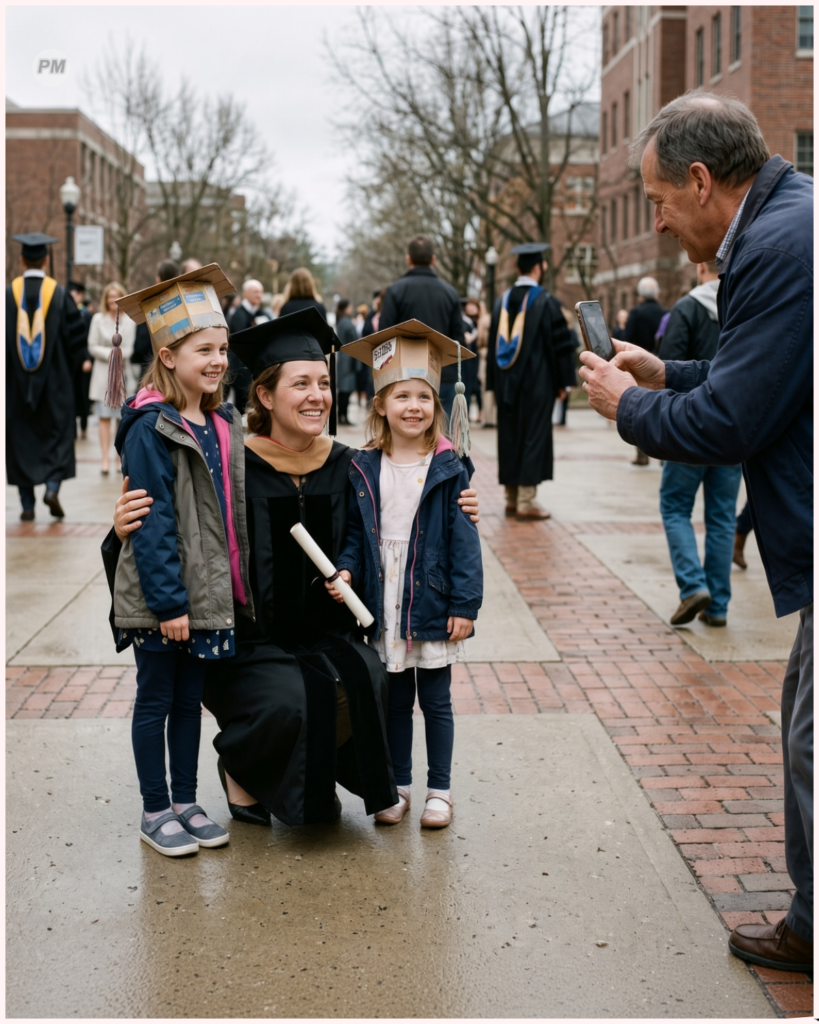
“Those cardboard hats.”
I nodded.
“They were pretty impressive.”
He was quiet for a moment.
Then said, “You know, I almost didn’t go.”
I turned toward him.
“Really?”
He nodded.
“Your mother was furious that morning. She said attending would make Whitney feel unsupported.”
I looked down.
Dad continued.
“And I thought about all the times I’d stayed home or kept quiet because I didn’t want to upset anybody.”
He shook his head.
“Then I realized I couldn’t remember the last time I’d done something just to make you feel important.”
My eyes filled.
“So you invented Lyall’s boat.”
He laughed.
“Poor Lyall. Never even owned a fishing pole.”
I laughed too.
Then leaned against his shoulder.
“I’m glad you came.”
He kissed the top of my head.
“So am I, sweetheart.”
Today, I’m thirty-five.
I’ve been a clinical supervisor for several years.
I’ve completed additional professional training, mentored graduate students, and helped develop programs supporting vulnerable families.
My diploma hangs in my office.
Beside it is the photograph Dad gave me that Christmas.
But my favorite picture isn’t the professional one.
It’s the photograph from the university quad.
Two little girls wearing graduation caps made from cereal boxes.
My father standing behind us.
And me kneeling between my nieces, laughing so hard that my eyes are nearly closed.
Whenever work becomes overwhelming, I look at that picture.
It reminds me of the people who showed up.
Eliza is older now.
She’s developing an interest in science and insists she wants to become a veterinarian.
Adeline changes her future career every other week.
Last month, she wanted to become an astronaut.
This month, she’s considering professional cake decorating.
Whenever they tell me about their dreams, I listen.
I ask questions.
I encourage them.
And I make sure they understand that their ambitions matter.
Both of them.
Equally.
