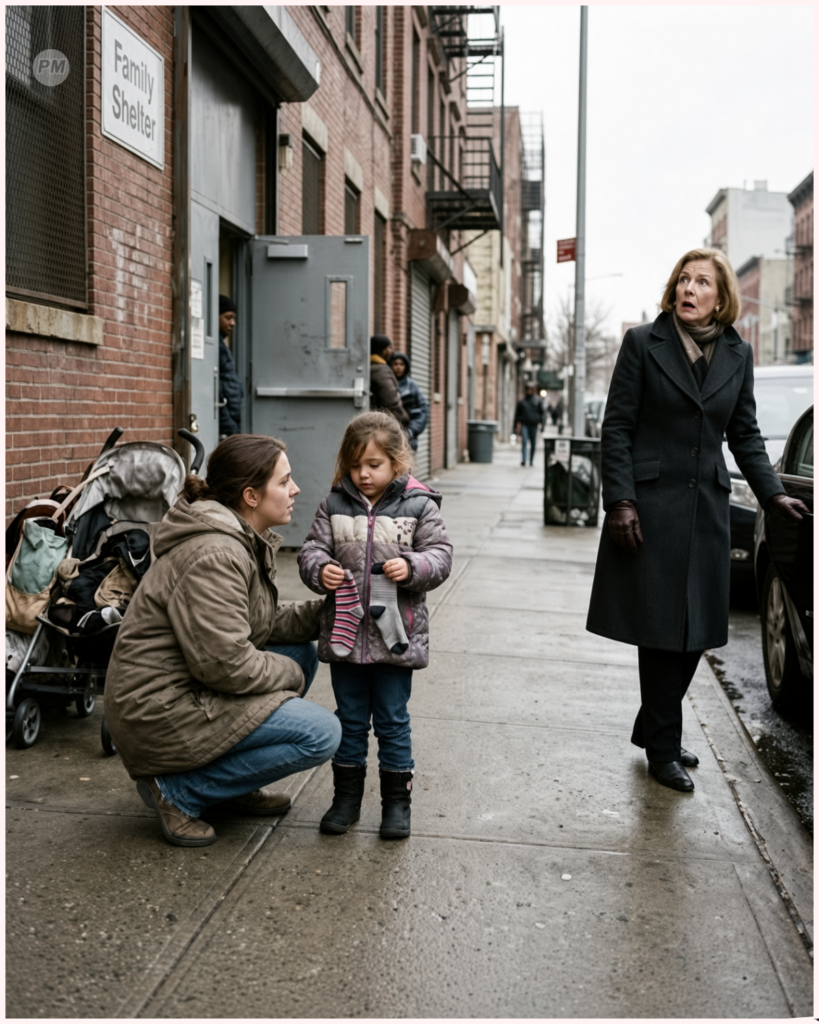
I nodded
I nodded.
“Yes.”
He looked hopeful.
Then I continued.
“And you were my parents when I needed help.”
His expression changed.
“You were my parents when Aaron died.”
I swallowed.
“You were my parents when Laya and I lost our apartment.”
My voice trembled.
“And you were my parents when you decided that renting out our home was more important than letting us live in it.”
He opened his mouth.
Nothing came out.
I stepped backward.
“Please leave.”
He looked at me.
“Maya, we’re going to lose everything.”
I shook my head.
“No, Dad.”
I opened the door.
“You’re going to lose what you took from someone else.”
Then I went inside.
The following Monday, I walked Laya to school.
She wore matching purple socks, her new winter coat, and a backpack decorated with little stars.
At the classroom door, Mrs. Cole greeted us.
“Good morning, Laya!”
Laya grinned.
“Mrs. Cole! I have an address!”
Her teacher looked at me.
I smiled and handed her the updated information form.
412 Hawthorne Street.
Laya pointed excitedly at the paper.
“That’s my house!”
Mrs. Cole smiled.
“That’s wonderful, sweetheart.”
Laya continued.
“I have my own room. And a backyard. And stairs!”
Her teacher laughed.
“That sounds very exciting.”
I watched my daughter disappear into the classroom.
Then Mrs. Cole touched my arm.
“Maya?”
I turned.
“I’m really happy for you both.”
My eyes filled.
“Thank you.”
I walked back to my car and cried for ten minutes.
Not because I was sad.
Because for the first time in months, I had given my daughter an answer that didn’t require an apology.
The investigation continued throughout the winter.
Daniel worked with an independent forensic accountant named Helen Brooks.
Every week, new records emerged.
The short-term rental business had been operating for nearly three years.
My parents had advertised the house under a different name.
They had redirected rental proceeds into accounts they controlled.
They had also submitted reimbursement requests for repairs that were either exaggerated or never performed.
But the most disturbing discovery came in February.
Daniel called me into his office.
“Maya, there’s something you need to see.”
He handed me a document.
It was a proposed agreement concerning my interest in the trust.
I looked at the final page.
There was a signature.
My signature.
Except I had never signed it.
I looked up.
“What is this?”
Daniel’s expression was serious.
“An apparent attempt to obtain your consent to a modification that would have expanded your parents’ control over certain trust assets.”
I stared at the paper.
“That’s not my signature.”
He nodded.
“We suspected as much.”
I looked down again.
The signature was close.
Close enough that someone unfamiliar with my handwriting might have accepted it.
My hands began shaking.
“They forged my name?”
“We’re having the document examined and investigating its origin.”
I sat back.
For three years, I had wondered whether my parents simply didn’t care about me.
Now I was confronting something worse.
They had actively worked to keep me from discovering what belonged to me.
Evelyn was furious when she learned about the document.
I’d never seen her raise her voice before.
That afternoon, she stood in Daniel’s office, gripping the back of a chair.
“They watched that child become homeless.”
Her voice broke.
“My great-granddaughter.”
Daniel remained quiet.
Evelyn looked at me.
“Maya, I need you to understand something.”
I nodded.
“I am not protecting them from the consequences of this.”
I swallowed.
“Even though Dad is your son?”
She closed her eyes.
“Especially because he is my son.”
My parents were formally removed from their positions as trustees.
An independent professional trustee took over administration of the trust under the court-approved arrangements.
The disputed accounts and transactions became the subject of further legal proceedings.
The suspected forgery and other financial misconduct were referred to the appropriate authorities for investigation.
My parents hired their own attorney.
Their initial response claimed that they had acted in good faith.
They argued that the rental arrangement was intended to preserve the property’s value.
They insisted that certain withdrawals were legitimate management expenses.
But their explanations became increasingly difficult to reconcile with the records.
There were photographs.
Messages.
Receipts.
Bank transfers.
And years of misleading communications.
For once, my mother’s ability to tell a convincing story wasn’t enough.
Meanwhile, I was learning how to live again.
I had spent so long worrying about immediate survival that ordinary stability felt unfamiliar.
I bought groceries without calculating every item in my head.
I scheduled a dental appointment I’d postponed for two years.
I replaced the worn tires on my car.
